Forgotten Weapons
Published 6 May 2018Get your copy here: https://amzn.to/2jzWnkI
Or here: https://amzn.to/2JOpMm3The Wipers Times was a satirical trench newspaper printed from February 1916 until December 1918 by British Captain F.J. Roberts and a crew of assistants. Such papers were not particularly uncommon, but the Wipers Times was particularly successful, well written, and long-lived, and it has survived in reprints today to a greater extent than any other similar work. A total of 23 issues were printed, and they consist of poetry, commentary, mock advertisements, advice columns, and short stories. While much of the humor is still quite accessible to us today, much of it also includes references, abbreviations, and inside jokes that are inscrutable to those who are not quite knowledgeable about life in the trenches.
Roberts and his cohorts were legitimate front-line soldiers, not writing as visiting journalists or from the safety of the rear echelons. Beyond its basic entertainment value, their writings also provide a rare and interesting view into the minds of men who were truly living the Great War.
Note that a book about the newspaper has also been printed, titled The Wipers Times, and with a very similar cover. If you want to buy a copy of the reprinted original issues, make sure you are not buying that book.
The BBC made a 90 minute program based on the Times, which is available in its entirely on YouTube here:
https://www.youtube.com/watch?v=SKPXu…[The original channel has been deleted, but I believe this is the same video: https://www.youtube.com/watch?v=juZBxhUYRpg]
(more…)
July 20, 2022
Book Review: The Wipers Times
July 10, 2022
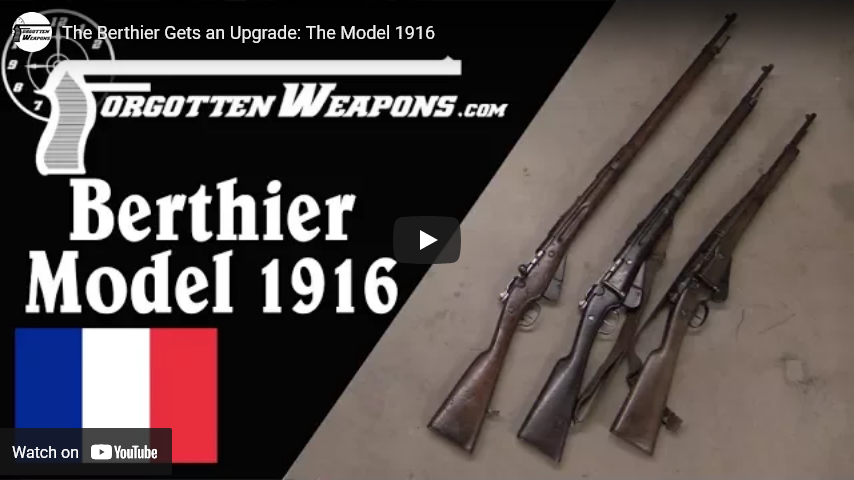
The Berthier Gets an Upgrade: The Model 1916
Forgotten Weapons
Published 26 Jul 2017http://www.patreon.com/ForgottenWeapons
The “Modifié 1916″ update to the Berthier system of rifles and carbines marked a major improvement in the gun’s combat effectiveness — really the first substantial overhaul to the design since it was developed in 1890. The two main elements of the upgrade were the addition of an upper handguard and an extension of the magazine from 3 rounds to 5, to match the capacity of the Mauser rifles used by Germany. In addition, several other improvements were made at the same time, including a redesign of the sights to favor quick target acquisition over long range precision and the addition of luminous radium elements to the sights. The upgrade package originally also included a dust cover over the bolt, but this was dropped for reasons I have not been able to determine.
This upgrade package was formally adopted in late 1916, and would go into production in 1917. However, it took a substantial time for the weapons to filter down to the front lines, and only a small number of M16 carbines and a very small number of M16 long rifles actually saw combat service before the Armistice. The M16 pattern (particularly the carbines) would form the standard armament for the French military right up to World War II, however, with Berthier carbine production continuing until 1939.
If you enjoy Forgotten Weapons, check out its sister channel, InRangeTV! http://www.youtube.com/InRangeTVShow
July 7, 2022
M38 Carcano Carbine: Brilliant or Rubbish?
Forgotten Weapons
Published 1 Aug 2017http://www.patreon.com/ForgottenWeapons
Cool Forgotten Weapons merchandise! http://shop.bbtv.com/collections/forg…
Carcano vs K98k Match video: https://www.youtube.com/watch?v=FAyxL…
I would like to propose that the M38 Carcano short rifle was, despite the poor reputation of the Carcano series of rifles, one of the best thought-out bolt action weapons of World War 2. Why, you ask? Well, let’s consider …
Only a few nations actually recognized the short ranges at which combat actually took place. Germany was one, as seen with its 8x33mm cartridge development, and Italy was another. The sights on the M38 series of carbines were made as simple fixed notches, with no adjustments to be knocked out of place unintentionally. With a 200 meter zero (or 150 meters, with the Finnish replacement front sight), the weapon needed no adjustment to make hits out to 300 meters, which is as far as anyone could realistically engage a target.
The M38 is a light and handy weapon compared to its contemporaries — 8.1 pounds and 40.2 inches (3.7kg and 1.02m) — and it fired a significantly lighter cartridge as well. The 7.35x51mm round used a 128gr (8.3g) bullet at 2400-2500 fps (735-755 m/s) depending on barrel length. This produced noticeably less recoil than rounds like the .30-06 or 8mm Mauser, which made it easier for troops to shoot effectively. The Carcano also had a 6-round capacity and fed with Mannlicher type clips, which are potentially faster to load than Mauser-type stripper clips.
Today we will discuss the M38 and these features (along with its predecessor, the M91 rifle) as they appear on paper. At the same time, over on InRangeTV, today we have the first stage of a 2-Gun Action Challenge Match in which I am shooting this M38 Carcano against Karl, who is using a Mauser K98k – so we will see how the theory works out in the field!
If you enjoy Forgotten Weapons, check out its sister channel, InRangeTV! http://www.youtube.com/InRangeTVShow

July 4, 2022
QotD: The French solution to trench warfare
That isn’t to say that battlefield tactics hadn’t improved. Quite to the contrary, 1918 saw both the Germans and the Allies deploy far more effective systems for assaulting trenches, though I would argue that it was actually the French who came closest to having the matter as figured out as one could have it with the equipment of 1918. The French method, termed la bataille conduite (“methodical battle”) has an understandably poor reputation because this method failed so badly against the technologies of 1940 but as we’ve seen that was quite a different technological environment than 1918.
On the defensive, the French had adopted many of the same principles of the German defense-in-depth we’ve already discussed. On the offense, they came to favor (particularly under the influence of Philippe Pétain and […] Ferdinand Foch) an offensive doctrine designed to maximize France’s position in an attritional contest: that is to limit losses and maximize enemy casualties while still taking and holding ground. The system favored limited “bite-and-hold” attacks, ideally limited such that the attack stopped before triggering the inevitable German counter-attack. Remember that it was when the attacker ran out of steam and the defender’s counter-attack came that the casualty ratios tended to shift to favor the defender. In French thinking, the solution was just to not reach that point.
Instead, the French came to favor – and the British and Americans picked up the same method by the end – elaborately prepared small offensives. The elaborate preparation meant planning out the attack carefully, using shorter but carefully planned hurricane barrages (all of this planning, of course took time) and then seizing the enemy’s forward positions and just their forward positions. Instead of then trying to push through – the old French notion of assault brutal et continu (“brutal and continuous” – a “keep up the pressure till they break” method) which Robert Nivelle had favored – methodical battle focused on “bite-and-hold”.
Once you hit your limited objectives in that first rush where enemy resistence is disoriented (from the short, hurricane barrage) and weaker – and thus where the casualty ratio favors you – you stop and begin fortifying your position. You dig those communications trenches, move up your artillery and brace for the counter-attack. By the time the enemy realizes you aren’t going to attack his second or third line positions (and trigger his devastating counter-attack), you are dug in and prepared for his attack (the hold part of “bite-and-hold”). To reestablish defense in depth, the defender now has to back up to establish new lines to the rear (or launch his own fresh offensive, but by late 1918, the Germans were too weak for this). A long series of such attacks – with significant intervals for fresh careful planning and stockpiling resources – could slowly but surely lever your opponent off of key positions, one by one. It would also preserve a favorable balance of casualties, ensuring that in the end, the enemy runs out of men and shells before you do (that is the “rupture” that Joffre had always hoped for, but which arrived but two years too late for his career).
Such a slow, expensive, bloody and unglamorous strategy was in some ways only politically possible once, by 1918, it had become apparent that all other options were exhausted. That said, to argue that this bite-and-hold operational doctrine broke the trench stalemate is probably not fair either. The progress of allied offensives in 1918 was extremely slow by even the standards of 1914. The German Spring Offensive was well and truly done in July and the Allied offensive picked up in August and ran through November as fast as it could (with Foch doing everything short of getting out and pushing the offensive to try to speed it up) and yet the final allied positions by November were not even in Germany. Even at its greatest distance in 100 days of unbroken victories by a force with materiel and numerical superiority, the front moved less than 100 miles and the overall casualty ratio was roughly even (around a million on both sides).
Bret Devereaux, “Collections: No Man’s Land, Part II: Breaking the Stalemate”, A Collection of Unmitigated Pedantry, 2021-09-24.
July 3, 2022
Model 1907/15 Berthier: The WW1 Standard Infantry Rifle
Forgotten Weapons
Published 24 Jul 2017http://www.patreon.com/ForgottenWeapons
When World War One broke out in 1914, France mobilized millions of men into military service — and it became abundantly clear that a lot of new rifles would need to be manufactured. The 1886 Lebel was no longer in production and was a slow rifle to make in any case — but the 1907 Colonial Berthier was being produced already, and was a more efficient design as well. By late 1914, plans were underway to drastically increase Berthier rifle production.
A few changes were made to the 1907 pattern, mainly changing the front end to accept the standard 1886 Lebel bayonet (“Rosalie”). After the first 80,000 had been made, the bolt handle was also changed from the bent carbine style to a heavier duty straight type. With these changes made, the Modele 07/15 was ready for mass adoption by the infantry, where it would serve side by side with the Lebel.
The primary manufacturer of 07/15 rifles was the St. Etienne arsenal, which build between 1.0 and 1.2 million of them by the spring of 1917. The Chatellerault arsenal produced another 436,000, and the Delauney Belleville automobile factory retooled its workshops to make rifles, producing another 170,000 of them. The Remington company in the US also took a contract to make 250,000 Berthier rifles, but was unable to meet the terms of the contract. Remington had taken on more wartime production work than it could handle, and failed to meet French quality and scheduling requirements. In August of 1916 that contract was cancelled, with just 9,440 rifles sent to France for use. The remaining 5,000-10,000 that had been made by Remington were sold on the commercial market in the US.
By 1916, it was clear that the 3-round capacity of the Berthier was a very real disadvantage (both tactically and psychologically) to the German Mauser rifles, and an upgrade program was put underway. This would ultimately become the 1916 pattern and would go into production in 1917.
If you enjoy Forgotten Weapons, check out its sister channel, InRangeTV! http://www.youtube.com/InRangeTVShow
July 2, 2022
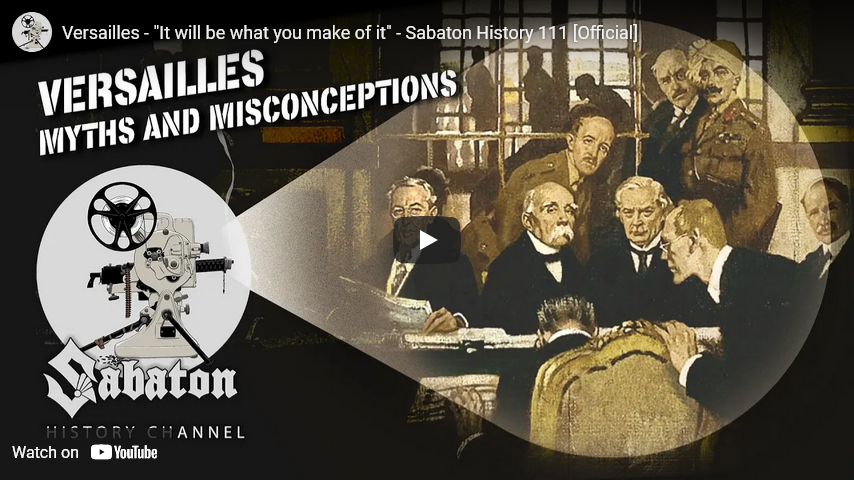
Versailles – “It will be what you make of it” – Sabaton History 111 [Official]
Sabaton History
Published 1 Jul 2022There are a great many myths and misconceptions about the Treaty of Versailles, and it has been used and even weaponized many times over the years. Today, Indy goes over the nuts and bolts of what it actually was and what it actually did.
Support Sabaton History on Patreon: https://www.patreon.com/sabatonhistory
Listen to “Versailles” on the album The War To End All Wars: https://music.sabaton.net/TheWarToEnd…
Listen to Sabaton on Spotify: http://smarturl.it/SabatonSpotify
Official Sabaton Merchandise Shop: http://bit.ly/SabatonOfficialShopHosted by: Indy Neidell
Written by: Markus Linke and Indy Neidell
Directed by: Rickard Erixon and Indy Neidell
Produced by: Pär Sundström, Astrid Deinhard and Spartacus Olsson
Creative Producer: Rickard Erixon, Indy Neidell
Set Design: Daniel Eriksson, Rickard Erixon,
Executive Producers: Pär Sundström, Joakim Brodén, Tomas Sunmo, Indy Neidell, Astrid Deinhard, and Spartacus Olsson
Post-Production Director: Marek Kamiński
Editor: Iryna Dulka
Sound Editor: Marek Kamiński
Archive: Reuters/Screenocean – https://www.screenocean.com
Colorizations by: Olga Shirnina, a.k.a. Klimbim – https://klimbim2014.wordpress.com/Sources:
IWM: 130-09+10, IWM 130-01
Auckland Libraries Heritage Collections 5-1276
Médiathèque de l’architecture et du patrimoine
hpebley3 from freesond.org
All music by: SabatonAn OnLion Entertainment GmbH and Stuffed Beaver LTD co-Production.
© Stuffed Beaver LTD, 2019 – all rights reserved.
June 26, 2022
QotD: Breaking the trench stalemate with strategic air power
What no one could have known in WWI was not merely that the technology for effective conventional strategic bombing wasn’t ready, but that it would probably never be ready. Interwar air-power theorists, seeing the potential of strategic airpower to bypass the trench stalemate by flying over it began to try to work out how this would be done. Giulio Douhet (1869-1930) argued that future wars would be fought and won in the air, with fleets of bombers using high explosives and chemical weapons to massacre enemy civilian centers, until civilians forced their governments to surrender. Douhet was not alone; his vision of airpower as shared, for instance, by the “father of the RAF”, Hugh Trenchard (1873-1956).
This concept, “morale bombing” as it is sometimes called, probably deserves its own post discussing its failures. But in brief, the concept was tested, with far larger amounts of bombs than Douhet or any other interwar theorist could have ever dreamed of, during WWII. The argument by air theorists that high altitude bombers could not be stopped was proved false when the British did exactly this, stopping German bombers over Britain in 1940. Moreover, terror bombing against civilian targets in Britain didn’t lead to surrender, but hardened resolve. Likewise, “morale” bombing against German targets by the allies didn’t lead to surrender, but hardened resolve. Later efforts to demoralize the North Vietnamese through a American bombing campaign in the Vietnam War didn’t lead to surrender, but hardened resolve. More recent efforts to demoralize or destroy terrorists and the Taliban through the use of airpower hasn’t lead to surrender, but rather hardened resolve. Likewise, efforts by the Syrian regime to defeat various opposition groups in Syria through the use of chemical weapon-based terror bombing didn’t lead to surrender (siege-and-starve tactics did), but hardened resolve.
It turns out the fundamental premise of the entire idea of morale bombing – that being bombed will make people want to stop fighting – was flawed. Morale bombing has been, depending on how hard you squint at the US air campaign over Japan in WWII (including the use of nuclear weapons) successful either once (out of many attempts) or never. In most cases, the sustained bombing of civilian centers has been shown to increase a population’s willingness to resist, making the strategy worse than useless.
The case for strategic bombing against industrial targets is marginally better, but only marginally. While airpower advocates, particularly in the United States promised throughout WWII that bombing campaigns against German industry could lead to the collapse of the German war machine, in the end many historians posit that the real achievement of the campaign was to lure the Luftwaffe into the air where it could be destroyed, thus denying the German army of air cover and close air support, particularly on the Eastern Front. Some dimunition of German industrial capabilities was accomplished (though it is not clear that this ever approached the vast resources poured into producing the large numbers of extremely expensive bombers used to do it, though the allies had such an industrial advantage over Germany, forcing the Germans to fight in expensive ways in the sky was a winning trade anyway), but the collapse of German industry never happened. As Richard Overy notes, German industrial output continued to rise during strategic bombing and only began to fall as a result of the loss of territory on the ground. Needless to say, “strategic bombing can sucker the enemy into wasting their close air support” was not the result that airpower advocates had promised, nor could it have broken the stalemate.
I don’t want to oversimplify the continued debate over the efficacy of strategic airpower here too much so let’s just say that the jury is still very much out as to if strategic airpower works even with modern technology; it certainly wouldn’t have worked with WWI era technology.
Bret Devereaux, “Collections: No Man’s Land, Part II: Breaking the Stalemate”, A Collection of Unmitigated Pedantry, 2021-09-24.
June 25, 2022
Why Russia’s Smartest General Failed in 1916 (the Brusilov Offensive)
The Great War
Published 24 Jun 2022Sign up for Curiosity Stream and get Nebula bundled in and SAVE 26%:
https://curiositystream.com/thegreatwarThe start of the Brusilov Offensive was the most successful Russian military operation during the First World War. It crippled the Austro-Hungarian Army and forced the Germans to divert troops from Verdun. But the Brusilov Offensive ultimately was a failure and cost the Russians an enormous number of men. What went wrong?
» SUPPORT THE CHANNEL
Patreon: https://www.patreon.com/realtimehistory» THANKS TO OUR CO-PRODUCERS
John Ozment, James Darcangelo, Jacob Carter Landt, Thomas Brendan, Kurt Gillies, Scott Deederly, John Belland, Adam Smith, Taylor Allen, Rustem Sharipov, Christoph Wolf, Simen Røste, Marcus Bondura, Ramon Rijkhoek, Theodore Patrick Shannon, Philip Schoffman, Avi Woolf, Emile Bouffard, William Kincade, Daniel L Garza, Stefan Weiß, Matt Barnes, Chris Daley, Marco Kuhnert, Simdoom» SOURCES
Buttar, Prit, Russia’s Last Gasp: The Eastern Front 1916-1917, (Oxford: Osprey Publishing, 2016)Dowling, Timothy C., The Brusilov Offensive, (Indianapolis: Indiana University Press, 2008)
Golovin, Nicholas, “Brusilov’s Offensive: The Galician Battle of 1916”, The Slavonic and East European Review, Volume 13, Number 39, (1935)
Schindler, John, “Steamrollered in Galicia: The Austro-Hungarian Army and the Brusilov Offensive, 1916”, War in History, Volume 10, Number 1, (2003)
Stone, David R., The Russian Army in the Great War: The Eastern Front, 1914-1917, (Lawrence, KS: University Press of Kansas, 2015)
Tunstall, Graydon A., “Austria-Hungary and the Brusilov Offensive of 1916”, The Historian, Volume 70, Issue 1, (2008)
Uzefovich, Alexis M., “Russia in the World War, 1914-1918”, The Military Engineer, Volume 33, Number 190, (1941)
» OUR SISTER CHANNEL
https://youtube.com/realtimehistory»CREDITS
Presented by: Jesse Alexander
Written by: Jesse Alexander
Director: Toni Steller & Florian Wittig
Director of Photography: Toni Steller
Sound: Toni Steller
Editing: Toni Steller
Motion Design: Toni Steller
Mixing, Mastering & Sound Design: http://above-zero.com
Research by: Jesse Alexander
Fact checking: Florian WittigChannel Design: Yves Thimian
Contains licensed material by getty images
Maps: MapTiler/OpenStreetMap Contributors & GEOlayers3
All rights reserved – Real Time History GmbH 2022
June 15, 2022
Model 1892 Berthier Artillery Musketoon
Forgotten Weapons
Published 19 Jul 2017http://www.patreon.com/ForgottenWeapons
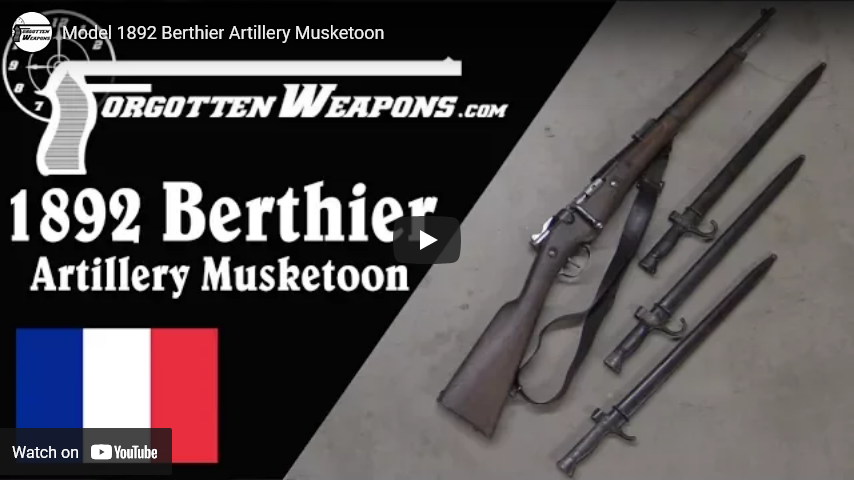
The original 1890 Berthier carbine was designed for cavalry, but a slightly modified version was produced (in small numbers) with a bayonet lug, for use by the Gendarmerie. In 1892, the French military would adopt that same carbine for use by an assortment of troops who were better suited with a carbine than a full size Lebel rifle. These included primarily artillery crews, but also engineers, messengers, drivers, and others.
The Modele 1892 Mousqueton d’Artillerie was basically identical to the 1890 cavalry carbine, including the same 3-round Mannlicher-type clip. It was put into production at both the St Etienne and Chatellerault factories, and by August of 1914 384,000 were in French inventory. By the time the improved 1916 model was put into production, a total of 675,000 of these carbines would be built.
If you enjoy Forgotten Weapons, check out its sister channel, InRangeTV! http://www.youtube.com/InRangeTVShow
June 2, 2022
M1915 Howell Automatic Rifle Enfield Conversion
Forgotten Weapons
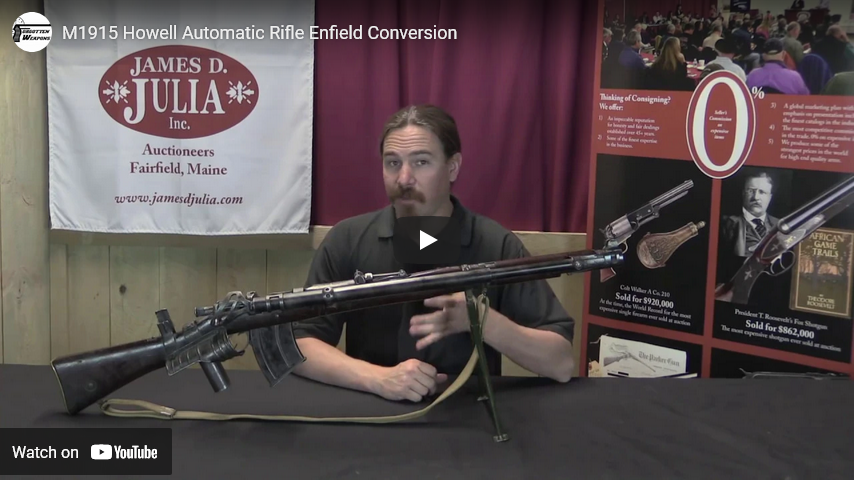
Published 28 Mar 2017The M1915 Howell Automatic Rifle is a conversion of a standard No1 MkIII Lee Enfield rifle into a semi-automatic, through the addition of a gas piston onto the right side of the barrel. Despite its very steampunk appearance, the Howell is actually a quite simple conversion mechanically. The rifle action had not been modified at all, and a curved plate on the end of the gas piston is used to cycle the bolt up, back, forward, and down just as it would be done manually.
The additional metal elements added to the gun are there to prevent the shooter from inadvertently getting their hand or face in the path of the bolt. The crude tubular pistol grip is necessary because the shooter’s hand on the wrist of the stock would normally be in the path of the bolt’s travel. Note that the Parker-Hale bipod on this example is a non-military addition from its time in private ownership.
In addition to these elements, the Howell has been fitted with a 20-round extended magazine to better exploit its rate of fire. However, the Howell was made as a semiautomatic rifle only, and not fully automatic. It was offered to the British military circa 1915, but never put into service. Instead, the British would significantly increase production and deployment of Lewis light machine guns. Howell would offer his conversion in basically the same form to the military again at the onset of World War 2, but was again turned down.
Shooting the Howell was remarkably successful — I had expected it to be very malfunction-prone, but in fact it ran almost completely without fault. In retrospect, I would attribute this to the simplicity of its conversion, which made no changes to the feeding and extraction/ejection elements of the SMLE. The gun was a bit awkward to hold, and the offset sights left one with really no cheek weld at all, but recoil was gentle thanks to the gas system’s function and added weight. Quite a remarkable gun, and one I am very glad to have been able to shoot.
http://www.patreon.com/ForgottenWeapons
Cool Forgotten Weapons merch, including this shirt specifically about the Howell! https://shop.bbtv.com/collections/for…
If you enjoy Forgotten Weapons, check out its sister channel, InRangeTV! http://www.youtube.com/InRangeTVShow
May 28, 2022
Modele 1890 Berthier Cuirassier Carbine
Forgotten Weapons
Published 17 Jul 2017http://www.patreon.com/ForgottenWeapons
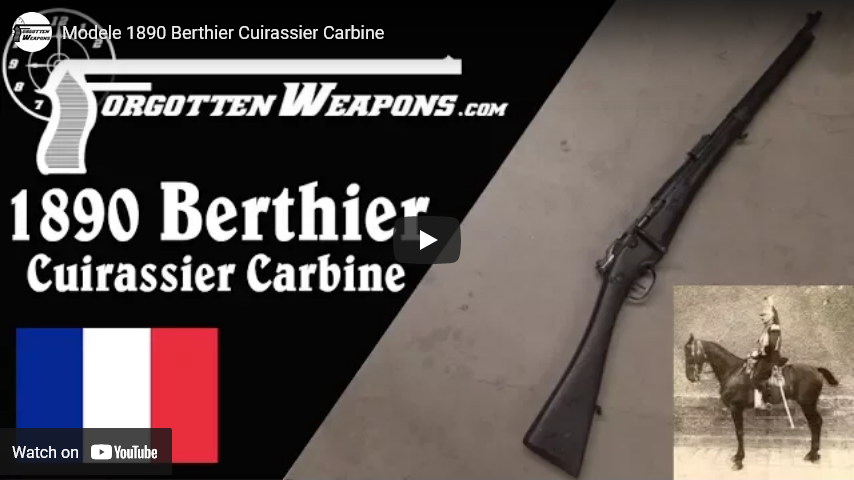
When the Modele 1890 Berthier carbine was adopted for the French cavalry, the decision was made to produce a special version for the Cuirassier troops. These were the elite heavy cavalry, equipped with steel breastplates and elaborate plumed helmets. They existed in that very brief window where the worlds of Napoleon and the smokeless-powder rifle coexisted.
The armor worn by the Cuirassier required some special adaptations to their firearms, specifically to the stocks. The scaled chinstrap of the helmet interfered with a normal cheek weld to the carbine, so the comb was removed from the stock. The metal buttplate also was a poor match for the metal cuirass, as it was difficult to hold the gun in position to aim. To account for this, a leather buttplate was used on these carbine, which would be much less slippery on armor.
Aside from these changes to the stock, the carbine was identical to the standard 1890 cavalry carbine. A total of 20,000 Cuirassier carbines were made in 1891 at the Chatellerault arsenal, and few survived World War One. By fairly early in 1915 the cavalry units had been repurposed as infantry, and the Cuirassier went into the trenches with the armor and carbines — perhaps better equipped, ironically, than the infantry in the greatcoats, kepis, and with Lebel rifles.
Thanks to Justin for finding this rifle for me!
If you enjoy Forgotten Weapons, check out its sister channel, InRangeTV! http://www.youtube.com/InRangeTVShow
QotD: Breaking the trench stalemate with tactical air power
But how much airpower does it take to really move a division out of position? In 1944, at the start of Operation Cobra as part of the Normandy breakout, it was necessary for US forces to move the powerful armored division Panzer Lehr out of its prepared positions outside of St. Lo. Over the course of an hour and a half, the U.S. Eighth Air Force hit Panzer Lehr with approximately three thousand aircraft, including 1,800 heavy bombers (each of which might have had bomb-loads of c. 2-3,500kg; the attack would have been the equivalent of about 13,000 Farman F.50s (of which only a hundred or so were built!)). By this point, even medium bombers carried bomb loads in the thousands of pounds, like the B-25 Mitchell medium bomber, with a bomb load of 3000lbs (1360kg). This was followed by a hurricane artillery barrage! Despite this almost absurdly awesome amount of firepower (which, to be clear, inflicted tremendous damage; by the end of Operation Cobra, Panzer Lehr – the heaviest and most powerful Panzer division in the west – had effectively ceased to exist), Panzer Lehr, badly weakened was still very capable of resisting and had to be pushed out of position by ground attack over the next three days.
Needless to say, nothing on offer in 1918 or for a decade or more after, was prepared to offer that kind of offensive potential from the air. That kind of assault would have required many thousands of aircraft with capabilities far exceeding what even the best late-war WWI bombers could do. Once again, while close air support doctrine was developed with one eye on the trench stalemate and the role airpower could play in facilitating a breakthrough and restoring maneuver (either by blasting the breakthrough or – as in Soviet Deep Battle doctrine – engaging enemy rear echelon units to bog down reinforcements). But the technology wasn’t anywhere near the decisive point by 1918. Instead, the most important thing aircraft could do was spot for the artillery, which is mostly what aircraft continued to do, even in late 1918.
Bret Devereaux, “Collections: No Man’s Land, Part II: Breaking the Stalemate”, A Collection of Unmitigated Pedantry, 2021-09-24.
May 25, 2022
M1915 Villar Perosa
Forgotten Weapons
Published 5 Aug 2016http://www.patreon.com/ForgottenWeapons
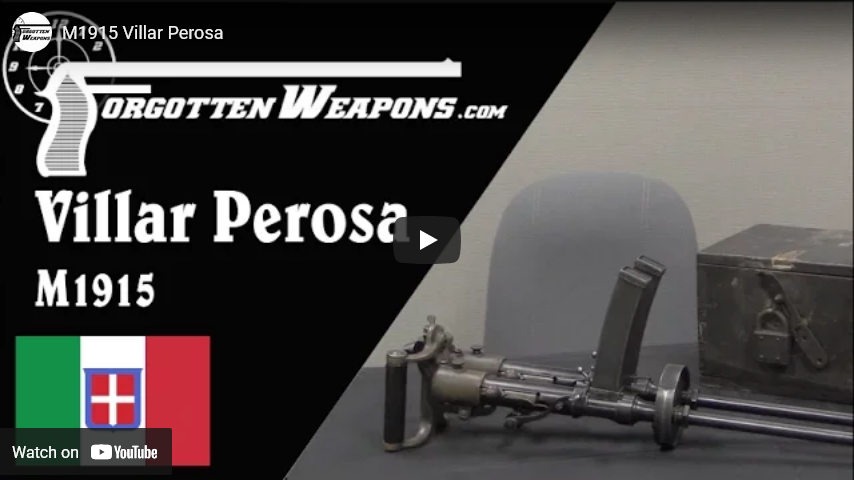
The Villar Perosa is one of the first small machine guns developed and used by a military force. It was designed in Italy and introduced in 1915 as an aircraft weapon, to be used in a flexible mount by an airplane’s observer. The gun consists of two independent firing actions mounted together. Each fires from an open bolt as a rate of 1200-1500 rounds/minute, feeding from a 25 round magazine of 9mm Glisenti cartridges. This allowed the maximum possible volume of fire in an aerial combat situation, where in 1915 ballistic power was not particularly important.
As aircraft armaments improved and synchronized, belt-fed machine guns became practical, the Villar Perosa was quickly made obsolete in aerial use. The Italian military experimented with several applications of the weapon in ground combat, including slings and belt fittings for walking fire, tripods, mounts with integral armor shields, and bicycle mounts. None of these proved particularly successful, as the elements that made the gun well adapted to early aerial use (high rate of fire with a small cartridge) made it relatively ineffective for infantry use.
Ultimately, the best use of the Villar Perosa was to break them up and convert the actions into shoulder-fired submachine guns. Designs to do this were developed by both the Beretta company and Villar Perosa themselves, and in 1918 these guns entered service in the same approximate period as the first German MP-18 submachine guns. Because of this recycling, intact M1915 Villar Perosa guns are quite rare today.
May 2, 2022
“Race To The Sea” – The Failure of the Schlieffen Plan– Sabaton History 110 [Official]
Sabaton History
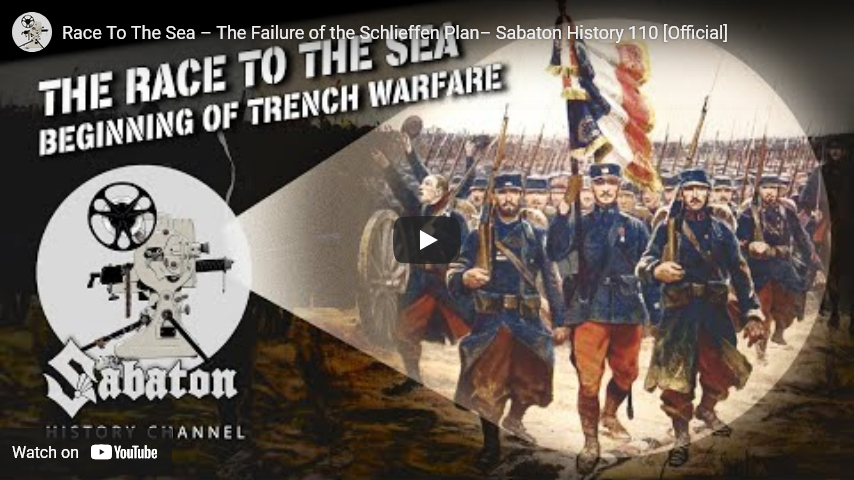
Published 1 May 2022In the fall of 1914, the initial mobile stage of the war on the Western Front came to an end outside of Paris and trench warfare set in. As the trench lines stretched from the Swiss border to northern France and Belgium, both sides realized that if they could head north quickly enough, they could turn the enemy’s flank and win the war NOW.
Support Sabaton History on Patreon: https://www.patreon.com/sabatonhistory
Listen to “Race To The Sea” on the album The War To End All Wars: https://music.sabaton.net/TheWarToEnd…
Watch the Official Music Video of “Race To The Sea” here: https://www.youtube.com/watch?v=m-yrj…
Listen to Sabaton on Spotify: http://smarturl.it/SabatonSpotify
Official Sabaton Merchandise Shop: http://bit.ly/SabatonOfficialShopHosted by: Indy Neidell
Written by: Markus Linke and Indy Neidell
Directed by: Rickard Eri
April 23, 2022
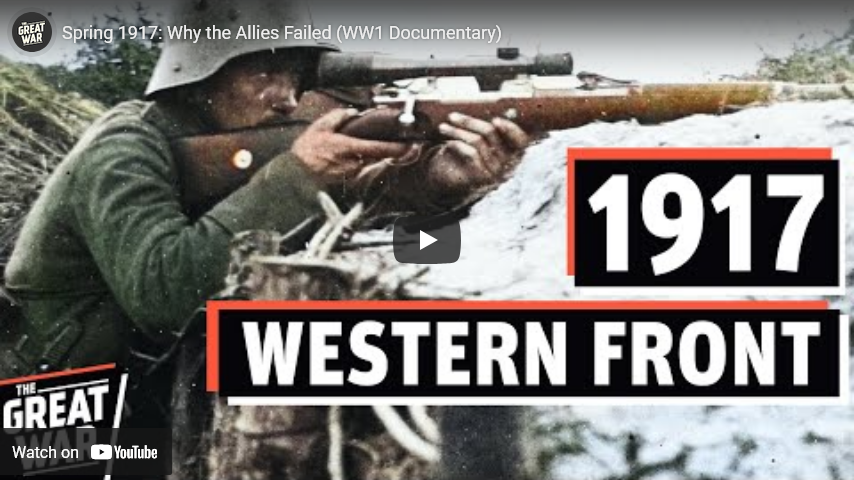
Spring 1917: Why the Allies Failed (WW1 Documentary)
The Great War
Published 22 Apr 2022Sign up for Curiosity Stream and get Nebula bundled in and SAVE 26%: https://curiositystream.com/thegreatwar
The Allied 1917 Spring Offensive masterminded by French general Robert Nivelle was supposed to end the stalemate on the Western Front and bring a decisive breakthrough. But the German Army also knew they couldn’t win the war on the offensive and thus prepared a new type of defensive system: The Hindenburg Line.
» SUPPORT THE CHANNEL
Patreon: https://www.patreon.com/thegreatwar» THANKS TO OUR CO-PRODUCERS
John Ozment, James Darcangelo, Jacob Carter Landt, Thomas Brendan, Kurt Gillies, Scott Deederly, John Belland, Adam Smith, Taylor Allen, Rustem Sharipov, Christoph Wolf, Simen Røste, Marcus Bondura, Ramon Rijkhoek, Theodore Patrick Shannon, Philip Schoffman, Avi Woolf,» SOURCES
Cook, Tim, “Storm Troops: Combat Effectiveness and the Canadian Corps in 1917” in Dennis, Jeffrey & Grey, Peter (eds), 1917: Tactics, Training and Technology: the 2007 Chief of Army’s Military History Conference, (Canberra: Australian History Military Publications, 2007)Coombes, David, Bloody Bullecourt, (Barnsley: Pen & Sword Military, 2016)
Doughty, Robert T, Pyrrhic Victory: French Strategy and Operations in the Great War, (Cambridge, MA: Harvard University Press, 2005)
Doughty, Robert A, “How did France Weather the Troubles of 1917?” in Dennis, Jeffrey & Grey, Peter (eds), 1917: Tactics, Training and Technology: the 2007 Chief of Army’s Military History Conference, (Canberra: Australian History Military Publications, 2007)
Farr, Don, A Battle Too Far: Arras 1917, (Warwick: Helion & Company, 2018)
Foley, Robert T, “The Other Side of the Wire: The German Army in 1917” in Dennis, Jeffrey & Grey, Peter (eds), 1917: Tactics, Training and Technology: the 2007 Chief of Army’s Military History Conference, (Canberra: Australian History Military Publications, 2007)
Lupfer, Timothy T, “The Dynamics of Doctrine: The Changes in German Tactical Doctrine During the First World War” Leavenworth Papers, No. 4, Combat Studies Institute, U.S. Army Command and General Staff College, (Fort Leavenworth, KS: 1981)
Nicholls, Jonathan, Cheerful Sacrifice: The Battle of Arras 1917, (London: Leo Cooper, 1990)
» OUR SISTER CHANNEL
https://youtube.com/realtimehistory» CREDITS
Presented by: Jesse Alexander
Written by: Jesse Alexander
Director: Toni Steller & Florian Wittig
Director of Photography: Toni Steller
Sound: Toni Steller
Editing: Jose Gamez
Motion Design: Philipp Appelt
Mixing, Mastering & Sound Design: http://above-zero.com
Research by: Jesse Alexander
Fact checking: Florian WittigChannel Design: Yves Thimian
Contains licensed material by getty images
Maps: MapTiler/OpenStreetMap Contributors & GEOlayers3
All rights reserved – Real Time History GmbH 2022