
Cossack forces have long been a key cavalry element of the Russian military, and this did not change during the Soviet era. The Cossacks had their own rather distinctive style of sword, the shashka, and the Red Army maintained the tradition of issuing them to Cossack cavalry troopers. In 1927, a new pattern was adopted, and it was produced and issued from 1928 until 1946. The shashka has a slightly curved, single-edged blade and no handguard. The model 1927 military type was initially made with a rather decorative pommel, but this was simplified to just a plain 5-pointed star as German advances into Russia really stressed Soviet industrial production. However, production and issue of the shashka continued uninterrupted throughout the war.
Originally there were separate trooper and officer versions of the model 1927, with the trooper version including the ability to stow the trooper’s Mosin-Nagant rifle bayonet on the side of the shaskha scabbard. As cavalry, the Cossacks were not expected to carry their rifles with bayonets fixed, and this served in lieu of a bayonet sheath. By 1944 this feature was omitted, as the M91/30 was replaced by the M38 and M44 carbines and submachine guns, which did not use bayonets.
The decorations returned to the M1927 shashka in 1945, with a series made for the Victory Day parade celebrating the defeat of Germany. Today’s example is one of these, and in beautiful condition.
February 14, 2024
Soviet World War Two Swords? The M1927 Shashka
February 11, 2024
Inkunzi PAW aka Neopup – 20mm Direct-Fire Grenade Launcher
Forgotten Weapons
Published Jun 22, 2018The Inkunzi PAW (Personal Assault Weapon) is a 20mm shoulder fired semiautomatic grenade launcher designed by Tony Neophytou (and previously known as the Neopup). It is a creative and very interesting weapon system, both from a mechanical perspective and also from a question of practical application.
The PAW has a 6-round detachable rotary magazine, and an effective range of 1000m for area targets and 600m for point targets. Its purpose is to give the individual soldier an explosive area-effect weapon that fires like a rifle. To this end, the ammunition has been developed to give a muzzle velocity of 1000fps (310m/s), giving it a far flatter trajectory and shorter flight time than a 40mm grenade, either low pressure or high. It allows rapid repeat shots, rapid reloading, and easy target transition. The high muzzle velocity (for a grenade launcher) makes range estimation and engagement of moving targets much simpler than with the rainbow-like trajectory of 40mm systems. For specialized modern applications like guarding against one or more vehicle suicide bombs, fast-moving pirate skiffs, it seems extremely compelling. That utility extends to typical targets as well, like light armored vehicles, buildings, gun emplacements, and even something as simply as a patch of brush with an enemy hiding within somewhere. Typical small arms fire requires a substantial expenditure of ammunition for targets like those, while an explosive 20mm projectile can neutralize them in one or two rounds, without the need for a direct hit. The lethal radius of a 20mm HEI shell is between 6 and 18 feet (2m – 6m) depending on who you ask. That’s a significant margin of error.
Mechanically, the PAW is a simple system to disassemble, and it uses a quite clever inertial locking system which is clean and reliable. The unique layout with the grip on the right side is done to accommodate the hydraulic recoil system, which allows the action to slide back into the stock assembly on each shot. This absorbs much of the recoil and spreads its effect out on the shooter, making it not unpleasant to shoot. An easy stowage feature allows the gun to be locked in its compressed configuration, shortening it for transit and also offering a way for the gun to be carried with a round chambered and ready to use, but with the trigger safely disconnected to prevent accidental firing for troops in armored vehicles or helicopters.
Compared to the American XM-25, the PAW strips away the overcomplications of laser designation and complex projectile fusing, which are arguably not really necessary anyway. It offers a simple and effective system, with tremendous firepower as well as suppression capability (nothing says go away quite like rapid fire explosives). It does this with a larger magazine and more compact and lighter weight design, no less.
It is rare to find a truly unique and innovative firearm these days, but that is exactly what Tony Neophytou has done here. The design is elegant in its simplicity, and well refined. It truly offers a unique set of capabilities — while it has been purchased in limited numbers by several smaller militaries, I hope to see it given serious consideration by some first-tier forces, as I think it has tremendous potential.
(more…)
February 9, 2024
You can’t pro-actively synergize action-oriented metrics in the heat of battle
No, I’m not sure if that headline makes any sense, as I was never particularly receptive to the latest buzzwords of any given management fad that went through from the 70s onwards. They all seemed to share a few characteristics along with a bespoke sheaf of buzzwords, PowerPoint slides galore, and lots of spendy courses you had to send all your employees to endure. Is there anything more dispiriting to staff morale than a VP or director who’s just returned from a week-long training seminar in an exotic location on this year’s latest “revolutionary” “transformational” management fad?
It’s bad when companies that make widgets or smartphone apps or personal hygiene products fall for these scams, but it’s terrifying to discover that your military isn’t immune … and in fact revel in it:

Image from “Fads and Fashions in Management”, The European Business Review, 2015-07-20.
https://www.europeanbusinessreview.com/fads-and-fashions-in-management/
We spent these last few decades since the fall of the Soviet Union weaving a comfortable web of CONOPS and implemented “efficiencies” constructed of consultant-speak, weekend-MBA jargon, and green eyeshade easy-buttons bluffed from the podium by The Smartest People in the Room™ to an audience on balance populated by people who already had the short list of jobs they wanted once they shrugged off their uniform in a PCS cycle or two.
Agree, endorse, parrot, prepare …. profit!
War is New™!, Revolutionary™!, Transformational™!. Hard power is Offset™! If we change a bunch of simple words in to multi-syllabic cute acronyms … then the future will be ours, our budgets will be manageable, and our board seats will be secured! Efficiency to eleventy!
Facing the People’s Republic of China on the other side of the International Date Line … how efficient do you feel? How effective?
Something very predictable happened in our quarter century roadtrip on the way to Tomorrowland; we realized instead we wound up on Mr. Toad’s Wild Ride instead.
I would like the record to show here in 2QFY24 that this exact problem was discussed in detail back when I was a JO in the mid-1990. This is not shocking to anyone who is wearing the uniform of a GOFO. They lived the same history I did.
We knew we were living a lie that we could sustain a big fight at sea. An entire generation of Flag Officers led this lie in the open and ordered everyone else to smile through it. Ignore your professional instincts, and trust The Smartest People in the Room™.
Once again, Megan Eckstein brings it home;
If U.S. military planners’ worst-case scenario arose in the Pacific — having to defend Taiwan from a Chinese invasion — American military forces would target Chinese amphibious ships.
Without them, according to Mark Cancian, who ran a 2022 wargame for the Center for Strategic and International Studies that examined this exact scenario, China couldn’t invade the neighboring island.
…
U.S. submarines would “rapidly fire everything they have” at the multitude of targets, Cancian said, “using up torpedoes at a much, much higher rate than the U.S. has expected to do in the past.”
Navy jets, too, would join in — but they’d run out of Long Range Anti-Ship Missiles within days, …
It’s this nightmare scenario that’s driving the Navy to increase its stockpile of key munitions: the LRASM, the MK 48 heavyweight torpedo, the Standard Missile weapons and the Maritime Strike Tomahawk, among others.
Over a decade after the Pacific Pivot, a couple of years after the US Navy became the world’s second largest navy after being the worlds largest for living memory of 99% of Americans, and two years after the Russo-Ukrainian War reminded everyone that, yeah … 3-days wars usually aren’t.
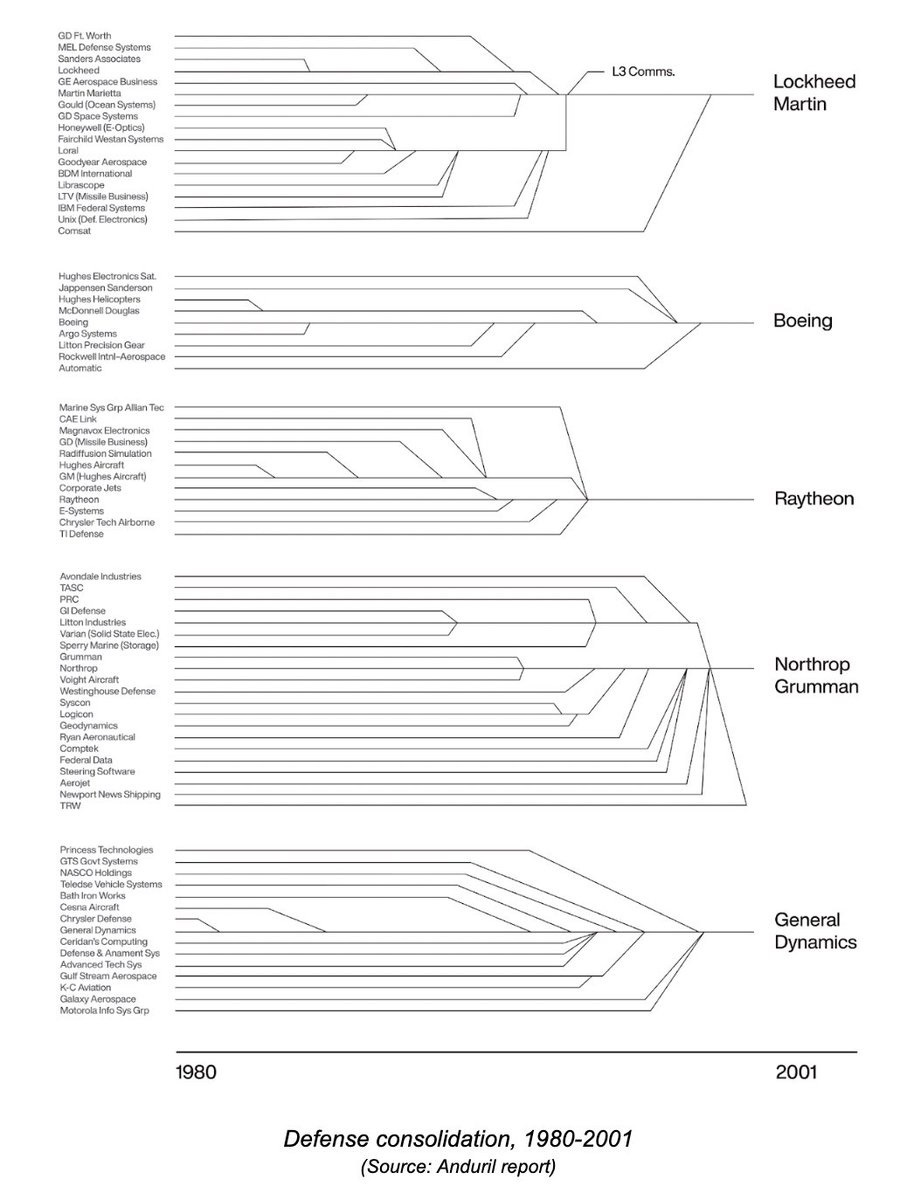
And the defence industries of the 1980s and 90s have all swallowed up smaller competitors — again following “normal” business practices of the time, seeking economies of scale and manufacturing efficiencies and closing down less-profitable assembly lines or entire lines of business.
Let’s go back to SECDEF Perry’s 1990s “Last Supper”, you know, the one that was all about the efficiencies of consolidation of the defense industry.
Three decades later, what is the solution to the strategic risk we find ourselves in due to our inability to arm ourselves?
… “the bottleneck is rocket motors” because so few companies are qualified to build them for the United States, Okano explained. To help, the Navy issued a handful of other transaction agreement contracts to small companies who will learn to build the Mk 72 booster and the Mk 104 dual-thrust rocket motor so prime contractors have more qualified vendors to work with, she added.
LOLOLOL … what “small companies?” That ecosystem is “old think”. If we need to go back to that structure, that will take decades not just to build, but decades of a viable demand signal.
Looks like we have started that as “small companies” perhaps repurpose part of their company to a military division. If we can just stop them from being gobbled up by the primes, it might be nice to return to a more robust, competitive ecosystem. Soviet-like consolidation and McNamaraesque efficiencies got us here, perhaps time to try something old as new again.
Nothing is less efficient to go to war with than a military designed for an efficient peace.
February 8, 2024
Beretta 1915: The first of the Beretta pistols
Forgotten Weapons
Published Jun 22, 2016The Italian military went into WWI having already adopted a semiautomatic sidearm — the Model 1910 Glisenti (and its somewhat simplified Brixia cousin). However, the 1910 Glisenti was a very complex design, and much too expensive to be practical for the needs of the global cataclysm that was the Great War. In response to a need for something cheaper, Tulio Marengoni of the Beretta company designed the Model 1915, a simple blowback handgun chambered for the 9mm Glisenti cartridge.
Only 15,300 of the Model 1915 pistol were made, because even they proved to be a bit more than the military really needed. One of their most interesting mechanical features is a pair of manual safeties — one on the back of the frame to lock the hammer and one on the left side to block the trigger. This proved a bit redundant, and the gun overall was rather large and heavy. In 1917 a scaled-down version in .32 ACP (7.65mm) was introduced which would be produced in much larger numbers. The 1915/17 would also omit the rather unnecessary hammer safety.
It is important to note that while the 9mm Glisenti cartridge is dimensionally interchangeable with 9×19 Parabellum, pistols designed for the Glisenti cartridge should never be used with standard 9×19 ammunition, as it is nearly 50% more powerful than the Glisenti specs, and doing so will quickly cause damage (and potentially catastrophic failure).
February 6, 2024
5 HEAVY Tanks | Tank Chats
The Tank Museum
Published Nov 10, 2023Enjoy this compilation of classic Tank Chats presented by David Fletcher. We’ve put together David’s chats on TOG 2, FV4005, Conqueror, Conway and the 40 Ton Centurion – representing some of the heaviest tanks in our collection.
(more…)
February 5, 2024
Western Front Tank Warfare 1944
World War Two
Published Nov 8, 2023Indy takes a look at the armoured beasts battling it out on the Western Front. On the German side we have vehicles like the long-serving Panzer IV, the sleek and modern Panther, and the obnoxiously heavy King Tiger. These are arrayed against the American stalwart, the M4 Sherman, and British tanks like the up-gunned Firefly, Cromwell, and Churchill.
(more…)
February 4, 2024
Johnson LMG: History & Disassembly
Forgotten Weapons
Published Feb 29, 2016The Johnson light machine gun is one of the lesser-known US military machine guns of WWII, although it seems to have been very popular with all those who used it in combat. Melvin Johnson made a commendable attempt to get his rifles adopted by the US military, but was unable to unseat the M1 Garand as American service rifle. However, he did make a significant sale of both rifles and light machine guns to the Dutch colonial army.
By the time those Dutch guns were ready to ship, however, the Japanese had overrun most of the Dutch islands. The guns were thus basically sitting on the docks with nowhere to go, and at that point the US Marine Corps took possession of them. Because of their short recoil action and quickly removable barrels, the Johnson guns were ideal for airborne Paramarines, and saw use in the Pacific with these forces. They were also used by the joint US/Canadian First Special Service Force in Italy.
In many ways, the Johnson LMG is similar to the German FG-42, although with more emphasis on full-auto use instead of shoulder rifle use. It fired from a closed bolt in semiauto and from an open bolt in full auto, and had a bipod both effective, light, and easily detachable. Overall the Johnson is a light, handy, and very easily dismantled weapon, and its popularity with combat troops seems well deserved.
February 2, 2024
The Sad Story of Churchill’s Iceman, Geoffrey Pyke
World War Two
Published Jan 31, 2024Geoffrey Pyke is remembered as an eccentric scientist who spewed out ideas like giant aircraft carriers made of icy Pykerete. But there was much more to him than that. He was a spy, a special operations mastermind, and his novel ideas contributed to the success of D-Day.
(more…)
J.M. Browning Harmonica Rifle
Forgotten Weapons
Published Sep 6, 2015Have you heard of Jonathan Browning, gunsmith and inventor? Among his other accomplishments, he is credited with designing the harmonica rifle in the US — and we have an example of one of his hand-made guns here to look at today (made in 1853). Browning was a Mormon, and spent several years slowly moving west periodically setting up gunsmithing shops before he reached his final destination of Ogden, Utah. There he settled down for good, and had 22 children with his 3 wives. One of those children also showed an aptitude for gunsmithing, and formally apprenticed to his father. You might recognize his name …
January 31, 2024
The rise of the “Technical”
Kulak at Anarchonomicon considers the innovation and adaptability that Chad’s ragtag forces displayed in the late 1980s to drive Libyan forces out of their territory, specifically the military use of Toyota pickup trucks as improvised gun carriages:
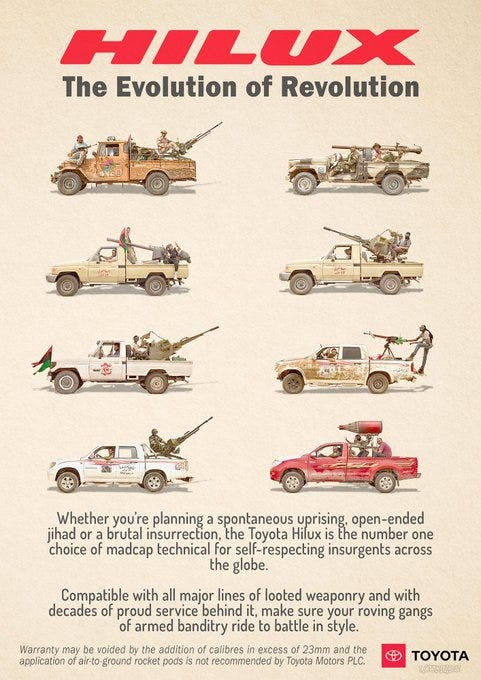
The Great Toyota War of 1987 was the final phase of the Chadian-Libyan conflict. Gadhafi’s Libyan forces by all rights should have dominated the vast stretches of desert being fought over: the Chadian military was less than a 3rd the size of the Libyan, and the Libyans were vastly better equipped fielding hundreds of tanks and armored personnel carriers, in addition to dozens of aircraft … to counter this the Chadians did something unique … They mounted the odds and ends heavy weapons systems they had in the truck beds of their Toyota pickups, and using the speed and maneuverability of the Toyotas, managed to outperform Libya’s surplus tanks and armored vehicles. By the end of the Chadian assault to retake their northern territory, the Libyans had suffered 7500 casualties to the Chadians 1000, with the Libyan defeat compounded by the loss of 800 armored vehicles, and close to 30 aircraft captured or destroyed.
The maneuverability and speed of the pickups made them incredibly hard to hit, and the tanks in particular struggled to get a sight picture … strafing within a certain range the pickups moved faster across the horizon than the old soviet tanks’ main gun could be hand cranked around to shoot them.
Since then Technology has become the backbone of insurgencies, militias, poorer militaries, and criminal cartels around the world. The ready availability of civilian pickups, with the ability of amateur mechanics to mount almost any weapon system in their truck-bed means that this incredibly simple system is about the most cost-effective and easy way for a small force to make the jump to mounted combat and heavy weapon.
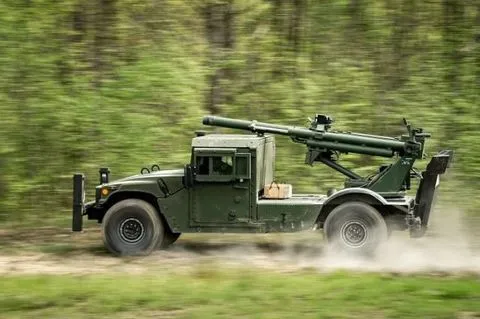
But these weapons are far less asymmetric than motorcycles. The increasing importance of mobility means even the most advanced armies are getting in on the game. The US Army is currently converting a portion of its Humvees to have their rear seat and trunk cut out for a truck bed so that they can run a mobile light artillery out of it:
Popular Mechanics article – https://www.popularmechanics.com/military/weapons/a28288/hawkeye-humvee-mounted-howitzer/
The importance of instant maneuverability far outstretches any advantage armor can give in this application. Since artillery shells are radar-detectable, and, follow a parabolic arc, their origin point is easily calculable. Thus shoot and Scoot tactics are necessary since it may only be a minute or two from firing a volley that counter artillery fire might be inbound.
Aside from The bemused jokes that the US is finally catching up with the tech Chad had in the 80s, The truth is most advanced forces have always had something light with a heavy gun that can travel at highway speeds … the fact the US is now converting Humvees to have full light artillery pieces is only really a continuation of the trend of semi-auto grenade launchers, TOW missiles, or anti-tank guns being placed on light fast vehicles since WW2.
The remarkable thing about the technical isn’t that they’re some unique capability militaries can’t use … most poorer countries field something equivalent (the Libyans seemed to have screwed up the unit composition of their force) … Rather the unique advantage is how easy and cheap they are for non-conventional or poorer forces to home assemble.
US combat-ready Humvees cost the military into the hundreds of thousands of dollars, a cost that is presumably even higher as they’re modified to carry heavy weapons systems.
As ridiculous as a Toyota with an Air-to-Ground rocket pod, or a repurposed anti-air gun might be, they’re cheap. The pickup truck new is $20,000-50,000, though I suspect any irregular force would pay closer to 1000-5,000 for something decades old, if they pay at all. Likewise, they’re trivial to source, which is good if sanctions or anti-money laundering laws are trying to stop you from buying anything, and as the Chadians proved: pretty much any captured or surplus heavy weapon will go on it.
This gets irregular forces into the mounted combat game … but it does slightly more than that. Pickup trucks, as any perturbed Prius driver will tell you, are shockingly common … perhaps one in 10 or more vehicles out there are some form of pickup truck. This not only makes them easy to source, but it disguises them and allows them to operate hidden amongst the rolling stock of civilian vehicles, requiring either visual identification or extensive intelligence work to tell them from mere civilians.
ISIS forces near Mosul shortly after its fall.
This combination of mobility, resemblance to civilian vehicles, and ability to deploy heavy weapons was used to devastating effect by the Islamic State during the 2014 Fall of Mosul. Striking quickly while Iraqi national tanks were deployed elsewhere the small Islamic force entered the city at 2:30 am, striking in small convoys that overwhelmed checkpoints with their firepower, executing and torturing captured Iraqi soldiers and targeted enemies as they went. Even after taking into account desertions and “ghost soldiers” (fake soldiers meant to pad unit numbers so corrupt officials could collect their pay) which significantly reduced the 30,000 Iraqi army and 30,000 police within the city … Even after allowing for all that, the Iraqi national forces still outnumbered the 800-1500 ISIS fighters at a rate of 15 to 1.
YET ISIS was able to achieve a total victory and take the whole of the city within 6 days.
2 years later it would take the Iraqi government with American backing 9 months to retake it.
How? How does a force of 1500 at most, most without any formal training, overwhelm and defeat a force of 12,000-23,000, which at least has some training, better equipment, and has an entire state behind it? How did ISIS do this entirely without air support? Even as the Iraqi government bombed them from helicopters?
How did they take in 6 days what would take the Iraqi government with full American backing 9 months to retake?
Well, they made the Iraqis break and run.

January 30, 2024
The Most Expensive Machine Gun Ever Sold
Forgotten Weapons
Published Nov 6, 2023Morphy’s recently took the world record for the most expensive machine gun ever sold at public auction — with a transferrable FN Minimi. It sold for a winning bid of $490,000, which became a total price of $588,000 after adding the 20% buyer’s premium. Good heavens. So today, let’s consider why someone might speak THAT MUCH money for a Minimi …
(more…)
January 27, 2024
AFN-49: The Forgotten Full-Auto Brother of the FN-49
Forgotten Weapons
Published 20 Oct 20230:00 Introduction and Overview of the AFN 49
1:23 Detailed Insight into the AFN 49’s Global Presence
3:01 Demonstration and Explanation of the AFN’s Unique Features
5:05 Auto Trip Feature: A Deep Dive
7:27 Unique Characteristics of the AFN 49
8:48 The Journey of AFN 49s to the US
10:17 Conversion of Luxembourg AFN 49s: A Historical Perspective
10:43 Conclusion and AcknowledgementsA note to censors: This video is not a tutorial on full auto conversion. It is an explanation of how the system works, and provides no instruction of how to fabricate or modify parts to modify a semiautomatic firearm into a fully automatic one. Doing that would be illegal for most people — although certainly not all; conversion or ownership of machine guns is legal in most places with the appropriate government permission.
The SAFN, aka FN-49, is one of the classic post-war European battle rifles, and was sold to nine different countries in the early 1950s before the FAL became FN’s primary combat rifle offering. What is often forgotten is that despite being limited to a fixed 10-round magazine, nearly half of all FN-49s produced were actually fully automatic AFN-49s. The Belgian Army, Luxembourg Army, Luxembourg Gendarmerie, and Belgian Congo all purchased the automatic pattern. So today, we’re going to take a look at how it differs from the regular SAFN that we are used to seeing.
Interestingly, a batch of the Luxembourg Gendarmerie rifles were imported into the US without anyone realising that they were automatic until they arrived and were being unpacked. InterArms went to the IRS (the NFA was a tax law administered by the Treasury; this was before the formation of the ATF) and proposed removing the selector levers and auto sears, as well as milling off their attachment points on the receivers. The IRS agreed that this would be an acceptable conversion to render the guns legally semiautomatic only, and the changes were made before the rifles were sold. They remain on the US collector market today as an interesting example of legal conditions prior to the adoption of a pointless and punitive decree of “once a machine gun, always a machine gun”.
Many thanks to the Royal Museum of the Armed Forces and Military History in Brussels for access to this very cool piece! Check them out here: https://www.klm-mra.be/en/
(more…)
January 25, 2024
USS West Virginia
The History Guy: History Deserves to be Remembered
Published 26 October 2023On December 7, 1941, the battleship USS West Virginia was at Pearl Harbor, moored on Battleship Row, next to USS Tennessee. During the Japanese attack, she was struck by seven torpedoes, sinking in shallow water. But the “We Vee” would rise again, and she would lead the American line of battle at the last battleship on battleship action in history. USS West Virginia deserves to be remembered.
(more…)
January 24, 2024
France’s Final Battle Rifle Iteration: The MAS 49-56
Forgotten Weapons
Published 24 May 2019While the development of the MAS 49 had given France a very utilitarian rifle that could serve as both for both marksmen and grenadiers, it could still be made better. In large part, the change to the 49-56 pattern was motivated by the move to adopt NATO-compatible 22mm rifle grenades. With the new muzzle hardware, several other changes were made. A gas cutoff was added, to prevent wear and tear on the action from grenade use (something that was found to be a real problem on the MAS 49). The gas port was also moved farther down the barrel, and the hand guard and barrel were both shortened to make the rifle a bit lighter and handier.
Production began in 1957, and about 175,000 of the rifles were made, seeing service as France’s standard front-line infantry rifle until the adoption of the FAMAS in 1979.
(more…)
January 23, 2024
T-34: The tank that won WWII
The Tank Museum
Published 27 Oct 2023The Soviet T-34 was the most prolifically produced tank of WWII. Basic and austere in design, it was highly effective and capable of being mass-produced. In this video we take a close look inside and out at the tank that made victory over Nazi Germany possible.
(more…)


