
Rex Krueger
3 Nov 2025yLinks from this video:
History of Raised Panels: https://www.youtube.com/watch?v=M6iIqZY4gvc
Learn About Hardwoods: https://www.youtube.com/watch?v=_NmKfzc3g-I&t=229s
Find and fix up a Rabbet Plane: https://www.youtube.com/watch?v=NcJeu0qMvwc&t=184sGet behind the scenes and FREE plans: https://www.patreon.com/rexkrueger
November 4, 2025
Making history the simple way
Comments Off on Making history the simple way
October 21, 2025
The amazing invisible detail
Rex Krueger
Published 20 Oct 2025Patrons saw this video early: / rexkrueger
Comments Off on The amazing invisible detail
October 15, 2025
Your tools belong in a chest
Rex Krueger
Published 29 May 2025Compass Rose Toolworks: https://www.compassrosetools.com/
Check out my Courses: https://rexkrueger.retrieve.com/
Patrons saw this video early: patreon.com/rexkrueger
Follow me on Instagram: @rexkrueger
Comments Off on Your tools belong in a chest
October 5, 2025
Chris Schwarz and the cheapskate workbench builder
Every week, Chris Schwarz republishes something from his back-catalogue of books and articles, generally on woodworking topics. This week, he posted the first half of an older blog post about the six personalities of workbench builders. I especially enjoyed the third segment:
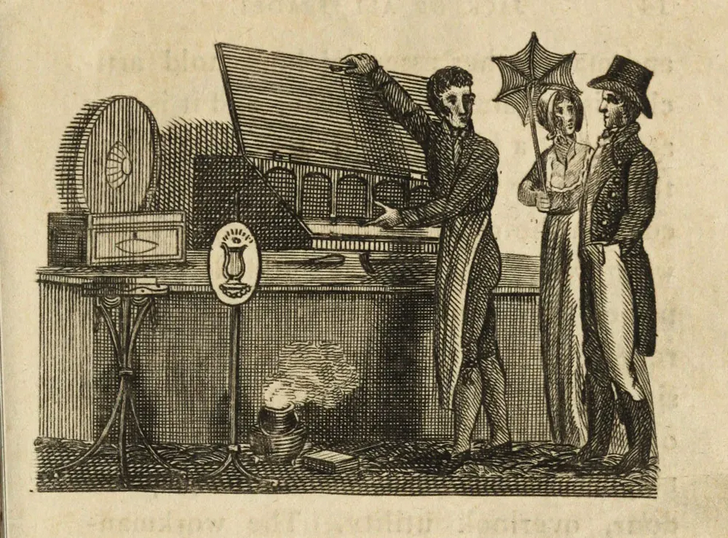
Workbench Personality No. 3: The Cheapskate
My encounters with The Cheapskate could fill a book on workbenches. This is but one short story.
I receive a fax. On the paper is the message: Could you call me at XXX-XXX-XXXX please? I have an important question about workbenches.
Intrigued, I call. My first question: Hey, uh, why the fax?
The Cheapskate: We’re not allowed to make long-distance calls here at my place of employment. But they didn’t say anything about making long-distance faxes.
A cold stone grows in my stomach.
The Cheapskate gets down to business: I want to build a Roubo workbench, but I’m tight on fundage. We’ve got these pallets where I work, and I’m wondering if those will work? I don’t know what the species is – something weird – and the stock is thin and filled with nails and spiral screw things.
I am certified in counseling The Pallet People. So I know what to do.
Question: What sort of sizes can you get from the pallets?
The Cheapskate: About 1/2″ thick, 4″ wide and 48″ long.
Me: So, for an 8′-long bench, you will need almost 100 of those pieces just for the benchtop. You will need to de-nail them, flatten them and glue them together in stages that are staggered – probably about 18 to 20 stages – if I remember right from my Pallet People Intervention Manual.
The Cheapskate: Brilliant! Thanks so much! I’ll do it!
A few weeks pass; another fax arrives.
The Cheapskate: I’m working on the benchtop, and I have a technical question for you. How little glue do I need to use to stick these pieces together? I mean, I’m trying to recover all the squeeze-out, but I’ve laminated seven layers so far and used up a 16 oz. bottle of glue. That’s crazy. Can I get away with just gluing a little bit at the top and bottom of each board – leaving the middle dry?
Me: I explain that glue is the cheapest part of any project. (“Not this one!” he interjects. “So far I’ve spent money only on glue!”) Deep breath. OK, I say, if you use this strategy, once you flatten the benchtop a few times, the top will delaminate.
There is silence on the phone line. (I’ve won!)
Then he answers: What if I put a paste of rice and water in the middle instead of glue? I’ve heard that rice glue was used in Japanese cultures. We have a lot of rice.
I unplug the office fax machine.
The Cheapskate sends me an email: I need to make a face vise and a tail vise, but all I have on hand is all-thread rod from a neighbor’s fencing job – 32 tpi. Can you help?
I am seriously considering counseling for myself when a follow-up email arrives. It continues the discussion of the 32 tpi vises.
The Cheapskate: I’m thinking a quick-release mechanism is the way to go – 32 tpi is really slow. But it’s super precise! So here’s the thing. I have a friend with a SawStop. He set the thing off when ripping my benchtop for me (some of the glue wasn’t dry). The SawStop cartridge has these strong blue springs in it. He was going to THROW THEM AWAY! That got me thinking: I could use those as a quick-release trigger for my vise – holding a bit of metal against the all-thread. Have you ever seen plans for something like this?
Weeks pass, and I hope The Cheapskate has taken up Animal Husbandry, cheaping out on animal condoms or something. But then I get a phone call.
The Cheapskate: I see you’re teaching a workbench class at the Marc Adams School of Woodworking.
Me: Yup.
The Cheapskate: I was wondering: Could you get a student to take videos of your lectures and send them to me? Not the building part. Just the part where you explain how to make the thing. I don’t really have the fundage to take a class.
Me: I’m afraid that’s not really fair to the students or the owner of the school. Sorry.
The Cheapskate: Hey, I totally understand. How about I just come to the class and watch through the window? Is that OK? I won’t build anything. I’ll just be there, like a fly on the wall to listen? That OK?
Comments Off on Chris Schwarz and the cheapskate workbench builder
How to Make a Stool with a Woven Seat | Paul Sellers
Paul Sellers
Published 9 May 2025I designed a basic introductory-level project to steer and guide any new woodworker into making a great first-time project. I also wanted a basic introduction to weaving Danish cord (but you can use nylon or natural rope) into a seat.
The two came together in a single stool that, though simple and fun to make, will last a lifetime. There are features to working the wood that you will be unlikely to see or learn about elsewhere because I designed the project with you, the beginner or novice woodworker and seat weaver, in mind.
Trade secrets and tips of the trade throughout, you might just amaze yourself, your family, and friends with a professional-looking outcome.
Bookmarks:
Rails Layout: 02:08
Shaping the Legs: 16:48
Glue Up: 35:34
Finishing: 51:53
Seat Weaving: 54:14
(more…)
Comments Off on How to Make a Stool with a Woven Seat | Paul Sellers
September 28, 2025
The beginning woodworker … an easy mark
On his Substack, Christopher Schwarz posts a weekly “earlywood” article pulled from his extensive back-catalogue of woodworking books and magazine articles. This week, he addresses the plight of the beginner in the woodworking hobby just before the internet became ubiquitous:
When people begin woodworking, most go through a phase (I did) in which they are willing to soak up every single piece of information they can find. Many will subscribe to multiple woodworking magazines, buy astonishing numbers of woodworking books, seek out catalogs and advertisements for woodworking tools, and buy anything they can afford that looks remotely useful.
This is when people are vulnerable. They need guidance. Unfortunately, woodworking is a mostly solitary pursuit. And so we spend incredible, astonishing and shocking amounts of money on equipment, books and instruction. And most of it is of questionable worth.
Because of this phenomenon:
- The woodworking magazine business had a glut of magazines. When we ran the numbers in the 1990s, we surmised that there should be three magazines serving woodworkers. Instead, there were more: Fine Woodworking, WOOD, American Woodworker, Woodsmith, Shopnotes, Workbench, Popular Woodworking, Woodworker’s Journal, Woodshop News, Woodcraft, Weekend Woodcrafts, Woodwork and a host of specialized magazines. What propped up these magazines? Beginners. Eventually, most woodworkers winnow their subscriptions down to one or two magazines. But the spendthrift beginner made it possible for many magazines to survive.1
- The woodworking book industry produced a glut of books. In the 1990s, my mailbox was stuffed with new woodworking books every week. It wasn’t unusual to see seven or eight new woodworking titles in a month. That’s coo-coo. Why did this work? New woodworkers wanted the latest information. New books are better than old books (duh!). And so publishers churned out books that had an 18-month life cycle before disappearing forever.2
- The woodworking tool industry thrives on new SKUs. After covering woodworking tool manufacturers for nearly three decades, it’s obvious that they introduce new products every year to goose sales. That’s why you have a new crop of cordless drill/drivers every year. And it’s also why you have a rash of odd products that seem (on the surface) to be innovative – silicone glue brushes, painter’s pyramids, many router table jigs, marrying a chisel with a rasp, aluminum squares, putting a laser on everything, oddball and worthless sanders (the Black & Decker Mouse; Porter-Cable Profile Sanders), and battery-powered clamps and tape measures. The list is endless, and it’s not a modern phenomenon. When my grandfather was woodworking in the 1970s, he was charmed by a jig that let you cut dovetails with a corded drill. The only people who are dumb enough to fall for these products are beginners and woodworking journalists. Beginners don’t know better, and journalists need copy to fill the empty space between the covers.3
Some of you might be thinking I’m exaggerating my experiences. I’m not. The good news is that the Internet did a Half-Nelson on most of these stupid business practices. When people now go through their “indiscriminate sponge” phase, they do it on YouTube and soak up as much ridiculousness as they wish.
For free. Mostly.
Eventually, they will be able to ignore the tool-chugging nincompoops and focus on what’s important: Building basic skills using simple and robust tools (and maybe a few well-built machines).
Honestly, it’s a good thing to be a bit jaded about the woodworking tool and publishing industries. It makes you a better consumer and encourages us to do better. So please, for the sake of the future of the craft, don’t buy the Bench Cookies.
- Some modern context follows. Many of these magazines have disappeared or have been consolidated. But you know what? I still think we have too many woodworking magazines these days. Or not enough. I forget which is right.
- More modern context follows. Most of these publishers have gone tits up. And good riddance. We don’t need a new book every year on advanced router techniques.
- Modern context follows. Nothing has changed here.
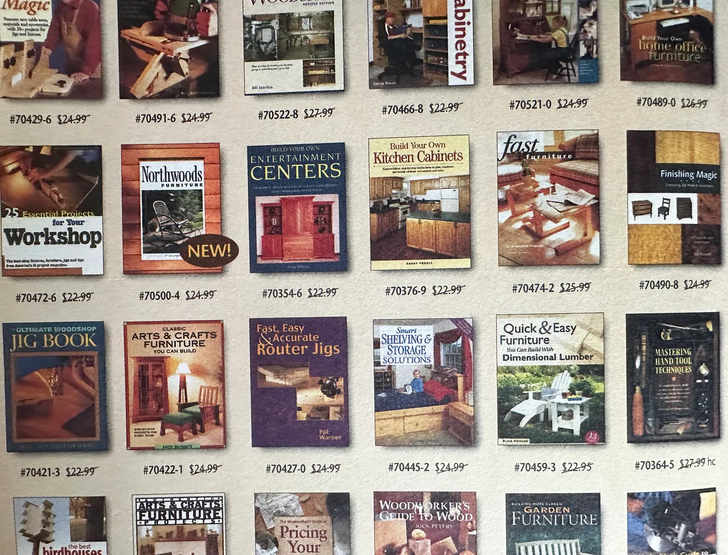
I matched this profile of the “indiscriminate sponge” beginner and I had huge numbers of woodworking books and magazines … until I finally noticed that the magazine articles in the latest issue were basically the same as the ones I’d first seen three years earlier, just with more gee-gaws and doo-dads added (microadjusters-for-everything were flavour of the month when I finally exited my sponge phase).
Comments Off on The beginning woodworker … an easy mark
September 23, 2025
Learn EVERYTHING from Home Depot wood
Rex Krueger
Published 22 Sept 2025
Comments Off on Learn EVERYTHING from Home Depot wood
September 11, 2025
Make the Joiners Mallet in an Afternoon
Rex Krueger
Published 2 May 2025
Comments Off on Make the Joiners Mallet in an Afternoon
September 5, 2025
September 2, 2025
How to Make a Poor Man’s Gauge | Paul Sellers
Paul Sellers
Published 25 Apr 2025Creating solutions does not always mean going out to buy dedicated manufactured tools but thinking about how you can become the solution.
In this short video, I show how you can set up an ingenious way to set out for hinge recessing, mortise and tenon parts, and then a beading tool in a matter of a minute or two only. It’s a trick that’s bailed me out time and time again.
It’s yours just by watching and learning!
(more…)
Comments Off on How to Make a Poor Man’s Gauge | Paul Sellers
August 26, 2025
Table saws, technological patents, and rent-seeking
Tom Knighton, who I’ve “met” on my favourite woodworking forum, celebrates a small victory in the never-ending battle against the rent-seekers of the corporate world:
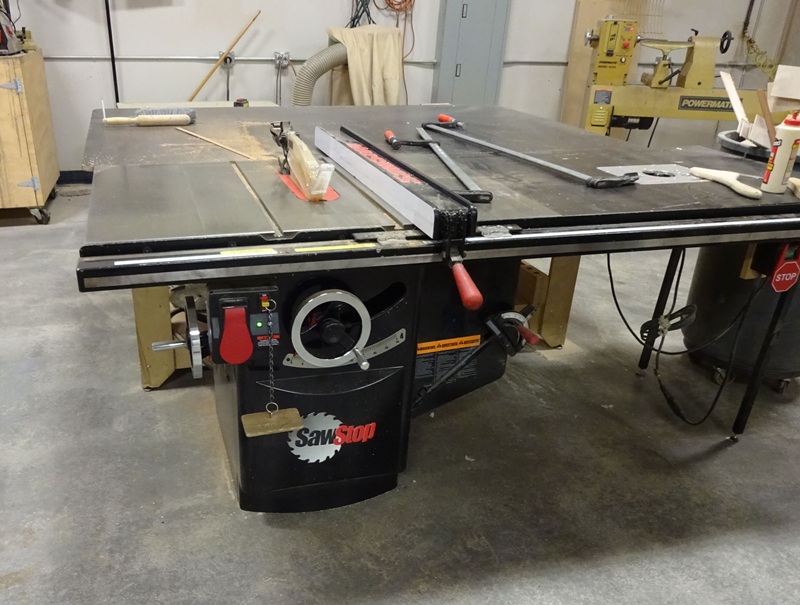
“SawStop” by Comfr is licensed under CC BY-SA 4.0 

 .
.
What does this have to do with rent-seeking?
Well, there’s a company called SawStop. They make really great table saws with a unique safety feature. They’re equipped with a brake and sensor that, when it detects moisture such as one might find in a human finger, it locks the saw and drops the blade down into the saw’s body.
It’s a really great bit of technology, and the saws happen to be really good saws, too, so the company has done well for itself.
However, it started out as a company seeking to license the technology, only no one wanted it at the time.
SawStop decided to try and press the United States government to mandate their technology on all new table saws, and the government was going to.
Was.
This video has a good rundown of the whole thing. (I’d embed it, but the channel doesn’t allow it for some reason.)
The short of it is that the rule that was being considered has now been tossed because it would specifically give SawStop a monopoly on table saw sales in the United States, legally. Yes, they were going to offer up a patent for the public domain, but it wouldn’t be enough to replicate the technology in and of itself.
Plus, at a time when woodworking isn’t the biggest hobby in the world, even if it had been enough, driving up the cost for a central piece of tooling that most consider essential for woodworkers ain’t the way to change that.
For example, Skil makes a jobsite saw that typically runs under $300. SawStop’s equivalent is around three times that much, and that’s a lot of money to spend on something you’re not sure you’ll even enjoy.
Especially since just being careful can prevent the need for the brake in the first place, to say nothing of the fact that if you cut wet wood, it’ll trigger the brake, which is a pain for a lot of people, especially building contractors whose lumber isn’t super dry to begin with.
Seeing the rug pulled out from under SawStop is great, but the real issue here is that it doesn’t happen often enough. Rent-seeking is all too common and all too often works.
Comments Off on Table saws, technological patents, and rent-seeking
August 22, 2025
You built a tool chest. Now, make it YOURS.
Rex Krueger
Published 21 Aug 2025
Comments Off on You built a tool chest. Now, make it YOURS.
August 1, 2025
How to make flat boards straight, smooth and square (stock preparation part 2) | Paul Sellers
Paul Sellers
Published 28 Jul 2013In this video Paul Sellers shows how to prepare a flat smooth board from rough stock. He does this with winding sticks and a no. 4 plane.
Part 1 is here: How to make square stock straight, sm…
Someone asked about the can Paul uses to lubricate the sole of the plane. You can find out how to make one here: http://paulsellers.com/2011/10/recycl…
To find out more about Paul Sellers and the projects he is involved with visit http://paulsellers.com
Comments Off on How to make flat boards straight, smooth and square (stock preparation part 2) | Paul Sellers
July 25, 2025
How to make square stock straight, smooth and square (stock preparation part 1) | Paul Sellers
Paul Sellers
Published 8 Apr 2013Paul Sellers shows how to prepare wood from its rough sawn state into useable stock. He goes into detail about how to remove twist from a square piece of wood and make it “four square”. He does all of this with hand tools. Specifically the plane, square and winding sticks. The video was first posted on https://woodworkingmasterclasses.com
To find out more about Paul Sellers and the projects he is involved with go to http://paulsellers.com
Comments Off on How to make square stock straight, smooth and square (stock preparation part 1) | Paul Sellers


