
“What has always alleviated our scarcity? What has always alleviated our environmental problems? Technology. What breeds technological dynamism? Economic success,” explains Joshua Jacobs, co-founder of the Conservative Future Project, a new pro-science, pro-technology organization that’s trying to get the Republican Party to embrace an open-ended future filled with driverless cars, stem-cell research, and private space exploration.
If that sounds like a tall order for a party whose leading presidential candidates in 2012 waffled on whether they believed in evolution, you’re right. But Jacobs argues forcefully that the GOP is no less anti-science than the Democrats and actually has a long history of pushing scientific and technological innovation.
Nick Gillespie sat down with Jacobs in Reason‘s D.C. studio to talk about how conservatives might stop standing athwart history yelling stop and march boldly into the future.
April 28, 2013
Reason.tv: Why the GOP Should Embrace Science
April 26, 2013
The sky is falling! The sky is falling! The PC is dying!
Matt Baxter-Reynolds challenges the Chicken Littles of the tech reporting world:
There are two problems with the statement “the PC is dying”. The first problem is that people like their PCs, and hearing that something that they have affection for is dying, or it isn’t relevant, or it’s going away, can be inflammatory.
The second, bigger problem, is that people when hearing this look at the PC that is today and has been a useful tool oftentimes for decades, and rightfully regard the statement as just being non-sensical. It’s patently untrue.
The idea of waking up one morning and finding a world bereft of PCs is silly. Most people reading this couldn’t do their jobs, studies, or hobbies without having access to a PC.
What is meant by “the death of the PC” is that the relevance of the PC within people’s lives is being diluted by compute devices that are not PCs and the ability to use them for activities that are rewarding yet do not require PCs. This has in fact been going on a long time (e.g. SMS), it’s just that we’ve reached a tipping point over the past few years where the whole world seems to be full of smartphones and tablets and everyone is now talking about it.
April 23, 2013
Seller of fake bomb detectors found guilty of fraud
Back in 2010, I said “There should be a special hell for this scam artist” who mocked up bomb detector kits and sold them for thousands of dollars in Iraq and other areas with a real need for protection against IEDs. It’s taken more than three years, but he’s finally been found guilty:
A Somerset-based businessman has been convicted of three counts of fraud over the sale of bogus bomb detectors after his operation was exposed in a BBC Newsnight investigation in 2010.
This was a scam of global dimensions. James McCormick marketed his fake bomb detectors around the world, selling them in Georgia, Romania, Niger, Thailand, Saudi Arabia and beyond.
But his main market was Iraq, where lives depended on bomb detection and where the bogus devices were, and still are, used at virtually every checkpoint in the capital.
Between 2008 and 2009 alone, more than 1,000 Iraqis were killed in explosions in Baghdad.
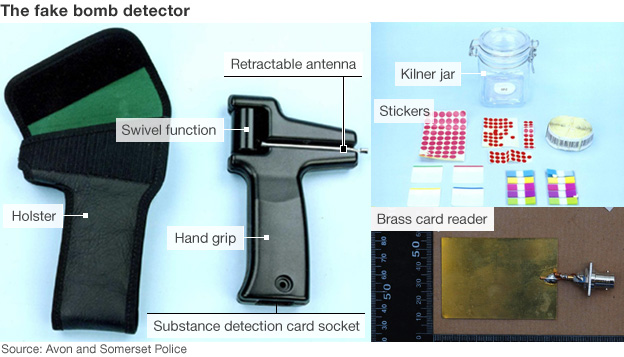
How the device was meant to work:
- A small amount of the substance the user wished to detect — such as explosives — was put in a Kilner jar along with a sticker that was intended to absorb the “vapours” of the substance
- The sticker was then placed on a credit-card sized card, which was read by a card reader and inserted into the device
- The user would then hold the device, which had no working electronics, and the swivelling antenna was meant to indicate the location of the sought substance
In other words, a magical dowsing stick that depended on the user to “detect” whatever the device was supposedly seeking. This wasn’t a case of a device that didn’t do what it was designed to do: it was a deliberate fraud with just enough “technological” mumbo-jumbo to appear to be a solution to a real problem:
The court heard that McCormick began his business by buying a batch of novelty “golf ball detectors” from the USA for less than $20 each. In fact they were simply radio aerials, attached by a hinge to a handle. He put the labels of his company, ATSC, on them and sold them as bomb detectors for $5,000 each.
He then made a more advanced-looking version which he was to sell for up to $55,000. The ADE-651 came with cards which he claimed were “programmed” to detect everything from explosives to ivory and even $100 bills. Police say the only genuine part of the kit — and the most expensive — was the carrying case.
To their credit, the police moved to investigate the same day the BBC’s original story broke. Strategy Page explained why the scam had been so easy to sell. Later it was reported that British civil servants and military personnel had been implicated in the fraud.
April 22, 2013
Not news: nearly 90% of all spreadsheets have errors
I’ve said it before, spreadsheets are great organizing tools and provide opportunities for both financial whizzes and ordinary folks to make splashy, expensive errors:
Microsoft Excel makes it easy for anyone to do the kind of number crunching once reserved for accountants and statisticians. But the world’s best-selling spreadsheet software has also contributed to the proliferation of bad math.
Close to 90% of spreadsheet documents contain errors, a 2008 analysis of multiple studies suggests. “Spreadsheets, even after careful development, contain errors in 1% or more of all formula cells,” writes Ray Panko, a professor of IT management at the University of Hawaii and an authority on bad spreadsheet practices. “In large spreadsheets with thousands of formulas, there will be dozens of undetected errors.”
Given that Microsoft says there are close to 1 billion Office users worldwide, “errors in spreadsheets are pandemic,” Panko says.
Such mistakes not only can lead to miscalculations in family budgets and distorted balance sheets at small businesses, but also might result in questionable rationales for global fiscal policy, as indicated by the case of a math error in a Harvard economics study. By failing to include certain spreadsheet cells in its calculations, the study by Harvard economists Carmen Reinhart and Kenneth Rogoff may have overstated the impact that debt burdens have on a nation’s economic growth.
There’s a reason I nominated Microsoft Excel as “The Most Dangerous Software on Earth“.
April 21, 2013
Documentary War for the Web includes final interview with Aaron Swartz
CNET‘s Declan McCullagh talks about an upcoming documentary release:
From Aaron Swartz’s struggles with an antihacking law to Hollywood’s lobbying to a raft of surveillance proposals, the Internet and its users’ rights are under attack as never before, according to the creators of a forthcoming documentary film.
The film, titled War for the Web, traces the physical infrastructure of the Internet, from fat underwater cables to living room routers, as a way to explain the story of what’s behind the high-volume politicking over proposals like CISPA, Net neutrality, and the Stop Online Piracy Act.
“People talk about security, people talk about privacy, they talk about regional duopolies like they’re independent issues,” Cameron Brueckner, the film’s director, told CNET yesterday. “What is particularly striking is that these issues aren’t really independent issues…. They’re all interconnected.”
The filmmakers have finished 17 lengthy interviews — including what they say is the last extensive one that Swartz, the Internet activist, gave before committing suicide in January — that have yielded about 24 hours of raw footage. They plan to have a rough cut finished by the end of the year, and have launched a fundraising campaign on Indiegogo that ends May 1. (Here’s a three-minute trailer.)
Swartz, who was charged under the Computer Fraud and Abuse Act, faced a criminal trial that would have begun this month and the possibility of anywhere from years to over a decade in federal prison for alleged illegal downloads of academic journal articles. He told the filmmakers last year, in an interview that took place after his indictment, that the U.S. government posed a more serious cybersecurity threat than hackers:
They cracked into other countries’ computers. They cracked into military installations. They have basically initiated cyberwar in a way that nobody is talking about because, you know, it’s not some kid in the basement somewhere — It’s President Obama. Because it’s distorted this way, because people talk about these fictional kids in the basement instead of government officials that have really been the problem, it ends up meaning that cybersecurity has been an excuse to do anything…
Now, cybersecurity is important. I think the government should be finding these vulnerabilities and helping to fix them. But they’re doing the opposite of that. They’re finding the vulnerabilities and keeping them secret so they can abuse them. So if we do care about cybersecurity, what we need to do is focus the debate not on these kids in a basement who aren’t doing any damage — but on the powerful people, the people paying lots of money to find these security holes who then are doing damage and refusing to fix them.
April 20, 2013
First world problem defined – high tech toilet faces technological obsolescence
Techhive‘s Jared Newman has, uh, the dirt:
Everyone knows the old axiom about consumer electronics: The rapid pace of technology quickly renders your new tech toys obsolete.
It turns out that not even high-tech toilets are immune from that truism. Kohler, which two years ago released its luxurious $6000 Numi toilet, has just announced the second-generation model, and it adds some essential upgrades not found in the current hardware.
The Numi first made waves in 2011 for its built-in speakers, FM radio, MP3 player and accompanying touch screen remote control, as well its hands-free operation and built-in bidet with “integrated dryer.” Equally noteworthy was the Numi’s striking design, and Kohler’s bizarre suggestion that the rich and famous should heed nature’s call in full view of nature.
Kohler’s promotional material for the Numi suggests that when you’ve spent $6000 on a toilet, you want to make sure it’s in full view of the neighbors.

April 18, 2013
Neologism of the week: “Glassholes”
Jason Perlow explains why Google Glass (or similar devices from other vendors) are inevitably going to be part of the future, and why many already refer to the users of such devices as “Glassholes”:
It could certainly be argued that whenever a new consumer technology enters society, those who are quick to adopt it are typically ridiculed by the have-nots. Eventually, many of these technologies become commonplace and are more accepted by the mainstream, particularly when they become more affordable.
This has pretty much always been the case, starting with the radio pager, then the cellular phone, text capable handsets, and then, of course, Bluetooth headsets, the smartphone and the tablet.
People who first used these things were once seen very much as elitist and not part of the mainstream, and they were considered disruptive.
To some extent, even with their popularity, they are still considered disruptive when used in various social contexts.
[. . .]
With Glass, because the device is being worn and there’s no indication of when it is being used, one has to assume that the wearer is recording everyone all of the time.
I can’t speak for anyone else, but I have serious issues with the notion that I could be recorded by everyone at any time.
Look, I am aware that law enforcement and government agencies have us under surveillance, and it’s not uncommon for people to be photographed and videoed hundreds of times per day, particularly if you live in a major city.
The growth of public surveillance has all kinds of civil liberties concerns, but it’s a done deal … you probably can’t avoid being recorded many times per day unless you stay at home with the blinds down (and turn off your cell phone, and avoid the internet, and …). The social and cultural issues around private surveillance will provide some fascinating legal wrangles in the very near future: where does my right to record (“lifelog”) all of my activities conflict with your right not to be so recorded? Will the concept of privacy be one of the first things jettisoned over the side?
Governments and law enforcement agencies will want maximum opportunity to use their surveillance tools — both for specific investigations and for general purpose Big Brothering — and if that means abandoning any pretense of protecting your privacy against invasion by non-government agencies, they’ll take it. They’re already 9/10ths of the way there as it is.
There are things you only say and do with close friends in confidence, others which may be revealed in private business meetings, et cetera. We all know and have seen what happens when supposedly “private” or unauthorized recordings are made behind closed doors and then leaked to the general public, either intentionally or accidentally.
It can cost someone their career. It can destroy one’s personal reputation. It will most certainly cause one strife with one’s friends and family. And as we have most recently seen, it can also cost you a Presidential Election.
He also discusses the possibility of social and technical controls to provide anti-lifelogging zones, which I strongly suspect will be simultaneously introduced almost immediately when Google Glass or similar technology is released to the public, and almost certainly more of a hassle for non-users of the technology for little or no actual benefit. It will be the usual politician’s syllogism: “Something must be done. This is something. Therefore we must do it.” As for the technical side, there is almost nothing more tempting to a certain kind of hacker than the technical equivalent of a “Do not touch” sign.
Obviously, for this type of anti-lifelogging tech to work, there has to be an agreed upon API or programmatic trigger signals that cannot easily be defeated by hackers.
But if it cannot be made to work, or if the effectiveness of the tech cannot be guaranteed, then I forsee situations where people will be forced to remove and surrender their devices in order to prevent the possibility of recording, as well as a change in our culture to be much more careful about what one says, even in very intimate situations.
And that is an Orwellian chilling effect that I think could be very harmful to the development of our society as a whole.
This chilling effect was evident in decades past in East Germany while the country was in fear of the ever-watching eyes and ears of the Stasi, which had perhaps the largest informant and surveillance network of any nation per capita in the Eastern Bloc during the Cold War, the USSR included.
Could this be the long-hoped-for breakthrough in battery technology?
In The Register, Tony Smith discusses a new prototype battery that might be coming to your electronic devices … eventually:
Electronics continue to shrink to ever smaller sizes, but researchers are having a tough time miniaturising the batteries powering today’s mobile gadgets. Step forward, bicontinuous nanoporous electrodes.
Smartphones use smaller power packs than they did five years ago, it’s true, but that’s because their chips and radios are more power efficient, not because of any major new battery technology.
Now boffins from the University of Illinois at Urbana-Champaign reckon they have come up with a new pocket-friendly electricity supply.
Enter the “microbattery”, a compact power cell constructed from many three-dimensional nanoporous electrodes capable, its developers claim, of delivering both high power and a large energy capacity.
The negative cathode was devised by another team at the university, but graduate student James Pikul, working under Bliss Professor of mechanical science and engineering William King, figured out how to create a compatible anode and put the two into a battery.
[. . .]
The cathode design, devised by a team led by the University’s Professor Paul Braun, is fast charging. Pikul reckons building a battery out of it yields a rechargeable that can be filled up in a thousandth of the time it takes to charge a comparably sized regular rechargeable cell.
Building a battery in a lab is one thing. Working out how to manufacture it commercially at a price that makes it a realistic power source for future devices is another thing altogether. Pikul and King will be working on that next.
Reason.tv: Why Bitcoin is Here to Stay
Don’t bet on the decentralized currency Bitcoin as a retirement investment, says Mercatus Center policy analyst Jerry Brito, but go long on it as the payment system of the future. Reason‘s Nick Gillespie talks with Brito, the editor of the new anthology Copyright Unbalanced, about Bitcoin bubbles and why governments are so afraid of this virtual payment system.
April 17, 2013
New frontier in crony capitalism – public-policy profiteering
Timothy Carney explains why the big companies that made ordinary incandescent lightbulbs were among the groups pushing to make those lightbulbs effectively illegal. It’s a classic case of using government power to reduce competition and increase profit margins for certain companies:
Absent barriers to entry, light-bulb profit margins had to stay low. GE could make superior bulbs — soft white, etc. — but people are only willing to pay so much of a premium for those. After all, we’re dealing with light here, which is kind of a commodity.
So, where to find barriers to entry? Maybe higher-tech bulbs? LEDs, CFLs, or other bulbs that offer longer life and greater efficiency. GE, Osram, and Sylvania jumped into those high-tech bulbs, got some patents. R&D expenses, higher manufacturing costs, proprietary information — these created barriers to entry and allowed heftier profit margins.
But what if you made a super-efficient long-life bulb — and nobody wanted it? What if you couldn’t convince consumers that these bulbs were good for them? Well, that’s when you thank your lucky stars that you are GE, with the largest lobbying budget of any company in America.
You “heavily back” legislation that will “effectively outlaw … the traditional incandescent light bulb.” Now all consumers are forced to play in the world where you have greater barriers to entry, and thus bigger profit margins.
The negative consequences here aren’t mere Tea Party concerns about “crony capitalism” or, say, freedom of choice. One cost is the erosion of competition. GE in this case has found a way to divorce profit from the delivery of value – and I call it public-policy profiteering.
Sure, these high-tech bulbs have value. But I think consumers, rather than politicians, should be the ones who determine what value they assign to energy efficiency and longevity. So, through government intervention, capitalism starts to resemble the Marxist caricature of capitalism — Big Businesses making profits while denying consumers what they want.
More on the US Navy’s laser weapon development effort
Earlier this month, it was reported that the US Navy had successfully tested their ship-mounted laser defence system called LaWS (earlier story here). Strategy Page has more information about the weapon system’s development:
The U.S. Navy believes it has found a laser technology that is capable of being useful in combat. This is not a sudden development but has been going on for most of the last decade. Three years ago the navy successfully tested this new laser weapon (six solid state lasers acting in unison), using it to destroy a small UAV. That was the seventh time the navy laser had destroyed a UAV this way. But the LaWS (Laser Weapon System) was not yet powerful enough to do this at the range, and power level, required to cripple the expected targets (missiles and small boats.) The manufacturer convinced the navy that it was just a matter of tweaking the technology to get the needed effectiveness. Three years later another test was run, under more realistic conditions. LaWS worked, knocking down a larger UAV at longer range. The navy now plans to install the system in a warship within the year for even more realistic testing.
The LaWS laser cannon was mounted on a KINETO Tracking Mount, which is similar, but larger (and more accurate than) the mount used by the Phalanx CIWS (Close In Weapons System). The navy laser weapon tests used the radar and tracking system of the CIWS. Four years ago CIWS was upgraded so that its sensors could detect speedboats, small aircraft, and naval mines. This was crucial because knocking down UAVs is not something that the navy needs help with. But with the ability to do enough damage to disable boats or missiles that are over two kilometers distant meant the LaWS was worth mounting on a warship. LaWS may yet prove incapable of working under combat conditions, but so far this new development has kept passing tests.
[. . .]
The LaWS uses electricity and more and more U.S. warships are producing a lot of electricity, mainly because it is used to operate electrical motors to propel the ship and, as part of that plan, operate weapons like LaWS. Thus a warship with an electrical drive (propulsion) system would be able support multiple shots from LaWS at low cost (a few dollars per firing). By current standards that’s pretty inexpensive ammo. The 20mm shells for the Phalanx cost less than $30 each, but you have to fire a hundred or more at each target. The 20mm cannon is being replaced by RIM-116 “Rolling Air Frame” missiles that have a longer range (7.5 kilometers) than the 20mm cannon (two kilometers) but cost nearly half a million dollars each.
Nearly half a century of engineering work has produced thousands of improvements, and a few breakthroughs, in making the lasers more powerful, accurate, and lethal. More efficient energy storage has made it possible to use lighter, shorter range ground based lasers effective against smaller targets like mortar shells and short-range rockets. Northrop’s move a decade ago was an indication that the company felt confident enough to gamble its own money, instead of what they get for government research contracts, to produce useful laser weapons. A larger high energy airborne laser would not only be useful against ballistic missiles but enemy aircraft and space satellites would also be at risk. But companies like Northrop and Boeing are still trying to produce ground and airborne lasers that can successfully operate under combat conditions. The big problem with anti-missile airborne lasers has always been the power supply. Lots of chemicals are needed to generate sufficient power for a laser that can reach out for hundreds of kilometers and do sufficient damage to a ballistic missile. To be effective the airborne laser needs sufficient power to get off several shots. So far, no one has been able to produce such a weapon. Shorter range solid state lasers need lots of electricity. This is difficult for aircraft or ground troops but not for properly equipped ship. That’s why these lasers remain “the weapon of the future” and will probably remain so for a while.
LaWS takes a different approach, using existing solid-state laser technology tweaked to complement the 20mm cannon shells normally used with Phalanx. Unlike the 20mm autocannon, the power of LaWS can be adjusted down to non-lethal (but blinding to the human eye) levels. That makes LaWS more flexible than the 20mm cannon and cheaper to operate. That will happen if LaWS proves able to operate under the same conditions that the 20mm cannon in Phalanx has operated for decades.
April 16, 2013
Andy Baio: Copyright is the new Prohibition
Techdirt‘s Mike Masnick explains:
Andy Baio has an absolutely fantastic video presentation that he did recently for Creative Mornings/Portland on what he’s calling The New Prohibition. It’s half an hour long, but absolutely worth watching.
[. . .]
This video lets him talk a bit about the aftermath — to explain the true chilling effects of the threat and the eventual settlement. Baio is a creator. It’s in his blood. It’s what he’s always done, but after this he was afraid to create. Being threatened with a lawsuit, even if you believe you’re right, is a scary and possibly life-altering moment. Lots of people who have not been in those shoes think it’s nothing and that they could handle it. You don’t know.
As he notes in the talk, copyright law is probably the most violated law in the US after speeding and jaywalking (and I’m not even sure copyright infringement is really in third place in that list). But getting rung up for one of those gives you a “bad day” situation, not a ruined life. Copyright, on the other hand, can ruin your life. And chill your speech and creativity.
And this is the worst part: so many people, especially kids, are at risk. Baio also famously highlighted the prevalence of the phrase “no copyright intended” on YouTube. Tons of kids uploading videos use clips of music and videos with a phrase like that. Or with statements about fair use. Or with copyright law quotes. All, as he notes, to try to find that magic voodoo that wards off a possible lawsuit. Most of those people aren’t being sued.
But they could be.
New study shows students of online courses learn as much as in traditional classes
At Marginal Revolution, Alex Tabarrok summarizes the findings from a recent large study:
In a large, randomized experiment Bowen et al. found that students enrolled in an online/hybrid statistics course learned just as much as those taking a traditional class (noted earlier by Tyler). Perhaps even more importantly, Bowen et al. found that the online model was significantly less costly than the traditional model, some 36% to 57% less costly to produce than a course using a traditional lecture format. In other words, since outcomes were the same, online education increased productivity by 56% to 133%! Online education trumps the cost disease!
Bowen et al. caution that their results on cost savings are speculative and it is true that they do not include the fixed costs of creating the course (either the online course or the traditional course) so these cost savings should be thought of as annual savings in steady-state equilibrium. The main reason these results are speculative, however, is that Bowen et al. only considered cost savings from faculty compensation. Long-run cost reductions from space savings may be even more significant, as the authors acknowledge.
The university model we’ve known for centuries is long overdue for change. However, remember that just about every new communication technology was touted as being “revolutionary” for education: the printing press, radio, movies, TV, and now online courses. The traditional university model has survived each new technological breakthrough relatively unscathed.
April 15, 2013
Tabatha Southey and the “Grapes of Math”
In the Globe and Mail Tabatha Southey hears the laments of readers “We need a new John Steinbeck for the Great Bitcoin Depression”, and she delivers:
Pa was a simple man, a techno-anarchist by trade, and long after the Bitcoin bust, he stayed on with the mining. “Don’t know nothin’ else,” Ma said, although she once suggested migrant IT work, at least until her own contract was renewed at the hospital where she worked most of her grown days for a pediatric endocrinologist’s wage.
Pa sat on the sofa, the whir of the computer fans all but drowning out the Cato Institute podcast he’d downloaded the night before. He’s there, frozen in my childhood, Pa, mining, mining, mining, with nothing but his iPhone, his laptop and, for a while, my sister’s old Tamagotchi, which he found in the couch cushions while looking for the remote, to amuse him.
Dodging viruses like crop-dusters, Pa is experiencing hard times. He never did come to trust that ol’ anti-virus software. Said it was reporting on him to the Federal Reserve. And always the dust, the dust, the dust, which may have been because Pa never did get round to changing the furnace filters. His time, he said, best spent elsewhere.
Pa, oh, Pa. He never did stop spreading the word of Ron Paul on completely unrelated news items.


