
The brother-in-law of a friend of mine died recently. He was 76, a good age considering his lifestyle. He had spent many years from morning till night sitting in a corner with his Spanish red wine, smoking and watching television. It was not a way of life that attracted me, but it was his choice and he stuck to it with a fine determination.
No doubt if he had followed doctors’ orders from the moment he first came to their attention (he had suffered, not surprisingly, a progression of serious illnesses) he would have survived a few years more. Clearly he did not think the bargain a good one: twenty years of abstinence for an extra four years, shall we say, of boredom. In a way I admired him for his utter rejection of what most people would consider common sense. A world ruled by common sense would be intolerable in its smug dullness.
The other admirable thing about the deceased was that he would have never claimed, never have dreamed of claiming, that his mode of life was anything but his own choice; he was responsible for its consequences, up to and including his death. He had made his bed, in fact his deathbed, and he was content to lie in it.
Theodore Dalrymple, “Warning: May Cause Lawsuits”, Taki’s Magazine, 2014-07-30.
July 23, 2015
QotD: Lifestyle choices
July 5, 2015
A half-baked theory from John Derbyshire
How much reality can you stand? John Derbyshire says it’s less than we used to be able to cope with:
T.S. Eliot’s observation that “human kind cannot bear very much reality” is surely up among the half-dozen wisest things ever said about our common nature.
There is, of course, individual variation in how much reality we can bear. I flatter myself by believing I am up toward the high end. I readily admit, however, that I have spent not insignificant portions of my life in a state of self-delusion driven by wishful thinking — a hugely underestimated force in human affairs. Some humility is in order, and not just for me.
There is group variation, too. Speaking generally, and again with much individual variation, the old can bear more reality than the young; men more than women; people in up-against-it professions like medicine or law enforcement more than those in comparatively sheltered occupations; people educated in STEM subjects (science, technology, engineering, math) more than humanities majors; and so on.
I am now going to propose a half-baked theory to you.
Theory: In advanced societies, the average amount of reality people can bear has declined across the past few decades.
This, I believe, has something to do with the ever-increasing availability of screen-based entertainment (movies, TV, the internet), something to do with the decline of religion, something to do with the revolution in manners that we call “political correctness,” and something to do with the falloff in violence, as chronicled by Steven Pinker.
There are surely connections there; but which is cause, which is effect, and which mere symptom, I don’t know. That’s why the theory is half-baked.
Illustrations: As we have seen these past few days, the whole zone of “identity” is shot through with barefaced, unblushing denial of reality.
All but a very tiny proportion of human beings are biologically male (an X and a Y chromosome in the genome) or female (two X chromosomes). A person who is biologically of one sex but believes himself to be of the other is in the grip of a delusion. That is what everybody would have said 50 years ago.
Some of those who said it would have followed up with an expression of disgust; some with unkind mockery; some with sympathy and suggestions for psychiatric counseling. Well-nigh nobody would have said: “Well, if he thinks he’s a gal, then he is a gal.” Yet that is the majority view nowadays. It is a flagrant denial of reality; but if you scoff at it, you place yourself out beyond the borders of acceptable opinion.
July 3, 2015
The unintended consequences of a bottled water ban
Mark J. Perry talks about the outcome of a well-intended ban of bottled water at the University of Vermont:
Here’s the abstract of the research article “The Unintended Consequences of Changes in Beverage Options and the Removal of Bottled Water on a University Campus,” which was just published in the July 2015 issue of the American Journal of Public Health (emphasis added):
Objectives. We investigated how the removal of bottled water along with a minimum healthy beverage requirement affected the purchasing behavior, healthiness of beverage choices, and consumption of calories and added sugars of university campus consumers.
Methods. With shipment data as a proxy, we estimated bottled beverage consumption over 3 consecutive semesters: baseline (spring 2012), when a 30% healthy beverage ratio was enacted (fall 2012), and when bottled water was removed (spring 2013) at the University of Vermont. We assessed changes in number and type of beverages and per capita calories, total sugars, and added sugars shipped.
Results. Per capita shipments of bottles, calories, sugars, and added sugars increased significantly when bottled water was removed. Shipments of healthy beverages declined significantly, whereas shipments of less healthy beverages increased significantly. As bottled water sales dropped to zero, sales of sugar-free beverages and sugar-sweetened beverages increased.
Conclusions. The bottled water ban did not reduce the number of bottles entering the waste stream from the university campus, the ultimate goal of the ban. With the removal of bottled water, consumers increased their consumption of less healthy bottled beverages.
[…]
Wow, nothing worked out as expected by the college administrators at the University of Vermont: a) the per capita number of bottles shipped to the University of Vermont increased significantly following the bottled water ban, and b) students, faculty and staff increased their consumption of less healthy bottled beverages following the bottled water ban. Another great example of the Law of Unintended Consequences. And the bottled water ban was not costless – the university paid to modify 68 drinking fountains, they paid for a publicity campaign, and they paid for lots of “free” reusable water bottles; and what they got was more plastic bottles on campus of less healthy beverages!
June 23, 2015
QotD: The Physician
Hygiene is the corruption of medicine by morality. It is impossible to find a hygienist who does not debase his theory of the healthful with a theory of the virtuous. The whole hygienic art, indeed, resolves itself into an ethical exhortation, and, in the sub-department of sex, into a puerile and belated advocacy of asceticism. This brings it, at the end, into diametrical conflict with medicine proper. The aim of medicine is surely not to make men virtuous; it is to safeguard and rescue them from the consequences of their vices. The true physician does not preach repentance; he offers absolution.
H.L. Mencken, “Types of Men 5: The Physician”, Prejudices, Third Series, 1922.
June 22, 2015
QotD: Obesity
The most maddening example of this is, of course, the case of thin people, or folks who could really stand to lose ten pounds, lecturing the obese on how stupid they are for letting themselves get fat. […]
As a friend who really struggles with his weight points out, the author seems not to understand that for people with a weight problem, weight loss often involves both: you’re tired and miserable and overweight, and also, you’re spending a huge amount of mental energy counting calories and making time for exercise.
Moreover, this really underplays the amount of mental energy we’re talking about. When you talk to people who have successfully lost really large amounts of weight as adults — amounts that bring them from the really risky “super-obese” category into something more normal — you find two things. First, that most of them don’t keep it off, unless they have bariatric surgery, in which case, 50 percent of them keep it off. And second, that the people who are keeping the weight off without surgery are going to extreme lengths to maintain their weight loss, lengths that most of us would probably find difficult to fit into our lives: weighing every ounce of food they consume, counting calories obsessively, exercising for long periods every day, and constantly battling “intrusive thoughts of food.”
It’s not quite fair to say that most of the public health experts I’ve seen talking about obesity are thin people brightly telling fat people that “Everything would be fine if you’d just be more like me!” But it’s not really that far off the mark, either. In the words of another friend who struggled with his weight, and got quite testy when I suggested weight loss was easy, “You’ve hit the pick six in the genetic lottery, and you think you earned it.”
Megan McArdle, “Dinner, With a Side of Self-Righteousness”, Bloomberg View, 2015-03-27.
June 18, 2015
Nutrition … what we thought we knew is wrong, again
At Real Clear Science, Ross Pomeroy explains how historical “expert knowledge” and government cheerleading pointed in exactly the opposite direction of today’s experts and government regulators:
For decades, the federal government has been advising Americans on what to eat. Those recommendations have been subject to the shifting sands of dietary science. And have those sands ever been shifting. At first, fat and cholesterol were vilified, while sugar was mostly let off the hook. Now, fat is fine (saturated fat is still evil, though), cholesterol is back, and sugar is the new bogeyman.
Why the sizable shift? The answer may be “bad science.”
Every five years, the Dietary Guidelines Advisory Committee, composed of nutrition and health experts from around the country, convenes to review the latest scientific and medical literature. From their learned dissection, they form the dietary guidelines.
But according to a new editorial published in Mayo Clinic Proceedings, much of the science they review is fundamentally flawed. Unlike experiments in the hard sciences of chemistry, physics, and biology, which rely on direct observational evidence, most diet studies are based on self-reported data. Study subjects are examined for height, weight, and health, then are questioned about what they eat. Their dietary choices are subsequently linked to health outcomes — cancer, mortality, heart disease, etc.
That’s a poor way of doing science, says Edward Archer, a research fellow with the Nutrition Obesity Research Center at the University of Alabama, and lead author of the report.
“The assumption that human memory can provide accurate or precise reproductions of past ingestive behavior is indisputably false,” he and his co-authors write.
Two of the largest studies on nutritional intake in the United States, the CDC’s NHANES and “What We Eat,” are based on asking subjects to recall precisely what and how much they usually eat.
But despite all of the steps that NHANES examiners take to aid recall, such as limiting the recall period to the previous 24 hours and even offering subjects measuring guides to help them report accurate data, the information received is wildly inaccurate. An analysis conducted by Archer in 2013 found that most of the 60,000+ NHANES subjects report eating a lower amount of calories than they would physiologically need to survive, let alone to put on all the weight that Americans have in the past few decades.
June 16, 2015
Over-diagnosis as a root cause of the “addiction surge”
Stanton Peele is not happy with the latest version of the standard psychological diagnosis document:
The American Psychiatric Association creates the gold standard for diagnoses of mental disorders in the United States — and worldwide — through its Diagnostic and Statistical Manual of Mental Disorders. DSM-IV was published in 1994. In 2013, DSM-5 was released.
As I describe in the March, 2014 issue of Reason, there are several notable peculiarities about the manual. DSM-5
eliminates the distinction between dependence and abuse. Instead it classifies substance use disorders as mild, moderate, or severe. Thus the DSM-5 does not explicitly recognize such a thing as drug addiction or dependence. But under “Substance Use and Addictive Disorders” the manual includes a category called “Behavioral Addictions” that so far consists of a lone entry: “Gambling Disorder.”
These two major conceptual changes immediately aroused suspicion. Writing in the New York Times, investigative reporter Ian Urbina accused the psychiatric establishment and pharmaceutical industry of expanding the whole treatment enterprise by including “mild” substance use disorders, as well as recognizing things other than substances as being addictive. Keith Humphreys, a Stanford psychology professor, “predicted that as many as 20 million people who were previously not recognized as having a substance abuse problem would probably be included under the new definition.”
My argument is more fundamental. The ways of thinking about substance use and disorders embedded in DSM-5 and promoted by American psychiatry are actually causing an epidemic of these disorders.
June 15, 2015
QotD: The modern Alcoholics Anonymous
I picked the wrong year to quit drinking.
If you’ve never been to an old-school AA meeting, imagine Vince Lombardi’s locker room if he’d been coaching Pilgrims with Tourette’s: a spartan, Quaker-meeting setup, all bootstrapping, no bullshit. A newcomer dumb enough to whine about their “feelings” gets ordered to scrub out the coffee urn by a gruff “old timer.”
That’s not what I slunk into in 1992, by which time then-faddish PBS fixture John “Finding Your Inner Child” Bradshaw had accidentally turned Alcoholics Anonymous into a New Age unicorn-and-rainbows therapeutic weep-fest that would’ve disgusted Greatest Generation founders Bill W. and Dr. Bob, who probably kept their fedoras on in the gutter.
Some meetings even served decaf.
Believe me: “Low self-esteem” is not your typical boozehound’s problem. Then again, about half the people I met in “the rooms” weren’t even alcoholics, just neurotics too cheap to get real therapy.
Remember, it was the 1990s, the era of The X-Files and Oprah at her tabloid low: at every 12-Step meeting, you’d meet “survivors of ritualistic Satanic abuse” and “recovered memory victims” and alien abductees and even “starseeds,” the self-proclaimed spawn of spacemen who’ve been sent to Earth to…do something or other. (Luckily the latter two never came to blows.)
There were so many “multiple personalities” at some meetings, we were probably breaking fire codes without knowing it.
And I lived in Boystown, so lots of the real drunks were gay, bi, trannies, lesbians of convenience, and even “two-spirited” (AKA gay Indians).
Despite all this, I never drank after my first meeting (ODAAT), worked the Steps, got a new job, and ten years later, I looked around at all the people who still hadn’t and thought, “I didn’t get sober so I could spend the rest of my life with these losers.”
It took me a decade to notice that none of the 12 Steps is “Go to meetings.” So I stopped. I couldn’t take the crazies. In retrospect, I was the crazy one for thinking I was rid of them.
Kathy Shaidle, “My Otherkin Headmate is a Two-Spirited Starseed!”, Taki’s Magazine, 2013-03-05.
June 2, 2015
The Chemistry of Cannabis & Synthetic Cannabinoids
Compound Interest posted an infographic on cannabis and synthetic cannabinoids:
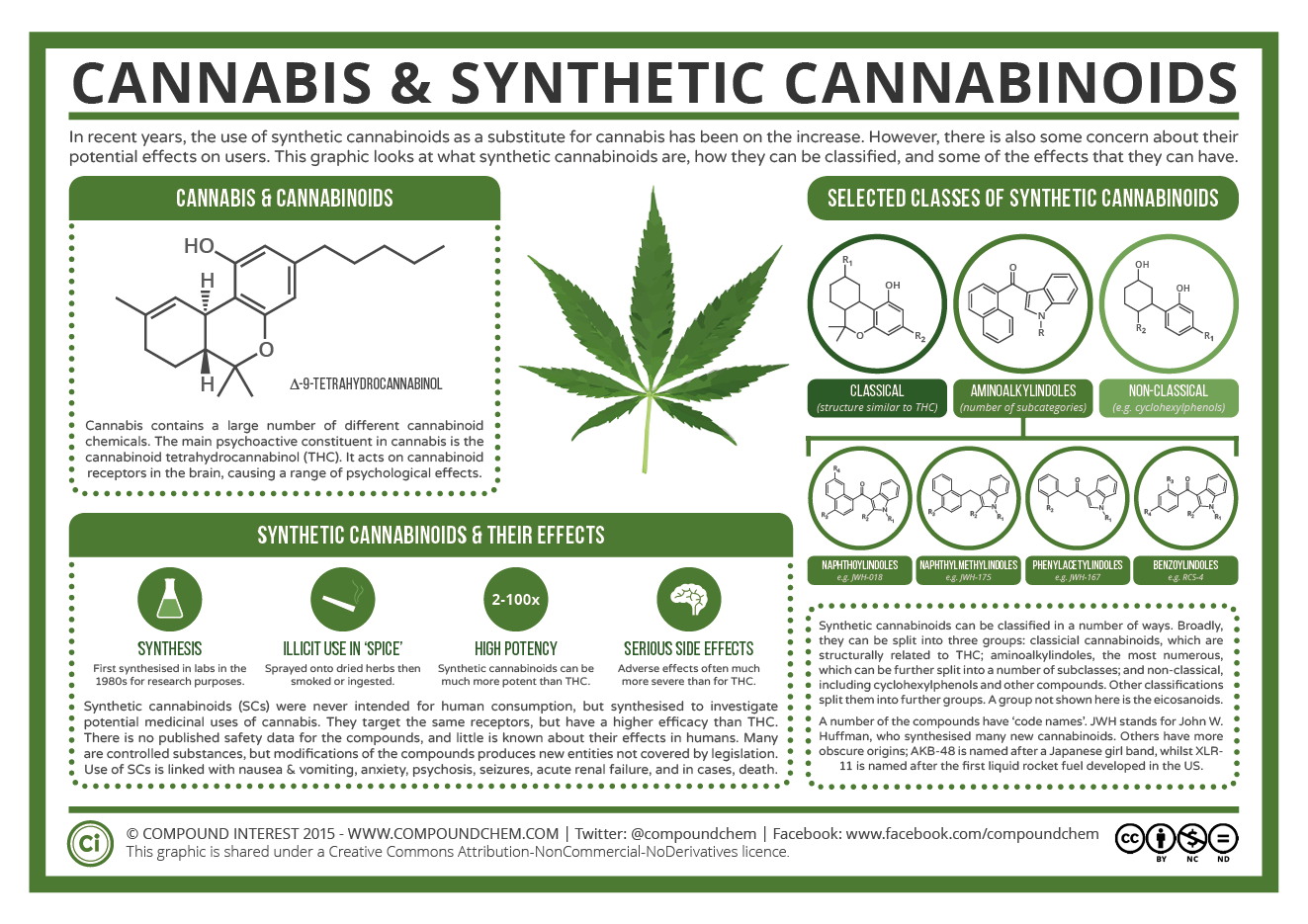
Click to see full-sized infographic.
In recent years, there’s been an increase in the number of media reports on users of synthetic cannabinoids. Commonly referred to by names such as ‘Spice’ or ‘K2′, the most recent reported case involved five UK students being hospitalised after use. But what are the chemicals present in ‘spice’ and similar drugs, and what are the chemical compounds in cannabis that they aim to mimic? That’s what this graphic and post attempt to answer.
May 22, 2015
May 18, 2015
Your diet isn’t working. And neither is yours. And yours, too.
In the Washington Post, Roberto A. Ferdman dishes the dirt on every diet guru’s most brilliant brain-fart … they don’t actually work.
For centuries, men and women have worked tirelessly to fit the physical molds of their time. Diets, which have ranged from the straightforward to the colorful and kind of silly, have produced a wide range of results — and all sorts of followings.
Not long ago, the Atkins diet villainized carbohydrates and convinced millions to avoid starches of any kind. Today, the Paleo diet, which purports to emulate the eating habits and digestive systems of ancient humans who lived for many fewer years than people on average do today, is perhaps the most popular — or at least talked about — dietary fad. Soon there will be another fad that sweeps the dieting conversation. And another one.
The question that seems to hover over all this diet talk is whether any of the myriad weight loss schemes have worked. If one had, shouldn’t it have survived the test of time? And if we’ve gone this long without a diet that has been shown to work — according to science, not simply the sellers of the fad — will one ever emerge that actually does?
The short answer is no, according to Traci Mann, who teaches psychology at the University of Minnesota and has been studying eating habits, self-control and dieting for more than 20 years. Over the course of her research, largely conducted at the University of Minnesota’s Health and Eating Lab, Mann has repeatedly asked these sorts of questions, and always found the same disappointing answers.
April 30, 2015
Organic wines as mere marketing buzz and gimickry
At VinePair, Kathleen Willcox explains why the “organic” label on your wine may be little more than a marketing ploy:
A lot of the buzz and imagery about organics appears to be just that – empty sound bites and gimmicks created by folks eager to cash in on the increasingly lucrative organic market. Where does that leave us? Not in an easy place.
Falling for marketers’ ploys is practically a full-time occupation in America (I’m not the only one who’s bought multiple cartons of fat-free ice cream hoping, this time, to finally find “creamy fat-free vanilla bliss” right?). Consumers’ perception of what organic agriculture is vs. the reality, and the halo of virtue with which it is bequeathed (and conventional agriculture’s implicit pair of devil’s horns) is, arguably, one of the biggest boondoggles in our culture today. More than half of Americans (55%) go organic because they believe it’s healthier. Meanwhile, there is really no evidence to back that assumption up. And even organic farmers use pesticides (sorry random lady at the bar). They just happen to be “natural.”
It’s never been a better time for organic marketers and companies. The market for organic food and beverages worldwide was estimated to be $80.4 billion in 2013 and is set to reach $161.5 billion in 2018, a compound annual growth rate of 15% per year. North America has the biggest market share, and will be responsible for roughly $66.2 billion by 2018.
But in the rush to get organic products out the door (and fulfill the public’s desire for healthier, more environmentally responsible products), some producers are often doing little more than following the letter of the USDA law to earn the “organic” label, consequences to the environment and our overall health be damned. In fact, from what producers and studies revealed, it may actually be worse for the environment and your body to buy organic wine from a large manufacturer instead of buying wine produced from grapes on a smaller vineyard sprayed judiciously with synthetic pesticides by a hands-on farmer.
April 21, 2015
The statistical anomalies of sex
As the old saying has it, “everyone lies about sex“:
Straight men have had twice as many sexual partners, on average, as straight women. Sounds plausible, seeing that men supposedly think about sex every seven seconds. Except that it’s mathematically impossible: in a closed population with as many men as women (which roughly there are) the averages should match up. Someone is being dishonest, but who? And why? These questions, along with many others, are explored in Sex by numbers, a new book by David Spiegelhalter, Winton Professor for the Public Understanding of Risk at the University of Cambridge.
“Sex is a great topic,” says Spiegelhalter. “There’s lots of it going on, but we don’t know what goes on or how much of it, because most of the time it goes on behind closed doors. It’s a really difficult topic to investigate scientifically, and a real challenge for statistics.” Spiegelhalter’s aim is to get people interested in a critical approach to the numbers they hear about in the news and give them the tools to figure out if they can be believed. “It’s really a book about statistics, using sex as an example.”
Statistics about sex are not all equally good. Some, like the number of births in a given year, are cast-iron facts, but others are much harder to come by. The number of sexual partners is a good example. The mismatch above comes from the third The National Survey of Sexual Attitudes and Lifestyles (Natsal), conducted between 2010 and 2012, in which men reported having had 14 sexual partners, on average, and women 7. Studies have suggested that women give lower numbers when they fear the survey isn’t entirely confidential, something that doesn’t seem to affect men (contrary to my expectation, it doesn’t induce them to exaggerate). So that’s one possible explanation for the mismatch: sadly, women still need to fear social stigma.
But there are other explanations too. One is that men (more than women) may have some of their sexual experience with sex workers. These aren’t included in the surveys, so their experiences are missing from the female tally. Another is that there are different attitudes as to what counts as a sexual partner. If a woman feels she’s been coerced by a man, for example, she may not want to count him.
April 19, 2015
The latest “breakthrough” in helping schizophrenics take their medicine
Scott Alexander recently attended a local psychiatry conference, with some essential themes being emphasized:
This conference consisted of a series of talks about all the most important issues of the day, like ‘The Menace Of Psychologists Being Allowed To Prescribe Medication’, ‘How To Be An Advocate For Important Issues Affecting Your Patients Such As The Possibility That Psychologists Might Be Allowed To Prescribe Them Medication’, and ‘Protecting Members Of Disadvantaged Communities From Psychologists Prescribing Them Medication’.
As somebody who’s noticed that the average waiting list for a desperately ill person to see a psychiatrist is approaching the twelve month mark in some places, I was pretty okay with psychologists prescribing medication. The scare stories about how psychologists might prescribe medications unsafely didn’t have much effect on me, since I continue to believe that putting antidepressants in a vending machine would be a more safety-conscious system than what we have now (a vending machine would at least limit antidepressants to people who have $1.25 in change; the average primary care doctor is nowhere near that selective). Annnnnyway, this made me kind of uncomfortable at the conference and I Struck A Courageous Blow Against The Cartelization Of Medicine by sneaking out without putting my name on their mailing list.
But before I did, I managed to take some notes about what’s going on in the wider psychiatric world, including:
– The newest breakthrough in ensuring schizophrenic people take their medication (a hard problem!) is bundling the pills with an ingestable computer chip that transmits data from the patient’s stomach. It’s a bold plan, somewhat complicated by the fact that one of the most common symptoms of schizophrenia is the paranoid fear that somebody has implanted a chip in your body to monitor you. Can you imagine being a schizophrenic guy who has to explain to your new doctor that your old doctor put computer chips in your pills to monitor you? Yikes. If they go through with this, I hope they publish the results in the form of a sequel to The Three Christs of Ypsilanti.
– The same team is working on a smartphone app to detect schizophrenic relapses. The system uses GPS to monitor location, accelerometer to detect movements, and microphone to check tone of voice and speaking pattern, then throws it into a machine learning system that tries to differentiate psychotic from normal behavior (for example, psychotic people might speak faster, or rock back and forth a lot). Again, interesting idea. But again, one of the most common paranoid schizophrenic delusions is that their electronic devices are monitoring everything they do. If you make every one of a psychotic person’s delusions come true, such that they no longer have any beliefs that do not correspond to reality, does that technically mean you’ve cured them? I don’t know, but I’m glad we have people investigating this important issue.


