As reported last year, Australian band Men At Work launched an appeal against a judgement requiring them to pay 5% of the royalties on their song “Down Under”. The appeal was dismissed:
Australia’s Federal Court upheld the decision which stated part of the song’s melody came from the tune Kookaburra Sits in the Old Gum Tree.
Record label EMI argued the writers did not plagiarise because the inclusion of two bars from the tune was a tribute.
The music company has also been ordered to pay costs.
The latest decision clears the way for Larrikin Music, the copyright owners for Kookaburra Sits in the Old Gum Tree, to claim millions of dollars in unpaid royalties from Down Under writers Colin Hay and Ron Strykert.
The original judgement was clearly insane: it assessed the damages at up to 60% of the profits earned by the band on that song (for two bars of a three-minute song). The revised judgement was much more proportional: 5%.
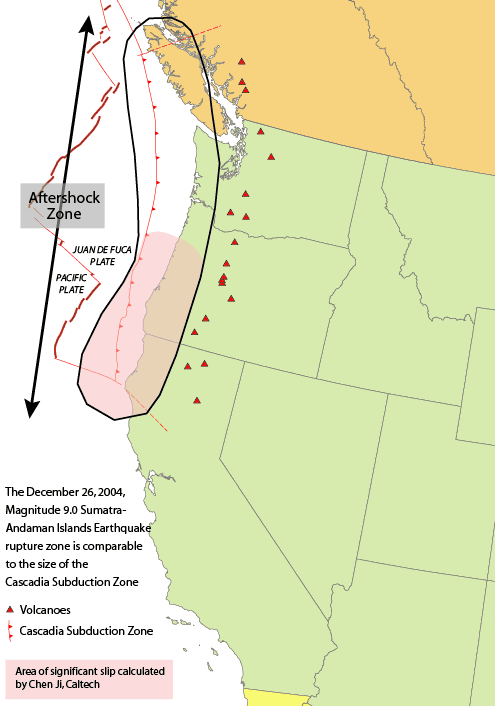
According to an article in The Economist, the well-known San Andreas fault in California is not the most likely to cause an earthquake of the magnitude of last week’s quake in Japan. The most likely source is the Cascadia subduction zone:
The most likely megaquake on the West Coast would be much further north — in fact, 50 miles off the coast between Cape Mendocino in northern California and Vancouver Island in southern British Columbia. This 680-mile strip of seabed is home to the Cascadia subduction zone, where oceanic crust known as the Juan de Fuca plate is forced under the ancient North American plate that forms the continent. For much of its length, the two sides of this huge subduction zone are locked together, accumulating stresses that are capable of triggering megaquakes in excess of magnitude 9.0 when they eventually slip. As such, Cascadia is more than a match for anything off the coast of Japan.
What makes Cascadia such a monster is not just its length, but also the shallowness of the angle with which the encroaching tectonic plate dives under the continental mass. The descending plate has to travel 40 miles down the incline before it softens enough from the Earth’s internal heat to slide without accumulating further frictional stresses. Could the fault unzip from end to end and trigger a megaquake — along with the mother of all tsunamis? You bet. By one account, it has done so at least seven times over the past 3,500 years. Another study suggests there have been around 20 such events over the past 10,000 years. Whatever, the “return time” would seem to be within 200 to 600 years.
And the last time Cascadia let go? Just 311 years ago.
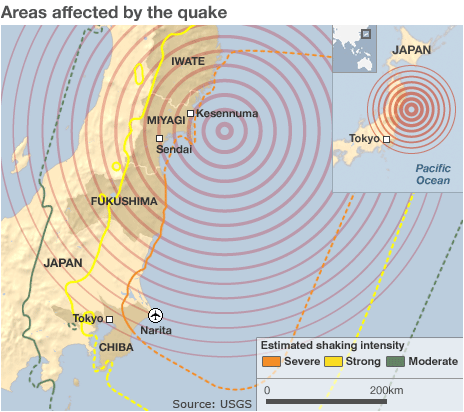
The earthquake by itself was one of the biggest ever recorded, and then the tsunami compounded the quake damage and will make relief and rescue efforts that much harder. Kevin Voigt has more:
The powerful earthquake that unleashed a devastating tsunami Friday appears to have moved the main island of Japan by 8 feet (2.4 meters) and shifted the Earth on its axis.
“At this point, we know that one GPS station moved (8 feet), and we have seen a map from GSI (Geospatial Information Authority) in Japan showing the pattern of shift over a large area is consistent with about that much shift of the land mass,” said Kenneth Hudnut, a geophysicist with the U.S. Geological Survey (USGS).
Reports from the National Institute of Geophysics and Volcanology in Italy estimated the 8.9-magnitude quake shifted the planet on its axis by nearly 4 inches (10 centimeters).
The temblor, which struck Friday afternoon near the east coast of Japan, killed hundreds of people, caused the formation of 30-foot walls of water that swept across rice fields, engulfed entire towns, dragged houses onto highways, and tossed cars and boats like toys. Some waves reached six miles (10 kilometers) inland in Miyagi Prefecture on Japan’s east coast.
An explosion at an earthquake-struck nuclear plant was not caused by damage to the nuclear reactor but by a pumping system that failed as crews tried to bring the reactor’s temperature down, Chief Cabinet Secretary Yukio Edano said Saturday.
Workers at the Fukushima Daiichi plant have begun flooding the reactor containment structure with sea water to bring the reactor’s temperature down to safe levels, he said. The effort is expected to take two days.
Radiation levels have fallen since the explosion and there is no immediate danger, Edano said. But authorities were nevertheless expanding the evacuation to include a radius of 20 kilometers (about 12.5 miles) around the plant. The evacuation previously reached out to 10 kilometers.
The largest earthquake since records began hit northern Japan at about quarter to three local time, just as the rush hour was about to start. BBC News has ongoing live coverage.
The tremor, measured at 8.9 by the US Geological Survey, hit at 1446 local time (0546 GMT) at a depth of about 24km.
A tsunami warning was extended across the Pacific to North and South America.
The Red Cross in Geneva warned that the tsunami waves could be higher than some Pacific islands, Reuters news agency said.
Coastal areas in the Philippines, Hawaii and other Pacific islands were evacuated ahead of the tsunami’s expected arrival.
New Zealand later downgraded its alert to a marine threat, meaning strong and unusual currents were expected.
Comments Off on Massive earthquake in northern Japan
I had been labouring under the impression that Australia had been freed from the colonial yoke in 1931, but I was mistaken:
TWENTY-FIVE years ago today, Australia became independent.
You might think this statement absurd. Surely Australia has been independent for a lot longer than that? Let me provide a lawyer’s answer: yes and no. Yes, Australia as a nation became independent at some unknown date after 1931. By 1931 it had the power to exercise independence but chose not to do so for some time. Arguably, having the capacity to exercise independence is enough to be classified as independent, although the parents of 20-something children who show no inclination to leave home may beg to differ.
The Australian states, however, did not gain their independence from Britain at that time. Bizarrely, they remained colonial dependencies of the British crown, despite being constituent parts of an independent nation. This meant state governors were appointed by the Queen on the advice of British ministers and that it was the Queen of the United Kingdom (not the Queen of Australia) who gave royal assent to state bills. When an Australian governor-general once complained to the British government about this anomaly, the response of British diplomats was that it was better to “let sleeping anomalies lie”.
H/T to Roger Henry for the link.
Comments Off on Happy 25th anniversary to independent Australia
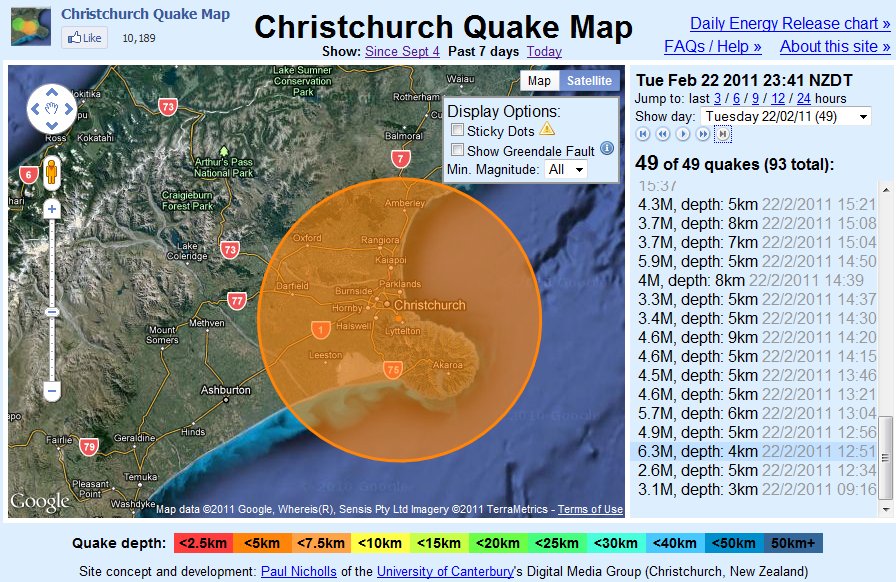
This quake has inflicted severe damage on downtown Christchurch, with 65 reported dead as of this morning, and the death toll almost certain to rise. The Wall Street Journal is running constant updates to this article as further news becomes available. TVNZ is also running a live feed.
Australia has offered whatever aid they can provide:
Australia’s Prime Minister Julia Gillard has told a press conference that Australia will give New Zealand whatever it needs to deal with the aftermath of the earthquake. She says she told her New Zealand counterpart, John Key, “anything you want that we’ve got we will get it to you.”
Comments Off on New Zealand struck by major earthquake