
The pop-culture image of elephants in battle is an awe-inspiring one: massive animals smashing forward through infantry, while men on elephant-back rain missiles down on the hapless enemy. And for once I can surprise you by saying: this isn’t an entirely inaccurate picture. But, as always, we’re also going to introduce some complications into this picture.
Elephants are – all on their own – dangerous animals. Elephants account for several hundred fatalities per year in India even today and even captured elephants are never quite as domesticated as, say, dogs or horses. Whereas a horse is mostly a conveyance in battle (although medieval European knights greatly valued the combativeness of certain breeds of destrier warhorses), a war elephant is a combatant in his own right. When enraged, elephants will gore with tusks and crush with feet, along with using their trunks as weapons to smash, throw or even rip opponents apart (by pinning with the feet). Against other elephants, they will generally lock tusks and attempt to topple their opponent over, with the winner of the contest fatally goring the loser in the exposed belly (Polybius actually describes this behavior, Plb. 5.84.3-4). Dumbo, it turns out, can do some serious damage if prompted.
Elephants were selected for combativeness, which typically meant that the ideal war elephant was an adult male, around 40 years of age (we’ll come back to that). Male elephants enter a state called “musth” once a year, where they show heightened aggressiveness and increases interest in mating. Trautmann (2015) notes a combination of diet, straight up intoxication and training used by war elephant handlers to induce musth in war elephants about to go into battle, because that aggression was prized (given that the signs of musth are observable from the outside, it seems likely to me that these methods worked).
(Note: In the ancient Mediterranean, female elephants seem to have also been used, but it is unclear how often. Cassius Dio (Dio 10.6.48) seems to think some of Pyrrhus’s elephants were female, and my elephant plate shows a mother elephant with her cub, apparently on campaign. It is possible that the difficulty of getting large numbers of elephants outside of India caused the use of female elephants in battle; it’s also possible that our sources and artists – far less familiar with the animals than Indian sources – are themselves confused.)
Thus, whereas I have stressed before that horses are not battering rams, in some sense a good war elephant is. Indeed, sometimes in a very literal sense – as Trautmann notes, “tearing down fortifications” was one of the key functions of Indian war elephants, spelled out in contemporary (to the war elephants) military literature there. A mature Asian elephant male is around 2.75m tall, masses around 4 tons and is much more sturdily built than any horse. Against poorly prepared infantry, a charge of war elephants could simply shock them out of position a lot of the time – though we will deal with some of the psychological aspects there in a moment.
A word on size: film and video-game portrayals often oversize their elephants – sometimes, like the Mumakil of Lord of the Rings, this is clearly a fantasy creature, but often that distinction isn’t made. As notes, male Asian (Indian) elephants are around 2.75m (9ft) tall; modern African bush elephants are larger (c. 10-13ft) but were not used for war. The African elephant which was trained for war was probably either an extinct North African species or the African forest elephant (c. 8ft tall normally) – in either case, ancient sources are clear that African war elephants were smaller than Asian ones.
Thus realistic war elephants should be about 1.5 times the size of an infantryman at the shoulders (assuming an average male height in the premodern world of around 5’6?), but are often shown to be around twice as tall if not even larger. I think this leads into a somewhat unrealistic assumption of how the creatures might function in battle, for people not familiar with how large actual elephants really are.
The elephant as firing platform is also a staple of the pop-culture depiction – often more strongly emphasized because it is easier to film. This is true to their use, but seems to have always been a secondary role from a tactical standpoint – the elephant itself was always more dangerous than anything someone riding it could carry.
There is a social status issue at play here which we’ll come back to […] The driver of the elephant, called a mahout, seems to have typically been a lower-status individual and is left out of a lot of heroic descriptions of elephant-riding (but not driving) aristocrats (much like Egyptian pharaohs tend to erase their chariot drivers when they recount their great victories). Of course, the mahout is the fellow who actually knows how to control the elephant, and was a highly skilled specialist. The elephant is controlled via iron hooks called ankusa. These are no joke – often with a sharp hook and a spear-like point – because elephants selected for combativeness are, unsurprisingly, hard to control. That said, they were not permanent ear-piercings or anything of the sort – the sort of setup in Lord of the Rings is rather unlike the hooks used.
In terms of the riders, we reach a critical distinction. In western media, war elephants almost always appear with great towers on their backs – often very elaborate towers, like those in Lord of the Rings or the film Alexander (2004). Alexander, at least, has it wrong. The howdah – the rigid seat or tower on an elephant’s back – was not an Indian innovation and doesn’t appear in India until the twelfth century (Trautmann supposes, based on the etymology of howdah (originally an Arabic word) that this may have been carried back into India by Islamic armies). Instead, the tower was a Hellenistic idea (called a thorkion in Greek) which post-dates Alexander (but probably not by much).
This is relevant because while the bowmen riding atop elephants in the armies of Alexander’s successors seem to be lower-status military professionals, in India this is where the military aristocrat fights. […] this is a big distinction, so keep it in mind. It also illustrates neatly how the elephant itself was the primary weapon – the society that used these animals the most never really got around to creating a protected firing position on their back because that just wasn’t very important.
In all cases, elephants needed to be supported by infantry (something Alexander (2004) gets right!) Cavalry typically cannot effectively support elephants for reasons we’ll get to in a moment. The standard deployment position for war elephants was directly in front of an infantry force (heavy or light) – when heavy infantry was used, the gap between the two was generally larger, so that the elephants didn’t foul the infantry’s formation.
Infantry support covers for some of the main weaknesses elephants face, keeping the elephants from being isolated and taken down one by one. It also places an effective exploitation force which can take advantage of the havoc the elephants wreck on opposing forces. The “elephants advancing alone and unsupported” formation from Peter Jackson’s Return of the King, by contrast, allows the elephants to be isolated and annihilated (as they subsequently are in the film).
Bret Devereaux, “Collections: War Elephants, Part I: Battle Pachyderms”, A Collection of Unmitigated Pedantry, 2019-07-26.
March 21, 2023
QotD: The elephant as a weapon of war
March 20, 2023
“The New American Empire lasted, at most, twenty years, if one counts the two falls of Kabul as brackets”
Ed West on the brief — and largely unacknowledged by Americans — high-water mark of the 21st century’s biggest empire:
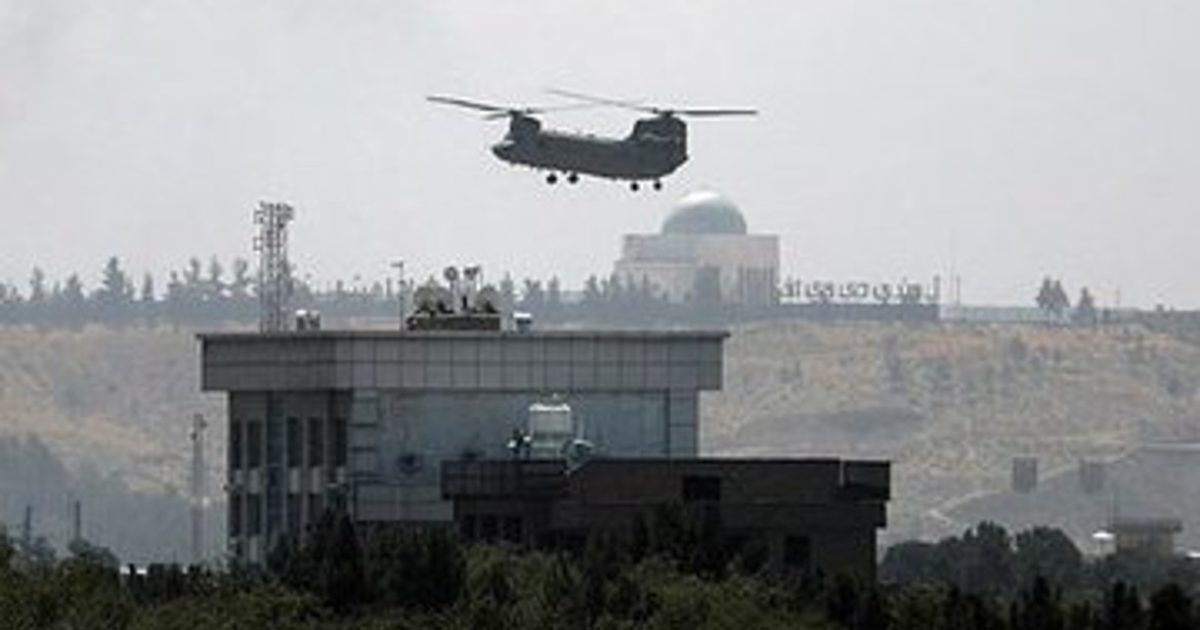
A Boeing CH-47 Chinook transport helicopter appears over the U.S. embassy compound in Kabul, 15 Aug 2021. Image from Twitter via libertyunyielding.com
This century has already seen its fair share of great delusions, society-changing disasters built on wishful thinking: you can loan mortgages to people who obviously can’t pay them back; you can cure pain with an opiate that won’t make people addicted; and now the unstoppable idea of equality of outcomes between races, a project doomed to failure and tragedy.
But none was perhaps so spectacularly disastrous as liberal imperialism. Twenty years ago, George W Bush sent the most powerful military the world had ever seen into the birthplace of Abraham to overthrow Saddam Hussein, and as Niall Ferguson wrote in the Wall Street Journal at the time: “the greatest empire of the modern times has come into existence without the American people even noticing”.
The New American Empire lasted, at most, twenty years, if one counts the two falls of Kabul as brackets. This was despite enormous technological supremacy, and genuine goodwill and benevolence among many of the state-builders.
The United States was “born liberal”, as historian Louis Hartz said, even if the crime wave of the late 20th century made that a dirty word, and the “New American Empire” would spread the benefits of liberalism to grateful beneficiaries around the world.
Yet what is so striking about the imperialists of the 21st century, compared to their forebears in the 19th, was just how little interest they seemed to show in the subject people. Their naivety about human nature, and their utopian belief that people around the world just wanted “freedom”, chimed with a lack of curiosity about humanity.
To think that people around the world might not be the same, that they might not want “freedom” nor have the social structure or culture that suited democracy, might be to venture into dangerous territory. To suggest that Iraq was incapable of democracy was insulting to Iraqis, since as the US president said ahead of the war: “There was a time when many said that the cultures of Japan and Germany were incapable of sustaining democratic values. Well, they were wrong. Some say the same of Iraq today. They are mistaken.”
Yet the defeated nations in 1945 had very old, well-established institutions and very strong national identities, something Iraq did not. The latter was extremely clannish, something no one seemed to consider. Sovereignty and strong institutions take generations to build, and cannot just be imposed by foreigners working on abstract principles like “democracy”.
Bush was not alone. That same year, John McCain had said: “There is not a history of clashes that are violent between Sunnis and Shias, so I think they can probably get along”. And on March 1, 2003, two weeks before the war started, Bill Kristol, editor of the Weekly Standard, had dismissed warnings about sectarian conflict: “We talk here about Shiites and Sunnis as if they’ve never lived together. Most Arab countries have Shiites and Sunnis, and a lot of them live perfectly well together.” On top of that, “Very few wars in American history were prepared better or more thoroughly than this one by this president.” He was totally wrong, while in contrast the American Conservative‘s pessimistic warnings about Iraq’s social fabric proved correct.
When 1 Ship Saved 30 others – The Sacrifice of Jervis Bay
Historigraph
Published 25 Nov 2022On the morning of November 5th 1940, the British merchant convoy HX84 was spotted and attacked by a German pocket battleship. Faced with the destruction of 37 merchant ships and a heavy blow against Britain’s survival, it fell to HMS Jervis Bay, the convoy’s only escort, to charge the enemy ship head on and at all costs buy some time for the merchant ships to escape.
(more…)
March 19, 2023
The Japanese Invade India! – WW2 – Week 238 – March 18, 1944
World War Two
Published 18 Mar 2023Operation U-Go, Renya Mutaguchi’s invasion of India, is in full swing this week, as his men aim at Imphal and Kohima; three Soviets Fronts batter their way through the Axis positions all over Ukraine; and there is a huge Allied bombing campaign at Cassino in Italy, which mistakenly kills a lot of Allied soldiers. That’s one busy week.
(more…)
Inside An M4 Sherman Tank With Historian James Holland
History Hit
Published 21 Nov 2022‘Inside An M4 Sherman Tank With Historian James Holland’
In this video, military historian James Holland gets inside the most iconic tank of the Second World War — the ubiquitous US M4 Sherman Tank.
With over 50,000 having produced between 1942 and 1945, the Sherman was the most widely used medium tank by the United States and Western Allies in World War II.
Easily produced, maintained and equipped with a 75mm gun as well as a single hatch-mounted .50 caliber machine gun (plus two lighter .30 cals positioned in the turret and forward hull), the Sherman proved extremely effective against soft targets. It still lacked the range and firepower of the German Panther and Tiger tanks, but its speed, manoeuvrability and fast rate of fire made it ideal wartime workhorse.
More recently, the M4 Sherman has risen to stardom with the release of Hollywood blockbuster Fury (2014), starring Brad Pitt and Shia LaBeouf.
(more…)
March 18, 2023
The US Adopts A Maxim: The Colt Model 1904
Forgotten Weapons
Published 9 Nov 2022The US Army spent nearly 16 years languidly testing the Maxim gun, but was never willing to actually make a decision until a final trial in 1903 finally settled the matter. The Maxim was deemed the best available machine gun and a contract was signed with Vickers, Sons, & Maxim to purchase 50 (later increased to 90). Eventually a total of 287 were procured; 90 from VSM and a further 197 made by Colt in the US. The first British guns were chambered for .30-03, with the Colts all made for the later .30-06 (and the VSM guns updated to that standard).
The Model 1904 was the heaviest Maxim gun ever made, weighing in at 62 pounds for the gun and another 80 for its tripod. Despite excellent reliability and durability, it was so heavy and unwieldy that it was pretty universally hated by American soldiers. The final order for 1904 Maxims was placed in 1908 and just the following year the M1909 Benet Mercie light Hotchkiss pattern was was adopted. By the time World War One arrived, half the Maxims had already been relegated to long-term storage. They were pulled out of the warehouses for training troops prior to their deployment to Europe, but they never saw any more significant military use.
(more…)
March 17, 2023
Ukrainian, Yugoslav and Baltic Nazis? – ϟϟ Foreign Fighters Part 2
World War Two
Published 16 Mar 2023Across Europe, non-Germans are filling the ranks of Heinrich Himmler’s forces. These foreign fighters certainly don’t meet the racial standards of the SS but times are tough and the Reichsführer-SS needs warm bodies. So, does that mean Himmler’s given up on the idea of a Germanic master race? Not at all. And he uses all sorts of twisted esoteric logic to justify his latest moves.
(more…)
March 16, 2023
Field Marshal Slim’s one and only demotion … from lance-corporal back down to private
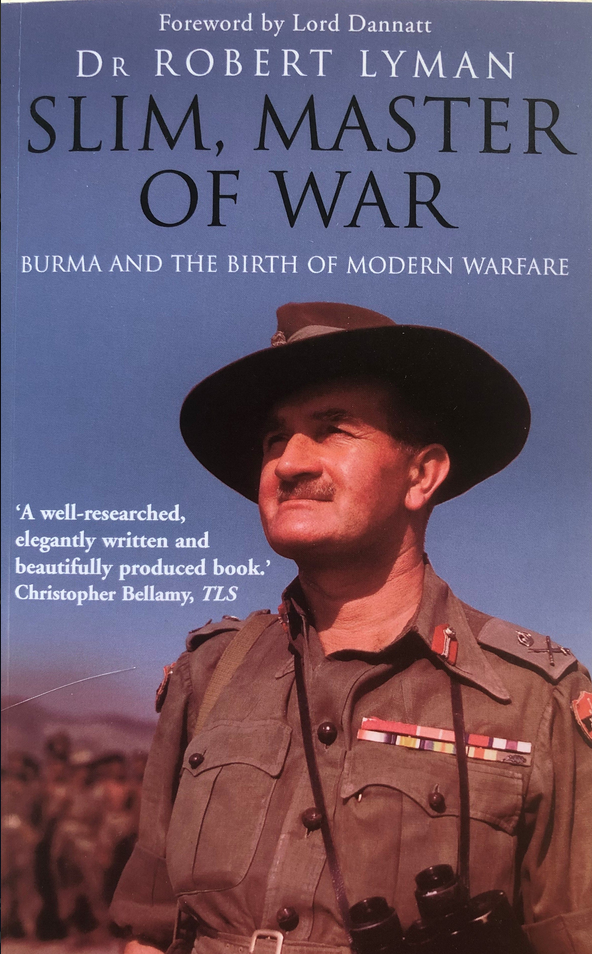
William Slim, arguably the best British general of the Second World War, didn’t have the fastest start to his military career, as recounted in an article by Frank Owen, the editor of the WW2 South East Asia theatre publication Phoenix. This and many others appear in Dr. Robert Lyman’s upcoming book Slim, Master of War:
The General stood on an ammunition box. Facing him in a green amphitheatre of the low hills that ring the Palel Plain, sat or squatted the British officers and sergeants of the 11th East African Division. They were then new to the Burma Front and were moving into the line the next day. The General removed his battered slouch hat, which the Gurkhas wear and which has become the headgear of the 14th Army. “Take a good look at my mug”, he advised. “Not that I consider it to be an oil painting. But I am the Army Commander and you had better be able to recognize me — if only to say “Look out, the old b…. is coming round”.
Lieutenant-General Sir William Slim, KCB, CB, DSO, MC (“Bill”) is 53, burly, grey and going a bit bald. His mug is large and weather beaten, with a broad nose, jutting jaw, and twinkling hazel eyes. He looks like a well-to-do West Country farmer, and could be one. For he has energy and patience and, above all, the man has common sense. However, so far Slim has not farmed. He started life as a junior clerk, once he was a school teacher, and then he became the foreman of a testing gang in a Midland engineering works. For the next 30 years Slim was a soldier.
He began at the bottom of the ladder as a Territorial private. August 4, 1914, found him at Summer camp with his regiment. The Territorials were at once embodied in the Regular Army, and Slim got his first stripe as lance-corporal. A few weeks later he was a private again, the only demotion that this Lieutenant-General has suffered.
It was a sweltering, dusty day and the regiment plodded on its twenty-mile route march down an endless Yorkshire lane. At that time British troops still marched in fours, so that Lance-Corporal Slim, as he swung along by the side of his men, made the fifth in the file, which brought him very close to the roadside. There were cottages there and an old lady stood at the garden gate.
“I can see her yet”, Slim reminisces. “she was a beautiful old lady with her hair neatly parted in the middle and wearing a black print dress. In her hand she held a beautiful jug, and on the top of that jug was a beautiful foam, indicating that it contained beer. She was offering it to the soldier boys.”
The Lance-Corporal took one pace to the side and grasped the jug. As he did, the column was halted with a roar. The Colonel, who rode a horse at its head, had glanced back. Slim was hailed before him and “busted” on the spot. The Colonel bellowed “Had we been in France you would have been shot.” Slim confides, “I thought he was a damned old fool – and he was. I lost my stripe, but he lost his army.” In truth he did, in France in March 1918. Bill soon got his stripe back.
Now in this corner of Palel Plain, one of India’s bloodiest battlefields and the scene of one of his greatest victories, Slim tells the officers and men of the 11th Division, “I have commanded every kind of formation from a section upwards to this army, which happens to be the largest single one in the world.” (At that time, Slim had under his command half a million troops.) “I tell you this simply that you shall realize I know what I am talking about. I understand the British soldier because I have been one, and I have learned about the Japanese soldier because I have been beaten by him. I have been kicked by this enemy in the place where it hurts, and all the way from Rangoon to India where I had to dust-off my pants. Now, gentlemen, we are kicking our Japanese neighbours back to Rangoon.”
Slim commanded the rear guard of the army that retreated from Burma in 1942. He is proud of that. His men marched and fought for a hundred days and nights and across a thousand miles. But this retreat was no Dunkirk. Says Slim “We brought our weapons out with us, and we carried our wounded, too. Dog-tired soldiers, hardly able to put one foot in front of another, would stagger along for hours carrying or holding up a wounded comrade. When at last they reached India over those terrible jungle mountains they did not go back to an island fortress and to their own people where they could rest and refit. The Army of Burma sank down on the frontier of India, dead beat and in rags. But, they fought here all through the downpour of the monsoon, and they saved India until a great new Army – which is this one – could be built up to take the offensive once again. In those days, if anyone had gone to me with a single piece of good news I would have burst out crying. Nobody ever did.”
He tells another story. One day he entered a jungle glade in a tank. In front of him stood a group of soldiers, in their midst the eternal Tommy. Assuming an optimism which he did not feel, Slim jumped out of the tank and approached them. “Gentlemen!” he said (which is the nice way that British generals sometimes address their troops) “Things might be worse!”
“‘Ow could they be worse?” inquired the Tommy.
“Well, it could rain” said Slim, lightly. He adds “And within quarter of an hour it did.”
History of the Royal Navy – Wooden Walls (1600-1805)
Ryan Doyle
Published 3 Mar 2013
(more…)
March 15, 2023
An Aircraft Carrier Without A Deck? | The Remarkable Brodie Landing System
Rex’s Hangar
Published 21 Sept 2022Today we’re taking a look at the remarkable Brodie Launch System. This device could be used on land or aboard ships, and it was designed to provide accessibility for light aircraft in extremely remote locations during WW2.
(more…)
March 14, 2023
Turkey has always been the awkward ally in NATO, but for how much longer?
In Strategika, Zafiris Rossidis examines the shift of Turkish sentiment away from its longstanding role in the NATO alliance and toward a more Russian-friendly and more independent stance in international affairs:
Turkish flag.
Photo by Burak Su via Wikimedia Commons.
A poll conducted in December 2022 by the Turkish company Gezici found that 72.8% of Turkish citizens polled were in favor of good relations with Russia. By comparison, nearly 90% perceive the United States as a hostile country. It also revealed that 24.2% of citizens believe that Russia is hostile, while 62.6% believe that Russia is a friendly country. Similarly, more than 60% of respondents said that Russia contributes positively to the Turkish economy.
Turkey began to distance itself from the United States as early as 2003, when it refused the passage of American troops to Iraq. In 2010, it destroyed the U.S.–Israel–Turkey triangle, breaking up with Israel. In 2011, Turkey implemented a policy in Syria that was hardly in line with U.S. interests. The final distancing took place in 2016, with the July coup, for which Turkey blamed the United States.
Turkey considers itself very important to the United States but declares that Ankara can live without Washington. This concept has become the point of departure for Turkey in its quest to reconstitute the Ottoman Empire. Minister of the Interior Süleyman Soylu declares that the Turkish government will design the new world order with the help of Allah, and Western powers will eat the dust behind almighty Turkey (December 8, 2022).
According to a RAND Corporation volume on Turkey, there are four scenarios for the future of Turkish strategic orientation: 1) Turkey will remain a difficult partner for the United States; 2) Turkey will become democratic and unite with the West; 3) Turkey will be between East and West, but have better relations with powers such as China, Iran, and Russia, than with the U.S. and the EU; and 4) Turkey will completely abandon the West.
From the evidence in the case of the Russian–Ukrainian war, Russia, China, Turkey, and Iran justify the Russian invasion since NATO and the EU have designs on their neighborhood. Above all, they are united by a common hatred for the West. They are frenemies and they know it: on the contrary, the U.S. tends to invest in frenemies as if they were true friends.
The U.S. observed the rapprochement of Turkey and Russia without renouncing the traditional alliance with Turkey, which today has no longer such importance. Turkey was useful when it was an “enemy” of the USSR and the U.S. made far too many concessions for the sake of this useful enmity. In short, there is some inertia in the modification of the principle “the enemy of my enemy is my friend”, as of course “the friend of a friend is my friend”. Turkey’s role in NATO worries the U.S., as Ankara–Moscow relations have acquired some shared strategic characteristics.
?he attraction between the two countries lies in their equally authoritarian governance models and the fact that their strategic culture and operational codes bear similarities: Both countries are revisionist, aggressive, and assertive in their regions; both countries claim to be encircled, which they use as a pretext for their unilateral actions; and both countries have militarized their foreign policy, waging hybrid warfare, resorting to proxy warfare, and blackmailing countries that offer resistance. Russia and Turkey cooperate on natural gas and oil pipelines; Russia has sold weapons such as the S-400 missile system to Turkey; Russia has provided technical assistance in the construction of Turkey’s nuclear plants; the two nations have collaborated in Central Asia (i.e., Azerbaijan); they import and export each other’s commodities; and Turkey has illegally transported Russian fuel to China and Iran, thereby bypassing sanctions on Russia, to mention only a few.
But the big issue for U.S.–Turkey relations against the backdrop of the Russian–Ukrainian war has four strands: First, the issue of the important role Turkey plays in the grain export agreement, which if cancelled will create a food crisis in Africa. Second, Turkey’s blackmailing of the NATO candidacies of Sweden and Finland. Third, the Turkish application to purchase the F-16 and the possible conflict between Congress and the Biden administration over the administration’s request to grant Turkey the license to do so. Finally, Turkey’s non-adoption of NATO sanctions against Russia. The possibility of Erdoğan using a strategy of tensions with Greece (e.g., multiple violations of Greek airspace, aggressiveness in the Aegean, weaponization of immigration, threats of bombing Athens with the new “Tayfun” short-range ballistic missile) to rally the electorate around his party and detach it from any opposition — all recent polls have AKP trailing the opposition — prior to the June election is one explanation for Turkey’s behavior that is being considered by the U.S., which nonetheless is angered that Turkey is the only NATO country that has not adopted the sanctions against Russia.
German Troop Trials “Push-Button” Gewehr 41(W)
Forgotten Weapons
Published 8 Nov 2022When the German army wanted a new semiauto service rifle in 1941, it received submissions from two companies; Walther and Mauser. Walther’s design didn’t strictly meet the criteria set forth, but it was clearly the better rifle and would eventually win the competition. This involved conducting troop trials, and Walther got an initial contract for 5,000 rifles for those trials. That first batch of rifles differed in several ways from the version that was ultimately put into mass production. Most substantially, the first version of the G41(W) had a push-button bolt release on the left side of the stock. After loading two stripper clips, one would push the button to close the bolt. Of course, one could also simply pull the bolt handle back slightly and release to do the same thing — and so the bolt release button was removed to simplify production. In addition, the bolt guide rail on the receiver would be lengthened on production, optics mounting rails were added (although never really used), and the serrations on the spring guide rod were dropped.
(more…)
March 13, 2023
Good “peacetime” generals versus good “wartime” generals
“Shady Maples“, a serving Canadian Army officer, explains why the skills and talents that allow an officer to rise to general rank in peacetime have no direct relationship with how that officer will perform in a shooting war:
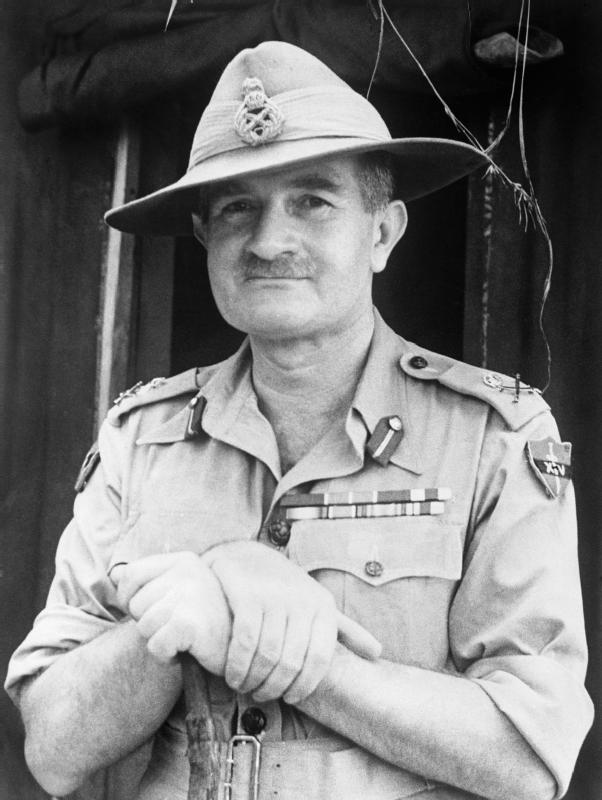
Field Marshal Sir William Slim (1891-1970), during his time as GOC XIVth Army in Burma.
Portrait by No. 9 Army Film & Photographic Unit via Wikimedia Commons.
I am not the first person to make these kinds of observations. Jim Storr has written about peacetime promotion culture in the British Army and Thomas E. Ricks did the same with U.S. Army. Here is an excerpt from Storr:
It appears that many of those whom the British Army promoted in peacetime during the twentieth century were found wanting on the outbreak of war. Promotion to high command in peacetime very much reflects the values of existing senior commanders, themselves largely the products of a peacetime promotion system. To that extent it reflects deeply held values, and has an obvious impact on operational effectiveness in war.
Roughly two-thirds of those who commanded formations in the BEF [British Expeditionary Force] of 1940 were either sacked, retired immediately, or were never given another formation to command in the field.
Ricks describes a similar phenomenon occurring in the U.S. Army during the Second World War. Many senior leaders who had risen during peacetime couldn’t perform under real-world conditions. Under the stern hand of George C. Marshall, then Chief of Staff of the U.S. Army, generals were removed from command at a rate that is unheard of today. Many of those who were fired had glowing records and some went on to redeem their reputations in later commands, which suggests that they had been promoted too soon or too high above their level of competence.
More recently, Russia has been churning through general officers in Ukraine, seemingly desperate to find someone who can achieve Putin’s war aims. If an army systematically promotes its officers above their level of competence in peacetime, then clearly their selection and assessment criteria are not aligned with the actual job requirements.
To illustrate the point, Storr compares careers of Second World War British Field Marshals. The first, Field Marshal John Verreker a.k.a. Lord Gort, was Commander-in-Chief (C.-in-C.) of the BEF during its disastrous efforts in France in 1940.
[Gort] was the epitome of the system: young, highly decorated, charismatic, promoted through and entirely within the system. He was only 51 when appointed CIGS [Chief of Imperial General Staff] … As C.-in-C. of the BEF, he “fussed over details and things of comparatively little consequence” and had a “constant preoccupation with things of small detail”.
After he oversaw the evacuation of British troops from Dunkirk, Gort was removed from command and served out the rest of the war in non-combatant posts. It should be noted that Gort was not a bad soldier. During the First World War, he rose from the rank of captain to acting lieutenant-colonel and in the process earned the Distinguished Service Order (with bar) and the Victoria Cross. It was during the interwar years that Gort ascended from the substantive rank of Major to Field Marshal. Battles may be won with good-enough tactics and a lot of chutzpah, but Gort was unprepared for the complexities of wartime command at the strategic level. He did, however, excel at playing politics.
For contrast, here is Storr’s description of Field Marshal William “Bill” Slim:
[The] 47-year-old Bill Slim was promoted to lieutenant-colonel in 1938, perhaps at the last possible opportunity. Slim had not been to Sandhurst; he had gained his commission “through the back door” and had come from a modest background. The outbreak of the Second World War saw him commanding a brigade in East Africa. Within four years he was commanding the Fourteenth Army in Burma … Slim was obviously not the product of a stable heirarchy in peacetime. His rise to fame came entirely during wartime. He was arguably one of the greatest British generals of the twentieth century. The contrast with Gort could not be more marked.
For his part, Ricks has a takes a wider view of how the post-war U.S. Army made some officers too big to fail:
Korea, Vietnam, and Iraq were all small, ambiguous, increasingly unpopular wars, and in each, success was harder to define than it was in World War II. Firing generals seemed to send a signal to the public that the war was going poorly.
But that is only a partial explanation. Changes in our broader society are also to blame. During the 1950s, the military, like much of the nation, became more “corporate” — less tolerant of the maverick and more likely to favor conformist “organization men”. As a large, bureaucratized national-security establishment developed to wage the Cold War, the nation’s generals also began acting less like stewards of a profession, responsible to the public at large, and more like members of a guild, looking out primarily for their own interests.
It seems like loyalty up became more important than loyalty out.
1949: HMS Implacable‘s Last Voyage | BBC Television Newsreel | Retro Transport | BBC Archive
BBC Archive
Published 19 Nov 2022HMS Implacable, a 149 year-old ship of the line — which survived the Battle of Trafalgar — embarks on her final, solemn voyage.
The figurehead, deck and stern cabin of this captured French ship are to be kept at the National Maritime Museum in Greenwich, but her hulk is to be towed out from Portsmouth dockyard and scuttled.
Originally broadcast 5 December, 1949.
(more…)
March 12, 2023
Zhukov hits the Ground Running – WW2 – Week 237 – March 11, 1944
World War Two
Published 11 Mar 2023The Soviets launch not one, not two, but three offensives in Ukraine this week, designed to destroy the entire southern wing of the German forces. The Japanese counterattack against the Americans on Bougainville finally begins after months of preparations, but there are more Japanese attacks elsewhere that get going: the operation to invade India.
(more…)


