
The Great War
Published on 9 Nov 2017After the turmoil of the past weeks in Petrograd, the Soviets and the Red Guards seize the opportunity and topple the provisional government under Alexander Kerensky. Their first goal is to pull out of the war. The Italians were still in full retreat during the Battle of Caporetto and the British Army was still advancing in Palestine.
November 10, 2017
The Russian October Revolution 1917 I THE GREAT WAR Week 172
Comments Off on The Russian October Revolution 1917 I THE GREAT WAR Week 172
November 4, 2017
November 3, 2017
Battle of Beersheba – Canadian Frustration – Balfour Declaration I THE GREAT WAR Week 171
The Great War
Published on 2 Nov 2017On the Western Front this week, the Canadians under Sir Arthur Currie attempt to advance once more, whilst Haig remains optimistic about an imminent breakthrough. Following Caporetto, the Italian retreat continues, whilst the British Army enjoys success on the Palestine Front, with a little help from mounted ANZAC troops. With Lenin’s return, the revolution looms over the Russian capital, whilst the Balfour Declaration is issued in Britain.
Comments Off on Battle of Beersheba – Canadian Frustration – Balfour Declaration I THE GREAT WAR Week 171
October 27, 2017
QotD: Russian meddling in US politics
In last week’s decidedly un-jocular “news”letter, I wrote about how the hypocrisy of the Left’s newfound outrage at Russia’s meddling in our politics can’t be summarized by saying “Romney was right!” when he said Russia was our biggest geopolitical foe in a debate with Barack Obama. Starting with George Kennan’s Long Telegram [link], conservatives spent the entirety of the Cold War pointing out that the Russians were undermining American life, and we got mocked and ridiculed for it by self-styled sophisticates who thought such concerns were little more than paranoia.
The ridicule didn’t end with the Cold War (when, by the way, the extent and danger of Russian meddling were much greater than they are now). Liberals were so invested in the idea that the political Right made too big a deal about Soviet Communism and that we used our hawkishness as an unfair wedge issue against Democrats that when Mitt Romney said an incandescently true thing about Putin’s Russia, liberals rolled their eyes and then laughed uproariously at Obama’s “the 1980s called” quip. In other words, they were so married to the myth of their moral and intellectual superiority, liberals preferred to stick with the punch-line than even imagine that reality wasn’t on their side.
Jonah Goldberg, “Binders Full of Asininity”, National Review, 2017-10-13.
Comments Off on QotD: Russian meddling in US politics
October 20, 2017
Operation Albion Concludes – Allied Failures In Belgium I THE GREAT WAR Week 169
The Great War
Published on 19 Oct 2017100 years ago this week, Operation Albion comes to a successful end for the Germans, as revolution is on the horizon in Russia. The Allies aren’t faring quite so well on the Western Front, where the weather continues to worsen and the death toll climbs ever higher. Haig believes a breakthrough is imminent and German morale is tested. The stalemate continues, but sooner or later the Battle of Passchendaele must come to an end.
Comments Off on Operation Albion Concludes – Allied Failures In Belgium I THE GREAT WAR Week 169
October 13, 2017
Operation Albion – Passchendaele Drowns In Mud I THE GREAT WAR Week 168
The Great War
Published on 12 Oct 2017The situation for the German Army on the Western Front looks grim, but in the East they have the upper hand and this week begin to put pressure on the Russians in Operation Albion – an amphibious landing operation in the Estonian archipelago. At the same time, the battlefield at Passchendaele is turning into a muddy swamp.
Comments Off on Operation Albion – Passchendaele Drowns In Mud I THE GREAT WAR Week 168
October 9, 2017
Great Northern War – Lies – Extra History
Extra Credits
Published on 7 Oct 2017Could Sweden have won the Great Northern War? Was Charles XII actually assassinated? James answers questions from our Patreon supporters in this special edition of Lies!
Comments Off on Great Northern War – Lies – Extra History
September 27, 2017
Stalin’s Great Purge – Effects on the Red Army 1936-1938
Military History Visualized
Published on 25 Aug 2017The Great Purge had a massive effect on Soviet Society and the Red Army. This video gives various insights in the numbers, effects and other aspects.
Comments Off on Stalin’s Great Purge – Effects on the Red Army 1936-1938
September 26, 2017
To mark the 100th anniversary of the Russian Revolution … sorta #TheDeathOfStalin
Entertainment One UK
Published on 11 Aug 2017In Cinemas Oct 20.
The internal political landscape of 1950’s Soviet Russia takes on darkly comic form in a new film by Emmy award-winning and Oscar-nominated writer/director Armando Iannucci.
In the days following Stalin’s collapse, his core team of ministers tussle for control; some want positive change in the Soviet Union, others have more sinister motives. Their one common trait? They’re all just desperately trying to remain alive.
A film that combines comedy, drama, pathos and political manoeuvring, The Death of Stalin is a Quad and Main Journey production, directed by Armando Iannucci, and produced by Yann Zenou, Kevin Loader, Nicolas Duval Assakovsky, and Laurent Zeitoun. The script is written by Iannucci, David Schneider and Ian Martin, with additional material by Peter Fellows.
#TheDeathOfStalin
www.deathofstalin.co.uk
Comments Off on To mark the 100th anniversary of the Russian Revolution … sorta #TheDeathOfStalin
September 25, 2017
Great Northern War – V: Rise and Fall – Extra History
Extra Credits
Published on 23 Sep 2017Charles XII narrowly escaped the Russian pursuit, with help from the Ottoman Empire. But the weak points in his army had been clearly exposed. Northern Europe united against him – but of course, Charles XII responded by launching a fateful counter-offensive into Norway.
Comments Off on Great Northern War – V: Rise and Fall – Extra History
September 24, 2017
Brilliant job on the Kalashnikov statue, Tovarisch, but what’s that weapon right there?
The Guardian reports on some emergency fix-ups required to a brand new statue honouring Mikhail Kalashnikov:
Workers have removed part of a new monument to Mikhail Kalashnikov, the inventor of the Soviet Union’s AK-47 assault rifle, after eagle-eyed Russians noticed that it mistakenly depicted a German second world war weapon.
The monument to the creator of one of Russia’s best known export brands was unveiled in central Moscow three days ago to much fanfare.
A metal bas-relief behind a statue of Kalashnikov depicts the AK-47 and other weapons all supposedly designed by the engineer, who died in 2013.
But embarrassed sculptor Salavat Shcherbakov had to admit that among them was the Sturmgewehr 44 (StG 44) assault rifle used by Nazi troops.
“We will rectify this,” Shcherbakov said in comments broadcast by state-run Rossiya 24 channel. “It looks like this [mistake] sneaked in from the internet.”
By Friday evening a square hole gaped where the German rifle had been depicted in the bas-relief.
Kalashnikov’s weapon, created in 1947, does have a striking resemblance to German arms designer Hugo Schmeisser’s StG 44 rifle, created in 1942, although they have major design differences.
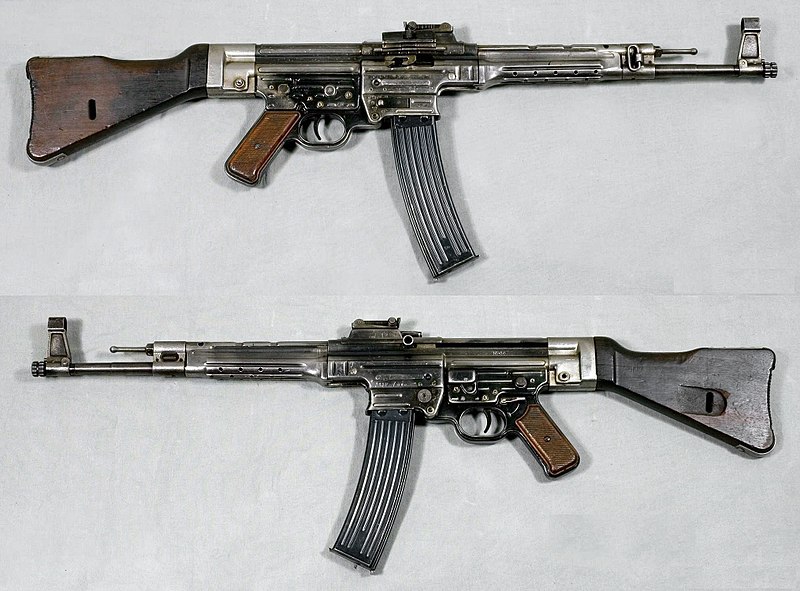
MP44 (Sturmgewehr 44), Germany. Caliber 8x33mm Kurz- From the collections of Armémuseum (Swedish Army Museum), Stockholm. (via Wikimedia)
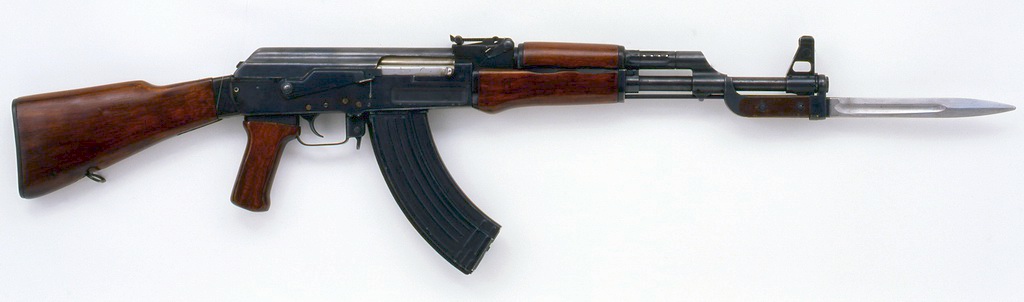
Kalashnikov АК-47 with bayonet attached (via Wikimedia)
Comments Off on Brilliant job on the Kalashnikov statue, Tovarisch, but what’s that weapon right there?
September 22, 2017
British Advance At Passchendaele I THE GREAT WAR Week 165
The Great War
Published on 21 Sep 2017Herbert Plumer had a cunning plan to crack the German defences at Passchendaele, he would “bite and hold” only small pieces of the German Hindenburg Line instead of aiming for the big breakthrough. It was still a costly tactic but it achieved results and the Germans under Ruprecht, Crown Prince of Bavaria, were worried.
Comments Off on British Advance At Passchendaele I THE GREAT WAR Week 165
September 18, 2017
Great Northern War – IV: Clash of Kings – Extra History
Extra Credits
Published on 16 Sep 2017Charles XII had gone to the Ukraine hoping for supplies and reinforcements, especially from the cossacks led by Ivan Mazeppa. But Peter the Great was hot on his trail, and had no intention of letting him off that easy.
Comments Off on Great Northern War – IV: Clash of Kings – Extra History
September 17, 2017
Mercenaries – War of the Pacific – Russian WW1 Remembrance I OUT OF THE TRENCHES
The Great War
Published on 16 Sep 2017It’s time for another episodes from the chair of wisdom, this week we talk about mercenaries in the war, the influence of the War of the Pacific and Russian WW1 war graves.
Comments Off on Mercenaries – War of the Pacific – Russian WW1 Remembrance I OUT OF THE TRENCHES
September 15, 2017
Attempted Military Coup in Russia – The Kornilov Affair I THE GREAT WAR Week 164
Published on 14 Sep 2017
The situation in Russia further escalates as Lavr Kornilov attempts to gain complete power with a military coup. The result is a disaster for him and thousands of armed Bolsheviks in the streets of Petrograd.
Comments Off on Attempted Military Coup in Russia – The Kornilov Affair I THE GREAT WAR Week 164


