We have discussed potlatch a lot so far but obfuscated exchange is one of my two major research interests, and it’s what first got me really interested in Ashley’s work.1 At some level the fundamental nature of the interaction is that rich men are paying for models to hang out with them, yet that rarely happens directly. Instead there are multiple ways in which the nature of this transaction is obfuscated. And note, it’s not because anything about bottle service is illegal, because it ain’t. Unlike prostitution, there are no laws against paying for arm candy, it’s just that it’s seen as extremely tacky and kind of a desperate move.
At this point, it’s worth digressing from Ashley’s work and laying out my own theory of obfuscated exchange before showing how Ashley applies the model to her data.2 So the starting point is to recognize that there are certain goods and services that may be more or less OK if you get them for free, but are gross, shameful, and/or illegal if you pay for them. For instance, payment transforms casual sex into prostitution and constituent service into bribery.
Now suppose you’re someone who has money, and who really wants to have no-strings sex with someone who isn’t really attracted to you, or to get a government service that the legislator or bureaucrat thinks you’re not entitled to. One way to handle this is you just do it anyway and break the taboo: you hire the prostitute or bribe the public official. Another way is you don’t do it: you think something like “I would gladly pay $200 for sex or $10,000 to get this zoning exemption, but that would be wrong and so I’m not doing it”. But what I find really interesting is when you find a way to have your cake and eat it too by buying the non-market good while obfuscating that you paid for it, hence obfuscated exchange.
In my 2014 Sociological Theory paper, I outline three forms of obfuscation:
- Gift exchange — I give you a gift and at some point in the future you give me a gift. There is a continuous tension between whether the gifts are traded for each other or are both expressions of a relationship.3 This ambiguity effectively allows gift exchange to trade goods that it would be immoral to directly exchange for one another. The classic example is that the difference between a sugar baby/sugar daddy relationship and a prostitute/john relationship is gift exchange vs cash on the barrelhead.
- Bundling — You and I engage in some type of innocuous commercial transaction, but we also have a relationship involving things that ought not to be sold. The classic example is a boss having sex with his worker, or a lawyer with his client.4 Is this just that two people with a business relationship also find one another irresistible, or is it quid pro quo sexual harassment? Interpreted as bundling, it is the latter, and there are some cases where it’s obviously little more than money laundering (as with the Congressman who went to prison for selling his house to a defense contractor, who immediately resold the house at a substantial loss).
- Brokerage — I hire someone to help me acquire something, and they pay the person I need it from, who then gives it to me. A majority of settlements under the Foreign Corrupt Practices Act look like this: AmericaCo is doing business in Corruptistan and hires LocalFixer who in turn just bribes PublicOfficial.
After that first paper, I introduced a fourth type, “pawning”, which is when an explicit debt is forgiven in exchange for a non-market good. This is how the mob gets gambling addicts to serve as co-conspirators in embezzlement and robbery. However Ashley didn’t find any pawning to speak of in her ethnography.
So back to Ashley, one of the things I love about her ethnography is you see three different obfuscation structures all at once. Again, at a fundamental level, what is happening is rich guys are paying for models to hang out with them, but not explicitly. Let’s start with the rich guys and work towards the models. What it says on the $30,000 credit card receipt is “champagne” or “vodka”. In theory the arm candy is incidental, even though that’s why the guys aren’t spending much less at BevMo and getting drunk in their hotel room. So the arm candy is bundled with the alcohol.
We might then think, OK, so the club provides the models, and in a sense they do, but the club doesn’t do this directly. Instead it pays a commission to night club promoters who arrange that the models be there in exchange for a commission on the table’s check. So the promoters act as brokers between the club and the models.
Now we might be thinking, OK, so the promoter gets a cut of the check and out of that he pays the models. Nope. As a rule promoters don’t pay models, and when they do it is widely seen as a death spiral desperation move. Rather, promoters recruit models through gift exchange. For reasons discussed in Ashley’s first book, models are constantly short on cash, and promoters will hang out in fashion districts looking for models who they can offer favors to and befriend. For instance, she talks about promoters who will drive SUVs around Manhattan offering models rides. A common pattern is to meet a group of models, identify the most popular girl in the clique, seduce her, and then get her to constantly mobilize her girlfriends to help you get paid by staying out until 4am, even though this means that they are so tired and hungover the next day that they miss their own auditions and photoshoots.
There is more than a little resemblance between the promoters and pimps. Aside from the vast moral difference that these guys don’t commit felonies and aren’t hyper-misogynists, they all come across as like Andrew Tate with their peacocking, their hustle mindsets, and the basic fact that their livelihood is based on leveraging their own charm into mobilizing pretty girls into making money for them from other men.
John Psmith and Gabriel Rossman, “GUEST JOINT REVIEW: Very Important People, by Ashley Mears”, Mr. and Mrs. Psmith’s Bookshelf, 2024-03-04.
- My other major research interest is diffusion, or how ideas and behaviors spread. This is the subject of my 2012 pop music radio book and my 2021 PNAS. The upshot of my take on diffusion is that you will be badly misled if you only pay attention to social contagion processes like word-of-mouth as it’s critical to consider the constant hazard (eg, advertising, government mandates, or the legitimacy that comes with a mature product category).
Rossman, Gabriel. 2012. Climbing the Charts. Princeton, NJ: Princeton University Press. https://www.google.com/books/edition/Climbing_the_Charts/E_37GZumy50C?hl=en
Rossman, Gabriel, and Jacob C. Fisher. 2021. “Network Hubs Cease to Be Influential in the Presence of Low Levels of Advertising”. Proceedings of the National Academy of Sciences 118(7). https://www.pnas.org/doi/10.1073/pnas.2013391118
- Rossman, Gabriel. 2014. “Obfuscatory Relational Work and Disreputable Exchange”. Sociological Theory 32(1):43–63. https://www.chapman.edu/research/institutes-and-centers/economic-science-institute/_files/ifree-papers-and-photos/obfuscatory-relational-work-and-disreputable-exchange.pdf
Rossman, Gabriel, Michael Munger, Alan Fiske, and Alex Tabarrok. 2016. “The Exchanges We Hide”. Cato Unbound. https://www.cato-unbound.org/issues/june-2016/exchanges-we-hide/
Schilke, Oliver, and Gabriel Rossman. 2018. “It’s Only Wrong If It’s Transactional: Moral Perceptions of Obfuscated Exchange”. American Sociological Review 83:1079–1107. https://www.oliverschilke.com/fileadmin/pdf/Schilke__Rossman._It_s_Only_Wrong_If_It_s_Transactional_-_Moral_Perceptions_of_Obfuscated_Exchange.pdf
Schilke, Oliver, and Gabriel Rossman. forthcoming. “Honor among crooks: the role of trust in obfuscated disreputable exchange”. American Sociological Review https://osf.io/6b793/
- Bourdieu, Pierre. 2000. Pascalian Meditations. Stanford, CA: Stanford University Press. especially “Twofold Truth of the Gift”
- Zelizer, Viviana A. 2005. The Purchase of Intimacy. Princeton, NJ: Princeton University Press.
July 19, 2026
QotD: Obfuscated exchange
July 18, 2026
Jevons and Baumol, and why they matter now
On the social media site formerly known as Twitter, Matt Ridley talks about the ideas of William Stanley Jevons and William Jack Baumol, whose ideas have become far more important over the last few decades:
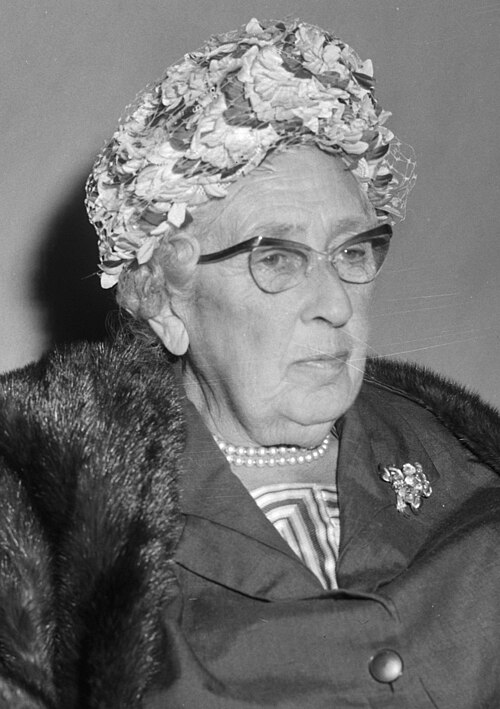
English mystery novelist Agatha Christie (1890-1976) at Schiphol Airport in Amsterdam on 17 September, 1964.
Photo by Joop van Bilsen for Anefo via Wikimedia Commons.
Agatha Christie once remarked that she had never expected to grow rich enough to own a car or poor enough not to have servants.
The reason this strikes us as bizarre today boils down to two names that you hear invoked a lot in the tech industry: Jevons and Baumol. One is shorthand for the expansion of products or professions with rising efficiency, the other for the shrinkage of products or professions with stagnant efficiency.
There’s a pleasing chronological symmetry between these twin ideas: William Stanley Jevons coined the Jevons paradox in 1865; William Jack Baumol described Baumol’s cost disease exactly a century later in 1965.
… For every industry that experiences efficiency gains, there’s another that does not. And this latter industry inevitably becomes less affordable. Baumol’s first example was string quartets: violinists are no more productive but you have to pay them more to prevent them running off to become software engineers. The productive industries drive up the labour costs in the rest of the economy.
Marc Andreessen jokes that if a hole appears in the wall of your house in California these days it is probably cheaper to glue a flat-screen television over it than hire a builder to repair it: a Jevons-deflated cost beats a Baumol-inflated one.
The big question of our age is can AI drag Baumol-shaded industries back into the sunlight of Jevons? Can it make things like healthcare, education, or government switch from rising costs to falling costs?
I fear not in the case of government because of a bureaucratic version of the Jevons and Baumol effects. As Cyril Northcote Parkinson put it in an article in the Economist in 1955: “Politicians and taxpayers have assumed (with occasional phases of doubt) that a rising total in the number of civil servants must reflect a growing volume of work to be done. Cynics, in questioning this belief, have imagined that the multiplication of officials must have left some of them idle or all of them able to work for shorter hours. But this is a matter in which faith and doubt seem equally misplaced.”
Since 1997, the British public sector has seen zero increase in productivity. That is to say, the average civil servant generates about the same output today as he did three decades ago.
Think about this for a second. Thirty years ago fax machines were high-tech, the internet was in its infancy, emails were new, Wi-Fi was scarce, mobile phones were voice-only. How is it remotely possible to be no more productive today than then?
We know the answer. Each email is now copied to a dozen people, each report is pasted and copied till it is twice as long, each Zoom call has five times as many attendees, each mobile call is followed up by three times as many WhatsApp messages – and each day at the desk is interrupted by a training session on transgender anticolonial sustainability. That’s a sort of Jevons-Baumol effect: a Jevol?
July 17, 2026
Why solar power is not the answer for Britain
On the social media site formerly known as Twitter, Sama Hoole looks at a recent World Bank report that shows very clearly why solar power should not even be on the power options list for Britain:

The World Bank ranked every country on earth for practical solar potential.
Britain came second from bottom. Not second from bottom in Europe. On the planet. Out of everywhere they measured, the only place with worse conditions for a solar panel is Ireland. Norway is above us. Norway, where the sun clocks off entirely for part of the year, is a better bet than Lincolnshire.
The reasons are not a mystery. We sit at 53 degrees north, the same line as Edmonton, Alberta. The sun in December gets about as high as a first-floor window and then thinks better of it. And there’s the cloud, which is not a detail, it is the national personality. A square metre of London gets 0.52 kilowatt hours of sunlight a day in December and 4.74 in July, so the panel does nine times less work in the month your heating is on than in the month it isn’t. Across the whole of 2024, British solar ran at 9.5% of what it’s rated at. The other 90.5% is a photograph of a power station.
Now the other column.
The ground we’re bolting it to is Trent valley silt and Lincolnshire fen. Some of it took three hundred years to drain. It grows wheat at yields that most of the planet cannot get near, in a climate so reliably damp that grass grows here without anyone asking it to, which is the entire reason this island has cattle and cheese and a butcher.
So we are, measurably, one of the worst places on earth for sunlight and one of the best on earth for food.
And we’ve had a good long look at both of those numbers and gone with sunlight.
Somewhere in Namibia, which the same report ranked first, there is a patch of absolutely nothing, in full sun, wondering what it did wrong.
July 16, 2026
“Only fans – Europe’s approach to air conditioning”
From the free-to-cheapskates portion of Ed West‘s most recent article on his Substack:
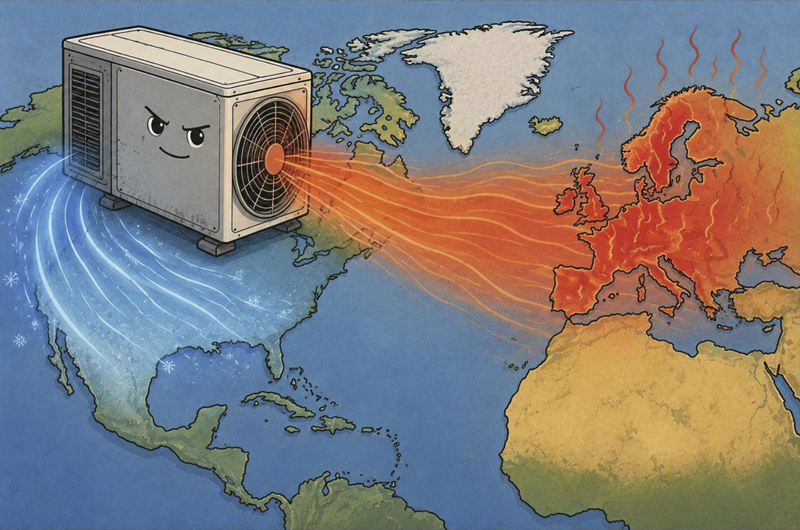
The EU may not actually believe this, but they thought you would …
Different climates have enjoyed advantages at different points in time. For most of history, industry and scholarship in southern Europe benefitted from significantly longer hours of sun and daylight much of the year compared to the north, allowing for more hours of work and study. James Belich noted in The World the Plague Made that this all changed with the expansion of the Basque whaling trade in the late medieval period, providing cheap wax for candles.
England and the Netherlands subsequently overtook the south in their levels of literacy, a transformation usually attributed to Protestantism, although this technical solution to a physical disadvantage certainly helped. As the northern countries grew richer, and were able to use more energy, so the climate came to be an advantage. Cooler areas of Europe in particular benefitted from a relative absence of vector-borne disease, dangerous insects and food poisoning, which made hotter regions of the world more lethal.
Yet the biggest curse of the lower latitudes is that heat makes us sluggish — since people struggle to work above 23° centigrade. As Maarten Boudry writes on his substack, “For every degree above 25°C (77°F), our cognitive performance declines by around two percent. And if synapses suffer, so does economic activity. At 30°C, office performance drops by almost 9 percent.”
I see that. I’ve been trying to write this in temperatures of up to 34°, which equates to a production level similar to a moderate hangover. If only there was some sort of technology that could make my home cooler.
Until relatively recently the world was dominated by a handful of relatively cold regions, and Paul Johnson observed in his history of the United States that human industry thrives in what Fahrenheit appreciators would call “the 60s”, a Goldilocks zone that turned New England and Greater Yankeedom into a powerhouse. The southern states, in contrast, were held back by higher mortality and the impossibility of productive work in the sweltering summer months, and until the mid-20th century were about 40 per cent poorer than the Union states.
The northerners were especially known for their work ethic and their inventiveness, a characteristic epitomised by the Boston-born Benjamin Franklin. Then in 1902, New York’s Willis Carrier changed everything with the one of the most world-changing inventions, the air conditioning unit; aircon has notably shifted population and power in the US southwards, but Dixieland is just part of a broader, global “sunshine belt”.
Among the most notable beneficiaries of this technology are the financial powerhouses of Dubai and Singapore. Lee Kuan Yew famously said of air conditioning that it was “perhaps one of the signal inventions of history. It changed the nature of civilization by making development possible in the tropics … The first thing I did upon becoming prime minister was to install air conditioners in buildings where the civil service worked.” Indeed, it has often been noted as characteristic of the city-state that the aircon is usually set to icy levels, reflecting their determination to be on work mode throughout the day.
While Singapore is the most famous beneficiary of Carrier’s invention, Japan has almost universal air conditioning, with 91 per cent of homes equipped, compared to 88 per cent in the US. China is home to more than 500 million aircon units, is the world’s largest manufacturer, and has also seen an economic shift towards the south. Vietnam, also likely to be a major economic power by mid-century, is as dependent on this technology as it is on its people’s ingenuity. The development of aircon, and medical breakthroughs in the treatment of tropical diseases, has shifted the centre of gravity away from the cold regions of the earth — just as the globe is warming up.
This year’s European heat wave, still ongoing, saw temperatures reach 37 last month in England, a June record. Many schools shut early, although one in Kent instead used air raid tunnels to teach children. London’s Central Line hit 39.4c, presenting a real risk of heat stroke.
Across Europe the hot weather has closed down not just schools but factories, offices and rail lines, and led to an estimated 10,000 deaths, with France top of the heat mortality charts. Indeed as Boudry writes, Europe has the worst heat-related excess deaths of any region — while fatalities in the US have declined by 75 per cent since the adoption of air conditioning.
Update, 17 July: Welcome, Instapundit readers! Have a look around at some of my other posts you may find of interest. I send out a daily summary of posts here through my Substack – https://substack.com/@nicholasrusson that you can subscribe to if you’d like to be informed of new posts in the future.
This is why so many of the kids are not “alright”
An interesting discussion at the social media site formerly known as Twitter, as Devon Eriksen responds to a comment from Stephen Fleming:
But don’t you understand?
There was a way. There was always a way.
We had it within our grasp, because we had already grasped it. The childhoods that you and your daughter had were available because you and your daughter had them.
All that the Boomers, and their parents, the eldest of the post WW2 generations, had to do was …
Nothing.
Just live in the paradise that their ancestors won for them, and make the minimum, the bare minimum, of effort that would have been required to actually sustain it.
That’s all.
Just keep things the way they were.
But they couldn’t handle that. Their fathers and grandfathers, the heroes that won WW2, made them jealous.
They wanted to be heroes, too.
So, for the sake of their own egos, they had to become Social Justice Warriors. They had to be Champions of Progress and Change.
They had to see the world they inherited as a pile of problems to be solved, rather than a pile of solutions to be cherished and preserved.
So they could feel like they were doing something important.
Almost all of the elder generations, even the ones who call themselves conservative and vote republican, are, in truth, socialist liberal progressives. Because they looked at paradise, and wanted to fix it instead of protect it.
That’s why the “republican” option was Reagan, the gun-ban guy, the social-welfare guy, the kiss-up-to-the-commies guy, the amnesty-for-foreign-invaders guy.
Reagan, the Hollywood liberal, the Obama of the 80s, instead of Joe McCarthy, Barry Goldwater, and Pat Buchanan.
Teens can’t have a summer job because elders had to be Third-World Compassion Heroes, and give us Hart-Cellar and eleventy-billion barbarians who don’t care about civilization, but will work cheap.
Teens can’t have a car because elders had to be Climate Emergency Heroes and give us emissions control laws and Cash for Clunkers.
Teens can’t have safe schools to learn at, because elders had to Anti-Racist Heroes and made it illegal to exclude violent thugs from our school districts. Just because those thugs generally come color-coded for your convenience.
Teens can’t have safe public spaces to hang out in, because elders had to be Compassion for the Underclass Heroes, and release violent savages into society, again and again, with a lecture and a slap on the wrist.
Teens can’t have a healthy economy to inherit, because elders had to be Equality Heroes and make sure every corporation that actually did anything useful was punished for not being Diverse, Equitable, and Inclusive enough to suit the ideal universe that exists only in their heads.
Teens can’t have dates, because elders had to be Anti-Sexist Heroes, and let feminists spend forty years diminishing the social value of men, until you had to a be a billionaire rockstar adventurer to avoid being an unsexy loser by default.
Teens can’t even be fit, healthy, and pretty, because elders had to be Sex Equality Heroes, and move women into the corporate workforce in droves, leaving children to be fed by corporate industrial slop factories.
Teens can’t have sane, well-adjusted, unspoiled girlfriends and wives, because elders had to be Champions of Sexual Freedom, and normalize unlimited female promiscuity, all in exchange for the largely unfulfilled promise of a little unshaven free-love yeti snatch.
And worst, of all, the crowning irony, the final dead hamster in the water pipe, is that all of this would be fixable, perhaps in three to five election cycles …
Except.
Except the elders don’t understand that any of this of this is happening.
They haven’t had a child in the household since 1997. They haven’t looked for an entry-level job since 1973. They haven’t gone on a date since 1981. They haven’t been laid off … ever.
They are safe with their paid-off houses and their investments and their pensions from 45 years at the same company and their social security and their medical plans.
It’s affecting the youngest generations first and worst. While the elders sit on their cruise ship, surveying the short with binoculars, wondering who all these ragged distressed looking people standing on the shore are.
And why they are holding signs that say “HELP”, “THIS IS ALL YOUR FAULT”, and “YOU STOLE THE LIFE I WAS SUPPOSED TO HAVE”.
Then they shrug, conclude that these must be the whiny losers, and everyone further inland is probably just fine, and everything is fine, because they fixed everything and they are all heroes, and the Summer of Love was the end of the Problematic Era of History and the beginning of the Great Enlightenment.
And when I am 74 years old, and the elders are all safely tucked into their cemetery plots, I will be torn apart by an angry mob for having white hair, and therefore being “one of them”.
And the mob will not care that I didn’t get to cast a vote until 1992, for the Man Who Predicted All Of This.
He called it the “giant sucking sound”.
Which is apt because it’s why everything sucks now.

July 13, 2026
Canada’s performative “grand strategic pivot away from the United States”
On the social media site formerly known as Twitter, L. Wayne Mathison provides the statistics to show that Prime Minister Carney’s big meeting with the Saudi Arabians is much more sizzle than steak:

Mark Carney wants Canadians to believe that courting Saudi Arabia represents some grand strategic pivot away from the United States.
The numbers expose the performance.
Saudi Arabia purchased roughly $1.3 billion in Canadian goods in 2025. Canada exported about $779 billion worldwide. That makes Saudi Arabia approximately 0.17 per cent of Canadian exports. It is a rounding error being marketed as an economic transformation.
Meanwhile, the real Canadian economy is voting with its money.
A new KPMG survey found that 57 percent of Canadian manufacturers have paused, reduced or cancelled capital investments. 42 percent have moved production to the United States or are considering doing so. Nearly one-third have already shifted at least some production south, and 61 percent say their businesses cannot survive without access to the American market.
That is the real Carney record: photo opportunities with Saudi royalty while Canadian factories, investment and future production quietly head for the border.
Ottawa keeps talking about “diversification”, but markets do not follow Liberal press releases. Capital goes where taxes are competitive, regulations are predictable, projects can be approved, energy is affordable and customers are close.
The latest trade figures make the point painfully clear. Canadian exports rose for the fourth consecutive month in May, driven by a 1.5 percent increase in exports to the United States. American-bound exports reached their highest level since February 2025 and still represented almost 70 percent of everything Canada shipped abroad. Exports to non-U.S. markets continued to shrink.
Canada should absolutely pursue new customers. But Saudi Arabia cannot replace an integrated continental market of more than 330 million people sitting directly beside us.
You do not reduce dependence on the United States by weakening Canadian competitiveness and watching manufacturers relocate there. You build Canadian strength first, then expand outward from a position of confidence.
Carney and the Liberals are doing the opposite.
They are allowing Canada’s productive base to erode while selling diplomatic tourism as economic strategy. They are chasing Saudi sovereign wealth while Canadian capital sits idle, scales back or leaves.
That is not diversification.
It is economic decline wearing a tailored suit and carrying a diplomatic passport. 🤡🌎
July 9, 2026
QotD: The labels “capitalism” and “socialism”
It was not necessary to be an intellectual to be dismayed by the inequality of industrial society. The Welsh-born factory owner Robert Owen envisaged an alternative economic model based on cooperative production and utopian villages like the ones he founded at Orbiston in Scotland and New Harmony, Indiana. It was in a letter to Owen, written by Edward Cowper in 1822, that the word “socialism” in its modern sense first appears. An unidentified woman was, Cowper thought, “well adapted to become what my friend Jo. Applegath calls a Socialist”. Five years later, Owen himself argued that “the chief question … between the modern … Political Economists, and the Communionists or Socialists, is whether it is more beneficial that this capital should be individual or in common”. The term “capitalism” made its debut in an English periodical in April 1833 — in the London newspaper the Standard — in the phrase “tyranny of capitalism”, part of an article on “the ill consequences of that greatest curse that can exist amongst men, too much money-power in too few hands”. Fifteen years later, the Caledonian Mercury referred with similar aversion to “that sweeping tide of capitalism and money-loving which threatens our country with the horrors of a plutocracy”.
Niall Ferguson, “Capitalism, Socialism and Nationalism: Lessons from History”, 2020-02.
July 5, 2026
Progressives are only against “some people” getting wealthy
Rob Henderson posted an accurate assessment of how progressives view certain kinds of wealthy people as being undeserving of their fortunes:
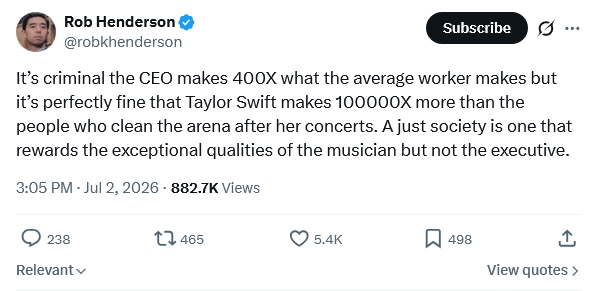
Konstantin Kisin explained why this is the case:
This is because the anti-capitalist left is not actually against people being crazy rich. They’re against certain types of people being crazy rich.
Artists and athletes make sense to them because they’ve played music and sports and because their success can be explained by “luck” and “talent”. Messi’s wealth is not offensive to them because they understand Messi is much better at football than they are.
But when it comes to business, the anti-capitalist leftist has no framework for understanding why Jeff Bezos might be super rich since 99% of them have never ever created a product, business or service that was of value to other people. They’ve never taken entrepreneurial risk. They’ve never employed people and felt the burden of responsibility that comes with that. They’ve never pick up a business and given it a play in the way they’ve picked up a ball or a guitar.
They *literally* don’t understand wealth creation. They think there is a fixed amount of money and the only thing a business does is split it unfairly.
It’s why they rage at Elon and other successful business leaders. Because they genuinely don’t understand why they’re wealthy.
Also, and this is just as important, athletes and artists are disproportionately young, attractive, “diverse”, left wing etc. Business leaders are “evil” middle aged white men whose success offends the average anti-capitalist leftist because they don’t understand a) what it is they do and b) that Elon Musk has the same talent advantage on them as Messi does, it’s just harder to measure.
July 3, 2026
QotD: Matthew Josephson’s The Robber Barons
During the 1920s, after graduation, Josephson became a journalist, an expatriate to France, and, after his return, a part of New York’s literary elite. He and Beard reconnected in 1930, and the mentor urged his student to write a book denouncing the men who had launched America’s industrial power. “Oh! those respectable ones”, Beard said of America’s capitalists, “oh! their temples of respectability — how I detest them, how I would love to pull them all down!” Happily for Beard, Josephson was handy to do the job for him. Josephson dedicated The Robber Barons to Beard, the historian most responsible for the book’s contents.
Josephson began research for his book in 1932, the nadir of the Great Depression. Businessmen were a handy scapegoat for that crisis, and Josephson embraced a Marxist view that the Great Depression was perhaps the last phase in the fall of capitalism and the triumph of communism. In a written interview for Pravda, the Soviet newspaper, Josephson said he enjoyed watching “the breakdown of our cult of business success and optimism”. He added, “The freedom of the U.S.S.R. from our cycles of insanity is the strongest argument in the world for the reconstruction of our society in a new form that is as highly centralized as Russia’s …”
Though not a member of the Communist Party, Josephson co-authored an open letter of support for the Communist Party candidates for President of the United States in 1932. “We believe”, the letter said, “that the only effective way to protest against the chaos, the appalling wastefulness, and the indescribable misery inherent in the present economic system is to vote for the Communist candidates”.
Josephson traced the troubled capitalist system of the 1930s back to the entrepreneurs of the late 1800s. Thus, by explaining what he thought was the wasteful, greedy, and corrupt development of steel, oil, and other industries under capitalism, Josephson was explaining to readers why the Great Depression was occurring. “I am not a complete Marxist”, Josephson insisted, “But what I took to heart for my own project was his theory of the process of industrial concentration, in Vol. 1 of [Marx’s] Capital, which underlay my book”.
Josephson never intended to write an objective view of American economic life in the Gilded Age. He did little research and mainly used secondary sources that supported his Marxist viewpoint. As he had written in the New Republic, “Far from shunning propaganda, we must use it more nobly, more skillfully than our predecessors, and speak through it in the local language and slogans.” Thus he wrote The Robber Barons with dramatic stories, anecdotes, and innuendos that demeaned corporate America and made the case for massive government intervention.
Burton W. Folsum, “How the Myth of the ‘Robber Barons’ Began — and Why It Persists”, Foundation for Economic Education, 2018-09-21.
June 30, 2026
QotD: Karl Marx and Friedrich Engels
Marx himself was an odious individual. An unkempt scrounger and a savage polemicist, he liked to boast that his wife was “née Baroness von Westphalen” but was not above siring an illegitimate son by their maidservant. On the sole occasion when he applied for a job (as a railway clerk) he was rejected because his handwriting was so atrocious. He sought to play the stock market but was hopeless at it. For most of his life he therefore depended on handouts from Engels, for whom socialism was an evening hobby, along with foxhunting and womanizing; his day job was running one of his father’s cotton factories in Manchester (the patent product of which was known as Diamond Thread). No man in history has bitten the hand that fed him with greater gusto than Marx bit the hand of King Cotton.
The essence of Marxism was the belief that the industrial economy was doomed to produce an intolerably unequal society divided between the bourgeoisie, the owners of capital, and a property-less proletariat. Capitalism inexorably demanded the concentration of capital in ever fewer hands and the reduction of everyone else to wage slavery, which meant being paid only “that quantum of the means of subsistence which is absolutely requisite to keep the laborer in bare existence as a laborer”. In chapter 32 of the first tome of Capital (1867), Marx prophesied the inevitable denouement:
Along with the constant decrease of the number of capitalist magnates, who usurp and monopolize all the advantages of this process of transformation, the mass of misery, oppression, slavery, degradation and exploitation grows; but with this there also grows the revolt of the working class …
The centralization of the means of production and the socialization of labor reach a point at which they become incompatible with their capitalist integument. This integument is burst asunder. The knell of capitalist private property sounds. The expropriators are expropriated.
It is no coincidence that this passage has a Wagnerian quality, part Götterdämmerung, part Parsifal. But by the time the book was published the great composer had left the spirit of 1848 far behind. Instead it was Eugene Pottier’s song “The Internationale” that became the anthem of Marxism. Set to music by Pierre De Geyter, it urged the “servile masses” to put aside their religious “superstitions” and national allegiances and to make war on the “thieves” and their accomplices, the tyrants, the generals, princes and peers.
Niall Ferguson, “Capitalism, Socialism and Nationalism: Lessons from History”, 2020-02.
June 28, 2026
QotD: Getting cloth to market in the ancient and medieval world
It should thus be of little surprise that regions involved in major textile production for export were often concentrated either on coasts or on rivers that were navigable to the sea (one may map the regions Pliny lists as major wool and linen exporters to find that they are all accessible by sea). While the sheep themselves may be grazed part of the year up in the uplands far from the coast, one of the great advantages of transhumance is that the sheep may transport themselves under the care of their shepherds to villages and lower pastures not too far from coastal towns which may serve as centers of textile production and major points of sale.
Now those transport costs become less and less significant the more valuable the goods being transported are. For a bulk good like grain (or common wool), transport may represent a majority of the costs. But if one is shipping something extremely valuable (particularly valuable per unit weight), the cost of acquisition at the source (and the profits of final sale) are much larger relative to the transport costs and less efficient methods of transportation become useful, thus the viability of silk and other expensive luxury goods being transported overland across Eurasia on the famous Silk Road.
Very high value fabrics didn’t need to come from so far afield though. In the Roman world, the province of Asia (corresponding roughly to western Turkey today) had several notable centers of production for particularly high valued textiles (on this, see I. Benda-Weber, “Textile Production Centers, Products and Merchants in the Roman Province of Asia” in Gleba and Pásztókai-Szeöke, op. cit.). Thyateira’s guild of purple-dyers (the πορφυροβάφοι) seem to have had trade contacts for their wares – wool dyed Tyrian purple via the murex snail – all over the province as well as in Macedonia and Italy. Weavers in the region were also known for producing fabrics with complex woven patterns and Miletus, one of the major ports in the region, had as noted the reputation for producing the best dyed wool in the Mediterranean. Such fabrics were highly valued and we find evidence that such fabrics were bought not merely by the Roman elite, but also made overland as far as Persia where such wares were valued at the Achaemenid (550-330 BC) court.
Neverthless, not all fabrics moving through trade in antiquity or the middle ages were rare or high value fabrics. As Jinyu Liu notes in a study of inscriptions relating to the textile trade, “coarse wool and wool of medium quality, and products made of these non-luxury wools dominated the market” in the Roman Empire, often being “pulled” through trade towards both large population centers in the interior of the empire and towards the Roman armies in the frontier provinces, both of which must have outstripped local production in their demand for textiles (Liu, “Trade, Traders and Guilds (?) in Textiles” in Gleba and Pásztókai-Szeöke, op. cit.). This trade included not just fabrics but also ready-made products like garments or blankets which must have been aimed at fairly modest people, neither the very poor (who couldn’t afford them) nor the wealthy (who wouldn’t have been caught dead in “ready-made” one-size-fits-no-one clothing), but rather the middling urban workers and common soldiers (and perhaps small farmers, though we might assume their households would produce most of their own textiles in the countryside where wool and flax, being agricultural and pastoral products, might be more available).
In Medieval Europe, just as in the ancient world, the centers of textile trading tended to follow the water as it made transport easier. England was a major wool-producing center in the high and later Middle Ages (and into the Early Modern period), with J.S. Lee (op. cit., 9) estimating production per capita exploding from around 1.3 pounds per person in the early 1300s to 7 pounds by the 1550s as the textile production system in England reoriented towards export. Wool products, produced in towns mostly in towns that were nearly coastal or had river-access flowed down by coastal trade and up the Thames to London to either be sold and used there or to be further exported to the dyers and fabric markets of the Low Countries (where fabrics could use the Rhine to travel further into the continent) or to be bought by the merchants of the Hanseatic League and so head into the Baltic.
Bret Devereaux, “Collections: Clothing, How Did They Make It? Part IVb: Cloth Money”, A Collection of Unmitigated Pedantry, 2021-04-09.
June 27, 2026
QotD: When Marxism went mainstream in higher education
“As Karl Marx’s ideological heirs in Communist nations struggle to transform his political legacy, his intellectual heirs on American campuses have virtually completed their own transformation from brash, beleaguered outsiders to assimilated academic insiders”, wrote Felicity Barringer.
There were notable differences, however. The stark, unmistakable contrast between the grinding poverty of the Communist nations and the prosperity of Western economies had obliterated socialism’s claim to economic superiority.
As a result, orthodox Marxism, with its emphasis on economics, was no longer in vogue. Traditional Marxism was “retreating” and had become “unfashionable”, the Times reported.
“There are a lot of people who don’t want to call themselves Marxist,” Eugene D. Genovese, an eminent Marxist academic, told the Times. (Genovese, who died in 2012, later abandoned socialism and embraced traditional conservatism after rediscovering Catholicism.)
Marxism wasn’t truly retreating, however. It was simply adapting to survive. Watching the upheaval in Poland and other Eastern bloc nations had convinced even Marxists that capitalism would not “give way to socialism” anytime soon. But this would cause an evolution of Marxist ideas, not an abandonment of them.
“Marx has become relativized”, Loren Graham, a historian at the Massachusetts Institute of Technology, told the Times.
Graham was just one of a dozen of the scholars the Times spoke to, a mix of economists, legal scholars, historians, sociologists, and literary critics. Most of them seemed to reach the same conclusion as Graham.
Marxism was not dying, it was mutating.
“Marxism and feminism, Marxism and deconstruction, Marxism and race – this is where the exciting debates are”, Jonathan M. Wiener, a professor of history at the University of California at Irvine, told the paper.
Marxism was still thriving, Barringer concluded, but not in the social sciences, “where there is a possibility of practical application”, but in abstract fields such as literary criticism.
Kristian Niemietz, “The New York Times Reported ‘the Mainstreaming of Marxism in US Colleges’ 30 Years Ago. Today, We See the Results”, Institute of Economic Affairs, 2020-09-18.
June 26, 2026
No “capital formation”, please: we’re Canadian
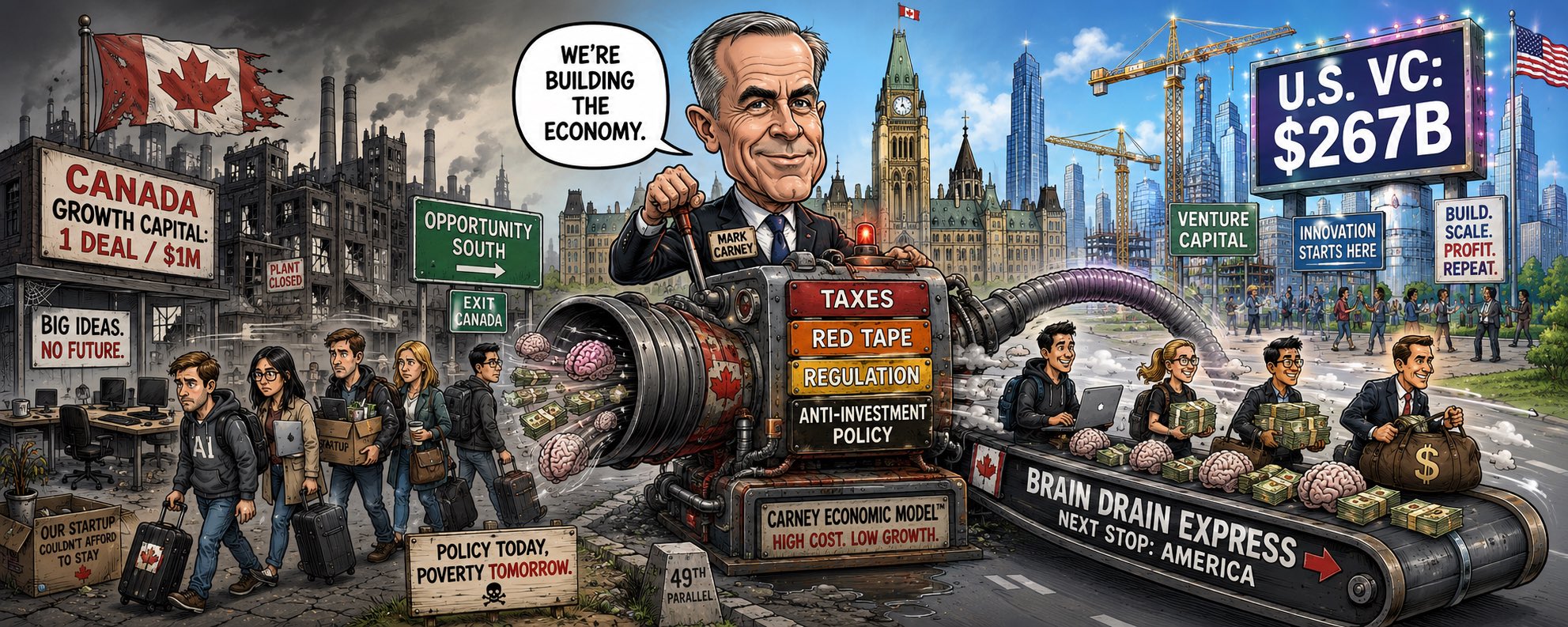
On the social media site formerly known as Twitter, L. Wayne Mathison identifies one of the biggest reasons the Canadian economy is falling ever further behind other industrialized nations:
AI-generated image from L. Wayne Mathison
Canada does not have a talent shortage.
It has a capital formation shortage.
In Q1 2026, Canada managed one growth-stage VC deal. One. Worth $1M.
That is lemonade-stand money in a global tech race.
The U.S. pulled in $267.2B in VC investment. Capital is not confused. It goes where risk is rewarded, scale is possible, and success is not treated like a moral offence.
Carney and the Liberals keep talking about “building the economy” while presiding over a country where founders raise seed money here, then scale somewhere else.
That is the real brain drain.
Not just doctors. Not just engineers. Builders. Founders. Investors. People who can turn ideas into payrolls.
They look at Canada and see taxes, red tape, weak productivity, political favouritism, and a government more interested in managing decline than getting out of the way.
Carney was sold as the adult in the room. OK. Then explain this: why is Canada producing press releases while the Americans are producing companies?
Because capital can smell fear.
And right now, Canada smells like a country that punishes ambition, subsidizes failure, and calls it fairness.
June 25, 2026
Credit card fee cap: a great idea, with the best of intentions … what possibly could go wrong?
Nobody likes credit card fees — except the banks that issue credit cards — so politicians figure that they can please the voters at no cost and mandate limits to the fees that credit card companies can charge. But who is going to suffer for this “at no cost” bit of rule-making?

“Credit Cards” by Sean MacEntee is licensed under CC BY 2.0 
 .
.
Two years ago, Illinois passed crowd-pleasing restrictions on credit card interchange fees, which are better known as “swipe fees”. The ban on charging fees on processing payments for tips and taxes has now been delayed twice by skeptical federal judges and lawmakers worried that they’ve crafted a financial mess. These interventions may be saving the state from itself, as a new report points out that the law threatens to hurt consumers, small retailers, and local financial institutions.
Delayed Ban on Fees for Processing Taxes and Tips
Passed as part of a 2024 revenue bill, the Interchange Fee Prohibition Act (IFPA) defines “interchange fee” as “a fee established, charged, or received by a payment card network for the purpose of compensating the issuer for its involvement in an electronic payment transaction”. It adds: “An issuer, a payment card network, an acquirer bank, or a processor may not receive or charge a merchant any interchange fee on the tax amount or gratuity of an electronic payment transaction if the merchant informs the acquirer bank or its designee of the tax or gratuity amount as part of the authorization or settlement process for the electronic payment transaction”.
“Although merchants have long advocated for this change, banking and payment industry representatives argue that it imposes an undue hardship by forcing them to process certain components of transactions without compensation,” attorneys Thomas V. Panoff and Maxwell Earp-Thomas noted for the National Law Review at the time. They also commented that the law could force Illinois payments to be processed differently than those originating in the rest of the country and the world beyond.
The situation is now being fought in court and in public between advocates who argue the fees are hidden costs and opponents who say they’re an industry-standard means to cover the cost of business.
[…]
Overall, Illinois lawmakers’ attempt to please the crowd by mandating lower costs looks poised to create a mess that could leave the state’s consumers, small banks, and retailers with higher costs and fewer choices if financial institutions leave to avoid headaches.
“To protect the integrity of the checkout experience and avoid driving financial providers from the Illinois market, the IFPA must be either repealed or overturned”, concludes Swedberg.
Credit card fees are undoubtedly burdensome for consumers and retailers. Ultimately the best way to avoid them is the traditional way: Use cash.
Formerly Peru’s First Lady, Keiko Fujimori is now President in her own right
The new President of Peru, Keiko Fujimori, faces a big economic challenge to her nation:

With just over 99% of ballots counted, Keiko Fujimori holds a lead of roughly 40,000 votes over Roberto Sánchez — less than half a percentage point, and the third consecutive Peruvian presidential contest decided by a margin that narrow. Sánchez led through the early days of counting, carried by rural and highland turnout; but the overseas votes, which broke for Fujimori above 63%, pulled the result the other way as the tally crossed 95%.
The outcome is no longer seriously in doubt. What remains in doubt is whether a victory this narrow constitutes a mandate to govern, or merely a turn to occupy the office in impotence.
Fujimori has never held executive power. What she inherits, however, is a name: her father, Alberto Fujimori, governed Peru from 1990 to 2000, stabilizing a hyperinflationary economy and crushing the Shining Path insurgency, albeit with darkly authoritarian techniques for which he was later convicted. Long known as Peru’s answer to Venezuela’s Hugo Chávez, Fujimori has cast a long shadow over Peruvian politics ever since.
Keiko served as his First Lady through the latter half of the 1990s, then built her own career: a congresswoman from 2006 to 2011, and the leader of Fuerza Popular (“Popular Force”) since. She spent 13 months in pretrial detention on corruption charges tied to Odebrecht financing; a court voided the case in January 2025. She has run for president four times, losing the previous three runoffs by margins under a single percentage point before, now, winning her fourth.
Her governing history is, as a result, tied deeply to her father’s. She has spent two decades defending it rather than living it, which is itself a kind of qualification in a country where economic memory often prevails over institutional memory. The model her father installed — trade liberalization, fiscal orthodoxy, an open door to foreign capital — has outlasted eight changes of president in ten years. The claims of Fujimorismo — the governing-economic doctrine named for Fujimori that has dominated ever since his time — is that it alone can be trusted to keep that model standing.
Keiko Fujimori’s flagship commitments are, consequently, the two pillars of Fujimorismo itself: a hard line on crime, and an unapologetic defense of the market economy.
The security platform proposes deploying the military against organized crime and prison disorder, taking inspiration both from Peru’s own recent past, and Nayib Bukele’s divisive tactics in El Salvador. Alongside this, the platform promises expanding video surveillance, and modernizing this apparatus through the use of artificial intelligence to detect corruption in public contracting. She insists that her father’s system’s abuses will not be repeated.
The economic platform is a much-needed deregulatory shock: cutting investment-approval timelines by 40%, reducing the fiscal deficit from 2.2% to 1% of GDP, and shrinking the state. As for exactly how that shrinking will be achieved besides the aforementioned measures, Keiko is not clear.
Nevertheless, both pillars of the plan were sold on a single word, repeated at her closing rally and in her final debate: order, against the chaos she says the left represents.
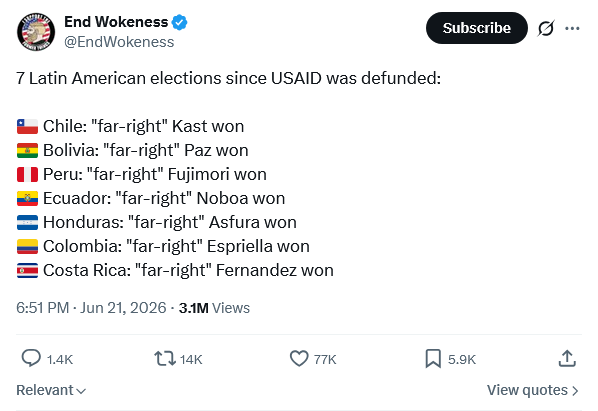
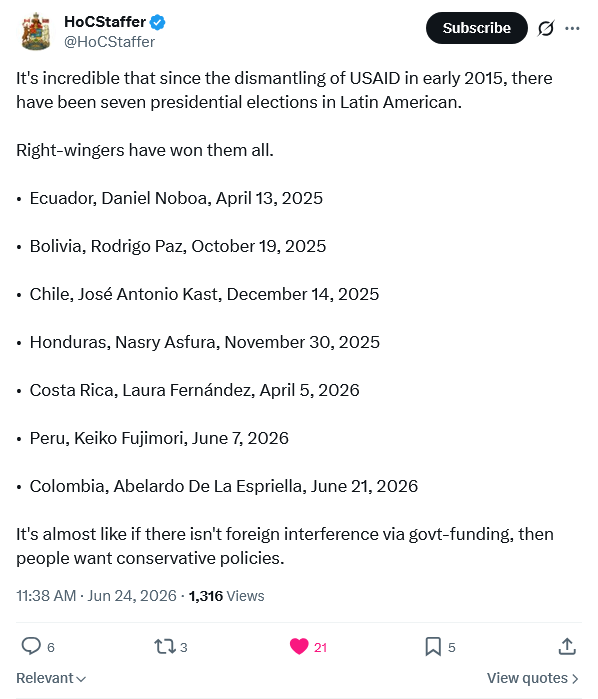
In counterpoint to recent claims that cutting USAID funding cost the lives of millions of children who depended on those funds, taking away USAID support in much of South America led to a number of electoral changes: