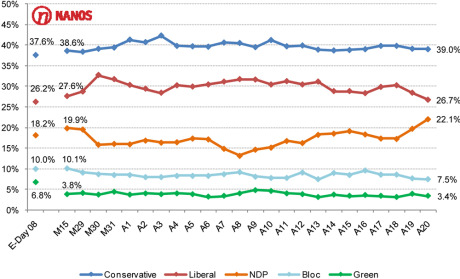
While not quite as dramatic as some of the headline polls over the last couple of days, the Nanos three-day tracking poll confirms that the NDP surge is real, knocking the Liberals decisively back into third place:
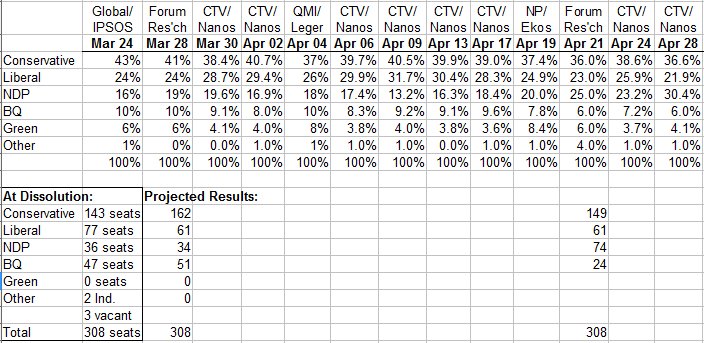
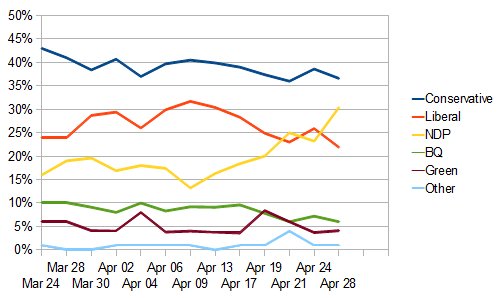

While not quite as dramatic as some of the headline polls over the last couple of days, the Nanos three-day tracking poll confirms that the NDP surge is real, knocking the Liberals decisively back into third place:
David Akin rounds up the information available from the advance polls over the Easter weekend:
Glen McGregor does all political junkies a favour by crunching the numbers on the advance poll turnout. The turnout was way up over 2008 and Glen ranks all 308 ridings based on the difference in advance poll turnout in 2008 compared to 2011.
I sliced Glen’s chart a little differently and attached a party affiliation based on which party held the riding at dissolution and then sorted the same list based simply on the number of ballots cast at advance polls in 2011.
[. . .]
The Conservatives, by most observers’ reckoning, have the best ground game of the major parties, followed by the NDP. A well-organized ground game means you get your supporters to the ballot box at the earliest opportunity. The Conservatives have done that before and appear to be doing that again. Eleven of the 20 highest turnouts are Tory ridings.
I find it notable that Simcoe-Grey, where independent Helena Guergis is trying to hold on has a very high turnout. Her Conservative opponent Kellie Leitch is a long-time Ontario and federal party activist and worker and, presumably, she has inherited a strong GOTV (get out the vote) organization. Or, interestingly enough, did Guergis hold on to some of that GOTV swagger she used to enjoy?
Talk about upsetting the stereotype of basement dwelling, dateless nerds:
The revelations come in research conducted lately in Canada among 10 to 16-year-olds by epidemiology PhD candidate Valerie Carson.
“This research is based on social cognitive theory, which suggests that seeing people engaged in a behaviour is a way of learning that behaviour,” explains Carson. “Since adolescents are exposed to considerable screen time — over 4.5 hours on average each day — they’re constantly seeing images of behaviours they can then potentially adopt.”
Apparently the study found that high computer use was associated with approximately 50 per cent increased engagement with “smoking, drunkenness, non-use of seatbelts, cannabis and illicit drug use, and unprotected sex”. High television use was also associated with a modestly increased engagement in these activities.
According to Ms Carson this is because TV is much more effectively controlled and censored in order to prevent impressionable youths seeing people puffing tabs or jazz cigarettes while indulging in unprotected sex etc. The driving without seatbelts thing seems a bit odd until one reflects that old episodes of the The Professionals, the Rockford Files etc are no doubt torrent favourites.
Oh, crikey. Because that’s exactly what we need to do to continue our recovery from the recession — re-open the constitutional debate all over again:
NDP Leader Jack Layton is willing to reopen talks on the Canadian Constitution in an effort to get Quebec to sign the document once there was a “reasonable chance of success.”
Layton was asked about the issue of constitutional talks on Tuesday in Montreal, where he is trying to capitalize on an apparent sharp increase in support for the NDP in recent public opinion polls.
The NDP leader, however, said he does not think the federal government should enter into constitutional negotiations with the provinces until “there is some reasonable chance of success.”
“It’s not a question of appeasing anybody. We have an historic problem. We have a quarter of our population who have never signed the Constitution. That can’t go on forever,” Layton said.
It just occurred to me the other night while watching the Joe Volpe story that we’ve been uniquely blessed in this election: not a single canvasser for any candidate has come to our door. The only contact with a candidate I’ve had in this whole election was when I contacted my local Libertarian candidate (Josh Insang). This may be a function of how strongly my particular poll voted Tory last time, but it’s a bit surprising.
The latest Nanos/Globe & Mail poll shows that the Conservatives might just be able to reach majority status if the Ontario numbers stay steady for the final week:
Nationally, the NDP is statistically tied for second place with the Liberals. But another story is emerging out of Ontario, where they are running third; the party’s surge in Quebec and other regions has not given it a similar bump in Ontario.
Pollster Nik Nanos sees this as a boon for the Tories — one that could well provide the Conservatives a route to that coveted majority.
“Talk about Jack Layton in Stornoway has actually helped the Conservatives in Ontario,” Mr. Nanos said Monday. “The Conservatives best chance to win a majority is in Ontario. If their numbers hold or start ramping up in Ontario that could be good news for the Conservatives. One of the scenarios that we could be looking at now is a squeaker of a majority government.”
Of course, the regional numbers are subject to a larger margin of error:
There is a margin of error of plus or minus 64 percentage points, 19 times out of 20, for the provincial sample.
I hope there’s a decimal place somewhere in that MoE.
Stephen Gordon wishes there was a way to disentangle sensible tax policy discussions from politics:
The Conservatives implemented two major tax cuts in the past five years: the two-point reduction in the GST, and the three-point reduction in the corporate income tax (CIT) rate. The GST cut was almost certainly a mistake, but no opposition party has challenged this decision in the election campaign.
On the other hand, every opposition party has promised to increase the CIT — the tax that is most harmful to economic growth. What is going on?
I see two answers to that question, and both are based on the presumption — possibly well-founded — that voters do not understand the concept of tax incidence. If you don’t understand how corporate taxes are passed onto workers, then the idea of taxing ‘wealthy corporations’ has a certain appeal: “I’m not a wealthy corporation, so it’s no skin off my nose.”
But of course, it is. So the only question is whether or not the opposition parties campaigning on increasing corporate tax rates understand who actually pays the CIT. If they do not understand that higher CIT rates reduce wages, then their competence as a government-in-waiting leaves something to be desired. If they do understand, then they are being less than honest about what the effects of their proposals will be.
The most efficient tax is broad-based and as close to non-distorting as possible. That is also the most hated form: the Goods and Services Tax. The Tory cut in the GST was terrible economics, but great politics. There, in a nutshell, is why stupid tax policies are the only ones on offer in the election campaign — because sensible policies require people to actually face up to the costs of the government they want. People much prefer the illusion that “someone else” is paying for the goodies.
The rise of the NDP in Quebec is forcing Bloc Québécois leader Gilles Duceppe to take a much stronger line against Jack Layton:
The NDP’s newfound status proved jarring enough for Duceppe to make a strident, emotional appeal to his base Saturday:
“This election is a battle between… Canada and Quebec,” said a message Saturday from the Bloc leader’s Twitter account.
He later erased that note and replaced it with a toned-down appeal for all sovereigntists to back his party. The message is a clear departure from previous campaigns that saw Duceppe work to broaden his appeal beyond sovereigntist voters.
“This election is not a left-right battle, but a battle between federalists and sovereigntists,” said the later message from Duceppe’s account. “Between the parties of the Canadian majority and Quebec.”
There are even anti-NDP attack ads, including a new one from the Liberals featuring a yellow traffic light and the message, “Not so fast, Jack.”
The Liberals have been forced to pay more attention to the NDP than they had planned, especially with the parties in a statistical tie in the latest polls. Liberal Leader Michael Ignatieff was even booed loudly at at hockey game last night, which has only been lightly mentioned in the media. His low personal popularity is starting to be seen as a big reason for the Liberals’ plight in the polls — although it can’t be the only reason.
The NDP’s financial promises are one area the Liberals can safely attack:
The Liberals are pointing out a series of alleged exaggerations in the NDP platform, saying the promises are based on invented revenues like a supposed $3.6 billion that would come in the first year of a climate cap-and-trade system. The Liberals call it, “fantasy money.”
The Liberals also heaped ridicule on the NDP promise to hire 1,200 new doctors and 6,000 nurses for the bargain-basement rate of $25 million.
They said the NDP promise to save $2 billion by slashing subsidies to the oil sands overstates the possible savings by four times, and that the math is similarly wonky on the NDP’s pledge to crack down on foreign tax havens.
“It’s time to take a close look at what Jack Layton’s saying to the Canadian people. The numbers add up and up and up,” Ignatieff said.
“Mr. Layton has got a platform that when you look at it closely has . . . $30 billion of spending, which we think is not going to be good for the economy and he derives it from sources we just don’t think are credible.
“He’s got a cap-and-trade system that’s going to deliver $3.5 billion in the first year. We don’t even have a cap and trade system. It’s science fiction.”
If you wanted an interesting election, this one is certainly shaping up as the most interesting in the last ten years:
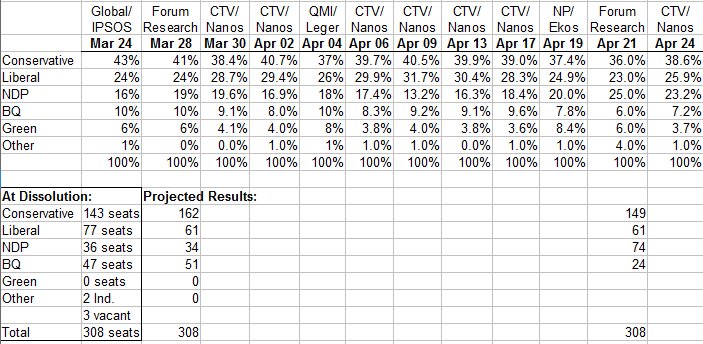
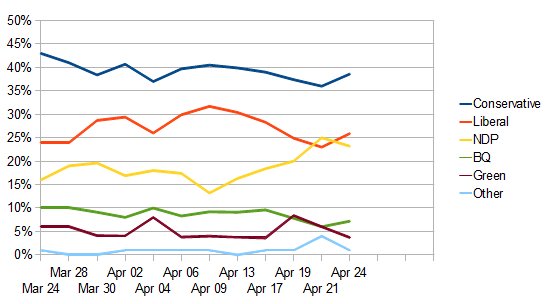
It may be just another blip in the polling, or it could really be the NDP benefitting from weaker BQ numbers. Lots of trees will be consumed in this debate, and many electrons will be inconvenienced. The national numbers don’t show the pattern all that well, but the NDP may finally be close to that popularity breakthrough they’ve been hoping for since the brief taste of power they got in the Trudeau years. Instead of asking the Liberal leader how many NDP cabinet seats he’d need to give to Jack Layton, we might be asking Jack how many Liberal cabinet ministers he’d have in his coalition.
Jack Layton’s New Democratic Party has surged past Gilles Duceppe’s faltering Bloc Quebecois and is now in first place in Quebec, according to an Ekos public opinion poll released exclusively to iPolitics.
The poll, conducted earlier this week, found the New Democrats have jumped 10 percentage points since the eve of the leaders debate to 31.1% while the Bloc has dropped like a rock by 7.4 percentage points to 23.7%.
The Liberals are steady at 20.6% while the Conservatives have dropped slightly to 16.9%.
While the margin of error is higher at the city level, in Montreal the NDP is at 32.9% while the Bloc is at 29.7%.
Nationally, the NDP is now in a statistical tie with the Liberals at 24.9% to 25.8%. Both lag well behind the Conservatives who were preferred by 34.5% of respondents.
Update: Jane Taber has more on the regional breakdown:
Atlantic Canada now is shaping up to be a three-way race, with the NDP gaining every day for the past seven days. The Tories are at 36.3 per cent followed by the Liberals with 33.1 per cent and the NDP at 28.3 per cent. (There is a margin of error of plus or minus 9.7 percentage points, 19 times out of 20 in the regional sample.)
In British Columbia, the Liberals have dropped significantly — Mr. Ignatieff has seen his support decrease from 33.5 per cent Monday to 22.7 per cent Wednesday night. The Conservatives have 43.5 per cent support and the NDP are at 29.6 per cent, up from 24.7 per cent the night before. (The margin of error in that province is plus or minus 7.9 percentage points, 19 times out of 20.)
In Quebec, Mr. Layton remains strong although the Bloc is still in first place with 32 per cent support compared to 23.4 per cent for the NDP, 20.8 per cent for the Liberals and 17.5 per cent for the Conservatives. “At 32 per cent it would be the worst ever showing for the BQ in a federal election,” Mr. Nanos said, noting that their previous worst showing was in 1997 where they won 37.9 per cent of the vote.
If all of this isn’t just a blip, it’s terrible news for Michael Ignatieff. That grinding noise you hear is the knife-sharpening back at Liberal HQ.
Update, the second: If the initial news was promising for Jack Layton, the poll done for La Presse must have been like a big shot of adrenalin:
A new poll by CROP for La Presse suggests that the enthusiasm for Mr. Layton is such that the NDP has now overtaken the Bloc Québécois in voting intentions for the first time in Canadian history. The online poll suggested that the NDP is now first choice for 36% of Quebecers, compared to 31% for the Bloc, 17% for the Conservatives and a mere 13% for the once mighty Liberal Party.
Having heard the NDP boast about “historic breakthroughs” over the years, I’m loath to get too carried away until these numbers are confimed by other pollsters. In 2008, Mr. Layton was in a statistical tie with Stéphane Dion two weeks before election day but ended up trailing by eight points and 40 MPs.
Yet there are signs this time might be different. In Quebec in particular, the Liberal brand is damaged goods and the Bloc is looking like a tired, one-trick pony. There is nowhere else to go for left-of-centre voters.
Update, the third: Forum Research says that the NDP is already in second place nationally:
“The Tories are ahead everywhere except Quebec, it’s all going to come down to what happens in Quebec,” says Mr. Bozinoff, noting the tradition of Quebec voters to move en masse when they have sharply changed preferences in past elections.
The survey of 2,727 voting-age Canadians was conducted Wednesday evening. It was an interactive voice response survey with a margin of error of plus or minus 2.2 per cent 19 times out of 20. The margin of error for regional and provincial breakdowns is slightly higher, but in such a large survey, with 348 citizens reached in the GTA alone, it is a reliable indicator of election trend lines.
Nationally, the survey gave the Conservative Party support from 36 per cent of decided and leaning voters, 25 per cent for the NDP, 23 per cent for the Liberal party, and six per cent each for the Green Party and the Bloc Québécois. A separate Forum Research analysis, based partly on ridings won and lost in the 2008 election, suggest the survey results would give the Conservatives 149 of the 308 Commons seats if an election were held today, with 71 seats for the NDP, 64 for the Liberals and the Bloc Québécois would have 24 seats.
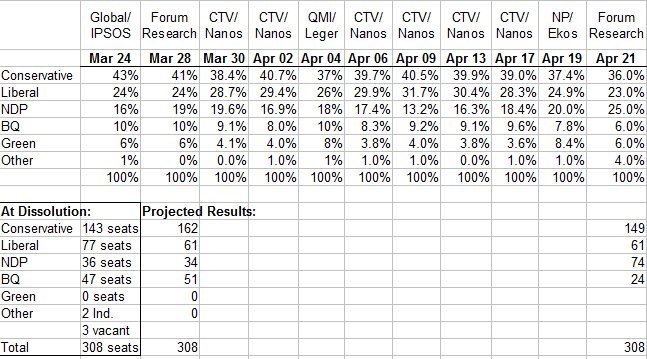
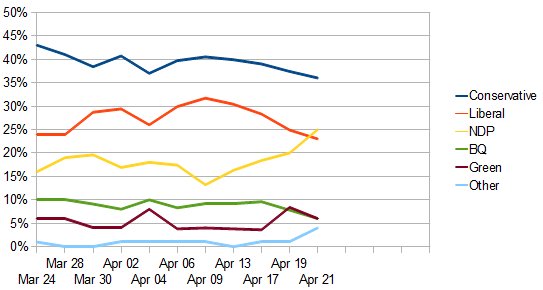
My occasionally updated percentage tracker, now (thanks to commenter request) with a graph to match:
Stephen Gordon explains why the spike of certain prices may not trigger interest rate hikes from the Bank of Canada:
The increase in the headline March CPI inflation rate is due to increases in a relatively small number of goods, and is best seen as a change in relative prices that will have only a transitory increase in the CPI. There are two ways that headline CPI can return to target. The first is that consumers adjust their spending patterns and substitute away from the goods whose prices have risen; the resulting fall in demand will bring prices back down. If this doesn’t happen, prices of other goods can fall — or at least rise more slowly — so that the rate of inflation of the broader index falls back to target.
The Bank of Canada is preoccupied with inflation, not fluctuations in relative prices, so the current increase in the CPI will only be a problem if firms and workers start using 3 per cent as a benchmark for increases in wages and the prices of other goods.
Even though the target is the headline CPI inflation rate, it is the Bank’s opinion that the core CPI inflation rate is a better predictor for future inflation. The components of core CPI are generally those whose prices are set infrequently and whose increases reflect expectations for future inflation as well as market conditions. If expected inflation starts to rise, it will be more visible in the core rate than in the headline number.
This is a fascinating article. I’m not sure I agree, although we’ll find out in less than two weeks if this is the “Black Day of the German Army Liberal Party”:
The Liberal party, like the Kaiser’s Germany, is stuck in the middle. (An analogy I do not expect any Liberal to use in public, ever.) To the right is the Conservative party. To the left, the NDP. Every election campaign is a two-front war.
To deal with this mortal peril, the Liberals have traditionally followed their own Schlieffen Plan.
In the event of electoral war, the Liberals move swiftly to the left. Taking ground from the NDP ensures vote splits go their way but also creates the perception that the NDP is out of the fight. Voters whose primary concern is stopping the barbarians in the East — the Conservatives, naturally — are thus forced to support the Liberals.
Now, here comes the part of the column Michael Ignatieff won’t like.
Dentists who have their spouses on their patient list are running the risk of losing their licenses:
Dentists are permitted to treat their spouses — but they better not have sex.
Put another way, dentists who have sex with their spouses better not be messing around with their teeth.
This is the current law of the land in Ontario, one that many dentists are secretly flouting and calling “dumb” and “stupid.”
In an interview with the Star earlier this week, Ontario Health Minister Deb Matthews conceded the dentists may have a point and has agreed to review the restriction.
H/T to Chris Greaves for the link.
Stephen Gordon says that the additional costs to the Canadian economy for slower border crossings rival (or possibly even exceed) the savings due to NAFTA:
It is difficult to overstate the importance of Canada-U.S. trade flows: roughly one-quarter of what Canada produces is exported to the United States, and the volume of imports from the U.S. is only slightly smaller.
The increased border security in the wake of the Sept. 11 attacks may be only a minor irritant in the context of a single border crossing, but a small cost multiplied by a large number of crossings can still end up being a very big number. Even a small perturbation in trade flows of this magnitude can have a significant effect on the Canadian economy.
A recent study by Trien Nguyen of the University of Waterloo and Randy Wigle of Wilfrid Laurier University and published in the March 2011 issue of Canadian Public Policy provides some estimates for the economic costs of border crossing delays. These costs can be startlingly large, especially in the auto sector. Parts and subassemblies of cars produced in North America crisscross the border several times during production, so custom rules and border delays can add an extra $800 to the cost of production. In contrast, cars imported from overseas only have to pass through customs once.



Powered by WordPress