Quotulatiousness

March 22, 2011

Why nobody takes conservative promises too seriously

Filed under: Cancon, Economics, Government, Politics — Tags: , , , , — Nicholas @ 09:37

Today is budget day, when federal Finance Minister Jim Flaherty will be introducing the Conservative budget for 2011. Unless something has suddenly changed in the government’s philosophy, don’t expect anything daring:

First and foremost, the budget should contain a plan for reducing federal spending in real terms over the next four or five years. Mr. Flaherty’s 2010 budget outlined how the federal government intended to restore balance to the federal books by 2015 by holding the line on spending increases to just over 1% a year while praying for a return to robust annual revenue increases. In fact, merely planning to hold the line on spending is never going to be enough. For one thing, the Conservatives have never proven themselves capable of pulling it off. Despite coming to power in 2006 on a message of fiscal restraint, the Tories raised federal program spending by an average of 6% in each of their first three budgets before the worldwide finance crisis of 2008. Since then, they have added $100-billion to the national debt, in large part thanks to stimulus spending of dubious worth.

According to the Canadian Taxpayers Federation, as of last Friday, Canada’s debt stood at nearly $563-billion. This means the debt repayments made over the 11 years before the recession began have been wiped out, and that the federal treasury is back to where it was before the Liberals’ then-finance minister Paul Martin brought down his austerity budget in 1995.

Since the Tories took power five years ago, program spending has expanded by nearly 40% and the federal civil service has grown by nearly 20%. We’re sorry, but we just don’t trust a government with a track record like the Tories’ to be able to regain budget balance simply by holding the line on new spending.

They can promise all sorts of things, but what they seem best at doing is pretending not to be “conservative” at all.

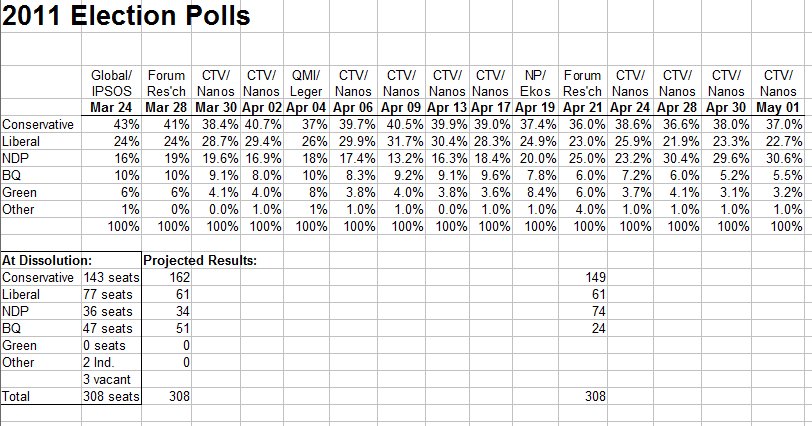
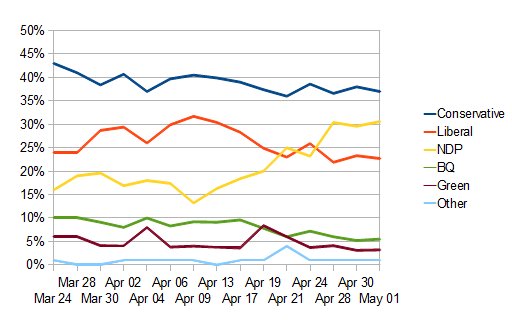
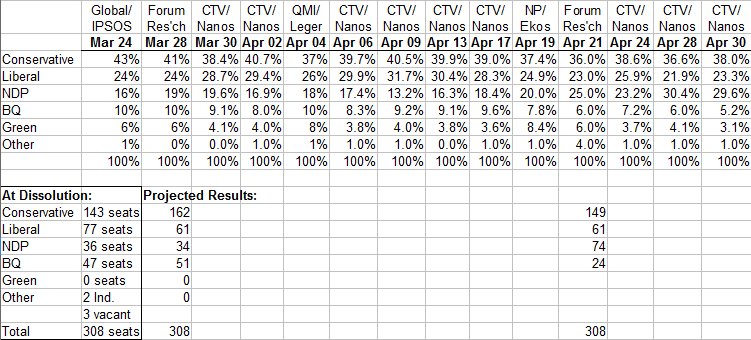
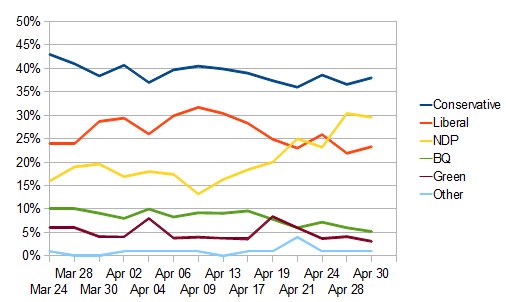
The government may fall, as the opposition are calling for even higher spending on “universities, home care, daycare, unemployment, seniors and Quebec”. This may work to the Conservatives’ advantage as they’re (temporarily) riding high in the opinion polls, so they might be able to win a majority if an election is forced on them over this budget. Of course, the opposition can read the polls too, so they may not be as eager to throw Stephen Harper an opportunity to win an easy victory.

Update: Well, the budget was tabled in the House, the opposition parties all rejected it “as it stands”, and the prime minister has stated they will not accept any amendments. For Thursday’s performance in the Ottawa Little Theatre, the budget will get first reading, which means the first opportunity for the government to be defeated . . . which means a May general election.

March 18, 2011

West coast earthquake zones

Filed under: Cancon, Environment, Pacific, USA — Tags: , , , , , — Nicholas @ 09:44

According to an article in The Economist, the well-known San Andreas fault in California is not the most likely to cause an earthquake of the magnitude of last week’s quake in Japan. The most likely source is the Cascadia subduction zone:

wikimedia.org - Cascadia subduction zone The most likely megaquake on the West Coast would be much further north — in fact, 50 miles off the coast between Cape Mendocino in northern California and Vancouver Island in southern British Columbia. This 680-mile strip of seabed is home to the Cascadia subduction zone, where oceanic crust known as the Juan de Fuca plate is forced under the ancient North American plate that forms the continent. For much of its length, the two sides of this huge subduction zone are locked together, accumulating stresses that are capable of triggering megaquakes in excess of magnitude 9.0 when they eventually slip. As such, Cascadia is more than a match for anything off the coast of Japan.

What makes Cascadia such a monster is not just its length, but also the shallowness of the angle with which the encroaching tectonic plate dives under the continental mass. The descending plate has to travel 40 miles down the incline before it softens enough from the Earth’s internal heat to slide without accumulating further frictional stresses. Could the fault unzip from end to end and trigger a megaquake — along with the mother of all tsunamis? You bet. By one account, it has done so at least seven times over the past 3,500 years. Another study suggests there have been around 20 such events over the past 10,000 years. Whatever, the “return time” would seem to be within 200 to 600 years.

And the last time Cascadia let go? Just 311 years ago.

Cascadia subduction zone image from wikimedia.org.

March 17, 2011

Rick Mercer on “the Harper Government”

Filed under: Cancon, Government, Humour, Politics — Tags: , — Nicholas @ 14:02

March 16, 2011

Ontario’s nuclear power industry

Filed under: Cancon, Japan, Technology — Tags: , , — Nicholas @ 07:32

I live near two nuclear power plants, and have done for more than a decade, but even with those two hints, I didn’t realize that Ontario gets 55% of its electricity from nuclear sources. For some reason, I thought we were somewhere in the 20-25% range — higher than the Canadian average of 15%, but not over half.

The Canadian Nuclear Association has posted a statement on their website (including the above nugget of information):

“Our thoughts are with the people of Japan and their relatives in Canada during this terrible time, as well as with the workers at the Fukushima station for their tireless efforts to protect the people offsite.

Over the coming days and weeks you can expect to hear many varying opinions on the events in Japan and even on Canadian nuclear facilities. Some will be based on fact and will contribute to a worthwhile discussion. Unfortunately, some of what you will hear may not be based on fact.

It’s important to remember the Fukushima plant was damaged, not as a result of any flaw in the reactor design, but from the largest ever earthquake in Japan’s history followed by a devastating tsunami. The nuclear industry — in Canada and around the world — has a history of working closely together to share technical expertise. We also have a history of examining operations and activities to ensure continuous improvements.

March 14, 2011

Canadian in Japan claims government “providing no help” to him

Filed under: Cancon, Government, Japan, Media — Tags: , , , , — Nicholas @ 09:13

Phillip Ilijevski is shocked that the Canadian government hasn’t been providing him with personalized information on what’s happening near him:

A Toronto man living in Japan says the federal government is “providing no help” to Canadians wanting to know if they should leave the earthquake and tsunami-ravaged country, especially given the nuclear threat.

Phillip Ilijevski teaches English in Takasaki, about 100 kilometres north of Tokyo. He called Canada’s Department of Foreign Affairs and International Trade to find out if it’s safe to stay in Japan, but says the only advice they gave him was to watch the news.

I have no idea why the Canadian government is expected to have better information on what’s happening in Japan in the aftermath of the earthquake and tsunami than the Japanese government, but it must be Stephen Harper’s fault, right?

If Mr. Ilijevski was in a third world nation with poor communications and little infrastructure, it might be reasonable to assume that Canadian officials would be in a better position to provide advice than local government, but in this case there’s no reason — Japan is better equipped to handle this kind of disaster (and public information flow) than just about any other nation on earth.

As jonkay said in a Twitter update: “As usual,when disaster strikes abroad, TStar’s #1 focus is finding a Canuck to bitch about how Ottawa isn’t helping him”

I’m not sure what a “paprade” is, but apparently Toronto had one

Filed under: Cancon, Humour, Media — Tags: , , — Nicholas @ 08:56

I guess the weekend staff were celebrating St. Patrick’s day a little early, as not only the photo caption (left) but also the pa(p)rade directions leave you a little misdirected:

The parade begins at Bloor and St. George Sts. and heads west to Yonge, where it turns south and goes to Queen and then heads west again to University, ending just south of Dundas on University.

The streets are expected to be closed from 8 a.m. to 3 p.m., making driving to the parade difficult.

Highlighting mine. Going west from Bloor and St. George won’t get you to Yonge Street for a fair amount of time:

H/T to Chris Greaves for bringing this to my attention.

March 10, 2011

Stephen Gordon: “business groups are pro-BUSINESS, not pro-MARKET”

Filed under: Cancon, Economics, Government — Tags: , , — Nicholas @ 13:01

Stephen Gordon provides a useful reminder about not conflating “business” interests with “free market” interests: they’re often in conflict.

This is something that should always be kept in mind in economic policy discussions: business groups are pro-BUSINESS, not pro-MARKET.

It is especially important to keep this in mind when we read news items such as this, in which several of Canada’s largest banks voice their opposition to the proposed TMX-LSE merger.

It is true that business groups will often make use the language of markets, and it is obviously in their interest to portray themselves as defenders of markets.

But they are a lobby group like any other, and cannot be relied upon to defend the general public interest.

This point is sometimes hard to see, especially since many business groups have the reputation of favouring such pro-market policies such as free trade. And so they do, but for precisely the wrong reason: as a way of increasing exports.

This is why you can often find big business working hand-in-mailed-gauntlet with regulators to shut down competitors and make it harder for new competitors to enter their markets: corporations do not naturally favour free markets. Corporations exist to maximize profit for their shareholders, not primarily to serve customers. Serving customers is one way to accomplish that end, but in a regulated economy it may not be the best way to do it. If you can get the naked force of government to muscle in and suppress other businesses, that leaves more profit for you (as long as you co-operate with the government, that is).

Small businesses don’t have the ability to cosy up to government in the same way big corporations can, so even if they band together in trade groups, they won’t have the ability to capture and direct the regulators in the way big businesses often can.

March 8, 2011

Canadian banks forced to enter 21st century

Filed under: Bureaucracy, Cancon, Economics, Government — Tags: — Nicholas @ 12:27

In a long-overdue move, the Canadian government is putting pressure on the banks to improve their glacial cheque-clearing time:

Ottawa is cutting the amount of time banks can hold cheques up to $1,500 to four business days from seven for consumers and small- and medium-sized businesses.

The measures detailed today, part of last year’s budget, will also give consumers “immediate access” to the first $100 deposited by cheque. There will be a 30-day period for comment.

“Lower-income seniors, Canadians without significant balances in their accounts, younger Canadians who do not have a long banking history, and people who receive cheques from newer employers or clients are often subject to longer cheque hold periods,” the Department of Finance said. “These are often the Canadians who most need quick access to their funds.”

This is great news for me personally: I’m self-employed. I bill my clients directly for a month’s work, they take time to process my invoice and issue a cheque, then I deposit it into my business account. Seven business days later after that, I can actually get some of that money into my personal account. It’s amazing how long seven business days can seem when you’re juggling the mortgage, property tax bills, utilities, and all the other things that can’t be postponed to a time when the bank lets you get at your own money.

H/T to Elizabeth for the link.

March 6, 2011

Don’t worry, liquor fans, they’ll soon stop over-serving you

Filed under: Cancon, Economics — Tags: , , — Nicholas @ 12:05

Did you know that the US shot glass is ever so slightly larger than the Imperial one? These guys didn’t, but they do now:

To be fussy about it — and who’s fussier than a liquor tax auditor? — a U.S. fluid ounce works out to 29.574 millilitres while the imperial (that is, Canadian) ounce is 28.413. While that may not sound like a big discrepancy to you, it means Canadian bars using U.S. shot glasses, as virtually all of them do, have spent years serving countless more litres of liquor than legally required. The upshot for your shots is that they’ll soon be 7% lighter.

Owners had no idea there was a difference between a U.S. shot and a Canadian one. “I’d say it’s totally unrecognized,” Tweter says. Finding imperial shot glasses proved impossible, and Tweter and Wilson took matters into their own hands. They sourced a factory in China to make a slightly smaller-than-usual vessel. Meet the Can-Pour, probably the only imperial ounce shot glass on the Canadian market.

As a result of rounding, the standard U.S. shot glass actually works out to 30 millilitres while the Can-Pour pours an even 28. Tweter points out this falls within Weights and Measurements Canada’s tolerances. A chart on Tweter and Wilson’s website shows how a bar with annual liquor purchases of $360,000 could save more than $25,000 by pouring a little less. Doesn’t that cheat the customer? “The two-millilitre difference is virtually undetectable. It’s literally drops,” Tweter says.

So drink up, Vancouver shot fans: you’ll soon be paying the same for slightly less alcohol per drink.

March 5, 2011

Local SCA group gets a bit of newspaper coverage

Filed under: Cancon, History, Randomness — Tags: , , — Nicholas @ 10:57

Actually, compared to a lot of newspaper articles on the SCA, this one isn’t too bad:

The Society is a global organization with some 30,000 registered members reliving the world before the 17th century. Most stick to European history, but there are plenty of katana-wielding Japan enthusiasts among the ranks. Members get together and do any and everything medieval and renaissance, from armored combat and blacksmithing to the craftier trades such as glass-etching and embroidery.

The Toronto group is know as the Canton of Eoforwicof, one chapter of the Kingdom of Ealdormere, which encompasses most of Ontario and is one of 19 worldwide kingdoms. Each kingdom has its own King, Queen and handful of other royals and nobility.

Unlike a Renaissance Faire, these gatherings are not for anyone’s entertainment but their own.

“We’re not playing to an audience, we’re just doing things for fun,” Ms. Carroll-Clark says.

No mention of rapier combat (my bit of the SCA), but that’s not surprising — even in the SCA it’s a minority interest.

March 1, 2011

CBC posts G20 mini-documentary

Filed under: Cancon, Government, Liberty, Media — Tags: , , — Nicholas @ 07:48

I haven’t had a chance to watch it yet, but Cory Doctorow says “This video makes me ashamed to be a Canadian”. You Should Have Stayed At Home:

It’s been eight months since the G20 and the iconic images are still with us — burning police cars, rampaging mobs, the massive security presence that according to the official story is all that stood between Canada’s largest city and chaos. But that’s not the whole story of Toronto’s G20. Astonishing new images caught on camera are now emerging and they expose a troubling new picture of what happened to hundreds of ordinary citizens caught in the huge police dragnet during those three highly-charged days last June.

Gillian Findlay presents a revealing new street-level perspective of what happened when thousands of police were deployed in downtown Toronto and instructed to do what was necessary to ensure the wall around the G20 Conference Centre was never breached. Exclusive eyewitness video obtained by the fifth estate brings to light startling images captured on cellphones and minicams by the innocent bystanders who found themselves on the wrong side of all that G20 “order.” In a rare television interview, Toronto Police Chief Bill Blair explains why police took the actions they did.

I was critical of the G20 even before things went off the rails. It was a stupid idea to hold it in the middle of Canada’s biggest city, and the police reaction to provocation was worthy of any rag-tag third world dictatorship.

February 28, 2011

“SwordFit” – combining western martial arts with fitness classes

Filed under: Cancon, Health, Sports — Tags: , — Nicholas @ 09:02

This sounds like an excellent idea:

Since Devon Boorman opened the Academie Duello Centre for Swordplay in Vancouver seven years ago, he’s taught actors, fans of medieval weapons as well as bankers and office workers. Like an action-oriented Pilates class, the Western martial art of swordplay requires the grace of a ballet dancer with the strength of a warrior. It’s not about building muscle mass, as in weight-lifting, but about building plyometric — that is, explosive — strength.

But last fall, he added a new hybrid to his lineup.

The 90-minute SwordFit workout at Academie Duello is designed to be a mix of technical and cross-training, and features two instructors — one for swordplay and one for general fitness. Meghan O’Connell, the fitness instructor, has a background in boxing and has based many of the exercises on boxing training circuits.

[. . .]

“Swordplay makes you feel graceful and powerful at the same time — like dance,” Mr. Boorman says. It strengthens arms and shoulders, and tones the core. “If you relax your core,” he says, “your posture will crumple and you will lose your balance.”

Ms. Thomas also enjoys the couples aspect to the class. “I like the fact that we can take turns being the attacker and the defender,” she says. “It really gets a lot of frustration out.”

Mr. Thom agrees. “There’s something so visceral and revitalizing about the clanging of the swords.”

H/T to Elizabeth for the link.

February 26, 2011

The increasing length of freight trains in Canada

Filed under: Cancon, Economics, Government, Railways, Technology — Tags: , , — Nicholas @ 13:22

Some eye-opening statistics on the length of freight trains being run by Canadian National (CN) and Canadian Pacific (CP) these days:

Transport Canada launched a six-part study into the long-train strategies at the country’s largest railways this month with an eye on developing policies for how these longer, heavier trains are assembled and run. The goal of the two-year study is to develop science-based regulations that will hopefully reduce the number of derailments in the country.

Despite the concern from regulators, these longer, heavier trains in recent years have been a godsend for North American railways, which swear by their safety. Not only do they improve the efficiency of the rails by reducing the number of trains required to transport goods, but they in turn reduce the crews needed and the fuel used to move their shipments.

If properly built, they can also reduce wear and tear on the trains and the tracks themselves by cutting down on in-train forces, lowering maintenance costs substantially over time.

The cynic in my asks why, if CN (for example) actually managed to reduce the number of rail accidents to an all-time low last year, the regulators are now launching the investigation. Fewer accidents now equals a point of serious concern on the part of the regulators? Why?

Up until the 1990s, the average freight train in Canada was about 5,000 feet (1.54 kilometres) long and weighed 7,000 tons. But it is now not uncommon to see these trains stretch to 12,000 feet, sometimes as much as 14,000 feet (more than four kilometres), weighing up to 18,000 tons.

While CN is comfortable sticking with the size of its longest trains now, about 12,000 feet, CP continues to push the boundaries of how long it can build its trains by developing some of the industry’s most cutting-edge technology in recent years to help it do so.

The benefits are clear. CP estimates, for example, that the labour costs alone on a typical transcontinental train are now 30% lower than they would be if it was using smaller trains.

So, the trains are longer, carry far more freight, cost less to run, and customers are happy. The government must act!

February 24, 2011

Ontario’s wine industry: stupid from 2007?

Filed under: Cancon, Wine — Tags: , , , — Nicholas @ 12:15

Michael Pinkus has more than a couple of bones to pick with Ontario wineries:

This is what I wrote while sitting at my table just minutes after my Cuvee pre-tasting:
“Here I sit tasting the wines from the fruit of the labour of Ontario winemakers for the 2011 Cuvee media pre-tasting … It is here we taste what the competition organizers and judges have deemed the best. Actually let’s get more specific, before us is one wine from each winery that entered the competition and we are told “These wines represent each participating winery’s top scoring wine from the Cuvee judging held in January”. In other words these are the top scoring wines from each individual winery’s submission … 62 wines in total. [. . . A few] were fantastic, well made wines worthy of their price (especially the Pelham which was an absolute steal at $24.95). But then there were others, whom I will not mention here by name but instead by price: a $45 Reserve Cabernet Franc, a $45 Cab-Merlot, a $55 Red Blend, a $40 Reserve Franc and a $35 Red Blend, that should all be ashamed of themselves for unleashing sub-par quality at astronomical prices. I’m talking about sub-par wines at above par prices for what the consumer is getting. This is not just about hurting the individual winery’s reputation but also, as one colleague pointed out to me, Ontario’s reputation as a whole. It’s time to stop trying to get all your money back at one shot — this is a long term investment people, and a tough one at that.

[. . .]

I was prepared to post that on the blog and just walk away (in effect, putting my own head in the sand) letting the chips fall where they may, but then it started to eat at me more and more. I want to keep writing about his industry, but what can I say? The final straw happened two days later at the bi-weekly media LCBO Vintages tasting and I have to admit to you I was appalled by a few of the Ontario wines being offered. I hopped on the train back home and found myself thinking about both tastings and penned the following:

I have been gentle on some of you over the years but seriously if these wines represent the best Ontario has to offer, give me a break. If the wines I tried at the Cuvee preview are some of the best wines wineries have to offer, then some wineries are in BIG trouble: (what was with that nasty-ass Merlot Icewine?). Don’t care what they submit: (a flat, flabby, bland Sauvignon Blanc, is that really what your winery does best?). Have given up: (a Gewurzt that has no Gewurzt characteristic to it what-so-ever). Are not paying attention: (a fume blanc so heavy handed on the fume that there was no fruit at all). And are just wasting grapes: (a poor excuse for an ’07 made with Franc and Sauv, an ’07!!!).

Two days later, at the LCBO Vintages tasting (for the March 19, 2011 release) I had to pull out my best conspiracy-theory to explain some of the Ontario wines we sampled. I know full well that the LCBO isn’t trying to be helpful to the Ontario wine industry, but never did I think they would stoop to this level: the tasting included a lackluster Sauvignon Blanc and a horrible Red Blend (you know who you are) … I suggest to you that the LCBO takes some of these atrocious wines to make Ontario look bad … advertise a red, from a good vintage like 2005, for under $15, and people will buy it, sip on it and just as quickly spit it out, vowing never to buy Ontario wines again. Thanks for nothing LCBO.

I’m not saying they do that with every Ontario wine (case in point: Cave Spring Cellars 2009 Estate Gewurztraminer), but I think they throw in a ringer every-so-often just to screw with their major competition, the wineries. Am I just paranoid? Well find out for yourself, buy each and every Ontario wine that comes thru Vintages and you tell me they are in the caliber claimed by the Board’s Vintages website: “the fine wine and premium spirits business unit of the LCBO. Our experts shop the world for fine wine and premium spirits of exceptional value.” Now, not every wine is to everybody’s taste you’ll say — true — but some of those wines the board tries to pawn off as “fine” are only fine for salad purposes and that’s all. I don’t buy this argument. As they say on ESPN NFL Football broadcasts, “C’mon Man”, this just ain’t happening.

Sturgeon’s Law claims that “Ninety percent of everything is crap”, and that applies to wine just as much as it does to novels. A big difference for wine is that even the crap is far better than it was just ten years ago. Nowadays, a crap wine is merely boring, not undrinkable as they once were. But that being said, Michael’s comments are worth paying heed — Ontario’s wine industry has problems galore from nature (cool climate wine production but a customer base accustomed to imported hot climate wines), legal obstacles (Ontario still treats wineries as if they produce radioactive waste, not wine), and the normal exigencies of competition: there’s no need to compound these problems with avoidable ones like poor quality control or (as Michael suggests) contempt for their customers.

February 23, 2011

Ontario actually considers liberalizing (some) liquor laws

Filed under: Bureaucracy, Cancon, Government, Law — Tags: , , — Nicholas @ 13:00

It’s a rare, rare thing for the Ontario government to consider any kind of liberalization, but especially one involving booze:

Could Ontario be saying good-bye to beer tents? The province’s government announced on Wednesday that it would be asking for public input on a series of possible liquor law changes.

Some of the changes considered would include relaxing the liquor laws at events and festivals, meaning drinkers would no longer be sequestered in beer tents, but could wander with a drink in hand.

It would also allow one-off event permit holders — weddings, parties and fundraisers, for example — to serve booze until 2 a.m., bringing their serving hours into line with bars. Current laws require special occasion permit holders stop serving alcohol at 1 a.m., with the exception of New Year’s Eve, when it’s 2 a.m.

Don’t hold your breath — this is still bluestockinged Ontario — but just the idea that they’re willing to discuss changes is heartening.

« Newer PostsOlder Posts »

Powered by WordPress