
Quotulatiousness

July 8, 2011

The Canadian right to free speech: not invented in 1982

Filed under: Cancon, History, Law, Liberty — Tags: , , , — Nicholas @ 10:03

Mark Steyn responds to former blogger Jason Cherniak about the free speech rights of Canadians:

You claim that the legal right to free speech “did not exist as a legal right before 1982”. This is bollocks de facto and de jure. When you say with all the blithe insouciance of a Dalhousie Law School alumnus that any right to free speech was “only respected by convention”, my response is what do you think the entire Canadian legal inheritance is, genius? It’s “convention”. That’s what the definition of Common Law is: a body of precedent, understandings of inherent authority — ie, “convention”. When Julian Porter, QC filed a motion objecting to the Canadian “Human Rights” Tribunal’s “secret trial”, he cited CBC vs New Brunswick, Ambard vs Attorney-General of Trinidad and Tobago – in other words, the accumulation of precedent, or, in your words, a respect for convention.

England, the mother of Common Law, has no written consititution, and thus no “constitutional rights” at all, but only “conventions”. Those “conventions” were the underpinning of the 1867 British North America Act and, more broadly, the third of a millennium of Canadian legal history before the Charter of Worthless Crap. As Blackstone put it, for lands “planted by English subjects”, “all the English laws then in being, which are the birthright of every subject, are immediately there in force”. In other words, long before 1982, free speech was a Canadian’s “birthright” — through convention. It’s all convention. In the English legal tradition, take away convention, and what’s left?

That’s why more countries have lived in liberty longer under Common Law than any other legal inheritance. Because what you dismiss as mere “convention” is, in fact, an understanding that “law” and laws are not the same thing. It’s not about the government writing down on a piece of paper everything that it will permit you, Jason the Barrister, to do. “Rights” are not those things granted by the sovereign and enumerated in statute, but the precise opposite: They’re restraints upon the sovereign. They’re not about what the state allows you to do, but about what the state is not allowed to do to you. The English legal tradition is imperfect (as all systems are) but it has been a better protector of this principle than any other. What part of that don’t you understand?

All of it, apparently. Because along comes that puffed up poseur Trudeau with all his modish contempt for the Canadian inheritance and he decides that, like you, he’s not big on convention and precedent and he’d rather have everything written down, all nice and “codified”. So now we have your 1982 Charter that, for the first time since Magna Carta, gives citizens what you call a “legal right” to free speech. And whaddaya know? Ever since we got a Trudeaupian “legal right” to it, there’s been less and less free speech than back in the bad old days when (according to you) we had no “legal right” to it at all. Ask yourself this, “Barrister and Solicitor”: Had Guy Earle delivered his lesbophobic putdowns at a Canadian comedy club in 1981, would he have had more or less “legal right” to free speech than he enjoys today?

I said in my post that, for you and yours, Trudeau is Year Zero. Your response confirms it. That a Canadian lawyer is willing to argue that a long, established, settled legal inheritance means nothing unless Father Pierre writes it down in his Napeoleonic Complex Code is bleak confirmation of how thoroughly he vacuumed Canada’s past — and, in doing so, perverted the very idea of what “rights” are. If yours is a typical Canadian lawyer’s view of the law, it certainly explains a lot. God help us all.
July 7, 2011

The end of Canada’s combat deployment in Afghanistan

Filed under: Cancon, Military, USA — Tags: , , — Nicholas @ 11:44

Matthew Fisher reports on the handover ceremony:

Canada’s first war in more than half a century ended at 11:18 a.m. local time Thursday, about 300 metres away from where the first Canadian combat troops set foot in Kandahar on Jan. 19, 2002.

The seventh and last Canadian to command Task Force Kandahar, Brig.-Gen. Dean Milner, signed over responsibility for Canada’s battle space to Col. Todd Wood of the 1st Stryker Combat Brigade, 25th Infantry Division, as NATO’s senior officer in the south, U.S. Army Maj.-Gen. James Terry, presided.

Milner repeatedly returned to the close friendships he had forged with Afghan security forces during a sometimes emotional address at the “transfer of authority” parade. In particular, he singled out his Afghan partner, Brig.-Gen. Ahmed Habibi for “leading from the front.”

July 6, 2011

Perhaps they should call themselves the Canadian Fundraising Society?

Filed under: Bureaucracy, Cancon, Health — Tags: — Nicholas @ 12:21

As it appears that they only have a sideline in cancer research these days:

An Ontario cancer researcher is concerned that the Canadian Cancer Society has proportionally shifted funding away from research and is spending more of its dollars on fundraising and administration costs.

“Most scientists don’t realize that the budget has been going up and up, and donations have been growing, but the budget for research has been shrinking,” said Brian Lichty, a researcher at McMaster University who is looking into treating cancer with viruses that kill tumours. “So they are surprised and disappointed when they find out that this is the case, and the trend.”

CBC’s Marketplace analyzed the Canadian Cancer Society’s financial reports dating back a dozen years. It discovered that each year, as the society raised more dollars, the proportion of money it spent on research dropped dramatically — from 40.3 per cent in 2000 to under 22 per cent in 2011.

The amount of money spent on research has increased slightly over the years, but as a portion of the Cancer Society’s growing budget, it’s almost been cut in half.

That lack of historical perspective, again

Filed under: Cancon, History, Humour, WW1, WW2 — Tags: , , — Nicholas @ 07:50

Mark Steyn pokes some fun at Tim Naumetz who managed to confuse the Vichy regime with Vimy Ridge, in an attempt to portray Stephen Harper as a history-distorting warmonger:

As Lilley points out, it was the Liberal Defence Minister John McCallum who made Vichy “a household name” in Canadian history when he confused France’s Second World War collaborationists with Canada’s greatest First World War battle: Vimy, Vichy, what’s the diff? (The Defence Minister made his error in seeking to explain an earlier confession that he’d never heard of the Dieppe Raid.) After blog-mockery from Lilley and others, Mr Naumetz and/or his somnolent editors have belatedly corrected his piece, although without acknowledging the error, never mind addressing the broader question of the cultural void in which he’s operating. I mean, it’s not even a particularly Canadian question: If you don’t know what Vichy is, it’s hard to figure out Casablanca.

[. . .]

I have no idea who “Tim Naumetz” is. (Any relation to Admiral Naumetz, whom the Bush-Cheney warmongers singlehandedly made a household name in the Pacific?) But truly he is a child of Trudeaupia. He belongs in the same category as Miles Hopper and Jason Cherniak, apparently grown men who write stuff like:

Canadians have a right to Freedom of Expression. We have that right because the Trudeau Government negotiated and passed the Charter of Rights and Freedoms.

Gotcha. So before 1982 Canadians had no right to Freedom of Expression? Thank you, Boy Genius. As I said of young Mr Cherniak:

One can only marvel at the near Maoist elimination of societal memory required to effect such a belief.

For these guys, Charter Day 1982 is Year Zero in Trudeaupia, and that’s that. You get a lot of that on the review pages, of course. When a critic says “This is the best sitcom since ‘Seinfeld””, all that means is “This is as far back as I remember.” But it’s the collectivization of “this is as far back as I remember” that’s so creepy about this crowd, as if they all went through the same historical vacuuming in school.

Which is presumably why it never even seems to occur to them that “this is as far back as I remember” is an inadequate argument when you’re attempting to argue that the current regime is attempting a wholesale makeover of national identity. I have no particular views on that one way or the other, but I notice that, consciously or otherwise, Mr Harper seems to have a tonal preference for pre-Trudeaupian language. For example, he welcomed Their Royal Highnesses to “our fair Dominion”. How often did that word pass Martin’s or Chrétien’s or Trudeau’s lips? I suppose Mr Naumetz would find that a bit déclassé, too, even though, in its political sense, it’s one of the few genuine Canadian contributions to the English language.

July 4, 2011

The difference between the 4th of July and the 1st is more than a few days

Filed under: Britain, Cancon, Government, USA — Tags: , — Nicholas @ 16:06

Publius, from his Dominion Day post this year:

It’s a quibbling nonsense and very foreign. The idea of an independence day is unCanadian. It is mostly an unconscious American import. Well, if the Yankees have it then so must we. Given that history is not taught in the school it is a plausible enough mistake. One of the reasons we are not taught our history in the schools is that so much of it is, how to put this, British. Not Swinging Sixties British. Not even Cool Britannia British. It’s the boring old sort of British. Queen Victoria. Old men in wigs. Long speeches that refer in passing to Magna Carta. Very dull. Since history abhors a vacuum many Canadians simply import whatever they’ve picked up about our southern neighbours.

It is one of this blog’s governing theses that Canada is the most boring nation on earth. Boring in the sense that nothing “exciting” ever happens her. No civil wars, insurrections, coups, putsch and the last rebellion was during Queen Victoria’s reign. Dull, duller, Canada. That is why the idea of an independence day is so unCanadian. A clean break from something implies drama. A gradual development is very dull. It is also very practical and very sensible, thus very Canadian. We might even venture to say that it is positively Burkean.

I was once asked, many moons ago now, by an American friend to explain how Canada became independent. My explanation ran like this: We went over to London, along with the Australians, New Zealanders, South Africans, Irish and Newfoundlanders and asked, very politely, if we might become independent. Nothing personal. It was just time to leave. We’d definitely stay in touch. Family being family and all. We’re definitely keeping the monarchy. Send us a telegrams if the European continent starts getting dicey. All the best chaps.

I can’t really improve on that explanation. I’m missing the odd imperial conference, to say nothing of the battle of Vimy Ridge and the Hundred Days. The gist is about right. No muskets, no machine guns, no blood bath. Civilized men speaking in polite tones to one another. A fuss was not made. Everyone was terribly decent. The British officials sighed about how time had passed. Their work was done and all. The final act of parenthood is to see the young ones off. So they did. Nary a tear. Upper lip being kept quite stiff.

July 1, 2011

Why Canadian students learn so little history

Filed under: Cancon, Education, History, Politics — Nicholas @ 12:33

An article in the newly launched Dorchester Review discusses the teaching of history:

Here in Canada the preoccupation with victimhood has mostly centred on Japanese Canadians and residential school “survivors.” Peter Seixas in Teaching Canada’s History (pp. 18-21) thinks children should be encouraged to condemn Caucasian writers who used terms like “Eskimo,” “primitive,” and “pagan.” What Seixas, a professor of education, seems not to appreciate is that schoolchildren are too young for this kind of academic pseudo-complexity and that their worldview is warped by pretentious classroom efforts to “heal the wounds.” Indeed what he advocates is what we have already had in many locales for a generation and counting.

[. . .]

In its more recent form, the classical model proposes that various integrated fields from science and math to English and second or classical languages should be covered at three stages (hence “trivium”), each time to a deeper, more systematic and engaging degree. For example, one approach for history could look like this, in four fields: (1) classical antiquity, (2) medieval-renaissance, (3) modern history, and (4) national, regional, and local history. Taught as a trivium, each of these four fields would be covered three times between grades one and twelve. Students today complain about repetition, but that is because they are tortured repetitively with the same introductory material by different uncoordinated teachers — rather than going into the subject more deeply and systematically as they grow older and more capable. As Anna Clark wrote in her 2008 paper on history teaching in Australia and Canada, “There is little point mandating the subject if it does not engage students and teachers.” Textbooks should be used as a guide not a crutch, as classical educators have long maintained.

[. . .]

We all have far to go. First, the evidence suggests that effective historical memory work is haphazard and unsystematic in public and many private schools. Students arrive at senior grades fundamentally culturally deprived and ignorant of facts. Even if narrative history is “compulsory” in Britain to age 14, in practice pupils lack “chronological understanding,” according to Ofsted, the agency that inspects school standards. Teachers have failed “to establish a clear mental map of the past.” Students “knew about particular events, characters and periods but did not have an overview.” In Canada, social studies curricula in the English-speaking provinces reveal a similar prevalence of disconnected, episodic case studies. In England (and presumably elsewhere), as Michael Gove’s critics admit, “The real problem is not with the curriculum, but with the schools’ failure to deliver it.”

Secondly, “critical skills” are introduced too early. “Where ignorance and scepticism meet, a course on British history becomes a course on running Britain down,” remarks one Financial Times writer: “By age 16, students will have as much cynicism and ‘distance’ as any educator could wish.” In Canada, a typical curriculum (Alberta’s) prescribes “historical thinking” in grade nine, “a process whereby students are challenged to rethink assumptions about the past.” But how can students “rethink” something they haven’t learned in the first place?

Regrettably, the British curriculum downgrades history to an elective after age 14, a premature cut-off that sabotages the three-stage process that classical educators promote. It reduces history to an elementary subject. It’s similar in Canada: after children are immersed in relativist “traditions and celebrations” (grade two in Ontario), they jump around in grades three to seven social studies from settlement in Upper Canada backwards to the middle ages; backwards again to antiquity, followed illogically by first nations and explorers and a survey of Canada. After grade seven, as in Britain, history becomes an elective. We have all seen the schoolbus with some banal motto painted on the side such as “On the Journey of Learning.” Most parents may never realize what this really means: “On a Journey to Nowhere in Particular.”

I went to school in the 60s and 70s and I loved history . . . just not the crap that was taught in history classes. It seemed to me that they deliberately tried to make Canadian history as boring as humanly possible. I had a few teachers who really seemed to enjoy teaching the subject, but for most of them it did appear to be just a tedious exercise they had to go through.

Canadian and US judicial differences

Filed under: Cancon, Law, Politics, USA — Tags: , , — Nicholas @ 11:49

Conrad Black, who is now very well-versed in the oddities of American court practices, contrasts them with their Canadian equivalents:

This brings me, most happily, to the subject of Canada Day, 2011. I regret to have to write that I have also discovered in this mundane Odyssey that Canada, too, has its share of obtuse judges. But it does not actively encourage pre-trial media lynchings; requires a plausible test before charges are laid and not just the mockery of the grand jury; has reasonably even and impartial procedural rules; the defence speaks last in trials; acquittals are not immediately reversible for sentencing purposes; few prosecutors revert to the private sector in Canada, and very few become politicians; and most judges are not, as they are in the United States, ex-prosecutors. And in Canada, the prison and prosecution industry is not a Frankenstein Monster that incarcerates 1% of all adults as in the United States (only about one-sixth of that, in Canada), or more African-Americans of university age than there are in university, as in the United States. And in Canada, the number of people with “a record,” (even if for impaired driving 10 years ago, or being disorderly at a fraternity party 30 years ago), is not 15% of the entire population, as it is in the United States (47 million people, none of whom is eligible, for that reason, to enter Canada, even on a family holiday to look at the Calgary Stampede).

Canada is not a prosecutocracy amok in a carceral state, and the United States, no matter how fervently tens of millions of Americans may stand, hand over heart, singing their splendid anthems on Monday, is. Above all other things, if I were in Canada this weekend, and a Canadian citizen, I would celebrate the country’s good fortune in having 33 million relatively well-adjusted people in a mighty treasure house of a country, a steadily more geopolitically enviable condition as the developing world, led by China, India, Indonesia, and Brazil, four of the five most populous countries, with 40% of the world’s population, consistently put up six to 10% annual economic growth rates, and buy Canada’s resources. Canadians can also celebrate their good fortune that there was never an economic justification for slavery in Canada; that its only close neighbour has not been militarily aggressive, and that it has the official languages of two of the world’s very greatest cultures.

June 29, 2011

“Yes, of course, there is racism in Canada”

Filed under: Cancon, History, Politics — Tags: , , , — Nicholas @ 15:24

Publius has a go at a silly speech by Senator Don Oliver on the idea that black Canadians need to “rise up and address the deep racism in this country that keeps them out of positions of power”:

Yes, of course, there is racism in Canada. As there is where ever different racial groups are present. Some portion of the humanity will always insist on thinking in tribal terms. Of all the countries in the world where such attitudes are least persistent it is in Canada. Senator Oliver then goes onto make this utterly absurd statement:

     Oliver blames Canada’s experience with slavery for much of the black community’s inability to support each other and for the stereotypes old-stock Canadians continue to show.

    “It really flows from the days of slavery . . . because of the slave mentality,” he explained, when someone got ahead, they would get dragged down by the group.

The overwhelming majority of Canadians don’t even know slavery existed in this country. The Senator even alludes to this in the interview. So you’re influenced by something you thought happened elsewhere? To say nothing of the risible notion that old-stock Canadians are more bigoted than newer group. Seriously? Groups that spent generations slaughtering each other over trivial differences in physical appearance, religious beliefs and language are suppose to show up in Canada and have no problem with blacks? Is the Senator aware of the Indian caste system? Is he aware of the prejudice shown in many Caribbean countries for darker blacks by lighter skinned blacks? There is likely more systematic racism, if we can call it that, in Jamaica than Canada.

[. . .]

The vast majority of Canadian blacks, or their parents, emigrated to Canada in the last forty years. They came here like most Canadians and there ancestors were never held as slaves on Canadian soil. Many of those who came to Canada before 1970 did so to escape the systematic racism of the American South. While this country was hardly a picture of tolerance by modern standards, it was far preferable to what else was on offer.

Canada’s Cormorant fleet to stay airborne thanks to former “Marine One” helicopters

Filed under: Britain, Cancon, Italy, USA — Tags: , , , , — Nicholas @ 12:29

The Cormorant is not quite the success story we hoped for when we bought the helicopters for our search and rescue operations. Part of the problem is that spare parts for the choppers are in very short supply. An unexpected source of spare parts just happened to come our way recently:

The helicopters sold to Canada are the so-called US101 version of the EH101 aircraft developed during the 1980s and 1990s in the UK and Italy by companies which are now grouped as AgustaWestland. The UK forces, after massive delays and cost overruns, eventually received two versions, both known as “Merlin” — a naval submarine-hunting variant and a cargo or troop-carrying one for the RAF. Both types finally reached frontline useability around 2004-2005, but their availability rates have been poor: perhaps due to the fact that the Merlin didn’t sell well worldwide and thus parts were at a premium.

However the Merlin did sell to the Bush administration, which was seeking to replace its ageing VH-3 Sea King presidential helicopters operated by the US Marines (the president’s chopper becomes “Marine One” when he is aboard, just as his airforce-operated plane becomes “Air Force One”). But the US101 project, managed by Lockheed on behalf of AgustaWestland, soon became mired in cost and time overruns every bit as bad as those which had hit the Royal Navy’s HM1.

The plan might well have been doomed from the outset, with requirements calling for 14 VIP seats, hardening against electromagnetic pulse, an executive washroom and communications equivalent to “a flying Oval Office” — a pretty big ask for an aircraft which can only lift four tonnes in its RAF cargo-carrying incarnation.

The US101 problems became bad enough that each new Marine One copter was projected to cost as much as an Air Force One jumbo jet, and the costs became an issue in the presidential election — with both Mr Obama and his opponent John McCain vying to issue the strongest condemnation of the aircraft. Obama in particular described it as “procurement amok”, and unsurprisingly it was axed as soon as he took office.

Now the Canadians, who also operate the EH101 under the name “Cormorant”, have snapped up the former presidential fleet of nine aircraft for $164m.

Auditor skeptical of Ontario government spending cut promises

Filed under: Cancon, Economics, Politics — Tags: , , , — Nicholas @ 07:15

With their track record on spending, it’d be hard to take the promises seriously, and the Auditor General isn’t optimistic that they will deliver on their promises:

A plan by Ontario’s Liberal government to slash the increase in annual spending by almost 400 per cent is too optimistic and could lead to service cuts, Auditor General Jim McCarter warned Tuesday.

The Liberals increased spending by 7.2 per cent a year since they were elected in 2003, but in the March budget vowed to cut the growth in spending to 1.8 per cent annually to help trim the $16.7-billion deficit.

Ontario voters, who head to the polls Oct. 6, should view the Liberal plan with “a moderately big grain of salt,” said McCarter. “Basically take that into consideration when you look at the pre-election report.”

The Liberals’ revenue projections were fine, he said, but their plan to keep the growth in spending below the rate of inflation for the next three years is “aggressive” rather than prudent.

“You’ve really got to have a pretty hard look at the assumptions underlying those expenses, and you may be forced to make some hard decisions from a service delivery point of view,” said McCarter. “The assumptions underlying those expense projections, rather than being cautious and prudent, were optimistic, they were aggressive, and in a lot of cases really reflected a best-case scenario.”

Political promises are rarely worth the paper they’re printed on, and this particular government’s spending habits make it even less likely that they’ll meet this promise.

June 26, 2011

Anti-semitism at the University of Toronto

Filed under: Cancon, Education, Liberty, Politics — Tags: , , — Nicholas @ 11:54

Post-graduate students at the U of T may have gotten a bit too honest and outspoken in class:

Picture the following: A discussion in a post-graduate university class on the topic of Jews turns ugly. The professor is uncritical when one student says he doesn’t want to be around Jews. Another student complains about “rich Jews,” implying their excessive power. In a subsequent class, the same professor, as if to validate those points, says half her department faculty are Jews and with her approbation, students conduct a ‘Jew count’.

While this sounds like an episode in Germany leading up to the anti-Jewish Nuremberg Laws, it occurred more recently and much closer to home, at the University of Toronto’s Faculty of Social Work. Now, more details are emerging under the exceptional circumstance of two U of T professors publicly criticizing a colleague for facilitating classroom anti-Semitism and the university administration’s inadequate response.

The controversy began when some visible minority students in a Social Work Master’s program at the University of Toronto expressed discomfort about being around “rich Jews,” in Professor Rupaleem Bhuyan’s class, regarding a proposed outing in 2009 to the Baycrest Centre, an internationally renowned Jewish geriatric and research facility. They were undoubtedly confident of a sympathetic ear from her. The previous year, Bhuyan denounced Israel as a satellite of the United States, unworthy of distinction as a separate country.

The few Jewish students in Bhuyan’s Master’s Program class were intimidated into silence for much of the discussion by a classroom culture slanted against them. Finally, one young woman spoke up, protesting her grandparents had come to Canada with virtually nothing and she was proud her family could now afford the fees for them to reside at Baycrest.

That must have rung an alarm bell for Professor Bhuyan, because startlingly, she then admonished her students not to divulge what transpired in class to outsiders.

H/T to Ilkka for the link.

June 24, 2011

“Damn! Another cursed Mordecai!”

Filed under: Books, Cancon, Media — Tags: , , , , , — Nicholas @ 12:02

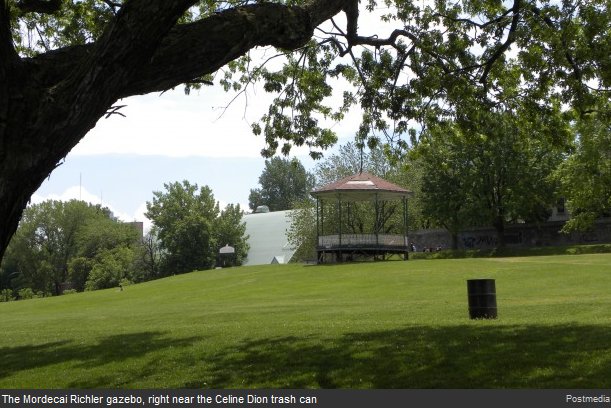
Barbara Kay takes issue with the token that Montreal has chosen to commemorate Mordecai Richler:

Mordecai Richler is Canada’s biggest claim to literary fame. If he had been born and lived in any other province but Quebec there would have been an outpouring of ideas on how to commemorate his life and achievements: perhaps renaming streets in his honour, building schools bearing his name, or erecting a statue featuring the disheveled genius wryly peering over his pince-nez at a smoked meat sandwich on wry…er, rye.

Instead Montreal’s political mandarins have decided he is getting a gazebo — a crummy little open pavilion at the foot of Mount Royal, with no known connection to the author. A place for people to come in out of the rain. Not quite a public toilet, but close.

That’s like naming the change house at an outdoor skating rink after Margaret Atwood, a pellet dispenser at the zoo after Yann Martel, or a maintenance shed after Margaret Laurence. But then, if Mordecai Richler had been born outside Quebec, maybe he wouldn’t have been inspired to the kind of savage indignation that made him such a household word (and often not in a good way) in his native Montreal.

She provides a rather more appropriate memorial gesture:

Here’s an idea: Montreal is riddled with potholes. The French for “pothole” is “nid-de-poule,” literally a chicken’s nest. How about if the word is officially changed to “mort-de-caille(ou)” which means “death of stone” (well, death of pebble, close enough). Henceforth let all Montreal potholes be called Mordecais. In this way, his name will forever be on every Montrealer’s lips, because Montreal potholes are ubiquitous and eternal, and yet not in a good way – “Damn! Another cursed Mordecai!” I think Richler himself would have appreciated the irony, and approved.

June 23, 2011

This is amusing

Filed under: Cancon, Soccer — Tags: — Nicholas @ 11:21

There’s only one team in the world I favour over England, and they just saved themselves from elimination with this effort:

H/T to David Akin for the link.

Your social media reputation and your future employment prospects

Filed under: Cancon, Media, Technology — Tags: , , , , , — Nicholas @ 09:30

Chris Greaves posted this link, which should be a warning to everyone to be (even more) careful about your online reputation:

Camille Cacnio, a part-time receptionist at a car dealership, was caught in a 3-second video clip, stealing clothing from a looted store during the Stanley Cup riots.

She was fired.

Professional mountain biker Alex Prochazka posed in front of a burning car, while wearing a T-shirt from his sponsor Oakley.

The sunglass company promptly dropped him.

Carpenter Connor Mcilvenna declared the riots “awesome” on his Facebook page, and posted several pro-riot status updates, such as “atta boy vancity!!! show em how we do it!!!” and “vancouver needed remodeling anyway….”

RiteTech Construction was listed as his employer on his Facebook profile, and the next morning, Mcilvenna was fired.

His boss said he was flooded with emails and didn’t want the company’s reputation linked to the man.

“I think this will be a turning point in how employers look at social media,” said Peter Eastwood, a partner at Borden Ladner Gervais in Vancouver. “This is an extremely powerful tool that has potentially enormous and immediate consequences for a business.”

This is something the early bloggers had to face, that what you post online (or what is posted about you) will be there forever. No rational employer is going to offer you a job in future without at the very least running a Google search on you, and there’s already a niche market for employers to explore (doing a deeper search on prospective employees). Background check and personal references? I’m starting to wonder why employers even bother going through the motions any more.

June 22, 2011

What is a balance-sheet recession?

Filed under: Cancon, Economics, USA — Tags: , , — Nicholas @ 12:07

Stephen Gordon has some really nasty looking diagrams explaining just what a balance sheet recession looks like:

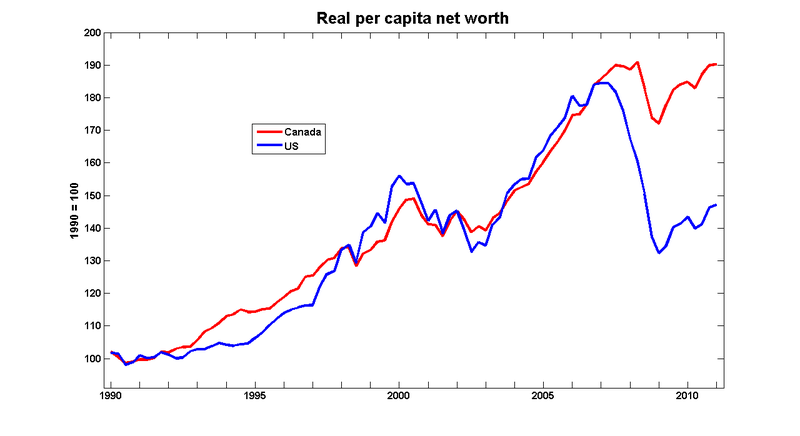
I had never heard the expression “balance-sheet recession” before this recent episode, and it’s time I got around to a comparison of the household balance sheets of the US and Canada. Of all my “Canada is not the US” posts, this is the one that makes me most grateful.

The quarterly data goes back to 1990, and it’s good to put the last few years in context. I’ve scaled all the series by price (the consumption spending deflator) and population. Here is the net worth series:

There’s been talk of a Japan-like ‘lost decade’ in the US; that seems optimistic. US real per capita net worth is back to what it was back in 1999.

More (and somewhat scarier) diagrams at the original post. It doesn’t even finish on a high note:

The US data go back to 1952, so I was able to check the last time the real, per capita value of US housing equity was at its current level. Even after looking at all of these graphs, the answer astonished me: 1978. Nineteen seventy-freaking-eight.

« Newer PostsOlder Posts »

Powered by WordPress


