Quotulatiousness

December 26, 2014

The skillful part of polling is how you phrase the questions

Filed under: Cancon, Media, Politics — Tags: , , , , — Nicholas @ 04:00

Richard Anderson rightly pours scorn on a recent poll on the upcoming 2015 federal election:

This isn’t a push poll, it’s a shove off the cliff and tell me where you land poll.

Let me put it another way:

    If you were forced to choose between vanilla ice cream that’s slightly melted, or a new type of calorie free ice cream that has the great taste of chocolate flavoured orgasms, which would you prefer?

The amazing thing is that the poll still gives the Harper Tories 40% of the vote. So for those of you keeping track at home when forced to choose between a real alternative and the fever dreams of the Canadian Left, the Tories still win. This isn’t a news story this is a sad desperate plea for Justin and Tom to get hitched.

This will never happen. Thomas Mulcair is a seasoned politician who leads the official opposition. The odds are between zero and nothing that he would ever consent to sharing political power, before an election is even held, with a neophyte playing guitar in the Gerald Butts Travelling Show. After years of slobbering media coverage the Once and Future Prime Minister is still being beaten in the polls by a dull bank manager with a terrible haircut. Wait just six months for when the Tory War Room gets fully fired up.

They turned Michael Ignatieff into a mound of excessively self-analyzed jelly. While Justin is more politically adept he is also far less substantive. The Liberal Party has to hope against hope they can spend the next ten months showing pictures of Justin’s adorable family before people figure out that when it comes to Justin there is no there there.

Now some of the embittered cynics in the backrow will counter that Barack Obama, an empty suit’s empty suit, was able to capture the Presidency twice. This is certainly true. Thing is that Barry of Chicago had two powerful trump cards: He is black (sort of) and wasn’t Geroge W Bush.

December 25, 2014

Canadian Pacific Holiday Train 2014

Filed under: Cancon, Railways — Tags: , — Nicholas @ 05:00

December 23, 2014

Creepy Christmas “traditions” – Elf et Michelf

Filed under: Cancon, Government, Liberty — Tags: , , , — Nicholas @ 04:06

Published on 14 Dec 2013

Foucault’s take on the elf on the shelf through an imagined conversation by @DrLauraPinto

H/T to Anthony L. Fisher for the video link:

Dr. Laura Elizabeth Pinto, a digital technology professor at the University of Ontario Institute of Technology, thinks Elf on the Shelf poses a criticial ethical dilemma. In a paper for the Canadian Centre for Policy Alternatives, Pinto wonders if the Elf is “preparing a generation of children to accept, not question, increasingly intrusive (albeit whimsically packaged) modes of surveillance.”

Sensing that she might come off as a humorless paranoid crank, Pinto clarified her position to the Washington Post:

    “I don’t think the elf is a conspiracy and I realize we’re talking about a toy. It sounds humorous, but we argue that if a kid is okay with this bureaucratic elf spying on them in their home, it normalizes the idea of surveillance and in the future restrictions on our privacy might be more easily accepted.” (Emphasis mine).

One could argue that the millions of adults walking around with NSA-trackable and criminal-hackable smartphones in their pockets are far more influential than a seasonal doll in setting the example to the next generation that surveillance is inevitable and Big Brother is not to be feared. Still, Pinto has a point when she writes:

    What The Elf on the Shelf represents and normalizes: anecdotal evidence reveals that children perform an identity that is not only for caretakers, but for an external authority (The Elf on the Shelf), similar to the dynamic between citizen and authority in the context of the surveillance state.

December 21, 2014

The first historical European martial arts tournament

Filed under: Cancon, History — Tags: , , — Nicholas @ 00:05

Aaron Miedema shared a link to this story about the first known tournament for historical European martial arts:

If I asked you when was the first historical European Martial Arts tournament what would you say? 1997? 2003?

Not even close.

How about where? America? Great Britain? Germany? France?

No, none of the above.

What if I told you that the earliest known tournament took place in a region of the globe which we probably don’t hear enough about, but which surely deserves to be known across the HEMA community: Quebec.

Yes. The first ever tournament took place on the island of Montreal in… 1889. Who was heading this tournament? Perhaps Alfred Hutton on a trip in Canada? Or how about one of those French guys from the Olympics? No, it was another HEMA pioneer. One which is unfortunately unknown to us because he did not leave us any manual, but an interesting figure all the same: David Legault.

[…]

Legault came back to Montreal around 1882. There were very few qualified fencing instructors in town at that time, and the art was going through a revival. His friends then encouraged David to open up a fencing salle in the former Institut Canadien, a learned French Canadian society which regularly drew the wrath of the church. There he will teach not only swordsmanship but also boxing, savate, wrestling, great stick and gymnastics. He will try to introduce the model inside Quebec schools, with more or less success, but his regular classes will grow in popularity and Legault will decide to change the nature of his club which will become known as the Guard of the Archiepiscopal Palace. This group acted as an honorary guard to the Catholic archbishop of Montreal as well as a sort of militia to prepare men for military service. Several similar groups will be created across the province, all of them teaching fencing. Volunteering in the Canadian army and various official militia units which were mostly English speaking was not very popular with French Canadians, and many turned toward these groups instead.

December 20, 2014

Repost – Induced aversion to a particular Christmas song

Filed under: Business, Cancon, Gaming, Media, Personal — Tags: , , , , — Nicholas @ 00:02

Earlier this year, I had occasion to run a Google search for “Mr Gameway’s Ark” (it’s still almost unknown: the Googles, they do nothing). However, I did find a very early post on the old site that I thought deserved to be pulled out of the dusty archives, because it explains why I can — to this day — barely stand to listen to “Little Drummer Boy”:

Seasonal Melodies

James Lileks has a concern about Christmas music:

This isn’t to say all the classics are great, no matter who sings them. I can do without “The Little Drummer Boy,” for example.

It’s the “Bolero” of Christmas songs. It just goes on, and on, and on. Bara-pa-pa-pum, already. Plus, I understand it’s a sweet little story — all the kid had was a drum to play for the newborn infant — but for anyone who remembers what it was like when they had a baby, some kid showing up unannounced to stand around and beat on the skins would not exactly complete your mood. Happily, the song has not spawned a sequel like “The Somewhat Larger Cymbal Adolescent.”

This reminds me about my aversion to this particular song. It was so bad that I could not hear even three notes before starting to wince and/or growl.

Mr. Gameways' ArkBack in the early 1980’s, I was working in Toronto’s largest toy and game store, Mr Gameways’ Ark. It was a very odd store, and the owners were (to be polite) highly idiosyncratic types. They had a razor-thin profit margin, so any expenses that could be avoided, reduced, or eliminated were so treated. One thing that they didn’t want to pay for was Muzak (or the local equivalent), so one of the owners brought in his home stereo and another one put together a tape of Christmas music.

Note that singular. “Tape”.

An ad from the year of Trivial Pursuit (via OSRcon)

An ad from the year of Trivial Pursuit (via OSRcon)

Christmas season started somewhat later in those distant days, so that it was really only in December that we had to decorate the store and cope with the sudden influx of Christmas merchandise. Well, also, they couldn’t pay for the Christmas merchandise until sales started to pick up, so that kinda accounted for the delay in stocking-up the shelves as well …

So, Christmas season was officially open, and we decorated the store with the left-over krep from the owners’ various homes. It was, at best, kinda sad. But — we had Christmas music! And the tape was pretty eclectic: some typical 50’s stuff (“White Christmas” and the like), some medieval stuff, some Victorian stuff and that damned “Drummer Boy” song.

We were working ten- to twelve-hour shifts over the holidays (extra staff? you want Extra Staff, Mr. Cratchitt???), and the music played on. And on. And freaking on. Eternally. There was no way to escape it.

To top it all off, we were the exclusive distributor for a brand new game that suddenly was in high demand: Trivial Pursuit. We could not even get the truck unloaded safely without a cordon of employees to keep the random passers-by from trying to grab boxes of the damned game. When we tried to unpack the boxes on the sales floor, we had customers snatching them out of our hands and running (running!) to the cashier. Stress? It was like combat, except we couldn’t shoot back at the buggers.

Oh, and those were also the days that Ontario had a Sunday closing law, so we were violating all sorts of labour laws on top of the Sunday closing laws, so the Police were regular visitors. Given that some of our staff spent their spare time hiding from the Police, it just added immeasurably to the tension levels on the shop floor.

And all of this to the background soundtrack of Christmas music. One tape of Christmas music. Over and over and over and over and over and over and over again.

It’s been over 20 [now 30] years, and I still feel the hackles rise on the back of my neck with this song … but I’m over the worst of it now: I can actually listen to it without feeling that all-consuming desire to rip out the sound system and dance on the speakers. After two decades.

December 19, 2014

In Stephen Harper’s Canada, politics beats economics every time

Filed under: Cancon, Economics — Tags: , , — Nicholas @ 00:03

Stephen Harper gets a lot of criticism for being an ideological hard-liner, but he gets nearly as much flak from small-government conservatives for being no better — and in some cases, much worse — than Jean Chrétien and Paul Martin. Earlier this month in Maclean’s, Stephen Gordon explained some of the reasons for Harper’s political and economic actions:

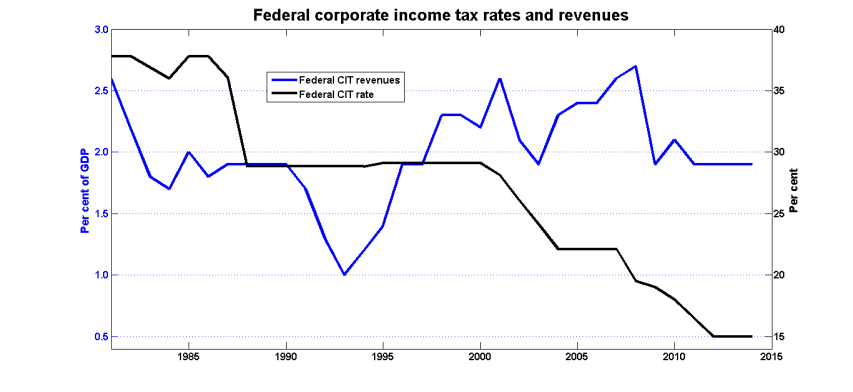
Politics, not economics, has also determined [Harper’s] strategy for achieving this goal [a smaller government-spending-to-GDP ratio]. If you asked an economist for the best way of reducing revenues, she’d probably prepare a list with the taxes that are the most harmful to the economy at the top, and the taxes that are the least harmful at the bottom. The GST would rank at or near the bottom of that list. (Here is a representative reaction to the Conservatives’ 2005 campaign promise to reduce the GST; here is an explanation for why economists think the GST is a good idea.) In economic terms, reducing the GST was probably the worst possible option available to the Conservatives.

But as far as politics goes, it was an inspired choice. It helped win the election, and — perhaps even more importantly — reducing the GST has made it that much harder for any future government to reverse the trend to lower spending. If the Liberals and the NDP were to ask an economist to provide a list of ways of generating the most revenues at the least economic cost, increasing the GST would be at or near the top of the list. But those two GST points are not going to come back to fill federal coffers in the foreseeable future. Both the Liberals and the NDP have campaigned at some point on anti-GST platforms, and history has not been kind to provincial governments that have raised the HST without an electoral mandate to do so. (The NDP’s proposal to increase corporate tax rates is the doppelgänger of the Conservatives’ GST cut. In economic terms, an increase in corporate taxes is probably the worst possible choice for generating revenues, but it’s a potential vote-winner. Maybe it will work for them as well as it did for the CPC.)

[…]

This brings us to the “starve the beast strategy” described in detail here: the reduction in revenues is now a justification for reducing expenditures. But, once again, the strategy is driven by politics, not economics. The elements are as follows (see also here and, most recently, here):

  1. Let transfer payments to individuals grow at the rate of GDP.
  2. Let transfer payments to provinces grow at the rate of GDP.
  3. Hold nominal direct program spending constant.

These elements have been in place in every budget since 2010. The economics of this approach are very dodgy: the economically efficient way to approach the problem of reducing spending is to perform a cost-benefit analysis and eliminate the programs that don’t pass the test. But the politics are something else. Cuts in transfer payments directly affect peoples’ personal finances, and could be reversed at no political cost. The same is true for cuts in transfer payments to the provinces; much of the Jean Chrétien-era cuts to the provinces were rescinded a few year later. The path of least political resistance is through direct program spending: the cost of paying federal public servants’ wages.

December 17, 2014

Canadian telcos: “there is no need for legally mandated surveillance and interception functionality”

Filed under: Business, Cancon, Law, Liberty — Tags: , , , — Nicholas @ 07:10

Sounds good, right? Canada’s telecom companies telling the government that there’s no reason to pass laws requiring surveillance capabilities … except that the reason they’re saying this is that “they will be building networks that will feature those capabilities by default“:

After years of failed bills, public debate, and considerable controversy, lawful access legislation received royal assent last week. Public Safety Minister Peter MacKay’s Bill C-13 lumped together measures designed to combat cyberbullying with a series of new warrants to enhance police investigative powers, generating criticism from the Privacy Commissioner of Canada, civil liberties groups, and some prominent victims rights advocates. They argued that the government should have created cyberbullying safeguards without sacrificing privacy.

While the bill would have benefited from some amendments, it remains a far cry from earlier versions that featured mandatory personal information disclosure without court oversight and required Internet providers to install extensive surveillance and interception capabilities within their networks.

The mandatory disclosure of subscriber information rules, which figured prominently in earlier lawful access bills, were gradually reduced in scope and ultimately eliminated altogether. Moreover, a recent Supreme Court ruling raised doubt about the constitutionality of the provisions.

[…]

Perhaps the most notable revelation is that Internet providers have tried to convince the government that they will voluntarily build surveillance capabilities into their networks. A 2013 memorandum prepared for the public safety minister reveals that Canadian telecom companies advised the government that the leading telecom equipment manufacturers, including Cisco, Juniper, and Huawei, all offer products with interception capabilities at a small additional cost.

In light of the standardization of the interception capabilities, the memo notes that the Canadian providers argue that “the telecommunications market will soon shift to a point where interception capability will simply become a standard component of available equipment, and that technical changes in the way communications actually travel on communications networks will make it even easier to intercept communications.”

In other words, Canadian telecom providers are telling the government there is no need for legally mandated surveillance and interception functionality since they will be building networks that will feature those capabilities by default.

December 12, 2014

Supreme Court swings and misses on cellphone privacy ruling

Filed under: Cancon, Law, Liberty — Tags: , , , , — Nicholas @ 07:00

Michael Geist on the most recent Supreme Court of Canada ruling on the ability of the police to conduct warrantless searches of cellphones taken during an arrest:

The Supreme Court of Canada issued its decision in R. v. Fearon today, a case involving the legality of a warrantless cellphone search by police during an arrest. Given the court’s strong endorsement of privacy in recent cases such as Spencer, Vu, and Telus, this seemed like a slam dunk. Moreover, the U.S. Supreme Court’s June 2014 decision in Riley, which addressed similar issues and ruled that a warrant is needed to search a phone, further suggested that the court would continue its streak of pro-privacy decisions.

To the surprise of many, a divided court upheld the ability of police to search cellphones without a warrant incident to an arrest. The majority established some conditions, but ultimately ruled that it could navigate the privacy balance by establishing some safeguards with the practice. A strongly worded dissent disagreed, noting the privacy implications of access to cellphones and the need for judicial pre-authorization as the best method of addressing the privacy implications.

The majority, written by Justice Cromwell (joined by McLachlin, Moldaver, and Wagner), explicitly recognizes that cellphones are the functional equivalent of computers and that a search may constitute a significant intrusion of privacy. Yet the majority cautions that not every search is a significant intrusion. It ultimately concludes that there is the potential for a cellphone search to be intrusive, it does not believe that that will be the case in every instance.

Given that conclusion, it is prepared to permit cellphone searches that are incident to arrest provided that the law is modified with some additional protections against invasion of privacy. It proceeds to effectively write the law by creating four conditions: a lawful arrest, the search is incidental to the arrest with a valid law enforcement purpose, the search is tailored or limited to the purpose (i.e., limited to recent information), and police take detailed notes on what they have examined and how the phone was searched.

December 9, 2014

Colby Cosh on the recent “unprecedented” terror attacks

Filed under: Cancon, Europe, History, Politics — Tags: , , , , — Nicholas @ 00:03

In his latest Maclean’s article, Colby Cosh talks about the recent “freelance” terror attacks on Canadian soil and points out that no matter what the reporters say, they’re hardly “unprecedented”:

There has been much discussion about how to think of the type of freelance Islamist terrorist that has recently begun to belabour Canada. What labels and metaphors are appropriate for such an unprecedented phenomenon? I possess the secret: It is not unprecedented. This has been kept a secret only through some odd mischance, some failure of attention that is hard to explain.

I discovered the secret through reading about 19th-century history, particularly the years from the 1848 revolutions to the outbreak of the First World War in 1914. The key was Bismarck, the Prussian minister-president who unified Germany. If you want to learn about Bismarck, you will probably pick up a book by some historian of international relations, such as A.J.P. Taylor. That’s the right place to start. But it means you can read a lot about Bismarck before finding out about the time in May 1866 when a guy shot him.

Ferdinand Cohen-Blind, a Badenese student of pan-German sentiments, waylaid Bismarck with a pistol on the Unter den Linden. He fired five rounds. None missed. Three merely grazed his midsection, and two ricocheted off his ribs. He went home and ate a big lunch before letting himself be examined by a doctor.

[…]

The point is not that Bismarck was particularly hated, although he was. The point is that this period of European (and American) history was crawling with young, often solitary male terrorists, most of whom showed signs of mental disorder when caught and tried, and most of whom were attached to some prevailing utopian cause. They tended to be anarchists, nationalists or socialists, but the distinctions are not always clear, and were not thought particularly important. The 19th-century mind identified these young men as congenital conspirators. It emphasized what they had in common: social maladjustment, mania, an overwhelming sense of mission and, usually, a prior record of minor crimes.

In my Origins of WW1 series, I quoted from The War That Ended Peace (which I still heartily recommend):

Margaret MacMillan describes the typical members of the Young Bosnians, who were of a type that we probably recognize more readily now than at any time since 1914:

    [They] were mostly young Serb and Croat peasant boys who had left the countryside to study and work in the towns and cities of the Dual Monarchy and Serbia. While they had put on suits in place of their traditional dress and condemned the conservatism of their elders, they nevertheless found much in the modern world bewildering and disturbing. It is hard not to compare them to the extreme groups among Islamic fundamentalists such as Al Qaeda a century later. Like those later fanatics, the Young Bosnians were usually fiercely puritanical, despising such things as alcohol and sexual intercourse. They hated Austria-Hungary in part because they blamed it for corrupting its South Slav subjects. Few of the Young Bosnians had regular jobs. Rather they depended on handouts from their families, with whom they had usually quarreled. They shared their few possessions, slept on each other’s floors, and spent hours over a single cup of coffee in cheap cafés arguing about life and politics. They were idealistic, and passionately committed to liberating Bosnia from foreign rule and to building a new and fairer world. Strongly influenced by the great Russian revolutionaries and anarchists, the Young Bosnians believed that they could only achieve their goals through violence and, if necessary, the sacrifice of their own lives.

The “peaceful century” from the defeat of Napoleon to the outbreak of the First World War was far from peaceful — we only see it as such in contrast to the bloodbath of 1914-1918. And terrorists of a type we readily recognize from the front pages of the newspapers today were prefigured exactly by the anarchist revolutionaries of a century ago.

December 8, 2014

RMR: Rick’s Rant – Turn Signals

Filed under: Cancon, Humour — Tags: — Nicholas @ 00:02

Published on 3 Dec 2014

Rick’s Rant for December 2nd, 2014.

December 7, 2014

A Supreme Court decision that actually improved privacy rights for Canadians

Filed under: Cancon, Law, Liberty, Technology — Tags: , , , — Nicholas @ 12:08

The courts have far too often rolled over for any kind of police intrusions into the private lives of Canadians, but a decision from earlier this year has actually helped deter the RCMP from pursuing trivial or tangential inquiries into their online activity:

A funny thing happens when courts start requiring more information from law enforcement: law enforcers suddenly seem less interested in zealously enforcing the law.

Back in June of this year, Canada’s Supreme Court delivered its decision in R. v. Spencer, which brought law enforcement’s warrantless access of ISP subscriber info to an end.

    In a unanimous decision written by (Harper appointee) Justice Thomas Cromwell, the court issued a strong endorsement of Internet privacy, emphasizing the privacy importance of subscriber information, the right to anonymity, and the need for police to obtain a warrant for subscriber information except in exigent circumstances or under a reasonable law.

The effects of this ruling are beginning to be felt. Michael Geist points to a Winnipeg Free Press article that details the halcyon days of the Royal Canadian Mounted Police’s warrantless access.

    Prior to the court decision, the RCMP and border agency estimate, it took about five minutes to complete the less than one page of documentation needed to ask for subscriber information, and the company usually turned it over immediately or within one day.

Five minutes! Amazing. And disturbing. A 5-minute process indicates no one involved made even the slightest effort to prevent abuse of the process. The court’s decision has dialed back that pace considerably. The RCMP is now complaining that it takes “10 hours” to fill out the 10-20 pages required to obtain subscriber info. It’s also unhappy with the turnaround time, which went from nearly immediate to “up to 30 days.”

In response, the RCMP has done what other law enforcement agencies have done when encountering a bit of friction: given up.

    “Evidence is limited at this early stage, but some cases have already been abandoned by the RCMP as a result of not having enough information to get a production order to obtain (basic subscriber information),” the memo says.

December 6, 2014

The “low-information voter”

Filed under: Cancon, History, Politics — Tags: — Nicholas @ 00:02

At The Gods of the Copybook Headings, Richard Anderson charts the sad decline of Michael Chong (whose brave attempt to reform our political system has been thoroughly neutered by the powers-that-be), and talks about the infamous “low-information voters” who somehow keep screwing up democracy … or something:

There has been much bemoaning in recent months about the “low information voter.” This is a polite euphemism for “lazy dumb asses.” The lazy dumb ass is a universal phenomenon but our age has take this once marginal figure and made him central to our political concerns. Different eras would have simply ignored the lazy dumb asses and restricted the franchise to people who give a rat’s ass about the political process. Oh what a Golden Age that was!

Why does it matter? A politician who knows that he must confront an engaged and informed electorate won’t try to pull half as many political stunts. Politics is the art of the possible which is another way of saying the art of whatever hell you can get away with. When a critical mass of the electorate are lazy dumb asses the job of the politician becomes easier. Lying is easier. Evading responsibility is easier. It’s the difference between dealing with an omniscience mother and an idiot man child. The electorate was never quite the former but it has now largely become the latter.

Sometimes half a loaf is worse than no loaf. Mr Chong earned some very impressive brownie points with the civic minded set when he resigned from cabinet and then proposed this bill. There was a kind of teary eyed delusion when it was first introduced. A principled politician making a principled stand on the very important principle of responsible government. Many of us nearly fainted from righteous appreciation.

The spectacle of the great and the good talking about the “low-information voter” is quite amusing: what you think they’re talking about isn’t actually the case. In most cases, they’re talking about you.

It’s been less than a century since the franchise was extended to most adults (by chronology, anyway) and a decade or so less for those with two “X” chromosomes. Harking back to some imaginary golden age when voters actually cared seriously about how to cast their votes is nonsense … the vast majority of voters — regardless of how broad or restrictive the franchise might be — were, are, and will forever continue to be low-information voters. This is because of our old friend from the dismal field of economics, the opportunity cost.

The cost to you for educating yourself about the political situation and the current contenders in any given election is almost always orders of magnitude higher than any possible benefit you might personally derive from getting your vote “right”. As a rational being, it’s insane for you to spend any time at all in figuring out who to vote for — this is why party labels are so important. You don’t know whether to vote for Saba Chen-O’Toole-Wenger or Mohammed Jean-Claude Campbell-Mirkovich? Check their party affiliations for a cheater’s guide. Ms. Chen-O’Toole-Wenger is for the Jacobins, while Mr. Campbell-Mirkovich is for the Falangists at least lets you know whether option A is better (for you) than option B. I’m not really a fan of the party system, but it clearly does provide a useful benefit in the voting booth.

November 30, 2014

Working for free

Filed under: Cancon, Economics — Tags: , — Nicholas @ 11:12

In Maclean’s earlier this month, Colby Cosh addressed the brief flare-up of controversy around comments by the Governor of the Bank of Canada on the topic of doing work for free:

It is inherently difficult to feel sorry for the guy whose signature is on the money. But the governor of the Bank of Canada, Stephen Poloz, has been receiving what must be an unfamiliar burst of catcalls for comments he made about underemployed youth on Nov. 3 and 4.

Canada, Poloz was explaining, is making a somewhat gimpy recovery from the financial bubble-burst of 2008-09. A lot of the lost employment has been superficially replaced, but an unusual quantity of the new work consists of part-time jobs being performed by people who would like full-time ones, and there are some 200,000 young people who are “out of work, underemployed, or trying to improve their job prospects by extending their education.

“I bet almost everyone in this room knows at least one family with adult children living in the basement,” he added. “I’m pretty sure these kids have not taken early retirement.”

The next day, at a hearing of the House of Commons finance committee, Scott Brison followed up, asking if Poloz anticipated a long-term “scarring” effect on young people whose entry into the labour market has coincided with a lingering recession. Poloz’s response has been summarized as: “Go work for free.” What he actually said was: “When I was asked yesterday, I suggested, as I have privately to young folks who ask me what they should be doing in this job environment, that people volunteer to do something which is at least somewhere related to their expertise, so that it’s clear they are gaining some learning experience during that period.”

In fewer words: yeah, go work for free. The remark led to a curious revival of this year’s earlier controversy over unpaid internships, particularly in the magazine industry. Poloz hadn’t technically said anything about unpaid internships, which are hardly the only means of amassing job experience by working for free, and in many cases probably not the best one. (If you want magazine work, don’t take an internship. Start a blog.) Nonetheless, there was a fresh round of recrimination for companies that faced legal and moral pressure months ago and stopped providing internships as a result.

One gets the sense that Poloz and his critics are talking past one another. The critics complained that not every underemployed young person has the luxury of living with his parents. But it is hard to see how that would contradict his personal advice to those who do have it. Everybody should make maximum use of their advantages in creating a career path. And a comfortable basement with no rent attached is one of the most widely available.

November 29, 2014

Lorne Scots unveil two Cenotaph additions in Brampton and Georgetown

Filed under: Cancon, Military — Tags: , , — Nicholas @ 00:03

My old militia regiment was in the news recently:

Lorne Scots at Georgetown Cenotaph

The communities of Brampton and Georgetown paid a special tribute to veterans of Afghanistan during Remembrance Week, adding the 12-year mission to local cenotaphs dedicated to Canada’s war dead.

On the year that the Canadian mission in Afghanistan drew to a close, civic leaders in both communities determined that adding “Afghanistan,” beneath the names of Canada’s other major conflicts would be a fitting tribute.

In separate ceremonies during Remembrance Week, The Lorne Scots (Peel, Dufferin and Halton Regiment) were given the honour of unveiling the new additions to the cenotaphs at the Brampton War Memorial and the Georgetown War Memorial.

“We are honoured by our communities and their tributes, this is a fine way to honour the soldiers who fell or were wounded in Afghanistan,” said Lieutenant-Colonel Duane Hickson, Commanding Officer of the Lorne Scots and an Afghanistan veteran. “And it’s very fitting to be doing this during Remembrance Week.”

The Canadian Armed Forces first deployed to Afghanistan in October, 2001, just weeks after the 9/11 attacks on New York and Washington.

The first Lorne Scot deployed in 2004, with the International Security Assistance Force in Kabul, with the Regiment’s biggest contributions in 2008, 2009 and 2010. The final Lorne Scot returned in September 2013 as part of the final rotation of Canadian soldiers in Afghanistan.

By the end of the mission, the Lorne Scots had deployed 46 soldiers and officers, nearly 25% of the unit, to Afghanistan, with the last soldier returning in 2013.

The Lorne Scots take pride in their role in their communities, participating in community events and parades every year, and represent them to the nation and on the world stage when they deploy abroad. LCol Hickson said the Regiment was honoured to be asked to take part in the unveiling and will continue to serve their nation and their communities.

November 28, 2014

Niagara’s wineries … too many too soon?

Filed under: Cancon, Wine — Tags: , — Nicholas @ 00:03

Michael Pinkus shares a cringeworthy report from a foreign wine writer on a recent winery tour in the Niagara region:

After giving it some thought it came to me as a sports reference: have we hit that expansion team overload amongst the wineries of Niagara? What I mean by that is a watering down of the talent available. For example: when a league (NHL, NFL, CFL, etc.) expands to include more franchises the biggest worry is that there will not be enough high-caliber talent in the pool to feed that new franchise and keep it competitive. Now apply the same theory to the wineries: with more and more wineries opening every year is the talent pool of engaged and conscientious prospective “manpower” really there to staff them? Is that the problem? Or should we just blame training and be done with it?

A wine writer from another country (who will remain nameless) wrote to me about a visit he recently made to a winery in Niagara (which will also remain nameless). Here were some of his comments about the tour he took:

“Worst tour: Inexperienced tour guide who didn’t understand what she’d been taught and gave a series of garbled ideas … e.g. windmill in vineyard uses propane to heat the vines, grafting is done because it’s too cold here to grow on own roots, [also] told us we wouldn’t enjoy the wines in the tasting and that their barrel fermented and aged Chardonnay was best in a spritzer.”

I’m not saying all wineries are bad, but there are some that leave, for lack of a better expression, a bad taste in the mouth — even when their food (or, for that matter, wine) is delicious. One of the wineries we visited in Niagara-on-the-Lake provided us such a lousy experience that they almost did not make our top five … but their food was just so memorably delicious, it was the thing that saved them — now imagine if they did not have that food, it would have been memorable for all the wrong reasons.

Whether it’s the lollygagging behind the counter, chatting with co-workers to the point where you indicate where to go with your chin (“it’s over there”), ignoring a guest until they approach you, or just being grumpy and surly, it all takes its toll on the winery’s reputation. A bad experience sticks in your mind more and longer than a good one. I especially remember a tasting at a famous Niagara-on-the-Lake winery about 10 years ago where, after buying two cases of wine between the three people I was with, the staff member who served us chased us out into the parking lot for the $5.50 tasting fee … I have never, ever forgotten that one.

I wonder if that last winery was the same one I’ve been avoiding for the last ten years … the experience wasn’t exactly the same, but it soured me on ever having anything to do with them again. Bad customer service in the wine trade has a much greater long-term than it does in, say, the fast food business.

« Newer PostsOlder Posts »

Powered by WordPress