Published on 3 Mar 2015
The capital of Nova Scotia attempts to attract tourism by embracing winter’s reality.
March 7, 2015
22 Minutes: Halifax Tourism Ad
March 5, 2015
Tax Free Savings Accounts
At Worthwhile Canadian Initiative, Livio Di Matteo talks about tax free savings accounts (TFSAs), registered retirement savings plans (RRSPs), and why some people are getting upset that some Canadians benefit more from these financial tools than others do:
A major theme running under most of these arguments goes something like this — Registered Retirement Savings Plans (RRSPs) at least leave “a legacy of tax revenue to future governments” whereas TFSAs may generate “supernormal” returns that will escape taxation and on top of it will accrue primarily to the well-off.
However, when I think of RRSPs and TFSAs, I see them both as essentially the same. They are both “tax expenditures” that are designed to encourage saving by promising some type of tax incentive. The broader debate should really be about how we want to encourage more saving and then about “tax expenditures” in general rather than how much we should allow as limits to either RRSP or TFSA contributions.
However, if we are going to argue about RRSPs and TFSAs, to my mind what differs is the timing of the break. For an RRSP, you are getting the tax incentive upfront and deferring the taxes until you withdraw the money. For a TFSA, you are making the contribution with after tax dollars and allowing the contribution to accumulate tax free — the tax benefit comes down the road as the money grows.
[…]
Young households with children who face more cash constraints might find the RRSP more attractive while older households would probably find the TFSA more attractive. All other things given, both vehicles are of greater advantage to higher rather than low income earners because higher incomes are more likely to be able to save — period. If you are going to make the argument that TFSAs are somehow favouring the wealthy or higher income earners, you need to acknowledge that the same argument applies to RRSPs.
Update, 7 March: It kinda helps when I remember to include the correct link to an article…
March 2, 2015
Food naming oddities
David Warren on the oddly named “Digby Chicken” and “Bombay Duck” along with a paean to the joys of food shopping in Parkdale:
Parkdale, which is to say, the inner core of the Greater Parkdale Area, in which the High Doganate is located, is a melting pot of innumerable overlapping ethnications. Among our most exotic immigrants are those from the far east: Nova Scotia, for instance, and Newfoundland. Shopping, at least for food in Parkdale, is a treat. We have every sort of specialist grocery, and in effect, groceries within groceries. One gets one’s Tibetan yak sausage, for instance, from a Serbian butcher whose store is cowboy-themed; ingredients for one’s Somali maraq from the Sinhalese grocery (via their Maldivian connexion); but the exhilarating, cardamom-infused gashaato instead via the Sikh Punjabis, as supplement to their Bengali sweets. Note, this culinary cross-dressing is the opposite of multiculturalism. Rather I would call it, “downmarket fusion.”
This being Lent, I try to avoid fish on Fridays. There’s enough of that for the other days, beans on rice will do, or perhaps sinfully on the last two Fridays, I indulged a craving for sweet potato in a Siamese red sauce. I woke this morning with a craving for salt, as well as protein, and as God is merciful, recalled to mind a little platter of Digby chicks in my fridge — obtained some days before from the Maritime ethnic section of a cheap local supermarket.
Digby Chicken has long been Nova Scotia’s answer to Bombay Duck. The latter, also salty, and so powerful in flavour and scent that it requires careful packaging, is actually a fish, the bummalo. Gentle reader may already be trying to construct an etymology from that, but there is no hope for him. The fish is actually harvested from the waters off Bombay. It was transported from there by rail, in the good old days of British Imperialism, aboard the Bombay Dhak (i.e. the Bombay Mail), which gave rise to such expressions as, e.g. “You smell like the Bombay Dhak.” Surely, that will be enough to go on.
February 24, 2015
A Victorian-era effort equivalent to a moon landing in the 20th century
At sp!ked, Alexander Adams tries to put the Franklin Expedition into a context we can understand:
In May 1845, two Royal Navy ships, HMS Terror and Erebus, embarked from London on a voyage with ambitious aims. The mission would forge a passage through the partially mapped channels of northern Canada and pioneer the Northwest Passage. This route from Greenland to Alaska via the icy channels on the Arctic Circle would open new trading routes and allow vessels to forgo the dangerous and lengthy passage around Cape Horn. The attempt would use new technology pioneered in Britain — coal-fired engines powering propeller screws for locomotion, and tinned food.
The Admiralty decided on a large party in two ships under the command of Arctic veteran Sir John Franklin. Hostile conditions, the use of new technology, and — critically — operating beyond immediate assistance of the few trading forts and whaling stations to the south, meant the expedition was the equivalent of a Victorian-era moon landing. If men, supplies, technology, knowhow or leadership failed, then deaths could be expected. However, experience suggested that if the attempt met insurmountable obstacles there was a fair chance of retreating with only minor casualties, if leadership was decisive enough.
For the purposes of communication, the expedition was supplied with watertight brass tubes to hold written messages, to be left behind in coastal cairns. Provisions for three years were supplied, as it was expected that two overwinterings, locked in sea ice, would have to be borne. Without coal and food depoted ahead, and without a supply ship following the next season, the Admiralty’s plan left Franklin perilously reliant on his own resources.
[…]
It became plain, as search parties brought back the few clues, that 129 officers and men had died in the greatest single disaster in Arctic exploration. A rough outline became clear. All had started well but the ships had been woefully underpowered by their engines and relied on their sails. Much of the tinned food — produced by a contractor who was the lowest bidder — turned out to be rotten. A later expedition, using identical tins, discovered that much of their provisions were inedible. Some tins of meat included bone, which reduced the edible content to half of what it should have been. Loose beads of solder may have caused lead poisoning and inadequate preparation of tinned food may have given rise to cases of botulism. Franklin’s ships became beset during their second and third summers, rendering them prey to tidal movements in ice and leaving men dangerously short of supplies. Their margin for survival had been cut to a bare minimum, as evidence of a terse note (the only one ever found) demonstrates. The message said that Franklin had died and survivors were abandoning the ships to head south with rowing boats. It was an impossibly long journey for starving men. (One of those boats — with skeletons — was discovered.)
February 17, 2015
Ontario’s political future seems unusually feminine
After the last serious challenger dropped out of the race to be leader of the Progressive Conservatives, Christine Elliot (my local MPP) now appears to be the default choice to fill the leadership role. Richard Anderson has a characteristic take on the near future of Ontario politics:
So that leaves Christine Elliott and a bunch of other people. I could, of course, look up the names of the other people but that would be a waste of valuable electrons. No doubt they are all honourable and public spirit individuals whose contributions to the political process Ontarians eagerly acknowledge. I guess. One would assume given the circumstances.
Christine Elliott is now unofficially the leader of the official opposition. In 2019 she will have the honour of being defeated by Kathleen Wynne in another improbable landslide. To some this sounds like a daunting and terrifying prospect. Don’t worry. When 2019 comes around you won’t be worried about another Win for Wynne. No sir. You’ll be too busy fighting for food at the burnt-out Loblaws to give a damn about politics. Change that you can believe in.
[…]
Growing up in that dark epoch known as the 1980s I well recall feminists complaining about how the world was run by cranky old men stuck in the past. Ancient dinosaurs who monopolized power and prevented those with youth and innovative ideas from coming to the fore of public life. So much has changed since that time. The male gerontocracy of the Reagan Era has been swept away by the female gerontocracy of the Wynne-Elliott Era. You’ve come a long way baby.
Now that feminism has utterly triumphed, with all three of the major parties run by women, we can appreciate how right the early feminists were about, well, everything. Now that women rule Ontario the economy is humming along splendidly, the finances are managed like a prudent housewife of old and peace and love has spread through out the land. Ordinary voters look to the Ontario matriarchy with a degree of trust and understanding that no male politician has ever commanded.
Let us give a moment of thanks.
February 16, 2015
Ontario Southland Railway plow chase
Published on 12 Feb 2015
On February 3, Ontario Southland operated their first plow of the season from Salford south to Tillsonburg, then west to St. Thomas. This was also the first time a pair of F units have been used in plow duty on the railroad.
H/T to Laura Spring for the link.
Operation CRABSTICK
Think Defence looks back at an anti-invasion project to deny airfields to German forces along the southeast coast of England after the Dunkirk evacuation and onset of the Battle of Britain:
A method was also sought to deny the runway to enemy gliders and transport aircraft and so the Canadian Pipe Mine was devised by the 1st Canadian Tunnelling Company. 50-70mm steel pipes were inserted into the ground using hydraulic pipe pushing equipment and laid in a criss cross pattern about 6ft under the surface. They were subsequently filled with explosives, usually a blasting gelignite called ‘Polar Blasting Gelignite’ which was very powerful.
They were also called McNaughton Tubes after the GOC of 1 Canadian Division who according to his biographer got the idea for using hydraulic rams from bootleggers who used the method for creating an offsite distribution point for their whiskey!
Only 9 airfields were identified for mining initially but this rose to include other locations, by the end of 1942, after the threat of invasion had receded, 30 locations were mined, not all of them airfields. It is estimated that over 40,000ft of pipe mines were installed.
During the war some of the pipe mines were made safe and removed because of the deterioration of the explosive filler but most were left in situ. After the war Canadian engineers were tasked with removal but it seems from reading different sources that records were incomplete and some doubt exists whether the clearance activity was completed. Additional clearance efforts were made, one that resulted in the death of a Ukrainian worker at one of the locations.
February 15, 2015
A new rifle for the Canadian Armed Forces?
Popular Science has a brief overview of a proposed new small arm for the Canadian Armed Forces:
Maybe Canada’s Armed Forces are fighting a Wendigo infestation no one knows about. Perhaps they’re engaged in a secret war against Bigfoot and his moose army for control of the Northwest Passage. There’s also the reality that Canada is a NATO partner and fights regular wars overseas; Canadian troops fought alongside American ones in Afghanistan from 2001 until March 2014. Well, to make Canada ready to take on their next foe, Colt Canada just released a video demonstration of a new prototype gun for the Canadian military. And it looks ridiculous.
The gun is a “bullpup,” meaning the magazine is fed into the gun behind the trigger rather than in front. The main effect of the bullpup design is that rifles can be shorter without losing any effectiveness. The gun can install either a three-round grenade launcher or a shotgun. Shotguns are useful in close quarters, while grenade launchers give more range than just hand-tossing a small explosive. The main gun fires 5.56 ammo, a standard NATO round. Future plans for the gun include smart targeting systems, like those found in TrackingPoint rifles.
They also include a rather bland video of the proposed new weapon firing 5.56mm rifle rounds, 12-gauge shotgun shells, and 40mm grenades:
February 12, 2015
“… the Canadians have a reputation for being very effective in combat”
Strategy Page explains why Canadian military instructors in Kurdistan sometimes need to use their weapons even if they may not technically be “in combat”:
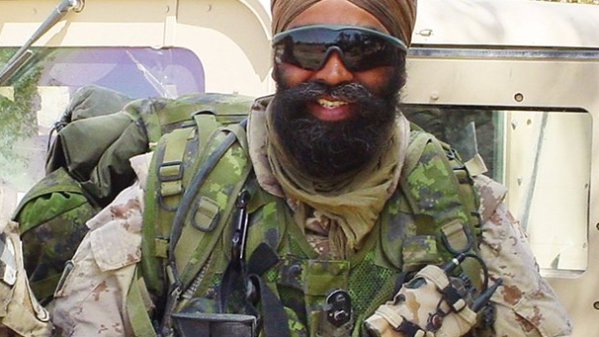
Canada has sent 625 troops (11 percent of them commandos) to train Iraqis (mainly Kurds) to more effectively fight ISIL. Canadian legislators (not to mention the media and many Canadians) insisted that these troops not be directly involved in combat. Then it became known that Canadian troops had, in the last three months, called in at least 13 air strikes on ISIL and in several instances Canadian commandos used sniper rifles to “neutralize” ISIL mortars and machine-guns. The military responded that this was not exactly involving Canadian troops in combat. Calling in air strikes is something you want to entrust to people with experience especially since Canada also has six F-18 fighter bombers operating over Iraq. Training Kurds to call in air strikes involves showing them how it is done. This is best done at the front line, and demonstrations by the more experienced Canadians is a very useful training technique.
The commandos firing on ISIL fighters was because some commandos were assigned as security for senior Kurdish commanders and Canadian advisors visiting the front lines. When the Canadians and Kurds came under fire the commandos quickly located and “neutralized” (killed or caused to flee) the ISIL men involved. Most of the critics accepted these explanations, which basically said that if you are going to train and advise combat commanders you have to spend some time near where the fighting it taking place. This is not only more realistic, but gives your trainers more credibility of your students can see their instructors in action.
World War II Relics: Juno Beach
Published on 5 Feb 2015
National Geographic television series The Sea Hunters Relics exploring the history of World War II Juno Beach.
February 10, 2015
Smug Torontonians preen themselves over another meaningless survey
Richard Anderson supplies the appropriate level of disdain:
It’s always nice when a big important magazine notices Canada. It’s also a big important British magazine. Even nowadays it’s extra special when mother says we’ve done so very well for ourselves. Did we mention the solarium we’re having installed? The Americans don’t have a solarium. Just thought we’d mention that. We got a great deal with the contractor. Excellent references.
Torontonians are known through out our fair dominion for two things: Having a gigantic tower that is no longer the most gigantic in the world and being incredibly smug. The original logo for Toronto actually featured a very smug looking beaver carefully ignoring the rest of Canada. If you paid close attention it was obvious the beaver was looking at New York but in a very nonchalant sort of way.
I hate it when The Economist or the OECD or UN or the OAS or whoever the hell puts out these surveys. Like most rankings the whole thing is a bit of numerical legerdemain. A recurring example of how the easiest way to bullshit your way through life is to use numbers. In what real common sense way is Toronto better than Sydney? Did you talk to someone who has lived in both cities?
Didn’t bloody think so. That would be journalism.
As a native Torontonian I would like to ask the editors of The Economist, those non-byline using smug bastards, why they think Toronto is so wonderful? Yes I know you visited here one summer for a conference. You strolled down Bloor Street and bought something at the Roots Store or Holts. It was so terribly clean and the homeless people were so very polite. Have you lived here? Would you ever in your right mind move from Chelsea to the Annex? Exactly. You’d prefer to be cramped and gouged in London than less cramped and less gouged in Toronto. Why? Because it’s friggin’ London! The potholes are older and more historic than the whole of Toronto.
February 9, 2015
The fantasy that CSE/CSIS oversight will actually protect the privacy of Canadians
Michael Geist on the rather disturbing news that Canadian intelligence agencies are busy watching the uploads of every internet user (including the Canadian users that CSE/CSIS are theoretically banned from tracking by the letter of the law):
… the problem with oversight and accountability as the primary focus is that it leaves the substantive law (in the case of CSE Internet surveillance) or proposed law (as in the case of C-51) largely unaddressed. If we fail to examine the shortcomings within the current law or within Bill C-51, no amount of accountability, oversight, or review will restore the loss of privacy and civil liberties.
First, consider the Snowden revelations that the CSE has been the lead on a surveillance initiative that gathers as many as 15 million uploads and downloads per day from a wide range of hosting sites that even appear to include the Internet Archive. The goal is reputed to be to target terrorist propaganda and training materials and identify who is uploading or downloading the materials. The leaked information shows how once a downloader is identified, intelligence agencies use other databases (including databases on billions of website cookies) to track the specific individual and their Internet use within hours of identified download.
The Levitation program, which removes any doubt about Canada’s role in global Internet surveillance, highlights how seemingly all Internet activity is now tracked by signals intelligence agencies. Note that the sites that host the downloads do not hand over their usage logs. Rather, intelligence agencies are able to track who visits the sites and what they do from the outside. That confirms a massive surveillance architecture of Internet traffic operating on a global scale. Is improved oversight in Canada alone going to change this dynamic that crosses borders and surveillance agencies? It is hard to see how it would.
Moreover, these programs point to the fundamental flaw in Canadian law, where Canadians are re-assured that CSE does not – legally cannot – target Canadians. However, mass surveillance of this nature does not distinguish between nationalities. Mass surveillance of a hundred million downloads every week by definition targets Canadians alongside Internet users from every corner of the globe. To argue that Canadians are not specifically targeted when it is obvious that the personal information of Canadians is indistinguishable from everyone else’s data at the time of collection, is to engage in meaningless distinctions that only succeed in demonstrating the weakness of Canadian law. Better oversight of CSE is needed, but so too is a better law governing CSE activities.
February 8, 2015
An ordinary February day on the railway in New Brunswick
EPIC CATCH!!! Dashing Thru the Snow – CN Train 406 West at Salisbury, NB (Feb 3, 2015)
I’m not even sure how many locomotives this train had …
Railfanning Post Blizzard of 2015 Storm #3.
Canadian National Railway locomotive 2304 (ES44DC) plows through huge snow drifts and gives me a big ass snow shower as it leads the daily CN manifest train 406 West (Moncton, NB to Saint John, NB) at Salisbury, New Brunswick.
I’m not sure how the train crew can even see with all that snow on the locomotive’s nose!
Southern New Brunswick was hit with three major blizzards in less than a week, and there is more snow in the forecast.
Filmed at 3:05pm, Tuesday February 3, 2015 at mile 11 of the CN Sussex Subdivision.
H/T to Roger Henry for the link.
February 6, 2015
Baird makes for the exit
Paul Wells on the somewhat precipitate departure of Canada’s foreign minister, John Baird:
This is the third time Stephen Harper has found himself suddenly short a foreign minister and the first time it has mattered. On May 26, 2008, Maxime Bernier resigned the portfolio after he left confidential documents at a girlfriend’s house, and the capital was briefly awash in bad puns about “leaky briefs.” In the federal election of May 2, 2011, Lawrence Cannon lost his seat to a rookie New Democrat. Now John Baird.
But Bernier was — is — a libertarian who was convinced that if governments talk to one another they will find new things to do when they shouldn’t be doing much of anything, so he was never entirely sure Canada should have a foreign minister and a little put out that it apparently had to be him. And Cannon took no joy in a job that pushed his limited interpersonal skills beyond their natural breaking point. […]
Baird, on the other hand, has been an absolute breath of fresh air. Of course he’s been a conservative (as opposed to merely a Conservative) foreign minister, so DFAIT lifers Paul Heinbecker and Jeremy Kinsman would reliably get the vapours at the mention of his name. He sold embassies and official residences. He informed DFAT-D (as the newly renamed ministry came to be called) envoys that they would have no more space in their cubicles in Ankara or Canberra than their counterparts in Ottawa were permitted. He stuck close to talking points, which could make him maddeningly terse: following him around central Europe last April, I passed a dejected reporter for the Polish newspaper Rzeczpospolita leaving the Canadian embassy in Warsaw. “They gave me 20 minutes for an interview,” my Polish colleague said. “When I ran out of questions, we still had eight minutes left.”
But Baird travelled constantly, met everyone who’d talk to him, kept his eyes open, and radically expanded the breadth and complexity of the Harper government’s foreign policy. When the Conservatives were elected in 2006, they acted as if Canada’s relations with the world could be reduced to the anglosphere (friendly governments in the U.S. and Australia, the palatable Tony Blair in London) plus Israel. When those governments changed, usually for the worse from Harper’s perspective, Ottawa’s instinct was usually to turtle and blame the stupid world.
The Avro Arrow
Published on 2 Feb 2015
The Avro Canada CF-105 Arrow was a delta-winged interceptor aircraft, with nuclear rockets and missiles, designed and built by Avro Canada as the culmination of a design study that began in 1953. The Arrow is considered to have been an advanced technical and aerodynamic achievement for the Canadian aviation industry. The CF-105 (Mark 2) held the promise of near-Mach 2 speeds at altitudes of 50,000 feet (15,000 m) and was intended to serve as the Royal Canadian Air Force’s primary interceptor in the 1960s and beyond. But when it was canceled it was a ruin for Canada’s pride. – https://en.wikipedia.org/wiki/Avro_Canada_CF-105_Arrow