
Today I Found Out
Published on 5 Nov 2017In this video:
As America gets ready for their upcoming Super Bowl parties (or Royal Rumble party, if that’s your thing), Cheez Whiz – the yellowish-orange, gooey, bland tasting “cheese” product – will surely make an appearance at some of them. But what is Cheez Whiz? Why did get it invented? And is there really cheese in Cheez Whiz?
Want the text version?: http://www.todayifoundout.com/index.php/2015/01/cheese-cheez-whiz/
November 17, 2017
Is There Any Cheese in Cheez Whiz? (And the Story of Kraft)
Comments Off on Is There Any Cheese in Cheez Whiz? (And the Story of Kraft)
November 14, 2017
“…the Mount Rushmore of Canadian television for grown-ups”
I stopped watching much television on a regular basis by the time I was in my late teens, so I’m certainly not qualified to talk about what shows might qualify as the greatest Canadian TV, but Colby Cosh points to Justin McElroy’s NCAA-style tournament bracket of Canadian TV (English language only) as perhaps the most accurate representation we’re likely to see:
The bracket provides for an interesting overview — necessarily short-sighted, and skewed toward shows that an online audience has a chance of remembering — of Canada’s English-language television history. McElroy made the choice to organize the “tournament” in thematic quadrants, which created an immediate problem in the small 16-show version of the bracket. Literally all the best English Canadian programs for adult audiences have been comedies, and were packed in with each other in the early rounds.
This is still a bit of a problem in the expanded version, and I am cross with McElroy for setting it up this way, but it is his baby. And when I think about it, I admire the way he made pretty indisputable choices within the comedy category. His original four comedy invitees to the tournament were SCTV, Corner Gas, The Kids in the Hall, and Trailer Park Boys.
That’s… pretty much the Mount Rushmore of Canadian television for grown-ups, isn’t it? I have a special fondness for SCTV, which is part generational and part parochial: if I peep over the top of my desktop Mac right now, I can look down at the plaza where they shot the walk-and-talk sequence in Rick Moranis and Dave Thomas’s “Play It Again, Bob.” And I could go have lunch in the restaurant where they wrote it, too.
SCTV’s capture of an NBC time slot, its (now widely acknowledged) out-competing of Saturday Night Live, and its monumental role in the imaginations of today’s influential comedians make it a special Canadian treasure. And it has aged pretty well: people of all ages still laugh at “Count” Floyd Robertson, I think.
[…]
These shows all did what is often thought to be nigh-impossible for Canadian TV: they found devoted, permanent international fans. Nearly all the shows in the other brackets are mere schlocky Canadiana, of no enduring interest to anyone else on the planet. The Degrassi franchise is perhaps the major exception — and even it might be called schlocky Canadiana, if we’re being frank with one another. Its reputation in the U.S. depends heavily on the social-realist adventurousness that the Canadian broadcast environment permitted: for Americans it seems to be almost like watching another country’s weird porn.
However, no mention of the great shows of Canadian [content] TV would be complete without at least a tip of the hat to one of the worst TV shows ever made.
Comments Off on “…the Mount Rushmore of Canadian television for grown-ups”
November 11, 2017
Mark Knopfler – “Remembrance Day”
Bob Oldfield
Published on 3 Nov 2011A Remembrance Day slideshow using Mark Knopfler’s wonderful “Remembrance Day” song from the album Get Lucky (2009). The early part of the song conveys many British images, but I have added some very Canadian images also which fit with many of the lyrics. The theme and message is universal… ‘we will remember them’.
Comments Off on Mark Knopfler – “Remembrance Day”
Vimy Ridge Heaven to Hell – Full Documentary
Bobmarliist
Published on 8 Feb 2013
Comments Off on Vimy Ridge Heaven to Hell – Full Documentary
November 6, 2017
The end of the battle of Passchendaele, 1917
The Canadian Corps under Lieutenant General Arthur Currie began the final phase of the battle on 6 November, 1917:
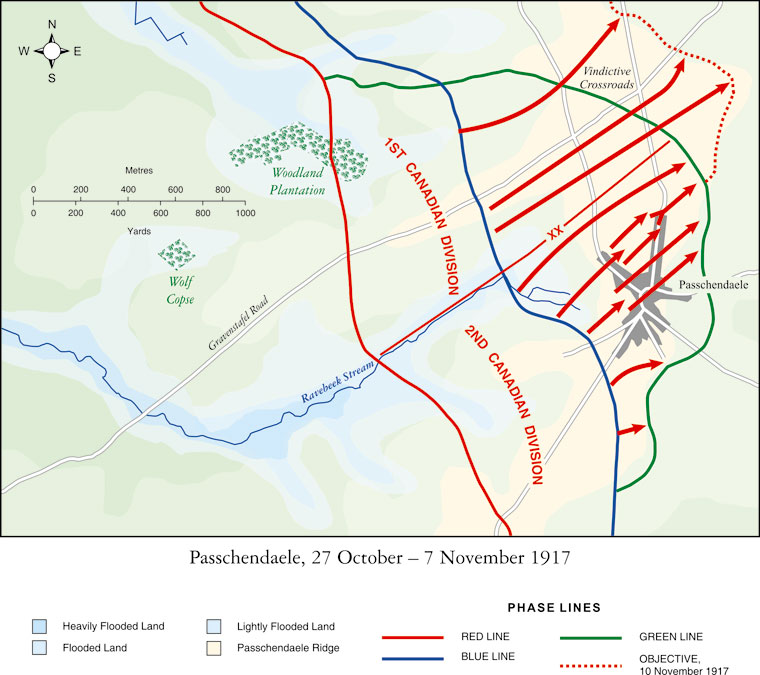
By 6 November, the Canadians were prepared to advance upon the Green Line. The final objective was to capture the high ground north of the town and to secure positions on the eastern side of Passchendaele Ridge. Again, according to Major Robert Massie: “The third attack … was the day when the First and Second Divisions took Passchendaele itself. On this occasion, the attack went off the most smoothly of any of the three. They had fair ground to go over, and especially those that went into Passchendaele itself had pretty fair going, and the objectives were reached on time.”
After early hand-to-hand fighting, the 2nd Division easily occupied Passchendaele just three hours after commencement of the attack at 0600 hours. The 1st Division, however, found itself in some trouble when one company of the 3rd Battalion became cut off and was stranded in a bog. When this situation eventually righted itself, the 1st Division continued toward its objectives. Well-camouflaged tunnels at Moseelmarkt provided an opportunity for the enemy to counterattack, but they were fended off by the Canadians. By the end of the day, the Canadian Corps was firmly in control of both Passchendaele and the ridge.
The final Canadian action at Passchendaele commenced at 0605 hours on 10 November 1917. Sir Arthur Currie used the opportunity to make adjustments to the line, strengthening his defensive positions. Robert Massie summed up the thoughts of many participating Canadians as follows: “What those men did at Passchendaele was beyond praise. There was no protection in that land. They could not get into the trenches which were full of mud, and you would see two or three of them huddled together during the night, lying on ground that was pure mud, without protection of any kind, and then going forward the next morning and cleaning up their job.”
[…]
The Canadians had done the impossible. After just 14 days of combat, they had driven the German army out of Passchendaele and off the ridge. There was almost nothing left of the village to hold. Altogether, the Canadian Corps had fired a total of 1,453,056 shells, containing 40,908 tons of high explosive. Aerial photography verified approximately one million shell holes in a one square mile area. The human cost was even greater. Casualties on the British side totalled over 310,000, including approximately 36,500 Australians and 3596 New Zealanders. German casualties totalled 260,000 troops.
For the Canadians, Currie’s words were prophetic. He had told Haig it would cost Canada 16,000 casualties to take Passchendaele – and, in truth, the final total was 15,654, many of whom were killed. One thousand Canadian bodies were never recovered, trapped forever in the mud of Flanders. Nine Canadians won the Victoria Cross during the battles for Passchendaele. While the human cost had been terrible: “Nevertheless, the competence, confidence, and maturity began in 1915 at Ypres a short distance away, and at Vimy Ridge earlier that spring, again confirmed the reputation of the Canadian Corps as the finest fighting formation on the Western Front.” So wrote esteemed Professor of History Doctor Ronald Haycock at the Royal Military College of Canada for The Oxford Companion to Canadian History in 2004.
Haig proved to be true to his word. By 14 November 1917, the Canadians had been returned to the relative quiet of the Vimy sector. They had not been asked to hold what it had cost them so much to take. However, by March 1918, all the gains made by Canada at Passchendaele would be lost in the German spring offensive known as Operation Michael.
General Sir David Watson praised the Canadian effort: “It need hardly be a matter of surprise that the Canadians by this time had the reputation of being the best shock troops in the Allied Armies. They had been pitted against the select guards and shock troops of Germany and the Canadian superiority was proven beyond question. They had the physique, the stamina, the initiative, the confidence between officers and men (so frequently of equal standing in civilian life) and happened to have the opportunity.”
British Prime Minister David Lloyd George was even clearer when it came to the Canadians: “Whenever the Germans found the Canadian Corps coming into the line they prepared for the worst.”
November 3, 2017
Battle of Beersheba – Canadian Frustration – Balfour Declaration I THE GREAT WAR Week 171
The Great War
Published on 2 Nov 2017On the Western Front this week, the Canadians under Sir Arthur Currie attempt to advance once more, whilst Haig remains optimistic about an imminent breakthrough. Following Caporetto, the Italian retreat continues, whilst the British Army enjoys success on the Palestine Front, with a little help from mounted ANZAC troops. With Lenin’s return, the revolution looms over the Russian capital, whilst the Balfour Declaration is issued in Britain.
Comments Off on Battle of Beersheba – Canadian Frustration – Balfour Declaration I THE GREAT WAR Week 171
October 31, 2017
We may no longer refer to a last-place candidate as having “lost their deposit”
Colby Cosh on a recent court ruling in that hotbed of radical democracy, the Alberta Queen’s Bench, declaring candidate deposits for federal elections to be unconstitutional:
Deposits are a tradition in Canadian federal elections as old as the ballot itself, dating to 1874. But Queen’s Bench Justice Avril Inglis’s ruling suggests that their days are probably numbered. They were introduced for the purpose, stated at the time and very often re-stated since, of deterring frivolous candidates for office. Before the year 2000, you needed to hand over $1,000 to run in a federal election: you got half back automatically if you complied with the Ps and Qs of election law, and the other half if you got at least 15 per cent of the vote.
This practice ran into trouble when (literal) communists litigated against it, arguing that it impeded the Charter rights of the poor and humble to participate in elections. Parliament acknowledged this by making the full $1,000 refundable, so talking heads no longer speak of “forfeiting one’s deposit” on election night. But the government continued to take the view that the “frivolous” need to be discouraged from pursuing federal candidacies. This was not really a satisfying rectification of the Charter issue, as Kieran Szuchewycz, an Edmontonian with some legal experience, seems to have noticed.
The truth is that Szuchewycz (who, for all I know, could be the guy who mops my local 7-Eleven) ran circles around the Department of Justice lawyers who turned up to oppose him. Justice Inglis has ruled that the $1,000 deposit fails almost every point of the Oakes test for laws that impinge on Charter rights. She found that “preserving the legitimacy of the electoral process” is an important objective, but the connection between having a grand lying around and being a “serious” candidate is not clear.
Szuchewycz observed that nowhere in the literature defending election deposits is “seriousness” or “frivolousness” defined. Nobody can point to an example of any harm arising from the existence of even admittedly frivolous candidates, like the long-established Rhinos.
And, well, the deposit doesn’t seem to discourage the Rhinos, does it? If you are well-heeled but “frivolous” you can afford the deposit. If you are in earnest, but broke, it’s a problem. And there are other “seriousness” tests in election law, notably the requirement for candidates to gather nominating signatures from riding residents. So what’s the thousand bucks for specifically?
Update, 8 November: Elections Canada is respecting the Alberta Queen’s Bench decision and no longer requires candidates in federal elections to submit a deposit. H/T again to Colby Cosh.
Comments Off on We may no longer refer to a last-place candidate as having “lost their deposit”
October 29, 2017
The Poutine crisis – “Toronto is living a cheese curd lie”
Toronto loves to adopt anything trendy and try to claim it as its own. Poutine, an imported delicacy from Quebec, early on was lovingly described as “the culinary equivalent of having unprotected sex with a stripper in the parking lot of a truck stop in eastern Quebec”, yet has been culturally appropriated as part of Toronto’s myriad of “local” dishes. Yet, according to this explosive investigatory report by Jake Edmiston, the so-called poutine that Toronto loves is … falsely labelled, inadequate, lacking a key component:
Some time ago, I realized that in Toronto, the cheese curds do not squeak. And cheese curds that do not squeak are a dangerous thing. They can trick you into thinking that cheese curds are just chopped-up cheese. The whole idea, to those unlucky enough to have never had a good one, must seem absurd: Eating cheese by itself, piece by piece in the same compulsive way that someone eats more chips than they need.
Think of the nightmare lived by a man scouring a city for chips that crunch but finding each bag stale. I am him.
As food-obsessed as it is, Toronto is living a cheese curd lie. It’s not always a popular assessment, though. One local cheesemonger took it rather badly.
“Who said that?” Afrim Pristine, the maître fromager at Cheese Boutique, demanded over the phone earlier this month.
“I say that,” I replied.
“You say that?” he said, confused. “Have you been to the Cheese Boutique?”
“I haven’t had your cheese curds yet.”
“So why would you say that?”
“I haven’t said it in print yet. I’m just saying that.”
“Okay. Um, I think you’re very, very wrong,” he said. “I think you’re incredibly wrong. To say that you can’t find good cheese curds in Toronto, I think, is crazy, actually.”
[…]
Curds are the butterflies of the cheese world — beautiful, transcendent, but only for an instant. They offer the rare example of cheese reaching its full expression as a snack unto itself, so airy and texturally complex that it is liberated from the usual dependence on crackers or bread or wine. Curds have been spared all the pressing and squeezing that occurs in the late stages of the cheddar-making process. They’re pulled right from the vat before any of that happens, still full of air and whey. That’s what makes them so much different than the cubes of mild cheddar beside the slices of salami on your cheese tray. Not for long. As that moisture seeps out over time, they inch closer to their cubed cousins, closer to ordinary. The squeak is, really, the only thing separating the two.

H/T to James Bow for the link.
Comments Off on The Poutine crisis – “Toronto is living a cheese curd lie”
October 28, 2017
QotD: Special forces are not a “cheaper” alternative to large, conventional forces
Special Forces are a good tool, and an old one … their origins go all the way back to colonial (mid 18th century) North America when units like Butler’s Rangers and Rogers’ Rangers were formed. The British kept skirmishing troops alive in the form of The Rifles (heirs to the traditions of numerous, famous “rifle” and “light infantry” regiments) and many 21st century Canadian regiments still bear similar titles. Special Forces had a rebirth of sort in World War II when the British made raiding and commando operations into an important tool ~ because they, the Brits, did not have the resources to take the fight to the Germans in Europe in 1941 and ’42. Modern history is full of raiding exploits from Entebbe to the killing of Osama bin Laden and it all encourages penny pinching politicians to believe, incorrectly, that a few Special Forces soldiers can replace battalions and brigades … they cannot, they do not: they are (relatively) narrow specialists who do a few, small things very, very well but cannot conduct major combat operations or even their own specialized tasks for anything like a sustained period.
Canada needs some Special Forces ~ maybe 2,500 is the right number, I do not know. But good Special Forces are always drawn from a large pool of tough, superbly disciplined, well trained sailors, soldiers and aviators. If the government wants to use more and more Special Forces in a variety of roles then it needs, above all, to maintain a large enough, high quality base from which to create and sustain them. Special Forces are part of a modern, combat capable (and, therefore, expensive) military … they are not a low cost replacement for it, no matter what the Liberal Party of Canada might want.
Ted Campbell, “Special Forces”, Ted Campbell’s Point of View, 2017-10-16.
Comments Off on QotD: Special forces are not a “cheaper” alternative to large, conventional forces
October 26, 2017
Bonus quote-of-the-day
In an article in the Globe and Mail, Lee Berthiaume (Canadian Press) reports that “The Trudeau Liberals may have promised to ramp up Canada’s role in peacekeeping, but new UN figures show there were fewer Canadian peacekeepers in the field last month than at any point in recent memory … [and] … The revelation comes as Canada prepares to host a major peacekeeping summit in Vancouver next month, raising fears the country will be badly embarrassed unless the numbers start rising – and fast … [because] … The intervening year [since the Liberals promised 600+ blue beret wearing peacekeepers] has instead seen a steady decrease in the number of Canadian blue helmets and blue berets deployed around the world, from 112 peacekeepers in August 2016 to 68 last month.”
This is risky for Canadian soldiers because the Trudeau regime is not exactly famous for making sound, well though out, carefully crafted plans ~ witness the small business tax fiasco and democratic reform, just for examples. It is possible, even probable, that rather than be embarrassed in public the Liberals will react, as cornered rats often do, and commit troops to a dangerous, hopeless, worthless mission just to avoid yet another political humiliation. Canadian soldiers may soon find themselves in some rotten hellhole with orders to not, under any circumstances, shoot at a child soldier, not even in self defence, or do any harm to a person of colour … because the Liberals know that the media will be watching ~ platoons of journalists will be deployed, each more anxious than the next to win some prize by being the first to report on a Canadian killing a black child.
Ted Campbell, “Cornered?”, Ted Campbell’s Point of View, 2017-10-25.
Comments Off on Bonus quote-of-the-day
So what was the point in the Sudbury byelection trial?
I admit I didn’t follow this case in any detail, but what little I did read left me scratching my head over what the actual crime was supposed to have been. I certainly don’t have any partiality for the defendants, but there really didn’t seem to be any “there” there in any “breaking the law” way. Chris Selley (who actually did have to pay attention to the trial) seems to have felt much the same way:
Justice Howard Borenstein kicked the living daylights out of the Crown’s case in the Sudbury byelection trial on Tuesday, acquitting Liberal operatives Gerry Lougheed and Pat Sorbara of bribery without the defence calling evidence. The “directed verdict” means he didn’t think any Crown evidence would result in a conviction even if a jury believed it entirely — not a great look for the prosecution. Defence lawyers Brian Greenspan (for Sorbara) and Michael Lacy (for Lougheed) didn’t say whether their clients would pursue the Crown for costs, but they were otherwise inclined to orate. Both called it a “vindication.”
“This is as close in law as you can have to saying, ‘she’s innocent,’ ” said Greenspan.
“Nothing changed during this case. The evidence that was presented was the evidence that was available from the very beginning,” said Lacy. “And yet here we are, however many days later, with no case to answer for. (It) raises questions about why they prosecuted this matter to begin with.”
No kidding. I wouldn’t trust the lawyers the Crown came up with to wash my car, but they can’t have come cheap.
Under the circumstances, it’d be quite reasonable for them to attempt to recoup their legal costs.
So that was that. Two Liberals, three charges, three acquittals — and rightly so, says I. As I’ve said before, the Crown’s desultory shambles of a case managed to shift me from thinking Lougheed and Sorbara behaved greasily, if not illegally, to thinking they had barely done anything noteworthy. Both claimed to have no regrets on Tuesday; moments after the acquittal, the Liberals welcomed Sorbara back into the fold on Twitter. The opposition’s rote angry press releases ring rather hollow — especially in the Tories’ case, considering all the recent allegations of riding-level skullduggery.
On the bright side, we have some precedent at least. This is the first time anyone has ever been charged under the bribery provision of the Ontario Election Act, which dates from 1998. Seven other provinces have similar bribery provisions in their election acts; so far as I can tell no one has ever been charged under them either. The only mentions made of the new provision in debates at the Ontario legislature were about how everyone would surely agree it was a great idea. The next time politicians decide to tinker with the Election Act, they should get their intentions on the record. Had Borenstein sided with the Crown, he would nearly have outlawed politics altogether.
The “sacred” Supply Management system Canada is fighting to preserve
The way our politicians talk about the supply management system, you’d think it was one of the founding issues of Confederation. They’re almost literally willing to abandon the NAFTA talks to preserve this encrusted bit of crony capitalist market distortion that hurts most Canadians in the wallet, to keep domestic producers happy. Matthew Lau explains the system our government is willing to crash the entire economy to save:
The United States wants Canada to end supply management, which impedes agricultural imports – dairy, eggs, and poultry. Canada’s trade negotiators and politicians steadfastly refuse, and in their defense of the policy call up an astounding piece of logic: that the less Canadians have, the richer we are.
Canada’s Agriculture Minister insists that supply management is an “excellent system” and that “to deal with anything else is simply a non-starter.” Supporters on the left argue that the policy is necessary to protect domestic farmers from unfair competition from American farmers who receive government subsidies.
Conservatives have argued the same. Current Parliament Member and former International Trade Minister, Ed Fast argued in a recent essay that America simply wants access to the Canadian market “to deal with its own problem of overproduction, to the detriment of Canadian farmers.”
Here is what all proponents of supply management are arguing: If we allow the Americans to send us milk, then their problem of overproduction becomes our problem. Don’t you see how problematic it is, how much poorer we will become if we allow them to send to us the fruits of their overproduction, and at a low price to boot? Don’t you see how much richer we would be if we had less milk?
The less milk we have, the higher the price of milk, the more we can “ensure that producers receive a reasonable return,” as Ed Fast put it – and having ensured that producers receive a reasonable return, certainly we shall all be richer. What could be more reasonable than ensuring Canadian producers receive a reasonable return?
In case the lunacy isn’t quite clear, he also offers a suggestion for a new supply management system for Canadians to “enjoy”:
If we’re made richer by having less dairy, poultry, and eggs, then why stop there? Why not create scarcity in all the other sectors in order to boost the domestic economy? For instance, consider that Ontario’s manufacturing sector has lost several hundred thousand jobs in the past twelve years or so. So according to the supply management logic employed by politicians, how can we revive this industry?
By destroying automobiles of course. And then throw up a tariff to make the purchase of automobiles abroad prohibitively expensive, in order to make sure the Americans, as well as other foreign producers, can’t take “unfair advantage” by inflicting us with cheap automobiles to deal with their problems of overproduction.
The result of such a policy would be that the price of automobiles would rise, thus enabling domestic manufacturers to earn reasonable returns. Destroying automobiles and instituting a tariff would revive the automobile manufacturing industry in Ontario and create thousands of jobs. If the Liberal government thinks supply management is an “excellent policy” they’d probably think this automobile policy is a panacea.
Indeed, the logic, or rather illogic, of the automobile policy is only an amplification and expansion of supply management. Both rest on the idea that we are richer when we have less.
Comments Off on The “sacred” Supply Management system Canada is fighting to preserve
October 24, 2017
More on Quebec’s niqab ban
Ted Campbell is emphatically against Quebec’s attempt to ban facial coverings for Islamic women:
These laws are stupid … but they are worse than stupid, they are an assault on individual liberty by a bunch of political nincompoops.
Now, there are a number of variants of head and face coverings, they are especially common among some Muslim women …
… and some restrictions on some of them in some situations are, pretty clearly, justified on common sense or security-identification grounds. We, most of us, can probably agree that a lady should not wear a burqa or chador or even a niqab when she’s driving a car (it might restrict her vision) or when she is applying for a driving licence, which is a pretty common form of recognized identification … and it seems pretty clear that airport security should insist that a burqa or chador must be removed for security screening (to permit positive facial recognition).
But, why the hell does the state ~ the BIG, collective, state ~ care what any individual wears when (s)he boards a bus. It ought to care that she deposits the correct fare, of course, or taps her card to pay, but why does the state care if her face is covered? It’s arrant nonsense, and it is an infringement on a fundamental right.
Reminder: you (and I, and Muslim women, too) have lots of rights but four of them are quite fundamental: life, liberty and property as defined by John Locke in 17th century England and privacy, as defined by Brandies and Warren in 19th century America. These rights all accrue to all individuals, only, and they, those individuals, need to have their fundamental rights protected against constant threats from collectives including religions, societies and states, themselves. These new laws, passed by big, collectivist states, are threats to individual liberties and must be challenged and overturned. Liberals, like Justin Trudeau, will not do it because they are progressives, not liberals, and because people like Justin Trudeau cannot think about fundamental rights … only about partisan, short term, political advantage.
Let me be clear about my own position:
- Women may wear whatever they want for their own (good or not so good) reasons; but
- It is wrong for anyone (including any father or husband or rabbi or provincial premier) to force women to dress in some certain way for social (including political) or religious reasons.
Your religion is a wholly private matter between you and your gods … you may never try to impose your beliefs on others, including your wife and children.

Comments Off on More on Quebec’s niqab ban
October 21, 2017
Canada’s equivalent to the NSA releases a malware detection tool
At The Register, Simon Sharwood looks at a new security tool (in open source) released by the Communications Security Establishment (CSE, formerly known as CSEC):
Canada’s Communications Security Establishment has open-sourced its own malware detection tool.
The Communications Security Establishment (CSE) is a signals intelligence agency roughly equivalent to the United Kingdom’s GCHQ, the USA’s NSA and Australia’s Signals Directorate. It has both intelligence-gathering and advisory roles.
It also has a tool called “Assemblyline” which it describes as a “scalable distributed file analysis framework” that can “detect and analyse malicious files as they are received.”
[…]
The tool was written in Python and can run on a single PC or in a cluster. CSE claims it can process millions of files a day. “Assemblyline was built using public domain and open-source software; however the majority of the code was developed by CSE.” Nothing in it is commercial technology and the CSE says it is “easily integrated in to existing cyber defence technologies.”
The tool’s been released under the MIT licence and is available here.
The organisation says it released the code because its job is to improve Canadian’s security, and it’s confident Assemblyline will help. The CSE’s head of IT security Scott Jones has also told the Canadian Broadcasting Corporation that the release has a secondary goal of demystifying the organisation.
Comments Off on Canada’s equivalent to the NSA releases a malware detection tool
October 20, 2017
Justin Trudeau’s government at the two-year mark
Paul Wells nicely lists all the good things the Trudeau government has managed to do during the first two years of its mandate, then gets down to the other side of the balance sheet:
The worse continues to pile up. I see no way the rushed and timid legalization of cannabis will drain the black market and, in hardening more penalties than it relaxes, it seems certain to provide busywork for police who have been asking only to be freed up to tackle more serious problems. (An internal Ontario government memo reaches the same conclusions.)
Since it’s impossible to find anyone in the government who’s conspicuous for saying no to any proposed spending spree, it’s a near dead-lock certainty that Canada will become a nursery for white elephants — and, unless this generation of public administrators is luckier than any previous generation, for corruption, somewhere in the system.
The government’s appointments system is, as one former staffer told me this week, “just a little f–ked,” with backlogs as far as the eye can see. There’s a serious bottleneck for important decisions, with the choke point in the Prime Minister’s Office. Rookie ministers, which is most of them, are held close. Those who don’t perform are sent new staffers from the PMO: career growth comes from the centre, not the bottom.
A cabinet full of political neophytes — and there is nothing Trudeau could have done to avoid that, given how few seats he had before 2015 — has been trained to cling for dear life to talking points. The result is unsettling: most of the cabinet simply ignores any specific question and charges ahead with the day’s message, conveying the unmistakable impression they are not as bright as — given their achievements before politics — they must surely be. Or that they think their audience isn’t. I doubt this is what anyone intends, but by now it’s deeply baked into the learned reflexes of this government.
Then there is this tax mess. I’m agnostic on the policy question: in my own life I’ve been spectacularly unimaginative in organizing my finances for minimal taxation. I put all the book money into RRSPs, called my condo an office for the two years I used it as one, and that was the end of that. But the summer tax adventure has left the Liberals with their hair on fire, for two broad reasons. One is that Bill Morneau’s personal financial arrangements are becoming surreal. The other is the way the project — and especially the life stories of its stewards, Trudeau and Morneau — undermined the Liberals’ claim to be champions of the middle class.
Wells very kindly doesn’t mention the ongoing flustercluck that is our military procurement “system” (which to be fair, the Liberals did inherit from the Harper Conservatives), which has gotten worse rather than better — and only part of that is due to Trudeau’s trumpeted “No F-35s” election pledge. The Royal Canadian Navy seem no closer to getting the new ships they so desperately need (aside from the Project Resolve supply ship, which the government had to be arm-twisted into accepting), and the government hasn’t yet narrowed down the surface combatant requirements enough to select a design.
Comments Off on Justin Trudeau’s government at the two-year mark


