Quotulatiousness

January 7, 2010

Marmite versus Vegemite

Filed under: Australia, Britain, Food, Humour, Randomness — Tags: — Nicholas @ 07:25

Charles Stross has run out of things to post that will rile up the reader base, so he finds another way to get the chattering masses chattering — by declaring his unnatural love for Marmite and Vegemite:

Note to American readers: Marmite is what I (being a Brit) grew up with. If you brew beer on a commercial scale, when you drain the fermenting vessel you end up with a scum of dead and dying yeast cells on the side. Some time in the late 19th century, rather than treating this as waste, some nameless genius had the idea of tasting it. It turns out that brewer’s yeast, once you lyse the cells by adding salt, tastes remarkably savoury — somewhat like soy sauce, only thicker (with much the same consistency as non-set honey). Marmite, the product, is mostly yeast extract, combined with salt and a few additional spices. It’s what belongs on toast, or cheese, or in gravy and sauces to add body to them. And the stuff’s addictive. I get through it in catering-tub quantities, alas: it’s my one real high sodium vice.

Vegemite . . . it’s the antipodean antithesis. Invented in 1922 by Dr Cyril P. Callister in Australia, it was designed to plug the strategic gap opened by unrestricted U-boat warfare against the vital British Marmite convoys that had kept the colonies supplied during wartime — or something like that. Kraft popularized it, pushed it into military rations during the second world war, and over a decade clawed back sales from Marmite until it’s now the favourite toast topping down under. The recipe differs somewhat from Marmite, as does the flavour — just enough that if you’re used to one, the other tastes slightly “off” — too flat, or too astringent.

If you want to really liven up a party, pour a small jar of Marmite into the fruit punch — or add Vegemite to the dog’s bowl (as long as you don’t mind being asked to clean up afterwards). Hours of friendly discussion and informed debate can be provoked by discussing the relative merits of the two products! And it’s always a good idea to introduce visiting American guests to what they’ve been missing all these years, by exhorting them to spread it on their bread “just like peanut butter”.

December 10, 2009

At this rate, we’ll all think of a place when we hear the name “Darwin”

Filed under: Australia, Environment — Tags: , , , — Nicholas @ 09:14

It’s a long article, but well worth reading in full:

People keep saying “Yes, the Climategate scientists behaved badly. But that doesn’t mean the data is bad. That doesn’t mean the earth is not warming.”

Let me start with the second objection first. The earth has generally been warming since the Little Ice Age, around 1650. There is general agreement that the earth has warmed since then. See e.g. Akasofu. Climategate doesn’t affect that.

The second question, the integrity of the data, is different. People say “Yes, they destroyed emails, and hid from Freedom of information Acts, and messed with proxies, and fought to keep other scientists’ papers out of the journals . . . but that doesn’t affect the data, the data is still good.” Which sounds reasonable.

There are three main global temperature datasets. One is at the CRU, Climate Research Unit of the University of East Anglia, where we’ve been trying to get access to the raw numbers. One is at NOAA/GHCN, the Global Historical Climate Network. The final one is at NASA/GISS, the Goddard Institute for Space Studies. The three groups take raw data, and they “homogenize” it to remove things like when a station was moved to a warmer location and there’s a 2C jump in the temperature. The three global temperature records are usually called CRU, GISS, and GHCN. Both GISS and CRU, however, get almost all of their raw data from GHCN. All three produce very similar global historical temperature records from the raw data.

[. . .]
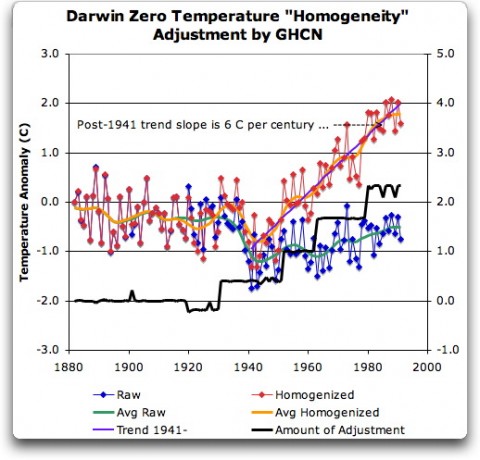
DarwinZeroWithAdjustments

Yikes again, double yikes! What on earth justifies that adjustment? How can they do that? We have five different records covering Darwin from 1941 on. They all agree almost exactly. Why adjust them at all? They’ve just added a huge artificial totally imaginary trend to the last half of the raw data! Now it looks like the IPCC diagram in Figure 1, all right … but a six degree per century trend? And in the shape of a regular stepped pyramid climbing to heaven? What’s up with that?

Those, dear friends, are the clumsy fingerprints of someone messing with the data Egyptian style . . . they are indisputable evidence that the “homogenized” data has been changed to fit someone’s preconceptions about whether the earth is warming.

One thing is clear from this. People who say that “Climategate was only about scientists behaving badly, but the data is OK” are wrong. At least one part of the data is bad, too. The Smoking Gun for that statement is at Darwin Zero.

I’m in no way qualified to pass judgement on any of this. My bias is usually to trust that the scientist has no pre-decided outcome in mind . . . and that they verify their data supports the conclusions before publishing. Climategate/Climaquiddick shows that, at least in one field, this is not true.

Normally, this sort of science-by-press-release is quickly exposed (think of the cold fusion and the Korean human cloning announcements, for example), which works to quickly stamp out the inclination among others who might try to game the system. In the case of AGW, they did more groundwork before going to the press . . . but if Darwin Zero is an example of the kind of work they did everywhere, then it’s just a better-hidden case of science-by-press-release.

Except — and this is huge — the implications of the deception were not limited to a few undeserving white-coated “scientists” getting press coverage and grant money. The AGW movement aimed at nothing less than a take-over of the entire economy, putting carbon commissars in charge of everything. Their work would lead to pseudo-scientific based controls over all human activities (because, as the EPA recently decided, all greenhouse gases must be regulated . . . and there’s carbon dioxide produced every time you exhale).

December 1, 2009

Australia’s Liberal Party dumps leader

Filed under: Australia, Environment, Politics — Tags: , — Nicholas @ 08:16

After losing a number of shadow ministers over a proposed carbon tax, Australia’s Liberals have replaced Malcolm Turnbull with AGW skeptic Tony Abbott.

Australian conservatives have shown the way by dumping the party leader who was in favour of massive carbon taxes and replacing him with one who stated last month that AGW is “crap.”

This makes Malcolm Turnbull, the suddenly-ex-leader of Australia’s Liberal party, the first major political victim of the Climategate furore. And his replacement Tony Abbott, the first politician to reap the benefits of the world’s growing scepticism towards ManBearPig. Of the three candidates, he was the only one committed to delaying the Australian government’s proposed Emissions Trading Scheme (ETS).

The trouble began last week when Australia’s opposition Liberal party began haemorrhaging frontbenchers, all of them preferring to lose their jobs than be railroaded by their leader into voting with the Government on Kevin Rudd’s new carbon tax.

November 8, 2009

Aussie iPhone owners rickrolled

Filed under: Australia, Technology — Tags: , , , , — Nicholas @ 18:56

The horror, the horror:

The attacks, which researchers say are the world’s first iPhone worm in the wild, target jailbroken iPhones that have SSH software installed and keep Apple’s default root password of “alpine.” In addition to showing a well-coiffed picture of Astley, the new wallpaper displays the message “ikee is never going to give you up,” a play on Astley’s saccharine addled 1987 hit “Never Gonna Give You Up.”

Tricking victims in to inadvertently playing the song has become a popular prank known as Rickrolling.

A review of some of the source code, shows that the malware, once installed, searches the mobile phone network for other vulnerable iPhones and when it finds one, copies itself to them using the the default password and SSH, a Unix application also known as secure shell. People posting to this thread on Australian discussion forum Whirlpool first reported being hit on Friday.

November 2, 2009

UAV market increases for Israeli manufacturer

Filed under: Australia, Cancon, Middle East, Military — Tags: , , — Nicholas @ 08:39

The American Predator UAV is selling very well — but the manufacturer can’t keep up with current domestic demand, so other nations are adopting the Israeli Heron as a worthwhile alternative:

Australian troops in Afghanistan begun using Israeli Heron UAVs two months ago. Last July, Australian troops went to Canada to receive training on the Heron, which Canadian troops have also adopted. Canada received its first Heron about a year ago. This model of the Heron is very similar to the 1.1 ton U.S. Predator. This Heron has a 500 pound payload capacity and can stay in the air for more than 24 hours per sortie. While Australia and Germany are buying its Herons, Canada is leasing them.

Last year, Canada also ordered half a dozen of the larger Israeli Heron TP UAVs. Equipped with a powerful (1,200 horsepower) turbo prop engine, the 4.6 ton aircraft can operate at 45,000 feet. That is, above commercial air traffic, and all the air-traffic-control regulations that discourage, and often forbid, UAV use at the same altitude as commercial aircraft. The Heron TP has a one ton payload, enabling it to carry sensors that can give a detailed view of what’s on the ground, even from that high up. The endurance of 36 hours makes the Heron TP a competitor for the U.S. MQ-9 Reaper (or Predator B), which is the same size as Heron.

October 16, 2009

Careful with those compact fluorescent bulbs

Filed under: Australia, Environment, Technology — Tags: , — Nicholas @ 12:43

Andrew Bolt wonders why the Australian government — which has banned the sale of old-fashioned incandescent light bulbs — is not being more pro-active about handling and disposing of the replacement compact fluorescents:

Tens of thousands of Australians will next month be forced to buy these new greenhouse-friendly CFLs without the Government warning them that, unlike normal light bulbs, they contain mercury and are dangerous when broken. What’s more, they shouldn’t just be thrown out with the rubbish.

How many consumers know this?

How many of them have looked up the Environment Department’s website to find what its bureaucrats falsely describe as the “simple and straightforward” precautions to take against poisoning should one of these lamps smash:

– Open nearby windows and doors to allow the room to ventilate for 15 minutes before cleaning up the broken lamp. Do not leave on any air conditioning or heating equipment which could recirculate mercury vapours back into the room.

– Do not use a vacuum cleaner or broom on hard surfaces because this can spread the contents of the lamp and contaminate the cleaner. Instead scoop up broken material (e.g. using stiff paper or cardboard), if possible into a glass container which can be sealed with a metal lid.

– Use disposable rubber gloves rather than bare hands.

– Use a disposable brush to carefully sweep up the pieces.

– Use sticky tape and/or a damp cloth to wipe up any remaining glass fragments and/or powders.

– On carpets or fabrics, carefully remove as much glass and/or powdered material using a scoop and sticky tape; if vacuuming of the surface is needed to remove residual material, ensure that the vacuum bag is discarded or the canister is wiped thoroughly clean.

– Dispose of cleanup equipment (i.e. gloves, brush, damp paper) and sealed containers containing pieces of the broken lamp in your outside rubbish bin – never in your recycling bin.

– While not all of the recommended cleanup and disposal equipment described above may be available (particularly a suitably sealed glass container), it is important to emphasise that the transfer of the broken CFL and clean-up materials to an outside rubbish bin (preferably sealed) as soon as possible is the most effective way of reducing potential contamination of the indoor environment.

“Simple and straightforward”? Peter Garrett’s department not only deceives you about global warming, but about the ease of this useful “fix”.

It doesn’t take a lot of imagination to foresee a lot of lawsuits down the road, as the majority of folks who need to change lightbulbs won’t have read these instructions, and will try to handle them the same as the ordinary light bulbs they’ve used forever.

October 9, 2009

Australian livers: industrial strength

Filed under: Australia, Randomness — Tags: , — Nicholas @ 00:05

I’m probably admitting that I’m a lightweight here, but a “limit” of 24 cans of beer per day seems, well, not actually a limit:

Australian motorsport fans are ruing militant alcohol consumption guidelines at one of the country’s most popular races – after being limited to a mere 24 cans of beer a day.

Police in charge of the Bathurst 1,000 car race in Bathurst, New South Wales, issued the restrictions before the start of the four-day event this Thursday.

Spectators are limited to one 24-can case each of full-strength beer, although if revellers are willing to consume lower-strength alcohol (3.5% abv or less) they will be entitled to a more satisfactory 36 cans.

Wine lovers have not escaped the heavy hand of the law either, being restricted to a punitive four litres a day.

<sarcasm>A mere four litres? How do they survive?</sarcasm>

H/T to “Fishplate” for the link.

« Newer Posts

Powered by WordPress


