
If you’ve been wondering about the state of democracy in Germany, your first move should be to check the latest update from eugyppius:
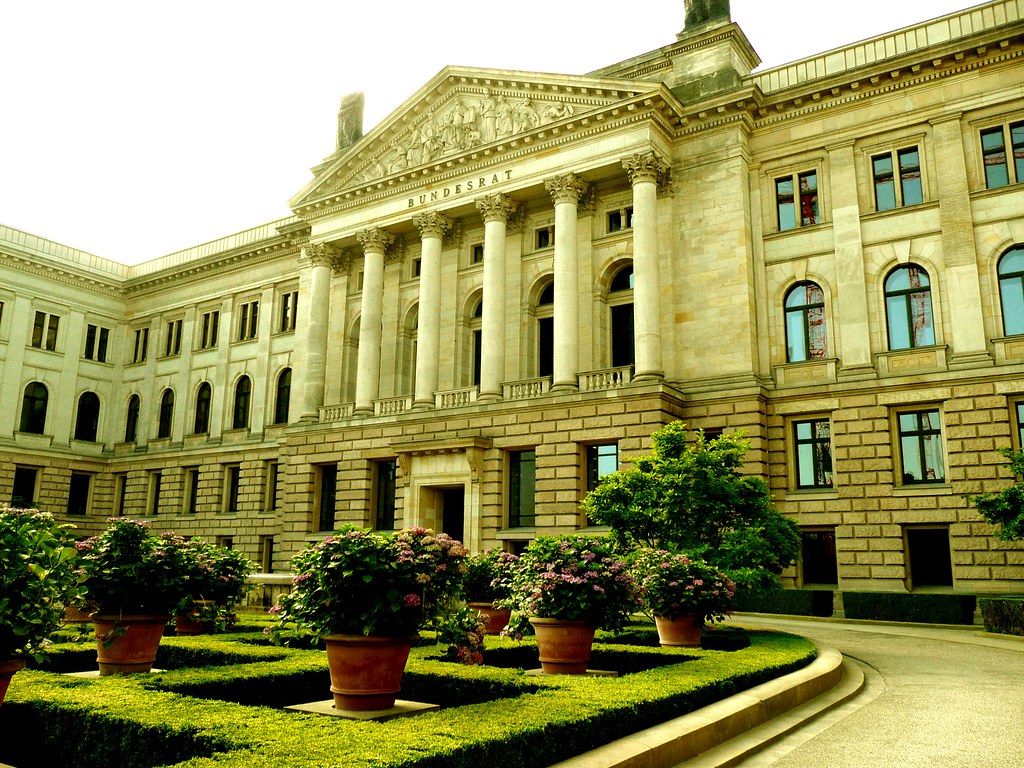
“Bundesrat of Germany” by photosteve101 is licensed under CC BY 2.0 
 .
.
In civics class, parties appear as little more than informal election-winning cooperatives. Now and again “the sovereign” – that is to say, “the people” – may grant one or various parties a limited right to govern, but the state is held to be in some sense public property. Politicians and their parties are at best its temporary custodians.1
Our Democracy Enjoyers particularly deplore state systems in which parties have captured the state – a special political form we might call the “party state”. Germany became a party state after 1933, when the NSDAP seized the entire state apparatus and outlawed all competitors. Contemporary states owned and operated by single parties include China, Cuba and North Korea. Our Democracy Enjoyers hate all single-party states because they are not democratic.
Party states need not however be single-party states. While the Socialist Unity Party (SED) effectively owned the DDR, they tolerated an array of subservient bloc parties from the very beginning. None of these parties ever had any chance of governing; they functioned only as extensions or alternative faces of the SED itself. These parties included gutted, early opposition parties like the CDU (Ost) and the Liberal Democratic Party (LDPD), but also SED concoctions like the Democratic Farmers’ Party (DBD) and the cynically post-Nazi National Democratic Party (NDPD). The SED cultivated these parties both as a democratic figleaf and also to integrate “non-proletarian” (particularly Christian) elements within the communist system. The precedent of the DDR shows that the party state can assume various innovative forms and that multiple parties may be useful for political, propaganda or other purposes.
My thesis of the Federal Republic is that it is also a party state. The only difference between the DDR and the BRD is that, in the BRD, several different parties share ownership of the state among themselves.
The three anecdotes at the head of this piece reveal this party ownership in incidental but telling ways. They show, for example, how a substantial portion of the police consider their oath of office to preclude loyalty to a democratically elected opposition party. Should the voters go rogue and install any such party at the state level, a prominent police union functionary openly hopes for insurrection and federal intervention. Periodically voiced ambitions and campaigns to cleanse the civil service of AfD elements come from a similar place. The ownership parties cannot countenance opposition creep into the bureaucracy, because they correctly regard the bureaucracy as their property.
The hysteria surrounding a thwarted SPD nomination to the Federal Constitutional Court reveals that the parties that own the BRD extend their proprietary interests not only to the executive and legislative branches, but also to the allegedly independent judiciary. The ruling parties have divided the prerogative to nominate judicial candidates informally among themselves. This prerogative is so jealously guarded that a leading Union politician cited a single thwarted SPD nomination to make the case for mass censorship and regulation of “alternative” media.
And while it is a minor incident that hardly matters, the dispute over the Otto-Wels-Saal shows that the proprietary feelings of the state parties extend to physical architecture, even specific rooms and buildings, which the parties of the party state regard not as public property but as their very own chambers – to name, possess and use as they see fit.
While progressive liberal political systems are all oligarchies, and this because of the Iron Law of Oligarchy, they are not all party states – far from it. The party state is a clunky and outmoded political system that historically arose out of accident or necessity, generally following a revolution perpetrated by a single party or political movement in a moment of particular ascendance. The Federal Republic was founded as a party state in 1949, mainly to foreclose the possibility that subversive National Socialist or communist elements might return to influence via democratic processes. This is the basic meaning of German “defensive democracy”, which denotes an array of legal or constitutional tools for the parties that own the state to fend off or criminalise competitors.
- Now, we know this is mostly nonsense. “The people” are an abstraction and as such they cannot grant anybody anything. All political systems ultimately redound to the control of more or less stable oligarchies. “Democracy” describes little more than a set of procedures via which the these oligarchies (or their representatives) assume power and enact their will.



Government is a collection of criminal gangs that take over and hold a territory using violence or threats thereof in order to loot the wealth of the inhabitants therein.
Comment by Eyrie — August 13, 2026 @ 18:40