On Substack Notes, John Carter shared this post by Theophilus Chilton, saying:
Fascinating. The American founders were explicitly trying to revive a stronger form of monarchical executive authority with the presidency, as a deliberate corrective to the relatively powerless Crown of the British Constitution, which had been effectively neutered by the doctrine of parliamentary supremacy.
Along similar lines, the American Bill of Rights was in most ways simply a restatement of the ancient rights of Englishmen.
So, of course, I had to go read the post:
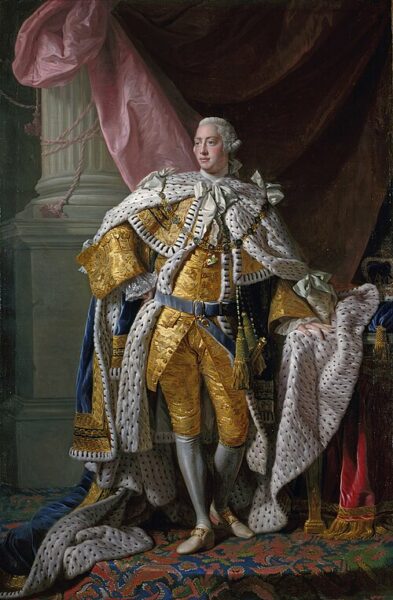
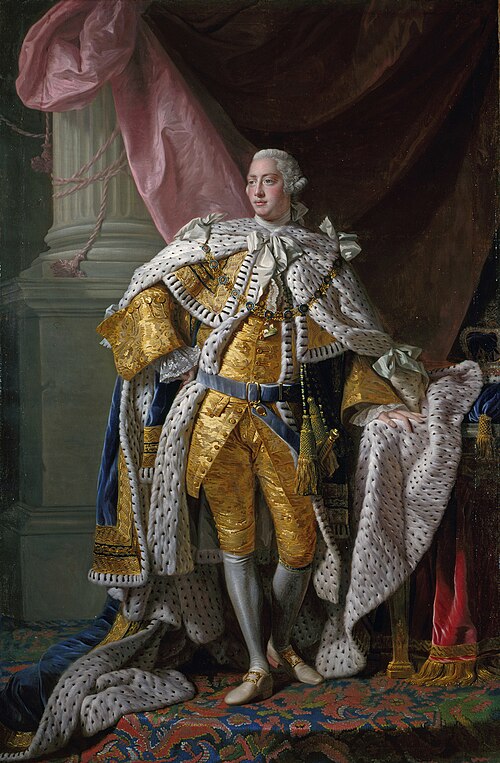
Too “kingly” but also not “kingly” enough for America’s Founding Fathers.
King George III in his Coronation robes.
Oil painting by Allan Ramsay (1713-1784) circa 1761-1762. From the Royal Collection (RCIN 405307) via Wikimedia Commons.
Recently, I’ve been reading an interesting book about 18th century political philosophy entitled The Royalist Revolution: Monarchy and the American Founding. In this work the author, Eric Nelson, guides the reader through the various aspects of the great inter-whiggish debates that roiled the American colonies prior to independence, and which then continued afterwards. One of the main premises is that a major faction within this debate — and indeed the one which ended up prevailing in the end — understood the relationship between colonies and mother country to be founded upon the king of Britain’s personal proprietorship over the colonies. This Patriot position was opposed by the Loyalist position which saw the colonies as existing under the laws and rule of Parliament.
Now this might seem strange to generations of Americans who grew up learning in school that the American revolutionaries fought against the great tyrant King George III who was set upon grinding the American colonies under his bootheel of oppression. That view would be quite surprising to many of the participants on the Patriot side, many of whom actually appealed to King George, both publicly and in private correspondence, to exercise kingly prerogative and overturn the various duties, laws, and taxes which Parliament had laid upon the colonies. This, indeed, was the crux of the Patriot argument, which is that because the colonies were originally founded under the personal demesne of the British King, they remained so even despite the temporary abolishment of the monarchy after the execution of Charles I in 1649. In the interregnum between that and the Glorious Revolution and restoration of a stable monarchy that was accepted by all classes as legitimate in 1688, Parliament had illegitimately usurped authority over the colonies. Because it was Parliament which was laying the Intolerable Acts and all the other complaints which the Americans had, it was Parliament against whom they wished to be protected.
But these Patriots were pining after a situation which no longer existed. In point of fact, the British kings since the Glorious Revolution had left whatever prerogative powers they might still have had unused. So it was with George III, who rejected the American colonists’ calls for him to intervene, knowing that doing so would have provoked a constitutional crisis in Britain which he would not have won. As a result, the American colonists chose to make their final break with the British monarchy and throw in their lot for independence, buttressed by Thomas Paine’s fleetingly persuasive but ultimately ineffectual pamphlet Common Sense.
However, after independence, the colonists were faced with providing their own governance. Initially, this was attempted under the Articles of Confederation, as well as their state constitutions, all of which were very whiggish in principle. They were also inadequate to the task. As every student who took high school civics knows, the solution to this was the Constitution of 1789.
Typically, students are taught that the new Constitution was designed to strengthen the ability of the federal government to handle the various issues that applied to the confederation of states as a whole. What we don’t generally hear, however, is that much of this included strengthening the roles and powers of the president to include several areas of prerogative powers which exceeded even the powers then available to the kings of Britain. The stock view of the Constitution is that it “was created to prevent anyone from getting too much power!” The actuality is that the Constitution was crafted, in part, to expand presidential power and create what was viewed at the time as a literally monarchical chief executive. Opponents of this described the proposed executive as “the foetus of monarchy”. Supporters often defended it on the basis that parliaments and congresses, if left unchecked by a strong executive whose interest was drawn from the body of the whole people, would themselves become the greatest threats to the liberties of the people.
The Founders who proposed this enhancement of the executive didn’t do this in a vacuum. Indeed, they had a century and a half of history about this very subject to draw from first-hand. Fresh in the collective mind of every Englishmen, both in the home country and in the colonies, were the English Civil Wars of the previous century. Beginning with the revolt of the parliamentarian army in 1642 through the regicide of Charles I in 1649, the protectorate of Oliver Cromwell, the attempted restoration of the House of Stuart under James II, until the final deposition of James and his replacement with William, Prince of Orange in the Glorious Revolution of 1688, Englishmen had a long series of examples from which to draw various conclusions.
So yes, they could see the parliamentarian excesses that took place during the Protectorate. Current in the collective national mind were the overreaches (whether real or imagined) of Parliament both during the interregnum and in the century since the acquisition of the throne by the House of Hanover. As noted above, among these overreaches, at least as viewed by many in the American colonies, was parliamentary interference in the affairs of the colonies, viewed as transgressions into the rightful domain of the king’s purview. Hence, by a strange twist, the Loyalists who opposed American independence before and during the Revolution were generally the more whiggish of the two sides, throwing in their lot with the parliamentary oligarchies. The Patriots, on the other hand, were desperately trying to get the king to reassert his royal prerogatives and intervene by reasserting his perceived rights to directly rule the colonies, something of a modified “high/low vs. the middle” type of scenario.




 .
.