In Without Diminishment, Geoff Russ discusses Javier Milei’s recent podcast appearance and his demonstration that unlike a lot of theoretical libertarians, he understands the dynamics of political power:
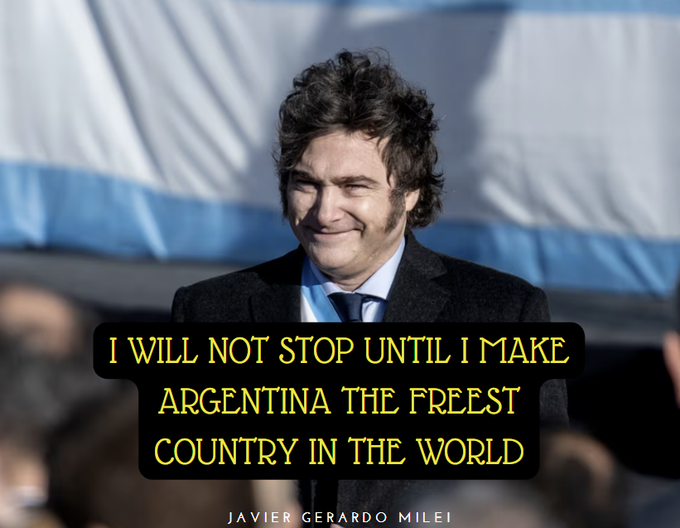
There are many liberals, libertarians and anarcho-capitalists who are really useless because all they do is criticise, let’s say, those of us who want to lead the world toward the ideas of freedom. And what they don’t realise is that power is a zero-sum game, and if we don’t have it, then the left will have it. Therefore, if you level your harshest criticism at those in your own ranks, you end up being subservient.
Have truer words ever been spoken by an English-speaking politician?
Argentine President Javier Milei’s words on the Lex Fridman podcast were a blunt reminder of something that many conservatives, particularly those in Canada, have chosen to forget.
Politics is the pursuit of political power and the chance to use it before your opponents can. Debates can be won, superb essays published, and quotes recycled from deceased politicians. Without power, however, it all amounts to nothing more than a glorified brainstorming session.
The thoughtful ideas and proposals go to waste if they lie stagnant in perpetual bickering opposition.
On October 26, Milei won a resounding victory in the legislative elections. His party, Liberty Advances, gained forty-two seats and smashed the hard-left Peronists who have dominated Argentina’s politics for more than half a century.
Milei is a fanatical believer in libertarian ideas, and has never pretended to be a moderate or incrementalist. He famously brandishes a chainsaw to represent his willingness to destroy the broken socialist status quo of Argentina.
Javier Milei at CPAC in National Harbor, Maryland 20 February, 2025.
Photo by Gage Skidmore via Wikimedia Commons.The rise of Milei has been a cultural battle for the soul of the country, and he is not shy about it. Milei leads a fresh, winning anti-Peronist coalition of forgotten and angry Argentines who want permanent, radical change.
It may be tempting to view Milei’s success as a pure affirmation of the appeal of libertarian ideology, but he is hardly Argentina’s first advocate of economic freedom. He succeeds because he is the opposite of a polite, centre-right reformer. Milei unapologetically embraces his place as a culture warrior seeking to remake the nation.
One of his targets is the institutional decadence and incompetence of the Peronist political machine. By swearing to snuff it out, Milei swept through traditional Peronist strongholds, whose voters had never considered voting for the formerly toothless Argentine opposition.

In Reason, Peter Suderman considers some of the lessons North Americans can learn from Milei’s stunning election victory:
To understand why Democrats overperformed in this week’s elections, look to Argentina.
Last month, Argentinian president Javier Milei won an unexpectedly large electoral affirmation, as his party significantly outperformed expectations by more than doubling its congressional representation in what was widely seen as a referendum on his agenda.
Over the past two years, Milei, the world’s most libertarian national leader, has slashed spending, cut red tape, and made his top priority restoring economic order and prosperity to a country that has long been a socialist basket case. Critics warned that his policies would be destructive, destabilizing, and unpopular. But not only did he deliver the country’s first balanced budget in over a decade, he oversaw a radical decline in inflation — from 200 percent when he entered office down to 32 percent last month.
Despite warnings that the country would reject Milei’s brand of austerity, the country responded with a strong vindication of his policies. In a post-election analysis, The New York Times noted that Milei’s message was that only he offered a “path for a country that has undergone years of runaway inflation under high-spending populist governments”. The report pointed to Milei’s economic record to explain his party’s win: “Many Argentines had grown tired of prices swinging wildly from day to day and of a ruling class they considered to be corrupt and irresponsible”.
The same report said Milei’s outsized victory was “unexpected”. But perhaps it shouldn’t have been, because economic stability and low inflation are what voters the world over clearly want.
When voters swept President Donald Trump into office for the second time last fall, large majorities of his voters gave the economy poor marks and said their own family finances had worsened over the years. Under President Joe Biden, the American economy had been wracked by the biggest surge in inflation in forty years. American voters punished the party that was in power when that happened.
This was true all over the world. After the pandemic, inflation skyrocketed globally, and in election after election, voters rejected ruling parties.
Inflation and economic instability have long been political losers: Look at Ronald Reagan’s victory over Jimmy Carter in 1980, and his ensuing near-sweep of states in 1984 after taming a decade of out of control price hikes. The post-pandemic years have further reinforced this lesson.
Update: Undoctrination looks at Milei’s time in office so far.
Undoctrination
Published 6 Nov 2025Javier Milei just pulled off the impossible … again.
In Argentina”s 2025 “midterm” elections, Milei’s 4-year-old party, La Libertad Avanza, went from a tiny minority to the largest party in the lower house, ending socialist dominance in Congress. The election was widely viewed as a referendum on Milei’s shock therapy plan for Argentina. The results are in: Argentines want more freedom.
In this video we cover:
How Milei slashed inflation from 211% to 31.8% in just 2 years
The 34,000 government jobs cut, 10 agencies eliminated, and 672 deregulations that freed the economy during Milei’s first year in office
How the Buenos Aires rental market exploded after lifting controls
How Peronists lost their veto-proof majority — and what it means for the futureAnd we feature expert analysis from Marcos Falcone, Policy Analyst, Center for Global Liberal and Prosperity.