Quotulatiousness

October 16, 2025

“The ‘big secret’ of the Soviet archives was that the communists really were communist”

Filed under: Books, Germany, History, Military, Russia, WW1, WW2 — Tags: , , , , — Nicholas @ 05:00

Big Serge talks to historian Sean McMeekin, the author of Stalin’s War and other works that some call “revisionist” for their different views of “settled” historical events:
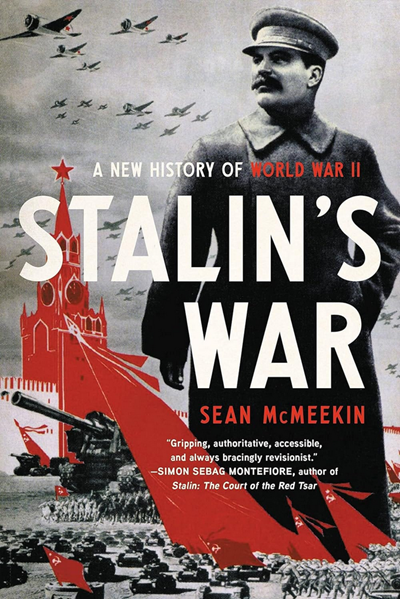
Big Serge: “One of the first things that stands out about your work is that you have found success writing about topics which are very familiar to people and have a large extant corpus of writing. World War One, the Russian Revolution, World War Two, and now a broad survey of Communism – these are all subjects with no shortage of literature, and yet you have consistently managed to write books that feel refreshing and new. In a sense, your books help “reset” how people understand these events, so for example Stalin’s War was very popular and was not perceived as just another World War Two book. Would you say that this is your explicit objective when you write, and more generally, how do you approach the challenge of writing about familiar subjects?”

Dr. McMeekin: “Yes, I think that is an important goal when I write. I have often been called a revisionist, and it is not usually meant as a compliment, but I don’t particularly mind the label. I have never understood the idea that a historian’s job is simply to reinforce or regurgitate, in slightly different form, our existing knowledge of major events. If there is nothing new to say, why write a book?

Of course, it is not easy to say something genuinely new about events such as the First World War, the Russian Revolution, or World War Two. The scholar in me would like to think that I have been able to do so owing to my discovery of new materials, especially in Russian and other archives less well-trodden by western historians until recently, and that is certainly part of it. But I think it is more important that I come to this material – and older material, too – with new questions, and often surprisingly obvious ones.

For example, in The Russian Origins of the First World War, I simply took up Fritz Fischer’s challenge, which for some reason had been forgotten after “Fischerites” (most of them less than careful readers of Fischer, apparently) took over the field. In the original 1961 edition of Griff nach der Weltmacht (Germany’s “Bid” or “Grab” for World Power, a title translated more blandly but descriptively into English as Germany’s Aims in the First World War), Fischer pointed out that he was able to subject German war aims to withering scrutiny because basically every German file (not destroyed in the wars) had been declassified and opened to historians owing to Germany’s abject defeat in 1945 – while pointing out that, if the secret French, British, and Russian files on 1914 were ever opened, a historian could do the same thing for one of the Entente Powers. I had already done a Fischer-esque history on German WWI strategy, especially Germany’s use of pan-Islam (The Berlin-Baghdad Express), inspired by a similar epigraph in an old edition of John Buchan’s wartime thriller Greenmantle – Buchan predicted that a historian would come along one day to tell the story “with ample documents”, joking that when this happened he would retire and “fall to reading Miss Austen in a hermitage”. So it was a logical progression to ask, if Fischer can do this for Germany’s war aims, why not Russia?

Readers may have missed the obvious Fischer inspiration for Russian Origins owing to the editors at Harvard/Belknap, who thought my original title – the obviously Fischer-inspired Russia’s Aims in the First World War – was boring and unsexy. Probably this helped sell books, but it did lend my critics an easy line that I was “blaming Russia for the First World War” rather than simply applying a Fischer-esque lens to Russia’s war aims. Some also called me Russophobic, which is understandable, though I think it misses the point. To my mind, subjecting Russian strategic thinking, wartime diplomacy and maneuvering to the same scrutiny as those routinely applied to Germany and the other Powers is taking the country seriously on its own terms, rather than ignoring Russia, as nearly every historian of, say, Gallipoli has done.

A book on Russian war aims was also long overdue. Other than an underwhelming Chai Lieven study from 1983 and a few articles, no one had really done this for Russia since Soviet scholars and archivists had (with very different motivations) published annotated volumes of secret Russian diplomatic correspondence back in the 1920s. For me, this was a door wide open, and I walked right in. Stalin’s War is in many ways a sequel to Russia’s Aims in the First World War (my own title!), written in a similar spirit, albeit much longer and in some ways more ambitious.

With the Russian Revolution, it was probably still harder to say anything really new, particularly after the popular histories of Richard Pipes and Orlando Figes (and a huge new literature written partly in response to them) came out in the 1990s. And I do not think my “take” was quite as revisionist or controversial as those on WWI or WW2. What I did try to do, in order to add something new to the story, was to combine my own research in a number of areas (Russian army morale reports before and after Order No. 1, depositions taken after the July Days, police reports from 1917, Bolshevik finances and expropriation policies, etc.) with new work done by others since 1991 on, especially, Russia’s military performance in WWI (a topic almost completely ignored in Cold War era literature on the Revolution, both Soviet and western), to reinterpret both the February and October Revolutions. In full disclosure, I would have preferred to write an ambitious history on just 1917, where I had the most original material and new points to make, but my publisher wanted a one-volume “comprehensive” history of the Revolution, so that is what I wrote. Like most historians and writers, I like to think that I write entirely from inspiration with a free hand, but of course there are all kinds of factors that play into our work.

Getting back to your question – while I have certainly done original research for all of these books, I am hardly the only historian to take advantage of Russian archives opened after the collapse of the USSR in 1991 – including, I should add, all the incredible archival material compiled by Russian researchers in the 1990s and 2000s into huge published volumes of Soviet-era documents. I think it is my mindset that differentiates me from other scholars who have taken similar advantage of this opportunity. Simon Sebag Montefiore, for example, uncovered incredibly rich veins of new material for Stalin. Court of the Red Tsar, as Antony Beevor did for Stalingrad, both of which books made an enormous splash. They’re not exactly “revisionists”, though. Rather, these historians retell stories already partly familiar, but with reams of fascinating new details that greatly enrich the story. I think this is a wonderful way to write history, and thousands of readers evidently agree. It is just not what I do.”

Big Serge: “I’m glad you brought up The Russian Origins of the First World War. This was the first of your books that I read, and I found it interesting for a counterintuitive reason, in that its arguments seem like they should be obvious and not particularly controversial. The essence of the book is that the Tsarist state had agency and tried to use the First World War to achieve important strategic objectives. That should be obvious, after all this was an immensely powerful state with a long pedigree of muscular foreign policy, but people are very accustomed to the Guns of August sort of narrative where all the agency and initiative is with Germany, and everyone else is reduced to the role of objects in a story where Germany is the sole subject.

It makes me think somewhat of a quip that Dr. Stephen Kotkin has used in interviews about his Stalin biographies, when he says that the “big secret” of the Soviet archives was that the communists really were communist. His point is that, even in a very convoluted and secretive regime, sometimes what you see really is what you get. I think you made a similar sort of point with Russian Origins. If I could paraphrase you, the big reveal is that the big, powerful Tsarist Empire was behaving like a big powerful empire, in that it had cogent war aims and it consistently sought to work towards those – so consistently in fact that the war aims were initially largely unchanged after the fall of the monarchy in 1917. You’re saying something very similar with Stalin’s War: the shocking secret here is that a powerful, expansionist, heavily militarized Soviet regime acted like it and worked aggressively to pursue its own peculiar interests.

How do you conceptualize this? It strikes me as a little bit odd, because, as you say, there is sometimes a bit of a stigma round the label “revisionist”, but your books generally present schemas that are fairly intuitive: Tsarist Russia was a big, powerful empire that pursued big imperial aims; Stalin was the protagonist of his own story and exercised a muscular, self-interested foreign policy; the Bolsheviks used extraordinary violence to conquer an anarchic environment. Are you surprised that people are surprised at these things?”

Dr. McMeekin: “I wish I was surprised, and perhaps at first I was, but I suppose that, over the years, I have become inured to the shocked! Shocked! reactions I receive when I point out fairly obvious things. Historians, like most groups, tend to be pack animals, who like to run in safe herds. When it comes to a familiar subject such as the outbreak of World War I, the literature tends to groove around well-trodden themes and questions. Certainly it has done since Fischerites took over the field: it’s Germany all the time, with perhaps a nod to Austria-Hungary in the Serbian backstory, or Britain with the naval race. France and Russia had almost disappeared from the story, as if one of the two major continental alliance blocs was irrelevant. I was heartened that my own treatment of Russia’s role in the outbreak of the war and Russia’s war aims garnered attention and shaped the conversation, both in itself and through Christopher Clark’s bestseller Sleepwalkers (which draws on Russian Origins). By contrast, Stefan Schmidt’s pathbreaking 2009 study of the French role in the outbreak of the war (Frankreichs Aussenpolitik in der Julikrise 1914), which Clark and I draw on heavily, has still not been translated into English, making barely a ripple in the profession. Clark and I have poked around with English-language publishers, trying to gin up interest in a translation, but so far without luck.

With the Second World War, I suppose the “shock” value is still greater, and perhaps therefore even less surprising. In Germany, after all, there are laws on the books making it illegal to “trivialize” the Holocaust, for example by foregrounding Soviet war crimes on the eastern front, and of course whole areas of the war such as the Molotov-Ribbentrop Pact, Soviet war plans in 1941, and even Lend-Lease are highly sensitive in Russia, though I’ll note that there has been a curious exception for the “full-on” revisionism of Rezun-Suvorov (Icebreaker, etc.) – perhaps because his thesis is so extreme as to be easily caricatured, or maybe just because his books sell so well, it has never been difficult to find them in Russian bookstores. In a way, I also think the popularity of Suvorov’s books in Russia relates to the way they do take the Soviet Union seriously as a great power, as I do, of course – whether or not one agrees with his thesis, and I’m sure many of his Russian readers do not, it is less condescending than western histories that treat the Soviets as passive victims of fate in the Barbarossa story before Stalin woke them up.

I was perhaps more surprised at the visceral reaction to Stalin’s War in Britain, particularly my discussion of Operation Pike (eg British plans to bomb Soviet oil installations in Baku in 1940), which sent certain reviewers into paroxysms of rage I found absolutely bewildering. If anything, I should have thought my sharply critical treatment of Hopkins and Roosevelt would have offended Americans far more gravely than my slightly more sympathetic portrayal of Britain’s wartime statesmen, but it was quite the opposite. Certainly some American Roosevelt admirers were annoyed, but this was nothing like British reviewers’ hysteria over Operation Pike. Curiously enough I had dinner not long ago with one of these reviewers, and he brought up Stalin’s War. He was very civil, full of British charm, but he still wanted desperately to know why I had argued that Britain “should have gone to war against the Soviet Union instead of Nazi Germany”. As always when I am accused of this – another reviewer stated this point blank in the TLS – I simply asked him if he could locate a passage in the book where I had stated any such thing? The entire subject of World War II has become so encrusted with emotion and taboos that I think it clouds people’s vision. They see ghosts.”
The hereditary aristocrats of the People’s Republic of China

To many western liberals, an aristocratic system is a disparaged and vestigial remnant of the distant past. An echo of the “bad old days” of anti-meritocratic wealth and privilege enjoyed by the lucky descendants of ancient conquerors and oppressors. Yet among the most well-connected and powerful people in China can only be described as “princelings”, as they are literally the children and grandchildren of the leaders of the Communist Party, especially those who took part in the “Long March”:

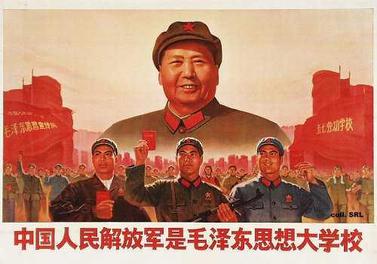
“The Chinese People’s Liberation Army is the great school of Mao Zedong Thought”, 1969.
A poster from the Cultural Revolution, featuring an image of Chairman Mao, published by the government of the People’s Republic of China.
Image via Wikimedia Commons.

In 1926, five years after becoming one of the founders of the Chinese Communist Party (CCP), Mao Zedong listed China’s enemies as “the warlords, the bureaucrats, the comprador class [businessmen dealing with foreign interests] and the reactionary section of the intelligentsia attached to them”. It is ironic that Mao would eventually create a new aristocracy, often referred to as the “princelings” (taizidang), every bit as hierarchical as that against which he had previously railed.

Perversely, when Mao Zedong came to power in China in 1949, there were not many structures of authority left to destroy. In the period of warlordism that succeeded the overthrow of the Qing dynasty by Sun Yat-sen in 2011 and ended with the consolidation of nationalist (Kuomintang) power by Chiang Kai-shek in 1936, the aristocracy of imperial China had been swept away. So too the Mandarin class, the Chinese bureaucrats selected by civil service examination, a system that started with the Sui dynasty in AD 581. As for the Chinese aristocracy, its last vestiges ended with the abolition in 1935 of the Dukedom of Yansheng which belonged to the descendants of Confucius.

So, in terms of social hierarchies, Mao inherited a clean sheet when he established the People’s Republic of China on October 1, 1949. The CCP leadership soon proved that, in the immortal words of George Orwell in his novel Animal Farm, “all animals are equal, but some animals are more equal than others”. In Beijing, Mao and China’s CCP leaders took residence in the palatial compounds located in Zhongnanhai, a waterside park established by the Yuan dynasty in the 13th century.

There is not even equality within the “red aristocracy”. Gradations are as clear-cut as if there were princes, dukes or marquises. The highest rank is accredited to the offspring of those CCP leaders who participated in the Long March. This iconic fighting retreat to a remote plateau in Shaanxi province followed the defeat of the Red Army in October 1934.

It is perhaps difficult for people in the West to understand the scale of Chinese veneration for the individuals who completed the Long March. With the possible exception of the migratory treks along the Oregon Trail, there is no comparable event in American or European history. Throughout their lives, leaders of the Long March enjoyed unparalleled prestige; it was a prestige that passed down to their children – hence the princelings.

The creation of the red aristocracy started with Mao himself. Within a few years of the establishment of the People’s Republic of China, Mao became a de facto emperor. On occasions he even referred to himself as such. He certainly lived the life of an emperor. At his commodious palace in Zhongnanhai, Mao surrounded himself with a harem of dancing girls who would occupy his bed and his swimming pool. In time-honoured fashion, China’s head of security and intelligence, Kang Sheng, procured girls for Mao as well as thousands of volumes of pornography.

[…]

My own experience of the princeling world confirmed that in China, despite its vast population a very small group of families form a governing nexus that has power far beyond its numbers. It is a group that seem to be getting stronger. The princeling proportion of the CCP central committee rose from 6 per cent in 1982 to 9 per cent in 2012. When I spoke to a princeling friend about the politburo standing committee that was elected in 2012, she told me that she personally knew five of its seven members; to her great delight three of them were princelings. It was through her that I met Deng Xiaoping’s daughters and spent a “country house” weekend with them and her princeling pals.

Here it became clear that, while most of the princelings I met were reformists in the Deng mode, there are also factions that are hard-line Maoists, like the one led by Xi Jinping. At the moment it appears that the reformist princelings have gained the upper hand. More light on Xi Jinping’s future and the outcome of this princeling tug of war may be shed at the Fourth Plenum of the 20th CCP Congress starting on October 20.

RIFfing the US federal workforce

Filed under: Government, Media, Politics, USA — Tags: , , , , — Nicholas @ 03:00

In Reason, J.D. Tuccille considers the impact of the US government shutdown on the federal civil service:

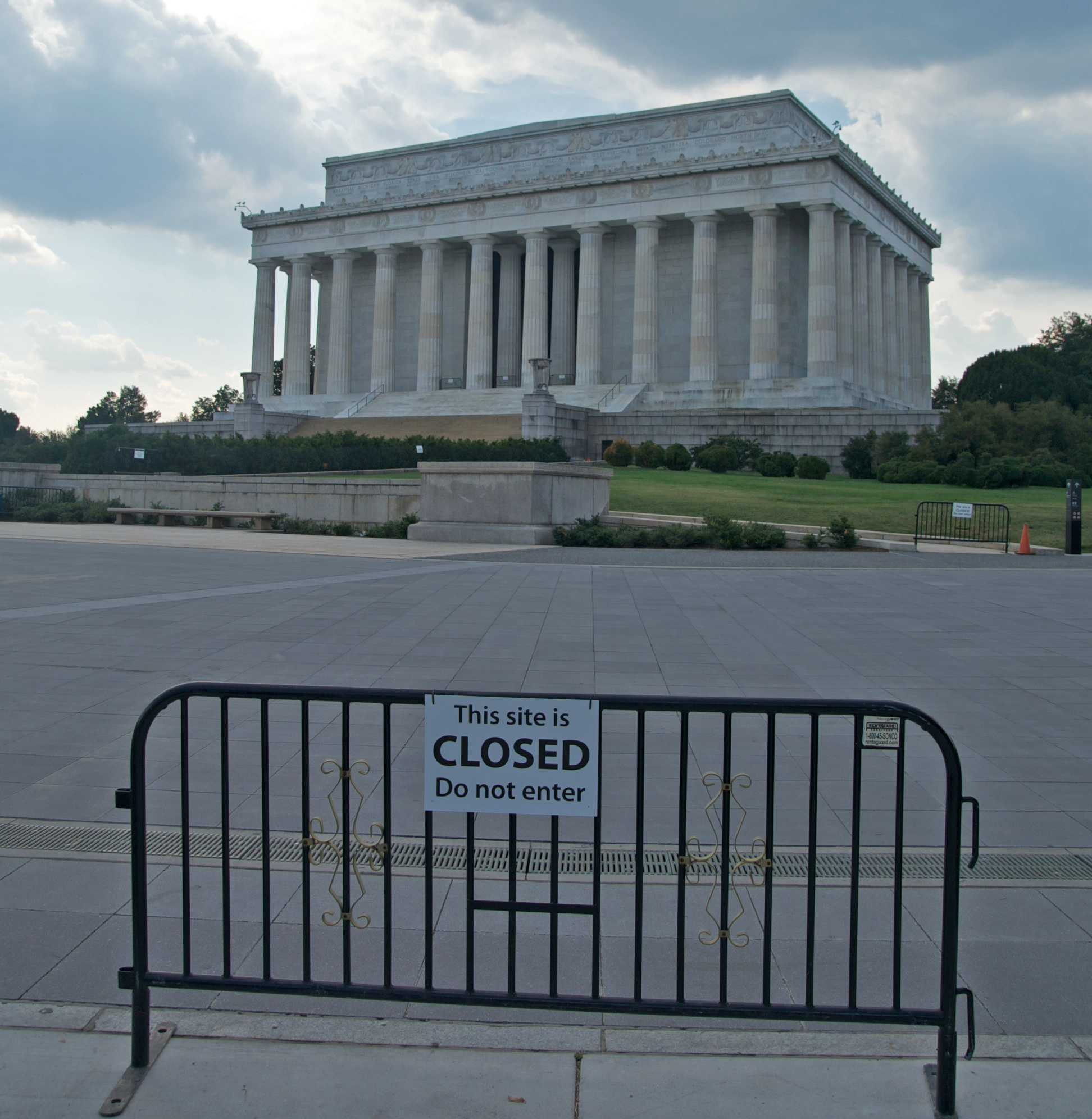
“Lincoln Memorial During Government Shutdown 2013” by Flickr user reivax is licensed under CC BY-SA 2.0 .

As promised — or threatened, if you wandered over to Reason by accident — the Trump administration has started using the government sort-of-shutdown as an opportunity to engage in mass layoffs of federal employees. In the game of chicken between Republicans and Democrats over just how much the government should overspend and on what, the losers so far appear to be some of the almost 3 million Americans who thought federal employment would be a comfortable way to collect a paycheck.

Setting thousands of former government workers loose to seek jobs elsewhere — preferably not involving money forcibly extracted from taxpayers — is a step in the right direction.

Shutdowns Are (Mostly) Political Theater

As we all should know by now, government shutdowns are largely political theater. National parks and museums are closed to inconvenience the public into believing something big is happening even as taxes keep getting collected and government enforcers continue twisting arms to make sure people comply with laws and rules that never should have been imposed.

The Brookings Institution’s David Wessel pointed out last week, “the Justice Department said 90% of its employees would be exempted from the furlough” and “the Department of Homeland Security said in its 76-page contingency plan that roughly 95% of its nearly 272,000 employees would remain on the job if a shutdown occurred”. Agencies accomplish this by defining “essential” employees who remain on the job in the broadest way possible.

Paychecks may be delayed during the shutdown. But after it ends, “employees who were required to perform excepted work during the lapse will receive retroactive pay” and “employees who were furloughed as the result of the lapse will receive retroactive pay for those furlough periods” according to the Office of Personnel Management. Basically, all federal employees eventually get paid whether they continue to work or are sent home for the duration of the “shutdown”.

An Opportunity To Reduce the Federal Workforce

At least, that’s how it usually works. This time is a little different because the Trump administration came into office promising to downsize the federal government. The Department of Government Efficiency (DOGE) was supposed to accomplish that goal, but the shutdown offers another opportunity. Even before furloughs began, the Office of Management and Budget (OMB) sent out a memo noting:

    With respect to those Federal programs whose funding would lapse and which are otherwise unfunded, such programs are no longer statutorily required to be carried out. Therefore, consistent with applicable law, including the requirements of 5 C.F.R. part 351, agencies are directed to use this opportunity to consider Reduction in Force (RIF) notices for all employees in programs, projects, or activities (PPAs) that satisfy all three of the following conditions: (1) discretionary funding lapses on October 1, 2025; (2) another source of funding, such as H.R. 1 (Public Law 119-21) is not currently available; and (3) the PPA is not consistent with the President’s priorities.

The White House is apparently taking this opportunity seriously. “Around 4,200 employees were laid off in total on Friday,” reports Eric Katz of Government Executive. The biggest cuts were at the Department of the Treasury (1,446 employees) and the Department of Health and Human Services (between 1,100 and 1,200 employees). The Department of Education, which President Trump proposes to totally eliminate, also experienced layoffs (466 or nearly 20 percent of its remaining workforce), as did the Environmental Protection Agency, Homeland Security, and Housing and Urban Development.

Everything this administration does seems to involve a bit of chaos, and the latest rounds of reductions in force are no different. While hundreds of employees of the Centers for Disease Control and Prevention (CDC) were included in the layoffs, some were fired by accident and immediately rehired.

Chris Bray notes that — stop me if you’ve heard this before — a district court judge has ruled that the President doesn’t have the power to do, well, pretty much anything to do with the federal workforce (what is it with the executive branch thinking they have powers that haven’t been explicitly approved by the judiciary?):

After a just absolutely bizarre hearing in a Northern California federal court, a judge has forbidden the Trump administration from laying off government employees. The hearing may have been held in the Court of the Red Queen: After Counsel to the Assistant Attorney General Elizabeth Hedges argued that she wasn’t going to get into the legal merits of the Trump administration’s layoffs because the court lacked jurisdiction and the plaintiffs hadn’t met the legal standards for filing a lawsuit, Judge Susan Illston warned that, actual quote, “This hatchet is falling on the heads of employees all across the nation and you’re not even prepared to address whether that’s legal?” Getting laid off is a hatchet attack, so we skip the arguments about ripeness and standing. It’s emotionally dire, a thing that feels very bad. Judges talk like this, now. OH GOD COUNSEL THIS IS LIKE A THING WITH A KNIFE THAT WOUNDS ME. Objection, your honor, inadequate trigger warning. […]

Illston declared the existence of a temporary restraining order from the bench, and I’ve been waiting for her written order to land on PACER. It’s here, and it’s … very … Well, okay: It has a lot of feelings. […]

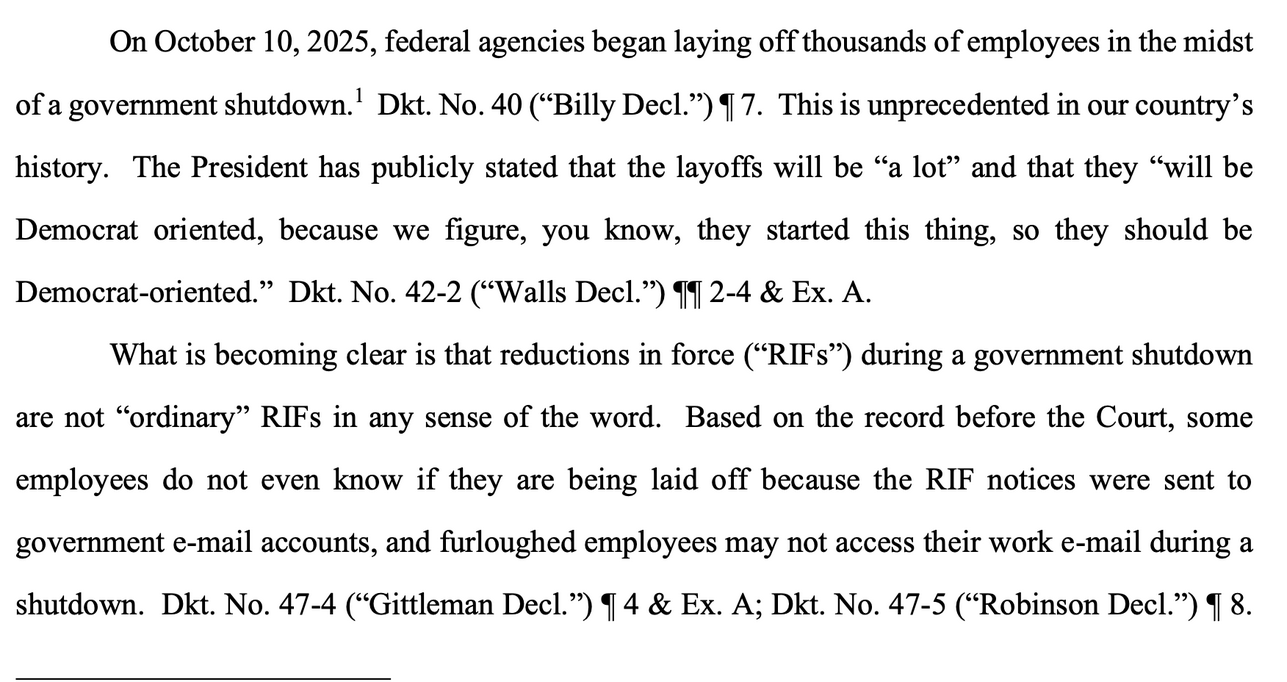
Opening paragraphs, first page:

Note that the first paragraph frames federal RIFs as historically unprecedented, while the second paragraph frames the current federal RIFS as not ordinary: different than the way RIFs are usually conducted. So this is unprecedented, but it has happened before, and the problem with the unprecedented thing is that it’s not being done the way the thing that has never been done before is usually done.

But anyway, a reduction in force of federal personnel during a shutdown is “unprecedented in our country’s history”. Of course, a reduction of force alone is not at all unprecedented, and the Clinton administration reduced the size of the federal bureaucracy by about 400,000 people. Illston doesn’t articulate a reason why reducing the bureaucracy during a shutdown is worse, or a reason why Clinton RIFs were good but Trump RIFs are a violent hatchet attack, but she clearly feels it. Of course, during a shutdown, the agencies being shrunk have no approved funding, so it would seem to make more sense to be careful about personnel costs, but this argument means that I just hurt people with a hatchet.

Above all, note that the argument out of the gate is a normative argument, not a legal argument. This is unprecedented! This is not ordinary! If a judge feels that something is a little off, she can order it stopped.

The Mexican-American War 1846-48

Filed under: Americas, Government, History, Military, USA, Weapons — Tags: , , , , , , — Nicholas @ 02:00

Real Time History
Published 16 May 2025

In the early 19th century, the United States and Mexico share a massive cross-continental border, but US settlement in Mexico, expansionist ideals and religious differences put the young republics on a collision course. As tensions boil over into bloodshed, the tiny, inexperienced US army marches to a war which will forge the modern United States.

Chapters:
00:00 Texas Republic
05:06 Declaration of War
07:03 The US Army
09:26 British Muskets in the Mexican Army
16:19 The Mexican Army
18:24 The Battles of Palo Alto and Resaca de la Palma
21:38 California and New Mexico
25:11 US Volunteers
28:40 Battle of Monterrey
33:03 Expanding the War
36:59 The Pedregal Battles
40:18 Battles for Mexico City
43:42 Treaty of Guadalupe Hidalgo
45:14 Legacy
(more…)

QotD: The Roman proclivity to accept changes that “go back to the way things used to be”

… for a lot of Roman reforms or other changes we just don’t have a lot of evidence for how they were presented. What we often have are descriptions of programs, proposals or ideas written decades or centuries later, when their effects were known, by writers who may be some of the few people in the ancient world who might actually know how things “used to be”.

What I will say is that the Romans were very conservative in their outlook, believing that things ought to be done according to the mos maiorum – “the customs of [our] ancestors”. The very fact that the way you say “ancestors” in Latin is maiores, “the greater ones” should tell you something about the Roman attitude towards the past. And so often real innovations in Roman governance were explained as efforts to get back to the “way things were”, but of course “the way things were” is such a broad concept that you can justify pretty radical changes in some things to restore other things to “the way they were”.

The most obvious example of this, of course, is Augustus with his PR-line of a res publica restituta, “a republic restored”. Augustus made substantial changes (even if one looked past his creation of an entire shadow-office of emperor!) to Roman governance on the justification that this was necessary to “restore” the Republic; exactly what is preserved tells you a lot about what elements of the Roman (unwritten) constitution were thought to be essential to the Republic by the people that mattered (the elites). And Augustus was hardly the first; Sulla crippled the tribunate, doubled the size of the Senate and made substantial reforms to the laws claiming that he was restoring things to the way they had been – that is, restoring the Senate to its position of prominence.

And one thing that is very clear about the Greeks and Romans generally is that they had at best a fuzzy sense of their past, often ascribing considerable antiquity to things which were not old but which stretched out of living memory. Moreover there is a general sense, pervading Greek and Latin literature that people in the past were better than people now, more virtuous, more upright, possibly even physically better. You can see this notion in authors from Hesiod to Sallust. This shouldn’t be overstressed; you also had Aristotelian/Polybian “cyclical” senses of history along with moments of present-triumphalism (Vergil, for instance, and his imperium sine fine). But still there seems to have been a broad sense of the folk system that things get worse over time and thus things must have been better in the past and thus returning to the way things were done is better. We’ve discussed this thought already where it intersects with Roman religion.

And the same time, here we run into the potential weakness of probing elite mentalités in trying to understand a society. Some Romans seem quite aware of positive change over time; Pliny the Elder and Columella are both aware of improving agricultural technology in their own day, particularly as compared to older economic writing by Cato the Elder. Polybius has no problem having the Romans twice adopt new and better ship designs during the First Punic War (though both are “just-so” stories; the ancients love “just-so” stories to explain new innovations or inventions). And sometimes Roman leaders did represent things as very much new; even Augustus combined his res publica restituta rhetoric with the idea that he was ushering in a saeculum novum, a “new age” (based on the idea of 110 year cycles in history).

So there is complexity here. The Romans most certainly did not have our strong positive associations with youth and progress. Their culture expected deference to elders and certainly didn’t expect “progress” most of the time; things, they thought, generally ought to be done as they had “always been done”. Consequently, framing things as a return to the mos maiorum or as a means to return to it was always a strong political framing and presumably many of the folks doing those things believed it. On the other hand the Romans seem well aware that some of the things they did were new and that not all of these “firsts” were bad and that some things had seemed to have gotten better or more useful since the days of their maiores. And some Romans, particularly emperors, are relatively unabashed about making dramatic breaks with tradition and precedent; Diocletian comes to mind here in particular.

Bret Devereaux, Referenda ad Senatum: January 13, 2023: Roman Traditionalism, Ancient Dates and Imperial Spies”, A Collection of Unmitigated Pedantry, 2023-01-13.

Powered by WordPress