
Devon Eriksen recently pointed out that today’s Marxists are hostile to space flight and off-world colonization. But in Cold War times, Marxists who ran countries were aggressively futuristic about space, treating it as the empire of their dreams.
What caused this turnaround?
To understand this, it’s helpful that to notice that spaceflight is not the only technology about which Marxist attitudes have done a 180. Nuclear power is another. More generally, where Marxists used to be pro-growth and celebrate industrialization and material progress, they’re now loudly for degrowth and renunciation.
But the history of western Marxism is more interesting than that. Western Marxists flipped to strident anti-futurism in the late 1960s and early 1970s while futurist propaganda in the Communist bloc did not end until its post-1989 collapse.
That 20-year-long disjunct was particularly strong about nuclear power, with the Soviets providing ideological support and funding to the foundation of European Green parties and the US’s anti-nuclear-power movement at the same time as they were pouring resources into nuclearizing their own power grid.
And that’s your clue. Domestic Marxism favored making power cheap and abundant, while their Western proxies pushed to keep it expensive and scarce and preached degrowth rather than expansion. Futurism vs. anti-futurism: why?
We don’t need to theorize about this. Yuri Bezmenov, a former gear in the Soviet propaganda machine, told us the answer starting in the early 1980s. Fewer people listened than should have.
Bezmenov explained that unlike Marxism in the Sino-Soviet bloc, Western Marxism was a mind virus, a memetic weapon designed to weaken and degrade its host societies from within, softening them up for totalitarianism and an eventual Soviet takeover. The West was to be denied power, both in a literal and figurative sense.
Ever wonder why today’s Marxists are so quick to make alliances with radical religious Islamists? This shouldn’t happen. According to Marxist theory, Islamism is a regression to an earlier stage of the dialectic than capitalism, and today’s Marxists ought to fear and hate it as a counter-ideology more than capitalism. But they don’t, because to them Islam is a tool to be used for nihilistic ends.
That nihilism is the actual purpose of Western Marxism and all its offshoots, including “woke”. One sign of this is how fervently it embraces the sexual mutilation of children.
The Soviets are gone but their program is still running autonomously in the brains of people who were infected by their Cold-War-era proxies and the successors of those proxies. And that program is nihilism all the way down.
Yuri Bezmenov should have been heeded. There is no simpler theory that fits the observed facts.
Eric S. Raymond, Twitter, 2024-05-14.
July 3, 2025
QotD: Why Marxists turned away from space exploration and colonization
July 2, 2025
The Korean War Week 54 – The War is One Year Old – July 1, 1951
The Korean War by Indy Neidell
Published 1 Jul 2025Over a year has passed since North Korean forces crossed the 38th Parallel and invaded South Korea, and while the war has seen the advantage switch hands time and again, one thing it has not seen is any sort of cease fire or peace negotiations. However, that might change soon, as this week both the Chinese and the Americans indicate their willingness to sit down and talk. South Korean President Syngman Rhee, however, is against any cease fire talks that do not set out to meet a big variety of his demands, demands which which the other warring parties do not see as being in their own best interests.
(more…)
“In short order, Trudeau was describing his own country with the kind of apocalyptic rhetoric one typically associates with, say, the Holocaust, Holodomor, or Rwandan Genocide”
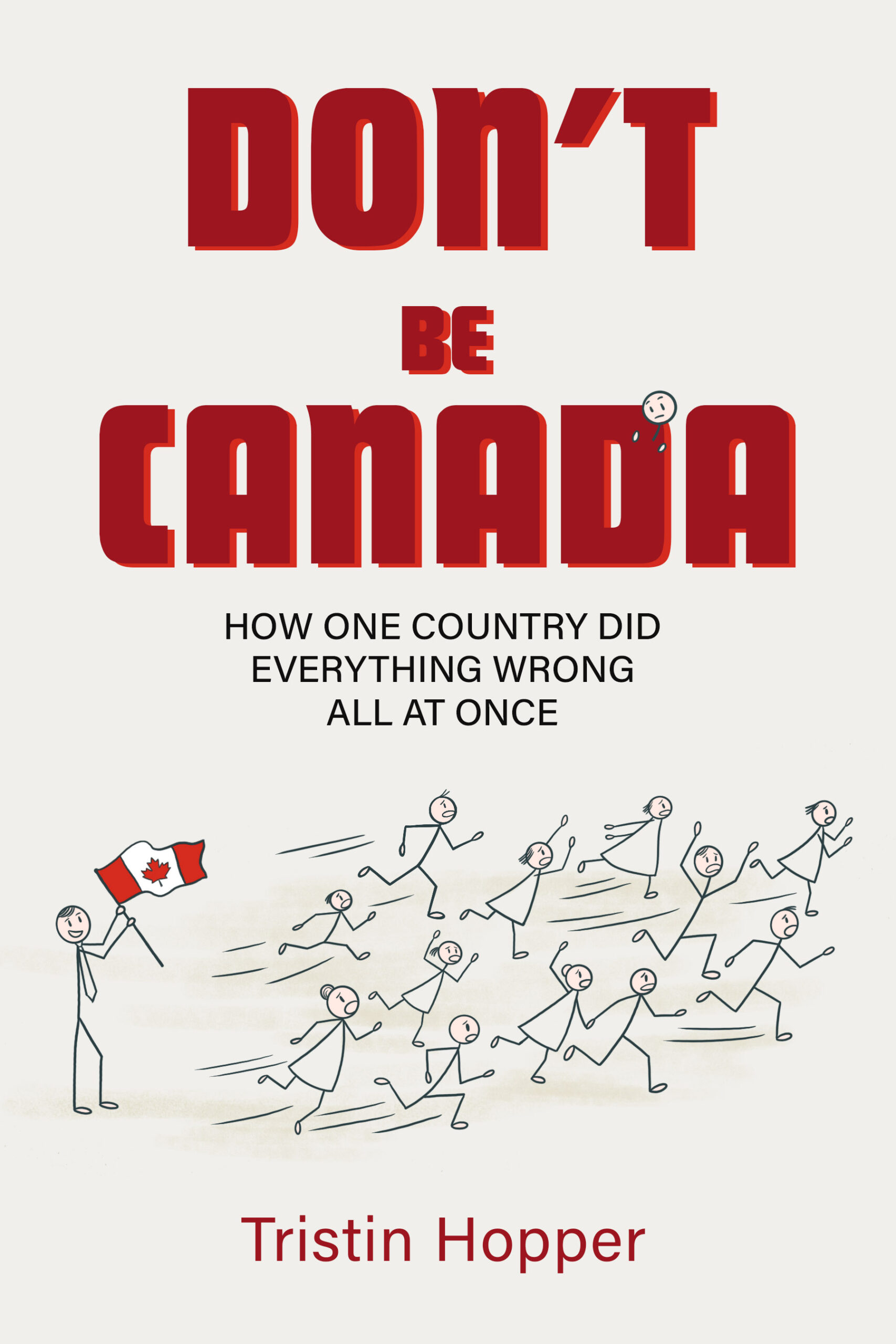
In Quillette, Tristin Hopper provides some excerpts from his book Don’t Be Canada: How One Country Did Everything Wrong All At Once, published earlier this year:

Prime Minister Justin Trudeau holding a teddy bear in the proximity of a soil disturbance in a field at the site of a former residential school in Cowessess First Nation, Saskatchewan.
July 6, 2021.
This is the story of how, in 2019, Canada became the first (and, to this day, only) country to declare itself guilty of committing an ongoing genocide against its own citizens.
To outsiders, who (correctly) view Canada as a humane democracy, the tale will seem bizarre. But to Canadians, there was a certain twisted political logic to it — at the time, at least.
In the late 2010s and early 2020s, back when my country was still ruled by Justin Trudeau, Canada’s progressive elites bought into then-ascendant social-justice manias with a born-again fervour that was arguably unmatched in any other nation. This was a time, readers will recall, when college students were busily confessing their internalised white supremacy and racist thought crimes to one another on social media. Seeking to ingratiate his Liberal Party with this young demographic, Trudeau extrapolated their cultish movement on a national scale.
His rhetorical style became increasingly manic, as one social-justice slogan led to another; with each being rapturously liked and retweeted on social media. In short order, Trudeau was describing his own country with the kind of apocalyptic rhetoric one typically associates with, say, the Holocaust, Holodomor, or Rwandan Genocide.
In this regard, Trudeau’s first truly epic act of national self-incrimination took place at a 2019 women’s conference in Vancouver. The PM had just been handed the final report of the National Inquiry into Missing and Murdered Indigenous Women and Girls (MMIWG), a probe he’d authorised as a means to investigate the high rates of homicide committed against Canada’s female Indigenous population.
As it turned out, however, the MMIWG report authors’ most prominent demand had nothing to do with the technical details of criminal investigation. Instead, they were focused on language: They wanted homicides targeting Indigenous women and girls to be described as an ongoing “race-based genocide” perpetrated by Canadian society at large.
Murder wasn’t the government’s only instrument of genocide, the authors claimed. Higher rates of Indigenous heart disease and suicide attempts were also described as foreseeable results of Canadian policies that are “explicitly genocidal”.
Canadians tend to feel guilty about the genuinely shameful way their country treated Indigenous peoples at many historical junctures (more on this below). Because of this high baseline guilt level, it is often seen as taboo (especially among journalists) to push back against even the most obviously counterfactual claims made on behalf of Indigenous peoples. And the MMIWG report was a case in point: the inquiry’s insistence that Canada was in the midst of an active genocide was reported uncritically by most media outlets.
Some public figures did speak out against this hyperbolic use of language — such as Roméo Dallaire, the retired general who’d been in Rwanda during that country’s (actual) genocide in 1994. Yet Canada’s most important public figure — Trudeau himself — accepted the inquiry’s conclusions without reservation; even if this meant that he was now signalling his status as leader of a nation that, day in, day out, under his own watch, was committing a genocide against its own population.
“Earlier this morning, the national inquiry formally presented their final report, in which they found that the tragic violence that Indigenous women and girls experienced amounts to genocide,” he told his Vancouver audience. Trudeau then paused for nine seconds to accommodate his desired reaction — which consisted of cheers and applause.
History of Britain IV: Caesar in Britain, Reconnaissance in Force, 55-54 BCE
Thersites the Historian
Published 29 Jan 2025Caesar’s landings in Britain illustrate his willingness to take risks, even unnecessary ones. The questionable decision-making, however, also led to the first surviving detailed description of people and events in Britain.
(more…)
QotD: The bane of socialism — boredom
Most “bad” dogs aren’t actually bad. They’re not misbehaving because they’re willful, or mean, or whatever. They’re just bored out of their fucking skulls, because the kind of bugman who gets a dog these days has no idea that you actually have to play with it, and pet it, and interact with it, in much the same way you have to interact with a young human. Given a dog’s limited intellect, the only thing it can think of to do to alleviate its boredom is chew on things, or dig in the yard, or piss on the rug, or, if all else fails, chew its own fur off.
Being slightly more complex critters, humans have more options, but bore a human enough — overfill his material needs, so that he’s stuffed to somnolence, but take his sense of purpose away — and you’ll see the exact same dog behaviors. Why do you think they shove all that metal shit in their faces? And no, I am absolutely not joking. Why all the huge, gaudy, gross tattoos? The constant changes of hair color and style?
Have you ever asked them?
Again, I’m 100% not joking. I know most of y’all avoid SJWs like the plague, and that’s a smart move, can’t blame you for it, but if you do, you’ll just have to trust me: I was in academia for a long time, so I was around not just SJWs, but bleeding-edge lunatic SJWs, and I asked them about it. One must be discreet about this, of course — hey, I’m thinking of getting a roll of toilet paper tattooed on my bicep, to remind me that We’re In This Together, what do you think? — but it’s fairly easy to do. And every time, they’d spin me some elaborate tale of how deep and meaningful it all is.
No, really. By some mental process I can’t begin to reproduce, getting Ruth Bader Ginsburg’s face tattooed on your calf is, to them, striking a blow at ambient civilization. That is the literal truth of their motivation. It’s the same reason the dog digs in the backyard, or pisses on the rug, or chews its own fur off: That’s the only agency it has, the only purpose it can find.
Severian, “Purpose”, Founding Questions, 2021-12-06.
July 1, 2025
Like a cheap suit, Canada folds under Trumpian pressure on the Digital Services Tax grab
A couple of days back, I characterized Prime Minister Mark Carney’s determination to push ahead with the Digital Services Tax “insane”, as it was overwhelmingly likely to trigger a strong reaction from the Trump administration. As it did. So, finally recognizing they were in a no-win situation, the federal government announced at the last minute that they wouldn’t be demanding the literally billions of dollars from the US “tech giants” after all. Michael Geist can legitimately say “I told you so” on this issue:
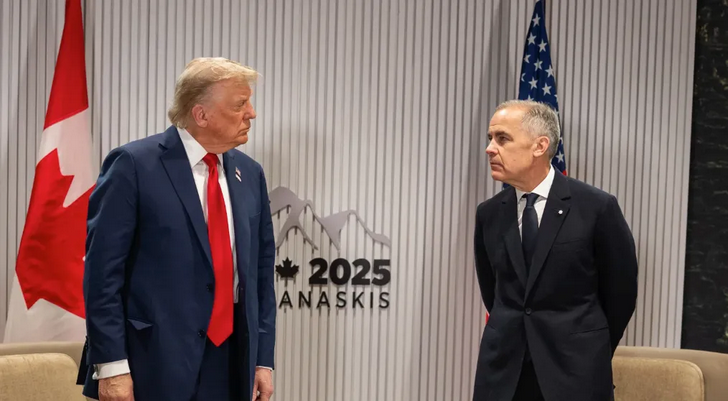
President Trump Attends G7 Summit in Canada by White House https://www.whitehouse.gov/gallery/president-trump-attends-g7-summit-in-canada/ CC BY 3.0 US
After years of dismissing the warnings of likely retaliation, the Canadian government caved last night on the digital services tax. Faced with the prospect of the U.S. suspending trade negotiations, Finance Minister François-Philippe Champagne announced that the government would drop the DST altogether, payments scheduled for Monday would be cancelled, and legislation will be forthcoming to rescind the legislation that created it in the first place. Over the weekend, I wrote about the repeated warnings that the DST was a serious trade irritant with the U.S. that cut across party and presidential lines. While ignoring the risks was bad enough, I argued that Canada played its DST card too early. Rather than delaying implementation in the hopes of incorporating it into a broader trade deal with U.S., it marched ahead, leading to an entirely predictable response from U.S. President Donald Trump. That left Canada in a no-win situation: stick with the DST but face the prospect of higher tariffs or embarrassingly drop the DST (and $7.2 billion in revenue over five years) with only restarting negotiations that were on until government overplayed its hand to show for it.
It is hard to overstate how badly the government managed the DST issue over the past five years. It alienated allies by pushing ahead with the DST despite efforts at an international deal at the OECD, stood alone in rejecting an extension of a moratorium on new DSTs, made the DST retroactive which solidified opposition, and continually downplayed the concerns of successive U.S. Presidents and Members of Congress from both sides of the aisle. Meanwhile, when companies began passing along the costs of the DST to Canadian businesses, it did nothing. And when they urged the government to delay implementation to at least allow for the issue to be incorporated into a broader trade pact, it ignored the advice.
At every step, there were better options. This year, the likelihood that the DST would come to a boil was obvious to anyone who was paying attention. But rather than following the UK strategy, which managed to salvage a smaller DST (2% rather than 3%) as part of a bigger agreement that includes a commitment to support UK digital access to the U.S. market and to negotiate a larger digital trade deal, Canadian officials seemingly assumed that the U.S. was bluffing and would not retaliate.
If this sounds familiar, it is because the Canadian government misreading the tech sector has become a hallmark of its policy. Talk tough, practically dare companies and foreign governments to respond, and then frantically seek an exit strategy when they do. This was the case with the Online News Act and Meta’s blocking of news links, with the government’s AI regulation which new Minister of AI Evan Solomon says will not be re-introduced, with the Online Harms bill, and now with the DST.
Tibet’s Last Stand: The Snow Lion vs. The Dragon – W2W 34
TimeGhost History
Published 29 Jun 2025The fate of Tibet is decided on the roof of the world as Mao’s China sets its sights on Lhasa. This episode traces the dramatic showdown between the snow lion and the dragon — from imperial legacies and British invasions to the last years of de facto Tibetan independence. Discover how realpolitik, Cold War indifference, and the carrot-and-stick tactics of Mao’s regime sealed Tibet’s fate. Watch as the Dalai Lama faces impossible choices, world powers look away, and the dream of independence is crushed beneath the weight of history.
(more…)
The Food Professor explains what Trump got right in his Trade War
On the social media site formerly known as Twitter, Dr. Sylvain Charlebois, aka @FoodProfessor explains how Trump’s Trade War strategy is working out for US interests, in contrast to the Trudeau/Carney governments’ approach:
The Globalism Hangover: What Trump’s Trade War Got Right
“Trump’s bombastic style aside, his nationalist approach to trade and food policy is forcing global institutions to justify their existence — and that’s a conversation Canada can no longer afford to ignore.”
For the past six months, President Donald Trump’s trade policies have been widely mocked, criticized, and condemned. Some of it is certainly warranted. The Wall Street Journal, for instance, recently likened his tariff-heavy approach to global trade as a direct path toward another Great Depression. But data out of the United States tells a more nuanced story — one that challenges conventional wisdom.
Despite persistent headwinds, the U.S. economy continues to outperform expectations. The Federal Reserve Bank of Atlanta projects second-quarter GDP growth at 3.8%. In May, the U.S. economy added 139,000 jobs, outpacing forecasts, while inflation remained subdued at 0.1% month-over-month and 2.4% annually. The U.S. trade deficit has been cut nearly in half, pointing to stronger export performance and a rebalancing of trade relationships.
Canada, by contrast, is showing signs of economic strain. The national economy is shrinking, manufacturing is struggling under U.S. trade pressure, and food inflation is outpacing general inflation. In short, our economy is not keeping pace—despite our public criticism of the Trump administration.
To make matters worse, the Trump administration has now halted all trade negotiations with Canada, signaling that our bilateral economic relationship holds little strategic value for Washington. For the U.S., Canada is no longer a priority — especially under a Carney-led government that has visibly pivoted toward Europe, a market still heavily invested in maintaining close ties with the United States. From an agri-food standpoint, this shift is consequential: access to our largest trading partner is narrowing, while Ottawa appears more focused on diplomatic optics than on securing stable, competitive trade channels for the Canadian agrifood economy.
This is the one thing the ‘Elbows Up’ crowd never understood — and still doesn’t. We’re not in a trade war with the U.S. There’s no war to be won. For Trump, this is about a realignment of the global order, plain and simple — one centered entirely on American supremacy.
Love him or loathe him, Trump is not destroying the U.S. economy — not yet, anyway. His unapologetically nationalist agenda extends far beyond tariffs. He has withdrawn U.S. support from key global institutions such as the WHO and is threatening to sever ties with others, including NATO and several UN-affiliated agencies. Among them is the Food and Agriculture Organization (FAO), the UN’s most authoritative body on food security.
At a recent event in Brazil, a senior FAO official acknowledged that fundraising dynamics have shifted. In the Trump era, governments are asking harder questions: Why should we fund the FAO? What domestic benefit does it provide? What used to be assumed support is now conditional — and arguably, more accountable.
This shift isn’t unique to Washington. Many countries are quietly aligning with the U.S. position, scrutinizing globalist institutions with renewed skepticism. Transparency and accountability are byproducts of this anti-globalist sentiment — something not inherently negative.
For decades, globalism pushed the world to believe that trade liberalization was the only viable path to growth and prosperity. It became conventional wisdom. But globalism has made some nations — and some people — richer, while leaving others behind. In the process, domestic sectors, including agriculture, were often sidelined or sacrificed in the name of global efficiency.
The problem with globalism, particularly in agri-food policy, is its tendency to pursue uniformity over relevance. Canada, for example, adopted the carbon tax under a globalist climate agenda that often overlooks the vital role food producers play in feeding people. Instead of being supported, the sector is too often vilified as a problem. But agriculture is not a liability — it is a necessity.
Trump’s message — wrapped, of course, in provocative and often abrasive language — is that one-size-fits-all global policies rarely work. Nations have different socio-economic realities, and those should come first. While cooperation is essential, so is recognizing local and regional priorities. In this sense, his “America First” approach is not without logic — especially when it seems to be yielding short-term economic gains.
For Canada’s agri-food sector, the lesson is clear: striking a better balance between global commitments and national imperatives is overdue. We should not abandon multilateral cooperation, but we must stop anchoring policy to global agendas we have little influence over. Instead, let’s define what works for Canadians — what supports our farmers, protects our food security, and reflects our unique landscape — while keeping the broader global context in view.
We are not there yet. But if this moment of disruption sparks a more realistic and regionally attuned approach to food policy, we’ll be better for it.
The Maple Leaf Forever
Columbia Yore
Published 13 Jun 2018The Maple Leaf Forever was written by Alexander Muir in 1867 and served as the unofficial anthem of Canada from 1867-1980.
QotD: Canadian measuring “systems”
We measure weather and room temperature in Celsius, but we still bake in Fahrenheit. Your weight is in pounds, but your car’s weight is in kilograms. You drink alcohol by the ounce, but soda by the millilitre. The phenomenon was summed up in an imaginary dialogue by Canadian comedian Janel Comeau. Scene: An American, a European and a Canadian. The American says “I use miles and pounds”. The European says “I use kilometres and kilograms”. The Canadian takes an assortment of global measuring systems, crushes them into a powder, and snorts them like cocaine before declaring, “I’m 5’3, I weigh 150lbs, horses weigh 1000kgs, I need a cup of flour and 1L of milk”.
And none of this is an accident. Canada’s bizarre system of half-imperial, half-metric represents the truce lines of a culture war battle whose scale and ferocity is all but forgotten today. There were people in the 1970s who wanted to purge this country of any memory of the imperial system. Feet, inches and gallons were a relic of a backwards, colonial age, and the future belonged to rationalist, scientific metrication. A small army of bureaucrats armed with meter sticks and one-litre jugs were dispatched to spread the metrication gospel. And if you didn’t comply with the new metric zeitgeist, you could face severe consequences. For example, if you were a gas station continuing to sell gas by the gallon instead of by the litre, you could be fined.
But this grand plan to reprogram the Canadian psyche was thwarted, and thwarted forever. And when you buy beef by the pound or do your carpentry with inches and feet, you are the unwitting legacy of a populist, anti-government protest movement that hated the metric system and went all-out to stop it. We’re talking protests. Lawsuits. Civil disobedience. This story will literally feature a group of pissed-off Conservative MPs opening a “freedom” gas station to defy federal mandates to sell gasoline by the litre.
Tristin Hopper The metric schism | Canada Did What?”, National Post, 2025-03-11.


