
Quotulatiousness

May 31, 2025

Depending on how you read the tea leaves, are all the signed treaties now to be ignored?

Filed under: Cancon, Government, History — Tags: , , , , , — Nicholas @ 04:00

In The Free Press Rupa Subramanya discusses King Charles’s land acknowledgement at the start of the Throne Speech earlier this week:
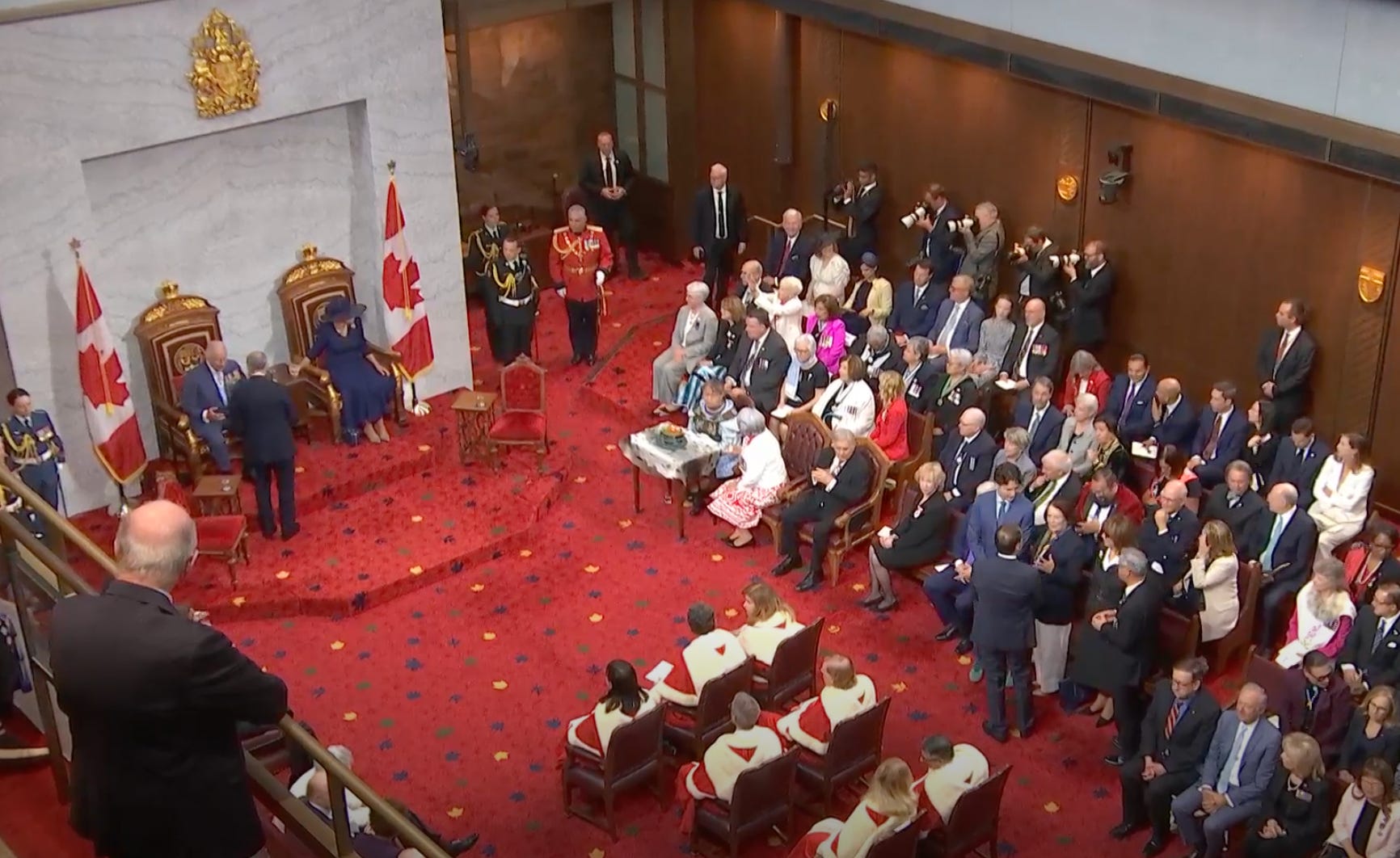
Mark Carney joins our visiting King in the traditional Making of the Small Talk.
Photo by Paul Wells from his Substack

Canadians have a fondness for land acknowledgments, [NR: while some of us think they’re merely virtue signalling on steriods which will end up causing more mischief in the long run] which have now become common at police press conferences, on Air Canada flights, at hockey games, and even at a Taylor Swift concert.

But nothing has caused more commotion than the spectacle of King Charles III opening the 45th legislative session of Parliament on May 27 with a land acknowledgment, when he declared from his throne: “I would like to acknowledge that we are gathered on the unceded territory of the Algonquin Anishinabe people. This land acknowledgment is a recognition of shared history as a nation.”

People will point out that King Charles’s speech was written by Canadian prime minister Mark Carney’s government (true) and that as the monarch he was being respectful to Canadian traditions (fine). But there is something deeply funny about the literal King of England talking about the lands his predecessors brutally conquered centuries ago like they’re still up grabs.

Kicking off Parliament with a speech is a time-honored tradition, but it’s rare for the monarch to deliver it in person, and is normally delivered by the governor general, Canada’s official stand-in for the king. The reason the king was there was to push back against the idea that Canada is for sale.

“There is no better way to assert Canada’s sovereignty than by inviting the sovereign,” said Philippe Lagassé, a constitutional expert at Carleton University in Ottawa, Ontario. “Carney invited the king as part of his renewed emphasis on Canadian nationalism rooted in our institutions and history.” (Unlike the U.S., which broke from Britain in 1776, Canada remained a colony until 1867, when it became a constitutional monarchy with a British-style parliamentary system and the UK monarch as head of state.)

Lagassé added that Carney’s invite to Charles was also likely done to “leverage President Trump’s affection for the king in Canada’s favor.”

Trump may love the monarchy, but Canadians have traditionally been indifferent towards it. But that’s changing, thanks to Trump’s “51st state” rhetoric.

According to a recent poll, 66 percent of Canadians now believe the monarchy helps set the country apart from the United States, up from 54 percent in April 2023. In 2023, 67 percent thought the royal family should have no formal role in Canadian society; today, that number has dropped to 56 percent.

In his speech, King Charles didn’t mention Trump by name, but the subtext was hard to miss: “Canada faces another critical moment. Democracy, pluralism, the rule of law, self-determination, and freedom are values which Canadians hold dear, and ones which the government is determined to protect.”


“U.S. libertarians [are] the best friends Canada doesn’t know it has”

In the National Post, Colby Cosh sings the praises of American libertarians for their work in trying to dismantle some of Donald Trump’s dubiously Constitutional extensions of presidential power:

The James L. Watson Court of International Trade Building at 1 Federal Plaza in Lower Manhattan, New York City.
Photo by Americasroof via Wikimedia Commons.

The U.S. Court of International Trade (CIT) issued a decision Wednesday that annuls various salvos of surprise economic tariffs, including ones on Canada, that have been enacted by President Donald Trump since his inauguration in January. I won’t lie to you: I had the same initial reaction to this consequential news that you probably did, which was “Hooray!” and then “Huh, there’s a U.S. Court of International Trade?”

This court is surely unfamiliar even to most Americans, no doubt because much of its work involves settling issues like “Do hockey pants count as ‘garments’ or ‘sports equipment’ under customs law?” Nevertheless, the CIT does have exclusive jurisdiction over civil actions involving U.S. trade law. It’s just that no president has ever before rewritten the tariff schedule of the republic in the half-mad fashion of a child taking crayons to a fresh-painted wall.

The American Constitution, from day one, has unambiguously assigned the right to set international tariffs to Congress. Congress is allowed to delegate its powers to the president and his agents for limited or temporary purposes, but it can’t abandon those powers to him altogether. Defining this legal frontier is what the CIT was asked to do, and their demarcation of it will now swim upward through higher appellate courts (its decision has been put on hold in the meantime).

The lawsuit was actually two parallel suits raising overlapping objections to the tariffs. One was brought forward by 12 U.S. states, and the other was filed by a group of tariff-exposed American businesses, including manufacturers of bikes, electronics kits and fishing equipment. The latter set of plaintiffs was roped together by the usual posse of heroic libertarians and legal originalists, including George Mason University law prof Ilya Somin.

About 24 hours after Trump originally announced the “Liberation Day” worldwide tariffs, Somin quickly blogged about how insanely unconstitutional the whole idea was, and concluded his article essentially by saying “I’m darn well gonna do something about this nonsense”. I don’t mean to suggest he deserves primary credit; I only intend to call attention, once again, to U.S. libertarians being the best friends Canada doesn’t know it has.

Social Hierarchy in the Early Roman Empire

Filed under: Europe, History — Tags: , , , , — Nicholas @ 02:00

seangabb
Published 31 Dec 2024

The second lecture in the series – an exploration of social divisions within the Early Roman Empire. Contents include:

00:00:00 – Introduction
00:05:37 – The Roman Social Structure
00:09:02 – The Position of the Emperor
00:11:49 – Perception and Role of the Emperor
00:19:24 – Evolution of the Imperial Senate
00:22:19 – What Kind of Men became Senators?
00:25:34 – The Functions of Senators
00:27:41 – The Equestrian Order
00:30:56 – Local Government
00:35:49 – The Imperial Bureaucracy
00:37:16 – Narcissus, Pallas, Felix
00:42:12 – Ordinary People
00:43:06 – Roman Citizenship
00:45:15 – How to Become a Citizen?
00:47:21 – Justice According to Class
00:51:34 – How was Status Legally Determined?
00:59:44 – Patron and Client
(more…)

QotD: Explaining the science to the non-scientific layperson

Filed under: Education, Media, Quotations, Science — Tags: , , , , — Nicholas @ 01:00

There’s a famous video in which Richard Feynman is asked by a BBC journalist if he can explain magnetism to him, and Feynman pauses for a moment and says “no”. The journalist is totally incredulous, and demands to know what Feynman means by that, and the great scientist tells him that he knows so little of the basics, and magnetism is so deep and so tricky,1 that it would be impossible to explain much of anything without either misleading him or giving him a false understanding.

I’ve always thought that nearly all pop science books fall into one version or another of this trap. Either they abandon all attempts at explaining the difficult concept in simple terms, or they simplify and elide so much as to become actively misleading.2 I call the latter horn of the dilemma “string theory is like a taco”-syndrome, and it’s by far the more common failure case. This is because undersimplification makes your audience feel dumb, while oversimplification makes them feel smart, so you sell a lot more books by oversimplifying. Unfortunately the effects on the audience of oversimplification are far more dangerous and insidious. After reading something impenetrable, you at least still know that you don’t really understand it, so there’s still a chance for you to go on and learn it some other way. Reading an oversimplified explanation, however, can fool you into thinking that you now grasp the concept, when in reality all you’ve grasped is a lossy analogy that will lead you astray.

All of which is to say I think it’s pretty impressive how well [author David] Reich does at diving into some of the real statistical meat of his techniques while still making them comprehensible to a smart layman. He has the gift that the greatest scientific expositors possess of being able to communicate in simple terms what it is that makes a problem hard, and then also giving you the broad strokes of an elegant solution to that hard problem. He doesn’t pretend that he hasn’t left anything out, instead he points out exactly where he’s glossed over details, so that you can go back and look them up if you want. This doesn’t sound all that impressive, but it’s actually really freaking hard to pull off, especially in a field that’s new and hence hasn’t been reformulated and recondensed a hundred times until it’s turned into a crystalline version of itself.

Okay, what was your favorite interesting genetic fact that this book taught you about a contemporary population? Mine was definitely that the various Indian jatis are as genetically distinct from one another as the Ashkenazi Jews are from everybody else. Not one group, but hundreds and hundreds of groups, all living in close proximity to each other, have gone millennia with incredibly minimal genetic mixing. How is that possible? It makes me take some of the assertions made by classical Indian texts a little bit more seriously.

Jane Psmith and John Psmith, “JOINT REVIEW: Who We Are and How We Got Here, by David Reich”, Mr. and Mrs. Psmith’s Bookshelf, 2023-05-29.


    1. It always bothered me when people ragged on Insane Clown Posse for expressing humility and awe at magnets. In fact their attitude is exactly the appropriate one. Back when ICP were in the news more often, I made a minor hobby of demanding that anybody who made fun of them explain magnets scientifically to me on the spot. Nobody ever succeeded.

    2. And sometimes, remarkably, a pop science book manages to make both mistakes at the same time. I’m reminded of Edward Frenkel’s horrible book Love & Math, which is full of passages like: “Think of the Hitchin fibration as a box of donuts, except that there are donuts attached not only to a grid of points in the base of the carton box, but to all points in the base. So we have infinitely many donuts — Homer Simpson would sure love that! It turns out that the mirror dual Hitchin moduli space, the one associated to the Langlands dual group, is also a donut topic/fibration over the same base. Donuts. Is there anything they can’t do?”

Powered by WordPress


