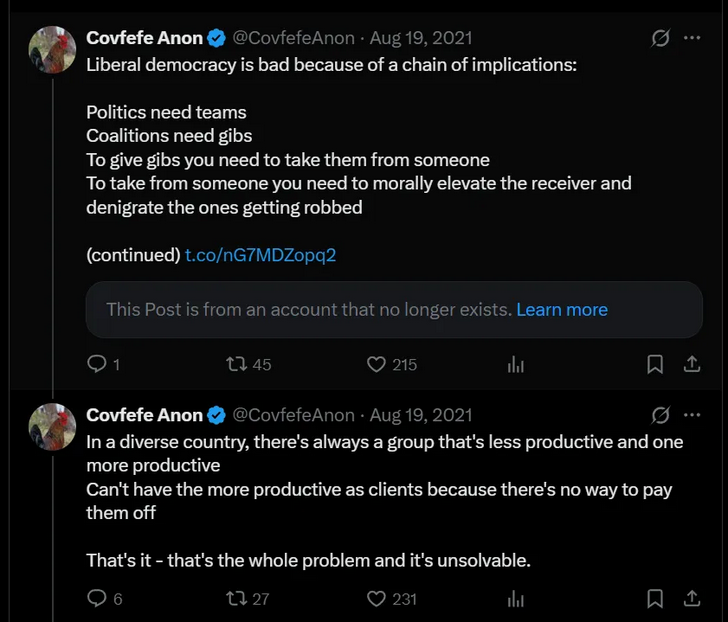
John Carter suggests that votes should be allocated to reflect the costs imposed on the voters by taxation, that is to ensure that those with the most “skin in the game” at least have their votes weighted more than those who pay little or no taxes but can still vote themselves more benefits:
Have you ever noticed how election results are regularly broken down geographically, as well by the demographic categories of age, sex, and – depending on the country – race, yet we almost never see the results separated into taxpayer vs taxeater status?
So anyhow.
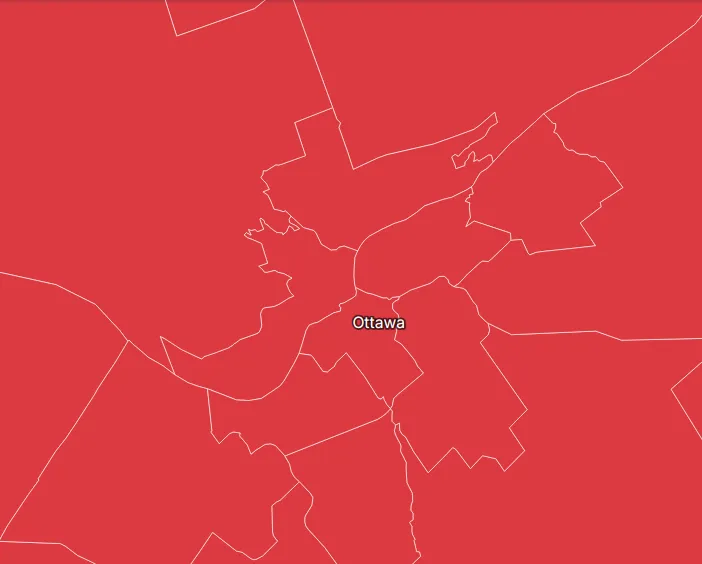
For my American readers, in Canadian elections the Liberal Party is denoted by red, as the Devil and Karl Marx intended.
It is absolutely no surprise that Ottawa voted solidly for the Liberal Party of Canada, whose base consists of three primary groups: migrants, public sector workers, and baby boomers, all of whom are regime client groups, and all of whom are tightly packed into the nation’s capital.
Perhaps it’s that it’s tax season and I’m in a grumpy mood because I just got the bad news, but I can’t help but wonder about how electoral politics would change if only taxpayers were allowed to vote. It’s common for “taxpayers” to be used as a synonym for “the voting public”, but this is a bit of linguistic legerdemain which obscures a core dynamic rotting the heart out of every liberal democracy: most of the population are not, in fact, taxpayers. First there are those who don’t earn enough to pay taxes, such as university students; then there are those receiving direct welfare payments of one form or another; then there are public employees, who although they pay tax on paper, are clearly net recipients of government largess since their paychecks come from taxes in the first place.
The most successful parties in country after country are the parties that mobilize client groups by promising to steal money from productive citizens and transfer that wealth to their non-productive clients. This dynamic is baked into the cake of any universal suffrage democracy, which is why Universal Suffrage is a Suicide Pact. Parties need client groups for electoral support; wealth can only be plundered from the productive; therefore the only available relationship is to cultivate non-productive clients.
The problem, of course, is that over time this destroys the economic productivity of the liberal democracy, because the productive groups will become less productive because what’s the point, or they’ll just look for the exits, while the client groups will swell, becoming simultaneously too expensive to maintain and to electorally heavy to dislodge.
I suspect you could fix all of this by simply tying votes to tax receipts, with only those who are net taxpayers being given the franchise in any given election. At a stroke this would disenfranchise the welfare underclass, government bureaucrats, and university students, all of whom should be prohibited from voting as a matter of principle. If you wanted to be really fancy, you could implement a tax-weighted vote: the more taxes you pay, the more your vote counts.
In addition to the salutary effects of reducing the electoral weight of female voters (since men tend to pay more in taxes), weighting votes by tax receipts would lead to a very interesting incentive structure. On the one hand, everyone hates paying taxes, and wants to minimize the taxes they pay; if only taxpayers were voting, this would place a strong downward pressure on taxes and, hence, on the size of government (thus forcing states to find other ways of funding themselves, via e.g. tariffs or service fees). On the other hand, people like to vote, so there would be a strong incentive not to evade taxes. On the gripping hand, since paying more tax means your vote counts for more, there would be a countervailing incentive to pay as much tax as you can afford. One might imagine a state functioning as a sort of de facto oligarchy, with the billionaires happily paying obscene levels of tax in order to gather as much political power to their class as possible, and enforcing their tyranny by voting to keep taxes on everyone else to the absolute bare minimum. This would be a truly dystopian brier patch to be thrown into.
Alas, we do not inhabit such a political experiment. Returning to the ostensible topic of yesterday’s Canadian election, however, it would probably not be an exaggeration to posit that if we did inhabit such a system, Canada’s Conservative Party would have rolled the Liberals in this and, in all likelihood, almost every other election.
That is not, however, what happened.
The high-level outcome is that, after running the country into the ground for the last decade, the Liberal Party has been elected for the fourth consecutive time, with a mandate to complete the project of crashing the plane of Dominion with no survivors. It brings me absolutely no pleasure to report that I predicted the Liberals would win before the election was even called. The Liberals are four seats short of forming a majority in parliament, meaning they cannot quite form a stable government on their own. This is not a problem for the Liberals, however. Despite the glorious collapse of the New Democratic Party – which plummeted from 25 seats in the last federal election to 7 in the current election, by far their lowest in 30 years – the NDP retains just enough seats for them to form a stable coalition government with the Liberals. In other words, the outcome of this election is that Canada will be in essentially the same situation it was in before the election, with the only meaningful difference being that the Liberals have a few more seats than they did before.