
Military History Vlogs
Published on 23 Feb 2018The introduction of the breech-loading rifle and the railroad had a tremendous influence on Warfare in the 19th Century. Although, not everyone was as fast or able to adopt then the Prussians. Austria, France and Russia had major issues. Most notably visible in the Austro-Prussian War (1866) and Franco-Prussian War (1870-1871).
March 16, 2018
How Rifles & Railroads influenced Warfare in the 19th Century
Comments Off on How Rifles & Railroads influenced Warfare in the 19th Century
March 15, 2018
All change – Cousins to the Vikings, Keenum to Denver, Bradford to Arizona and Bridgewater to the Jets
 The big news on the first day of NFL free agency was that former Washington quarterback Kirk Cousins has passed up better offers from the New York Jets and the Arizona Cardinals to accept a $28 million-per-year deal with the Vikings. This is only the second NFL contract where all of the money is guaranteed for the three-year term. The Vikings also traded for Denver quarterback Trevor Siemian to back up Cousins (the deal includes a seventh-round 2018 pick for Minnesota and a 2019 sixth-round pick for Denver). The three free agent quarterbacks from the Vikings are each reported to have signed or be about to sign with new teams: Case Keenum with the Broncos, Sam Bradford with the Arizona Cardinals, and Teddy Bridgewater with the New York Jets.
I must admit, right up to the last second, I was still hoping Bridgewater would be one of our quarterbacks, even if the team didn’t want to risk having him be the unchallenged starter. Now I’m going to have to cheer for the Jets as long as Teddy is starting for them. This blow to the Bridgewater Underground may be fatal. If there’s any remaining activity among the surviving cells, I’ll keep you posted. After all, there was a second coming of Sir Francis, back in the mists of time. Maybe Teddy will also return to the Purple down the road.
Comments Off on All change – Cousins to the Vikings, Keenum to Denver, Bradford to Arizona and Bridgewater to the Jets
DicKtionary – H is for Homicide – Francisco Macias Nguema
TimeGhost
Published on 14 Mar 2018H is for homicide, the taking of lives
Bloodthirsty people with pistols or knives
Or government leaders than strangled their nations
And Macias Nguema killed whole populations.Join us on Patreon: https://www.patreon.com/TimeGhostHistory
Written and Hosted by: Indy Neidell
Based on a concept by Astrid Deinhard and Indy Neidell
Produced by: Spartacus Olsson
Executive Producers: Bodo Rittenauer, Astrid Deinhard, Indy Neidell, Spartacus Olsson
Camera by: Ryan Tebo
Edited by: Bastian BeißwengerA TimeGhost format produced by OnLion Entertainment GmbH
Comments Off on DicKtionary – H is for Homicide – Francisco Macias Nguema
Vintage Stanley Planes: Is older really better?
Rex Krueger
Published on 25 Jan 2018Most hand tool collectors and users go way back when they get Stanley bench planes. Older ones are usually more valuable and are often considered to work better, especially when compared to later-model, post-war planes. But this wisdom is almost totally wrong. Stanley planes did start to suck in the 1960s, but the planes they made in the 1950s and before may be the best they ever made. These late-model planes have improved features, thicker castings, easier adjustment and more precise machining. And, these planes are typically ignored by collectors, so you can get them cheap.
Are you thinking about shelling out big bucks for a premium plane? Maybe first, you should check out a late-model Stanley.
Comments Off on Vintage Stanley Planes: Is older really better?
QotD: The self-harming reality of tariffs
Unintended harm to American companies is a recurring problem with tariffs, even those meant to protect American jobs from competition that our government deems unfair. After Bush imposed steel tariffs, steel-consuming industries pointed out that they employed far more Americans than the steel industry itself, and argued that the net effect of the policy on jobs was negative.
Anti-dumping laws, which put tariffs on foreign imports that are supposedly being sold at too low a price, usually target intermediate goods and therefore make the downstream American producers that use them less competitive. Daniel Ikenson, a trade-policy analyst at the Cato Institute, notes that the government, perversely, is forbidden by law from considering the impact of tariffs on these producers before levying the tariffs.
Then there’s the question of costs. Gary Hufbauer and Sean Lowry, a senior fellow and research associate, respectively, at the Peterson Institute for International Economics, calculated [PDF] that Obama’s tariffs on Chinese tires cost American consumers at least $900,000 for every job they saved for one year. That’s before taking account of job losses caused by lower spending by consumers on other products and by retaliatory Chinese tariffs. This very high cost per job, they point out, is consistent with research on other instances of trade protection.
In an interview, Hufbauer notes that our efforts to protect industries from competition have typically not resulted in their revival and impose extremely high costs for any jobs they save. He cites the textile and maritime industries, both of which have been protected for decades, as examples of these disappointing results.
Ramesh Ponnuru, “The High Cost of U.S. Protectionism”, Bloomberg View, 2016-07-01.
Comments Off on QotD: The self-harming reality of tariffs
March 14, 2018
Ontario’s tax dollars at work
At Worthwhile Canadian Initiative, Frances Woolley shows the picture that will define Ontario politics for years to come:
In Ontario, public sector employees earn more than private sector employees. Many workers in the private sector earn the minimum wage, or only slightly above minimum wage. The peak of the public sector earnings distribution is much higher, at twenty-something dollars per hour, and there are a good number of public sector workers earning $40 or $50 an hour.
There are many things missing from this picture. Most importantly, it excludes highly-paid self-employed professionals, such as doctors, lawyers, and accountants, as well as entrepreneurs and business owners. It also excludes self-employed people in the trades, such as plumbers, electricians and contractors. The numbers are non-trivial: 13 percent of Ontario workers are self-employed. A good chunk of the upper part of the private sector earnings distribution is missing from the picture. On the other hand, the hourly wage distribution above excludes non-wage benefits that are more common in the public than the private sector, such as employer contributions to health insurance and pension plans.
Furthermore, the picture does not take into account the differences in the nature of work in the public and private sector. Many public sector jobs, such as nursing, social work, and teaching, require relatively high levels of skill and education. There are private sector jobs that require skill and education as well – but, as noted earlier, many of those jobs are carried out by self-employed professionals, so are not in the graph.
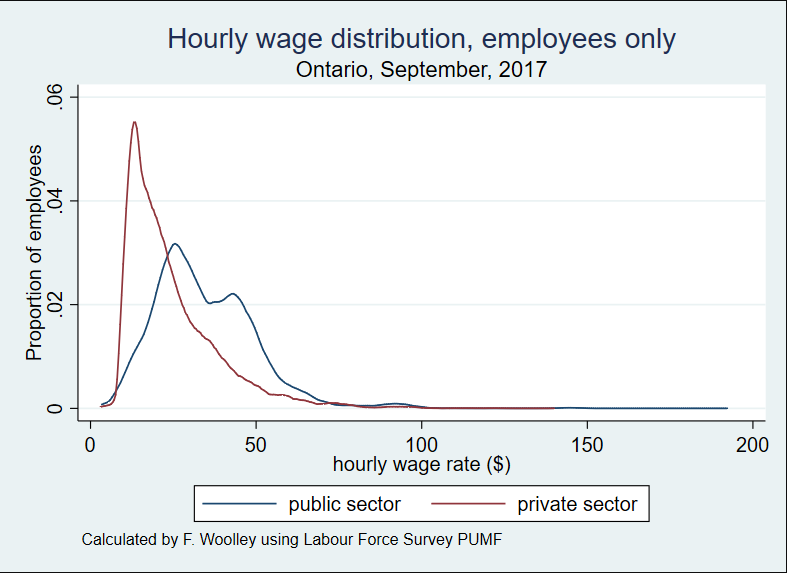
Even noting the exclusions, it’s striking that the old trade-off between public and private sector jobs — that civil servants got lower pay but better benefits and job security — has long since ceased to function. Civil servants, on the whole, now get higher pay than private sector workers, but have retained or even improved the benefits advantage over their private counterparts … and also still retain the job security that private workers can only dream of.
Comments Off on Ontario’s tax dollars at work
The navy we need versus the navy we’re willing to pay for
Ted Campbell recounts the ups and downs of the federal government’s plans for the Royal Canadian Navy over the last few decades:

A Chilean navy boarding team fast-ropes onto the flight deck of RCN Halifax-class frigate HMCS Calgary (FFH 335) during multinational training exercise Fuerzas Aliadas PANAMAX 2009.
US Navy photo via Wikimedia.
One of my old friends, commenting to another equally old friend on social media, said this: “Surely, the PM and his government must see the obvious — that as the oceans warm and the ice melts the Northwest Passage becomes navigable year round. He’s been sounding off about climate change ad nauseum so that would seem to be understood by him. As a teacher he must also know that European colonial powers sought a shortcut between east and west but were deterred by ice. That’s changed, which he acknowledges, and Canada’s claim of the.increasingly ice free Northwest Passage as sovereign territory is under threat. Absent Canada’s willingness, and any capability, to enforce it’s claim, Canada surrenders any legitimate right to ownership of the Northwest Passage and the resources in the territory it abuts. That a maritime nation bordered by three oceans needs a blue-water navy is axiomatic. And once the PM acknowledges that the Northwest Passage is about to become Canada’s Suez Canal he must recognize that it, too, needs to be protected and defended by the Royal Canadian Navy. But the navy can only do that if it has ships and sailors. If Canada doesn’t expend the effort to protect its shores and assert its claims someone else will.” Sound pretty sensible, doesn’t it? Climate change will, very possibly, open the Northwest Passage; it Canada cannot patrol and police those waters then others will exploit them; it’s the Navy’s job to patrol and police our waters … I have argued that the “constabulary fleet” that should do that ought not to be in the Navy, but that’s a different issue … for now.
[…]
Way back when ~ I’m working from memory and I’m happy to have these numbers corrected ~ the Royal Canadian Navy said, in a document called “Leadmark,” if my memory serves, that, in addition to infrastructure (headquarters, schools, dockyards, etc) it needed:
- A fleet with global “reach” which meant more than a dozen “major combatants” (destroyers and frigates) plus four support ships so that, at any time, it could have one combat-ready task group in each of any two of the world’s oceans;
- A coastal (three coasts) patrol fleet consisting of a mix of submarines and another dozen “minor combatants” (corvettes and mine hunters);
- Organic air elements for those fleets;
- Auxiliary and training vessels.
Circumstances changed over time but the Paul Martin government finally committed to new helicopters for the fleet and thanks to his decision and to the perseverance of the Harper government they are, finally, entering service, only 25 years after Jean Chrétien abruptly cancelled the Mulroney government’s signed contracts for (then) new shipborne helicopters.
[…]
What we, Canadians, do not have is a properly funded plan to build the real Navy that the country with the world’s longest coastline, that borders three oceans, needs and deserves.
Since I am pretty sure that, absent some catastrophic events, Prime Minister Trudeau has no interest in warships (or the Coast Guard) I can be fairly confident that while new ships will be built they will be too few in number for the jobs that need doing.
There are no votes in promising to rebuild the military. The Liberals will ignore it and the Conservatives would be wise to not make it much of a campaign issue … Canadians, an overwhelming majority of Canadians just don’t care. But the Conservatives need to get some first rate naval and shipbuilding people into a room and decide, for themselves, what the real costs are for what the Royal Canadian Navy really needs.
The expected warming of the Arctic Ocean and the potential opening of new shipping lanes through areas currently claimed by Canada should be a huge encouragement for the federal government to get serious about ensuring that the RCN, the Canadian Coast Guard and the RCMP are properly prepared and equipped to protect our sovereignty in this region. As in so many other climate change matters, however, the government loves to talk the talk but is manifestly uninterested in walking the walk. More new ships, submarines, helicopters, bases, and the military staff to crew/staff them would be a very expensive commitment that wouldn’t shore up votes in those critical marginal constituencies and would reduce the government’s ability so spend money in aid of getting re-elected (the Liberals are in power now, but the same sort of political calculus applies to the Tories as well).
Mr. Campbell is a Conservative and clearly harbours hopes that Admiral Andrew Scheer will be more willing to make the RCN a priority, but history does not support that hope. The last time (and possibly only time outside periods of declared war) that a Canadian government was serious about the military was before 1957. Canadians are hopelessly in love with the idea of being a peaceful nation and have never been willing to engage with that old Latin tag “Si vis pacem, para bellum“
Comments Off on The navy we need versus the navy we’re willing to pay for
“[Jordan Peterson has] been described as ‘rightwing’ or ‘far right’ by journalists who have apparently forgotten how to think”
In The Guardian, Gareth Hutchens discusses the rise of Jordan Peterson:
Professor Jordan B Peterson is not yet a household name in Australia.
But he’s in the middle of a speaking tour that has found an enthusiastic audience. All four speaking events have sold out, including his Sydney and Brisbane shows this week. Organisers know they could have booked more venues.
Why are Australians paying to hear him talk?
Peterson loathes identity politics, rails against postmodernism and “neo-Marxism”, and despises gender studies and political correctness. He asserts the biological differences between men and women, and delivers pep talks on how to live a meaningful life and how to find the right partner.
He gives lectures on the truths embedded in myths and legends that are thousands of years old.
To appreciate where he’s coming from, it helps to be familiar with Nietzsche and Dostoevsky and their premonition that the death of mass belief in God would lead to nihilism and/or the rise of totalitarian value systems as alternatives.
I’ve watched Peterson’s online lectures for a while now, after he became an internet celebrity in late 2016.
It’s been fascinating witnessing media outlets trying to come to terms with him. He’s been described as “rightwing” or “far right” by journalists who have apparently forgotten how to think.
Does he belong to the far right because he loathes political correctness, identity politics and postmodernism? Noam Chomsky has made similar criticisms for decades. As did Christopher Hitchens.
Is it rightwing to lament the damage done to the left by the increasing tendency of leftist students on North American campuses to harass people who challenge their ideological orthodoxy? Nicholas Christakis, a sociologist and physician from Yale University, who is a self-confessed progressive, says he can’t understand their behaviour. Bret Weinstein, a former biology professor of Evergreen State College, says he can’t understand it either. He considers himself “deeply progressive” but he says the left is “eating itself.”
Peterson deserves to be taken seriously.
Comments Off on “[Jordan Peterson has] been described as ‘rightwing’ or ‘far right’ by journalists who have apparently forgotten how to think”
Battle Stack: The Battle of Isandlwana tactics
BattleStack
Published on 25 Nov 2016The Battle of Isandlwana was fought between the British and Zulus in 1879. Find out what happened with this animated tactics video!
Comments Off on Battle Stack: The Battle of Isandlwana tactics
QotD: Lotteries
I am not a fan of the scratch-game lottery. It does not provide the same amount of amusement as burning a one-dollar bill. Time it, if you doubt me. You can scratch off a card in three seconds: scritch scritch scritch, ah crap. Please play again! But a dollar bill gives you at least 17 seconds of entertainment — more, if you set off the smoke alarm. Otherwise it’s the same effect: One dollar has passed from your hand into the great chain of being, and whether it subsequently manifests itself as a Trix bar in the pocket of a state employee or acrid smoke in the kitchen, it’s all just molecules in the end. And you’re out a buck.
But! Now the lottery has decided to give you a second chance. You mail in your losing lottery tickets — at least five duds, please — and they hold another drawing to confirm that you’re not only still a loser, but now you’re out 37 cents for postage.
James Lileks, “Backfence: A second-chance column for you”, Star Tribune, 2005-02-01
Comments Off on QotD: Lotteries
March 13, 2018
Trump Is ‘Destroying’ Regulations
ReasonTV
Published on 12 Mar 2018The president’s first year of slowing down regulations shattered previous records. But will politics and legislative inaction stall things from here?
—–
With his tariffs on aluminum and steel, family-separating crackdowns on nonviolent illegal immigrants, and authoritarian musings about executing drug dealers, President Donald Trump can be a libertarian’s nightmare.Except when it comes to regulatory reform.
The Competitive Enterprise Institute (CEI), a Washington, D.C.-based free market think tank that focuses on the administrative state, tallied up the number of regulations in Trump’s first year in office and found, “This is the lowest count since records began being kept in the mid-1970s.” CEI Vice President for Policy Clyde Wayne Crews told Reason that, “I haven’t seen personally anything like the regulatory reductions that have taken place.”
What’s producing these results? In part, the president’s early executive orders mandating that with every new regulation two old ones get killed, and that the net imposed regulatory cost of each agency and department be zero. Trump has also appointed some real reformers to change the way the executive branch does business: Scott Gottlieb at the Food and Drug Administration (FDA), Ajit Pai at the Federal Communications Commission, Betsy DeVos at the Department of Education, and Rick Perry at the Department of Energy.
Chief among the anti-bureaucratic bureaucrats is Neomi Rao, administrator of the obscure-sounding but important Office for Regulatory Affairs (OIRA), which applies cost-benefit analyses to proposed regulation while making sure it still aligns with legislative intent. Rao, who came to the administration after founding the Center for the Study of the Administrative State at George Mason University’s Antonin Scalia Law School, tells Reason that, “We have done more in our first year than any president since we’ve been keeping records, which is back to Reagan.”
President Trump appears genuinely enthusiastic about this push, talking up FDA reforms in both of his State of the Union addresses, and crowing at a December red-tape-cutting ceremony that, “The never-ending growth of red tape in America has come to a sudden screeching and beautiful halt.”
But Crews warns that a midterm will be much harder for Trump to navigate than the comparative honeymoon of 2017. “I think in 2018, he’s going to have a much tougher time meeting the goal,” Crews said. “When you’re acting alone as president and you can’t make law on your own, the barrier that you run into is you run out of low-hanging fruit.”
Produced by Matt Welch and Alexis Garcia. Camera by Todd Krainin, Ian Keyser, Mark McDaniel, and Jim Epstein.
Comments Off on Trump Is ‘Destroying’ Regulations
The economic argument for carbon taxes
Tim Worstall explains what a carbon tax is supposed to do, as opposed to what many environmental activists want it to do:
The essential economic analysis is that carbon emissions are an “externality.” There are costs to third parties of the freely chosen activities of consenting adults. If there aren’t such third party costs then the adults get to consent – as long as your bedroom contains only those freely consenting adults then what goes on there is up to you. But if there are those third party costs – say, the noise from the enjoyments causes lost sleep among the neighbours – then some societal power to force an adjustment seems reasonable enough.
Again, economics analyses here by suggesting that we’ll get too much, or too many, of those third party costs if people aren’t paying for them. If we’ve not got to pay to soundproof the orgy then we’ll have more orgies than if we do. It’s fair that we insist upon such soundproofing perhaps. But sometimes we cannot insist upon such direct actions – then we’ve got to try and change the price system. Which is what the carbon tax does.
There are benefits to using fossil fuels – transport, heat, cooking and so on. Given current technological levels immediate banning would mean billions die – commonly thought to be a Bad Thing. But there are those costs imposed upon others as well in the climate change the emissions cause. The answer is that we look to that greatest good of the greatest number, the utilitarian answer. Where emissions produce more value than the damage they cause – including over time – then we want them to continue. Where they don’t then we want them to stop. That way we get the maximum possible value being created and thus all humans – over time – are as rich as we can be given current technologies.
Calculating what this number is, this tax rate, is also known as determining the social cost of carbon emissions. The Stern Review may or may not have exactly the right number but it’s a good enough starting point, $80 per tonne CO2. Say 50 cents or so per gallon of gas. Slap that tax on and we’ve corrected the price system. People who use gas are now paying the environmental costs of their use. So, anything they use it for must create greater value than the damage being caused. We’re copacetic at this point, we’ve the optimal level of emissions.
Note that this logic still works whatever you think of the rate. 1 cent or $100 a gallon, the logic is still the same, we’re only arguing over what is that social cost of carbon. Stick a tax on of whatever it is and we’re done.
Even if climate change isn’t a problem, or isn’t happening, we do still need some tax revenues somewhere. It’s also better to tax consumption than incomes or capital, better to tax things inelastic in demand with respect to price than those elastic. Fossil fuel consumption taxation is a consumption tax and the demand for fossil fuels is, in the short to medium term at least, inelastic. We’re fine with fuel taxation therefore.
For a quick backgrounder on the concept of externalities, MR University did a video on this a few years back. For reasons to worry that your government might not be quite as revenue-neutral in imposing a Pigouvian tax, Warren Meyer also has doubts.
Comments Off on The economic argument for carbon taxes


