
People were poorer. Household incomes grew enormously, and as they did, food budgets shrank relative to the rest of our consumption. People in the 1960s also liked steak and chicken breasts better than frankfurters and canned meats. But most of them couldn’t afford to indulge their desires so often.
The same people who chuckle at the things done with cocktail franks and canned tuna will happily eat something like the tripe dishes common in many ethnic cuisines. Yet tripe has absolutely nothing to recommend it as a food product, except that it is practically free; almost anything you cooked with tripe would be just as good, if not better, without the tripe in it. If you understand why folks ate Trippa alla Romana, you should not be confused about the tuna casserole or the creamed chipped beef on toast.
Megan McArdle, “Friday Food Post: The Economics Behind Grandma’s Tuna Casseroles”, Bloomberg View, 2015-10-30.
December 4, 2017
QotD: Why mid-20th century Americans ate what they did – 3
December 3, 2017
Command and microcontrol
Ted Campbell relays some thoughts from a recent British criticism of how military operations are now capable — and therefore very frequently are — micromanaged by higher authority:
There is a very useful and, I hope, thought provoking article (written under a nom de plume by a serving British officer) published in the Wavell Room website.* It is entitled “Mission Command; The Fall of the Strategic Corporal; the Rise of the Tactical Minister,” and in it the author laments the fact ~ and it is a fact in Canada, too, I assert ~ that “British Mission Command and performance has regressed, largely as a result of our headquarters incorporating American military information technology as well as replicating American headquarters structures and manning. During recent counterinsurgency operations we have employed increased quantities of manpower, technology and process to try and make sense of the exponentially increasing volumes of information piped into an increasingly static headquarters. These bloated headquarters have bred a culture of over planning and control. The information technology revolution has allowed Ministers and UK based senior officers to directly reach down to the tactical level in distant operational theatres.” As a British general said in a recent speech titled “‘In command and out of control’ [the] creep at the National Level to from Mission Command to Mission Control. Prolonged campaigning in Iraq and Afghanistan has created an expanded bureaucracy with a function of identifying and mitigating risk that has not receded. The advent of ‘lawfare’ and a hysterical media has reduced our Civil Service’s threshold for presentational and reputational risk. This has led to an ever increasing legal and policy oversight and scrutiny of operations. The lack of domestic appetite for wars of choice rather than of national survival has led to a dramatically reduced appetite for risk to life on operations.” I am 99.99% certain that several serving Canadian generals and senior officers (post ship/regiment-battalion and squadron command level) could have and wish they had written the same words.
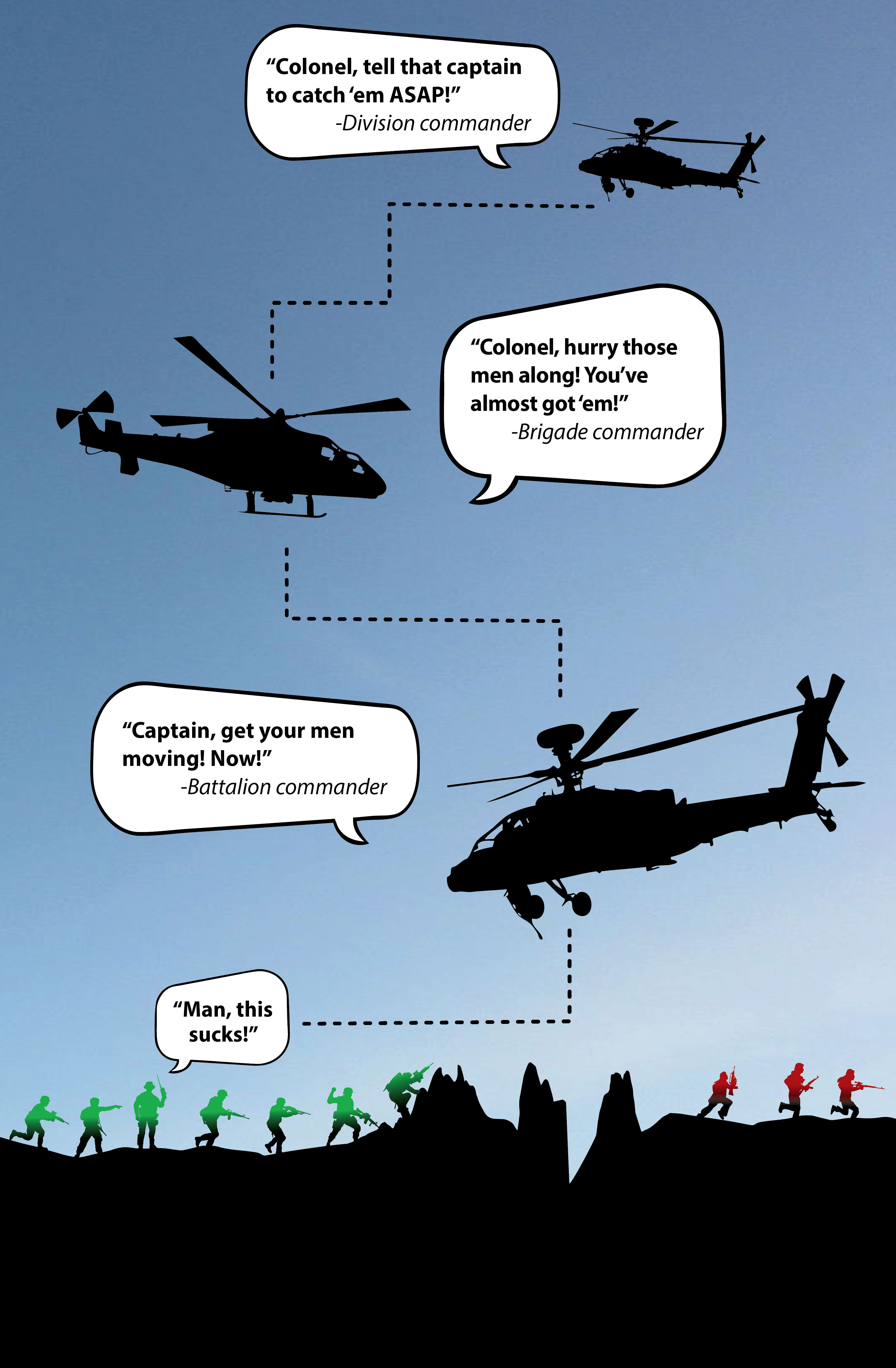
First, the very term “Mission Command” is rubbish. I know there is a whole body of literature about it, but it’s still rubbish ~ just well very documented rubbish. There is, very simply, command which is supported by control. The notion of “Mission Command” came about in the USA when it became clear that too many US senior officers were unable to exercise effective combat command because they were “nervous nellies” (or overzealous careerist) who would not or could not trust their subordinates to get on with the job. The image of a helicopter belonging to the division commander hovering over a helicopter belonging to the brigade commander hovering over the battalion commander’s helicopter that is hovering over the company of men on the ground comes to mind. Then a few other US military leaders decided that a new “concept” and a few PowerPoint presentations featuring gothic lettering and pictures of German generals would put things right … instead things went from bad to worse, but not just in the US military.
[Click to see full-size image]
Second, command and control (C2) is, actually, a quite simple thing to understand … it is the whole process by which a commander receives and analyzes his (or her) orders, does his (or her ~ always presumed from here on in) reconnaissance, makes his appreciation (estimate) of the situation and his plan and then issues the orders that commit his troops to battle. There it is in under 40 words … that’s not too hard to grasp, is it? But it can be bloody hard to do!
Shell Recycling – WW1 Monuments in WW2 – Resistance Movements I OUT OF THE TRENCHES
The Great War
Published on 2 Dec 2017Chair of Wisdom Time!
Alberta debates marijuana legalization … oddly
Colby Cosh’s most recent column is a real-life illustration of the old Bastiat saying that “The worst thing that can happen to a good cause is not to be skillfully attacked, but to be ineptly defended”:

I will leave better informed people to discuss Mr. Orr’s creative interpretation of the Cultural Revolution as being a proto-Reaganite anti-drug crusade. Actually, I am just informed enough to discuss it, briefly. Here’s the discussion: it’s bananas.
And yet! — the nonsense about China might not even have been the silliest part of the speech. Orr has concerns that legalized marijuana might not serve to suppress illegal production. This could, in itself, be a legitimate point. There is a genuine fear that the licensed vendors will set the price too high to compete with existing dealers. But it is not quite the point Orr chose to make. He seems to be convinced that licensed growers cannot compete with the black market at any price.
Why is it that criminals grow pot? Orr’s answer is not “because growing pot has, until now, been a crime.” That would be too easy. “Let’s look at it from a business point of view,” he suggests…
“The black market doesn’t have to pay taxes. They don’t have to pay (worker’s compensation). In most cases they don’t have to pay for any capital expenditures on land or buildings. They don’t have to buy business licences. In many cases they don’t pay for power… Anybody who tries to do this legally is going to have to pay all of these expenses, and you think you can compete financially on that level with them?”
This, of course, explains why, when we want furniture or shoes or chicken, we all invariably buy them in back alleys from underground businesses. But if Orr were to actually look around Alberta — even his own part of Alberta — he would see that lawful businesses do have some advantages.
Legal growers can raise hundreds of millions of dollars in capital markets not run by guys named Lefty or Snake. They can recruit scientists, professional marketers, and horticultural experts without having to hope Walter White shows up. They can exploit economies of scale. They can buy or rent acres of land without having to hide from helicopters. They can do business in broad daylight: they can rent billboards.
And meanwhile, it is not really as though illegal pot growers don’t have labour costs, or overhead, or capital and land requirements. Underground businesses that don’t pay “tax” still have to spend money, often more money, on the basic protective services that taxes buy the rest of us. Any economist could have told Mr. Orr as much. But I am afraid he got his economics out of the same Cracker Jack box his Chinese history came from.
History of the Gun – Part 5: Percussion
RugerFirearms
Published on 22 Jan 2010The “History of the Gun” online video series produced by Ruger is a unique look at the progression of firearms technology throughout the years, hosted by Senior Editor of Guns & Ammo Garry James. Part 5 examines Percussion.
QotD: Why mid-20th century Americans ate what they did – 2
A lot of the ingredients we take for granted were expensive and hard to get. Off-season, fresh produce was elusive: The much-maligned iceberg lettuce was easy to ship, and kept for a long time, making it one of the few things you could reliably get year round. Spices were more expensive, especially relative to household incomes. You have a refrigerator full of good-looking fresh ingredients, and a cabinet overflowing with spices, not because you’re a better person with a more refined palate; you have those things because you live in 2015, when they are cheaply and ubiquitously available. Your average housewife in 1950 did not have the food budget to have 40 spices in her cabinets, or fresh green beans in the crisper drawer all winter.
Megan McArdle, “Friday Food Post: The Economics Behind Grandma’s Tuna Casseroles”, Bloomberg View, 2015-10-30.
December 2, 2017
Goat Yoga Gets Baaaaaa-nned
ReasonTV
Published on 1 Dec 2017Good, old-fashioned goats and the ancient Hindu practice of yoga are two things that don’t seem to go together.
And yet, last year, a small farm in Corvallis, Oregon started offering classes that combined the two. Goat yoga is exactly what it sounds like: the practice of yoga in the presence of goats.
—————-
Soon these classes had a 900-person waiting list for an hour of ritual calisthenics with a bunch of horned ruminants.
Within a year, the unlikely trend had spread across the nation.
“We would go through the different asanas and the different flows,” explains Amanda Bowen, a goat-yoga instructor in Maryland, “and the goats will come around and interact with people as we’re doing the class.”
And then the unstoppable force of goat yoga locked horns with the immovable object of the Washington, D.C. Department of Health.
When Congressional Cemetery Director Paul Williams applied for a livestock permit in the District of Columbia, he was greeted by four lawyers “ready to throw every curve ball they possibly could at me to prevent goat yoga.”
But goat springs eternal. Since Manchester, N.H. reversed its ban late last summer, the only place in the country where risk-averse municipal bureaucracies are undermining this fitness-to-farm trend threat is the nation’s capital.
Produced, shot, narrated, and edited by Todd Krainin.
Breaking news from 55 BC
Despite the written records left by Julius Caesar, Cicero, and Tacitus, until now there had apparently been no physical evidence of Caesar’s invasion of Britain:
… a chance excavation carried out ahead of a road building project in Kent has uncovered what is thought to be the first solid proof for the invasion.
Archaeologists from the University of Leicester and Kent County Council have found a defensive ditch and javelin spear at Ebbsfleet, a hamlet on the Isle of Thanet.
The shape of the ditch at Ebbsfleet, is similar to Roman defences at Alésia in France, where a decisive battle in the Gallic War took place in 52 BC.
Experts also discovered that nearby Pegwell Bay is one of the only bays in the vicinity which could have provided harbour for such a huge fleet of ships. And its topography echoes Caesar’s own observations of the landing site.
Dr Andrew Fitzpatrick, Research Associate from the University of Leicester’s School of Archaeology and Ancient History said: “Caesar describes how the ships were left at anchor at an even and open shore and how they were damaged by a great storm. This description is consistent with Pegwell Bay, which today is the largest bay on the east Kent coast and is open and flat.
“The bay is big enough for the whole Roman army to have landed in the single day that Caesar describes. The 800 ships, even if they landed in waves, would still have needed a landing front 1-2 km wide.
“Caesar also describes how the Britons had assembled to oppose the landing but, taken aback by the size of the fleet, they concealed themselves on the higher ground. This is consistent with the higher ground of the Isle of Thanet around Ramsgate.”
Thanet has never been considered as a possible landing site before because it was separated from the mainland until the Middle Ages by the Wanstum Channel. Most historians had speculated that the landing happened at Deal, which lies to the south of Pegwell Bay.
Great Movie Fighting Techniques as illustrated by Helen of Troy
Lindybeige
Published on 31 Jan 2014This video played fine within Sony Vegas Studio, but very oddly in Windows Media Player. On YouTube it seems to be part way between the two. I just wish my videos would look and sound the way I set them in the editing software. No matter – this will have to be good enough. I have delayed uploading it too long already.
This feature film (also broadcast as a mini-series) has I think enough commentable material in it for one more video.
Reaching the limits of the “Burleigh effect”
ESR on the recent wave of news about sexual misdeeds of powerful politicians and prominent members of the media:
So, John Conyers now hints that members of Congress have been covering up widespread sexual assaults and workplace harassment from within their ranks for years, and that if he goes down lots of others will go down with him.
This is credible. We already know Congress has been paying out hush money to the tune of $17M to keep a lid on such allegations. That figure suggests that if there’s full disclosure, the carnage is going to be terrible.
But…Democrats will get hurt a lot worse than Republicans.
Why do I say this? Because Republicans have already been through a media hostility filter. The same J. Random Reporter (and Reporterette) that will manufacture chin-tugging excuses for the likes of Bill Clinton or Al Franken positively slavers at the thought of catching some old white conservative dude with his pants down. It is therefore likely that the really egregious Republican cases are already over.
Democrats, on the other hand, have been protected by what I’ll call the Burleigh effect. You remember Nina Burleigh, who said in public she’d give Bill Clinton a blowjob if it would protect abortion rights? Yeah, that.
The sewage the press has been not covering (Cokie Roberts said every female reporter in DC knew not to get on an elevator with Conyers) is likely to bust loose now. Especially because the hard-left faction of the Democrats obviously sees this as a way to purge the Clintonites.
I predict it’s going to be a grim time to be a Democrat in the next three months. Republicans will doubtless try to prolong the agony into the 2018 election season, and might succeed. In any case their campaign to stop the odious Ray Moore is looking pretty doomed,
History of the Gun – Part 4: The Flintlock
RugerFirearms
Published on 1 Jan 2010The “History of the Gun” online video series produced by Ruger is a unique look at the progression of firearms technology throughout the years, hosted by Senior Editor of Guns & Ammo Garry James. Part 4 examines the Flintlock.
QotD: Why mid-20th century Americans ate what they did – 1
Most people are not that adventurous; they like what’s familiar. American adults ate what they did in the 1950s because of what their parents had served them in the 1920s: bland, and heavy on preserved foods like canned pineapple and mayonnaise.
Megan McArdle, “Friday Food Post: The Economics Behind Grandma’s Tuna Casseroles”, Bloomberg View, 2015-10-30.
December 1, 2017
“Maybe Trump’s voters aren’t angry enough yet”
One of the most disturbing phenomena of modern American political discourse is just how badly Trump’s critics are doing their jobs. It’s almost as though they’re collectively trying to get him another term in office. ESR has a bit of a rant:
I have more and more sympathy these days for the Trump voters who said, in effect, “Burn it all down.” Smash the media. Destroy Hollywood. Drain the DC swamp. We’ve all long suspected these institutions are corrupt. What better proof do we need than their systematic enabling of rape monsters?
As a tribune of the people Trump is deeply flawed. Some of his policy ideas are toxic. His personal style is tacky, ugly, and awful. But increasingly I am wondering if any of that matters. Because if he is good for nothing else, he is good for exposing the corruption, incompetence, and fecklessness of the elites – or, rather in their desperation to take him down before he breaks their rice bowls they expose themselves
Yeah. Is there anyone who thinks all these rocks would be turning over if Hillary the serial rape enabler were in the White House? Nope. With her, or any establishment Republican, it’d be cronyism all they way down, because they’d feel a need to keep the corrupt elites on side. Not Trump – his great virtue, perhaps overriding every flaw, is that he doesn’t give a fuck for elite approval.
Maybe Trump’s voters aren’t angry enough yet. It’s not just a large number of women our elites have raped and victimized, it’s our entire country. Our infrastructure is crumbling, our debt is astronomical, our universities increasingly resemble insane asylums, our largest inner cities are free-fire zones terrorized by a permanent criminal underclass. And what’s the elite response? Oh, look, a squirrel – where the squirrel of the week is carbon emissions, or transgender rights, or railing at “white privilege”, or whatever other form of virtue signaling might serve to hide the fact that, oh, look they put remote-controlled locks on their rape dungeons.
It’s long past time for a cleansing fire.
All Quiet On The Eastern Front – Action in East Africa I THE GREAT WAR Week 175
The Great War
Published on 30 Nov 2017This week in the Great War, the Battle of the Ngomano was fought in East Africa between the Germans and Portuguese, which was a decisive win for Lettow-Vorbeck’s men. On the Eastern Front, the fighting stops and Trotsky published the secret treaties that Russia and the other Allies had signed. The Battle of Cambrai continued, with attacks and counterattacks from both sides, including the implementation of the new Hutier assault tactics. Armando Diaz was making changes for the better on the Italian Front, with the express aim of improving the morale among his men.
Censorship on the web
At City Journal, Aaron Renn explains why some of the concerns about censorship on the Internet are not so much wrong as misdirected:
The basic idea of net neutrality makes sense. When I get a phone, the phone company can’t decide whom I can call, or how good the call quality should be depending on who is on the other end of the line. Similarly, when I pay for my cable modem, I should be able to use the bandwidth I paid for to surf any website, not get a better or worse connection depending on whether my cable company cut some side deal to make Netflix perform better than Hulu.
The problem for net neutrality advocates is that the ISPs aren’t actually doing any of this; they really are providing an open Internet, as promised. The same is not true of the companies pushing net neutrality, however. As Pai suggests, the real threat to an open Internet doesn’t come from your cable company but from Google/YouTube, Twitter, Facebook, and others. All these firms have aggressively censored.
For example, Google recently kicked would-be Twitter competitor Gab out of its app store, not for anything Gab did but for what it refused to do — censor content. Twitter is famous for censoring, as Pai observes. “I love Twitter, and I use it all the time,” he said. “But let’s not kid ourselves; when it comes to an open Internet, Twitter is part of the problem. The company has a viewpoint and uses that viewpoint to discriminate.” (Twitter’s censors have not gotten around to removing the abuse, some of it racist, being hurled at Pai, including messages like “Die faggot die” and “Hey go fuck yourself you Taliban-looking fuck.”)
Google’s YouTube unit also censors, setting the channel for Prager University to restricted mode, which limits access; Prager U. is suing Google and YouTube. YouTube has also “demonetized” videos from independent content creators, making these videos ineligible for advertising, their main source of revenue. Much of the complaining about censorship has come from political conservatives, but they’re not the only victims. The problem is broad-based.
Yet sometimes Silicon Valley giants have adopted a see-no-evil approach to certain kinds of content. Facebook, for instance, has banned legitimate content but failed to stop Russian bots from going wild during last year’s presidential election, planting voluminous fake news stories. Advertisers recently started fleeing YouTube when reports surfaced that large numbers of child-exploitation videos were showing up on supposedly kid-friendly channels. One account, ToyFreaks, had 8 million subscribers — making it the 68th most-viewed YouTube channel — before the company shut it down. It’s not credible that YouTube didn’t know what was happening on a channel with millions of viewers. Other channels and videos featured content from pedophiles. More problems turned up within the last week. A search for “How do I …” on YouTube returned numerous auto-complete suggestions involving sex with children. Others have found a whole genre of “guess her age” videos, with preview images, printed in giant fonts, saying things like, “She’s only 9!” The videos may or may not have involved minors — I didn’t watch them—but at minimum, they trade on pedophilic language to generate views.


