Quotulatiousness

June 9, 2013

Original author of the Patriot Act decries its current abuse

Filed under: Government, Law, Liberty, Media, USA — Tags: , , , , — Nicholas @ 10:20

In the Guardian, Jim Sensenbrenner demands to see the current misuse of the Patriot Act brought to an end:

Last week, the Guardian reported that the Obama administration is collecting records of every call made to, from or within the US, as well as records of many digital communications. President Obama has tried to deflect criticism by claiming “every member of Congress has been briefed on this program.” While some members of Congress were briefed — particularly those on the intelligence committees — most, including myself, were not.

The administration claims authority to sift through details of our private lives because the Patriot Act says that it can. I disagree. I authored the Patriot Act, and this is an abuse of that law.

I was the chairman of the House judiciary committee when the US was attacked on 11 September 2001. Five days later, the Justice Department delivered its proposal for new legislation. Although I, along with every other American, knew we had to strengthen our ability to combat those targeting our country, this version went too far. I believed then and now that we can defend our country and our liberty at the same time.

[. . .]

In his press conference on Friday, President Obama described the massive collection of phone and digital records as “two programs that were originally authorized by Congress, have been repeatedly authorized by Congress”. But Congress has never specifically authorized these programs, and the Patriot Act was never intended to allow the daily spying the Obama administration is conducting.

To obtain a business records order like the one the administration obtained, the Patriot Act requires the government to prove to a special federal court, known as a Fisa court, that it is complying with specific guidelines set by the attorney general and that the information sought is relevant to an authorized investigation. Intentionally targeting US citizens is prohibited.

Technically, the administration’s actions were lawful insofar as they were done pursuant to an order from the Fisa court. But based on the scope of the released order, both the administration and the Fisa court are relying on an unbounded interpretation of the act that Congress never intended.

QotD: Whistleblowers

Filed under: Government, Media, Quotations, USA — Tags: , , , , — Nicholas @ 09:36

The U.S. government is on a secrecy binge. It overclassifies more information than ever. And we learn, again and again, that our government regularly classifies things not because they need to be secret, but because their release would be embarrassing.

Knowing how the government spies on us is important. Not only because so much of it is illegal — or, to be as charitable as possible, based on novel interpretations of the law — but because we have a right to know. Democracy requires an informed citizenry in order to function properly, and transparency and accountability are essential parts of that. That means knowing what our government is doing to us, in our name. That means knowing that the government is operating within the constraints of the law. Otherwise, we’re living in a police state.

We need whistle-blowers.

Leaking information without getting caught is difficult. It’s almost impossible to maintain privacy in the Internet Age. The WikiLeaks platform seems to have been secure — Bradley Manning was caught not because of a technological flaw, but because someone he trusted betrayed him — but the U.S. government seems to have successfully destroyed it as a platform. None of the spin-offs have risen to become viable yet. The New Yorker recently unveiled its Strongbox platform for leaking material, which is still new but looks good. This link contains the best advice on how to leak information to the press via phone, email, or the post office. The National Whistleblowers Center has a page on national-security whistle-blowers and their rights.

Bruce Schneier, “What We Don’t Know About Spying on Citizens: Scarier Than What We Know”, The Atlantic, 2013-06-06

Jim Souhan has drunk the Purple Kool-Aid

Filed under: Football, Media — Tags: , , — Nicholas @ 09:24

In the Twin Cities, Jim Souhan has always been a voice of reason among the sports writers, rarely falling into the trap of optimism about the Minnesota Vikings. His carefully cynical, humourous approach has always set him apart from the herd. Until now

For decades, when you left the Vikings’ Winter Park facility, you needed a long shower. Maybe even a luffa.

You were constantly confronted with the ugly realities of an ugly business, from ownership and management infighting to angry and sometimes felonious players. Paranoia often ruled, and often for good reason. The Vikings had a lot to hide.

These days, the franchise that brought you such great hits as Denny Green’s Basement Tapes, The Love Boat, the Original Whizzinator and “Straight Cash, Homey,” has become the kind of place you wouldn’t mind bringing your children.

Wednesday, while enjoying 100 percent player attendance at an OTA for the first time in memory, the Vikings played host to a bunch of Special Olympic athletes, kids who are competing in Punt, Pass & Kick. While that’s not exactly a new development — Green pushed players to be active in the community — the atmosphere at Winter Park has changed.

It used to be like “Game of Thrones.” Now it’s more “Cheers,” with Jared Allen as Norm.

Winter Park has become a place of genial professionalism. The organization has achieved remarkable stability among key employees on all levels, and the team’s best players also tend to be their most gracious representatives when dealing with the public and media. Leslie Frazier might be the friendliest coach in football, and Adrian Peterson might be the friendliest superstar in sports.

June 8, 2013

Don’t put too much faith in denials from Verizon and other companies…

Filed under: Business, Government, Law, Liberty, Technology — Tags: , , , , , — Nicholas @ 10:10

As Mic Wright points out, the companies named in the Prism leaks may not be acting as free agents:

Pastor Niemoller’s “First they came…” poem is over-quoted but with good reason. It is far too easy to be complacent. Addicted and reliant as many of us are on free web services, it’s more convenient to just accept the companies outright denials that they have been complicit with the NSA’s programme. But look closely at those statements and things become rather less clear, as Michael Arrington pointed out.

The tech industry’s denials have been carefully drafted and similarly worded. It is not unfeasible to imagine that those companies have turned over users’ personal information to the NSA in another fashion. Facebook founder and CEO Mark Zuckerberg’s statement was one of the strongest: “Facebook is not and has never been part of any program to give the US or any other government direct access to our servers. We have never received a blanket request or court order from any government agency asking for information…”

Zuckerberg’s words are reassuring until you consider that any company that receives an order under the Foreign Intelligence Surveillance Act Amendments Act — the legislation the Obama administration is using to justify the broad surveillance — is forbidden from disclosing they have received it or disclosing any information about it. It’s not surprising that no mea culpas have emerged from major tech firms or that Palantir — the big data surveillance company with the $5 billion valuation and CIA funding — denies any connection with the project. The NSA has been a Palantir client and one of the company’s co-founders, billionaire investor Peter Thiel, also sits on Facebook’s board.

Anonymous claims to have successfully hacked Turkish government network

Filed under: Europe, Government, Middle East, Technology — Tags: , , , — Nicholas @ 09:48

A report at RT.com says the Turkish government’s internal network has been breached by members of Anonymous:

Turkish government networks were hacked on Wednesday, compromising the private information of staffers in PM Tayyip Erdogan’s office, a source in PM’s office confirmed to Reuters. The attack was in support of the ongoing anti-government protests.

Staff email accounts were reportedly accessed after a phishing attack, and those affected were cut off from the network, a source said.

Anonymous hacked the Prime Minister’s official website (basbakanlik.gov.tr) and gained access to staff email addresses, passwords and phone numbers, the group said in a press release.

[. . .]

The group also stressed it will not share most of the hacked data because it “respects people’s privacy” and “does not believe in the full use of power against the weak.”

Feingold was right, back in 2001

Filed under: Government, Liberty, USA — Tags: , , , , , — Nicholas @ 09:42

Former US senator Russ Feingold was the only member of the senate to vote against the original Patriot Act:

He took a stand against the legislation because it increased the federal government’s authority exponentially and didn’t require enough judicial oversight.

Now here we are more than a decade later and it has been revealed that the U.S. government has been collecting massive amounts of data on millions of Americans every single day, using provisions found in the Patriot Act as justification.

Through the secret “PRISM” surveillance program and court orders compelling at least Verizon to provide records on all its customers, the FBI and NSA have enjoyed access to unthinkable amounts of Americans’ data, all without ever informing the public of alarming domestic surveillance.

In his address on the Senate floor in 2001, Former Sen. Feingold seemingly warned the U.S. about the exact thing so many Americans are outraged over today.

[. . .]

“In 2001, I first voted against the PATRIOT Act because much of it was simply an FBI wish list that included provisions allowing our government to go on fishing expeditions that collect information on virtually anyone,” the statement read. “Today’s report indicates that the government could be using FISA in an indiscriminate way that does not balance our legitimate concerns of national security with the necessity to preserve our fundamental civil rights.”

“This is deeply troubling. I hope today’s news will renew a serious conversation about how to protect the country while ensuring that the rights of law-abiding Americans are not violated,” he added.

Charles Stross talks about writing The Jennifer Morgue

Filed under: Books, Britain, Business, Media — Tags: , , , — Nicholas @ 09:07

If you haven’t yet read any of the “Laundry” books by Charles Stross, you really are missing out on a treat. The Jennifer Morgue was the second in the series and Charles has a blog post up about how the book came to be written:

All stories have several seeds. In the case of “The Jennifer Morgue”, the first seed was the surprising success of “The Atrocity Archives”. The novel my agent initially thought was unsaleable sold to Golden Gryphon, a small but respectable Lovecraftian publisher in the United States. It went gold, going into reprint and becoming their second-best selling title at the time. Then, to everyone’s surprise, the additional novella I wrote for the book (“The Concrete Jungle”) made the shortlist for the Hugo award in 2005. This was a stunning surprise. GG had only sold around 3000 copies of the book; the other novellas on the shortlist had all appeared in magazines or anthologies with four to ten times the number of copies sold! After some hurried email consultation, Gary and Marty at GG agreed to let me put the whole novella on the web, to make it more readily available to the Hugo voters. I don’t know if that’s what did the trick, or if there were additional home-mover effects from the Worldcon in 2005 being held in Glasgow (thus bringing more British voters in than normal) but at the end of August that year I became the dazed and surprised owner of a very shiny trophy.

(And the performance anxiety that had been haunting me for years—”I’m not a real writer, I’m just winging this”—went away for a while.)

But anyway. This success coincided with a French publisher making an offer for translation rights to “The Atrocity Archives”, which in turn got my agent’s attention. She proposed a sequel, and James Bond was so obvious that I don’t think I even considered any alternatives. It would have to be the Movie Bond franchise, for most people these days don’t grow up on the original Ian Fleming novels (the way I did); the humour would come from the incongruity of Bob Howard in James Bond’s shoes. We decided to auction the new book, along with paperback rights to “The Atrocity Archives”, and ended up cutting a deal whereby Golden Gryphon would publish “The Jennifer Morgue” in hardcover while Ace rolled “The Atrocity Archives” in trade paperback, and eventually in mass market. Which then left me pondering what to write … because every Bond movie (or novel) needs a Bond-sized plot device, doesn’t it?

By this time we were into late October 2005. One evening, we were eating a Chinese take-away in front of the TV, watching a documentary on the Discovery Channel about one of the most bizarre CIA projects to happen during the Cold War — Project Azorian (better, but mistakenly, known to the public as “Operation Jennifer”). Seriously, if you don’t know about it, go follow that link right now; it’s about how the CIA enlisted Howard Hughes to help them build a 63,000 ton fake deep-see mining ship, the Glomar Challenger, as cover for a deep-sea grapple that would descend 4,900 metres and raise the hull of a shipwrecked Soviet nuclear missile submarine, the K-129. (Project Azorian was so James Bond that the engineering crew working on the ship were cracking jokes about the bald guy stroking the white cat in his seat on the bridge. How post-modern can you go?)

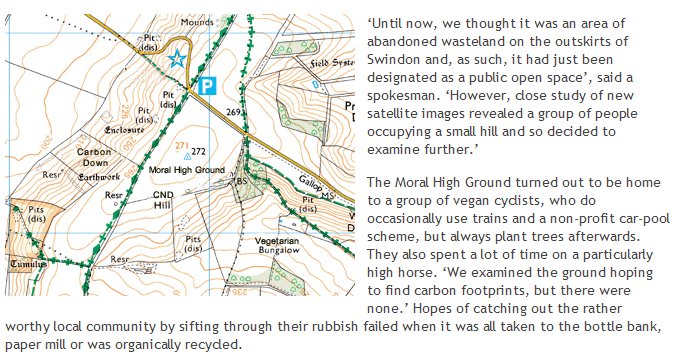
The Moral High Ground has finally been mapped

Filed under: Britain, Humour — Tags: , — Nicholas @ 08:34

NewsBiscuit provides the details on the latest Ordnance Survey discovery:

Moral High Ground map

June 7, 2013

This week in Guild Wars 2

Filed under: Gaming — Tags: , — Nicholas @ 11:24

My weekly Guild Wars 2 community round-up at GuildMag is now online. We’re still experiencing the last stages of the Southsun Cove content, and starting to get details on the next content update: The Dragon Bash, coming June 11th. There’s also the usual assortment of blog posts, videos, podcasts, and fan fiction from around the GW2 community.

Who is Glenn Greenwald?

Filed under: Government, Law, Liberty, USA — Tags: , , , , — Nicholas @ 08:14

The New York Times profiles Glenn Greenwald:

After writing intensely, even obsessively, for years about government surveillance and the prosecution of journalists, Glenn Greenwald has suddenly put himself directly at the intersection of those two issues, and perhaps in the cross hairs of federal prosecutors.

Late Wednesday, Mr. Greenwald, a lawyer and longtime blogger, published an article in the British newspaper The Guardian about the existence of a top-secret court order allowing the National Security Agency to monitor millions of telephone logs. The article, which included a link to the order, is expected to attract an investigation from the Justice Department, which has aggressively pursued leakers.

On Thursday night, he followed up with an article written with a Guardian reporter, Ewen MacAskill, that exposed an N.S.A. program, Prism, that has gathered information from the nation’s largest Internet companies going back nearly six years.

“The N.S.A. is kind of the crown jewel in government secrecy. I expect them to react even more extremely,” Mr. Greenwald said in a telephone interview. He said that he had been advised by lawyer friends that “he should be worried,” but he had decided that “what I am doing is exactly what the Constitution is about and I am not worried about it.”

Taking the battle to the patent trolls

Filed under: Business, Law — Tags: , , , — Nicholas @ 08:01

In The New Yorker, Tim Wu suggests some lines of counter-attack to use against patent trolls:

There are good laws in place that could fight trolls, but they sit largely unused. First are the consumer-protection laws, which bar “unfair or deceptive acts and practices.” Some patent trolls, to better coerce settlement, purposely misrepresent matters such as the strength of their patents, the extent of other settlements, and their actual willingness to litigate. Second, there are plenty of remedies available under the unfair-competition laws. Some trolls work by aggregating an enormous number of patents, and then present the threat that one of their thousands of patents might actually be valid. The creation of these portfolios for trolling may be “agreements in restraint of trade” under Section 1 of the Sherman Antitrust Act, or they may “substantially lessen competition” under the Clayton Antitrust Act. More generally, the methods of the trolls are hardly what you would call ordinary methods of competition; they should be considered, rather, what the Federal Trade Commission calls “unfair methods of competition” under Section 5 of the F.T.C. Act. The Commission has the power to define and punish methods of business that are inherently harmful with few or no redeeming benefits, and that’s what trolling is. Finally, it is possible that the criminal laws barring larceny and schemes to defraud may cover the conduct of some trolls.

Unfortunately, other than in Vermont, these laws remain largely unenforced, for reasons that aren’t particularly good. Trolls, to switch metaphors, are like cancer cells: they mimic ordinary activity, namely the assertion of patent rights. A war on trolls could become a war on patent holders in general. Since the line between the two can be fuzzy, the argument is that war might deter some real invention. It might, for example, lump universities in with the extortion artists.

But that justifies caution, not inaction. All law enforcement involves this problem of sorting. There is a narrow line between the legitimate trader who knows the stock market well and the criminal inside trader, yet that doesn’t mean securities laws should be left unenforced.

The world’s longest undefended “no touching zone”

Filed under: Cancon, History, USA — Tags: , , — Nicholas @ 00:01

H/T to John Farrier for the link.

June 6, 2013

D-Day 1942 or 1943

Filed under: Britain, Cancon, France, Germany, History, Military, USA, WW2 — Tags: , , , — Nicholas @ 10:17

At Military History Now, there’s a look at a few of the allied plans for invading France before the actual June 6, 1944 operation:

IKE’S SLEDGEHAMMER
Almost as soon as America entered the war with Nazi Germany, generals Dwight Eisenhower and George Marshall were both lobbying for a strike across the English Channel into France. One plan foresaw a joint British and American assault on either of the French port cities of Cherbourg or Brest as early as the fall of 1942. The operation, codenamed Sledgehammer, would see a force of just six divisions attack, capture and hold either one of the two strategically-vital, deep-water harbours. The force, which likely would have totalled no more than 60,000 men, would have been expected to withstand the inevitable Nazi counterattacks until spring when more reinforcements could arrive. Despite the fact that the Germans would have been free to throw as many as 30 divisions at the invaders, the U.S. Joint Chiefs (as well as the Soviets) endorsed Sledgehammer wholeheartedly. The American commanders seemed to favour any plan that would bring U.S. forces into action in Europe quickly, while Stalin was thrilled at the prospect of an Allied offensive in Western Europe — anything to divert German forces away from the Russian front. Oddly enough, while the mission called for the heavy use of American air and sea power, at the time there was still only a handful of combat-ready U.S. Army units in England. As such, the ground portion of the invasion would be left entirely up to the British military. Cooler heads, namely Prime Minister Churchill, convinced Eisenhower to shelve Sledgehammer – Britain was already stretched thin in Egypt and America still had yet to fully mobilize for the war in Europe. An invasion of France would simply have to wait.

OPERATION ROUNDUP
Later in 1942, the Allies roughed out a second plan to put troops ashore in Western Europe the following spring. This operation, dubbed Roundup, called for 18 British and 30 American divisions to hit a series of landing zones along a 200 km stretch of coastline between Boulogne-sur-Mer near Calais and the port of Le Harve. Overhead, more than 5,700 Allied aircraft were to sweep the skies of the Luftwaffe clearing the way for a series of airborne drops. D-Day was set for some time in April or May of 1943. The British, already strained by three years of total war against the Axis, were understandably reluctant to throw their army headlong into the teeth of Germany’s Channel fortifications. They pushed instead to attack Sicily and Italy – what Churchill called the “soft underbelly of Europe” — by way of North Africa. A sober appraisal of British and American fleet strength, air assets and manpower ultimately convinced the Allied high command that no invasion could be mounted until 1944 at the earliest. For one thing, American factories had yet to manufacture enough of the landing craft needed for such a massive undertaking. Washington and London turned their attention instead towards a late 1942 invasion of Tunisia – Operation Torch. The rest is, as they say, history.

As any Canadian military historian would probably have said to either of these proposals … I have two words: Operation Jubilee.

The Dieppe Raid, also known as the Battle of Dieppe, Operation Rutter and, later, Operation Jubilee, was a Second World War Allied attack on the German-occupied port of Dieppe. The raid took place on the northern coast of France on 19 August 1942. The assault began at 5:00 a.m. and by 10:50 a.m. the Allied commanders were forced to call a retreat. Over 6,000 infantrymen, predominantly Canadian, were supported by a Canadian Armoured regiment and a strong force of Royal Navy and smaller Royal Air Force landing contingents.

The objective of the raid was discussed by Winston Churchill in his war memoirs:

    “I thought it most important that a large-scale operation should take place this summer, and military opinion seemed unanimous that until an operation on that scale was undertaken, no responsible general would take the responsibility of planning the main invasion…

    In discussion with Admiral Mountbatten it became clear that time did not permit a new large-scale operation to be mounted during the summer (after Rutter had been cancelled), but that Dieppe could be remounted (with the new code-name “Jubilee”) within a month, provided extraordinary steps were taken to ensure secrecy. For this reason no records were kept but, after the Canadian authorities and the Chiefs of Staff had given their approval, I personally went through the plans with the C.I.G.S., Admiral Mountbatten, and the Naval Force Commander, Captain J. Hughes-Hallett.”

Objectives included seizing and holding a major port for a short period, both to prove it was possible and to gather intelligence from prisoners and captured materials, including naval intelligence in a hotel in town and a radar installation on the cliffs above it. Although the primary objective was not met and secondary successes were relatively few, some knowledge was gained while assessing the German responses. The Allies also wanted to destroy coastal defences, port structures and all strategic buildings. Due to the failure to secure Dieppe this objective was not met in any systematic sense. The raid had the added objective of providing a morale boost to the troops, Resistance, and general public, while assuring the Soviet Union of the commitment of the United Kingdom and the United States.

A total of 3,623 of the 6,086 men (almost 60%) who made it ashore were either killed, wounded, or captured. The Royal Air Force failed to lure the Luftwaffe into open battle, and lost 96 aircraft (at least 32 to flak or accidents), compared to 48 lost by the Luftwaffe.[2] The Royal Navy lost 33 landing craft and one destroyer. The events at Dieppe later influenced preparations for the North African (Operation Torch) and Normandy landings (Operation Overlord).

Operation Jubilee clearly showed that the plans for both Sledgehammer and Roundup would have been bloody failures.

Rail technology changes on a slower timescale than other transportation systems

Filed under: Business, Railways, Technology — Tags: , , , , — Nicholas @ 09:50

The Economist looks at innovation in the railway business:

Compared with other modes of transport, train technology might seem to be progressing as slowly as a suburban commuter service rattling its way from one station to another. Automotive technology, by contrast, changes constantly: in the past decade satellite-navigation systems, hybrid power trains, proximity sensors and other innovations have proliferated. Each time you buy a new car, you will notice a host of new features. Progress is apparent in aircraft, too, with advances in in-flight entertainment and communication, fancy seats that turn into beds, and quieter and more efficient engines. Trains, meanwhile, appear to have changed a lot less.

Actually, the perception of change is much greater for cars and airplanes, but there are few changes in those areas that are not merely evolutionary rather than revolutionary. Incremental changes are the rule of the day, as neither cars nor planes travel significantly faster than they did thirty years ago … but they do it safer and more comfortably now.

This comparison is not entirely fair. For one thing, people buy their own cars, so they pay more attention to automotive innovation. Carmakers are engaged in a constant arms race, trumpeting new features as a way to differentiate their products. Nobody buys their own trains. Similarly, air passengers have a choice of competing airlines and are far more likely to be aware of the merits of rival fleets than they are of different types of train. In addition, notes Paul Priestman of Priestmangoode, a design consultancy that specialises in transport, trains have longer lives, so technology takes longer to become widespread. The planning horizon for one rail project he is working on extends to 2050. “You have to think about longevity, whereas the car industry wants you to buy a new car in two years,” he says.

Another big difference is that the way railways operate — with a small number of powered units (locomotives) and a very large number of unpowered units (freight cars and passenger cars) that have to be reliably connected to one another and operate successfully. A car can go on any kind of road (or even none, in many places) and a plane can fly in any part of the sky, but a train needs an engineered right-of-way that falls within established standards of curvature, elevation change, and overhead and side clearance. Because of this, any piece of railway equipment that does not run on its own isolated track (like monorails or the various flavours of high speed railways) must always meet the existing standards … which have been slowly evolving since the mid-nineteenth century. With so much capital invested in existing right-of-way and rolling stock, the costs for introducing significant changes can be astronomical.

There’s also the fact that unlike other forms of transportation, passenger and freight trains operate in different and sometimes conflicting ways. Passenger trains need to operate on a known schedule between high population centres at relatively high speed. With higher speed goes a need for better braking systems and more capable signalling methods. Unlike a train full of new cars or iron ore, you can’t just park a train full of living human beings on a siding for a few hours to allow slower trains to clear the way (unless you’re Amtrak or VIA). Passenger trains have to have top priority, which often means the railways have to delay freight traffic to ensure that the passengers are not unduly delayed.

One solution to the problem is to provide separate tracks for the passenger trains, but this can be very expensive, as the places where the extra tracks would be most effective is also where the land is at peak cost: in and around major cities. Most passenger trains are now run by government agencies or corporations acting as agents for local, regional, or state governments, so they sometimes use the power of eminent domain to gain access to the land. This is a politically fraught area, as the more land they need to take, the tougher the process will get.

Brakes are also getting an upgrade. Stopping a train can take so long that locomotive-operators, also known as engineers, often have time to contemplate their fate before an impact. “Your life races before you,” says a former operator who, years ago in Alabama, helplessly watched as his freight train, its emergency brakes screeching, headed towards a stalled truck that ultimately managed to pull off the tracks in time. Stopping a train pulling a hundred cars at 80kph can require 2km of track. Road accidents take far more lives, but 1,239 people were killed in more than 2,300 railway accidents in 2011 in the European Union alone.

Much of the problem is that the faster a train’s wheels are spinning, the hotter its brake shoes get when engaged. This reduces friction and hence braking power, a predicament known as “heat fade”. Moreover, nearly all trains power their brakes with compressed air. When switched on, air brakes activate car by car, from the locomotive to the back of the train. It can take more than two minutes for the signal to travel via air tubes to the last car.

Again, it’s not physically or financially possible to switch over all existing cars to newer technology in one fell swoop, so any updated brake technology must be 100% compatible with what is already in use, or you risk creating more dangerous situations because some brakes may operate out of sequence which will increase the chances of accidents.

Norfolk Southern, an American rail operator, now pulls roughly one-sixth of its freight using locomotives equipped with “route optimisation” software. By crunching numbers on a train’s weight distribution and a route’s curves, grades and speed limits, the software, called Leader, can instruct operators on optimum accelerating and braking to minimise fuel costs. Installing the software and linking it wirelessly to back-office computers is expensive, says Coleman Lawrence, head of the company’s 4,000-strong locomotive fleet. But the software cuts costs dramatically, reducing fuel consumption by about 5%. That is a big deal for a firm that spent $1.6 billion on diesel in 2012. Mr Lawrence reckons that by 2016 Norfolk Southern may be pulling half its freight with Leader-upgraded locomotives. A competing system sold by GE, Trip Optimizer, goes further and operates the throttle and brakes automatically.

This is a good use of computer technology: you add the software on top of the existing infrastructure and use it to detect operational gains without needing to make system-wide changes to all freight cars.

IMF forced to admit that the Greek bailout “included notable failures”

Filed under: Economics, Europe, Greece — Tags: , , , , — Nicholas @ 08:58

In the Guardian, Larry Elliott, Phillip Inman and Helena Smith round up the IMF’s self-criticisms over the handling of the bailout package imposed on Greece:

In an assessment of the rescue conducted jointly with the European Central Bank (ECB) and the European commission, the IMF said it had been forced to override its normal rules for providing financial assistance in order to put money into Greece.

Fund officials had severe doubts about whether Greece’s debt would be sustainable even after the first bailout was provided in May 2010 and only agreed to the plan because of fears of contagion.

While it succeeded in keeping Greece in the eurozone, the report admitted the bailout included notable failures.

“Market confidence was not restored, the banking system lost 30% of its deposits and the economy encountered a much deeper than expected recession with exceptionally high unemployment.”

In Athens, officials reacted with barely disguised glee to the report, saying it confirmed that the price exacted for the €110bn (£93bn) emergency package was too high for a country beset by massive debts, tax evasion and a large black economy.”

Under the weight of such measures — applied across the board and hitting the poorest hardest — the economy, they said, was always bound to dive into an economic death spiral.

« Newer PostsOlder Posts »

Powered by WordPress