Quotulatiousness

November 1, 2019

“Unbreakable” – Guerrilla Warfare – Sabaton History 039 [Official]

Filed under: China, History, Media, Military, Russia, WW2 — Tags: , , , , , , — Nicholas @ 06:00

Sabaton History
Published 31 Oct 2019

The exact topic of Sabaton’s song “Unbreakable” will forever be a mystery. But we do know that it has to do with guerrilla warfare, which is what Indy will dive into in this episode.

Support Sabaton History on Patreon: https://www.patreon.com/sabatonhistory

Listen to The Art of War (where “Unbreakable” is featured):
CD: http://bit.ly/TheArtOfWarStore
Spotify: http://bit.ly/TheArtOfWarSpotify
Apple Music: http://bit.ly/TheArtOfWarAppleMusic
iTunes: http://bit.ly/TheArtOfWariTunes
Amazon: http://bit.ly/TheArtOfWarAmz
Google Play: http://bit.ly/TheArtOfWarGooglePlay

Listen to Sabaton on Spotify: http://smarturl.it/SabatonSpotify
Official Sabaton Merchandise Shop: http://bit.ly/SabatonOfficialShop

Hosted by: Indy Neidell
Written by: Indy Neidell, Spartacus Olsson and Markus Linke
Directed by: Astrid Deinhard and Wieke Kapteijns
Produced by: Pär Sundström, Astrid Deinhard and Spartacus Olsson
Creative Producer: Joram Appel
Executive Producers: Pär Sundström, Joakim Broden, Tomas Sunmo, Indy Neidell, Astrid Deinhard, and Spartacus Olsson
Post-Production Director: Wieke Kapteijns
Maps by: Eastory
Edited by: Iryna Dulka
Sound Editing by: Marek Kaminski

Eastory YouTube Channel: https://www.youtube.com/channel/UCEly…
Archive by: Reuters/Screenocean https://www.screenocean.com
Music by Sabaton.

Sources:
– RIA Novosti archive
– Colorization of Mao Zedong by Olga Shirnina a.k.a. Klimbim
– IWM: NA 15129
– Water splash sound effect – littlerobotsoundfactory

An OnLion Entertainment GmbH and Raging Beaver Publishing AB co-Production.

© Raging Beaver Publishing AB, 2019 – all rights reserved.

From the comments:

Sabaton History
2 days ago
There are many examples where guerrilla warfare was used in an attempt to force out or at least harass a foreign invader or domestic military power. Partisan movements are almost always connected to a certain ideology or party — after all, they rebel against a power they disagree with. We haven’t mentioned a lot of different movements and causes in this episode, not because we don’t value or support them or their cause, but because we have a limited amount of time to cover a general topic in. As Indy also states in the video, we have picked several examples to describe what guerrilla warfare was. Please share any additional groups or events that are relevant for this episode, but keep it civil and keep your political thoughts to yourself.
Cheers, The Sabaton History team
September 15, 2019

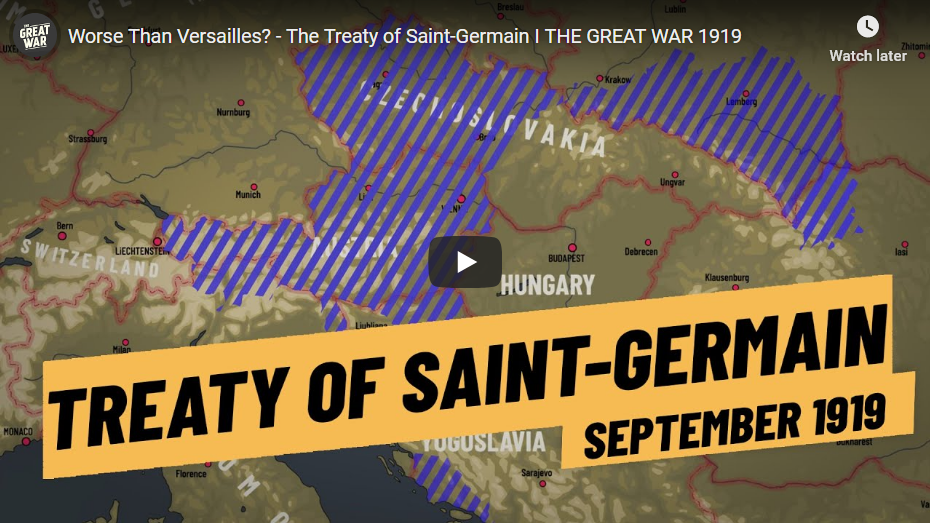
Worse Than Versailles? – The Treaty of Saint-Germain I THE GREAT WAR 1919

Filed under: Europe, History, WW1 — Tags: , , , , , , — Nicholas @ 04:00

The Great War
Published on 13 Sep 2019

Signup for your FREE trial to The Great Courses Plus here: http://ow.ly/F9LC30po9ux

The Great Courses Plus is currently available to watch through a web browser to almost anyone in the world and optimized for the US, UK, and Australian markets. The Great Courses Plus is currently working to both optimize the product globally and accept credit card payments globally.

The Treaty of Versailles between the Allies and Germany was only one of the peace treaties that followed the defeat of the Central Powers. The new Austrian republic, one of the countries that emerged from the collapse of the Austro-Hungarian Empire, also tried to get a favorable deal with the Allies in Paris in 1919. Like Versailles, the The Treaty of Saint-Germain caused an outcry across the country.

» SUPPORT THE CHANNEL
Patreon: https://www.patreon.com/thegreatwar
Merchandise: https://shop.spreadshirt.de/thegreatwar/

»CREDITS
Presented by: Jesse Alexander
Written by: Jesse Alexander
Director: Toni Steller & Florian Wittig
Director of Photography: Toni Steller
Sound: Toni Steller
Editing: Toni Steller
Mixing, Mastering & Sound Design: http://above-zero.com
Motion Design: Christian Graef – GRAEFX
Maps: Daniel Kogosov (https://www.patreon.com/Zalezsky)
Research by: Jesse Alexander
Fact checking: Florian Wittig

Channel Design: Alexander Clark
Original Logo: David van Stephold

A Mediakraft Networks Original Channel

Contains licensed material by getty images
All rights reserved – Real Time History GmbH 2019

August 10, 2019

Enter Yugoslavia Part 2 | BETWEEN 2 WARS I 1929 Part 3 of 3

Filed under: Europe, History — Tags: , , , , , , , — Nicholas @ 06:00

TimeGhost History
Published on 9 Aug 2019

As 1929 approaches, the Kingdom of Serbs, Croats and Slovenes spirals closer and closer to collapse. When the parliament descends into murderous chaos, it is up to King Alexander to decide what to do…

Join us on Patreon: https://www.patreon.com/TimeGhostHistory

Hosted by: Indy Neidell
Written by: Francis van Berkel and Spartacus Olsson
Directed by: Spartacus Olsson and Astrid Deinhard
Executive Producers: Bodo Rittenauer, Astrid Deinhard, Indy Neidell, Spartacus Olsson
Creative Producer: Joram Appel
Post-Production Director: Wieke Kapteijns
Research by: Francis van Berkel
Edited by: Daniel Weiss
Sound design: Make Kaminski

Archive by: Reuters/Screenocean http://www.screenocean.com

A TimeGhost chronological documentary produced by OnLion Entertainment GmbH.

From the comments:

TimeGhost History
1 hour ago
We don’t delete or ban any opinions which disagree with other opinions. We delete comments that contain historical fallacies and political propaganda by antidemocratic organisations, irrespective of political leaning. This means that we do not tolerate any lies or propaganda that forward the agenda of, for instance, Nazis, Fascists, Stalinists, Leninists, other ultra-Marxists or Anarchists. That is within our responsibility according to the laws in our territory which forbids the dissemination of false flag information, propaganda, and symbols connected to organizations that have been found to be unconstitutional and an immediate danger to a democratic, free society by the German courts, in accordance with §86 and §86a of the German Penal Code. The law specifically mentions NDSDAP in §86 and the KPD in §86a (NSDAP is the Nazi Party and KPD the Communist party). Moreover we do not tolerate hate speech, racism, xenophobia, and the denial of proven crimes against humanity. This is in perfect agreement with the opinion forwarded by The US Supreme Court on society’s responsibility to fight against that kind of speech and it is in agreement with numerous EU and EU member state laws against same said speech.

August 3, 2019

Enter Yugoslavia Part 1 | BETWEEN 2 WARS I 1929 Part 2 of 3

Filed under: Europe, History — Tags: , , , , , — Nicholas @ 04:00

TimeGhost History
Published on 1 Aug 2019

Formed in the ashes of the Great War, the Kingdom of Serbs, Croats, and Slovenes is already facing some pretty difficult birth pangs.

Join us on Patreon: https://www.patreon.com/TimeGhostHistory

Hosted by: Indy Neidell
Written by: Francis van Berkel and Spartacus Olsson
Directed by: Spartacus Olsson and Astrid Deinhard
Executive Producers: Bodo Rittenauer, Astrid Deinhard, Indy Neidell, Spartacus Olsson
Creative Producer: Joram Appel
Post-Production Director: Wieke Kapteijns
Research by: Francis van Berkel
Edited by: Wieke Kapteijns
Sound design: Marek Kaminski

Sources:
– Colorization by Klimbim and Normansteward

A TimeGhost chronological documentary produced by OnLion Entertainment GmbH.

From the comments:

TimeGhost History
6 hours ago
We don’t delete or ban any opinions which disagree with other opinions. We delete comments that contain historical fallacies and political propaganda by antidemocratic organisations, irrespective of political leaning. This means that we do not tolerate any lies or propaganda that forward the agenda of, for instance, Nazis, Fascists, Stalinists, Leninists, other ultra-Marxists or Anarchists. That is within our responsibility according to the laws in our territory which forbids the dissemination of false flag information, propaganda, and symbols connected to organizations that have been found to be unconstitutional and an immediate danger to a democratic, free society by the German courts, in accordance with §86 and §86a of the German Penal Code. The law specifically mentions NDSDAP in §86 and the KPD in §86a (NSDAP is the Nazi Party and KPD the Communist party). Moreover we do not tolerate hate speech, racism, xenophobia, and the denial of proven crimes against humanity. This is in perfect agreement with the opinion forwarded by The US Supreme Court on society’s responsibility to fight against that kind of speech and it is in agreement with numerous EU and EU member state laws against same said speech.

May 15, 2019

Mussolini and D’Annunzio On The Rise – Allies in Crisis Over Italy I THE GREAT WAR April 1919

Filed under: Europe, History, Italy, Military — Tags: , , , , , — Nicholas @ 04:00

The Great War
Published on 14 May 2019

» SUPPORT THE CHANNEL
Patreon: https://www.patreon.com/thegreatwar
Merchandise: https://shop.spreadshirt.de/thegreatwar/

Italy joined World War 1 in 1915 after it had been promised territorial gains in the Treaty of London. Now that the Central Powers had been defeated, the Italian government and the Italians themselves expected that their contribution would be honored at the Paris Peace Conference. But France, Great Britain and the US had other plans and so the Italian government was caught between the new realities at Paris and the nationalists at home.

» SOURCES
Gerwarth, Robert. The Vanquished. Why the First World War Failed to End, 1917-1923 (Penguin, 2017).

Leonhard, Jörn. Der überforderte Frieden. Versailles und die Welt 1918-1923 (CH Beck, 2018)

Macmillan, Margaret. The Peacemakers: Six Months that Changed the World (London: John Murray, 2001).

Report: Disorders Inquiry Committee 1919-1920 (Calcutta: Superintendent of Government Printing, India: 1920)

Sullivan, “Vittoria Mutilata” in 1914-1918 online. International Encyclopedia of the First World War https://encyclopedia.1914-1918-online…

Thompson, Mark. The White War: Life and Death on the Italian Front 1915-1919 (London: Faber, 2008).

» SOCIAL MEDIA
Twitter: https://twitter.com/WW1_Series
Reddit: https://reddit.com/r/TheGreatWarChannel

»CREDITS
Presented by: Jesse Alexander
Written by: Jesse Alexander
Director: Toni Steller & Florian Wittig
Director of Photography: Toni Steller
Sound: Toni Steller
Editing: Toni Steller
Mixing, Mastering & Sound Design: http://above-zero.com
Motion Design: Christian Graef – GRAEFX
Maps: Daniel Kogosov (https://www.patreon.com/Zalezsky)
Research by: Jesse Alexander
Fact checking: Florian Wittig

Channel Design: Alexander Clark
Original Logo: David van Stephold

A Mediakraft Networks Original Channel

Contains licensed material by getty images
All rights reserved – Real Time History GmbH 2019

May 11, 2019

Balkans, Bazookas, and Bunkers – WW2 – OOTF 002

Filed under: Europe, Greece, History, Military, Weapons, WW2 — Tags: , , , , — Nicholas @ 04:00

World War Two
Published on 9 May 2019

Out of the Foxholes is back to answer your questions about the war. In this episode, we take a look at anti-tank weaponry for infantry, the German defensive lines of the Westwall, the never-finished German aircraft-carrier Graf Zeppelin and the Balkans. The Chieftain, who has his own YouTube channel about tanks and armored vehicles, joins us to answer some of your technical questions. Do you have any questions of your own? You can submit them here: https://community.timeghost.tv/c/Out-…

Join us on Patreon: https://www.patreon.com/TimeGhostHistory
Or join The TimeGhost Army directly at: https://timeghost.tv

Check out The Chieftain on Youtube: https://www.youtube.com/user/TheChief…

Follow WW2 day by day on Instagram @World_war_two_realtime https://www.instagram.com/world_war_t…
Join our Discord Server: https://discord.gg/D6D2aYN.
Between 2 Wars: https://www.youtube.com/playlist?list…
Source list: http://bit.ly/WW2sources

Written and Hosted by: Indy Neidell
Produced and Directed by: Spartacus Olsson and Astrid Deinhard
Executive Producers: Bodo Rittenauer, Astrid Deinhard, Indy Neidell, Spartacus Olsson
Creative Producer: Joram Appel
Research by: Joram Appel
Edited by: Wieke Kapteijns and Spartacus Olsson

Archive by Screenocean/Reuters https://www.screenocean.com.

A TimeGhost chronological documentary produced by OnLion Entertainment GmbH.

From the comments:

World War Two
Out of the Foxholes is back! While we can’t make this into a regular thing yet, releasing one on set days and stuff, we love doing them and will publish one whenever we find some time to make them. In this edition, The Chieftain joins us to tackle some of the technical questions we have received. Did you know that the Chieftain has made several special episodes about tanks and tactics leading up to World War Two on his own channel? You can find that right here: https://www.youtube.com/user/TheChieftainWoT
If you want to submit a question of your own, you can do that right here: https://community.timeghost.tv/c/Out-of-the-Foxholes-Qs

Please consider supporting us on Patreon, as this project is almost fully driven by the financial support we receive on there. You can find our Patreon page right here: https://www.patreon.com/TimeGhostHistory

Cheers,
Joram

November 2, 2018

Austria-Hungary Disintegrates – The Ottoman Empire Leaves the War I THE GREAT WAR Week 223

The Great War
Published on 1 Nov 2018

The Ottoman Empire has been on the retreat in the Middle East since the renewed British offensive in September and now, as the allies are threatening the Turkish heartland and also Constantinople, the Ottoman Empire calls for an armistice. The Armistice of Mudros is signed as the remaining Central Powers also struggle to keep their Empires together.

July 21, 2017

July Days In Petrograd – Blood On The Nevsky Prospect I THE GREAT WAR Week 156

Filed under: Europe, History, Military, Russia, WW1 — Tags: , , , , , — Nicholas @ 06:00

Published on 20 Jul 2017

The tensions between the Russian Provisional Government, between the civilians and the Bolsheviks turn violent this week 100 years ago. Machine Guns fire into the demonstrations on the Nevsky Prospect and arrest warrants are issued for Lenin and Trosky. At the same time the preliminary bombardment for the Battle of Passchendaele begins on the Western Front.

November 6, 2016

The First Shots of World War 1 – Serbian River Warfare | OUT OF THE ETHER

Filed under: Europe, History, Military, WW1 — Tags: , , , , — Nicholas @ 04:00

Published on 5 Nov 2016

In this episode of Out Of The Ether, Indy got a great comment from Pavle Pavlovic about Bodrog, the ship from which the first shots of the Great War were fired.

August 20, 2016

QotD: Violence in wartime – the great exception

Filed under: Germany, History, Quotations — Tags: , , , , , — Nicholas @ 01:00

War is the great exception, the great legitimizer of murder, the one arena in which ordinary humans routinely become killers. The special prevalence of the killer-ape myth in our time doubtless owes something to the horror and visibility of 20th-century war.

Campaigns of genocide and repressions such as the Nazi Holocaust, Stalin’s engineered famines, the Ankha massacres in Cambodia, and “ethnic cleansing” in Yugoslavia loom even larger in the popular mind than war as support for the myth of man the killer. But they should not; such atrocities are invariably conceived and planned by selected, tiny minorities far fewer than 0.5% of the population.

We have seen that in normal circumstances, human beings are not killers; and, in fact, most have instincts which make it extremely difficult for them to engage in lethal violence. How do we reconcile this with the continuing pattern of human violence in war? And, to restate to one of our original questions, what is belief in the myth of man the killer doing to us?

We shall soon see that the answers to these two questions are intimately related — because there is a crucial commonality between war and genocide, one not shared with the comparatively negligible lethalities of criminals and the individually insane. Both war and genocide depend, critically, on the habit of killing on orders. Pierson observes, tellingly, that atrocities “are generally initiated by overcontrolled personality types in second-in-command positions, not by undercontrolled personality types.” Terrorism, too, depends on the habit of obedience; it is not Osama bin Laden who died in the 9/11 attack but his minions.

This is part of what Hannah Arendt was describing when, after the Nuremberg trials, she penned her unforgettable phrase “the banality of evil”. The instinct that facilitated the atrocities at Belsen-Bergen and Treblinka and Dachau was not a red-handed delight in murder, but rather uncritical submission to the orders of alpha males — even when those orders were for horror and death.

Human beings are social primates with social instincts. One of those instincts is docility, a predisposition to obey the tribe leader and other dominant males. This was originally adaptive; fewer status fights meant more able bodies in the tribe or hunting band. It was especially important that bachelor males, unmarried 15-to-25 year-old men, obey orders even when those orders involved risk and killing. These bachelors were the tribe’s hunters, warriors, scouts, and risk-takers; a band would flourish best if they were both aggressive towards outsiders and amenable to social control.

Over most of human evolutionary history, the multiplier effect of docility was limited by the small size (250 or less, usually much less) of human social units. But when a single alpha male or cooperating group of alpha males could command the aggressive bachelor males of a large city or entire nation, the rules changed. Warfare and genocide became possible.

Actually, neither war nor genocide needs more than a comparative handful of murderers — not much larger a cohort than the half-percent to percent that commits lethal violence in peacetime. Both, however, require the obedience of a large supporting population. Factories must work overtime. Ammunition trucks must be driven where the bullets are needed. People must agree not to see, not to hear, not to notice certain things. Orders must be obeyed.

Eric S. Raymond, “The Myth of Man the Killer”, Armed and Dangerous, 2003-07-15.

May 17, 2016

Josip Broz Tito in World War 1 I WHO DID WHAT IN WW1?

Filed under: Europe, History, Military, WW1 — Tags: , , — Nicholas @ 05:00

Published on 16 May 2016

Josip Broz, later known as Tito, was one of the most controversial and important people of the 20th century. His political identity and his determination were built during his military service in the Austro-Hungarian Army where he had to fight in Serbia and in Galicia.

May 17, 2014

QotD: Modern echoes of 1914

Filed under: Europe, History, WW1 — Tags: , , , , — Nicholas @ 00:01

Though the debate on this subject is now nearly a century old, there is no reason to believe that it has run its course.

But if the debate is old, the subject is still fresh — in fact it is fresher and more relevant now than it was twenty or thirty years ago. The changes in our own world have altered our perspective on the events of 1914. In the 1960s-80s, a kind of period charm accumulated in popular awareness around the events of 1914. It was easy to imagine the disaster of Europe’s ‘last summer’ as an Edwardian costume drama. The effete rituals and gaudy uniforms, the ‘ornamentalism’ of a world still largely organized around hereditary monarchy had a distancing effect on present-day recollection. They seemed to signal that the protagonists were people from another, vanished world. The presumption stealthily asserted itself that if the actors’ hats had gaudy green ostrich feathers on them, then their thoughts and motivations probably did too.

And yet what must strike any twenty-first-century reader who follows the course of the summer crisis of 1914 is its raw modernity. It began with a squad of suicide bombers and a cavalcade of automobiles. Behind the outrage at Sarajevo was an avowedly terrorist organization with a cult of sacrifice, death and revenge; but this organization was extra-territorial, without a clear geographical or political location; it was scattered in cells across political borders, it was unaccountable, its links to any sovereign government were oblique, hidden and certainly very difficult to discern from outside the organization. Indeed, one could even say that July 1914 is less remove from us — less illegible — now than it was in the 1980s. Since the end of the Cold War, a system of global bipolar stability has made way for a more complex and unpredictable array of forces, including declining empires and rising powers — a state of affairs that invites comparison with the Europe of 1914. These shifts in perspective prompt us to rethink the story of how war came to Europe. Accepting this challenge does not mean embracing a vulgar presentism that remakes the past to meet the needs of the present but rather acknowledging those features of the past of which our changed vantage point can afford us a clearer view.

Among these is the Balkan context of the war’s inception. Serbia is one of the blind spots in the historiography of the July Crisis. The assassination at Sarajevo is treated in many accounts as a mere pretext, an event with little bearing on the real forces whose interaction brought about the conflict. In an excellent recent account of the outbreak of war in 1914, the authors declare that ‘the killings [at Sarajevo] by themselves caused nothing. It was the use made of this event that brought the nations to war.’ The marginalization of the Serbian and thereby of the larger Balkan dimension of the story began during the July Crisis itself, which opened as a response to the murders at Sarajevo, but later changed gear, entering a geopolitical phase in which Serbia and its actions occupied a subordinate place.

Our moral compass has shifted, too. The fact that Serbian-dominated Yugoslavia emerged as one of the victor states of the war seemed implicitly to vindicate the act of the man who pulled the trigger on 28 June — certainly that was the view of the Yugoslav authorities, who marked the spot where he did so with bronze footprints and a plaque celebrating the assassin’s ‘first steps into Yugoslav freedom’. In an era when the national idea was still full of promise, there was an intuitive sympathy with South Slav nationalism and little affection for the ponderous multinational commonwealth of the Habsburg Empire. The Yugoslav wars of the 1990s have reminded us of the lethality of Balkan nationalism. Since Srebrenica and the siege of Sarajevo, it has become harder to think of Serbia as the mere object or victim of great power politics and easier to conceive of Serbian nationalism as an historical force in its own right. From the perspective of today’s European Union we are inclined to look more sympathetically — or at least less contemptuously — than we used to on the vanished imperial patchwork of Habsburg Austria-Hungary.

Christopher Clark, The Sleepwalkers: How Europe Went To War In 1914, 2012.

October 26, 2013

NATO after the cold war

Filed under: Europe, Military, Russia, USA — Tags: , , , , — Nicholas @ 09:15

Austin Bay looks at the latest re-invention of the North Atlantic Treaty Organization (NATO):

As the Cold War faded in the early 1990s, “end of NATO” prognosticators argued that the collapse of the Soviet Union would lead to the collapse of the military alliance forged to defeat it. They maintained that intra-alliance political frictions, no longer checked by the threat of Soviet tanks and nuclear weapons, would inevitably fracture the complex organization.

Moreover, Western Europe, re-cast as the European Economic Community and preparing for life as the European Union, could do it alone, militarily and economically. According to these seers, the outbreak of peace in Europe meant Europeans no longer needed to fret with those overbearing Americans.

However, European peace didn’t break out, not quite. Instead, Yugoslavia broke up, a USSR in Balkan miniature, its dissolution sparking a series of dirty wars on European soil.

U.N. peacekeeping efforts in the Balkans failed to prevent massacres like Bosnia’s Srebrenica genocide. When Kosovo exploded, the Clinton Administration, Britain and France sidestepped the U.N. To fight the Kosovo War, they used a democratic political alliance capable of waging war on behalf of a better peace: NATO. By doing so, they reinvented NATO as a global actor for the North Atlantic democracies.

Balkan troubles still plague Europe, but NATO’s Kosovo intervention staunched the bloodshed. European diplomats also quickly learned that (excepting Serbia) the ex-Yugoslav Balkan states regarded NATO and the European Union as classy clubs. Diplomatic clout is one of NATO’s continuing utilities. Membership has prestige. Dangling NATO and European Union membership still encourages better, if not quite good, Balkan behavior.

[…]

The “deep goal” of this new round of reinvention is to insure that the alliance can fulfill its NATO treaty Article 5 obligation to current members. Article 5 commits every NATO nation to the defense of a member suffering attack by a non-NATO member. NATO invoked Article 5 after the 9-11 terror attacks on the U.S. The 9-11 Article 5 invocation and the Kosovo War were predicates to NATO’s “beyond Europe” involvement in Afghanistan and in Libya 2011.

NATO’s demise is anything but imminent. Evolving threats have seeded closer cooperation.

June 2, 2012

The Eurovision Song Contest and the European Union

Filed under: Europe, History, Humour, Media — Tags: , , , , , — Nicholas @ 09:45

Mark Steyn on the similarities between the top TV event in Europe and the EU itself:

One recalls the 1990 Eurovision finals in Zagreb: “Yugoslavia is very much like an orchestra,” cooed the hostess, Helga Vlahović. “The string section and the wood section all sit together.” Shortly thereafter, the wood section began ethnically cleansing the dressing rooms, while the string section rampaged through the brass section pillaging their instruments and severing their genitals. Indeed, the charming Miss Vlahović herself was forced into a sudden career shift and spent the next few years as Croatian TV’s head of “war information” programming.

Fortunately, no one remembers Yugoslavia. So today Europe itself is very much like an orchestra. The Greek fiddlers and the Italian wind players all sit together, playing cards in the dressing room, waiting for the German guy to show up with their checks. Just before last week’s Eurovision finale in Azerbaijan, The Daily Mail in London reported that the Spanish entrant, Pastora Soler, had been told to throw the competition “because the cash-strapped country can’t afford to host the lavish event next year,” as the winning nation is obliged to do. In a land where the youth unemployment rate is over 50 percent, and two-thirds of the country’s airports are under threat of closure and whose neighbors (Britain) are drawing up plans for military intervention to evacuate their nationals in the event of total civic collapse, the pressing need to avoid winning the Eurovision Song Contest is still a poignant symbol of how total is Spain’s implosion. Ask not for whom “Ding-Ding-A-Dong” dings, it dings for thee.

« Newer Posts

Powered by WordPress