
Quotulatiousness

June 28, 2019

The “V-word” in political discussions

Filed under: Americas, Economics, Politics — Tags: , , , — Nicholas @ 05:00

Kristian Niemietz explains why “Venezuela” isn’t a sensible or satisfactory answer to claims in favour of socialism:
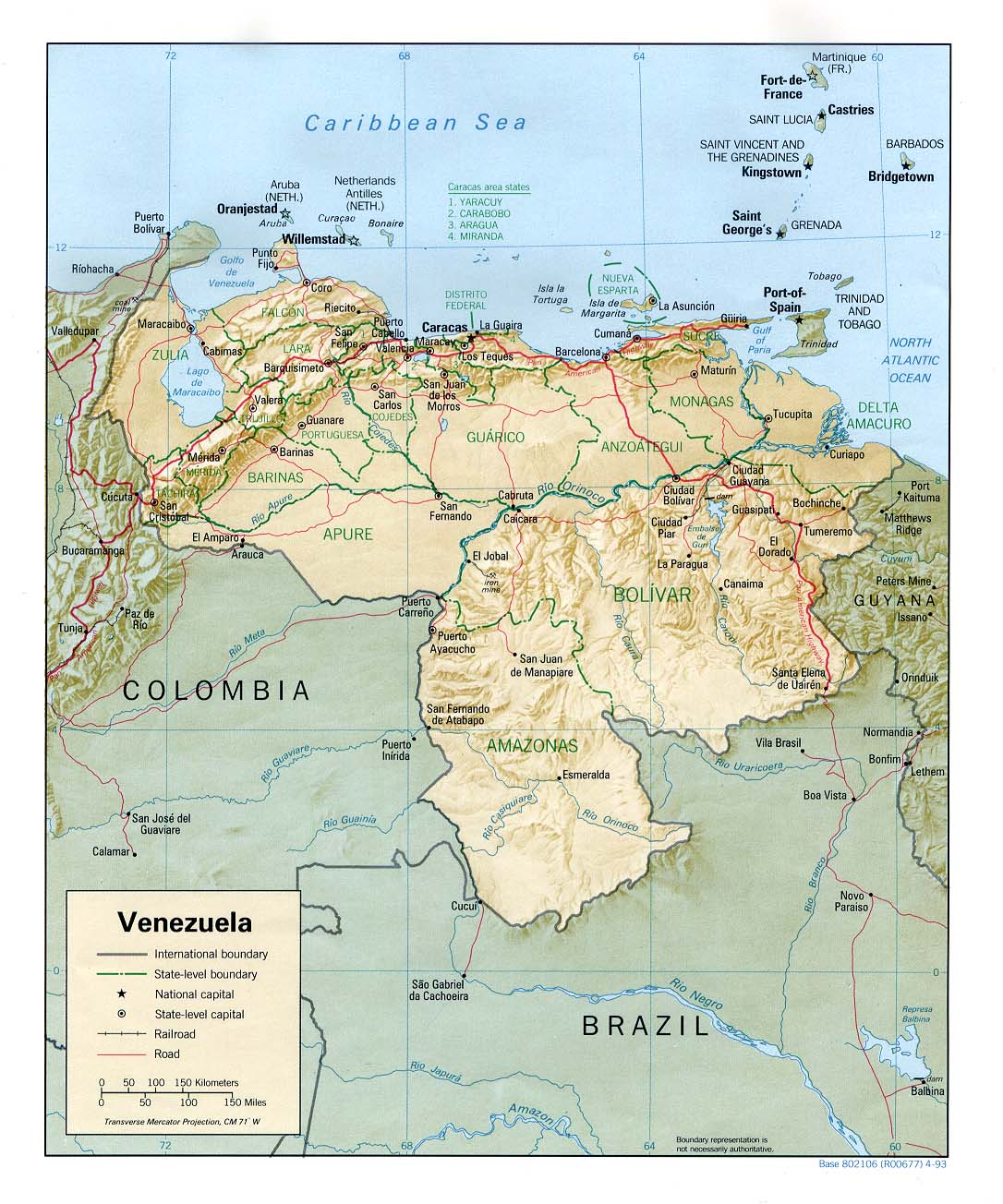
Shaded relief map of Venezuela, 1993 (via Wikimedia)

The main point to note is that Venezuela is an actual country, not a shorthand for “everything I don’t like about the Left”. It is a country that is in trouble for specific, identifiable reasons, not for being, somehow, generically, “too left-wing”. This sounds obvious when you put it like that, but deviations from this point are the main cause of V-word inflation.

So when somebody on the Left proposes to, for example, raise income tax, wealth taxes, or corporation tax, people on the pro-market side should not respond by shouting “Venezuela!”. Because that’s not what happened in Venezuela. Venezuela is not a high-tax economy, or at least, their tax burden is not what ruined them.

In the same way, if somebody on the Left proposes to hike the minimum wage, to abolish university tuition fees, or to ban zero-hour contracts, shouting “Venezuela!” is not the answer either. Those are bad ideas, sure. But those are not the ideas that destroyed Venezuela.

In short, we shouldn’t bring up Venezuela in a discussion of run-of-the-mill left-wing policies, which bear little relationship to anything that Chávez and/or Maduro did.

Furthermore, when somebody points out a genuine social problem in Britain, “Yeah but Venezuela!” is not much of a reply. Socialists are sometimes good at identifying problems, even if they are terrible at developing solutions. It is true that we have some of the highest housing costs in the world. It is true that our productivity performance, and as a result, wage growth, are poor, and have been poor for far too long. It is true that our welfare system is riddled with flaws, and often fails to support people who have fallen on hard times.

“It’s much worse in Venezuela, which is the system you lot want!” is not good enough. “It’s much better in capitalist countries X and Y – which is the system we should learn from” is more like it. So in such cases, it’s best to leave Venezuela out of it. Let “Venezuela” be a country, not a rhetorical all-purpose put-down.

That said – don’t declare that moratorium just yet. When prominent British socialists call for mass nationalisations, when they call for price controls and capital controls, when they deride the rule of law as a mere “bourgeois” construct that only serves “the elites” – then yes, it is absolutely fair to point out that this is exactly what happened in Venezuela. Here, we’re not talking about some allegorical “Venezuela”, but about the actual country, and about specific things that happened there. These are the very policies, and this is the very mindset, which turned what was once South America’s richest country into a basket case. This argument may not “resonate with people” – but it’s true.

Further to that: when socialists claim that “their” version of socialism will be completely different from any of its previous incarnations, that it will be genuinely democratic, empowering, grassroots-based and non-hierarchical – then it is fair to point that this is exactly what the Chavistas also used to say.

Some Western socialists are currently trying to convince themselves that Chávez and Maduro just never really aspired to a different kind of socialism, that authoritarian populism is all they ever wanted. This is fundamentally untrue, and Western socialists used to know this very well. The project of Venezuelan socialism started with the aspiration that this time would be different, that this time, “socialism” would not mean an all-powerful state controlling everything. It started with the aspiration that there could be completely different forms of collective ownership, which had nothing to do with the top-down nationalised industries of the past.

The appeal of Millennial Socialism rests on the delusion that the democratic, bottom-up socialism Millennial Socialists aspire to is a fundamentally novel aspiration, and that nobody in history has ever tried to build anything like this before.

But it is not a new aspiration. This was precisely what Chávez’s and Maduro’s “21st Century Socialism” was also about, which is why it used to be so popular in the West. A moratorium on the V-word would just play into the hands of those who now want to pretend that none of this ever happened, and that “Millennial Socialism” is novel, untried and untested.


August 22, 2018

That’s not a minimum wage increase. This is a minimum wage increase!

Filed under: Americas, Economics, Government — Tags: , , — Nicholas @ 03:00

Fifteen dollars as a minimum wage? Pffffft. Venezuela just hiked their minimum wage to $30*. Your move, capitalist pigs.

We should indeed praise the success of Bolivarian Socialism in Venezuela. For they’ve been able to announce a 60 fold increase in the minimum wage. Isn’t that a massive boost to the fight against inequality, a proof that this state control of the economy raises the living standards of the poor? No, truly, we’re told, repeatedly, that raising the minimum wage is a necessary and important part of that fight against the drear circumstances facing the poor. The US minimum wage of $7.25 an hour, just think how rich we’d all be if that were $435 an hour. We could all work just the one hour a week and live well. The British minimum wage, raise it to £400 or so an hour. Why not? After all, Venezuela’s application of proper socialist principles has shown us what is possible.

* Spoiler: that’s $30 per month, not per hour. But it’s a vast increase over the previous minimum wage, no?

August 4, 2018

QotD: Supply and demand

Filed under: Economics, Quotations — Tags: , , , — Nicholas @ 01:00

… that terribly simplistic stuff about supply and demand in those econ 101 classes is actually true. Prices are not some arbitrary numbers thrown at something by the capitalist neoliberals in order to do down the proletariat. They’re vital and essential information about who wants what and who is willing to produce what. Where the supply and demand curves meet is where the market will clear and the market price will be the market clearing price. The meaning of this is that when you decide to arbitrarily throw a price at something you’re going to up set that balance. And if you tell producers that the price will be lower than the market one then they will produce less. And as demand curves slope downwards so will consumers desire more at that lower price. Thus price fixing below the market price produces a shortage, a dearth.

This is not some optional feature, it’s an essential fact about our universe. It is the explanation for those food shortages that Venezuela has been having. More than that it’s the only explanation we need or desire. Fix prices below the market price and you will have shortages. Stop fixing prices and you will stop having shortages.

So, well done to Venezuela for giving in to reality there. And this is something that we need to take on board too. Rent controls which fix the price of housing below the market price will lead to a shortage of housing. And the opposite applies too – fix the price of labour above that market price with a minimum wage and you’ll have an excess supply of labour. Or, as we usually call that, an excess of unemployment.

The price of something simply is the price of something and don’t ever forget it.

Tim Worstall, “Congratulations To Bolivarian Socialism – Finally A Sensible Economic Policy In Venezuela”, Forbes, 2016-10-15.

July 28, 2018

“[S]ocialism is the leading man-made cause of death and misery in human existence”

Filed under: Economics, History, Media, Politics, USA — Tags: , , , — Nicholas @ 05:00

David Harsanyi isn’t cool with people trying to make socialism cool again:

On the same day that Venezuela’s “democratically” elected socialist president, Nicolas Maduro, whose once-wealthy nation now has citizens foraging for food, announced he was lopping five zeros off the country’s currency to create a “stable financial and monetary system,” Meghan McCain of The View was the target of internet-wide condemnation for having stated some obvious truths about collectivism.

During the same week we learned that the democratic socialist president of Nicaragua, Daniel Ortega, is accused of massacring hundreds of protesters whose economic futures have been decimated by his economic policies, Soledad O’Brien and writers at outlets ranging from GQ, to BuzzFeed, to the Daily Beast were telling McCain to cool her jets.

In truth, McCain was being far too calm. After all, socialism is the leading man-made cause of death and misery in human existence. Whether implemented by a mob or a single strongman, collectivism is a poverty generator, an attack on human dignity and a destroyer of individual rights.

It’s true that not all socialism ends in the tyranny of Leninism or Stalinism or Maoism or Castroism or Ba’athism or Chavezism or the Khmer Rouge — only most of it does. And no, New York primary winner Alexandria Ocasio-Cortez doesn’t intend to set up gulags in Alaska. Most so-called democratic socialists — the qualifier affixed to denote that they live in a democratic system and have no choice but to ask for votes — aren’t consciously or explicitly endorsing violence or tyranny. But when they adopt the term “socialism” and the ideas associated with it, they deserve to be treated with the kind of contempt and derision that all those adopting authoritarian philosophies deserve.

But look: Norway!

Socialism is perhaps the only ideology that Americans are asked to judge solely based on its piddling “successes.” Don’t you dare mention Albania or Algeria or Angola or Burma or Congo or Cuba or Ethiopia or Laos or Somalia or Vietnam or Yemen or, well, any other of the dozens of other inconvenient places socialism has been tried. Not when there are a handful of Scandinavian countries operating generous welfare-state programs propped up by underlying vibrant capitalism and natural resources.

Of course, socialism exists on a spectrum, and even if we accept that the Nordic social-program experiments are the most benign iteration of collectivism, they are certainly not the only version. Pretending otherwise would be like saying, “The police state of Singapore is more successful than Denmark. Let’s give it a spin.”

June 3, 2018

QotD: Price controls just make things more expensive in real terms

Filed under: Economics, Government, Quotations — Tags: , , , — Nicholas @ 01:00

One of the perennial, and pernicious, political ideas is that if things are “too expensive” then we can fix that by just passing a law to make them less expensive. We see this just about everywhere and its sadly not limited to the more idiot sector of the left. Although of course it thrives there. Venezuela is a complete and total mess because Hugo Chavez and Nicolas Maduro thought they would make life cheaper by limiting prices by law. Payday lending doesn’t exist in certain states because people like Elizabeth Warren insist that interest rates should not go “too high”. Those usury laws mean that interest rates are infinite – as the lending simply isn’t available at all. And yes, people over on the right have made the same sort of mistake – Nixon tried to fix gas prices after all.

Price fixing just always leads to things getting more expensive. As David Friedman explains:

    The result – that price control results in a cost to the consumer, pecuniary plus nonpecuniary, higher than the uncontrolled price – does not depend on the details of the [supply and demand] diagram. Consumers cannot consume more gas than producers produce, so the nonpecuniary cost must be large enough to drive quantity demanded down to quantity supplied. Quantity supplied is lower than without price control, so cost to the consumer must be higher.

Tim Worstall, “Memo For Would Be Price Fixers – Price Controls Always Make Things More Expensive”, Forbes.com, 2016-08-16.

April 4, 2018

DicKtionary – I is for Investment – Gregor MacGregor

Filed under: Americas, History — Tags: , , , , , , — Nicholas @ 04:00

TimeGhost
Published on 3 Apr 2018

I for investment, for financial success,
Or for a failure, cause it’s hard to guess,
But if there’s one man who could make you a beggar,
It’s today’s star, Gregor MacGregor.

Join us on Patreon: https://www.patreon.com/TimeGhostHistory

Written and Hosted by: Indy Neidell
Based on a concept by Astrid Deinhard and Indy Neidell
Produced by: Spartacus Olsson
Executive Producers: Bodo Rittenauer, Astrid Deinhard, Indy Neidell, Spartacus Olsson
Camera by: Ryan Tebo
Edited by: Bastian Beißwenger

A TimeGhost format produced by OnLion Entertainment GmbH

March 16, 2018

QotD: Achieving socialist nirvana

Filed under: Americas, Economics, Government, Quotations — Tags: , , , , — Nicholas @ 01:00

The evidence is in. Again. Socialism and government statism is the only way to eliminate income inequality.

As reported in Reuters, a 3 university study of conditions in Venezuela has shown that 90% of citizens now live in poverty. But socialism can only achieve so much. The other 10% must suffer in abject affluence so that the 90% can have income equality.

That in Venezuela income equality necessitates poverty is a design feature of the policy and not a fault.

Venezuela has also demonstrated that socialism can not only eliminate income inequality, it can also eliminate obesity. There was no need to deploying a sugar tax, when the income equalization policies achieved the same ends. You see, Venezuelans reported losing an average of 11 kilograms in 2017. This was on top of losing an average of 8 kilograms in 2016.

Viva Venezuela. Viva Chavez. Viva Maduro.

“I Am Spartacus”, “Nirvana – income equality and a truly fair society”, Catallaxy Files, 2018-02-23.

August 5, 2017

At least someone on the left is willing to find fault with Venezuela’s leadership

Filed under: Americas, Politics — Tags: , , — Nicholas @ 03:00

Of course, when I say “find fault”, I mean “criticize for not being even more horrible“:

Ken Livingstone, a former mayor of London, has blamed the turmoil in Venezuela on the unwillingness of the former president, Hugo Chávez, to execute “oligarchs” after he came to power.

Livingstone, who is suspended from the Labour party, also blamed the economic crisis in the country on the government’s failure to take his advice on investment in infrastructure, which he said would have reduced the Latin American state’s dependence on oil.

The former mayor, a longtime supporter of the late president Chávez and his successor Nicolás Maduro, said the socialist leader’s enemies wanted to restore their power.

“One of the things that Chávez did when he came to power, he didn’t kill all the oligarchs. There was about 200 families who controlled about 80% of the wealth in Venezuela,” Livingstone told Talk Radio.

“He allowed them to live, to carry on. I suspect a lot of them are using their power and control over imports and exports to make it difficult and to undermine Maduro.” When pressed, Livingstone said he was “not in favour of killing anyone”.

Livingstone visited Venezuela during his time in office as mayor of London, striking a cut-price oil deal with Maduro to supply Transport for London. The Labour leader, Jeremy Corbyn, has also regularly expressed his admiration for Chávez, saying in 2013 he was “an inspiration to all of us fighting back against austerity and neoliberal economics in Europe”.

August 4, 2017

Short memories and willing self-deception over Venezuela

Filed under: Americas, Economics, Media, Politics — Tags: , , , , , — Nicholas @ 03:00

In the Los Angeles Times, James Kirchick took the pundits to task for their adulation of Venezuela’s government as it plunged deliberately into a humanitarian disaster:

Shaded relief map of Venezuela, 1993 (via Wikimedia)

On Sunday, Venezuelan President Nicolas Maduro claimed victory in a referendum designed to rewrite the country’s constitution and confer on him dictatorial powers. The sham vote, boycotted by the opposition, was but the latest stage in the “Bolivarian Revolution” launched by Maduro’s predecessor, the late Hugo Chavez. First elected in 1998 on a wave of popular goodwill, Chavez’s legacy is one of utter devastation.

Thanks to Chavismo’s vast social welfare schemes (initially buoyed by high oil prices), cronyism and corruption, a country that once boasted massive budget surpluses is today the world’s most indebted. Contraction in per capita GDP is so severe that “Venezuela’s economic catastrophe dwarfs any in the history of the U.S., Western Europe or the rest of Latin America” according to Ricardo Hausmann, former chief economist of the Inter-American Development Bank. Transparency International lists Venezuela as the only country in the Americas among the world’s 10 most corrupt.

Socialist economic policies — price controls, factory nationalizations, government takeovers of food distribution and the like — have real human costs. Eighty percent of Venezuelan bakeries don’t have flour. Eleven percent of children under 5 are malnourished, infant mortality has increased by 30% and maternal mortality is up 66%. The Maduro regime has met protests against its misrule with violence. More than 100 people have died in anti-government demonstrations and thousands have been arrested. Loyal police officers are rewarded with rolls of toilet paper.

The list of Western leftists who once sang the Venezuelan government’s praises is long, and Naomi Klein figures near the top.

In 2004, she signed a petition headlined, “We would vote for Hugo Chavez.” Three years later, she lauded Venezuela as a place where “citizens had renewed their faith in the power of democracy to improve their lives.” In her 2007 book, The Shock Doctrine, she portrayed capitalism as a sort of global conspiracy that instigates financial crises and exploits poor countries in the wake of natural disasters. But Klein declared that Venezuela had been rendered immune to the “shocks” administered by free market fundamentalists thanks to Chavez’s “21st Century Socialism,” which had created “a zone of relative economic calm and predictability.”

Chavez’s untimely death from cancer in 2013 saw an outpouring of grief from the global left. The caudillo “demonstrated that it is possible to resist the neo-liberal dogma that holds sway over much of humanity,” wrote British journalist Owen Jones. “I mourn a great hero to the majority of his people,” said Oliver Stone, who would go on to replace Chavez with Vladimir Putin as the object of his twisted affection.

May 23, 2017

Venezuela’s American “useful idiots”

Filed under: Americas, Economics, Media — Tags: , , , , — Nicholas @ 04:00

Marian L. Tupy on the American apologists for the ongoing economic and humanitarian disaster unfolding in Venezuela, thanks to that country’s embrace of socialism:

… all socialist countries eventually come to experience similar economic and political problems. And, just as surely, there will always be those in the West who will jump to socialism’s defense. Vladimir Lenin, the founder of the Soviet state, called such people “useful idiots”.

I was reminded of the immensely seductive nature of socialism this week, when Tucker Carlson, the host of the eponymous show on Fox News, hosted a young socialist from The Students and Youth for a New America. To give you a sense of the conversation between the two, I have transcribed some of Dakotah Lilly’s statements below:

    “We need to acknowledge that what Venezuela is facing right now is terrorism at the hands of the opposition. Opposition has bombed schools, they have bombed buses, [and] they have taken wiring and strung it across roads to behead cops on motorcycles. These are not choir boys. These are violent extremists, hell-bent on taking away the progress that Venezuela has made over the past few years.”

    “If you look at the casualties that have happened in the past few months in these protests, the majority of those that have been killed have been trade unionist leaders, have been dedicated Chavistas, have been people on the Left.”

    “In terms of economics, the sanctions that the United States has put on Venezuela and the hoarding done by multi-national corporations in Venezuela, certainly does not help the [economic] situation.”

Almost everything that Lilly says here is demonstrably false. Extensive reporting by the New York Times, hardly a promoter and defender of “unbridled capitalism”, shows that most of the victims of political violence in Venezuela have been anti-government protesters.

Prey for Socialism’s Siren Call

Moreover, the sanctions imposed by the United States on a few individuals connected to the Venezuelan government have nothing to do with that country’s economic meltdown.

Aside from oil exports, Venezuela does not have or make anything that anyone in the world wants to buy. Thus, when the oil price collapsed from $140 to less than $50 a barrel, the country lost most of the foreign exchange it needed to purchase food and consumer goods abroad. Shortages ensued.

Admittedly, it is not entirely fair to criticize American millennials for their almost unfathomable ignorance. The state-schools system is, by and large, broken. American pupils can go through years of primary and secondary “education” without learning about communist crimes and socialist economic failures. Solutions to these problems are not easily to find. History and economics are not the most popular of subjects, and more often than not, the faculties are Left-leaning.

To make matters worse, young people, such as Dakotah Lilly, are deeply idealistic and easy prey to the siren call of socialism. They see the imperfections of free-market democracy at home and assume that countries with the opposite economic and political arrangements, such socialist Venezuela, must offer a better life to their people.

As Steven Horwitz pointed out earlier this month, “you can’t deny that Venezuela is a socialist calamity“:

This humanitarian disaster has raised the question of who or what to blame. That question puts self-proclaimed socialists and their progressive sympathizers in a difficult spot. After all, one can easily find lots of examples (from Michael Moore to Bernie Sanders) of people on the left praising or endorsing Chavez’s economic policies. So what can people who took that position say in the face of this disaster? And what can the defenders of free enterprise say as well?

Many on the left will start by denying that socialism is at fault. Sometimes they’ll deny that the Chavez-Maduro policies were “real” socialism. In other cases, they’ll argue that while their intentions might have been good, corruption and poor implementation doomed good policies to failure.

Both of these arguments have real problems.

If those policies were not “real” socialism, then why did so many sympathetic to socialism express so much support for them and argue that they would be transformative in ways socialists value? Chavez himself made such claims.

Do all of them not understand what socialism is? The variety of attempts Chavez made to prevent markets and prices from working and to substitute some form of economic planning in the name of the people have been broadly consistent with socialism since Marx. If that’s not socialism, what exactly is meant by that word anymore?

February 7, 2017

Simón Bolívar – Lies – Extra History

Filed under: Americas, History — Tags: , , , — Nicholas @ 02:00

Published on Jan 21, 2017

James talks about our mistakes, and adds additional stories, for the Simón Bolívar series!

February 4, 2017

Simón Bolívar – VI: All Good Things – Extra History

Filed under: Americas — Tags: , , , , — Nicholas @ 04:00

Published on Dec 24, 2016

Simón Bolívar hoped to bring the nations of South America together in one great federation, but he feared that people would think he meant to make himself a king. He tried to step back, but revolution threatened from within his ranks and his body had grown weak with illness.

January 30, 2017

Simón Bolívar – V: Heavy is the Head – Extra History

Filed under: Americas, History — Tags: , , , — Nicholas @ 03:00

Published on Dec 17, 2016

After so many failures, Simón Bolívar finally began to find success: Gran Colombia, Peru, and Bolivia all stood free from Spanish rule. He raced to found new governments and consolidate the liberty he’d earned, but resources had been stretched too thin.

January 25, 2017

Simón Bolívar – IV: Defeat is Not Surrender – Extra History

Filed under: Americas, History — Tags: , , , , — Nicholas @ 04:00

Published on Dec 10, 2016

Failure had taught Simón Bolívar one important lesson: no single state in Spanish South America could win independence alone. To succeed, he needed to form one great state, united and able to stand up to the might of Spain.

January 22, 2017

Simón Bolívar – III: Leavings and Returns – Extra History

Filed under: Americas, History — Tags: , , , , — Nicholas @ 02:00

Published on Dec 3, 2016

The failure of his first attempted revolution in Venezuela only fanned the flames of Simón Bolívar’s determination to end Spanish reign over South America. Convinced that he needed to unite the entire continent in freedom, he gathered troops and set out with a new purpose. But his ferocity threatened to overwhelm his ideals.

« Newer PostsOlder Posts »

Powered by WordPress

