
HardThrasher
Published 5 Apr 2025The background to the Dams raid; how it came into being and how it fitted into the assault on Nazi Germany. In which we discuss Banes Wallis, Arthur Harris and a man called Winterbotham.
THESE LINKS ARE ONLY FOR THE SERIOUSLY SEXY
Merch! – https://hardthrasher-shop.fourthwall.com
Patreon – https://www.patreon.com/LordHardThrasherBibliography
James Holland – Dambusters: the Races to Smash the Dams 1943
Max Hastings – Chastise – The Dambusters Story
Alan Cooper – The Battle of the Ruhr
Adam Tooze – The Wages of Destruction
Martin Millbrook and Chris Everett – The Bomber Command War Diaries
Edward Westerman – Flak German Anti Aircraft Defences [sic] 1914-1945
Tami Davis Biddle – Rhetoric and Reality in Air Warfare
Donald A Miller – Masters of the Air
April 7, 2025
Dambusters Part 1 – The Battle of the Ruhr
April 4, 2025
SVD Dragunov: The First Purpose-Built DMR
Forgotten Weapons
Published 3 Dec 2024The development of the Dragunov designated marksman’s rifle was spurred by the NATO adoption of the 7.62x51mm cartridge. The Red Army had standardized on a new suite of infantry weapons using the intermediate-sized 7.62x39mm round, and feared being out-ranged in open terrain by NATO units. The Soviet squad needed some way to reach out and engage a NATO machine gun or antitank weapon that might be beyond the range of their RPD light machine gun. And so in 1957, specifications were issued for a new 7.62x54Rmm precision rifle.
Three designers responded with proposals; Dragunov, Konstatinov, and Simonov. The Simonov was not really suitable (it was a scaled-up SKS in essence), and the Konstantinov was not as accurate as the Dragunov. And so, Evgeniy Dragunov’s rifle was adopted in 1963 as the SVD. Dragunov himself was a talented competitive marksman, and this experience undoubtedly contributed to the quality of his design. The SVD is a rotating bolt rifle with a lightweight short-stroke gas piston and a light-be-accurate barrel. It was issued to ever squad in mechanized infantry units, and was an important part of infantry armament, still in service today.
(more…)
February 26, 2025
G33/40: Special Carbine for the Gebirgsjager
Forgotten Weapons
Published 8 Nov 2024When the Germans took over control of the Czechoslovakian arms industry, they took some time to work out what out to mass produce at the Brno factory. In the interim, they decided to restart production of the Czech vz33 Mauser carbine as the Gewehr 33/40 for German mountain troops. This was a truly short carbine with a 19.4 inch (490mm) barrel, which the Czechs had used for mostly police applications. German had used a short carbine back before World War One, but with Spitzer ammunition it was deemed too harsh shooting (both blast and recoil) to be worth the reduced length. Well, that calculation was different for mountain troops.
The G33/40 also had a distinctive added metal plate on the left side of the stock to help protect it in mountain use. The G33/40 would remain in production for three years, from 1940 until 1942 (after which the rifle production changed to standard K98ks). About 130,000 were made, with 945 receiver codes in 1940 and dot codes thereafter.
(more…)
February 20, 2025
Retaking Burma with the Fourteenth Army in 1945
Dr. Robert Lyman discusses the start of the campaign to reconquer Burma from the Japanese led by Lieutenant General Bill Slim and the Fourteenth Army:
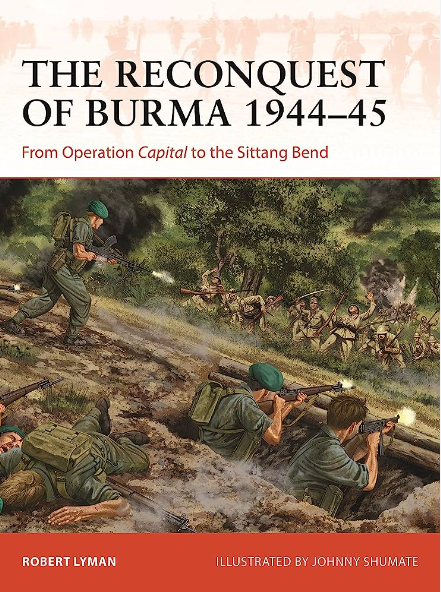
Why Burma? Because in Burma in 1945 a series of marvellous military miracles (is there a synonym starting with “m” for concatenation?) engineered by General Bill Slim and his mighty 14th Army, broke the back of the Japanese Burma Area Army and smashed forever Tokyo’s dreams of an empire in South East Asia. 1945 is worth celebrating!
Even today, few people are aware of just how dramatic these events were, and just how spectacular was the victory wrought by the Indian, British, African, US and Chinese forces in the country.
Indeed, at the start of 1945 few people would have predicted the extraordinary outcome of the developing campaign. If Lieutenant General Sir Bill Slim (he had been knighted by General Archibald Wavell, the Viceroy, the previous October, at Imphal) had been asked in January 1945 to describe the situation in Burma at the onset of the next monsoon period in May, I do not believe that in his wildest imaginings he could have conceived that the whole of Burma was about to fall into his hands. After all, his army wasn’t yet fully across the Chindwin. Nearly 800 miles of tough country with few roads lay before him, not the least the entire Burma Area Army under a new commander, General Kimura. The Arakanese coastline needed to be captured too, to allow aircraft to use the vital airfields at Akyab as a stepping stone to Rangoon. Likewise, I’m not sure that he would have imagined that a primary reason for the success of his Army was the work of 12,000 native levies from the Karen Hills, under the leadership of SOE, whose guerrilla activities prevented the Japanese from reaching, reinforcing and defending the key town of Toungoo on the Sittang river. It was the loss of this town, more than any other, which handed Burma to Slim on a plate, and it was SOE and their native Karen guerrillas which made it all possible.
Crossing the Irrawaddy
(Victoria State Archives)The potential of a Karenni-based resistance raised the possibility, long argued by old Burma hands, of a British armed and trained fifth column operating behind Japanese lines for the purpose of gathering battlefield intelligence and undertaking limited guerrilla action. Slim had long complained about the poor quality of the battlefield intelligence (as opposed to the signals intelligence, about which he was well provided) that he and his Corps commanders received. He was concerned, among other things, about knowing “what was on the other side of the hill”, the product of information provided – where it existed – by effective combat (ground and air) reconnaissance. There was no shortage of organisations attempting to assist in this task – at least twelve – but their coordination was poor and most reported to SEAC or parts of India Command, rather than to 14 Army. Slim dismissed most of these as “private armies” which offered no real help to the task of defeating the enemy on the battlefield. One of the groups, part of Force 136 (i.e. Special Operations Executive, or SOE), which had operated in front of 20 Indian Division along the Chindwin between 1943 and early 1944 under Major Edgar Peacock (and thus known as “P Force”) did sterling work with local Burmese and Karen agents reporting on Japanese activity facing 4 Corps. Persuaded that similar groups working among the Karens in Burma’s eastern hills – an area known as the Karenni States – could achieve significant support for a land offensive in Burma, Slim (to whom Mountbatten transferred responsibility for Force 136 in late 1944 for this purpose) authorised an operation to the Karens. Its task was not merely to undertake intelligence missions watching the road and railways between Mandalay and Rangoon, but to determine whether they would fight. If the Karens were prepared to do so, SOE would be responsible for training and organising them as armed groups able to deliver battlefield intelligence directly in support of the advancing 14 Army. The resulting operation – Character – was so spectacularly successful that it far outweighed what had been achieved by Operation Thursday the previous year in terms of its impact on the course of military operations in pursuit of the strategy to defeat the Japanese in the whole of Burma. It has been strangely forgotten, or ignored, by most historians ever since, drowned out perhaps by the noise made by the drama and heroism of Operation Thursday, the second Chindit expedition. Over the course of Operation Extended Capital some 2,000 British, Indian and Burmese officers and soldiers, along with 1,430 tons of supplies, were dropped into Burma for the purposes of providing intelligence about the Japanese that would be useful for the fighting formations of 14th Army, as well as undertaking limited guerrilla operations. As historian Richard Duckett has observed, this found SOE operating not merely as intelligence gatherers in the traditional sense, but as Special Forces with a defined military mission as part of conventional operations linked directly to a strategic outcome. For Operation Character specifically, about 110 British officers and NCOs and over 100 men of all Burmese ethnicities, dominated interestingly by Burmans (which now also included 3-man Jedburgh Teams) mobilised as many as 12,000 Karens over an area of 7,000 square miles to the anti-Japanese cause. Some 3,000 weapons were dropped into the Karenni States. Operating in five distinct groups (“Walrus”, “Ferret”, “Otter”, “Mongoose” and “Hyena”) the Karen irregulars trained and led by Force 136, waited the moment when 14 Army instructed them to attack.

January 29, 2025
Canadians – “polite lunatics”
In The Line, Mitch Heimpel talks about a Canadian culture from a time before a Canadian PM could get away with maligning the country as having “no core identity”:
In recent days, The Line has spoken of the need for Canada to go “full psycho”. To “Make ‘Canada’s back’ a threat”. And, specifically, to recapture a Canadian identity that was, not long ago, widely shared — Canadians as scary and even dangerous. My own mind had been on similar topics of late, and I’d been thinking, specifically, about how those representations used to show up not just in our pop culture, but in American pop culture.
And in at least one place, you can find it still: Shoresy, a hilarious comedy show about Canadian hockey hosers that has found success on both sides of the border.
Shoresy is interesting not because it’s new, but almost because it’s retro. Once upon a time, the kind of Canadian identity shown in Shoresy was just … Canadian identity. Here’s a great example of what I mean that I suspect many readers will have seen: 1968’s The Devil’s Brigade, a film about the First Special Service Force, a joint Canadian-American unit that would become the forerunner to the American Green Berets. The film is a remarkable reflection of the attitudes that the two cultures had about each other. In one particular scene, after the Americans (predominantly tough guy actors Claude Akins and James Coburn) have spent days making sport of the Canadians, a new Canadian sergeant — played by Jeremy Slate — is introduced in a mess hall scene. Mild-mannered, lithe, and even bespectacled, the Sergeant sits down next to Akins and begins to insult him. He starts by literally elbowing the American bully for room at the table in the Mess and proceeds to call him a fat tub of lard.
Sgt. Patrick O’Neill (Jeremy Slate) in the mess hall scene in The Devil’s Brigade (1968).
Once Akins has had enough, he attacks the Canadian sergeant, who reveals himself to be the unit’s new hand-to-hand combat instructor, and proceeds to pummel Akins while barely smudging his glasses. After having bruised the American’s body, as well as his ego, he returns to dinner and punctuates it by asking Akins for the salt. Akins hands it over.
This was not a remarkable representation. The Americans used to view us as polite lunatics. This showed up not just in American media, but also our stories about ourselves. Characters like Slate’s sergeant Patrick O’Neill showed up in the songs of Stompin’ Tom, Ian Tyson, and even Gordon Lightfoot. They’re memorialized in the works of Robert Service and Al Purdy. Purdy, in particular, describes this archetype well, both in At the Quinte Hotel and in The Country North of Belleville:
backbreaking days
in the sun and rain
when realization seeps slow in the mind
without grandeur or self-deception in
noble struggle
of being a fool –A country of quiescence and still distance
a lean land
not like the fat south.In those few lines, Purdy captures Canadiana so easily. A people shaped by distance and the harshness of the land. Capable of the toughness needed to endure. With just a little foolishness mixed in for good measure.
Polite lunatics.

December 3, 2024
Evolution of Airborne Armour
The Tank Museum
Published Jul 19, 2024Lightly armed airborne troops are at a huge disadvantage when faced with regular troops with heavy weapons and armour. In World War II this led to huge losses for paratroops on Crete and at Arnhem. Since then, many attempts have been made to level the playing field, to give airborne soldiers a fighting chance.
From the Hamilcar gliders of World War II to the C17 Globemaster, we look at how to make a tank fly.
00:00 | Intro
00:47 | The Origins of Airbourne Operations
02:34 | Gliders
07:20 | A Tank Light Enough to Fly?
09:02 | Success & Failure
14:24 | Post-War Solutions
17:41 | Better Aircraft – Better Tanks?
20:15 | Strategic Deployment
21:39 | ConclusionThis video features archive footage courtesy of British Pathé. This video features imagery courtesy of http://www.hamilcar.co.uk/
#tankmuseum
November 30, 2024
Forgotten War Ep 5 – Chindits 2 – The Empire Strikes
HardThrasher
Published 29 Nov 202402:00 – Here We Go Again
06:36 – Perfect Planning
13:16 – Death of a Prophet
14:51 – The Fly In
18:56 – Dazed and Confused (in the Monsoon)
20:40 – Can’t Fly in This
31:54 – Survivor’s ClubPlease consider donations of any size to the Burma Star Memorial Fund who aim to ensure remembrance of those who fought with, in and against 14th Army 1941–1945 — https://burmastarmemorial.org/
(more…)
November 25, 2024
The Experimental SOE Welrod MkI Prototype
Forgotten Weapons
Published Aug 12, 2024The Welrod was a program to develop a silent assassination pistol for British SOE (Special Operations Executive) late in 1942. It needed to be chambered in the .32 ACP cartridge, be effective to a range of 15m, and have its firing not recognizable as a firearm at 50m distance. The project was led by Major Hugh Quentin Reeves, who developed much of SOE’s inventory of gadgets.
The Welrod concept was ready in January 1943, and it was not quite the Welrod that we recognize today. This initial MkI design used a fixed internal 5-round magazine and a thumb trigger, along with a rifle style bolt action mechanism. Samples were produced in April 1943, and testing showed that it was rather awkward to use. A MkII version was quickly developed in June 1943 with a more traditional style of grip and magazine, and formal trials led to the adoption of that MkII design. Incidentally, this is why the first Welrod produced was the MkII, and the later production version in 9mm was designated the MkI (it was the first mark of 9mm Welrod).
Eventually many thousands of Welrod pistols were manufactured, and they almost certainly remain in limited use to this day. This example we have today is the only surviving MkI example, however.
(more…)
November 7, 2024
Forgotten War Ep4 – Rise of the Chindits
HardThrasher
Published 4 Nov 2024Please consider donations of any size to the Burma Star Memorial Fund who aim to ensure remembrance of those who fought with, in and against 14th Army 1941–1945 — https://burmastarmemorial.org/
(more…)
October 3, 2024
D-Day 80th Anniversary Special, Part 2: Landings with firearms expert Jonathan Ferguson
Royal Armouries
Published Jun 12, 2024This year marks the 80th anniversary of D-Day, the Allied invasion of France which took place on 6th June 1944. From landing on the beaches of Normandy, the Allies would push the Nazi war machine and breach Hitler’s Atlantic Wall.
To commemorate this, we’re collaborating with IWM to release a special two-part episode as Jonathan will look at some of the weapons that influenced and shaped this historic moment in history.
Part 2 is all about the pivotal landings, including allied efforts to aid in its success.
0:00 Intro
0:25 Twin Vickers K Gun
2:03 Pointe du Hoc
2:45 Water off a DUKW’s back?
3:50 Magazines x3
4:07 Usage & History
5:50 Bring up the PIAT!
7:00 Dispelling (Or Projecting via Spigot) Myths
7:55 PIAT Firing Process
9:50 PIAT Details
10:31 Usage in D-Day
13:19 Pegasus Bridge
15:05 MG 42
15:41 Defensive Machine Gun
16:37 1200 RPM
17:35 Replaceable Barrel
19:08 Usage in D-Day
21:37 Sexton Self-Propelled Gun
21:33 Artillery in D-Day
22:15 Run-In Shoot
22:40 The Need for Mobile Artillery
23:25 Usage in D-Day
24:21 17-Pounder Gun
25:11 Function & Usage
26:05 Usage in D-Day
28:00 IWM at HMS Belfast
30:27 Outro
(more…)
September 18, 2024
D-Day 80th Anniversary Special, Part 1: Paratroopers, with firearms expert Jonathan Ferguson
Royal Armouries
Published Jun 5, 2024This year marks the 80th anniversary of D-Day, the Allied invasion of France which took place on 6th June 1944. From landing on the beaches of Normandy, the Allies would push the Nazi war machine and breach Hitler’s Atlantic Wall.
To commemorate this, we’re collaborating with Imperial War Museums to release a special two-part episode as Jonathan will look at some of the weapons that influenced and shaped this historic moment in history.
Part 1 is all about the “tip of the spear”, the Paratroopers.
0:00 Intro
0:55 STEN MK V
1:40 History of the Sten
3:00 Mark V Details
6:23 Usage in D-Day
8:38 M1A1 Carbine
10:38 M1A1 Details
14:09 Usage in D-Day
15:01 ACME ‘Cricket’ Clicker
17:31 The Longest Day
19:30 Outro[NR: I’m glad Jonathan discussed that bloody clicker scene in The Longest Day … it bugged me the very first time I watched the movie as a young army cadet in the mid-1970s.]
(more…)
September 11, 2024
The Korean War Week 012 – Green Light for Incheon – September 10, 1950
The Korean War by Indy Neidell
Published 10 Sep 2024Douglas MacArthur’s brazen plan to land two full divisions far behind enemy lines and sabotage the North Korean logistics finally gets the green light from the President and the Joint Chiefs of Staff, despite the myriad difficulties everyone knows the operation will face. It is to go off next week. In the field, the North Korean offensive against the Naktong Bulge continues, though it seems to be running out of steam, and the UN forces get beefed up as the first British troops to arrive in Korea join the battle line.
Chapters
01:03 Recap
01:23 KPA Offensive and Counterattacks
07:31 JCS Approve Incheon
10:33 Eugene Clark Investigates
13:32 More UN Forces for the fight
15:00 Summary
15:24 Conclusion
18:14 Call to Action
(more…)
July 14, 2024
QotD: Method acting
Fortunately, pop Wonka is played by Christopher Lee — or, as one of my kids exclaimed, “It’s Count Dooku!”, that being the name of his splendid turn in Star Wars. Lee is having a grand old time at the moment, doing ten minutes in every blockbuster around. My favourite moment in the Lord of the Rings movies isn’t actually in any of the movies, but in one of those “the making of” documentaries that appears on the DVD. It’s the scene where Saruman gets stabbed by Grima Wormtongue, and Lee explains to director Peter Jackson that the backstabbing sound isn’t quite right, because in his days with British Intelligence during the war he used to sneak up and stab a lot of Germans in the back and it was more of a small gasp they made. Jackson backs away cautiously.
Mark Steyn, “Charlie and the Chocolate Factory”, The Spectator, 2005-07-30.
June 30, 2024
Operation Olympic – 100,000 US casualties in 60 days? – WW2 – Week 305 – June 29, 1945
World War Two
Published 29 Jun 2024The casualty projections for the planned November invasion of Kyushu, Japan are in … or are they? They might have been “massaged” a little to sell the operation more easily. The fight in the field still goes on, though, with parachutes flying over Luzon as more American troops land, and an Australian advance on Borneo.
(more…)
June 11, 2024
QotD: Mandatory fun
The Soviets, at least, went so far as to organize an entire massive government bureaucracy around the idea of Proletkult, which aimed at replacing “bourgeois” art wholesale with the “proletarian” version. You’re free to slog through the novels of guys like Maxim Gorky to see if it worked or not; for now I’ll simply note that the first head of Proletkult, Anatoly Lunacharsky, officially carried the title “Enlightenment Commissar”. […]
The other way the European Left built socialism was with sports, of course, and though it will never happen under the current dispensation, I’d love to read a solid academic history of the USSR’s Olympic teams. Viktor Suvorov (of the famous “Suvorov Thesis” of the Ostfront) insisted that pretty much all Soviet travel teams were comprised entirely of Spetsnaz commandos, and while I don’t doubt this is largely true, there were, on the other hand, “military” teams that were almost entirely civilian. To take one famous example, NHL legend Sergei Fedorov came up with CSKA Moscow, which — for some mysterious reason — you have to dig a bit to learn was the official Red Army hockey team. As in, Fedorov — though only sixteen — was in the Soviet Army, specifically to play hockey, and he wasn’t the only one. There was such a thing as “pro” hockey in the USSR, and it was very popular, but all the best “pros” played for Armed Forces teams, because anyone good enough at hockey to go “pro” would find himself drafted …
Severian, “Marx Was Right After All (an ongoing series)”, Rotten Chestnuts, 2021-01-12.


