
The Tank Museum
Published 3 April 2025Operation Market Garden failed because the tanks of XXX Corps did not reach the Paras in Arnhem in time. Many historians have argued that the British armoured column “let the side down”. But is this actually true?
We reckon there are six reasons why the operation was a total disaster. It was a poor plan from the get-go, relying on a rate of advance that would outmatch the German invasion of France in 1940. Bad weather prevented the deployment of badly-needed reinforcements, and the terrain Guards Armoured were expected to traverse – a single road with impassable conditions on either side – significantly hampered the efforts of the tank crews.
Poor intelligence also meant that the British column was not prepared for resistance from a retreating and desperate German Army. It was a combination of all these factors that caused Market Garden to unravel completely.
Despite the complications, many acts of valour were carried out by both the airborne and armoured divisions, including the legendary assault across the Waal by the US 82nd Airborne.
So, join us as we explore these six reasons why Operation Market Garden failed and decide for yourself whether XXX Corps could have done anymore.
00:00 | Introduction
02:23 | #1 – A Bad Plan
06:22 | #2 – Poor Intelligence
07:51 | #3 – Difficult Terrain
11:27 | #4 – Determined Resistance
13:45 | #5 – Bad Weather
14:38 | #6 – Loss of Surprise
19:45 | What Went Wrong?
(more…)
August 21, 2025
Six Reasons Operation Market Garden FAILED
August 19, 2025
Dieppe 1942: The Failed Raid That Shaped D-Day
Battle Guide
Published 2 May 2025On 19th August 1942, as dawn was breaking along the coast of occupied France, a force of just over 6,000 men stormed the beaches around the port town of Dieppe in the first major allied strike against Hitler’s Atlantic Wall. Within a matter of minutes hundreds lay dead or wounded, washed up against seawalls, hung on wire entanglements or incinerated in the burning landing craft. Over 60% of the mainly Canadian assault force were killed, wounded or captured by the end of the day, and the Dieppe Raid has, for the allies, gone down as one of the most infamous days of the Second World War.
(more…)
August 17, 2025
Battle of Norway, 1940
Real Time History
Published 7 Mar 2025The Battle of Norway in Spring 1940 cemented the reputation of the daring and invincible German war machine under Adolf Hitler. But while Denmark and Norway were successfully occupied by Germany, the campaign came at a heavy cost. This was especially true for the German Kriegsmarine which lost a significant amount of warships including the Blücher — losses that essentially crippled them for the remainder of the war.
(more…)
July 17, 2025
Afghan refugees and the British government
On Substack, Fergus Mason explains why the British government got deep into a secretive program to bring thousands of former Afghan soldiers and their families to Britain:
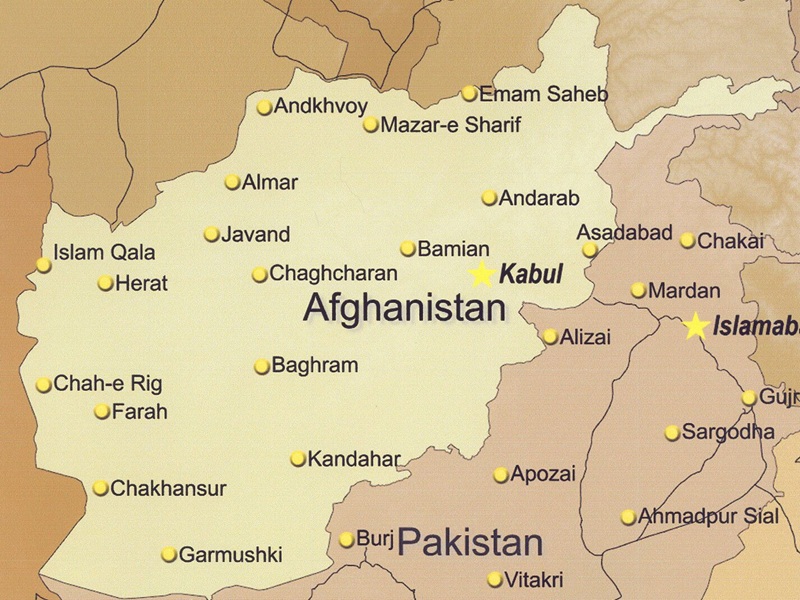
So here’s what we know so far. In February 2022 a Royal Marine officer, working for the Director of Special Forces, sent an email to several Afghans in Britain. These people were involved in the effort to rescue former interpreters and Afghan National Army special forces soldiers who were at risk of reprisals from the Taliban regime, and the Marine wanted to know whether some Afghans who claimed to be ex-special forces really were. The officer intended to attach a filtered list of around a hundred names from an Excel spreadsheet, but inadvertently attached the whole file — which contained around 25,000 names. One of the Afghans he sent the list to immediately passed it on to someone else – this time in Afghanistan. MoD sources are stressing that these were all trusted Afghans, but … well, we’ll get to that shortly.
And then nothing much happened for 18 months. The Taliban didn’t round up and shoot everyone on the list, even though they now claim to have had it since early 2022. But then, in August 2023, an Afghan man — a former soldier who had applied for asylum in Britain, but been rejected — popped up on Facebook. He promptly released part of the spreadsheet, then threatened to post all of it. At this point the government swung into action. First, it pressured Meta, which owns Facebook, to shut down the group the data was posted in and remove the user. Then the Ministry of Defence, under former defence secretary Ben Wallace, applied for a super-injunction to prevent the media from reporting anything about the leak, what the government planned to do about it, or what it was going to cost. It even banned anyone from revealing the existence of the injunction itself. That injunction was granted to Wallace’s successor, Grant Shapps, and the entire story was killed before it became public. The government was already drawing up a plan to bring tens of thousands more Afghans to Britain; the media and Parliament weren’t allowed to mention it; the British people, of course, were not to be allowed to know a thing. The degree of secrecy imposed was truly extraordinary.
And, over the last 18 months or so, the government has quietly been running a huge and very expensive operation to bring those identified as being at risk to Britain. From those listed on the spreadsheet, 23,900 former Afghan soldiers, policemen and intelligence officers were deemed to be in danger because of the leak. So, of course, were their families. How many people does the government plan to bring in under this scheme, in total? Nobody knows. Early estimates, according to court documents, were that 43,000 Afghans would be given asylum in Britain. Yesterday, officials insisted the real total was 6,900; even that dramatically lower number is a big addition to the 24,000 Afghans the government has admitted to bringing in under other, declared schemes. However, horrifyingly, last June three judges — Sir Geoffrey Vos, Lord Justice Singh and Lord Justice Warby — issued a written (but, of course, secret) ruling that up to a hundred thousand people could be at risk if the Taliban got their hands on the list.
Embarrassment for the British government, certainly, both for the initial cock-up and the ridiculous follow-up. It’s going to be expensive to resettle all those refugees and their often quite large families (guesstimates range from £850 million up to £6 billion), but not really a big deal, right? Well, about that …
I’ve already mentioned Afghan culture’s horrific misogyny. This leads to some truly dire attitudes towards women who don’t comply with Afghan society’s draconian rules of female behaviour (which boil down to having no rights and not being allowed to leave the house without a burqa and a male relative). One of the consequences of this is that Afghan men have unleashed a tidal wave of sexual assaults across Europe. At least one migration expert has noted that as well as their frequency, assaults by Afghans are remarkable for their brutality, audacity and often downright stupidity. Austrian political scientist Cheryl Benard wrote:
Can these men possibly expect that their attempts will be successful? Do they actually think they will be able to rape a woman on the main street of a town in the middle of the day? On a train filled with other passengers? In a frequented public park in the early afternoon? Are they incapable of logical thought — or is that not even their aim? Do they merely want to cause momentary female hysteria and touch some forbidden places of a stranger’s body? Is that so gratifying that it’s worth jeopardizing their future and being hauled off to jail by scornful and disgusted Europeans? What is going on here? And why, why, why the Afghans? According to Austrian police statistics, Syrian refugees cause fewer than 10 percent of sexual assault cases. Afghans, whose numbers are comparable, are responsible for a stunning half of all cases.
Type two words into Google — Afghane and Vergewaltigung — and a cornucopia of appalling incidents unfolds before you.
Incidentally, to all you lefties who’re undoubtedly sputtering with fury as you read this, don’t even think of writing Benard off as an anti-Afghan racist. Her husband is former US ambassador Zalmay Khalilzad, who is Afghan.
But surely, the “trusted” former Afghani soldiers, police and intelligence officers being brought in are bound to be much better able to adapt to British culture, right? Uh, well …
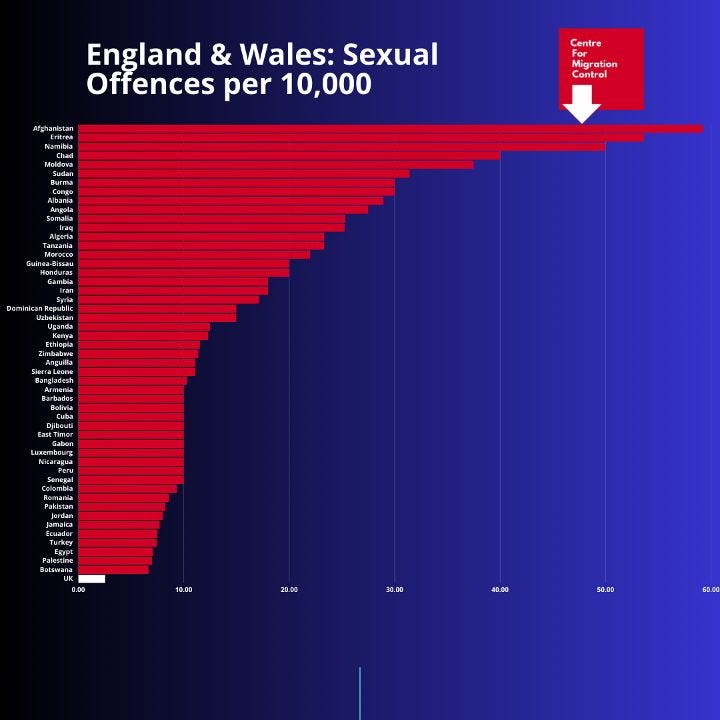
The government has been very reluctant to release — or even admit it possesses — statistics on the link between nationality and crime, but under pressure from independent MP Rupert Lowe it finally did so in March. This showed that among Afghans in Britain, 59 per 10,000 have been convicted of a sexual offence — 22.18 times higher than British men, at 2.66 per 10,000:
By the way, yes, I know the graph is from the Centre for Migration Control — but the data is from the Ministry of Justice and was obtained by a Freedom of Information request. I’ve checked the graph against the data, and it’s accurate.
[…]
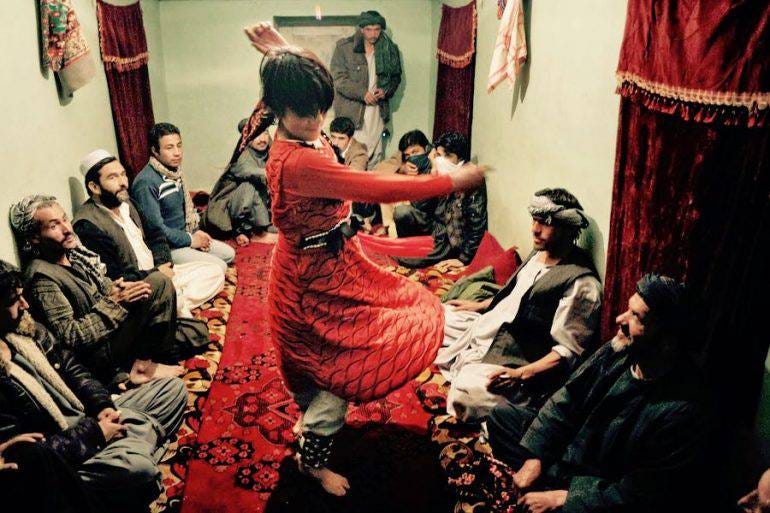
Does this photo of Afghan men watching a young boy dance give you the creeps? It should.
It’s not only women at risk, by the way. Afghan men aren’t averse to raping young boys, either. One of the most revolting aspects of Afghan culture — and that’s saying something — is the tradition of bacha bazi (Dari for “boy play”). Prepubescent boys are forced to dress up as girls then dance for, and “entertain”, men. This strain of paedophilia was common among anti-Taliban warlords and the Afghan security forces, particularly the police. The Taliban claim to be against the practice; their founder, the late Mullah Omar, actually was violently opposed to it. However, many prominent Taliban commanders also enjoy a spot of recreational pederasty.
Of course the obvious answer to this is “But most Afghan men aren’t rapists!” I agree; most of them aren’t. But an alarmingly high percentage of them are, and our governments clearly can’t keep the rapey ones out. The graph and its underlying statistics prove that beyond any possible doubt. And while it’s easy to downplay the statistics by saying it’s still “only” 77 sexual offences committed by Afghans over a two-year period, bear in mind that a) that’s 77 offences that wouldn’t have happened if we hadn’t let any Afghans in and b) this number is only convictions. In Britain just 3.1% of sexual offences reported to the police (around a third of which are rapes) lead to a conviction, which brings the potential number of Afghan suspects up to 2,484. The police estimate that only 10-15% of sexual offences are even reported; that could mean Afghans committed between 16,500 and 25,000 sexual offences across that same two-year period. Afghans would have to be bringing stupendous benefits to this country to make 25,000 sexual offences a worthwhile price to pay; indeed, many (emphatically including me) would argue that it wouldn’t be an acceptable price under any circumstances.
In Spiked, Tim Black on the government’s decision to hide everything for as long as they possibly could … for reasons:
Yet as catastrophic an error as this data leak was, the state has somehow managed to compound it with a series of decisions that made a terrible situation even worse. Successive Conservative and Labour governments effectively mounted a cover-up of both the data breach itself and the response. They slowly undertook a secret evacuation and relocation programme for the Afghans without telling even the Afghans affected about the data breach and the fact their lives were at risk. At the same time, they sought to hide all this from the British public, too, even while thousands of Afghan refugees were quietly being deposited in hotels and in military accommodation across the country. All with no explanation.
It is this de facto cover-up, this attempt on the part of ministers and senior officials to hide state errors and actions from public view, which is the most disturbing aspect of this whole sorry affair. They set about shielding a data breach followed by a costly, large-scale asylum scheme from any form of accountability, criticism or debate. And they did so by exploiting a legal tool that has never been used before by a British government – namely, the superinjunction.
This effective cover-up did not happen immediately. In fact, it wasn’t until early August 2023, a whole 18 months after the data breach took place, that the leak was finally brought to the attention of officials. A support worker responsible for settling Afghans in the UK emailed Luke Pollard, Labour MP for Plymouth, and James Heappey, the then Conservative defence minister, warning them that he’d seen the database circulating online. Days later, journalists also became aware of the leak. It was this that finally prompted the Ministry of Defence and the government to launch a covert mission, codenamed Operation Rubific, to shut down the leak and help Afghans put at risk get to the UK (after being vetted in Pakistan).
It was at this point that the authorities took the unprecedented step of applying for a superinjunction. This legal tool doesn’t only prevent journalists from reporting on the subject of the injunction. It also prevents anyone from acknowledging that the injunction even exists. Ministers argued that this extreme free-speech-defying measure was necessary to prevent the Taliban from becoming aware of the datasheet’s existence. Granted in September 2023, the superinjunction acted like a form of legal dark magic, rendering the data breach and the government response to it invisible. It insulated both from even the possibility of scrutiny.
Members of parliament could have still used their parliamentary privilege to speak up. But since all reporting had been prohibited, MPs found themselves in the same place as the wider public – in the dark. For nearly two years, then, we have all borne blind witness to the state’s conspiracy of silence. Until this week, that is, when defence secretary John Healey decided the superinjunction was no longer necessary.
It wasn’t just the British having issues with Afghan forces, as @InfantryDort recounts on the social media site formerly known as Twitter:
Among the Wildflowers @deaflibertarian
Did the high ranks really tell American soldiers to stand down and not interfere when children were being sexually assaulted in the Middle East region?TLDR, but you need to read it to get what I’m saying. I know it may be hard to understand how American Soldiers could witness horrors in Afghanistan and feel powerless to stop them. But let me try to explain. Fellow veterans, feel free to add on or correct me, because this rot ran deep.
1. We were forged to kill, then reprogrammed to hesitate. The warrior was replaced with a social worker in a helmet. Instead of rehearsing “react to contact,” we sat through PowerPoints on cultural sensitivity. Our edge dulled by doctrine that taught us empathy for the enemy and suspicion of ourselves.
2. We were ordered to practice “courageous restraint”. Sounds noble. It wasn’t. It meant ignoring your instincts. It meant second-guessing every shot, every step. The Army trained us to fight, then punished us for following that training. We were told killing the enemy might make things worse, as if leaving them alive made anything better.
3. Every success was credited to the Afghan army. Every failure pinned on us. We propped up a Potemkin military, full of cowards and thieves, and were ordered to salute the illusion. We whispered truths in smoke pits while speaking lies in briefings.
4. Under certain generals, aggressiveness was punished harshly. They’d clip the wings of the hawks and reward the peacocks. It’s like blaming a wolf for baring its teeth when surrounded by jackals.
5. “Green on Blue” attacks poisoned every partnership. The Taliban infiltrated Afghan ranks so deeply we stopped sleeping. Trust vanished. No one dared provoke them. Not over child rape, not over beatings, not over anything. Every Blue 1 report was a career landmine, so the truth stayed buried.This was the cocktail we drank every day:
• Restraint over reaction
• Illusion over integrity
• Shame over strengthWe were taught to see women as property, not to intervene. To accept children as sexual currency for Afghans, not to interfere. That the blame for every failure lay with us, not the corrupt warlords we empowered.
And was it non-consensual sexual currency? Because the culture was so backwards, we were told villagers would give their kids to powerful Afghans as tribute. And that the kids themselves understood the assignment. How f****d is that? How evil? How diametrically opposed to everything we believe?
And once you’re complicit in enough sin, it gets easier to stay silent. When you’ve spent years maintaining a lie, the truth becomes radioactive. Ripping off the bandage would mean admitting the whole war was infected.
We stood “shonna ba shonna” or shoulder to shoulder with some of the worst people humanity ever produced. And we called it partnership.
That’s how this happened.
A culture of confusion.
A doctrine of deceit.
A war that killed our ability to fight the very evil we were sent to destroy.There is a silver lining here. History has proven that our suspicions were right. And luckily, many of us are still in uniform or in charge of the DoD apparatus. We will NEVER let this happen again. And I will shout this from the rooftops to make sure that’s the case.
Infantry Dort, X.com, 2025-07-16.
June 6, 2025
QotD: D-Day landing on Sword Beach
A few hours before the Canadians aboard the Prince Henry climbed into that landing craft, 181 men in six Horsa gliders took off from RAF Tarrant Rushton in Dorset to take two bridges over the River Orne and hold them until reinforcements arrived. Their job was to prevent the Germans using the bridges to attack troops landing on Sword Beach. At lunchtime, Lord Lovat and his commandos arrived at the Bénouville Bridge, much to the relief of the 7th Parachute Battalion’s commanding officer, Major Pine-Coffin. That was his real name, and an amusing one back in Blighty: simple pine coffins are what soldiers get buried in. It wasn’t quite so funny in Normandy, where a lot of pine coffins would be needed by the end of the day. Lord Lovat, Chief of Clan Fraser, apologized to Pine-Coffin for missing the rendezvous time: “Sorry, I’m a few minutes late,” he said, after a bloody firefight to take Sword Beach.
Lovat had asked his personal piper, Bill Millin, to pipe his men ashore. Private Millin pointed out that this would be in breach of War Office regulations. “That’s the English War Office, Bill,” said Lovat. “We’re Scotsmen.” And so Millin strolled up and down the sand amid the gunfire playing “Hieland Laddie” and “The Road to the Isles” and other highland favorites. The Germans are not big bagpipe fans and I doubt it added to their enjoyment of the day.
There was a fair bit of slightly dotty élan around in those early hours. As I mentioned during On the Town, I knew a chap who was in the second wave of gliders from England, and nipped out just before they took off to buy up the local newsagent’s entire stack of papers — D-Day special editions, full of news of the early success of the landings. He flew them into France with him, and distributed them to his comrades from the first wave so they could read of their exploits.
But for every bit of dash and brio there were a thousand things that were just the wretched, awful muck of war. Many of those landing craft failed to land: They hit stuff that just happened to be there under the water, in the way, and ground to a halt, and the soldiers got out waist-deep in the sea, and struggled with their packs — and, in the case of those men on the Prince Henry, with lumpy old English bicycles — through the gunfire to the beach to begin liberating a continent while already waterlogged and chilled to the bone.
The building on the other side of the Bénouville Bridge was a café and the home of Georges Gondrée and his family. Thérèse Gondrée had spent her childhood in Alsace and thus understood German. So she eavesdropped on her occupiers, and discovered that in the machine-gun pillbox was hidden the trigger for the explosives the Germans intended to detonate in the event of an Allied invasion. She notified the French Resistance, and thanks to her, after landing in the early hours of June 6th, Major Howard knew exactly where to go and what to keep an eye on.
Shortly after dawn there was a knock on Georges Gondrée’s door. He answered it to find two paratroopers who wanted to know if there were any Germans in the house. The men came in, and Thérèse embraced them so fulsomely that her face wound up covered in camouflage black, which she proudly wore for days afterward. Georges went out to the garden and dug up ninety-eight bottles of champagne he’d buried before the Germans arrived four years earlier. And so the Gondrée home became the first place in France to be liberated from German occupation. There are always disputes about these things, of course: some say the first liberated building was L’Etrille et les Goélands (the Crab and the Gulls), subsequently renamed — in honour of the men who took it that morning — the Queen’s Own Rifles of Canada house. But no matter: the stylish pop of champagne corks at the Café Gondrée was the bells tolling for the Führer‘s thousand-year Reich.
Arlette Gondrée was a four-year old girl that day, and she has grown old with the teen-and-twenty soldiers who liberated her home and her town. But she is now the proprietress of the family café, and she has been there every June to greet those who return each year in dwindling numbers […] The Bénouville Bridge was known to Allied planners as the Pegasus Bridge, after the winged horse on the shoulder badge of British paratroopers. But since 1944 it has been called the Pegasus Bridge in France, too. And in the eight decades since June 6th no D-Day veteran has ever had to pay for his drink at the Café Gondrée.
Mark Steyn, “June 6th, 1944”, SteynOnline, 2024-06-06.
June 5, 2025
D-Day and the Battle of Normandy on screen
Adrian Goldsworthy. Historian and Novelist
Published 4 Jun 2025Following on from the video about tank battles on screen, we look at the coverage of D-Day and the Battle of Normandy in movie and television dramas. This will be posted two days before the 81st anniversary of D-Day. As usual, this is a little about how good they are as drama and more about the historical background.
00.00 Introduction
02.50 Churchill
11.38 “Men on a mission” movies INTRO
16.45 Female Agents
20.20 The Dirty Dozen
32.06 The Big Red One
38.10 D Day: The Sixth of June
41.58 Patton
46.00 Night of the Generals
47.48 Breakthrough (1950)
49.36 Breakthrough (1971)
50.24 Pathfinders
57.48 Overlord
01.00.00 Storming Juno
01.04.48 My Way
01.12.12 They were not divided
01.17.24 Band of Brothers
01.51.00 Saving Private Ryan
02.33.45 The Longest Day
03.00.48 Conclusion and the “Ones that got away”For the discussion of the Pegasus Bridge project:
• Fighting On Film Podcast: Pegasus Bridge S…
June 1, 2025
Panzers Attack! – Ten Days in Sedan
World War Two
Published 31 May 2025May 10, 1940. A new kind of warfare comes to the fore as a German Panzer Group rumbles through the Ardennes towards Sedan. Heinz Guderian has one goal in mind — Get to the Meuse! If he can manage that, then the Battle of France may be over before it even begins. Can the Allies hold back the armoured armada?
Chapters
01:05 German Forces
04:13 Blitzkrieg Theory, Applied
07:37 The Advance Begins
14:50 The Allied Plan
17:59 A Tight Schedule
20:57 Summary
21:16 Conclusion
(more…)
May 29, 2025
Q&A: The Falklands War of 1982
Forgotten Weapons
Published 3 Jan 2025Since I spent a couple weeks hiking across the Falklands and then visiting battlefields (and penguins), it seems reasonable to do a Q&A video about the place and the 1982 war there between Argentina and the UK. All the questions were provided by Forgotten Weapons Patrons.
01:38 – How did the FAL perform, seeing as both sides used it?
03:43 – Effectiveness of light and heavy weapons in the war
08:49 – Would the British have been better off Yomping with AR15s, like the SAS used?
10:09 – Is there much local animosity to Argentina today?
12:21 – Local food and adult beverages
15:31 – What do people do for fun on the Falklands?
17:52 – Oldest small arm in service during the war?
20:18 – Military equipment wreckage on the islands
22:06 – Value of full powered rifle round in the FI terrain?
24:31 – Minefields
25:44 – Interaction of weapons with different effective ranges
28:46 – Did Exocet spur development of CIWS?
31:00 – What has been done to defend the islands against another invasion?
33:51 – Issues with an army designed to fight the USSR in Europe deploying to the South Atlantic?
35:30 – Weirdest weapon used in the conflict?
36:29 – Field modifications of small arms and unique kit
38:20 – Were British vehicle at risk of damage there?
39:40 – Engagement ranges
40:23 – Relevancy of bayonet fighting
41:28 – Unique equipment used by the Falkland Islands Defense Force
43:27 – American view of the Falklands War today
44:41 – Which Yomp route did we take?
45:01 – Did we visit Ajax Bay or the cemetery?
46:00 – Reality vs my expectations of the islands
46:57 – How would the war go if it happened today instead of in 1982?
48:25 – Did British soldiers use Argentine FALs?
(more…)
May 15, 2025
Inventing “American Bushido“
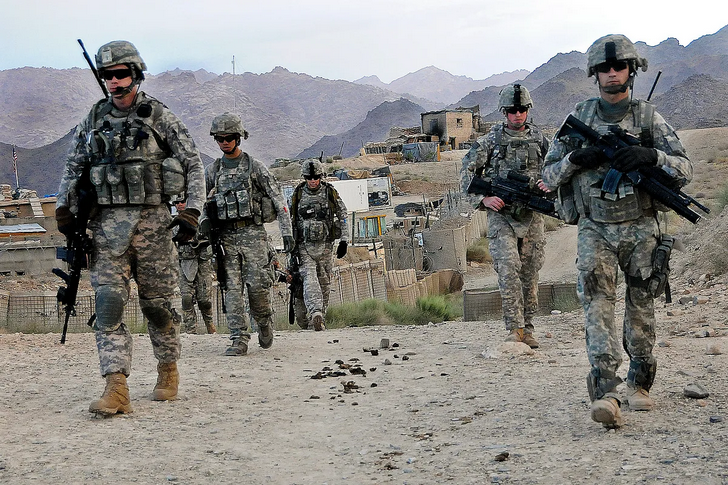
Secretary of Defense Rock identifies where this new military cult came from:
In the decades since the end of the Cold War, the United States military has undergone a cultural transformation — not merely in terms of technology, doctrine, or geopolitical posture, but in its self-conception. What has emerged is a new martial identity, one that fuses an idealized warrior code with fetishized notions of lethality and tactical superiority. This identity, what might be termed an “American Bushido“, is not merely a rhetorical or symbolic phenomenon. It is an ideological formation with material consequences for how wars are planned, how personnel are trained and selected, and how national security strategy is interpreted through the narrow prism of combat prowess. At its core, this American Bushido enshrines tactical skill and lethal capacity as ends in themselves, rather than as tools in service of coherent political objectives. But has also branched out more broadly into American society in unhealthy ways, corroding civic culture. This elevation of the warrior ethos risks distorting strategic judgment, encouraging a professional military caste isolated from civilian oversight, and glorifying violence as the central expression of national power at home and abroad.
The concept of Bushido, the feudal Japanese code of honor among the samurai, was historically a synthesis of martial discipline, spiritual rectitude, and absolute loyalty.1 In the twentieth century, however, Imperial Japan weaponized Bushido as state propaganda stripping it of nuance and repurposing it to justify fanatical nationalism, unquestioning obedience, and mass sacrifice in the service of empire leaving a trail of destruction and war crimes that rivaled Nazi Germany in World War II.2 On the tactical level, that meant banzai charges into machine gun fire and kamikaze missions that turned pilots into human-guided cruise missiles. On the strategic level, that meant one decisive battle that would single-handedly win the war in an era of mass mobilization. In the American context, however, Bushido has been appropriated and reimagined as a branding tool and cultural phenomenon: a way to market military service as a modern warrior whose path translates to all walks of life, stripped of its philosophical depth but saturated with over-the-top aggression.
[…]
In this context, the move toward an AVF, formalized by President Nixon in 1973 and championed by the Gates Commission in 1970, was seen as a political necessity and a strategic recalibration.3 The commission drew a sharp analogy between military service and public infrastructure, framing the draft as a form of taxation in service of national needs. As they put it, “It can expropriate the required tools and compel construction men and others to work until the job is finished or it can purchase the goods and manpower necessary to complete the job.”4 In this view, conscription was not a moral aberration but a practical mechanism through which the state could marshal resources, including human labor, to fulfill collective obligations.5 But this collective obligation had been pushed to the brink, and an all-volunteer force offered a path to professionalize the force, improve quality and morale, and insulate the military from the social upheavals tearing through the nation. Voluntarism was framed as a means of restoring legitimacy and operational effectiveness, ensuring that those who served did so by choice, not coercion. In many ways, voluntarism was a return to the American tradition but did so embracing the concept of the professional soldier and not the citizen soldier. While this shift solved many short-term problems, it also began a long-term process of separating the military from the broader public, contributing to the rise of a distinct warrior class and the cultural isolation of the armed forces from civilian society.
The development of the AVF worked about as one could expect through the 1980s, eventually culminating in the 100-hour war in the Persian Gulf, a campaign that showcased overwhelming American technological and tactical superiority with just 63 American dead.6 In the aftermath, President George H. W. Bush famously proclaimed, “By God, we’ve kicked the Vietnam syndrome once and for all!“7 But while the battlefield triumph seemed to bury the ghosts of Vietnam, the underlying mentality never truly died; it was only displaced. What had definitively died was the draft, and with it, the citizen-soldier model that had once anchored the American military to broader society. In its place emerged an increasingly professionalized force, insulated from the public and shaped by the lessons and traumas of a war that continued to cast a long shadow over American strategy, civil-military relations, and the political appetite for sustained conflict.
GWOT has accelerated American Bushido
The U.S. military’s post-9/11 transformation unwittingly accelerated this. Terms like “warfighter”, “operator”, and “lethality” replaced earlier bureaucratic or strategic vocabulary. Secretary of Defense Jim Mattis, nicknamed “Mad Dog” and revered for his battle-hardened persona, became the symbolic vanguard of this transformation. Phrases such as “unleash lethality” began appearing in speeches, documents, and strategic vision statements.8 Underlying all of this was a single premise: that the decisive instrument of American power was the warrior, and that the ultimate measure of military effectiveness is the capacity to kill.9
There is no doubt that tactical excellence is a prerequisite for military success, and nobody has done it better than the modern American military. But the rise of American Bushido has elevated tactical proficiency to the level of doctrine itself, often at the expense of strategic clarity. This phenomenon is not unique to the U.S., but it is particularly acute within a military-industrial ecosystem flush with funding, prestige, and cultural deference. The result has been a proliferation of elite units, special operations forces, and kinetic capabilities, often deployed with great fanfare but little discernible strategic gain, as given by the recent two-billion-dollar campaign attempting to pound the Houthis into submission in Yemen from the air.
[…]
Even still, it’s a bizarre framing because there never was a “warrior ethos” in the American tradition to nostalgically return to, at least not in the mythologized sense currently being invoked. The foundational ideal of national defense was not the professional warrior, but the citizen-soldier: an ordinary individual who took up arms out of civic duty, served for a finite period, and then returned to civilian life. Soldiering, in this tradition, was a temporary obligation, not a permanent identity. It was a job — necessary and honorable, but not meant to confer moral superiority or define a lifelong caste. Only a small number of officers and NCOs were considered to be professionals who led a variety of militia and volunteers in American conflicts.
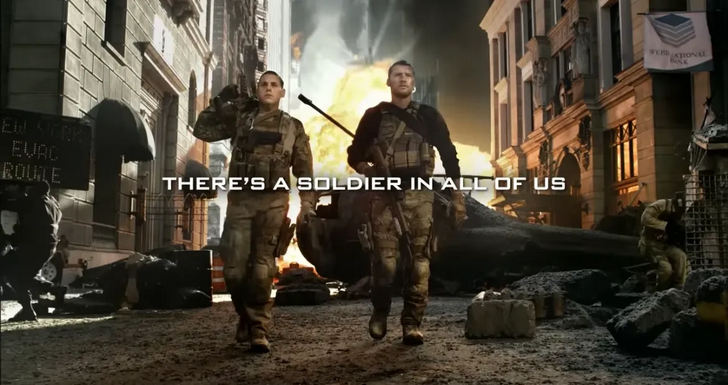
One might mistake the famous Call of Duty tagline “there’s a soldier in all of us”, as a manifestation of American Bushido. But in truth, it gestures toward the opposite. The commercial depicts ordinary people stepping briefly into a role demanded by extraordinary circumstances, the very ethos of the citizen-soldier tradition. However stylized or commercialized, the message remains: soldiering is not a sacred vocation reserved for an elite few, but a responsibility that can emerge from within the ordinary citizen. In that sense, there is a soldier in all of us.
1. See Inazō Nitobe, Bushido: The Soul of Japan (1900), Cameron Hurst, “Death, Honor, and Loyalty: The Bushidō Ideal”. Philosophy East and West 40, no. 4 (1990): 511–27. Tasuke Kawakami, “BUSHIDŌ IN ITS FORMATIVE PERIOD”. The Annals of the Hitotsubashi Academy 3, no. 1 (1952): 65–83, Karl F. Friday, “Bushidō or Bull? A Medieval Historian’s Perspective on the Imperial Army and the Japanese Warrior Tradition”. The History Teacher 27, no. 3 (1994): 339–49, and Stephen Turnbull, The Samurai and the Sacred (Osprey Publishing: Oxford, 1999).
2. For Bushido in the Imperial Japanese context, see John W. Dower, War Without Mercy: Race & Power in the Pacific War (Pantheon Books: New York, 1986), Edward J. Drea, Japan’s Imperial Army: Its Rise and Fall (University Press of Kansas: Lawrence, 2016, S. C. M. Paine, The Japanese Empire: Grand Strategy from the Meiji Restoration to the Pacific War (Cambridge University Press: Cambridge, 2017) The Wars for Asia, 1911–1949, (Cambridge University Press: Cambridge, 2012), and Robert Edgerton, Warriors Of The Rising Sun: A History Of The Japanese Military (Basic Books: New York, 1999).
3. Thomas S. Gates, The Report of the President’s Commission on an All-Volunteer Armed Force (Washington, DC: U.S. Government Printing Office, 1970).
4. Ibid., 23.
5. Milton Friedman, the 1976 Nobel Prize-winning economist, played a pivotal role on the Commission, where his influential intellectual arguments helped overcome the significant institutional resistance.
6. For scholarship on the military’s post-Vietnam recovery and AVF transition, see James F. Dunnigan, Raymond M. Macedonia, Getting It Right: American Military Reforms After Vietnam to the Gulf War and Beyond (William Morrow & Co: New York, 1993) and Suzanne C. Nielsen Lieutenant Colonel, An Army Transformed: The U.S. Army’s Post-Vietnam Recovery and the Dynamics of Change in Military Organizations (US Army War College Press: Carlisle, 2010).
7. Quoted from Maureen Dowd, “After the War: White House Memo; War Introduces a Tougher Bush to Nation”, New York Times, March 2, 1991.
8. U.S. Department of Defense, Summary of the 2018 National Defense Strategy of the United States of America (Washington, DC: DoD, 2018), 1.
9. The emphasis on the warrior ethos was set in motion in part because the events of March 23, 2003, when an 18-vehicle convoy from the 507th Maintenance Company took a wrong turn and was ambushed by insurgents in Nasiriyah, southern Iraq. See Vernon Loeb, “Army Plans Steps to Heighten ‘Warrior Ethos'”, Washington Post, September 8, 2003.
May 11, 2025
Why Yugoslavia Fell in Just 11 Days?
World War Two
Published 10 May 2025In this Fireside Chat, Indy and Sparty answer questions on the German invasions of Yugoslavia and Greece. Why did the Yugoslav state fall so quickly? Why were the Greeks able to hold out so much better? And why was the airborne assault on Crete so chaotic on both sides?
(more…)
May 8, 2025
Dambusters – Was It Worth It?
HardThrasher
Published 5 May 2025The third and final part in a series on the Dambusters Raid; looking at the attacks themselves and their aftermath
(more…)
May 3, 2025
Development of the Uzi Family: Standard, Mini, and Micro
Forgotten Weapons
Published 4 Jan 2025The Uzi was originally designed in the 1950s, and it was on the technological cutting edge at the time. The stamped receiver, telescoping bolt, and compact magazine-in-grip layout made it an inexpensive and effective weapon. Its sedate 600 round/minute rate of fire helped as well, making it easy to shoot effectively. Uziel Gal experimented with a compact version at that time, but dropped the idea when he proved unable to make a smaller version with the same low rate of fire as the standard pattern.
Fast forward to the late 1970s, and the designers at IMI revisited the idea of a compact Uzi. They were willing to accept the increased rate of fire of a shorter receiver and lighter bolt, and their first prototypes were ready in 1978. full export sales began in 1980. The gun was advertised as having a 900 rpm rate of fire, but the reality was much higher.
The final step of classic Uzi development was the Micro Uzi, introduced in 1986. This was actually developed form the semiautomatic, closed-bolt Uzi Pistol made for American commercial sales. That pistol was given a select-fire trigger group and a folding stock, and it became a micro-compact submachine gun for only the most tactical of operators. It was advertised as having a 1200 rpm rate of fire, but this was again underestimated to improve sales.
In reality, the standard Uzi does fire at about 600 rpm. The Mini (in closed-bolt form) ran at 1300+ in my testing at S&B, and the Micro was over 1400 rpm. Where the original Uzi is best kept in fully automatic mode and can easily fire single shots when desired, the Mini and Micro Uzis are definitely best suited to semiautomatic use. Firing them in fully automatic is a much more difficult proposition if one wants to maintain any level of accuracy and situational awareness.
Thanks to Sellier & Bellot for giving me access to this set of Uzis to film for you!
(more…)
May 1, 2025
Military Tactics In The Falklands
Pegasus Tests
Published 27 Dec 2024A discussion with Ian McCollum of Forgotten Weapons about Argentine and British tactics during the Falklands War.
#forgottenweapons
April 19, 2025
Dambusters – Part 2 – The Countdown to the Raid
HardThrasher
Published 17 Apr 2025The speed with which a theory had to be put into practice, and the opening phase of the raid itself.
(more…)
April 11, 2025
Beretta 93R: The Best Machine Pistol?
Forgotten Weapons
Published 13 Dec 2024The Beretta 93R (“Raffica”) was developed in the 1970s by Beretta engineer Paolo Parola at the request of Italian military special forces. It took the basic Beretta 92 pistol design and added a well-thought-out burst mechanism under the right-side grip panel. It does not have a plain full-auto setting, but only semiauto and 3-round burst. To help keep the gun controllable, it has a heavier slide to reduce cyclic rate, a detachable shoulder stock, and a folding front grip to help control the muzzle. It uses extended 20-round magazines and is actually remarkably controllable (or so I am told; I have not had a chance to shoot one myself).
(more…)


