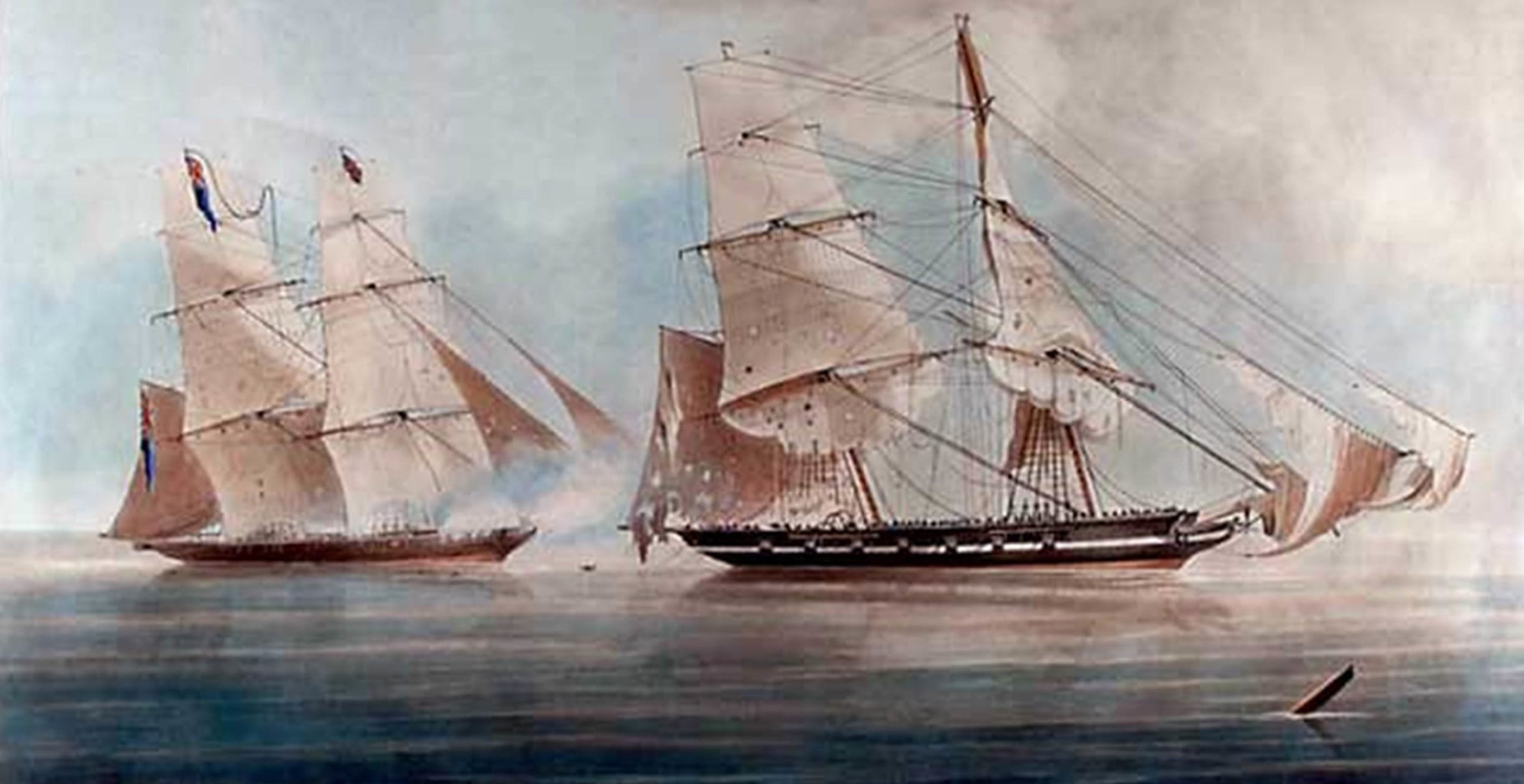
“What Wilberforce vanquished was something even worse than slavery,” says [Eric] Metaxas [in Amazing Grace], “something that was much more fundamental and can hardly be seen from where we stand today: he vanquished the very mindset that made slavery acceptable and allowed it to survive and thrive for millennia. He destroyed an entire way of seeing the world, one that had held sway from the beginning of history, and he replaced it with another way of seeing the world.” Ownership of existing slaves continued in the British West Indies for another quarter-century, and in the United States for another 60 years, and slave trading continued in Turkey until Atatürk abolished it in the Twenties and in Saudi Arabia until it was (officially) banned in the Sixties, and it persists in Africa and other pockets of the world to this day. But not as a broadly accepted “human good”.
There was some hard-muscle enforcement that accompanied the new law: the Royal Navy announced that it would regard all slave ships as pirates, and thus they were liable to sinking and their crews to execution. There had been some important court decisions: in the reign of William and Mary, Justice Holt had ruled that “one may be a villeyn in England, but not a slave,” and in 1803 William Osgoode, Chief Justice of Lower Canada, ruled that the institution was not compatible with the principles of British law. But what was decisive was the way Wilberforce “murdered” (in Metaxas’ word) the old acceptance of slavery by the wider society. As he wrote in 1787, “God almighty has set before me two great objects: the suppression of the slave trade and the reformation of manners”.
The latter goal we would now formulate as “changing the culture” — which is what he did. The film of Amazing Grace shows the Duke of Clarence and other effete toffs reeling under a lot of lame bromides hurled by Wilberforce on behalf of “the people”. But, in fact, “the people” were a large part of the problem. Then as now, citizens of advanced democracies are easily distracted. The 18th-century Church of England preached “a tepid kind of moralism” disconnected both from any serious faith and from the great questions facing the nation. It was a sensualist culture amusing itself to death: Wilberforce goes to a performance of Don Juan, is shocked by a provocative dance, and is then further shocked to discover the rest of the audience is too blasé even to be shocked. The Paris Hilton of the age, the Prince of Wales, was celebrated for having bedded 7,000 women and snipped from each a keepsake hair. Twenty-five per cent of all unmarried females in London were whores; the average age of a prostitute was 16; and many brothels prided themselves on offering only girls under the age of 14. Many of these features — weedy faint-hearted mainstream churches, skanky celebs, weary provocations for jaded debauchees — will strike a chord in our own time.
“There is a great deal of ruin in a nation,” remarked Adam Smith. England survived the 18th century, and maybe we will survive the 21st. But the life of William Wilberforce and the bicentennial of his extraordinary achievement remind us that great men don’t shirk things because the focus-group numbers look unpromising. What we think of as “the Victorian era” was, in large part, an invention of Wilberforce which he succeeded in selling to his compatriots. We, children of the 20th century, mock our 19th-century forebears as uptight prudes, moralists and do-gooders. If they were, it’s because of Wilberforce. His legacy includes the very notion of a “social conscience”: in the 1790s, a good man could stroll past an 11-year-old prostitute on a London street without feeling a twinge of disgust or outrage; he accepted her as merely a feature of the landscape, like an ugly hill. By the 1890s, there were still child prostitutes, but there were also charities and improvement societies and orphanages. It is amazing to read a letter from Wilberforce and realize that he is, in fact, articulating precisely 220 years ago what New Yorkers came to know in the Nineties as the “broken windows” theory: “The most effectual way to prevent greater crimes is by punishing the smaller.”
Mark Steyn, The [Un]documented Mark Steyn, 2014.
July 19, 2025
QotD: William Wilberforce and the anti-slavery movement
July 16, 2025
QotD: Slavery in history
The British Empire’s principal association with slavery is that it abolished it. Until William Wilberforce, the British Parliament and the brave men of the Royal Navy took up the issue, slavery was an institution regarded by all cultures around the planet as a constant feature of life … Britain expunged it from most of the globe.
It is pathetic but unsurprising how ignorant all these brave “anti-fascists” are. Yet there is a lesson here not just for Britain but for America, too: when a society loses its memory, it descends inevitably into dementia.
Mark Steyn, After America: Get Ready for Armageddon, 2011.
June 24, 2025
“Britain’s bill for Caribbean slavery comes to £19 trillion – fifteen times the current annual budget of the UK government”
The demands for reparations for historic wrongs will continue to grow, but the chances of any of the hustlers making the demands are remarkably slim, and thank goodness for that, because if the principle ever gets established we’ll be on a never-ending beggar-my-neighbour jag:
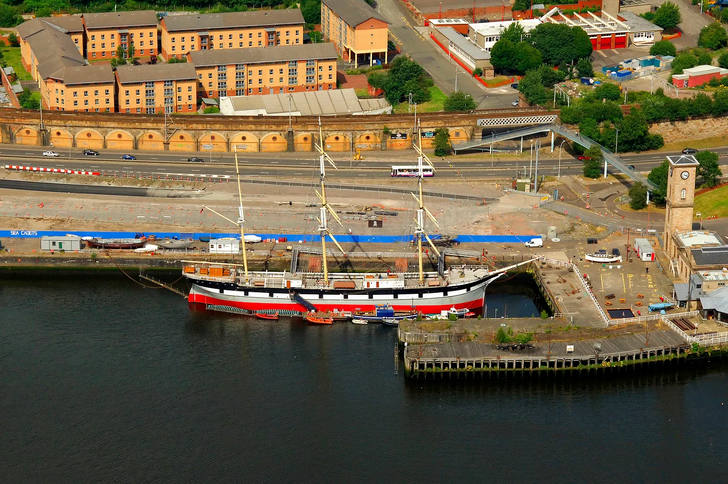
Britain’s bill for Caribbean slavery comes to £19 trillion — fifteen times the current annual budget of the UK government — according to the 2023 Brattle Report. And if the “Glasgow — City of Empire” display at the Kelvingrove Museum is anything to go by, Scotland owns a large share of that, since Glasgow was “one of the major port cities” involved in the slave-trade, whose profits played “a crucial role” in its economic development and prosperity.
The debt-collectors are already knocking at the door. In March 2023, Clive Lewis, MP and shadow Foreign Secretary under Jeremy Corbyn, called for the UK government to start “meaningful negotiations” over reparations with Caribbean countries. The following autumn, Lewis’s parliamentary office became the centre of a reparations-campaign, funded by Irish billionaire Denis O’Brien. And in April this year, Sir Keir Starmer received the Prime Minister of Barbados, Mia Mottley, into No. 10. “We’ve known each other many years as good colleagues and now as leaders who think alike”, said Starmer. Mottley has stated that Britain owes Barbados £3.9 trillion and it was she who pushed for reparations onto the agenda of the Commonwealth Heads of Government summit last year.
But the case for reparations doesn’t add up. Yes, some Britons were involved in inhumane slave-trading and slavery, mainly from about 1650 to the early 1800s, when they transported over 3.2 million slaves from Africa to the Americas. Yet, while campaigners portray British involvement as uniquely dreadful. It wasn’t.
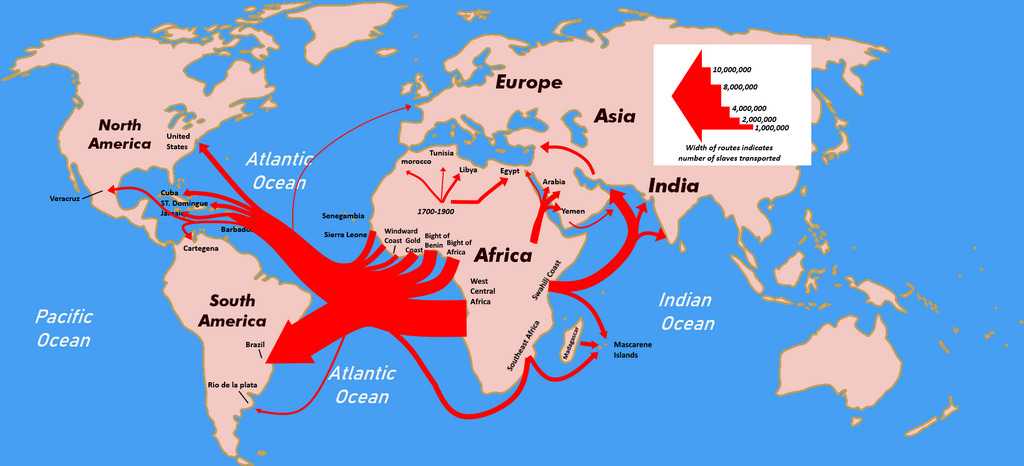
Up until the end of the 18th century AD slavery and slave-trading were universal institutions, practised since the dawn of time on every continent by peoples of every skin colour. In North America, indigenous societies in the Pacific North-West were built on slave-labour, since subsistence required the rapid processing of salmon, and the quantity of work outstripped the supply of female labour. So, raiding for slaves was endemic. Thousands of miles to the south, the Comanche ran “the largest slave economy” in the 1700s — according to Oxford’s Pekka Hämäläinen. Meanwhile, on the other side of the Atlantic, Arabs had been busy slave-raiding and -trading since at least the 7th century AD. According to one authority, the Muslim trade transported 17 million slaves mainly from Africa, but also from Europe, to the southern and eastern coasts of the Mediterranean. This is one context out of which reparations-advocates like to abstract British slavery.
Another is African complicity. British slave-ships off the coast of West Africa didn’t have to raid inland to obtain their slaves. They just waited on the coast for them to be brought. Africans had been busy enslaving and trading other Africans for centuries, first to the Romans, then to the Arabs, and finally to the Europeans. As early as 1550 the Kingdom of the Kongo was exporting up to 8,000 African slaves annually to the Portuguese.
The final context that campaigners studiously ignore is the fact that Britain was among the first states in the history of the world to abolish slave-trading (in 1807) and slavery (in 1833) throughout its territories. It then used its dominant power to suppress both slave-trading and slavery from Brazil, across Africa and India, to New Zealand for the second half of the British Empire’s life. In the 1820s and ’30s, the Slave Trade Department was the Foreign Office’s largest unit. By mid-century the Royal Navy was devoting over 13 per cent of its total manpower to stopping transatlantic slave-trading. The cost of this alone to British taxpayers was at least the equivalent of up to £1.74 billion today or 12.7 per cent of the UK’s current expenditure on development aid — for half a century. According to the eminent historian, David Eltis, the nineteenth-century costs of slavery-suppression exceeded the eighteenth-century benefits.
The West Africa Squadron, which freed 150,000 African slaves.
May 8, 2025
QotD: Trade empires
The final (and possibly ultimate) sort of empire is the Trade Empire. These develop more because exploring traders have a need for safe bases and secure lines of communication to make their trade work. Theoretically trade empires could be land based (and both the American West and the Chinese spread down the Silk Road argue the case that they started as trade security rather than conquest … no matter how they finished). But in reality the main cause of and reason for trade empires is the development of water transport. Specifically ocean transport.
So let us consider the motives of Empire in a few cases.
The Phoenicians had a magnificent trade empire, though with a few elements we find familiar from the more recent Viking version, or indeed the Venetian “Republic” — namely a bit of raiding, and quite a bit of slave trading. All three broadened into a bit of conquest — Carthage, Normandy and the sack of Constantinople in the 4th Crusade come to mind — but all those offshoots were by-products of the original cultures, and none of them became the norm for the ongoing home culture (each of which faded away as circumstances changed and they failed to adapt). So we could say that they were essentially trading empires.
Greece and Carthage and Rome were also trade empires, initially letting their security concerns drag them into a bit of conquest on the side. The difference in their cases was that the conquest element became dominant and completely changed the “homeland”. The city states of Greece becoming the world-conquering hordes of Alexander, and completely undermining the vibrant city state cultures that had proceeded them. The Phoenician trading city of Carthage becoming an expansionary conquest state that eventually pushed Rome too hard. And Rome’s overseas campaigns in Spain and North Africa completely undermining the independent farmer/citizen/soldier class of the Roman Republic, and replacing them with a system of professional troops whose loyalty could only be bought by ever increasing conquests by the emperors.
Naturally every expansion eventually reaches limits, and the concern reverts to trying to secure what you have, and hold the outsiders further away. Which is why, amusingly, people like the Romans and the Chinese came through their expansionary conquest phase, and then found themselves back in the position of having to protect the fringes through deals with tribes that can be traded with/employed by/or paid tribute. Cue Attila the Hun and his ilk.
So empires on the way down may also be considered trade and security empires I suppose, though many still had a conquest impulse (for fame or fortune or simply to pay the defenders off) built in, or tried to act as if they were still conquering hordes. Cue Constantinople and Belisarius.
In fact most empires will go through a variety of stages, though I think it fair to say that most empires have a core purpose and attitude, no matter how they tinker at the edges to deal with specific circumstances.
Nigel Davies, “Types of Empires: Security, Conquest, and Trade”, rethinking history, 2020-05-02.
April 7, 2025
QotD: The new Neolithic agrarian villages allowed for the development of the parasitic state
… despite all these drawbacks, people whose distant ancestors had enjoyed the wetland mosaic of subsistence strategies were now living in the far more labor-intensive, precarious confines of the Neolithic village, where one blighted crop could spell disaster. And when disaster struck, as it often did, the survivors could melt back into the world of their foraging neighbors, but slow population growth over several millennia meant that those diverse niches were full to the bursting, so as long as more food could be extracted at a greater labor cost, many people had incentive to do so.
And just as this way of life — [Against the Grain author James C.] Scott calls it the “Neolithic agro-complex”, but it’s really just another bundle of social and physical technologies — inadvertently created niches for the weeds that thrive in recently-tilled fields1 and the fleas that live on our commensal vermin, it also created a niche for the state. The Neolithic village’s unprecedented concentration of manpower, arable land, and especially grain made the state possible. Not that the state was necessary, mind you — the southern Mesopotamian alluvium had thousands of years of sedentary agriculturalists living in close proximity to one another before there was anything resembling a state — but Scott writes that there was “no such thing as a state that did not rest on an alluvial, grain-farming population”. This was true in the Fertile Crescent, it was true along the Nile, it was true in the Indus Valley, and it was true in the loess soils of “Yellow” China.2 And Scott argues that it’s all down to grain, because he sees taxation at the core of state-making and grain is uniquely well-suited to being taxed.
Unlike cassava, potatoes, and other tubers, grain is visible: you can’t hide a wheatfield from the taxman. Unlike chickpeas, lentils, and other legumes, grain all ripens at once: you can’t pick some of it early and hide or eat it before the taxman shows up. Moreover, unhusked grain stores particularly well, can be divided almost infinitely for accounting purposes (half a cup of wheat is a stable and reliable store of value, while a quarter of a potato will rot), and has a high enough value per unit volume that it’s economically worthwhile to transport it long distances. All this means that sedentary grain farmers become taxable in a way that hunter-gatherers, nomadic pastoralists, swiddeners, and other “nongrain peoples” are not, because you know exactly where to find them and exactly when they can be expected to have anything worth taking. And then, of course, you’ll want to build some walls to protect your valuable grain-growing subjects from other people taking their grain (and also, perhaps, to keep them from running for the hills), and you’ll want systems of measurement and record-keeping so you know how much you can expect to get from each of them, and pretty soon, hey presto! you have something that looks an awful lot like civilization.
The thing is, though, that Scott doesn’t think this is an improvement. It certainly wasn’t an improvement for the new state’s subjects, who were now forced into backbreaking labor to produce a grain surplus in excess of their own needs (and prevented from leaving their work), and it wasn’t an improvement for the non-state (or, later, other-state) peoples who were constantly being conquered and relocated into the state’s core territory as new domesticated subjects to be worked just like its domesticated animals. In fact, he goes so far as to suggest that our archaeological records of “collapse” — the abandonment and/or destruction of the monumental state center, usually accompanied by the disappearance of elites, literacy, large-scale trade, and specialist craft production — in fact often represent an increase in general human well-being: everyone but the court elite was better off outside the state. “Collapse”, he argues, is simply “the disaggregation of a complex, fragile, and typically oppressive state into smaller, decentralized fragments”. Now, this may well have been true of the southern Mesopotamian alluvium in 3000 BC, where every statelet was surrounded by non-state, non-grain peoples hunting and fishing and planting and herding, but it’s certainly not true of a sufficiently “domesticated” people. Were the oppida Celts, with their riverine trading networks, better off than their heavily urbanized Romano-British descendants? Well, the Romano-Britons had running water and heated floors and nice pottery to eat off of and Falernian wine to drink, but there’s certainly a case to be made that these don’t make up for lost freedoms. But compare them with the notably shorter and notably fewer involuntarily-rusticated inhabitants of sub-Roman Britain a few hundred years later and even if you don’t think running water is worth much (you’re wrong), you have to concede that the population nosedive itself suggests that there is real human suffering involved in the “collapse” of a sufficiently widespread civilization.3
But even this is begging the question. We can argue about the relative well-being of ordinary people in various sorts of political situations, and it’s a legitimately interesting topic, both in what data we should look at — hunter-gatherers really do work dramatically less than agriculturalists4 — and in debating its meaning.5 And Scott’s final chapter, “The Golden Age of the Barbarians”, makes a pretty convincing case that they were materially better off than their state counterparts, especially once the states really got going and the barbarians could trade with or raid them to get the best of both worlds! But however we come down on all these issues, we’re still assuming that the well-being of ordinary people — their freedom from labor and oppression, their physical good health — is the primary measure of a social order. And obviously it ain’t nothing — salus populi suprema lex and so forth — but man does not live by
breada mosaic of non-grain foodstuffs alone. There are a lot of important things that don’t show up in your skeleton! We like civilization not because it produces storehouses full of grain and clay tablets full of tax records, but because it produces art and literature and philosophy and all the other products of our immortal longings. And, sure, this was largely enabled by taxes, corvée labor, conscription, and various forms of slavery, but on the other hand we have the epic of Gilgamesh.6 And obviously you don’t get art without civilization, which is to say the state. Right?Jane Psmith, “REVIEW: Against the Grain, by James C. Scott”, Mr. and Mrs. Psmith’s Bookshelf, 2023-08-21.
1. Oats apparently began as one of them!
2. It was probably also true in Mesoamerica and the Andes, where maize was the grain in question, but Scott doesn’t get into that.
3. No, the population drop cannot be explained by all the romanes eunt domus.
4. That famous “twenty hours a week” number you may have heard is bunk, but it’s really only about forty, and that includes all the housekeeping, food preparation, and so forth that we do outside our forty-hour workweeks.
5. For example, does a thatched roof in place of ceramic tiles represent #decline, or is it a sensible adaptation to more local economy? Or take pottery, which is Bryan Ward-Perkins’s favorite example in his excellent case that no really, Rome actually did fall: a switch in the archaeological record from high-quality imported ceramics to rough earthenwares made from shoddy local clays is definitely a sign of societal simplification, but it isn’t prima facie obvious that a person who uses the product of an essentially industrial, standardized process is “better off” than someone who makes their own friable, chaff-tempered dishes.
6. Or food rent and, uh, all of Anglo-Saxon literature, whatever.
April 6, 2025
Judgement Day at Nuremberg: Hitler’s Butchers Meet Their Fate
World War Two
Published 5 Apr 2025The Nuremberg Trials begin. Twenty-four of Hitler’s closest Nazi allies face judgment for crimes of aggressive war, mass enslavement, and genocide. At stake is more than justice for the dead; it’s the birth of a new legal order. We examine the trials, the accused, and whether Nuremberg delivered justice or simply vengeance.
(more…)
March 14, 2025
Firefly and the Lost Cause
Feral Historian
Published 8 Nov 2024I’ve often been questioned for making Civil War comparisons when discussing Firefly. Here I explain why Firefly not only reflects but is based on the Lost Cause mythology of the Confederacy.
For further background on how secession was framed at the start of the American Civil War, battlefields.org has plain text copies of several of the Confederate States’ declarations of causes for secession up at https://www.battlefields.org/learn/pr…. You can see how slavery is mentioned a lot, but often framed in terms of the second-order effects of Northern policy damaging their economy, infringing on sovereignty, etc. It varied by state of course, Virginia kept it vague with references to the Federal government “perverting said powers” granted it, while Mississippi was very clear about slavery being the cause.
00:00 Intro
01:12 The Lost Cause
03:27 Selling the Peace
05:28 Causes
06:59 Firefly as a Lost Cause
March 6, 2025
Passionate belief in historical untruths
As mentioned in earlier posts, one of the most toxic exports from Australia to the rest of the Anglosphere has been the academic indulgence in believing that “settler colonialism” explains everything about the history of Canada, Australia, New Zealand and anywhere else the British diaspora touched:
Throughout the English-speaking world elites are falling over themselves to believe the very worst of their own countries.
In Britain, the Church of England has committed itself to spend an initial £100 million on slavery-reparations in response to the discovery that its endowment had “links” with African enslavement. “The immense wealth accrued by the Church … has always been interwoven with the history of African chattel enslavement”, a document explains. “African chattel enslavement was central to the growth of the British economy of the 18th and 19th centuries and the nation’s wealth thereafter”. And this has “continuing toxic consequences”.
Yet almost none of this is true. The evidence shows that the Church’s endowment fund was hardly involved in the evil of slave-trading at all. Most economic historians reckon the contribution of slave-trading and slavery to Britain’s economic development as somewhere between marginal and modest. And between abolition in 1834 and the present, multiple causes have intervened to diminish slavery’s effects.
Consonant with his church’s policy, the (then) Archbishop of Canterbury, Justin Welby preached a sermon in Christ Church Cathedral, Zanzibar last year, in which he criticised Christian missionaries for treating Africans as inferior and confessed that “we [British] must repent and look at what we did in Zanzibar”.
Really? What the British did in Zanzibar during the second half of the 19th century was to force the Sultan to end the slave-trade. Indeed, the cathedral in which the archbishop was preaching was built over the former slave-market. And here’s what the pioneering missionary David Livingstone wrote about black Africans in 1871: “I have no prejudice against [the Africans’] colour; indeed, anyone who lives long among them forgets they are black and feels that they are just fellow men…. If a comparison were instituted, … I should like to take my place among [them], on the principle of preferring the company of my betters”.
[…]
St. John Baptiste church was one of many local churches to go up in flames during Justin Trudeau’s performative national guilt trip over “unmarked mass graves” at former Residential Schools across Canada.
Which bring us to Canada. The May 2021 claim by a Kamloops Indian band to have discovered the remains of 215 “missing children” of an Indian Residential School was quickly sexed up by the media into a story ‘mass graves’, with all its connotation of murderous atrocity. The Toronto Globe and Mail published an article under the title, “The discovery of a mass gravesite at a former residential school in Kamloops is just the tip of the iceberg”, in which a professor of law at UBC wrote: “It is horrific … a too-common unearthing of the legacy, and enduring reality, of colonialism in Canada”. Prime Minister Justin Trudeau ordered Canadian flags to be flown at half-mast on all federal buildings to honour the murdered children. Because the Kamloops school had been run by Roman Catholics, some zealous citizens took to burning and vandalising churches, 112 of them to date. The dreadful tale was eagerly broadcast worldwide by Al Jazeera.
Yet, four years later, not a single set of remains of a murdered Indian child in an unmarked grave has been found anywhere in Canada. Judging by the evidence collected by Chris Champion and Tom Flanagan in their best-selling 2023 book, Grave Error: How the Media Misled us (and the Truth about the Residential Schools), it looks increasingly probable that the whole, incendiary story is a myth.
So, prime ministers, archbishops, academics, editors, and public broadcasters are all in the business of exaggerating the colonial sins of their own countries against noble (not-so-very) savages — from London to Sydney to Toronto. Why?
February 10, 2025
Everyday Life in the Roman Empire – The Position of Women
seangabb
Published 11 Sept 2024Part five in a series on Everyday Life in the Roman Empire, this lecture discusses the position of women during the Imperial period. Here is what it covers:
Introduction – 00:00:00
Limited Rights for the Lower Classes (95 per cent) – 00:02:02
Rome: The Patria Potestas – 00:07:02
Rome: Marriage – 00:13:05
Rome: Education of Girls – 00:18:40
Rome: Woman and Business – 00:22:11
Rome: Women and Politics – 00:30:07
Rome: Women Gladiators? – 00:33:30
The Empresses – 00:35:20
Agrippina the Younger – 00:39:36
Women: Rome and Athens Compared – 00:41:38
Evidence from Egypt – 00:46:22
Women Priests and Bishops in the Early Church? – 00:53:43
Women in Britain – 01:02:00
Bibliography – 01:05:20
(more…)
December 16, 2024
The academic battle over the legacy of the British Empire
In the Washington Examiner, Yuan Yi Zhu reviews The Truth About Empire: Real histories of British Colonialism edited by Alan Lester:
… the story fitted awkwardly with the new dominant historical narrative in Britain, according to which the British Empire was an unequivocally evil institution whose lingering miasma still corrupts not only its former territories but also modern-day Britain.
When Kipling lamented, “What do they know of England, who only England know?” he was not being elegiac as much as describing a statistical fact. Contrary to modern caricatures, apart from episodic busts of enthusiasm, Britons were never very interested in their empire. At its Victorian peak, the great public controversies were more likely to be liturgical than imperial. In 1948, 51% of the British public could not name a single British colony; three years later, the figure had risen to 59%. Admittedly, this was after Indian independence, but it should not have been that hard. Proponents of the “imperial miasma” theory are right in saying that British people are woefully ignorant about their imperial past; but that was the case even when much of the world was colored red.
The Truth About Empire: Real Histories of British Colonialism is a collection of essays edited by Alan Lester, an academic at the University of Sussex who has been at the forefront of the cultural conflict over British imperialism on the “miasma” side — though, like all combatants, he denies being a participant. Indeed, one of the book’s declared aims is to show that its contributors are not engaged in cultural warring.
Their nemesis, whose name appears 376 times in this book (more often than the word “Britain”) is Nigel Biggar, a retired theologian and priest at the University of Oxford. In 2017, Biggar began a project to study the ethics of empire alongside John Darwin, a distinguished imperial historian. The now-familiar academic denunciations then came along, and Darwin, on the cusp of a quiet retirement, withdrew from the project.
Lester was not part of the initial assault on Biggar but has since then emerged as his most voluble critic. He disclaims any political aims, protesting that he and his colleagues are engaged in a purely scholarly enterprise, based on facts and the study of the evidence.
Yet some of Lester’s public interventions — he recently described a poll showing that British people are less proud of their history than before as an “encouraging sign” — are hard to square with this denial. Biggar, by contrast, is refreshingly honest that his aims are both intellectual and political. I must add that both men are serious scholars, which is perhaps why neither has been able to decisively bloody the other in their jousts.
[…]
“What about slavery?” asks Dubow’s Cambridge colleague Bronwen Everill. Unfortunately, her four pages, which read like a last-minute student essay, do not enlighten us. The most she can manage is to point to an 18th-century African monarch abolishing the slave trade as evidence that the British do not deserve any plaudits for their abolitionist efforts across the world, whose cost has been estimated at 1.8% of its gross domestic product over a period of 60 years.
Meanwhile, Abd al Qadir Kane, Everill’s abolitionist monarch, only objected to the enslavement of Muslims but not to slavery generally, his progressive reputation resting mainly on the misunderstandings of Thomas Clarkson, an overenthusiastic English abolitionist. (Either cleverly or lazily, Everill quotes Clarkson’s misleading account, thus avoiding the need to engage with the historiography on Islamic slavery in Africa.)
Everill’s central argument is that abolitionism allowed Britain to rove the world as a moral policeman and to overthrow rulers who refused to abolish slavery. It is never clear, however, why this was morally bad. If anything, Britain did not go far enough: Well into the 1960s, British representatives still manumitted slaves on an ad hoc basis in its Gulf protectorates, when the moral thing would have been to force their rulers to abolish slavery, at gunpoint if necessary.
December 15, 2024
“Outside Sub-Saharan Africa, Homo sapiens are vermin, in the Australian sense — an introduced species with no co-evolved local predators”
You have to admit that Lorenzo Warby has a way with words to introduce a new essay, yes?
Outside Sub-Saharan Africa, Homo sapiens are vermin, in the Australian sense — an introduced species with no co-evolved local predators. That means that their strongest selection pressures — both genetic and cultural — have almost always been about dealing with other humans.
We are the cultural species par excellence. Cultures can be reasonably thought of as collections of life-strategies. Culture tends to be persistent — aspects of culture can be highly persistent.
It is worth keeping in mind that genetic selection can occur surprisingly quickly — i.e., in a relatively short number of generations, depending on the intensity of the selection pressures. A very clear example of this is the evolution of lactase persistence in pastoralist, or agro-pastoralist, populations. (The decades-long experiment in domesticating silver foxes is an extreme example.)
The great advantage of cultural selection is that it is faster than genetic selection but culture still has to show some “stickiness”, some persistence, to be useful. Especially in the evolution of signals, norms and social strategies.
The regions where the local physical environment has been successfully managed longest — or most thoroughly — are Europe, particularly North-West Europe, East Asia and India (especially by high-jati Indians). So, those are the areas where natural and cultural selection has been most focused on selection for dealing usefully with other humans. Those populations have also been the most successful in dealing with the modern world, wherever they go. This hardly seems a coincidence.
The regions where dealing with the local physical environment has been most salient are Sub-Saharan Africa — all those co-evolved parasites, pathogens, predators and mega-herbivores — and Australia — which is full of deserts and spiky things likely to poison you. Much of Africa is also semi-desert forager lands, while the tsetse fly stopped the central African plains generating the equivalent of the connecting — for good or ill — pastoralist cultures of the Eurasian steppes. Both continental-scale regions therefore historically had low human population densities.
The consequence in Africa was that Sub-Saharan Africa has, for millennia, been a region of endemic slavery. Labour was more valuable than land, which led — as it usually did historically — to labour bondage: the violent/coercive extraction of labour’s scarcity value. In this case, the low population density meant that folk were regularly seized and transported, thus requiring the level of domination for folk to be moved at will — i.e., slavery rather than some form of serfdom.
Increased selection to deal with the physical environment meant comparatively less selection to deal with other humans. Sub-Saharan African and Australian Aboriginal populations have been rather less successful at dealing with the modern world than have other populations. (Claims about the success of recent African immigrants seem to be overstated.) The key element of the modern world is domination of social outcomes by human interactions to the greatest extent yet achieved in history. Again, that relative lack of success hardly seems like a coincidence.
Yes, it is true that selection for transportation across the Atlantic as slaves was negative in all sorts of senses. The churn of slavery massively undermined cultural transmission, the selection was for physical robustness and, if anything, against executive functions (which are highly heritable). Nevertheless, with the partial exception of recent African immigrants — who are selected for initiative and education — both populations have been markedly less successful than other groups.
There are certainly factors which affect that either way. Not inflicting on Australian Aborigines the dual metabolic disasters of the farming and processed-food revolutions at the same time would be good. Not under-policing the localities in which folk live is also good.
Nevertheless, there is no reason to think that capacities — which are a genetic, epigenetic and cultural matter — will be evenly distributed across all populations. Indeed, we have very good reasons to think that that will not be the case, due to the variations in selection pressures — whether genetic, environmental or cultural, including interactions between the three. It is not a good idea, for instance, to spend 1400 years marrying your cousins.
Even when means and medians are the same in the distribution of some trait across groups, differences in the size of tails — i.e. the number of extreme outliers — can lead to differences in the distribution of outcomes. Any population with a persistently larger tail of high physical robustness and lower executive functions — which can be an ethno-racial pattern but also a class pattern — will tend to have higher rates of violent crime. Conversely, any population with a smaller tail of lower executive functions — for example, East Asians with a long history of underclass males not breeding but selection for reproductive success through passing examinations and cooperative farming — will tend to have lower rates of violent crime.
Sufficient variance in traits — so having a larger “right tail” of positive-for-human-flourishing characteristics — can be enough on its own to increase a group’s success. Tail effects matter.1
The persistence of gene flows across human populations does undermine any strong notion of human subspecies among Homo sapiens. It does not imply equal distributions of capacities across human populations.
Hence, evolutionary thinking is neither comfortable nor comforting.
1. Given that human males — like males across species — have a flatter distribution of traits — so more positive and negative outliers — having equal numbers of males and females at the top ends of hierarchies suggests some level of discrimination against males. Conversely, having female prison populations begin to approach male populations in size suggests some level of discrimination against, even persecution of, females.
October 29, 2024
The slavery reparations grift – “it’s not possible for us to compensate a man for having made him better off”
The demands for reparations from Britain over the slave trade are not based on the actual history as much as emotion and selective blindness to the facts:

The Official Medallion of the British Anti-Slavery Society, by Josiah Wedgwood 1795.
British Abolition Movement via Wikimedia Commons.
No, no, stop squealing. Yes, slavery was appalling, vile, we’re all damn glad we don’t do it any more. But slave labour was not free.
We could — possibly should — look at the difference between that subsistence level that the slaves got and what free labour — not free as in at no cost, free as in free to choose — got at the same time. The answer being not much difference in fact. If we’re to believe Jason Hickel (which, of course, we shouldn’t) free labour in England got below subsistence incomes. To be Marxist, what was the expropriation from those slaves, from the value of their labour? And, well, not a hugely different amount from that of free labour at the time.
While imperial Britain soared to sustainable economic development and global military superpower status, the enslaved and their descendants were left to this day with enduring pain, persistent poverty and systemic suffering.
This is, as the cool kids say, problematic. Beckles is from Barbados. So, let us use Barbados numbers. And compare them to Sierra Leone and Liberia. The places that slaves not transported across to their servitude were freed into.
So, Hils, Matey, what is this poverty and pain you’re condemned to?
An obvious point — it’s not possible for us to compensate a man for having made him better off.
But we need to go further too. Britain did not benefit from this labour anyway. We did not then have a state controlled economy, we do not now have a state controlled economy. Britain didn’t own the slaves so it’s not Britain that — even if you can prove that there should be reparations — which should pay for owning the slaves it didn’t.
This does then rather leave the reparations argument being that Barbados — or whoever — needs to go around suing, individually, the estates of those who owned slaves. Good luck with that one.
The so-called Slavery Abolition Act, the most racist legislation ever passed in the British parliament,
Aha, have you ever in your puff seen such a perfect perisher of an argument? That abolition of slavery itself was the most racist legislation ever?
Aha, aha, aha. Becks must have practised that one in the mirror a lot for no audience would be able to hear that without screaming in laughter.
compensation of £20m in cash paid as reparations to the enslavers. The enslaved were valued at £47m, and the remaining amount was paid off with labour in kind for four extra years of enslavement after they were freed. They received no compensation for the theft of their labour or the denial of their human identity.
A £20 million bribe and cheap at twice the price. For that’s what it was. A bribe. One we’re still paying off today — no, Osborne did not pay it off, he issued more gilts to pay off the old ones — and I’m wholly happy to be paying my mite of that amount. Absolute damn bargain, freeing 700k people from slavery for such a trivial sum. As to the slaves, well, they gained their freedom. Which is of value. Actually, that’s rather the point, freedom has value, no?
October 23, 2024
Canadian history through the propagandist lens
Fortissax casually tosses a few bricks into the glass house of Canadian history as it has been taught to schoolchildren over the last 30-40 years:
During our annual Not One Body Found season, I thought I’d discuss the truth about the brutal violence and savagery of North America’s most early, prominent and influential indigenous tribes, and popular narratives surrounding them.
If you’re an ethnic Canadian, born in the 1990s, you’re no doubt familiar with the education system’s attempts to subject you to a program of Maoist-style struggle sessions over the alleged genocide of the indigenous peoples in Canada. These struggle sessions in classrooms and collective humiliation rituals serve multiple purposes. One is to de-legitimize the history of, and perpetuate the ongoing deconstruction of Canada. The other is to de-legitimize the existence of the Canadian people as a nation (defined as a group sharing ethnic, cultural, and historical ties), in preparation for demographic replacement via mass migration.
The average Canadian’s school experience is filled with a turbo-charged version of liberal Noble Savage mythology, which is still propagated by leftists and indigenous activists. This has given the impression to many of the indigenous tribes as a singular race, continent-wide, uniformly peace-loving, non-binary, nature-appreciating matriarchal egalitarians until the evil, white, patriarchal Christian man arrived.
This resembles equally revisionist history about the Indo-European invasions into Europe around 4000 B.C. against the Pre-Indo-Europeans. You know that story: patriarchal brutes from the Eurasian steppes, with their advanced bronze weaponry and horse-powered chariots, wiped out the longhouse-dwelling, peace-loving, egalitarian agricultural Early European Farmers, who were feminist. This theory, conceived by Maria Gimbutas, a feminist intellectual, was debunked and discarded years ago. In reality, the Early-European-Farmers were extraordinarily warlike, violent, engaged in child murder or sacrifice and were apparently innovative as they built monuments like Stonehenge. This is much the same for indigenous in North America. All of this is framed in a Marxist oppressor-oppressed paradigm.
Tales of cruel treatment, deliberate biological warfare via smallpox blankets (of which there is only one known reference, with attempts to implement unknown), or extermination by colonial death squads haunts the minds of Canadians, planting the seeds of self-doubt and masochism. If you listen carefully to the rhetoric of leftists and indigenous activists, you’d be led to believe there was an industrial mass-slaughter of tribes, with conveyor belts funneling indigenous people into machines that spit out moccasins and dream catchers. The depopulation of indigenous tribes was not the result of deliberate action but rather Europeans being far more numerous and carrying diseases to which they had no immunity. The second cause was perpetual, brutal warfare by the survivors against each other. The mass depopulation from epidemic disease in North America occurred in the mid-1600s, after epidemic breakouts in the filthy, cramped conditions of Europe. Not almost a hundred years later in 1763, where smallpox blankets are merely discussed by General Jeffrey Amherst and Colonel Henry Bouquet.
Indigenous activists believe they were subject to a holocaust-style genocide. It is not a coincidence that the amplifying of the National Day for Truth and Reconciliation occurs at the same time as the Managerial Regime in Canada has declared itself a “post-national state” (which the indigenous also live in and suffer consequences from). They believe Canada is a country without a people. Ironically this lines up with activists’ own definition of “cultural genocide”, because in 1867 during Confederation Year, according to census data, Canada was 92% Anglo-French, 7% miscellaneous Europeans, and the remaining 1% indigenous. Canada is unquestionably, unmistakably, a European construct of Anglo-French extraction.
In 2021, seemingly out of nowhere, the public was subjected to the establishment of this astroturfed federal holiday, which was made statutory—still only for employees of the federal government (what a coincidence!)—as of March 2023. Participation in this public humiliation ritual involves the coerced wearing of orange, and sometimes red, shirts. Canadians across the political spectrum knowingly or unknowingly participate in this ritual, with many rough, cowboy-hat-wearing, lifted-big-black-truck-driving conservatives, as well as tattooed, soy-eating, vegan ketamine enthusiast quartz-worshiping leftists also enthusiastically partaking.
It’s called being a decent human being, Chud! Schools, the monopolized legacy media, corporations, and brands all recognize and partake in the humiliation ritual, directed exclusively at ethnic Canadians. Football games have their players sing the national anthem, and every clinically obese, corn-syrup-slurping sportsball fan claps as the announcer humiliates and shames him or her with a land acknowledgement to prove to the crowd and community that they “don’t see race”. Medical professionals and university faculty across the country also include land acknowledgements in professional email signatures. Even law enforcement gleefully participate in the the ritual, dancing like circus monkeys to the tune of people who despise them.
October 17, 2024
Historian Answers Google’s Most Popular Questions About Ancient Sparta
History Hit
Published Jun 26, 2024Were the Spartans actually the best warriors? Did they really throw their babies off cliffs? Did they … HUNT their slaves? Ancient Greek historian Roel Konijnendijk answers your most googled questions about the Spartans.
00:00 Intro
00:35 When did the Spartans live?
01:00 Were the Spartans Greek?
01:30 Were the Spartans a professional army?
03:00 Were the Spartans the best warriors?
04:46 How did the Spartans train?
06:43 Did the Spartans throw babies off cliffs?
07:42 Did the Spartans practise eugenics?
09:55 Did the Spartans steal food?
10:21 Were the Spartans vegetarian?
11:18 Were the Spartans better than Athens?
12:54 Did Sparta have a navy?
13:15 Why didn’t Sparta have walls?
14:22 Did the Spartans hunt their slaves?
15:30 Did the Spartans get their slaves drunk?
16:42 Did the Spartans have a king?
17:57 Was Sparta a democracy?
19:13 Why did the Spartans fight at Thermopylae?
19:45 Why did the Spartans only send 300?
21:30 Were the Spartans betrayed at Thermopylae?
22:42 Did the Spartans beat the Persians?
24:00 Were the Spartans muscular?
25:40 Did the Spartans have long hair?
26:25 Did the Spartans have same sex relationships?
28:27 Were the Spartan women equal?
(more…)
October 4, 2024
QotD: Farmers and slaves in ancient Mesopotamia
In one of my favorite parts of the book [Against The Grain], Scott discusses how this shaped the character of early Near Eastern warfare. Read a typical Near Eastern victory stele, and it looks something like “Hail the glorious king Eksamplu, who campaigned against Examplestan and took 10,000 prisoners of war back to the capital”. Territorial conquest, if it happened at all, was an afterthought; what these kings really wanted was prisoners. Why? Because they didn’t even have enough subjects to farm the land they had; they were short of labor. Prisoners of war would be resettled on some arable land, given one or another legal status that basically equated to slave laborers, and so end up little different from the native-born population. The most extreme example was the massive deportation campaigns of Assyria (eg the Ten Lost Tribes of Israel), but everybody did it because everybody knew their current subjects were a time-limited resources, available only until they gradually drained out into the wilderness.
Scott Alexander, “Book Review: Against The Grain“, Slate Star Codex, 2019-10-15.