
Much has been written about Rachel Jeantel, routinely described as the prosecution’s “star witness” in the George Zimmerman trial, almost as if she were some sort of new-generation civil-rights icon. Jeantel has been variously praised by liberals for her street smarts, and lamented by conservatives as emblematic of the tragic detours of the Great Society. Both agree that in some sense she is a victim of the social forces that for decades now have been forging an underclass.
Perhaps — but from her testimony and her post-trial interviews for hire, we learned that Ms. Jeantel was confident and savvy about using electronic media while at the same time apparently illiterate, given that she could not read “cursive.” Yet whose fault is it that she preferred to post obscenities rather than scroll over to a book? Jeantel’s worldview appears anti-liberal to the core. She admitted that her original testimony under oath was not fully accurate: Trayvon Martin, we now learn, wanted to “whoop ass” and so threw the first blow against Zimmerman. Yet Jeantel did not say that at the trial; she was quite willing to see the defendant convicted on false testimony.
Jeantel was unapologetic about her use of “retarded” as a putdown, her preposterous homophobic accusations that George Zimmerman could have been some sort of crazed gay rapist, and her casual use of slurs like “bitch,” “nigga,” and “crazy ass cracker.” True, Jeantel is impoverished and no doubt “underserved” by a host of government agencies entrusted with providing support to the less well off. Yet by both past American and present global standards, she is not victimized in the sense of suffering hunger, unaddressed health problems, or lack of access to technology.
In today’s topsy-turvy world, we are to emphasize the untruth that Ms. Jeantel is poor in the Dickensian sense, while ignoring the truth that her matter-of-fact worldview is by contemporary liberal benchmarks homophobic, racist, and misogynistic — and entirely contrary to the race-blind meritocracy that a much poorer, much more heroic generation of civil-rights leaders once sacrificed for.
From 1619 to 1865, African-Americans in a large region of North America were enslaved. For the century following the Civil War, they were deprived in the South of civil rights that were supposed to be accorded citizens of the United States, and elsewhere were often subjected to insidious racism. In the last half-century, a vast private effort has sought to change the American psyche while a vast public one has used government resources to attempt to redress racist legacies. These are elemental issues of good and evil that are at the heart of the human experience and must continue to be addressed — but not in the manner of our era of psychodramatic trivialization.
Victor Davis Hanson, “Our Postmodern Angst”, National Review, 2013-08-13
August 14, 2013
QotD: Our Postmodern Angst
June 20, 2013
The world map of modern slavery
In The Atlantic, Olga Khazan talks about the countries that appear on this US State Department map of human trafficking:

China, Russia, and Uzbekistan have been named among the worst offenders when it comes to human trafficking, according to a State Department report released Wednesday, joining Iran, North Korea, Cuba, Sudan, and Zimbabwe on the bottom “tier” of the U.S. human trafficking rank.
Their lower designation means the U.S. may sanction those countries with measures like cancelling non-humanitarian and military assistance, ending exchange visits for government officials, and voting against any IMF or World Bank loans.
China, Russia, and Uzbekistan had previously been on the “Tier 2 Watch List,” a middling designation for countries that show little progress in making strides in preventing forced labor. Because they had been on the “Watch List” for four years, the State Department was obligated to either promote or downgrade them.
In China, the one-child policy and a cultural preference for male children perpetuates the trafficking of brides and prostitutes.
“During the year, Chinese sex trafficking victims were reported on all of the inhabited continents,” the report found. “Traffickers recruited girls and young women, often from rural areas of China, using a combination of fraudulent job offers, imposition of large travel fees, and threats of physical or financial harm, to obtain and maintain their service in prostitution.”
However, the State Department also singled out the country’s epidemic of forced labor, in which both internal and external migrants are conscripted to work in coal mines or factories without pay, as well as its continued use of re-education hard labor camps for political dissidents.
However, it’s also worth keeping in mind that there are two common definitions of human trafficking in use, one of which is an outrage to common decency while the other is an attempt to conflate sex work with slavery:
1) The transport of unwilling people (usually women, but of course can at times be either men or children) into forced prostitution. This is of course illegal everywhere: it’s repeated rape just as a very start. It is also vile and we should indeed be doing everything possible to stamp it out.
2) The illegal movement of willing people across borders to enter the sex trade. Strange as it may seem there really are people who desire to be prostitutes. People would, other things being equal, similarly like to be in a country where they get a lot of money for their trade rather than very little. Given these two we wouldn’t be surprised if people from poorer countries, who wish to be in the sex trade, will move from those poorer countries to richer countries. And such is the system of immigration laws that many of them will be unable to do this legally: just as with so many who wish to enter other trades and professions in the rich world. You can make your own mind up about the morality of this but it is obviously entirely different from definition 1).
June 18, 2013
A brief history of Habeas Corpus
In Reason, Jonathan Hafetz reviews a new book by Anthony Gregory called The Power of Habeas Corpus in America: From the King’s Prerogative to the War on Terror:
This tension between the ideal and the reality of habeas corpus is central to Anthony Gregory’s excellent new book, The Power of Habeas Corpus in America. Gregory, a research fellow at the Independent Institute, provides a valuable contribution to the literature on habeas corpus, one with broader implications for civil liberties, state power, and justice in a liberal democracy. The book does not attempt to capture all of the complex doctrinal shifts in habeas over the centuries. Instead, it synthesizes these developments to underscore a paradox: the way habeas serves as “both as an engine and a curb on state power.” In the process, Gregory charts how power dynamics have historically shaped struggles over habeas and its role in American society.
Gregory situates this paradox early in habeas‘ history. During the 15th and 16th centuries, habeas served mainly as a mechanism for England’s central courts to assert control over ecclesiastical courts and other rival tribunals. By demanding that reason be given why any of the king’s subjects was imprisoned, habeas helped increase the crown’s authority and legitimacy.
By the late 17th century, on the other hand, habeas had become a means of challenging royal authority itself, eventually taking on its modern incarnation as the Great Writ of Liberty. Yet even here, the story is more complex. Building on the pioneering work of historian Paul Halliday, Gregory points out that, contrary to popular interpretations, habeas‘ potential as a judicial constraint on state power was threatened by legislation. Gregory notes, for instance, how the famous Habeas Corpus Act of 1679, labeled by William Blackstone as a “second Magna Carta and stable bulwark of our liberties,” ultimately diluted the writ’s potency and flexibility by tying it down to statute. Increasingly, habeas‘ efficacy would be seen to depend on legislative action — an understanding perhaps best illustrated by U.S. Supreme Court Chief Justice John Marshall’s statement that a federal court’s power to award the writ “must be given by written law.”
[. . .]
The contradictions within habeas were manifested during antebellum America, where the writ was used both to bolster slavery and to undermine it. Slave owners employed habeas to apprehend runaways — for example, by petitioning state courts in the North to assist in apprehending their “property.” Other state courts in the North, by contrast, sometimes used habeas to free slaves or block their return to the South. Ultimately, the ability of state courts to wield habeas in defense of individual liberty was limited by Supreme Court rulings barring state interference with the enforcement of federal fugitive slave laws and, eventually, with federal detentions generally — an example of what Gregory describes as the dangers of centralization.
A significant counter to Gregory’s thesis is the role federal habeas corpus played during the 20th century in helping enforce civil rights in the South and in advancing the criminal procedure revolution undertaken by the Supreme Court to protect the rights of defendants. Gregory’s account here runs against the traditional narrative in which habeas‘ centralization was critical to its continuing role in protecting liberty. In response, Gregory cites the declining utility of federal habeas corpus following several decades of Supreme Court decisions and congressional restrictions that have made it more difficult for prisoners not merely to obtain relief but even to have their claims heard by a judge. Federal habeas, Gregory writes, has become a “shell of what it promised to be.”
June 15, 2013
Moral panic of the month – sex trafficking
In Forbes, Tim Worstall explains why so many stories about sex workers being smuggled across borders and forced to work as prostitutes may be based on imaginary numbers:
The full paper is here. And I’m afraid that it’s a horrible mess. And not just because they rather gloss over the two meanings of “trafficking” that are used in the debate.
Those two meanings are as follows:
1) The transport of unwilling people (usually women, but of course can at times be either men or children) into forced prostitution. This is of course illegal everywhere: it’s repeated rape just as a very start. It is also vile and we should indeed be doing everything possible to stamp it out.
2) The illegal movement of willing people across borders to enter the sex trade. Strange as it may seem there really are people who desire to be prostitutes. People would, other things being equal, similarly like to be in a country where they get a lot of money for their trade rather than very little. Given these two we wouldn’t be surprised if people from poorer countries, who wish to be in the sex trade, will move from those poorer countries to richer countries. And such is the system of immigration laws that many of them will be unable to do this legally: just as with so many who wish to enter other trades and professions in the rich world. You can make your own mind up about the morality of this but it is obviously entirely different from definition 1).
There is a third possible meaning which is used by some campaigners which is any foreigner at all who is a sex worker. This is obviously a ridiculous one: especially in the EU given the free movement of labour.
We might paraphrase the two definitions as the “sex slavery” definition and the “illegal immigrant” one. I would certainly argue that the first one is a moral crime crying out to the very heavens for vengeance while the second leaves me with no more than a heartfelt “Meh”.
He also links to a Guardian story about a sex trafficking investigation in Britain from a few years ago called Operation Pentameter:
The UK’s biggest ever investigation of sex trafficking failed to find a single person who had forced anybody into prostitution in spite of hundreds of raids on sex workers in a six-month campaign by government departments, specialist agencies and every police force in the country.
The failure has been disclosed by a Guardian investigation which also suggests that the scale of and nature of sex trafficking into the UK has been exaggerated by politicians and media.
Current and former ministers have claimed that thousands of women have been imported into the UK and forced to work as sex slaves, but most of these statements were either based on distortions of quoted sources or fabrications without any source at all.
We could simply assume that there’s something wildly different about the UK. Something that means that there are, to a reasonable approximation, zero sex slaves in the UK while 30% or more of sex workers in Denmark, Sweden and Germany are all sex slaves. This isn’t an argument that’s likely to pass the smell test to be honest. The explanation is instead that the two different meanings of “trafficked” are being used here.
April 5, 2013
What to do when the law is wrong
J.D. Tuccille explains why he’s teaching his son to break the law:
In 1858, hundreds of residents of Oberlin and Wellington, Ohio — many of them students and faculty at Oberlin College — surrounded Wadsworth’s Hotel, in Wellington, in which law enforcement officers and slavehunters held a fugitive slave named John Price, under the authority of the Fugitive Slave Act. After a brief standoff, the armed crowd stormed the hotel and overpowered the captors. Price was freed and transported to safety in Canada [. . .] I know these details because my son recently borrowed from the library The Price of Freedom, a book about the Oberlin-Wellington Rescue, as the incident is called (PDF). My wife and I used it as a starting point for telling our seven-year-old why we don’t expect him to obey the law — that laws and the governments that pass them are often evil. We expect him, instead, to stand up for his rights and those of others, and to do good, even if that means breaking the law.
Our insistence on putting right before the law isn’t a new position. I’ve always liked Ralph Waldo Emerson’s sentiment that “Good men must not obey the laws too well.” That’s a well-known quote, but it comes from a longer essay in which he wrote:
Republics abound in young civilians, who believe that the laws make the city, that grave modifications of the policy and modes of living, and employments of the population, that commerce, education, and religion, may be voted in or out; and that any measure, though it were absurd, may be imposed on a people, if only you can get sufficient voices to make it a law. But the wise know that foolish legislation is a rope of sand, which perishes in the twisting …
Rope of sand the law may be, but it can strangle unlucky people on the receiving end long before it perishes. John Price could well have ended up with not just the law, but a real rope, around his neck, just because he wanted to exercise the natural freedom to which he was entitled by birth as a sapient being.
John Price ended his life as a free man because he was willing to defy laws that said he was nothing but the property of other people, to be disposed of as they wished. He got a nice helping hand in maintaining his freedom from other people who were willing to not only defy laws that would compel them to collaborate in Price’s bondage, but to beat the hell out of government agents charged with enforcing those laws.
March 17, 2013
Debunking St. Patrick
In Slate, David Plotz separates the myth from what is known about the real St. Patrick:
Today we raise a glass of warm green beer to a fine fellow, the Irishman who didn’t rid the land of snakes, didn’t compare the Trinity to the shamrock, and wasn’t even Irish. St. Patrick, who died 1,507, 1,539, or 1,540 years ago today — depending on which unreliable source you want to believe — has been adorned with centuries of Irish blarney. Innumerable folk tales recount how he faced down kings, negotiated with God, tricked and slaughtered Ireland’s reptiles.
The facts about St. Patrick are few. Most derive from the two documents he probably wrote, the autobiographical Confession and the indignant Letter to a slave-taking marauder named Coroticus. Patrick was born in Britain, probably in Wales, around 385 A.D. His father was a Roman official. When Patrick was 16, seafaring raiders captured him, carried him to Ireland, and sold him into slavery. The Christian Patrick spent six lonely years herding sheep and, according to him, praying 100 times a day. In a dream, God told him to escape. He returned home, where he had another vision in which the Irish people begged him to return and minister to them: “We ask thee, boy, come and walk among us once more,” he recalls in the Confession. He studied for the priesthood in France, then made his way back to Ireland.
He spent his last 30 years there, baptizing pagans, ordaining priests, and founding churches and monasteries. His persuasive powers must have been astounding: Ireland fully converted to Christianity within 200 years and was the only country in Europe to Christianize peacefully. Patrick’s Christian conversion ended slavery, human sacrifice, and most intertribal warfare in Ireland. (He did not banish the snakes: Ireland never had any. Scholars now consider snakes a metaphor for the serpent of paganism. Nor did he invent the Shamrock Trinity. That was an 18th-century fabrication.)
December 26, 2012
“Quentin Tarantino finally comes of age as a filmmaker”
While I doubt I’ll catch this in the theatre, Kurt Loder makes this sound like an interesting film:
With Django Unchained, Quentin Tarantino finally comes of age as a filmmaker. Tarantino’s brilliance as a writer and craftsman have always been clear. But even his last picture, the Holocaust revenge fantasy Inglourious Basterds, was overwhelmed by his geeky obsession with vintage genres (in that case, old war movies). When he showed us a group of Jews huddled in a basement being shot through the floorboards above, but declined to go below and show them actually dying (it might have clouded the film’s comedy), he shortchanged the movie’s putative subject.
With Django, the director has brought off a perfect marriage of style and history. He has appropriated the universe of another beloved genre, the spaghetti western (in particular Sergio Corbucci’s brutal 1966 cult film, Django), and set within it an unsparing tale of American slavery. The movie is outrageously funny, but it’s also unflinchingly committed to a full exploration of the horrors of its subject. Where many movies about black bondage are diluted by liberal hankie-wringing, this one feels fueled by a black rage that still simmers today. It might be the most savage cinematic depiction of slavery ever made.
Some early reviewers have expressed dismay about the movie’s extensive deployment of the word “nigger.” (“It’s a nigger on a horse,” says one marveling cretin as a black man rides by on his mount.) It’s hard to know what to say about such a reaction, except to point out that, hey, it’s a movie about slavery.
November 15, 2012
Human trafficking in the US
At the Foundation for Economic Education, Lewis Andrews explains how immigration reform will also help to combat the scourge of human trafficking:
Restrictive immigration policies have long been associated with a variety of economic problems including the diminished availability of foreign business and scientific talent, the inability to fill low-skilled agricultural and service jobs typically scorned by legal residents, and reduced access to the kind of entrepreneurial enthusiasm characteristic of those willing to risk their futures in another country.
Only recently has it become clear how restrictive immigration laws also produce harmful social consequences, particularly when it comes to the age-old scourge of human trafficking — the use of force and fraud to supply cheap labor and sexual services.
To understand these consequences, it is important to appreciate just how lucrative a branch of organized crime the modern slave trade has become. Efficient transportation, technological advances in both farming and factory work, and advances in communication have all combined to make the use of forced labor very cheap by historical measures.
Free the Slaves, a Washington, D.C.-based nonprofit, has calculated the return on the cost of an enslaved field worker in 1850s Alabama at just 5 percent, whereas today a trafficked farmhand can yield the owner anywhere from double digits to 800 percent. Similarly, an imprisoned prostitute shuttled around the boroughs of New York City in a van by a driver scheduling appointments on his cell phone can service as many as 40 customers in a single shift. As one researcher coldly but accurately put it, “People are a good commodity as they do not easily perish, but they can be transported over long distances and can be re-used and re-sold.”
The result, according to the United Nations Office on Drugs and Crime, is that 2.5 million victims, approximately 80 percent female and 50 percent under the age of 18, are being trafficked around the world at any given time. In 2005 the International Labor Organization in Geneva, Switzerland, estimated the annual revenues from this “industry” at $32 billion, or $13,000 per victim.
September 14, 2012
October 13, 2011
July 29, 2011
“This is the first global human rights legislation. How can people not know about it?”
I’m ashamed to say that this was news to me:
Monday, August 1, is a holiday in Canada. Everyone knows that. But what is the name of the holiday?
[. . .]
It is “Emancipation Day.”
You’re scratching your head, aren’t you? Don’t be embarrassed. Be angry — angry that you have been denied a truly majestic story all Canadians should know and cherish.
On August 1, 1834, slavery was abolished throughout the British Empire. “Emancipation Day” has been celebrated ever since in Jamaica, Trinidad, Barbados, and elsewhere.
[. . .]
In 1793, a free black man named Peter Martin – who had served with Butler’s Rangers in the American Revolution – told the legislature of the abduction of Chloe Cooley, a black slave who had been bound, gagged, thrown in a boat, and taken to the United States for sale. Simcoe seized the opportunity and moved to immediately abolish slavery.
It was a radical, audacious move. And it was too much. Wealthy slaveowners in the legislature resisted and Simcoe was forced to compromise: Existing slaves would be denied their freedom but the importation of slaves would stop and the children of slaves would be freed when they reached age 25. In effect, slavery would slowly vanish.
It was not the sweeping victory Simcoe wanted. But it was the abolitionists’ first legislative victory anywhere in the British Empire.
June 29, 2011
“Yes, of course, there is racism in Canada”
Publius has a go at a silly speech by Senator Don Oliver on the idea that black Canadians need to “rise up and address the deep racism in this country that keeps them out of positions of power”:
Yes, of course, there is racism in Canada. As there is where ever different racial groups are present. Some portion of the humanity will always insist on thinking in tribal terms. Of all the countries in the world where such attitudes are least persistent it is in Canada. Senator Oliver then goes onto make this utterly absurd statement:
Oliver blames Canada’s experience with slavery for much of the black community’s inability to support each other and for the stereotypes old-stock Canadians continue to show.
“It really flows from the days of slavery . . . because of the slave mentality,” he explained, when someone got ahead, they would get dragged down by the group.
The overwhelming majority of Canadians don’t even know slavery existed in this country. The Senator even alludes to this in the interview. So you’re influenced by something you thought happened elsewhere? To say nothing of the risible notion that old-stock Canadians are more bigoted than newer group. Seriously? Groups that spent generations slaughtering each other over trivial differences in physical appearance, religious beliefs and language are suppose to show up in Canada and have no problem with blacks? Is the Senator aware of the Indian caste system? Is he aware of the prejudice shown in many Caribbean countries for darker blacks by lighter skinned blacks? There is likely more systematic racism, if we can call it that, in Jamaica than Canada.
[. . .]
The vast majority of Canadian blacks, or their parents, emigrated to Canada in the last forty years. They came here like most Canadians and there ancestors were never held as slaves on Canadian soil. Many of those who came to Canada before 1970 did so to escape the systematic racism of the American South. While this country was hardly a picture of tolerance by modern standards, it was far preferable to what else was on offer.
June 5, 2011
Surely this “cure” is worse than the “disease”?
John Perry Barlow retweeted a link to this Kuwait Times post:
A female political activist and former parliamentary candidate has recommended the introduction of legislation to legalize the provision of enslaved female concubines for Muslim men in Kuwait in a bid, she says, to protect those men from committing adultery or corruption.
The activist, Salwa Al-Mutairi, suggested apparently seriously in a video broadcast online that she had been informed by some clerics that affluent Muslim men who fear being seduced or tempted into immoral behavior by the beauty of their female servants, or even of those servants ‘casting spells’ on them, would be better to purchase women from an ‘enslaved maid’ agency for sexual purposes.
She suggested that special offices could be set up to provide concubines in the same way as domestic staff recruitment agencies currently provide housemaids.
December 30, 2010
Cartographic explanation for the order of secession
A fascinating NYT post looks at one of the most influential maps of the US Civil War period:
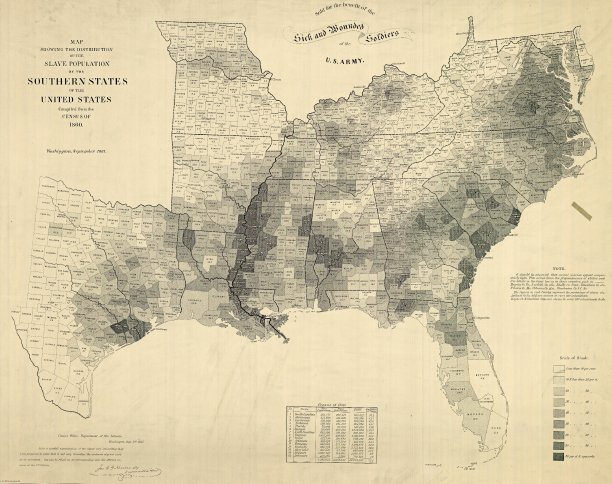
The 1860 Census was the last time the federal government took a count of the South’s vast slave population. Several months later, the United States Coast Survey — arguably the most important scientific agency in the nation at the time — issued two maps of slavery that drew on the Census data, the first of Virginia and the second of Southern states as a whole. Though many Americans knew that dependence on slave labor varied throughout the South, these maps uniquely captured the complexity of the institution and struck a chord with a public hungry for information about the rebellion.
The map uses what was then a new technique in statistical cartography: Each county not only displays its slave population numerically, but is shaded (the darker the shading, the higher the number of slaves) to visualize the concentration of slavery across the region. The counties along the Mississippi River and in coastal South Carolina are almost black, while Kentucky and the Appalachians are nearly white.
H/T to Walter Olson for the link.
August 12, 2010
If you search for “James Buchanan worst president ever” you get 1,550,000 hits
But in spite of that, he’s still getting a dollar coin minted in his honour:
The 15th coin in the presidential $1 coin program honors President James Buchanan. It features an image of the president with the inscriptions “James Buchanan”, “In God We Trust”, “15th President” and “1857-1861.”
The reverse side of the coin shows the Statue of Liberty. The ceremonial launch and coin exchange will take place at Wheatland, the former president’s home.
About the only thing that might make this a good idea is if the value is pegged to the pre-Civil War dollar.


