
Quotulatiousness

November 6, 2010

Robert Fulford on Dierdre McCloskey’s latest book

Filed under: Books, Economics, History, Media — Tags: , , , , — Nicholas @ 12:19

As a dabbler in economic thought (but not an economist), I’m always interested in new books on different aspects of economics. Robert Fulford has probably prompted me to buy Deirdre McCloskey’s Bourgeois Dignity: Why Economics Can’t Explain the Modern World:

In a time of sharply limited budgets, this gives a special urgency to the ideas of Deirdre McCloskey, an economic historian at the University of Illinois. She thinks she knows how economic growth works.

Why did northwestern Europe begin growing rich in the 17th century, a process that continues to this moment? Why did various countries elsewhere in Europe have similar success, along with countries created by Europeans, including the United States and Canada?

McCloskey sets aside most of the reasons for prosperity that her academic peers identify. Scientific innovation, natural resources, education, Protestant theology, trade agreements — these can be important but they do not explain global patterns. Often, they are present in societies that have failed.

The West’s success, McCloskey believes, turns out to be a question of imagination, attitude and sensibility. It depends on how we talk and write about business — in fact, how people in the West feel about it.

Fulford also points out that McCloskey has had a very unusual life:

It’s not possible to write about McCloskey without noting the most remarkable aspect of her life, which she described eleven years ago in Crossing: A Memoir. In 1995, Donald McCloskey, a 52-year-old professor, married for 30 years, a father of two, realized that his real identity was as a woman. He began a program of hormone treatment, multiple surgeries and electrolysis, emerging as Deirdre.

As a scholar, she noted that this physical change involved a cultural transformation as well. Having been both a man and a woman, she drew up a long list of changes she’s discovered in herself. Here are a few of them. She cries, she likes cooking, she’s more easily startled by loud noises, she listens intently to stories people tell of their lives and craves detail. She can’t remain angry for long. She’s less impatient, drives less aggressively, has more friends. She’s stopped paying attention to cars and sports. And she feels duty-bound to wash the dishes.
September 2, 2010

“How can you fall in love if you can’t see her face?”

Filed under: Asia, Military, Religion — Tags: , , , , , , — Nicholas @ 12:24

Along with the manifold military problems facing the troops in Afghanistan, there are some social issues that tend to boggle the minds of the western soldiers:

Western forces fighting in southern Afghanistan had a problem. Too often, soldiers on patrol passed an older man walking hand-in-hand with a pretty young boy. Their behavior suggested he was not the boy’s father. Then, British soldiers found that young Afghan men were actually trying to “touch and fondle them,” military investigator AnnaMaria Cardinalli told me. “The soldiers didn’t understand.”

[. . .]

Sociologists and anthropologists say the problem results from perverse interpretation of Islamic law. Women are simply unapproachable. Afghan men cannot talk to an unrelated woman until after proposing marriage. Before then, they can’t even look at a woman, except perhaps her feet. Otherwise she is covered, head to ankle.

“How can you fall in love if you can’t see her face,” 29-year-old Mohammed Daud told reporters. “We can see the boys, so we can tell which are beautiful.”

Even after marriage, many men keep their boys, suggesting a loveless life at home. A favored Afghan expression goes: “Women are for children, boys are for pleasure.” Fundamentalist imams, exaggerating a biblical passage on menstruation, teach that women are “unclean” and therefore distasteful. One married man even asked Cardinalli’s team “how his wife could become pregnant,” her report said. When that was explained, he “reacted with disgust” and asked, “How could one feel desire to be with a woman, who God has made unclean?”

It’s a telling point that western troops were committed to Afghanistan without being fully briefed on the social customs of the people for whom and among whom they’d be doing their jobs. Ignorance isn’t a solid basis for any kind of trust, and without gaining the trust of locals, the troops will always be at a severe informational disadvantage.

August 16, 2010

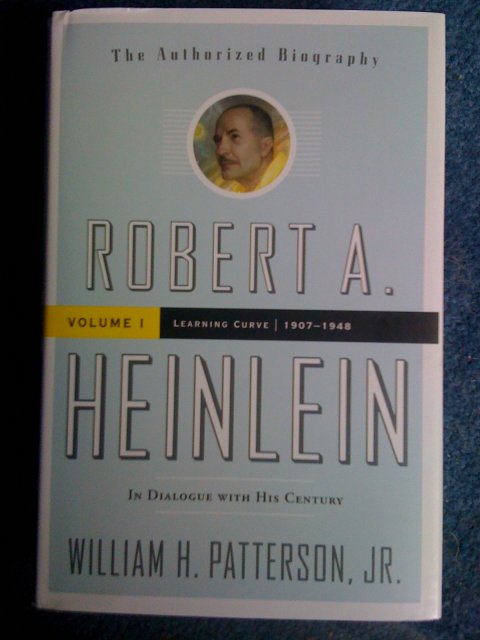
Cory Doctorow on the new Robert Heinlein biography

RAH by PattersonI finished reading the first volume last night, and I can’t wait for volume two. Cory Doctorow summarizes John Clute’s review with his own observations (Clute compared Heinlein’s work to Doctorow’s):

Heinlein was notoriously recalcitrant about his early life and the two wives he was married to before his epic marriage to Virginia Heinlein. He repeatedly burned correspondence and other writings that related to that period. Clute suggests that this is partly driven by Heinlein’s desire to be Robert A Heinlein, titan of the field, without having to cope with his youthful embarrassments. It’s a good bet — lots of the stuff that drives young people to write science fiction also makes them a pain in the ass to be around until they work some of the kinks out of their system (I wholeheartedly include myself in this generalization).

It’s interesting to see his own growth, from his early priggishness (he was nicknamed “the boy general” as a plebe at the Naval Academy) which undoubtedly was not helped by his health issues and tendency to stammer. He was in the shadow of his older brother Rex Ivar for most of his youth, even following him to the Academy three two years later. Rex Ivar was the favourite child in the family and Robert never seemed to be able to do as well in his parents’ eyes as the older boy.

Robert Heinlein was probably a pretty toxic individual as a teenager, based on the evidence Patterson presents — it’s pretty clear even after most of the information was sanitized by Heinlein’s third wife Virginia. Patterson never met Heinlein, and by the time he took on the biography, most of the people who knew Heinlein were fading from the scene. I think he did a very good job with the information available to him, but the biography definitely improves after the Academy years.

Patterson also puts forward a pretty comprehensive case for the idea that Heinlein’s fiction generally conveys Heinlein’s own political beliefs. This is widely acknowledged among Heinlein fans, save for a few who seem distressed by the idea that the blatant racism and sexism (especially in the earlier works) are the true beliefs of the writer at the time of writing and would prefer to believe that Heinlein didn’t write himself into his works. I got into a pretty heated debate with one such person at the Heinlein panel at the 2007 Comicon, who maintained the absurd position that Heinlein’s views could never be divined by reading his fiction — after all, his characters espouse all manner of contradictory beliefs! (To which I replied: “Yes, but the convincing arguments are always for the same set of beliefs, and the characters who challenge those beliefs are beaten in the argument.”) Not that I fault Heinlein for this — it’s an honorable tradition in SF and the mainstream of literature, and I find Heinlein’s beliefs to be nuanced and complex, anything but the reactionary caricature with which he is often dismissed.

It should be no surprise to anyone over 30 that Robert Heinlein’s political and philosophical views changed over his lifetime. This is discussed in some depth in the book, frequently from Heinlein’s own letters to friends at various points. He lost his religious views very early on (if he ever really had them, other than for conforming to familial expectations), and after leaving the Navy he was deeply involved in Upton Sinclair’s EPIC movement.

His belief in world government must have been hard to sustain, given that he had a great deal of experience of the political process, both in Kansas City during the Pendergast years, and in California with EPIC. Corruption, dirty dealing, and backroom bargaining were the way things got done, and it would be hard to believe that things would be better with a single world-wide government.

What seems to have gotten him involved in EPIC was his first-hand experience of poverty and seeing the plight of the “Okies” who’d come to California after the dust bowl wiped out so many farms in the central states. There were not enough jobs for them, even displacing the Mexican migrant labourers, and they were ineligible for state assistance until after they’d been in California for a year. Sinclair appeared to be the only politician with any plan other than oppressing the Okies enough to force them to move on.

August 10, 2010

Hey kids, are your parents uptight about you having sex?

Filed under: Britain, Health — Tags: , , — Nicholas @ 07:10

That’s to be expected. They’re even more uptight about their parents having sex:

Over the last few months there have been numerous headlines about the sex lives of the over-50s — almost all negative. The HIV infection rate in this group has doubled, we are told. The numbers of over-50s suffering from chlamydia, syphilis, gonorrhoea, herpes and genital warts is growing. One doctor even wrote about his shock at treating the sexual diseases of what he called “cheerfully promiscuous” baby boomers.

It is true there are probably some people at middle age who mistakenly think their sexual partners are above suspicion, and others who did not enter their dating lives using condoms. Safer sex practices may not come so easily for them, yet the prominence and style of these articles underscores the sexual ageism that pervades our society. Where are the positive messages about the sex lives of people in their 50s, 60s, 70s and beyond? Do we ever hear the truth about how sexually vibrant they can be — without an attached warning about physical dangers and moral pitfalls? Sex among elders is surely one of the greatest sexual taboos in western society.

July 29, 2010

BC government finds an issue to distract the media

Filed under: Cancon, Health, Law — Tags: , , , , — Nicholas @ 09:44

Adrian MacNair linked to this Vancouver Sun article, saying “”B.C. halts penis-arousal test for youth sex offenders” Say whaaaaaaatttt?”

A moratorium has been placed on tests done on B.C. youth sex offenders measuring their penis arousal in response to sexual stimuli after the province’s top child advocate launched an immediate investigation Wednesday.

The device in question is called a “penile plethysmograph” — or PPG. In a lab setting, it is attached to male genitals so technicians can measure changes in “penile tumescence” — essentially erections that reflect the state of arousal in subjects shown photographs of adults, children and even babies in varying states of undress while at the same time being read a story that describes coercive or forced sexual activity.

So, until it came to light, the government was showing provocative images and reading pornographic stories to teenage boys to find out if they got erections during the process? Would anyone be surprised to find that teenage boys found this whole exercise sexually arousing? Teenage boys are hard-wired to find all sorts of things sexually arousing!

The point of the test is to reportedly predict whether offenders have gained control of their deviant arousal patterns through treatment or if they have not learned how to suppress deviance and will be a strong risk for re-offending.

Again, we’re talking about teenage boys . . . I’d be more suspicious if they found that one of them was managing not to react to such stimulus!

Okay, yes, I’m unfairly stereotyping, at least to some degree. But this sort of “test” or “experiment” would be flagrantly illegal if it were being done by anyone other than a government-funded health organization, wouldn’t it?

June 26, 2010

Texas conservatives want to take you back

Filed under: Law, Liberty, Politics, USA — Tags: , , , , , , — Nicholas @ 11:06

Take you back to the middle of the last century, or even further:

Texas Republicans are a conservative lot. Still, it’s difficult to imagine mainstream GOP voters demanding their neighbors be jailed for engaging in a little hanky-panky behind closed doors.

Nevertheless, the state’s Republican party has voted on a platform by which their candidates will stand, and it includes the reinstatement of laws banning sodomy: otherwise known as oral and anal sex.

The party’s platform also seeks to make gay marriage a felony offense, which may be confusing to most given that the state does not sanction or recognize same sex marriages, meaning any such ceremony conducted does not bear the weight of law. Whether this means the GOP wants gay couples married in other states to be pursued through Texas as dangerous criminals, the party did not specify.

“We oppose the legalization of sodomy,” the platform states. “We demand that Congress exercise its authority granted by the U.S. Constitution to withhold jurisdiction from the federal courts from cases involving sodomy.”

Texas Republicans must be a much more sexually repressed bunch if all of this managed to pass muster with the party faithful. They also appear to be in an anti-immigrant frenzy, with measures custom-designed to alienate Spanish-speaking voters also passed as part of the platform.

May 26, 2010

Evolutionarily speaking, everything old is new again

Filed under: Science — Tags: , , , , , — Nicholas @ 12:46

An idea that seemed fairly common in the 1960s and 70s appears to be regaining credibility:

When two drunken men fight over a woman, alcohol and stupidity may not be the only things at work. Sadly, evolution may have shaped men to behave this way. Almost all of the traits considered to be masculine — big muscles, facial hair, square jaws, deep voices and a propensity to violence — evolved, it now seems, specifically for their usefulness in fighting off or intimidating other men, allowing the winner to get the girl.

That, at least, is the contention of David Puts, an anthropologist at Pennsylvania State University, in an upcoming paper in Evolution and Human Behavior. Dr Puts is looking at how sexual selection gave rise to certain human traits. A trait is sexually selected if it evolved specifically to enhance mating success. They come in two main forms: weapons, such as an elk’s horns are used to fight off competitors; and ornaments, like a peacock’s tail, which are used to advertise genetic fitness to attract the opposite sex.

Researchers have tended to consider human sexual selection through the lens of the female’s choice of her mate. But human males look a lot more like animals designed to battle with one another for access to females, says Dr Puts. On average, men have 40% more fat-free mass than women, which is similar to the difference in gorillas, a species in which males unquestionably compete with other males for exclusive sexual access to females. In species whose males do not fight for access to females, males are generally the same size as, or smaller than, females.

April 20, 2010

No wonder that “sexy librarian” meme got started

Filed under: Randomness — Tags: , , , — Nicholas @ 09:10

It’s all there in the 1992 study, recently made available on the web:

A 1992 survey of 5,000 U.S. librarians, long withheld by a professional journal, found one in five respondents had engaged in sexual trysts among the stacks.

Will Manly, who said the New York-based Wilson Library Bulletin withheld the results of his survey in 1992, published results recently on his Web site indicating 51 percent of librarians in the early 90s were willing to pose nude for money and 61 percent of respondents admitting to renting an X-rated film, the New York Daily News reported Monday.

H/T to Radley Balko for the link.

February 24, 2010

Sex and the single warlord

Filed under: Media, Middle East, Military — Tags: , , , , , — Nicholas @ 12:50

Strategy Page discusses one of the less-well-publicized aspects of life in Afghanistan:

[. . .] in the Islamic world, sex is, well classified. Especially illicit sex. Thus some enterprising reporters have latched onto the ancient practice (in the entire region, from North Africa to India) of using young (well, teenage down to about ten) boys for sex and other entertainments (dancing, cross dressing, camel jockeys). This has been a thing with the rich and powerful in the area, for thousands of years. In some places it is sort of legal, but generally it is tolerated, even if officially forbidden. That’s because this sort of thing is most popular among the wealthy and powerful. Getting this story for Western audiences is dangerous, as those who indulge would rather make Western reporters disappear, than stop. These guys don’t consider themselves pederasts, just the custodians of ancient cultural traditions. Or something like that.

When the Taliban came to power in the mid 1990s, they outlawed the practice, but it continued anyway, just more discreetly. The Taliban tried to crack down on homosexuality in general, especially in the south, around Kandahar (the “capital” of the pro-Taliban Pushtun tribes.) Didn’t work. Casual homosexuality has long been the custom down there, and Afghans from other parts of the country (especially non-Pushtuns) have a large repertoire of humor and insults about the proclivities of those Kandaharis (one of the more printable ones is about how birds flying over Kandahar have to do so with one wing, as the other one must be used to cover the avian backside.)

January 29, 2010

This is more than a slight confusion of terminology

Filed under: Asia, Health, Military — Tags: , , , — Nicholas @ 08:33

Jon (my former virtual landlord) sent along a link to this FoxNews story indicating that there is a long road ahead — sociologically speaking — for Afghanistan:

An unclassified study from a military research unit in southern Afghanistan details how homosexual behavior is unusually common among men in the large ethnic group known as Pashtuns — though they seem to be in complete denial about it.

The study, obtained by Fox News, found that Pashtun men commonly have sex with other men, admire other men physically, have sexual relationships with boys and shun women both socially and sexually — yet they completely reject the label of “homosexual.” The research was conducted as part of a longstanding effort to better understand Afghan culture and improve Western interaction with the local people.

The research unit, which was attached to a Marine battalion in southern Afghanistan, acknowledged that the behavior of some Afghan men has left Western forces “frequently confused.”

The report details the bizarre interactions a U.S. Army medic and her colleagues had with Afghan men in the southern province of Kandahar.

[. . .]

Apparently, according to the report, Pashtun men interpret the Islamic prohibition on homosexuality to mean they cannot “love” another man — but that doesn’t mean they can’t use men for “sexual gratification.”

Trying to use a western term, which almost certainly has highly negative connotations to Afghans who may have encountered it, isn’t likely to be helpful in dealing with the Pashtuns. Labelling is the least of the concerns, I’d think.

The U.S. army medic also told members of the research unit that she and her colleagues had to explain to a local man how to get his wife pregnant.

The report said: “When it was explained to him what was necessary, he reacted with disgust and asked, ‘How could one feel desire to be with a woman, who God has made unclean, when one could be with a man, who is clean? Surely this must be wrong.'”

September 10, 2009

More than you probably wanted to know about gender

Filed under: Health — Tags: , , — Nicholas @ 12:31

By way of John Scalzi’s Delicious bookmarks page, a thoughtful explanation of what people mean by ‘gender’ and why it is different from ‘sex’:

I have been asked at various times what people mean by “gender” and why it is different from “sex’. Also I’ve been asked to explain the multitudinous types of “trans” people, and why they often seen to be at each other’s throats. Hopefully I can traverse the various minefields involved without offending too many people, but sadly there are so many different perspectives out there that I’m bound to offend someone. My apologies in advance.

So, gender, what is it? Many people still think that gender and sex are the same thing. People, animals, even objects in many languages, are either male or female, one or the other, a very simple binary choice. Sadly life is never that simple. I’d like you to consider four different ways in which things are viewed as masculine or feminine.

Biological sex

That’s easy, isn’t it? People have one sort of dangly bits or the other. You either have XX chromosomes or XY chromosomes. You either produce sperm or eggs. Simple.

Well, no. Biology is a fickle thing. Many people are born with ambiguous biology. I don’t just mean genuine hermaphrodites, though such people do exist. All sorts of things can happen to us in the womb, and thereafter, that make our gender difficult to determine by physical tests. These conditions are known as “intersex”, and there are an enormous number of different ones. The Intersex Society of North America has a fairly comprehensive list of them together with data on how common they are. It is reasonably certain that as many as 1 in 1000 people have an ambiguous biological sex in one way or another, and as people get old and parts of their body wear out that can increase significantly.

« Newer Posts

Powered by WordPress

