Quotulatiousness

September 1, 2020

“John from America” and the South Pacific cargo cults

Filed under: Books, Economics, History, Pacific, Religion, WW2 — Tags: , , , , — Nicholas @ 03:00

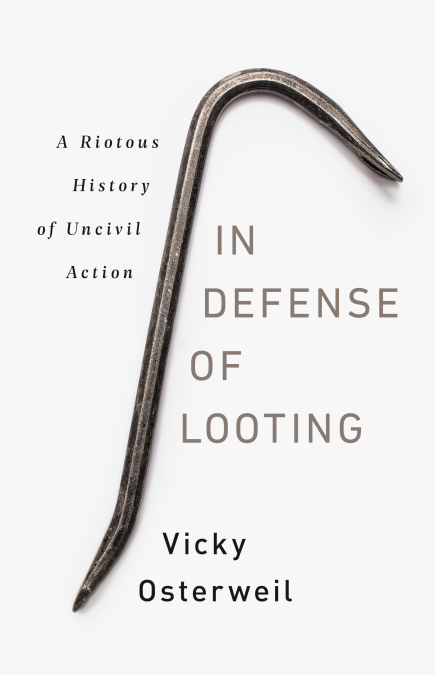
Steven W. Aunan responds to Vicky Osterweil’s recent book on the joy of looting (which was clearly informed by her almost total innocence of any economic understanding) and also tells the story of the perhaps mythical “John from America” and the cargo cults of islanders in the South Pacific during and after World War II:

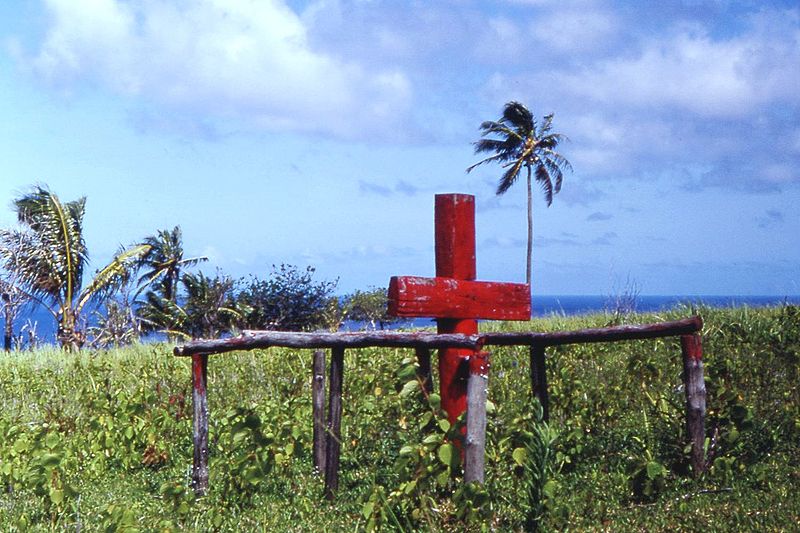
Ceremonial cross of John Frum cargo cult, Tanna island, New Hebrides (now Vanuatu), 1967.
Photo by Tim Ross via Wikimedia Commons.

In 1940, or so goes the myth, a man who identified himself as “John from America” appeared in a native village in the New Hebrides Islands with a message: Rebel against the colonizers, their missions, their schools, their laws, and John would reward them with free housing, clothing, food, and transportation.

The result was the “John Frum Cargo Cult” that persists to this day in the modern-day South Pacific nation of Vanuatu.

Frum’s message was remarkably similar to Vicky Osterweil’s message: rebel against settler domination, against the history of whiteness, and someone will reward you with all the free stuff you need.

Like Osterweil’s chaotic myth of impossibly contradictory Marxist worlds, we can’t be sure who the mythical John Frum was, how or when he arrived, whether he was a man or a spirit-being, if he lived in the U.S. or in the island’s active volcano, or if he first appeared as a tiger on an island where no tigers live, as a black man with a moustache, or as a white man who magically spoke the native language.

You can pick your own truth about Frum, because Marxists will tell you it’s no better than anyone else’s truth.

And, like every other false promise spoken by the fork-tongued followers of the dead white male devil Karl Marx, John Frum brought with him a vision of the future in which the old social order is violently dismantled, a new world is born, and the people emerge with material wealth, happiness, hope, and success.

After Frum left the islands, large numbers of Americans in their flying machines immediately and miraculously followed, building military airstrips and bringing in enormous quantities of cargo. Everything came to pass just as John Frum had promised.

The residents of the islands, of course, did not understand modern manufacturing or transportation, or that World War II was underway. The cargo simply arrived at the airstrip in the jungle, apparently by magic.

Kind of like the Target stores around the country that are repeatedly looted only to be magically restocked by the invisible hand of an invisible genius named John Galt.

August 30, 2020

“When I use the word looting, I mean the mass expropriation of property, mass shoplifting during a moment of upheaval or riot. That’s the thing I’m defending.”

Filed under: Books, Law, Politics, USA — Tags: , , , — Nicholas @ 05:00

An NPR interview with author Vicky Osterweil about her new book In Defense of Looting, published last week:

During the uprisings of this past summer, rioting and looting have often gone hand in hand. Can you talk about the distinction you see between the two?

“Rioting” generally refers to any moment of mass unrest or upheaval. Riots are a space in which a mass of people has produced a situation in which the general laws that govern society no longer function, and people can act in different ways in the street and in public. I’d say that rioting is a broader category, in which looting appears as a tactic.
Often, looting is more common among movements that are coming from below. It tends to be an attack on a business, a commercial space, maybe a government building — taking those things that would otherwise be commodified and controlled and sharing them for free.

Can you talk about rioting as a tactic? What are the reasons people deploy it as a strategy?

It does a number of important things. It gets people what they need for free immediately, which means that they are capable of living and reproducing their lives without having to rely on jobs or a wage — which, during COVID times, is widely unreliable or, particularly in these communities is often not available, or it comes at great risk. That’s looting’s most basic tactical power as a political mode of action.

It also attacks the very way in which food and things are distributed. It attacks the idea of property, and it attacks the idea that in order for someone to have a roof over their head or have a meal ticket, they have to work for a boss, in order to buy things that people just like them somewhere else in the world had to make under the same conditions. It points to the way in which that’s unjust. And the reason that the world is organized that way, obviously, is for the profit of the people who own the stores and the factories. So you get to the heart of that property relation, and demonstrate that without police and without state oppression, we can have things for free.

Importantly, I think especially when it’s in the context of a Black uprising like the one we’re living through now, it also attacks the history of whiteness and white supremacy. The very basis of property in the U.S. is derived through whiteness and through Black oppression, through the history of slavery and settler domination of the country. Looting strikes at the heart of property, of whiteness and of the police. It gets to the very root of the way those three things are interconnected. And also it provides people with an imaginative sense of freedom and pleasure and helps them imagine a world that could be. And I think that’s a part of it that doesn’t really get talked about — that riots and looting are experienced as sort of joyous and liberatory.

[…]

What would you say to people who are concerned about essential places like grocery stores or pharmacies being attacked in those communities?

When it comes to small business, family owned business or locally owned business, they are no more likely to provide worker protections. They are no more likely to have to provide good stuff for the community than big businesses. It’s actually a Republican myth that has, over the last 20 years, really crawled into even leftist discourse: that the small business owner must be respected, that the small business owner creates jobs and is part of the community. But that’s actually a right-wing myth.

A business being attacked in the community is ultimately about attacking like modes of oppression that exist in the community. It is true and possible that there are instances historically when businesses have refused to reopen or to come back. But that is a part of the inequity of the society, that people live in places where there is only one place where they can get access to something [like food or medicine]. That question assumes well, what if you’re in a food desert? But the food desert is already an incredibly unjust situation. There’s this real tendency to try and blame people for fighting back, for revealing the inequity of the injustice that’s already been formed by the time that they’re fighting.

H/T to Amy Alkon for the link.

Update: Ann Althouse also commented on the NPR interview:

I don’t know if other people in “the movement” are happy to see that idea spoken aloud [that looters and rioters have “always been a part of our movement”]. I’ve been hearing that there are 2 groups of people — the peaceful protesters and these mysterious other people, who, I’ve noted, the journalists don’t seem to care to identify and investigate. Osterweil is saying these are not 2 different groups. It’s one movement, and it’s been going on for a long time.

[…]

That seems to present looting as street theater with a message. It makes an argument. A terrible argument. We’ve heard that argument in words many times over the years, and most Americans reject it. We want to work and build wealth and enjoy our lives and we want the great mutual benefits of hard work and wealth. Osterweil’s looting is a switch from making the argument against property in words and to speak with actions — the destruction of property. But that doesn’t make the argument more convincing! It’s a nasty tantrum thrown because you can’t convince people with your ideas. Ironically, fortunately, it makes the argument for the other side.

Andrew Sullivan – “… let’s be frank about this and call this by its name: this is very Weimar. The center has collapsed.”

In the latest Weekly Dish, Andrew Sullivan finds himself in agreement with Marcus Aurelius: “The object of life is not to be on the side of the majority, but to escape finding oneself in the ranks of the insane.”

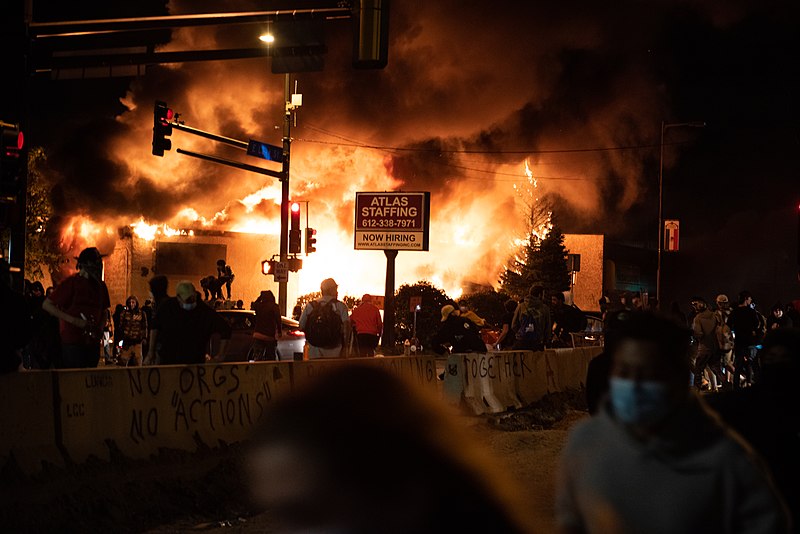
A building burning in Minneapolis following the death of George Floyd.
Photo by Hungryogrephotos via Wikipedia.

I don’t think I’m the only one, as even the Democrats seem now to realize. And this massive blindspot is not hard to understand. When a political party finds itself so wedded to a new and potent ideology it cannot call out violence when it sees it, then it is walking straight into a trap. When the discourse on the left has become one in which scholars and editors and Tweeters vie with one another to up the ante on how inherently evil America has always been, redescribe it as a slaveocracy, and endorse racist books that foment the most egregious stereotypes about “whiteness”, most ordinary people, who love their country and are mostly proud of its past, will rightly balk. One of the most devastating lines in president Trump’s convention speech last night was this: “Tonight, I ask you a very simple question: How can the Democrat Party ask to lead our country when it spends so much time tearing down our country?” A cheap shot, yes. But in the current context, a political bullseye.

The key theme of the RNC was reminding people of the American narrative that once was. Yes, it was unbelievably vulgar. Yes, it looked like a cross between a sophisticated CGI video-game and a crude car dealer ad with a dollop of Leni Riefenstahl. But it was extremely effective. To see that, you have to remove your frontal cortex and put it in a jar, accept that it’s all going to be a series of lies so massive they stupefy us into stutters, and then cop the feels. Pence gave us a vision of America that was a souped up Disney special from the early 1960s — from Fort McHenry no less. And look at the icons Trump invoked: Wyatt Earp, Annie Oakley, Davy Crockett, and Buffalo Bill. You can mock. But in the midst of a culture being redescribed by the left as a form of foul and relentless “white supremacy”, and in a moment of arson and rioting, it felt like a kind of balm.

All this reassurance played out against a backdrop of Kenosha, which was burning, and Minneapolis, where a suicide led to a bout of opportunistic looting, and Washington DC, where mobs of wokesters went through the city chanting obscenities, invading others’ spaces, demanding bystanders raise fists in solidarity, with occasional spasms of violence. These despicable fanatics, like it or not, are now in part the face of the Democrats: a snarling bunch of self-righteous, entitled bigots, chanting slogans rooted in pseudo-Marxist claptrap, erecting guillotines — guillotines! — in the streets as emblems of their agenda. They are not arguing; they are attempting to coerce. And liberals, from the Biden campaign to the New York Times, are too cowardly and intimidated to call out these bullies and expel them from the ranks.

[…]

And let’s be frank about this and call this by its name: this is very Weimar. The center has collapsed. Armed street gangs of far right and far left are at war on the streets. Tribalism is intensifying in every nook and cranny of the culture. The establishment right and mainstream left tolerate their respective extremes because they hate each other so much.

The pattern is textbook, if you learn anything from history: an economic crisis resulting in mass unemployment; the pent-up psychological disorders a long period of lockdown can and will unleash; a failure of nerve on the part of liberals to defend the values and institutions of liberal democracy, and of conservatives to keep their own ranks free of raw demagogues and bigots. But critically: a growing sense of disorder and violence and rioting as simply the background noise; and a sense that authorities do not have the strength or the stomach to restore order. What most people want in that kind of nerve-wracking instability is a figure who will come in and stamp it out. In Trump, we have someone who would happily trample any liberal democratic norm to do it. And the left seems to be all but begging him to do it — if only to prove them right.

A long time ago, I was mocked for saying that I believed that the election of Donald Trump was an extinction-level event for liberal democracy. But this is where we are. There is no place for liberal debate or dissent, just competing mobs deploying propaganda, intimidation and mutual racial hatred. Norms are trashed, from the shameful cooptation of national monuments for partisan purposes, to violating the privacy and peace of ordinary citizens because they are not in the ranks of agitators. Liberals are now illiberal; conservatives are revolutionaries. The Republican convention we are witnessing makes no pretense of even publishing a platform — all to demonstrate total and unfailing fealty to the leader whose own family is now assumed to succeed him. What about this pattern of events do we not already understand?

June 23, 2020

The “Battle of Dijon”

Filed under: France, Law, Military — Tags: , , , — Nicholas @ 05:00

I post a lot of accounts of ancient and modern wars and battles, but the “Battle of Dijon” actually took place earlier this month and has been widely mischaracterized in the media, as John Lichfield recounts:

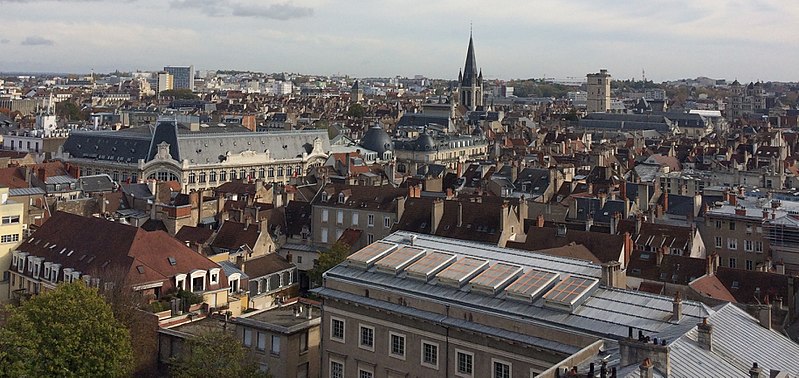
Dijon viewed from Saint-Bénigne Cathedral with the Palace of the States of Burgundy, the Notre-Dame and Saint-Michel churches, the Saint-Nicolas tower, the former Saint-Bénigne abbey palace (ENSA), The Lafayette galleries, the old department stores at Le Pauvre Diable and la Ménagère.
Photo by Twibo2 via Wikimedia Commons (caption translated by Google Translate).

Dijon, the capital of Burgundy, rarely attracts the world’s attention. There is Dijon mustard of course. There is Dijon blackcurrant liqueur (Cassis de Dijon). There are many beautiful, old Burgundian streets and buildings. But of all the medium to large cities in France, Dijon (population: 159,000) is surely the least talked about.

Then, abruptly, last weekend Dijon had the great misfortune to become newsworthy. War broke out, we were told, between “Chechen gangs” and “Arab gangs”. The dispute was, some French media reported, about the right to traffic drugs. The Daily Mail announced that the French army had been sent in to restore order. Marine Le Pen compared Dijon to Beirut. Similar “wars between migrant communities” now threatened, she said, all over France.

All these reports were, I believe, wrong or deeply misleading. What did happen in Dijon over four days the other weekend was surreal and disturbing. But the incidents defy simple explanation or political point-scoring. They say, perhaps, more about Chechnya, and the values — good and bad — of exiled Chechens, than they do about the wider racial issues of France. The severity of the violence probably owed something to the frustrations of France’s recent nine weeks of Covid lockdown. The political and media reaction was skewed by the fact that the events occurred while France was in the midst of a debate about race and policing – in the wake of the George Floyd killing in the United States.

On Sunday evening, on the third night of violence in Dijon, President Emmanuel Macron happened to be addressing the nation on TV. He said, among many other things, that he would resist all pressure to splinter France into ethnic communities.

So what had happened over four days in Dijon? There are several conflicting accounts. Here, briefly, are the facts that I have been able to establish.

On 9th June a 15-year-old (some say 16-year-old) boy of Chechen origin was badly beaten up outside a chicha (hookah) bar in central Dijon. His attackers were local men in their 30s of African and North African origin. According to the Chechen version of events, the men were drug-dealers. The injured boy apparently had no connection with drugs. The dealers attacked him because local Chechens were known to be hostile to drug-trafficking. They put a gun in the boy’s mouth and said: “We hate Chechens. We’re going to let you live so you can tell the other Chechens what’s going to happen to them.”

Three days later a convoy of cars arrived in Dijon packed with Chechen men from several other parts of France, as well as Belgium and Germany. Local media and police say that there were 100 of them; the Chechens say that there were only 15. They smashed up the chicha bar, assaulted its owner and then rampaged through the multi-racial Les Grésilles area of council estates just north-east of central Dijon.

June 18, 2020

The origins of Antifa

Filed under: Germany, History, Politics, USA — Tags: , , , , , — Nicholas @ 05:00

Kyle Shideler outlines the history of Antifa from the Weimar Republic to the streets of cities all over the western world:

“antifa 8973ag” by cantfightthetendies is licensed under CC BY 2.0

With riots and civil unrest metastasizing across the United States, the president declared he intends to designate Antifa as a terrorist group. Predictably, the talking heads rushed out to declare that Antifa doesn’t really exist, and even if it did the president couldn’t possibly target it using that legal designation. They argue Antifa is an amorphous blob of discontents, not a functioning organization, and certainly not one which could be designated and targeted for concentrated counterterrorism enforcement.

As usual, the Twitterati don’t know what they are talking about. Reality is both simpler and more complex.

To begin at the beginning: Antifa — real name: Antifaschisitsche Aktion — was born during the street-fights of the 1932 Weimar Republic. It was founded by the Stalinist Communist Party of Germany (KPD), although various Communist “anti-fascist defense” units were associated with the KPD much earlier.

Anti-fascist Action’s sole purpose was to help the KPD combat other political parties for control of the streets in the revolutionary politics of the rapidly failing Weimar Republic.

And yes, they fought the Nazis.

But they also fought liberal parties, conservative parties, and anyone and everyone who got in their way. While these early antecedents were short-lived, it is useful to view Antifa in this context. More than anything, Antifa exists to serve as a tool of revolutionary politics in a failed (or failing) state.

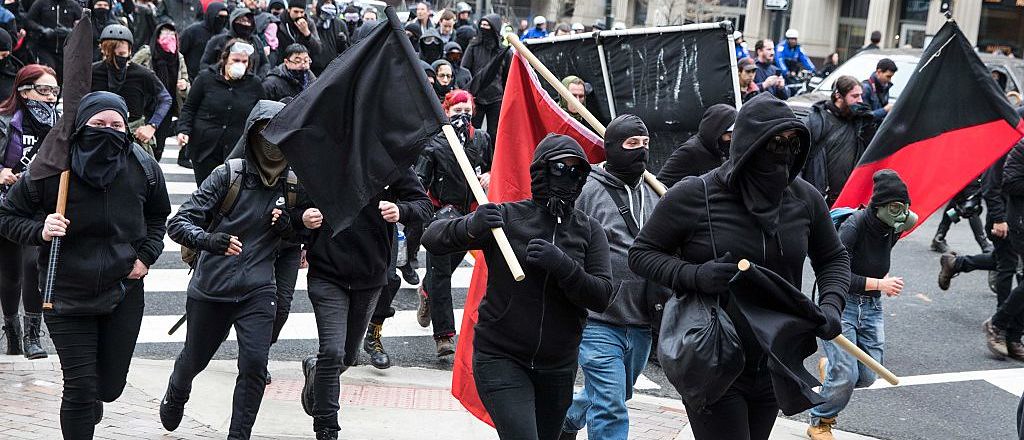
Antifa would reestablish itself in the early 1980s, also in Germany, out of Autonomism. Autonomism is an anti-authoritarian anarcho-Marxist ideology associated with the Communist urban guerilla organizations of 1970s and ’80s Europe like Red Army Faction and the Red Brigade. Autonomism would find a home among the young punks of Germany’s squatters’ rights movement. Around this time, Antifa tactics like the “black block,” where large numbers of rioters dress in black and move together in formation as part of a larger protest, were developed.

H/T to Rafe Champion for the link.

June 12, 2020

An unwelcome return to the 1960s

Filed under: History, Media, Politics, USA — Tags: , , , — Nicholas @ 05:00

David Warren reflects on how many parallels we’re seeing in the current year to the worst aspects of the 1960s:

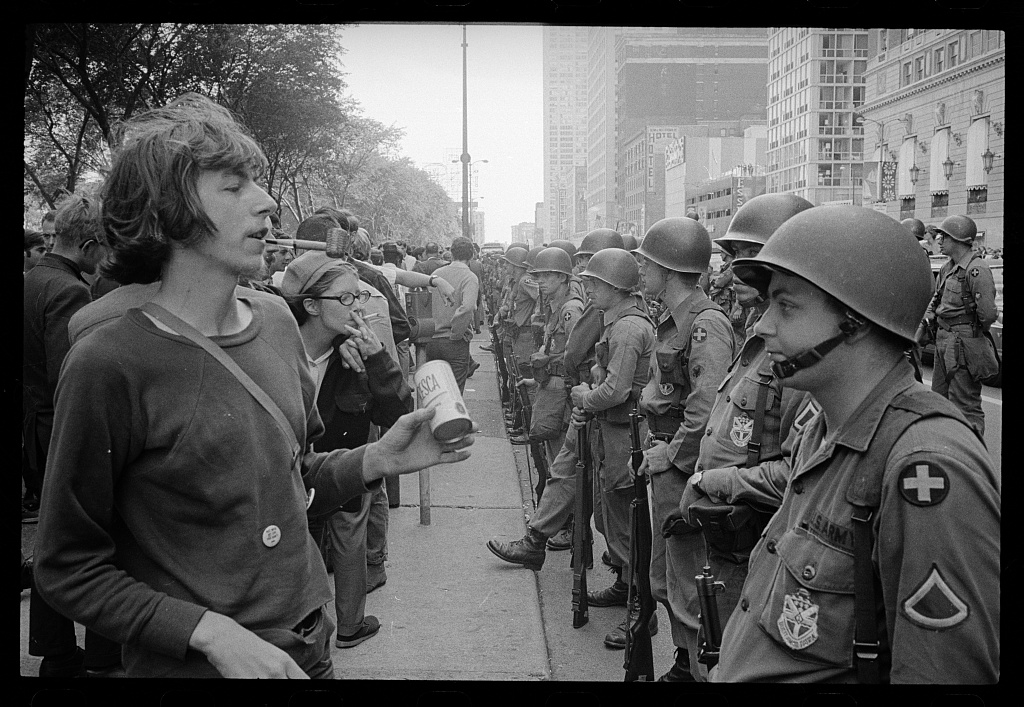
Young “hippie” standing in front of a row of National Guard soldiers, across the street from the Hilton Hotel at Grant Park, at the Democratic National Convention in Chicago, August 26, 1968. Photo by Warren K. Leffler for US News & World Report via Wikimedia Commons.

As an old Cold Warrior, and once “science kid,” whose childhood developed through the 1960s, there is nothing that ought to surprise me. We have Antifa today; we had the Weather Underground then. We have parallels to every event I witnessed through the idiot box of adolescence, and vice versa. Even the destruction of American cities by riots and crime isn’t new; nor the supine response of our liberal leaders. The obvious left bias of news and entertainment was the same then as now, only less shrieking. The replacement of flatfoot journalists, with malicious ideological clowns from the universities, then a work in progress, was by the end of the last century, complete. The poison spread, through all media of information. We’ve reached an Age of Unreason to match Robespierre’s, and seem now to be waiting for a Napoleon.

Charlatans are the handmaids of paganry. That the charlatans slide into violent insurrection, even against the better pagan customs, is not something historically new.

The alternative is improbable: another Age of Faith. This would necessarily include a subsidiary restoration of faith in science — in the modest belief that if we follow the facts where they lead, as opposed to where we want them to go, a lost perception of cosmological order will also be, willy-nilly, restored. “Modern science” — an unambiguously Christian construct — depends entirely on one assumption. It is, that a universe God created will make sense. Logic, or the principle of non-contradiction, will hold up, and where it doesn’t seem to be doing so, it is not God, but we, who have got it wrong.

By the inversion of “values,” at the present day, the sane views are labelled as “psycho.” The truth is not the true, but what we (or our masters) want to call true. This “truth” is “settled,” from one moment to another; and is not to be discovered, but imposed.

June 9, 2020

How we are supposed to view the rioting protests in major US cities

Filed under: Media, Politics, USA — Tags: , , , , , — Nicholas @ 03:00

David Thompson shares the essential parts of a Vice article, telling us insufficiently woke dullards how to think about the ongoing civil unrest in many American cities after the death of a man at the hands (well, technically the knees) of Minneapolis police:

A building burning in Minneapolis following the death of George Floyd.
Photo by Hungryogrephotos via Wikipedia.

In the pages of Vice, a moral lecture, delivered from on high:

    How to Talk to Relatives Who Care More About Looting Than Black Lives.

As an exercise in question-begging and dense, self-satisfied presumption, it’s quite a thing, that headline. It’s very now.

Among those of us deemed insufficiently woke and therefore suspect, questions may arise. For instance, in what way will those “black lives” be improved by the destruction of local infrastructure, local businesses, and the subsequent, perhaps dramatic, reduction in trust and goodwill? And what if the stores and homes in question — the ones being smashed, stripped of their contents and set ablaze — are owned by people who happen to be black, as has often been the case? What if the places being looted and vandalised with abandon, indeed exultation, are depended on by people who also happen to be black, whether as customers or employees? Given the levels of material, social and economic destruction, should these people be content, indeed pleased, to be former employees? Unemployed people who now have no local grocer, or garage, or pharmacy?

Alas, such considerations appear to have eluded the keen mental processes of the article’s author, Ms Rachel Miller, a young woman who dutifully declares her pronouns and boasts of being a “Buzzfeed alum.”

    If you’re not Black but want to support BLM, having fraught conversations with your kinda (or definitely) racist loved ones will likely not be fun, but it’s a very worthy undertaking.

Right from the off we’re informed, firmly, that any perceptible reservations about looting and rioting, or reservations about the Black Lives Matter movement — say, regarding its demented far-left agenda, its racial tribalism, and the stated goal of abolishing capitalism, prisons and the police — must be taken as an indicator of being “kinda (or definitely) racist.” Wokeness is not, it seems, a recipe for cognitive subtlety. “Some people,” we’re told, “appear to be far more worried about the fate of a Nordstrom or Target store than that of the actual human lives of protesters.” Again, one might deduce that only those protesting with, shall we say, physical enthusiasm have “actual human lives,” unlike their victims, whose hopes and livelihoods can be gleefully destroyed as an act of righteous liberation. From local amenities.

June 4, 2020

Trudeauvian “performative sanctimony” on display … again

Filed under: Cancon, Government, Media, Politics — Tags: , , , , — Nicholas @ 03:00

Chris Selley on the Prime Minstrel’s latest attempt to virtue signal on racial issues:

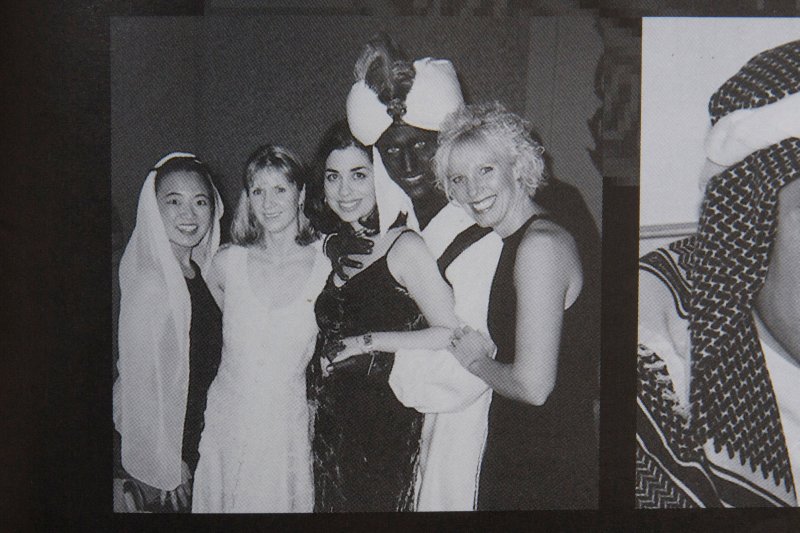
Justin Trudeau with dark makeup on his face, neck and hands at a 2001 “Arabian Nights”-themed party at the West Point Grey Academy, the private school where he taught.
Photo from the West Point Grey Academy yearbook, via Time

In agonizing for 21 seconds before answering a question about President Donald Trump’s threat to send the military after civilian protesters in American cities, Prime Minister Justin Trudeau likely risked causing as much trouble as he was hoping to avoid. Those who would like to see him denounce the president in full throat might be as annoyed as those who think he should accept there’s nothing Canada can really do to help and look out for our own best interests while the socio-political nightmare plays out.

Trudeau’s response wasn’t anything inspiring or novel or revolutionary. “It is a time for us as Canadians to recognize that we too have our challenges — that black Canadians and racialized Canadians face discrimination as a lived reality every single day,” he said. “There is systemic discrimination in Canada, which means our systems treat Canadians of colour, Canadians who are racialized, differently than they do others.”

He continued: “We need to see that, not just as a government and take action, but we need to see that as Canadians. We need to be allies in the fight against discrimination. We need to listen, we need to learn and we need to work hard to figure out how we can be part of the solution on fixing things.”

But here, at least, he was getting to the nub of the issue: To the extent the federal government can make things better for marginalized Canadians, Trudeau is the guy driving the boat. To read some of his ministers’ pensées, you would think they were just regular folks.

[…]

In the meantime, however, you can bet the farm we will soon learn that the Liberals’ changes to impaired driving laws — allowing police to stop and breathalyze drivers without any suspicion of impairment — have disproportionately affected black and Indigenous drivers in particular. Literally everybody saw it coming except Trudeau and his ministers.

OK, I’m kidding — they saw it coming too. They might want to log off, dial down the performative sanctimony and think on that a while.

June 2, 2020

Antifa

Filed under: Government, Law, Politics, USA — Tags: , , , , , — Nicholas @ 03:00

Arthur Chrenkoff welcomes the move to designate the Antifa movement as domestic terrorists:

“antifa 8973ag” by cantfightthetendies is licensed under CC BY 2.0

President Trump’s decision to designate Antifa as a terrorist organisation is long overdue.

Whether you call them a terrorist organisation or a criminal organisation – or both – the underlying facts are the same: Antifa is a network of groups committed to a violent revolution to overthrow the democratic system of government and replace it with some sort of a communist “dictatorship of proletariat”, whoever the current proletariat is supposed to be (which does not in the end matter very much, because it’s all about the party organisation rather than “the masses”). To effect such revolution, Antifa uses tactics of violence against people it considers enemies as well as destruction of property. Remember, these people are not Scandinavian social democrats or even Bernie and AOC-style “democratic socialists” who advocate and follow a democratic and peaceful path of transformation to achieve their objectives of building what they consider a better and more just society. Antifa are thugs who desire to tear down and destroy the current political and economic order and erect their utopia on its ashes. They want to abolish democracy, capitalism, liberalism and all the other existing institutions in favour of a Marxist-Leninist state — or just for the fun of it if they are more of an anarchist rather than communist frame of mind. Groups whose the entire modus operandi is based on breaking law and criminal activity have no legitimate place in a democratic society. Antifa are the political organised crime.

The label Antifa has been used and abused too long to muddy the waters and confuse people — many of whom, granted, want to be confused. Because fascism is objectively bad (and considers so by an overwhelming majority of people), calling themselves “anti-fascist”, Antifa seeks to claim the moral high ground and the role of the good guys who stand up to white supremacists, neo-Nazis and other extreme element. But you cannot simply judge people by who their enemies are, or who they say their enemies are — you also have to judge them by their intentions, actions and aims. In the Second World War, the United States and the United Kingdom and their Western allies were anti-fascist, but so was the Soviet Union. Stalin hated fascists (except for a period of two years in 1939-41 when he collaborated with them). This did not make him a good guy, even if for the Allies at the time it made him the lesser of the two evils. Coincidentally, for Stalin the label “fascist” was a very broad one, applying not just to German Nazis and their sympathisers but to anyone opposed to communism and the Soviet Union and so in turn opposed by them, including at times even social democrats and other non-revolutionary socialists {“social fascists” in the Stalinist nomenclature). And so it is for Antifa — we are all fascists, from the few skinheads at the political fringes to all the mainstream parties and ideologies of both the right and the left. Just as in Russia in 1917 onward and all the other communist countries in history, your position on the democratic political spectrum can never give you an ultimate immunity, it only determines the order in which you will be shot (left-wingers and anarchists last, because they can be used the longest by the forces of revolution).

May 31, 2020

On “spontaneous” riots

Filed under: Law, Media, Politics, USA — Tags: , , , , — Nicholas @ 03:00

David Warren had a brush with a riot as a youngster — not as a participant, but as a near-victim — so the psychology of riots has a personal edge:

To a trained observer, the organizers of the riot stand out. They are dressed distinctly, they are giving orders; they are directing the attacks. They will usually be wearing expensive communications equipment. A drama coach would notice that their harangues are premeditated and rehearsed, to stir violence. That anger in the crowd was available to them, as their raw material, goes without saying; their art consists of “weaponizing” it.

Fascists — the real ones, in pre-war Italy and Germany — were masters of this art. So were the Communists with whom they had streetfights. The blackshirts today, a near-monopoly of the Left, descend from this rich tradition. When Antifa and other leftist scum shut down public discussions in universities and elsewhere, they may use the latest technology, but to old-fashioned ends.

What is alarming is not that these people exist — radical evil is a fact in human nature — but that they are given permission to act lawlessly. Rather than arrest and prosecute them, the liberal authorities agree to silence the legitimate speaker. They are trying to avoid confrontation, with people who sought confrontation, and will seek a larger confrontation next time. The prestige of these devils in human flesh is increased by their victories.

An injustice, such as the apparent murder of George Flynn by a vicious cop, while three more stood and watched, was the pretext for the riots. It was convenient for aggravating racial tensions, by which the Democrat party hopes to retrieve black votes that had been getting away from them. I would not wish to omit this dimension of the permission they grant to rioters. Politics are a cynical business.

But note, the mostly white folk in Antifa, prefer black neighbourhoods to start race riots, for that is where resentments will be easiest to exploit. (Masks help to conceal their whiteness.) This means that the victims of the riots, whose property and businesses are gutted, will also be mostly black. The media elide this aspect of the lawlessness, because they want Republicans to be defeated, too.

The moral stench is overpowering.

January 16, 2020

QotD: Progressive hatred

Filed under: Politics, Quotations, USA — Tags: , , , , , — Nicholas @ 01:00

Something that has been noticeable for a long time now is that the Left is in a perpetual state of rage. The smallest things send them into spasms of anger. They hate Trump and they really hate his voters. They will go rummaging around in the social media history of people, looking for reasons to hate them. It’s not a general all-encompassing hate, like hating the fans of a rival sports team, but a very personal and cruel hate. They want the victim to suffer and they want to enjoy his suffering.

One reason for this, obviously, is that many people attracted to the Left are mentally unstable, so their politics are just a vehicle for their pathology. Many of the Antifa people, for example, have no coherent political thoughts. They just like being crazy on the streets and causing mayhem. This is the type of person who was attracted to the riots that used to follow the big economic summits. There was never any purpose to their rampages, other than the thrill of smashing things and causing mayhem.

Another more important reason for the rage is the nature of leftist politics in our post-national age. Being on the Left no longer means joining a group that has a tangible enemy, against whom the group throws themselves. The days of unionist, socialists and communists operating as collectives are gone. Even the post-modern movements like climate change and sexual politics is atomized. Much of it is backed by the sorts of people the Left used to oppose like rich people and business.

The Z Man, “It’s Personal”, The Z Blog, 2019-11-12.

January 13, 2020

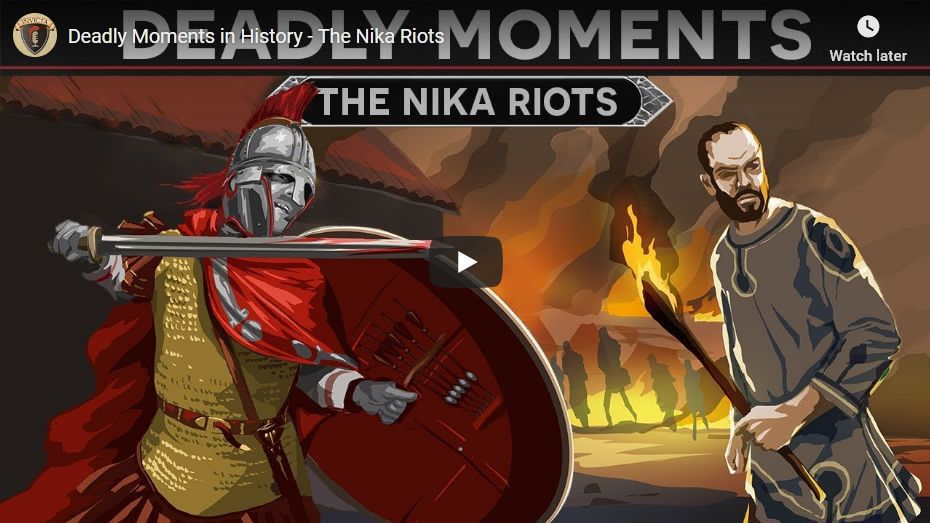
Deadly Moments in History – The Nika Riots

Invicta
Published 27 Feb 2018

We relive the deadly Nika Riots which brought the Emperor Justinian to his knees and resulted in the death of 30,000 civilians. In our journey we will explore the history of chariot racing, the undercurrents of dissent, and the blow by blow unfolding of the riot.

Support future documentaries: https://www.patreon.com/InvictaHistory
Twitter: https://twitter.com/InvictaHistory

Documentary Credits:
Research: Invicta and Luas McCahill
Script: Invicta
Artwork: Robbie McSweeney
Editing: Invicta
Music: Total War Soundtrack, Dreamnote, Recognition

Literary Sources
History of the Wars, I by Procopius
Empress Theodora by J. A. S. Evans
Justinian: The Last Roman Emperor by G. P. Baker

December 25, 2019

The Wildest Christmas Party Ever? – December 24th – TimeGhost of Christmas Past – DAY 1

Filed under: History, Military, USA — Tags: , , , — Nicholas @ 04:00

TimeGhost History
Published 24 Dec 2019

The first day of TimeGhost of Christmas is about a legendary Christmas Party bearing the equally legendary name of “the Eggnog Riots”, which took place on Christmas Eve in 1826 at the Military Academy at West Point, New York.

Join us on Patreon: https://www.patreon.com/TimeGhostHistory

Hosted by: Indy Neidell
Written by: Joram Appel and Spartacus Olsson
Directed by: Spartacus Olsson and Astrid Deinhard
Executive Producers: Bodo Rittenauer, Astrid Deinhard, Indy Neidell, Spartacus Olsson
Creative Producer: Joram Appel
Post-Production Director: Wieke Kapteijns
Research by: Joram Appel
Edited by: Mikołaj Cackowski
Sound design: Marek Kamiński

Colorizations by:
Norman Stewart – https://oldtimesincolor.blogspot.com/
Dememorabilia – https://www.instagram.com/dememorabilia/

Sources:
NYPL Digital Collections
From the Noun Project:
Wine by Ayub Irawan
Drunk by Ates Evren Aydinel
Whisky by Made by Made
Rum by Andreja Kirma
clock by Maurício Brito

Soundtracks from Epidemic Sound:
Howard Harper-Barnes – “A Sleigh Ride Into Town”
Etienne Roussell – “A Winter’s Night”
Mike Franklyn – “Christmas Bliss”

A TimeGhost chronological documentary produced by OnLion Entertainment GmbH.

December 23, 2019

Policing London – His Majesty King Mob – Extra History – #4

Filed under: Britain, History, Law — Tags: , , , — Nicholas @ 04:00

Extra Credits
Published 22 Dec 2019

John Fielding, Henry Fielding’s brother, took over the Bow Street Runners after his brother’s death. He was well known as a man who could identify over 3,000 criminals by voice alone. After all, he was blind. But his real contribution to policing was his organizational skills. He created the first Central Database of stolen goods and suspect descriptions and published papers that included not only London criminals but also descriptions of criminals wanted by other prisons in the country. And while the courts may have loved him, the public was much more skeptical. These were times marked by distrust in authority and having a criminal database seemed like an intrusion on personal liberty. What was required to change public opinion?

Join us on Patreon! http://bit.ly/EHPatreon

November 23, 2019

QotD: Populism and democracy

Filed under: Asia, Politics, Quotations — Tags: , , , — Nicholas @ 01:00

As I have previously confessed, I became a Tory at the age of six. This was riding home from St Anthony’s, on the crossbar of our family servant’s bicycle, through an angry crowd in Lahore. He’d been sent to fetch me from danger. This beloved man, Bill, whose turban revealed him to be a Christian, chose a long route home, to skirt the crowd. But there was no avoiding them, and in the course of our wild ride, I distinctly remember blood and corpses. The crowd was demanding, as I recall, death for the hostages from a hijacked Indian aeroplane, but in the absence of its intended victims, began taking its violence out on itself. Yairs, a lurid spectacle.

I was not so precocious: it took me twenty more years to sort out what I might mean by the word “Tory.” But the view itself began in Hobbesian fear, that day, with my discovery that “the people” stink. They are mindless animals, and put some wrath in them, they will lose their bashfulness. And of course, not only in West Pakistan; for gradually one makes the further discovery that “the people are the people are the people” everywhere. They need to be tamed, cautioned, repressed, sometimes caged. My response to misty-eyed rhetoric for “democracy” is unfavourable. “Populism” is, in my sight, unambiguously evil — even when its cause be, for the moment, just. Given more time, and the inevitable failure to achieve immediate goals, the cause itself will turn rancid.

David Warren, “Crowds & powers”, Essays in Idleness, 2016-11-08.

« Newer PostsOlder Posts »

Powered by WordPress