
… in the same manner that many white people who initially signed on to the whole “don’t be a racist” program because it seemed fair were eventually alienated by the escalating rhetoric of “justice won’t be achieved until the last evil melanoma-prone ice devil baby is smashed dead against a rock,” many men — and even women — who had no problem with ideas such as equal pay and female suffrage started to get grossly turned off by rhetoric and policies that viewed being born male as an original sin that demanded eternal punishment.
Even though black women live longer than white men in the USA … and even though women control more disposable wealth than men do … and even though women are snagging most of the college degrees these days … and even though the law and public sympathy heavily lean toward women in any dispute between the sexes … and even though the media portray men as either bumbling incompetents or bloodthirsty rape-monsters … and even though men are far more likely to commit suicide, die on the job, or be homeless than women … we’re still lectured by these bitter fat blobs and their testosterone-free male enablers that misandry isn’t real because men still benefit from certain mysterious “systemic” and “institutional” advantages that none of these assholes seem able to enumerate even when calmly asked to do so.
It’s a funny sort of “patriarchy” we inhabit.
To allege that women are capable of malice and violence and deception is only to allege that they’re human. To expect anything less of them would be dehumanizing and patronizing — which, ironically, shares a root word with “patriarchy.” When feminism ditched the “equity” rhetoric in favor of a menses-splattered pagan goddess religion that depicts men as irredeemable worker drones and women as innocent angels, men who weren’t entirely asleep or pussy-whipped realized that the rules had changed and that they were under attack. But even to notice that a lot of women openly exult in hating men gets you labeled a “woman-hater.”
Misandry is real, and those who seek to deny or justify it deserve a stern paddling. And even if you acknowledge that it’s real, don’t try to make excuses for it using some postmodern gobbledygook, because then you become a misandry apologist — a misandropologist. Just admit that women can be every bit as mean, nasty, horrid, foul, vile, shitty, and hateful as men. It’s part of the human condition.
Naïve as it may be, I envision an enlightened future where there is no longer any misogyny or misandry — only a beautiful, sweet, shared sense of misanthropy.
Jim Goad, “Confronting the Misandropologists”, Taki’s Magazine, 2017-05-08.
June 27, 2019
June 17, 2019
“We’ve reached peak identitarian bollocks”
Brendan O’Neill follows up on the disturbing story of two lesbians who were physically assaulted on a London bus:
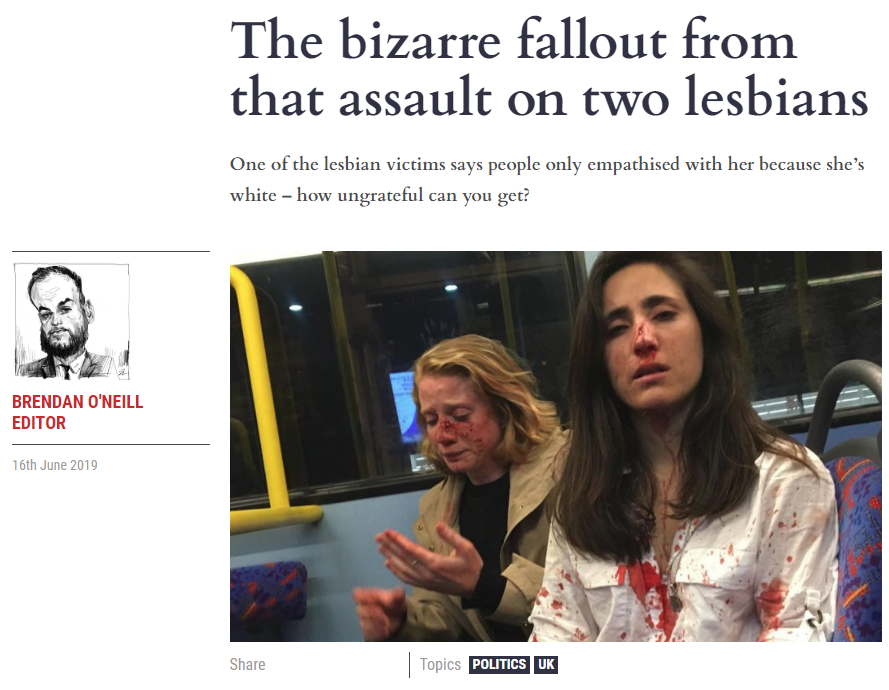
Talk about ungrateful. Brits, and people around the world, offered empathy and solidarity to the two gay women who were battered by thugs on a London bus. And yet now one of the women has turned around and told us we only care about them because they are white. It’s only because they are “two attractive, white, cisgender women” that so many people and organisations gave a damn about them and tweeted about them, apparently. Thanks a bunch. We offer our human concern for your wellbeing and you tell us we’re being racist. We’ve reached peak identitarian bollocks.
The woman in question, who goes only by the name “Chris”, has written a piece for the Guardian. Natch. The intro lets us know what we’re in for: “The photo of me and my date went viral – but only as we’re white, feminine and cisgender.” Translation: you racist, transphobic idiots wouldn’t have cared half as much if this had been two bloodied and bruised black women or trans women. The “commodification” of “my face” came at the “expense of other victims whose constant persecution apparently does not warrant similar moral outrage”, says Chris.
What is most striking about her piece is that she flagellates herself for her privilege. Yes, this woman who last month was badly beaten allegedly on account of her sexuality is now beating herself up in the national press over her privileged identity. She says she has “evaded much of the violence and oppression imposed on so many others by our capitalist, white-supremacist, patriarchal system because of the privileges I enjoy by dint of my race, health, education, and conventional gender presentation”. What a strange, self-hating mindset it must take to be victimised for your sexuality and then to say: “God, I’m SO privileged.”
Chris even does us the service of providing a list of people who are far less privileged than her and who us phoney empathisers should finally start noticing. It is “open season”, she says, on “people of colour, indigenous people, transgender people, disabled people, queer people, poor people, women and migrants”. This is classic virtue-signalling. She is engaging in the Oppression Olympics while making it clear she doesn’t deserve any gold medals in said Olympics because she is white, educated, cisgender, etc. A masterclass in identitarian showboating.
June 3, 2019
The “Miss India” controversy
The Times of India published an image of the Miss India competition finalists that drew heavy condemnation on social media:
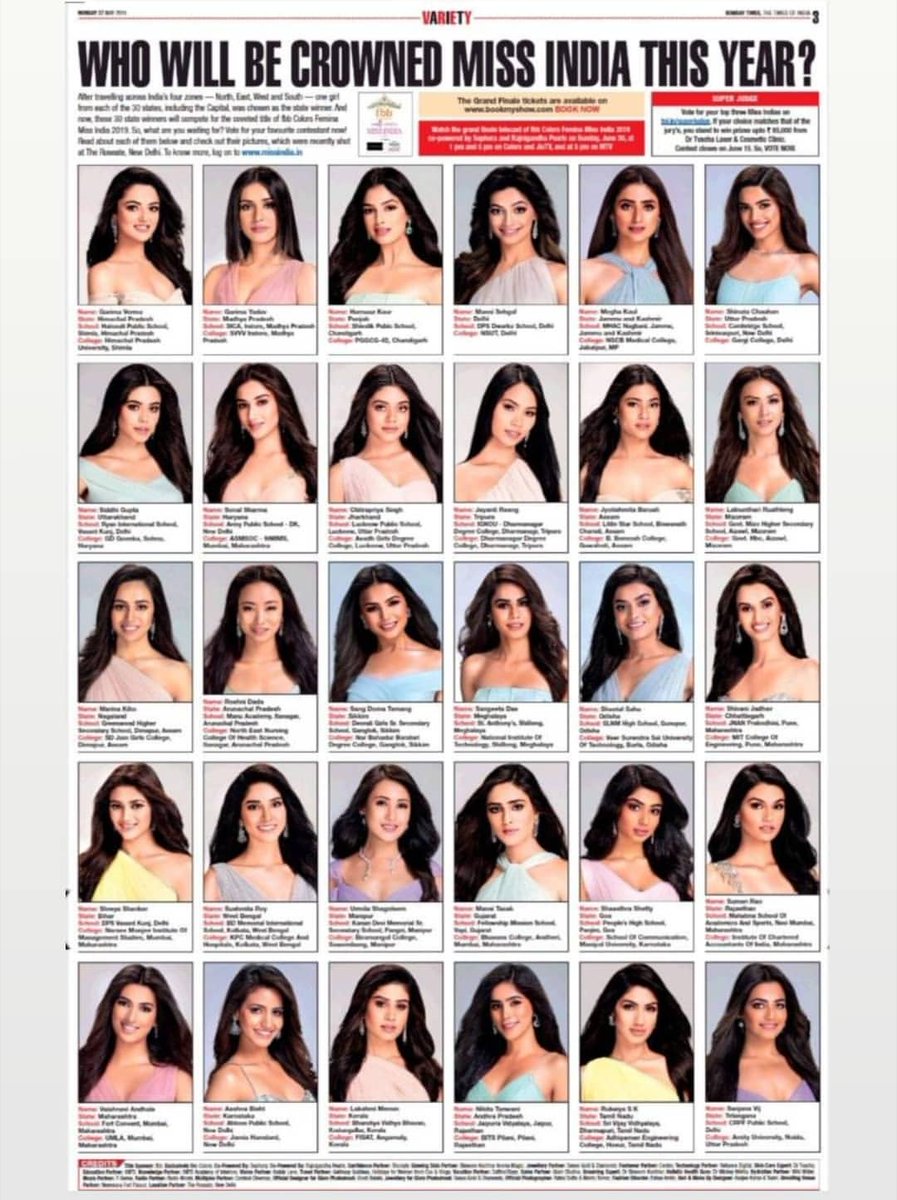
Tim Worstall explains at least some of the reasons why these young women don’t seem to resemble the majority of Indians:
To start with a question – doesn’t anyone read Jane Austen any more? For that is all that is needed to understand why all the finalists in this year’s Miss India contest seem to have the same rather pale and white complexion. Certainly, rather paler and whiter than the general run of the mill complexion seen across India.
We can also offer a Marxist interpretation – it’s a class thing, innit?
[…]
Yes, India does have that caste issue, it is true that higher castes are generally associated with lighter skins colours, lower with darker. There are even those who would insist that the caste system exists in order to maintain that dominance of the fairer skinned over the darker, something that has worked well in doing so for millennia.
And yet, Jane Austen. Apologies, the various heroines blur into a montage of Emma Thompson and Keira Knightley for me but then that’s just an expression of my masculinity, not bothering with chick flicks. But there is a scene where the sisters are fussing over their bonnets as they go out for a walk. Be careful – Lizzie? – or you might get freckles and then what man would want you? As one blessed with such melanin enhancement myself, finding it most attractive in others, why this obsession? Because a porcelain complexion was a signifier of social status.
Not because of the racial obsessions of the times – we are talking of an era when a thoroughly dark skin could make you a chattel slave, a white one not. But because a porcelain white skin was a signifier of social status therefore a porcelain white skin was a sign of social status.
70 to 80 percent of the population worked hard, outside. That meant being tanned. Only the rich did not need to do so. Thus only the rich were that pasty white which is the fate of the English gene pool when consistently out of the Sun. White was a symbol of social status not because it was white but because it meant “not farm labour”.
Of course, in the English and later European context, that dynamic started to change during the Industrial Revolution, as more and more “working class” work was done indoors and pale skin slowly declined as an indicator of wealth and privilege and instead tanned skin assumed that role (only the wealthy could waste time being outdoors, in the sun).
So, what will happen in India? Presently the country is what, still 50% of the people labouring in the fields? Something we know is declining as a portion and we expect to get to something like the English situation in a few decades, no? 6 to 8% compound GDP growth rates cause that sort of thing. 98% of all will be working under fluorescent strip lights, not under the Sun. Having both the leisure and the money to gain a tan will be a marker of social status and thus will be desired.
As to when this happens the switch really didn’t take that much time in England. Certainly in the 1930s that paleness was still highly desired. By the 1960s it was changing. Today tanning lotions sell in vast volumes, skin whiteners to the indigene English not a single drop.
When will we know the change is happening in India? It’ll not be airbrushed and photoshopped pictures of Miss India contestants that are that first marker. The day someone opens a tanning salon in an Indian urban centre and doesn’t immediately go bust will be that signifier that the great change is under way.
May 30, 2019
QotD: Wahhabism and the West
“You’re right,” he says, “it shouldn’t be different for Islam, but we make it different. Muslims fought for king and empire in both world wars. Muslims were the backbone of the Indian army. Ataturk’s Turkey was an example of Muslims functioning perfectly well in a modern democratic society — but Ataturk’s Turkey is going away. We don’t have that trust any more. It was a Wahhabi who assassinated the chief justice in British India, and that is more or less the only brand of Islam exported today — extremist Saudi-style Wahhabism. All these giant mosques you see going up in cities all over the world are not paid for locally, they’re paid for by Saudi Arabia. They’re trying to make it one-size-fits-all Islam, and a type of Islam that regards the West as its enemy, instead of the mom-and-pop Islam of the past.”
So you’re saying the problem is not Islam, the problem is Wahhabism?
“No! Wahhabism is the symptom. The problem is us. We don’t defend ourselves. If you are a woman living alone in a Muslim community in Europe, you do not venture out after 6 p.m. If there are sexual assaults by Muslims, and the allegations are made public by the victims, the accuser is inevitably accused of racism. Nobody disputes that it happened, but they’re held to a different standard because the victims are Swedes or Danes and the accused is from a Muslim country. It’s believed that it’s unreasonable to expect decent behaviour from an Afghan or an Iraqi — which is racist. You’re denying the humanity of these people. And so you surrender incrementally. You live in a citadel. You make ridiculous changes to your own culture. In Britain the banks don’t give piggy banks to children any more, because the “piggy” might be offensive. There’s a fetishisation of the burka, which should be regarded as what it is — a prison for women. Why should we abandon our own heritage to barbarism? I’m a nineteenth-century imperialist a hundred years past my sell-by date.”
Mark Steyn, interviewed by John Bloom, “Mark Steyn, Cole Porter and Free Speech”, Quadrant, 2017-05-11.
May 14, 2019
QotD: Karl Marx, noted racist
For those who see Marx as their hero, there are a few historical tidbits they might find interesting. Nathaniel Weyl, himself a former communist, dug them up for his 1979 book, Karl Marx: Racist. For example, Marx didn’t think much of Mexicans. When the United States annexed California after the Mexican War, Marx sarcastically asked, “Is it a misfortune that magnificent California was seized from the lazy Mexicans who did not know what to do with it?” Engels shared Marx’s contempt for Mexicans, explaining: “In America we have witnessed the conquest of Mexico and have rejoiced at it. It is to the interest of its own development that Mexico will be placed under the tutelage of the United States.”
Marx had a racial vision that might be interesting to his modern-day black supporters. In a letter to Engels, in reference to his socialist political competitor Ferdinand Lassalle, Marx wrote: “It is now completely clear to me that he, as is proved by his cranial formation and his hair, descends from the Negroes who had joined Moses’ exodus from Egypt, assuming that his mother or grandmother on the paternal side had not interbred with a nigger. Now this union of Judaism and Germanism with a basic Negro substance must produce a peculiar product. The obtrusiveness of the fellow is also nigger-like.” Engels shared Marx’s racial philosophy. In 1887, Paul Lafargue, who was Marx’s son-in-law, was a candidate for a council seat in a Paris district that contained a zoo. Engels claimed that Lafargue had “one-eighth or one-twelfth nigger blood.” In a letter to Lafargue’s wife, Engels wrote, “Being in his quality as a nigger, a degree nearer to the rest of the animal kingdom than the rest of us, he is undoubtedly the most appropriate representative of that district.”
Marx was also an anti-Semite, as seen in his essay titled “On the Jewish Question,” which was published in 1844. Marx asked: “What is the worldly religion of the Jew? Huckstering. What is his worldly God? Money. … Money is the jealous god of Israel, in face of which no other god may exist. Money degrades all the gods of man — and turns them into commodities. … The bill of exchange is the real god of the Jew. His god is only an illusory bill of exchange. … The chimerical nationality of the Jew is the nationality of the merchant, of the man of money in general.”
Walter E. Williams, “What Do Leftists Celebrate?”, Townhall.com, 2017-05-10.
May 12, 2019
QotD: The British Army between the wars
In the nineteenth century the British common soldier was usually a farm labourer or slum proletarian who had been driven into the army by brute starvation. He enlisted for a period of at least seven years – sometimes as much as twenty-one years – and he was inured to a barrack life of endless drilling, rigid and stupid discipline, and degrading physical punishments. It was virtually impossible for him to marry, and even after the extension of the franchise he lacked the right to vote. In Indian garrison towns he could kick the “niggers” with impunity, but at home he was hated or looked down upon by the ordinary population, except in wartime, when for brief periods he was discovered to be a hero. Obviously such a man had severed his links with his own class. He was essentially a mercenary, and his self-respect depended on his conception of himself not as a worker or a citizen but simply as a fighting animal.
Since the war the conditions of army life have improved and the conception of discipline has grown more intelligent, but the British army has retained its special characteristics – small size, voluntary enlistment, long service and emphasis on regimental loyalty. Every regiment has its own name (not merely a number, as in most armies), its history and relics, its special customs, traditions, etc., etc., thanks to which the whole army is honey-combed with snobberies which are almost unbelievable unless one has seen them at close quarters. Between the officers of a “smart” regiment and those of an ordinary infantry regiment, or still more a regiment of the Indian Army, there is a degree of jealousy almost amounting to a class difference. And there is no question that the long-term private soldier often identifies with his own regiment almost as closely as the officer does. The effect is to make the narrow “non-political” outlook of the mercenary come more easily to him. In addition, the fact that the British Army is rather heavily officered probably diminishes class friction and thus makes the lower ranks less accessible to “subversive” ideas.
But the thing which above all else forces a reactionary view-point on the common soldier is his service in overseas garrisons. An infantry regiment is usually quartered abroad for eighteen years consecutively, moving from place to place every four or five years, so that many soldiers serve their entire time in India, Africa, China, etc. They are only there to hold down a hostile population and the fact is brought home to them in unmistakeable ways. Relations with the “natives” are almost invariably bad, and the soldiers – not so much the officers as the men – are the obvious targets for anti-British feeling. Naturally they retaliate, and as a rule they develop an attitude towards the “niggers” which is far more brutal than that of the officials or business men. In Burma I was constantly struck by the fact that the common soldiers were the best-hated section of the white community, and, judged simply by their behaviour, they certainly deserved to be. Even as near home as Gibraltar they walk the streets with a swaggering air which is directed at the Spanish “natives.” And in practice some such attitude is absolutely necessary; you could not hold down a subject empire with troops infected by notions of class-solidarity. Most of the dirty work of the French empire, for instance, is done not by French conscripts but by illiterate Negroes and by the Foreign Legion, a corps of pure mercenaries.
To sum up: in spite of the technical advances which do not allow the professional officer to be quite such an idiot as he used to be, and in spite of the fact that the common soldier is now treated a little more like a human being, the British army remains essentially the same machine as it was fifty years ago.
George Orwell, “Democracy in the British Army”, Left, 1939-09.
April 22, 2019
Internal challenges to Microsoft’s current discriminatory hiring practices
At Quartz, Dave Gershgorn looks at how Microsoft is facing internal dissent over their current hiring practices, which actively encourage discrimination against certain racial and gender groups:

Some Microsoft employees are openly questioning whether diversity is important, in a lengthy discussion on an internal online messaging board meant for communicating with CEO Satya Nadella.
Two posts on the board criticizing Microsoft diversity initiatives as “discriminatory hiring” and suggesting that women are less suited for engineering roles have elicited more than 800 comments, both affirming and criticizing the viewpoints, multiple Microsoft employees have told Quartz. The posts were written by a female Microsoft program manager. Quartz reached out to her directly for comment, and isn’t making her name public at this point, pending her response.
“Does Microsoft have any plans to end the current policy that financially incentivizes discriminatory hiring practices? To be clear, I am referring to the fact that senior leadership is awarded more money if they discriminate against Asians and white men,” read the original post by the Microsoft program manager on Yammer, a corporate messaging platform owned by Microsoft. The employee commented consistently throughout the thread, making similar arguments. Quartz reviewed lengthy sections of the internal discussion provided by Microsoft employees.
“I have an ever-increasing file of white male Microsoft employees who have faced outright and overt discrimination because they had the misfortune of being born both white and male. This is unacceptable,” the program manager wrote in a comment later. The Microsoft employees who spoke to Quartz said they weren’t aware of any action by the company in response, despite the comments being reported to Microsoft’s human resources department.
When contacted by Quartz, Microsoft pointed to comments by three company officials in the message-board threads. A member of Microsoft’s employee investigations team responded to the initial post in January, writing that the company does not tolerate discrimination of any kind. Another Microsoft staff member, who leads the team that helps the board of directors determine executive pay, explained the diversity-based compensation initiative. “Our board and executive leadership team believe diverse and inclusive teams are good for business and consistent with our mission and inspire-to culture,” she wrote. “Linking compensation to these aspirations is an important demonstration of executive commitment to something we believe strongly in.
April 7, 2019
Rubin “Hurricane” Carter and the murders at the Lafayette Bar and Grill in Paterson, New Jersey
I was too young to know anything about Rubin “Hurricane” Carter except what I “learned” from listening to Bob Dylan’s “Hurricane” long after the events. In Quillette, Lona Manning recounts the story, which doesn’t agree with Dylan’s interpretation (but Dylan was far from the only journalist or celebrity to be fooled):
How many people who followed the BBC Radio 4 podcast series about Rubin “Hurricane” Carter were startled — or even outraged — when Carter was not triumphantly vindicated in the final episode?
In the small hours of June 17, 1966, two black men walked into a late-night Bar and Grill in Paterson, New Jersey and opened fire on the occupants. They left bartender James Oliver and patron Fred Nauyoks dead at the scene and mortally wounded a woman named Hazel Tanis, who would succumb to her injuries a month later. Another customer named Willie Marins lost an eye in the shooting but survived. Neighbors Patty Valentine and Ronald Ruggiero told police that they had seen two black males flee the scene in a white vehicle. This testimony was corroborated by petty thief Alfred Bello who walked past the dead and the dying to empty the cash register after the shooters had fled.
Half an hour later, Paterson police stopped middleweight boxer Rubin Carter and his companion John Artis in a car bearing out-of-state plates that matched the eyewitnesses’ description. A search of the car yielded a .32 and a 12 gauge shotgun, the weapons police later determined had been used in the shooting. Carter and Artis were eventually indicted by a grand jury and convicted of the Lafayette murders in 1967. Carter vehemently protested his innocence and his case became a cause célèbre after his 1975 autobiography found its way into the hands of Bob Dylan. Carter was retried in 1976, after the New Jersey Supreme Court ruled that the first conviction had been unsafe. Despite support from Dylan, Muhammad Ali and the New York Times, the two were convicted again. John Artis was paroled in 1981, and Carter was finally released in 1985 after the second conviction was overturned and prosecutors declined to try him a third time.
Sports reporters Joel Hammer and Steve Crossman spent 18 months researching and reinvestigating the case and promised listeners of the BBC’s podcast that they would provide the “full” and “true” story. Their in-depth look at the crime provides far more detail about the murders than can be gleaned from Bob Dylan’s 1975 protest song or the hagiographic 1999 Norman Jewison film starring Denzel Washington. Dylan accused the prosecution team of framing Carter for the slayings and called them “criminals in their coats and their ties” who were “free to drink martinis and watch the sun rise.” Crossman and Hammer are likewise very critical of the prosecution; for example, they think that Alfred Bello should never have been allowed to testify. How could the life of such a man, be in the palm of some fool’s hand? And they argue that the prosecution ignored — or perhaps even suppressed — an investigation into a very plausible suspect, Eddie Rawls (who is now deceased). But they stop short of calling it a frame-up and an attempt at judicial murder.
On the other hand, Crossman and Hammer think the “racial revenge motive” was a reasonable one. The very first newspaper accounts of the slaughter at the Lafayette Grill included the speculation that the murders were committed in revenge for the slaying, earlier that night, of black bartender Roy Holloway and this would also be the prosecution’s contention. That Crossman and Hammer now accept the plausibility of this theory is a significant concession to the prosecution’s version of events, not least because it was Judge Lee Sarokin’s rejection of this motive which led him to overturn the second conviction—the prosecution’s case, he ruled, had been based on “racism rather than reason.”
Coincidentally, on the front page of the East Bergen Record, under the murder story, there was a wire service article about Stokely Carmichael proclaiming “Black Power” at a rally in Mississippi, an event which marked the transition from the peaceful civil rights tactics of Dr. Martin Luther King to the radical activism of the Black Panthers. These two articles encapsulated all the elements of the Lafayette Grill case that continue to be debated over 50 years later. Why did someone walk into a working-class bar and slaughter the occupants? Was the black community in Paterson in a ferment that night because a white man blew off Holloway’s head with a shotgun? And what, if anything, did this have to do with the state of race relations in America at the time?
March 25, 2019
QotD: Village life
I hate rumor. Perhaps I hate it more because I grew up in a village.
The people who imagine villages are idyllic and every person in it loves the other like a brother or sister, have no knowledge of people — or reality. Sure, in many villages in isolated places, most of the people there are related to some degree. This was not true where I grew up, because the village was already in the process of exploding into a large-city suburb. It wasn’t visible to me as a child, because it was so slow, and newcomers still took years to integrate, but it it had been going on for so long that the appellation of “aunt” given to any grown woman by any child was just courtesy, not truth. Still, had we been all related, people who imagine that makes for harmonious living must have been only children and the children of only children.
No, never mind, I’m being silly. Those people are actually enormous racists and oikophobes. Hating their own home, they imbue places far away, particularly those inhabited by people who tan more than they do, with the qualities of heaven. They also in the process make those people-who-tan (or as I always think when I’m the object of this type of thought, and yes, I am, it’s what enables them to think themselves my intellectual superiors a-priori “Little brown peoples”) less than human. They (we) are not people with our own agency, and all the virtues and vices of mankind, but sort of little pets, perfect, well behaved and needing both the protection of our masters, the pale enlightened, and their pat on the head for how good we are. (Most of the left’s ideas on “defeating colonialism” envision themselves as benevolent colonial masters. In fact, the colonialism of Marxist ideas in Africa is what has made it hell on Earth, far worse than any colonial overseers could do. By turning their best and brightest into Marxist apostles at our “finest universities” they get to send these ideas back to Africa. There was some idea they would flourish there among people unsullied by greed and the wish to succeed individually (yes, it’s that racism again. It is inherent in the left’s contrived “celebration” of black people, Kwanza, which is really a celebration of socialist principles. And no, is in no way African. It was invented in the US. For one there isn’t such a thing as an “African” holiday. The continent is as or more varied than Europe (because transport was near impossible for most of its existence, tribes and villages were very isolated indeed.)) It didn’t. Instead it has made Africa worse than ever before. And this was done by turning its favorite sons, its brightest sparks into poison pills. Colonialist Marxism is appalling and responsible for the deaths of millions. As is Marxism everywhere.)
Sarah Hoyt, “Painted All In Tongues”, According to Hoyt, 2017-03-20.
March 22, 2019
Debunking Stephen Jay Gould
Several years back, I linked to a David Friedman post on a study that contradicted a key argument in Stephen Jay Gould’s book The Mismeasure of Man. While I’ve read a few of his books, it’s been nearly 15 years since I last read anything by him … by now I only have a vague recollection of what he wrote, but his works were quite popular at the time. Much more recently Russell T. Warne looked at different problems in Gould’s work that are much more damaging to his reputation:
Stephen Jay Gould, the famous 20th century paleontologist, published his most celebrated work, The Mismeasure of Man, in 1981. Gould’s thesis is that throughout the history of science, prejudiced scientists studying human beings allowed their social beliefs to color their data collection and analysis. Gould believed that this confirmation bias was particularly powerful when a scientists’ beliefs were socially important to them. […] The Mismeasure of Man provides a great deal of evidence that scientists’ pre-existing beliefs color their judgment — but not in the way he intended. Rather, the book is a perfect example of the sin it purports to expose in others. Gould’s Marxist political beliefs made him attack intelligence research because he saw it as a threat to his egalitarian social goals. Ironically, it was this allegiance to ideology over data that made Gould himself a classic examplar of a biased scientist.
[…]
Most criticism of The Mismeasure of Man was confined to the recherché world of psychologists who study intelligence. However, a new debate opened up in 2011 when a team of anthropologists argued that Gould’s analysis of the data on cranium measurements from 19th century scientist Samuel George Morton was flawed. Gould cast Morton as a racist who fudged his data to match his beliefs about white racial superiority because of a supposed larger skull capacity. Instead, the anthropologists argued, it was Gould who manipulated the data to support his biases.
This ignited a series of follow-up articles in the scholarly literature by authors taking a variety of positions regarding Morton’s data and Gould’s interpretations. Weisberg believed that the re-analysis was flawed and Gould was mostly correct. Kaplan and his colleagues claimed that Morton’s interpretations were flawed, but that Gould was incorrect in believing that he could discern Morton’s actions and motivations. Finally, Mitchell believed that Morton’s data were accurate and that the interpretations were colored by the racism of the era, but the claim that Morton subtly manipulated the data was a fiction created by Gould.
Though still unresolved, the debate shows that a critical analysis of specific sections of The Mismeasure of Man is warranted. After writing an article about Lewis Terman, an important developer of early intelligence tests, I decided that a 23-page section of The Mismeasure of Man would be a valuable section of the book to analyze. This section is Gould’s description and analysis of the Army Beta test, one of the tests that Terman helped create. The Army Beta was used in World War I to screen illiterate recruits for military service.
Having read some of the primary scholarly work about the Army Beta, I knew that some of Gould’s claims were inaccurate. However, I was unprepared for the level of pervasive deception that I encountered when I carefully checked Gould’s claims against the historical record. Moreover, I discovered overwhelming evidence that any pretense of Gould being “objective” — even if defined as “fair treatment of data” — is a farce. In The Mismeasure of Man, Gould elevates his biases to the status of uncontestable facts and to great lengths to hide the truth from his readers.
February 5, 2019
QotD: Democracy and diversity
Whether ethnic diversity is compatible with democratic republican government is open to question, though it is considered impolite, or worse, to raise that question. Democracy requires a demos. Truly free, democratic, and stable multiethnic societies are rare, as the Europeans are learning again. There’s Switzerland, sure, but a core principle of the Swiss solution is separation: the country’s four ethnicities are mostly concentrated in their own cantons. Switzerland is a highly decentralized confederacy, where most political issues get decided at the canton level, which minimizes ethnic and regional tensions. The federal government in Bern is practically invisible; most Swiss can’t name their country’s president. This is not a model easily replicated.
The history of the United States does not convincingly prove that ethnic diversity is part and parcel with democracy. Ask a random man in the street of any blue-state city what the purpose of America is, and he’s likely to tell you that it’s immigration—though the word appears nowhere in the founding documents. The U.S. was, from its beginnings, multiethnic, multiracial, multi-religious, and multilingual. But until recently, this background condition was not seen as the font of our national strength. Rather, for most of our history, it was a problem to be overcome through nation-building and assimilation, which America excelled at. By the early 1960s, United States had come close to creating its own unique national ethnicity, albeit one that starkly excluded African-Americans. But even this exception seemed to be moving rapidly toward resolution before the country gave up on nation-building in the late 1960s. One can make a strong case that the early Civil Rights movement was a product of the mid-century high-water mark of American nationalism. Listen to Martin Luther King’s “I Have a Dream” speech; it’s striking how classically nationalist it is, from its evocation of the country’s geographical features to the reaffirmation of its basic creed of freedom, equality, and individual rights, to its Old Testament rhetoric rooted in John Winthrop’s Puritanism.
E.M. Oblomov, “The Case for National Realism: Diversity is the hallmark of empires, not democracies”, City Journal, 2019-01-02.
January 26, 2019
QotD: Racism, paranoia, and Presidential Derangement Syndrome
Political prejudice is not the moral equivalent of racial prejudice, but they operate in very similar ways, as anybody who ever has spent much time around a genuine racist or anti-Semite knows. Taxes too high? Blame the blacks. Not making enough money? Blame the Mexicans. Foreign policy seem overwhelmingly complex? Blame the Jews. Whataburger gave you a full-on corn-syrup Coke instead of a Diet Coke? Blame the blacks, Mexicans, Jews, subcontinental immigrants … somebody. Racism and anti-Semitism are metaphysical creeds, and those who adhere to these creeds see the work of the agents of evil everywhere. For them, there is no world outside race and racism.
In this, they are very similar to the Hillary Clinton–voting Manhattan balletomanes who seethe that they must endure being seated in the David Koch theater. David Koch’s brand of libertarianism is mild and constructive, and it has about as much to do with ballet as Keith Olbermann has to do with astrophysics. But for the fanatic, even to hear the name spoken is unbearable.
The people who believe that there can be no art, literature, culture, or life apart from politics are people who do not understand art, literature, culture, or politics.
Imagine being so mentally poisoned and so spiritually sick that you feel the need to organize a protest at New York–Presbyterian Hospital because the institution accepted $100 million — the largest gift in its history, being put to purely philanthropic health-care purposes — from someone whose political views are at odds with your own. Imagine what it must be like to feel that doing that is a moral imperative. Imagine sitting down to listen to a Beethoven string quartet and being filled with paralyzing anxiety that the cellist might not share your views on the Arab–Israeli conflict.
Kevin D. Williamson, “No Republicans Need Apply”, National Review, 2017-02-12.
January 7, 2019
The Private Army of the British East India Company
Brandon F.
Published on 15 Dec 2018Before the days of the Raj, British India was ruled by a private corporation: The Honourable East India Company. The Company, which began in India as a purely mercantile institution, eventually came to control vast territories across the subcontinent. These wild frontiers and busy cities required garrisons to defend them, and the expansion of Company interests demanded the ability to wage war. To do this, the Company commanded a massive private army. Made up of both European and Indian soldiers, and working in close — if not always frictionless — tandem with H.M.’s regiments, it was a fascinating institution that only came to an end with the massive Sepoy Mutiny of 1857 and the dissolution of Company rule.
In this video, I discuss the organization of this army, and the way in which it related to government forces.
If you would like to support the Channel on Patreon:
https://www.patreon.com/BrandonF
January 6, 2019
“Carding” is an infringement of rights that does nothing to reduce crime
Chris Selley wonders why the blatantly unconstitutional practice of “carding” people without even a hint of suspicion that they’ve done anything wrong was instituted in the first place:
… it’s far easier to make a case that carding has no effect at all on serious crime than that it has a huge one. But even if previous carding practice had “worked,” even if the new regulation had stopped it from working, it barely even amounts to a defence. As [Justice Michael] Tulloch notes, “the regulation simply gives effect to the existing law that people do not have to provide their identification when there are no reasonable grounds to believe the person has committed an offence.”
If carding “worked,” in other words, it relied on citizens not knowing or caring about their already-existing right to be left alone whilst minding their own business, or being too intimidated to exercise that right — as well they might be. Politely refusing an armed man or woman’s request to identify yourself is no small thing, all the more so if you have “nothing to hide.”
The problems inherent in such a situation are myriad. There are quantifiable harms: People were denied jobs and security clearances, and in at least one case menaced by child services, thanks to information stored in police databases that implicated them in nothing other than being included in a police database. And there are more existential harms. Imagine growing up with a squeaky-clean nose yet constantly feeling like a person of police interest. It’s profoundly alienating, especially when targets quite logically conclude, based on well-documented statistics if not their own intuition, that they’re being harassed because of their race, skin colour or some other innate characteristic. It’s no less insidious if the bias is unconscious; it might even be more so.
Nothing good can come from it, and plenty bad. It hinders police in solving crimes, for one thing: “When a segment of society believes that it has been unfairly targeted by the police,” Tulloch writes, “it will delegitimize the police in their eyes.” All those desperate calls for witnesses to come forward will be met more skeptically. Tulloch cites research showing “inappropriate interaction with police” can even “desensitize young people from guilt regarding potential acts of crime.”
QotD: English racism
The old-style contemptuous attitude towards ‘natives’ has been much weakened in England, and various pseudo-scientific theories emphasising the superiority of the white race have been abandoned. Among the intelligentsia, colour feeling only occurs in the transposed form, that is, as a belief in the innate superiority of the coloured races. This is now increasingly common among English intellectuals, probably resulting more often from masochism and sexual frustration than from contact with the Oriental and Negro nationalist movements. Even among those who do not feel strongly on the colour question, snobbery and imitation have a powerful influence. Almost any English intellectual would be scandalised by the claim that the white races are superior to the coloured, whereas the opposite claim would seem to him unexceptionable even if he disagreed with it. Nationalistic attachment to the coloured races is usually mixed up with the belief that their sex lives are superior, and there is a large underground mythology about the sexual prowess of Negroes.
George Orwell, “Notes on Nationalism”, Polemic, 1945-05.


