Quotulatiousness

February 8, 2022

“… across the developed world the elite rise up against the masses: it’s like an anti-1848, prefiguring the post-democratic era that the 2020s will usher in”

A round-up at SteynOnline of various “elites” in Canada and elsewhere rising up against the sexist, hate-speechin’, Islamophobic, transphobic, Putin-controlled white supremacists who are demanding an end to rule-by-decree:

In Ottawa, attempts by agents provocateurs to provoke violence at the Freedom Rally have gone nowhere. So last night, “anti-hate” buffoon Bernie Farber, friend to censors everywhere, was reduced to hate-hoaxing for Justin by circulating “anti-semitic flyers” sent to him by a “friend” “in Ottawa”. Inevitably, within moments, they were revealed to be from something entirely different in Florida some weeks ago. So Bernie explained that his imaginary friend in Ottawa had seen actual hate flyers in Ottawa but had accidentally emailed him a similar flyer from America or something … These days Farber disgraces even himself.

Meanwhile, the Ottawa police have begun arresting citizens trying to deliver food to the truckers. There is no basis in Canadian law for the actions these goon coppers are taking, but the attitude of their dreadful police chief is: hey, the law is whatever I say it is. So he has ordered the arrest of citizens for “mischief”. By mischief, he means bringing sustenance or heat to protesters passing the night in temperatures of twenty below.

~Many parts of the western world are in a very dark place right now, but none more so than Canada. Its unseen prime minister, who came into office promising “sunny ways”, can no longer appear in public and sweepingly, tweetingly declares that he doesn’t need to because the sort of chaps you run into out there are rubes who don’t even know they’re Islamophobes, transphobes, thisaphobes, thataphobes, too dumb even to be aware they’re working for Putin.

As Tucker and I used to joke five years back, across the developed world the elite rise up against the masses: it’s like an anti-1848, prefiguring the post-democratic era that the 2020s will usher in. The present showdown between the Bollywood Bridesmaid and the truckers who deliver his quinoa has made it about as explicit as you can get. The good humour in the face of elite contempt is impressive. Here are a couple of typical “angry” “hate-filled” “white supremacists”:
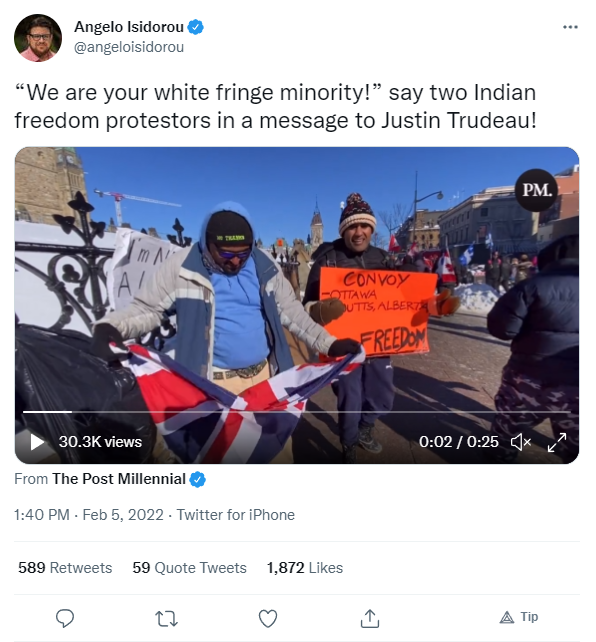
Who are the real “Sunny Ways” guys? A serial blackface fetishist is calling the masses racist and the court eunuchs of Canada’s state-funded media dutifully tag along.

~The truckers are rallying against “vaccine mandates”, which have no justification in science: The Prime Minister, who is as vaxxed, jabbed and boostered as any mammy singer on the planet, is supposedly hors de combat because he’s down with a second dose of the Covid.

Oh, but don’t worry! To be sure, the common understanding of the word “vaccine” is that you won’t catch what you’re being vaccinated against. But what we really mean is that, if you do get it, it won’t be serious, you won’t be in the ICU, and you certainly won’t die of it.

And by “certainly” we mean, well, probably. Israel, en route to be the world’s first entirely fourth-jabbed nation, currently has a daily death toll higher than before it started giving anyone the first jab. There is no public-health justification for making liberty conditional on compliance with the developed world’s failed strategy of coerced vaccines and constant testing.

At SDA, Francisco provided some quick notes on the situation on the streets in Ottawa over the last couple of days:

Looks like the cops got a couple of slip tanks and some jerry cans. A couple of pickup trucks got towed for having slip tanks on them. Nothing major. The new rule is if you have the paperwork to prove you’re a trucker you can transport fuel to your own vehicle but not to someone else’s. A campaign has started to get everyone on the hill to carry an empty jerry can with them at all times. Let the cops figure out which ones have fuel.

There was a show of force by police. Estimate was up to 100 officers in one group. They got their photo-op for the corporate press. Looks great on TV but it had no real impact. Everyone is still there.

Word on the street is that the goal for the police is to get everyone out of there today, clean things up tomorrow and have parliament resume on Wednesday. To which I say good luck.

Morale amongst the protesters is high.

Again take everything I just wrote here with a grain of salt. It’s a fluid situation and good intel is hard to come by in the heat of the moment.

I am not a lawyer, but I’m deeply puzzled at what part of the Criminal Code the Ottawa police are depending on for these imposed restrictions on fuel, food, and other supplies being provided to the truckers by ordinary Canadians. I don’t recall any provision in the law allowing police to confiscate the legal goods of ordinary people on a whim.

Brendan O’Neill on the shitshow that was the original fundraising campaign to help the truckers on their way to Ottawa:

We need to talk about GoFundMe’s withholding of millions of dollars from the Canadian truckers protesting against vaccine mandates. This is union-busting 21st-century style. This is a multimillion-dollar company using its corporate clout to starve working-class activists of funds. This is a signal from Silicon Valley, clear and loud, that it will wield its power to crush any form of political agitation from “the lower orders” that pushes too hard against the political consensus. Anyone who thinks this clash between a profit-making fundraising website and drivers pissed off at being pushed around by Covid authoritarians is just another weird online spat needs to think again. This is far more than that. It is a scoping out of the battlelines over freedom and power that are likely to define the internet era.

GoFundMe’s deprivation of funds to the truckers protesting against Canada’s vaccine rules is, to my mind, one of the most egregious and anti-democratic acts yet carried out by the California-based elites who oversee the World Wide Web. These truckers, such essential workers, are revolting against Canadian PM Justin Trudeau’s introduction of a new rule earlier this month stipulating that truckers who cross the Canada-US border will need to be vaccinated or else go into quarantine after every trip. This is a mad demand. It would severely undermine some truckers’ ability to earn a living. So truckers have risen up. They drove their vast rigs across Canada in what came to be known as the Freedom Convoy before stopping in the capital Ottawa where they have been blocking roads and causing fainting fits among middle-class liberals who cannot understand why these oiks won’t just carry on dropping off sacks of kale to the local Whole Foods and stop going on about their pesky rights.

There has been an outpouring of support for the truckers. Canadians and Americans tired of corona-authoritarianism are cheering the truckers for honking a huge collective horn at the elite consensus on Covid. Despite the best efforts of woke politicians and columnists to depict the truckers as QAnon on wheels, as a motorised version of Mussolini’s March on Rome, many people know that in truth they are decent working people who simply object to the state making their lives that bit harder. People also know that the woke set’s attempts to delegitimise the Freedom Convoy by flagging up “far-right” comments made by a tiny handful of the truckers is a tactic as old as capitalism itself. Elite opponents of working-class organisation have always used smear and innuendo to try to nullify the throng. Seeing this smear campaign for what it is, lots of folk decided to give the truckers a few bucks. But GoFundMe had other ideas.

GoFundMe says the 10million Canadian dollars raised via its website, on a page titled “Freedom Convoy 2022”, will not be given to the truckers after all. It cited police reports about “violence” in the convoy. What violence? Where? Thousands and thousands of people have joined the truckers’ protest and yet there have only been three arrests. One person was arrested for being in possession of a weapon, one for causing “mischief”, and one for making a threatening comment on social media. As far as mass protests go, this is a staggeringly low level of allegedly criminal behaviour. I once visited the Occupy camp at St Paul’s in London and witnessed at least three misdemeanours in the one hour I was there (public urination, threatening speech, and a disturbing of the peace by a man on smack who kept shouting “GET TAE FUCK”). For a mass, angry, revolting movement, Freedom Convoy is uncommonly peaceful. GoFundMe’s “violence” blather is clearly a jumped-up pretext for its political decision to punish the truckers.

On Friday, GoFundMe issued a statement saying that Freedom Convoy was a peaceful movement when it first started but it has since “become an occupation”. And so, “no further funds will be directly distributed to the Freedom Convoy organisers”. Instead, the $9million that remains in GoFundMe’s coffers will be distributed to “credible” charities or refunded to the people who donated if they fill in a form. As if to make it super clear that this is all very political, Facebook has now removed a page promoting a Freedom Convoy in Washington, DC and deleted the personal account of the trucker who set it up. “It’s censorship at its finest”, he said, and he’s not wrong. This looks like a cut-and-dried case of the new capitalist oligarchies siding with the political establishment – in this case, Justin Trudeau – to shrink and silence the consensus-threatening cries of ordinary people.

I didn’t donate to the original crowdfunding campaign for the truckers on GoFundMe, but after that company attempted to quite literally steal $10 million away from the truckers and donate the money instead to causes they approved of, I scraped up a few bucks to add to the replacement fundraising efforts with GiveSendGo and I will actively avoid ever sending GoFraudMe a penny.

Matt Gurney has driven in from Toronto to see for himself what the protest looks like:

Depending on which person you’re using as your explainer of the local vibe, you could reasonably walk away convinced that most of what was happening in Ottawa was a pretty big party, or a hostile invasion by thugs and harassers. I wanted to find out which one it was, so on Sunday, I drove in from Toronto, arriving early Monday morning. I spent hours wandering the city, particularly the area immediately around Parliament Hill, trying to answer that question. Is this a huge group of friendly people? Is this a mob of unruly, dangerous types?

The answer is yes.

The following is my view of the situation in Ottawa, and should be seen entirely in that light. I should also note that I’m a tall, unsmiling white dude with a buzzed head who wandered the area in a gigantic and delightfully warm NFL hoodie, and it’s very possible that my experience was skewed by the fact that I blended in. There are other protest sites at other parts of the city, as well, and I’ll be heading out to some of them later. The observations below are what I saw around Parliament, and within perhaps a 10-minute walk of it.

The first thing you should know is that the protest is, in the main, friendly, at least to someone like me. The photos you’d have seen do it justice. Large transport trucks and smaller personal vehicles are packed tightly together along major streets around Parliament, and the road space and surrounding sidewalks have been colonized by the occupants. Booths and folding tables are everywhere, some selling trinkets, others for supplies or flyers and leaflets. I suspect this will anger locals tired of the protest, but I have to call it as I see it: the overall vibe was quite friendly. I spent about two hours wandering the largest sites, and was struck by the amount of direct eye contact. There’s none of the usual practiced disinterest in those around you that you internalize when you live in a big city (Ottawa is big enough, in that respect). The protesters are eager to make eye contact and to chat, about everything — the weather (warmer!), the Superbowl, and, oh, how Trudeau has to go and the pandemic is a lie. And how about those Maple Leafs?!

[…]

For all the friendly chatter, there is another element in the group. I haven’t owned any bars, but I’ve spent some very pleasant evenings in them, plus an entire career observing people, and I have passable danger-spotting skills. (My success rate at avoiding getting suddenly sucker-punched at dive watering holes hovers at very near 100 per cent!) There is a harder, nastier edge to this group, what my bar-owning friend would have called “the hard men.” It’s not large, at least not in the area immediately around Parliament during daylight — there are other areas I’ll be checking out later today, and the vibe may well change. The group around Parliament is overwhelmingly quite pleasant and, as noted, unusually friendly and eager to chat. But anyone who denies there’s another element there, though, is blind to it, wilfully or otherwise.

Again, I’m a big white guy, and I blend in by default, but more than once I felt myself being calmly but directly observed by exactly the type my bar-owning friend spoke of. There are hard people there, often in small groups, talking quietly by themselves, or standing silently, watching the comers and goers. If you know what to look for, and not all of us do, they’re easy to spot. The more friendly, chatty types give them a wide berth. I spent a few interesting moments standing by a folding table stacked high with hygiene supplies, observing three stone-faced men participating in a kind of staredown with one of the roving police units. The police simply stopped and stood in place. No one said a thing. After maybe a minute, the hard men left. The police marched off. A woman behind the table with the toilet paper and tooth paste tubes looked at me with relief.


January 22, 2022

“China’s statistics remain in the hands of officials who carefully do everything possible to make sure China’s image remains unblemished”

Filed under: China, Government, Health — Tags: , , , , , — Nicholas @ 03:00

I’ve been a disbeliever in official Chinese statistics for many years — one of the first repeat topics on the blog in 2004 was the unreliable nature of Chinese government statistics on economic growth. As a result, I find it very easy to believe that the Chinese statistics on deaths due to the Wuhan Coronavirus pandemic are unreliable, as John Horvat explains:

Wuhan Institute of Virology.
Wikimedia Commons.

As the latest wave of COVID cases surges in the West, all is quiet in the East. It has always been quiet. Millions have died from the coronavirus epidemic as it sweeps the world. However, few consider it strange that the nation where the virus first appeared amid an entirely unprotected public of 1.3 billion people should record a mere 4,636 fatalities over the past three years.

China’s statistics remain in the hands of officials who carefully do everything possible to make sure China’s image remains unblemished. They claim that low numbers are due to the communist nation’s brutal “zero tolerance” policies. China is presented as a model for the West.

Some voices are appearing that dispute this claim. One expert says the fatality figures are likely closer to 1.7 million. This figure would put China in the same camp as the rest of the world. It would also point to the failure of the world’s strictest lockdown and explain the recent shutdowns of whole cities and regions due to the virus, which supposedly kills no one in China.

[…]

Communist parties have always used statistics as a tool and weapon to advance their agenda. Officials feel free to change the numbers to reflect well upon the state, which controls everything. Truth is whatever furthers the fortunes of the party. If statistics must be changed as a result, there is no problem. Hence the notorious unreliability of communist statistics.

The problem is complicated by anxious officials who must report good news to party leaders or face the consequences of their failures, including death. Zero tolerance numbers may be statistically impossible and even absurd, but most officials prefer their survival over inconvenient truths.

Also disturbing is the complicity of Western media that repeat the cooked numbers of communist regimes. Few dare to question impossible figures or “follow the science” when leftist prestige is involved. During the long Cold War, the West presented the Soviet Union as the second-largest economy. When the Berlin Wall fell, the actual size of the economy was found to be significantly less.

Even in a centrally planned socialist state, incentives matter. In the west, failing to meet expected standards may get you fired (unless you work for the government), but in authoritarian states like China it can get you shot or exiled to a remote labour camp for years or decades. The top statisticians know that the numbers they work on are … massaged … at every stage even before they are aggregated for regional or national reporting, but there is literally no point in telling the truth and there is much to be gained by “scenario-ing them rosily” because your bosses will only accept good news regardless of reality.

January 17, 2022

“We need to address the corrosive influence of behavioural science on public life”

Filed under: Britain, Government, Health, Media, Politics — Tags: , , , — Nicholas @ 03:00

Frank Furedi on the British government’s use (and over-use) of “nudge” polices to influence the behaviour of the British public:

Behavioural science, aka “nudging”, has been used by the government during the pandemic to scare people into doing the “right” thing. This insidious development has even been acknowledged by Simon Ruda, one of the co-founders of the Behavioural Insights Team, aka the Nudge Unit, which is part-owned by the UK government. He wrote that the “most egregious and far-reaching mistake made in responding to the pandemic has been the level of fear willingly conveyed [to] the public”.

Though he said that the propagation of fear had more to do “with government communicators and the incentives of news broadcasters” than with behavioural scientists themselves, Ruda’s admission is still striking. He even expressed concern about the state’s willingness “to use its heft to influence our lives without the accountability of legislative and parliamentary scrutiny”.

Ruda is not the only behavioural scientist concerned about officialdom’s systematic scaremongering. On 22 March 2020, a paper written by the Scientific Pandemic Influenza Behaviour Advisory Committee (SPI-B) for the government’s Scientific Advisory Group for Emergencies (SAGE) complained that the public was too relaxed about the pandemic. “A substantial number of people still do not feel sufficiently personally threatened”, it stated, adding that too many “are reassured by the low death rate in their demographic group”. It then urged the government to increase “the perceived level of personal threat… among those who are complacent, using hard-hitting emotional messaging”.

Some members of SAGE have since reported feeling “embarrassed” by the nature of SPI-B’s advice. As one regular SAGE attendee put it last year: “The British people have been subjected to an unevaluated psychological experiment without being told that is what’s happening.”

It is to be welcomed that at least some behavioural scientists are now questioning the political use of their discipline. But the problem goes deeper than fear-mongering during the pandemic. We need to address the corrosive influence of behavioural science on public life in general.

January 14, 2022

People who tell “noble lies” are still liars who should not be trusted

In Spiked, Matt Ridley considers why so many scientists went along with the disinformation campaign to obscure or discredit the lab-leak theory on the origins of the Wuhan Coronavirus:

Wuhan Institute of Virology.
Wikimedia Commons.

In August 2007 there was an outbreak of foot-and-mouth virus on a farm in Surrey. It was a few miles from the world’s leading reference laboratory for identifying outbreaks of foot and mouth. Nobody thought this was a coincidence and sure enough a leaking pipe at the laboratory was soon found to be the source: a drainage contractor had worked at the lab and then at the farm.
In December 2019 there was an outbreak in China of a novel bat-borne SARS-like coronavirus a few miles from the world’s leading laboratory for collecting, studying and manipulating novel bat-borne SARS-like coronaviruses. We were assured by leading scientists in China, the US and the UK that this really was a coincidence, even when the nine closest relatives of the new virus turned up in the freezer of the laboratory in question, at the Wuhan Institute of Virology.

Now we know what those leading scientists really thought. Emails exchanged between them after a conference call on 1 February 2020, and only now forced into the public domain by Republicans in the US Congress, show that they not only thought the virus might have leaked from a lab, but they also went much further in private. They thought the genome sequence of the new virus showed a strong likelihood of having been deliberately manipulated or accidentally mutated in the lab. Yet later they drafted an article for a scientific journal arguing that the suggestion not just of a manipulated virus, but even of an accidental spill, could be confidently dismissed and was a crackpot conspiracy theory.

Jeremy Farrar – who organised the call on 1 February with Patrick Vallance, Francis Collins, Anthony Fauci and a Who’s Who of virology – had already spilled a few of the beans in his book, Spike, published last year. He wrote that at the start of February 2020 he thought there was a 50 per cent chance the virus was engineered, while Kristian Andersen of the Scripps Research Institute was at 60-70 per cent and Eddie Holmes of Sydney University put it at 80 per cent. But some time after the call they all changed their mind. Why? They have never troubled us with an answer.

Now, however, we have an email from Farrar, sent on Sunday 2 February to Francis Collins, head of the National Institutes of Health, and Anthony Fauci, head of the National Institute of Allergy and Infectious Diseases. It recounts the overnight thoughts of two other virologists Farrar had consulted, Robert Garry of Tulane University and Michael Farzan of the Scripps Research Institute, as well as Farrar’s own thoughts. Even after the call, their concern centred on a feature of the SARS-CoV-2 genome that had never been seen in any other SARS-like coronavirus before: the insertion (compared with the closest related virus in bats) of a 12-letter genetic sequence that creates a thing called a furin cleavage site, which makes the virus much more infectious.

January 13, 2022

Canadians believe we have the world’s best healthcare system … we’re sadly deluded about that, as the pandemic has demonstrated

Filed under: Cancon, Government, Health — Tags: , , , — Nicholas @ 03:00

In The Line, Harrison Ruess points out how far down the international “league table” Canadian healthcare ranks, despite our fervent beliefs that it’s our healthcare system that somehow “defines” what it is to be Canadian (I’ve honestly never understood that particular belief):

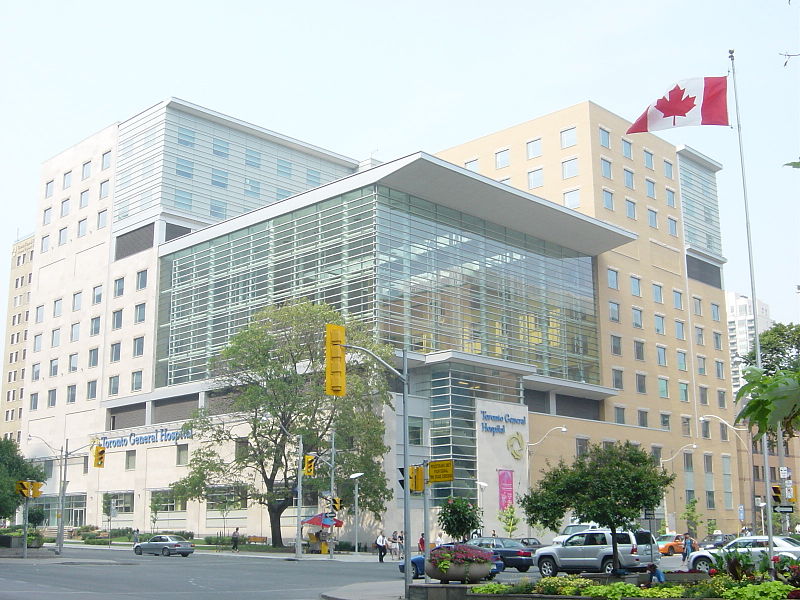
Toronto General Hospital in 2005.
Photo via Wikimedia Commons.

Millions of Canadians are extremely proud of our health-care system. They defend it and are utterly convinced of its greatness. They react with hostility to any hint of change.

But on what basis could Canada make a claim to health-care greatness?

According to OECD data, on life expectancy Canada ranks 16th. On morality rates from avoidable causes, we’re 23rd. On cancer survival rates we range from 13th down to 18th, depending on the cancer type. On the number of one-year-olds vaccinated for diphtheria, tetanus and pertussis, we rank an abysmal 37th (even the U.S. is higher here at 27th. Gulp.). One area where we do rank closer to the top is spending as a proportion of GDP, where we sit at seventh.

In modern parlance of TL;DR, what the OECD data says is that Canada spends a disproportionately large amount of money to get strongly mediocre health outcomes.

For an overall picture we can look at the World Health Organization’s ranking system, which measures, “responsiveness (both level and distribution), fair financing, and health inequality, in addition to the more traditional goal of population health.” Here, Canada ranks 30th overall.

“But …” I’m sure you’re about to say … “Canada has universal health care!”

Yes. And that’s good. But the shortfall of that argument is that dozens of other countries have universal health care and many also have far better overall outcomes. In short, universal health care access is not a unique feature in Canada. For instance, a few notable countries from the WHO’s top 10 include France, Italy, Singapore, Spain, Austria, and Japan. These are hardly countries that let citizens go bankrupt or die in the streets when they need health care.

So why are we so darned committed to defending the Canadian status quo?

I genuinely can’t make sense of it. Canadians are smart, sensible people. We want the best for ourselves and our children. But at the same time, we have a very long history of refusing to change and improve our health care despite every piece of evidence that says we desperately must do better. The COVID pandemic has made this especially clear over the last couple years, but none of this is new.

As Robyn Urback recently asked in the Globe & Mail, “When do we admit Canada’s health-care system just isn’t working?” and as Matt Gurney pondered on TVO, “When can we start trying to make it [better]?”

January 6, 2022

The war on “ultra-processed food”

Filed under: Britain, Business, Food, Health, Politics — Tags: , , , , , — Nicholas @ 05:00

Our self-imagined “elites” have a new crusade to prosecute — the crusade against “ultra-processed food”:

In “public health”, the name of the game is to interfere with people’s lives without having your own choices meddled with. This is straightforward with smoking since the philosopher kings of the nanny state don’t smoke. Alcohol is more tricky since most of them drink, but minimum pricing — which was introduced in Ireland yesterday — offers the perfect way to penalise ordinary people while leaving fine wine and craft beer unaffected.

The war on food poses the trickiest problem since its pretext — obesity — is the result of over-consumption and physical inactivity rather than the consumption of any specific type of food. “Junk food” is too narrow since most people interpret it to mean “fast food” from a handful of restaurant chains. And so, in the absence of an obvious dietary culprit, the “public health” lobby is shifting towards a crusade against “ultra-processed food”.

Most people don’t know what this means, but it sounds bad if you have an instinctive objection to industry and modernity. Perhaps it evokes thoughts of “chemicals” and “E numbers”. Certainly, it sounds like the opposite of the “natural”, “organic” and “home made” food so beloved of those who think they are superior to other people. It is, however, a classic “public health” bait and switch. Just as people didn’t realise that a ban on “junk food” advertising would result in adverts for cheese and butter being banned, people won’t realise what a war on ultra-processed food means for them until it is too late.

In a deranged op-ed in BMJ Global Health, some of Mike Bloomberg’s minions from Vital Strategies call for tobacco-style regulation of “ultra-processed food”, starting with warning labels.

    Simply put, ultra-processed foods are foods that can’t be made in your home kitchen because they have been chemically or physically transformed using industrial processes. They are recognisable on the supermarket shelf as packaged foods that are ready-to-eat, contain more than five ingredients and have a long shelf-life. The industrial processing, as well as the cocktail of additives, flavours, emulsifiers and colours they contain to give flavour and texture, make the final product hyper-palatable or more appealing and potentially addictive, which in turn leads to poor dietary patterns.

    With more than half the total calories consumed in high-income countries coming from ultra-processed foods and rapid increases in low- and middle-income countries, these products are exposing billions of people to a higher risk of type 2 diabetes, heart disease, stroke, depression and death.

Scary stuff, eh? Alas, they don’t give any examples of ultra-processed foods so let us instead turn to a recently published study about them …

    Baked goods, including cakes, pastries, industrial breads, and soft drinks ranked among the top contributors to sales of UPFDs [ultra-processed food and drinks]

According to the the British Heart Foundation, ultra-processed foods include …

    Ice cream, ham, sausages, crisps, mass-produced bread, breakfast cereals, biscuits, carbonated drinks, fruit-flavoured yogurts, instant soups, and some alcoholic drinks including whisky, gin, and rum.

I’m not sure how hard liquor made the cut, but I suppose if you’re going be a fun sponge you might as well go all the way.

December 30, 2021

HogmaNO! Scottish government warns Scots not to cross the border to celebrate Hogmanay

Filed under: Britain, Government, Health — Tags: , , , , , , — Nicholas @ 03:00

In Scotland, one of the traditions of the winter is Hogmanay (spelled umpteen different ways), the last day of the old year, but Scottish public health and government officials are trying to keep the Scots away from the English border this year:

Scots have been urged not to travel to England for new year celebrations to get around the more stringent Covid-19 restrictions north of the border.

There is no travel ban currently in place to stop people going to England, where nightclubs are still open.

But Deputy First Minister John Swinney said doing so would go against the “spirit” of Scottish Covid-19 measures.

He said travelling would be “the wrong course of action” due to the “serious situation” with the Omicron variant.

Case numbers in Scotland hit “alarming” record highs over Christmas and Boxing Day, with the faster-spreading strain now accounting for the majority of all infections.

First Minister Nicola Sturgeon — who is to update MSPs in a virtual sitting of the Scottish Parliament on Wednesday afternoon — said she expected the figures to rise even more in the days ahead.

Scots have been encouraged to stay at home as much as possible, and to limit any social gatherings to no more than three households.

Large events such as Edinburgh’s traditional Hogmanay street party have been cancelled, with extra curbs in hospitality settings and nightclubs shut down entirely.

Clubs remain open south of the border, where no new restrictions are being imposed, but Mr Swinney told BBC Breakfast that he would “discourage” anyone from travelling to England to see in the new year.

He said: “People are free to make their own judgments. But what we have got recognise is that Omicron is a serious threat to absolutely everybody within our society and we have all got to take measures to protect ourselves by limiting our social contacts and connections and by complying with the restrictions we have in place.

Despite the Scottish government’s warnings, English pubs along the (currently) undefended border are expecting over a hundred thousand thirsty Scots to invade on the 31st:

English border pubs are expecting upwards of 100,000 Scottish and Welsh revellers to cross into England on New Year’s Eve amid mounting anger at Nicola Sturgeon and Mark Drakeford for cracking down on festivities.

December 18, 2021

The bully doesn’t actually want you to do this one thing they demand, they want your constant submission to all demands

Filed under: Government, Health, Media — Tags: , , , , — Nicholas @ 05:00

Charles Eisenstein on the ongoing relationship between the citizens of most western countries and their governments:

The relationship between our governing authorities and the public today bears many similarities to the abuser-victim dynamic. Facing a bully, it is futile to hope that the bully will relent if you don’t resist. Acquiescence invites further humiliation. Similarly, it is wishful thinking to hope that the authorities will simply hand back the powers they have seized over the course of the pandemic. Indeed, if our rights and freedoms exist only by the whim of those authorities, conditional on their decision to grant them, then they are not rights and freedoms at all, but only privileges. By its nature, freedom is not something one can beg for; the posture of begging already grants the power relations of subjugation. The victim can beg the bully to relent, and maybe he will — temporarily — satisfied that the relation of dominance has been affirmed. The victim is still not free of the bully.

That is why I feel impatient when someone speaks of “When the pandemic is over” or “When we are able to travel again” or “When we are able to have festivals again.” None of these things will happen by themselves. Compared to past pandemics, Covid is more a social-political phenomenon than it is an actual deadly disease. Yes, people are dying, but even assuming that everyone in the official numbers died “of” and not “with” Covid, casualties number one-third to one-ninth those of the 1918 flu; per-capita it is one-twelfth to one-thirty-sixth. As a sociopolitical phenomenon, there is no guaranteed end to it. Nature will not end it, at any rate; it will end only through the agreement of human beings that it has ended. This has become abundantly clear with the Omicron Variant. Political leaders, public health officials, and the media are whipping up fear and reinstituting policies that would have been unthinkable a few years ago for a disease that, at the present writing, has killed one person globally. So, we cannot speak of the pandemic ever being over unless we the people declare it to be over.

Of course, I could be wrong here. Perhaps Omicron is, as World Medical Association chairman Frank Ulrich Montgomery has warned, as dangerous as Ebola. Regardless, the question remains: will we allow ourselves to be held forever hostage to the possibility of an epidemic disease? That possibility will never disappear.

Another thing I’ve been hearing a lot of recently is that “Covid tyranny is bound to end soon, because people just aren’t going to stand for it much longer.” It would be more accurate to say, “Covid tyranny will continue until people no longer stand for it.” That brings up the question, “Am I standing for it?” Or am I waiting for other people to end it for me, so that I don’t have to? In other words, am I waiting for the rescuer, so that I needn’t take the risk of standing up to the bully?

If you do put up with it, waiting for others to resist instead, then you affirm a general principle of “waiting for others to do it.” Having affirmed that principle, the forlorn hope that others will resist rings hollow. Why should I believe others will do what I’m unwilling to do? That is why pronouncements about the inevitability of a return to normalcy, though they seem hopeful, carry an aura of delusion and despair.

In fact, there is no obvious limit to what people will put up with, just as there is no limit to what an abusive power will do to them.

H/T to Perry de Havilland for the link.

December 14, 2021

The Omicron variant of the Wuhan Coronavirus

Filed under: Government, Health, Media — Tags: , , , , , — Nicholas @ 03:00

Jim Treacher gets to the essential question about the dreaded and fast-spreading Omicron variant that the media somehow always forgets to ask:

We’ve seen a lot of headlines about the Omicron variant, which is the latest thing we’re all supposed to panic about. That’s how it works: You must be driven into a perpetual state of hysteria. You must never be allowed a moment to stop and catch your breath and think about what’s happening, because you might fall into badthink. The latest name for that is Omicron.

Omicron! OMG!! Run around like a headless chicken!!!

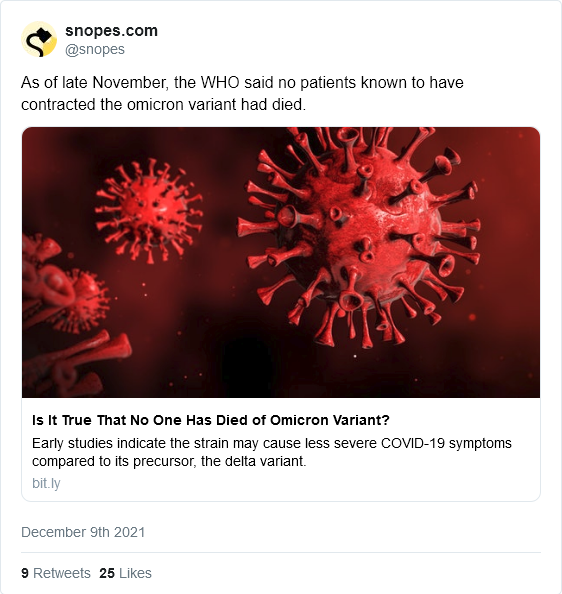
But here’s a question that none of our moral, ethical, and intellectual betters in the press are asking, because they have no incentive to ask: How many people have died of Omicron?

Like, in the entire world. It doesn’t need to be a precise number. A rough estimate is fine. You can round up to the nearest 10.

Anybody? Hello?

I’m not sure how trustworthy Snopes is, but they say the number so far is … zero.

Zip.

Zilch.

Goose egg.

1 – 1.

None.

So please excuse me if I don’t freak the hell out every time somebody gets Omicron. Every story about it lists the number of cases but glosses over minor little details. Like what happens to the people who get it.

Do they get sick?

If so, how sick do they get?

If not, what’s the problem?

The media is just selling fear, as usual. Yes, COVID-19 is real, and a lot of people have died. No, nobody is dying from this Omicron variant. That’s good news, which is why the “news” isn’t interested.

Of course, on the weekend British PM Boris Johnson announced the death of someone in Britain who had contracted the Omicron variant … but it’s not clear if the person’s death was a direct result of that infection. So, we know at least one person has died with the Omicron variant, but we don’t know if it was from it.

December 8, 2021

Pandemic authoritarianism in the EU will be the death of Europe’s liberal traditions

In Spiked, Brendan O’Neill says we’re watching the “death of Europe” driven by the authoritarian instincts of government and EU leaders in thrall of public health officials:

Europe is on a precipice. It has marched, blindly, towards something very much resembling tyranny. Austria will shortly criminalise those who refuse the Covid vaccine. Germany looks set to follow. Ursula von der Leyen, president of the European Commission, is wondering out loud if every member state should do likewise and make offenders of those who reject this form of medication. In Italy you are deprived of your livelihood rather than your liberty if you say no to vaccination: the unvaxxed are not permitted to work. Anywhere. In Greece, everyone over the age of 60 must pay the government 100 euros for every month they remain unvaxxed. As if the Greek government, in cahoots with its masters in Brussels, had not immiserated Greek pensioners enough already.

Police in Rotterdam opened fire on people protesting against Covid restrictions. Three were seriously injured. Austrian cops have wielded batons and shields against the thousands who took to the streets of Vienna to say no to mandatory vaxxing. In Brussels, the black, bureaucratic heart of the EU project, water cannons and tear gas were unleashed upon citizens agitating against vaccine passes. The irony is almost too much: in the European quarter of Brussels, the very part of Europe in which the modern European sensibility was forged by politicians, experts and technocrats, ordinary people make a blow for freedom and the forces of this supposedly liberal new continent beat them down. Rarely has modern Europe’s bluster about “human rights” and “respect” been so savagely exposed.

What is happening in Europe right now is nothing short of terrifying. We are not merely witnessing another round of Covid restrictions. This isn’t just the introduction of another set of emergency measures that some people believe are necessary to stave off the latest Covid wave and the Omicron threat lurking on the horizon. No, we are living through a chilling overhaul of the entire relationship between the state and the individual, with the state empowered to such an extraordinary degree that it can now instruct its citizens on what to inject into their bodies, and the individual so politically emaciated, so denuded of rights, that he no longer even enjoys sovereignty over himself, over that tiny part of the world that is his own body and mind. We are witnessing the violent death of European liberalism and the birth pangs of a new and deeply authoritarian era.

Many seem not to recognise how serious a development mandatory vaccination is. Even those of us who are pro-vaccination, who have been happily vaxxed against Covid-19, should look with nothing less than horror upon the proposal that it should be an offence not to be vaccinated; that a citizen should be fined thousands upon thousands of euros if he refuses this treatment. One of the ideas being discussed in Austria ahead of its mandatory vax law that will be introduced in February is that citizens who refuse vaccination will be summoned to a local court. If they ignore the summons twice they will face a fine of 3,600 euros. If they continue ignoring the state’s demand that they receive medical treatment that they do not want, they’ll be fined 7,200 euros. These are life-ruining fines. There is no talk – yet – of imprisoning people who reject the vaccine, but the Austrian state is making it crystal clear that it will happily wield its power to propel the unvaxxed into destitution.

[…]

This spells the end of freedom as we know it. Bodily autonomy is the foundation stone of self-government, and self-government is the thing that gives freedom meaning. If we do not enjoy sovereignty over our minds and our flesh, then we are not free in any meaningful way. And it won’t just be the minority of people who feel forced to receive the vaccine whose freedom will suffer under this new regime of state power over people’s bloodstreams and muscles and flesh – everyone’s freedom will. The state diktat determining that only those who receive a certain form of medical treatment will get to enjoy freedom will make freedom itself contingent upon doing what the state wants you to. Even the vaxxed will not be truly free people in this world. Rather, we will be the beneficiaries of state favour, the enjoyers of small privileges, in return for our agreeing to receive an injection. We will have a license from on high to go about our daily lives. And we will know that that license could swiftly be revoked if we refuse medical treatment in the future. The redefinition of “freedom”, the making of liberty contingent upon submission to medicine, will throttle the rights of all of us – vaxxed and unvaxxed alike.

December 7, 2021

Sarah Hoyt on the nonsense of so many pandemic measures

Filed under: Bureaucracy, Government, Health, Media — Tags: , , , , — Nicholas @ 03:00

Posting at Instapundit, Sarah Hoyt lists some of the many, many poor and even counter-productive public-health-theatre measures most western governments have been indulging in since the beginning of 2020:

Wuhan Institute of Virology.
Wikimedia Commons.

Let’s say you’re one of those insane people who dismissed the low numbers of death/serious illness aboard the Diamond Princess because apparently people on cruise ships have “top quality medical care” (Coo-ey! Is the sky made of candy floss in your world?) in what world — even a candy floss sky one — did it make sense to close local grocery stores but keep Walmart open? In what world did it make sense to direct flow in stores so everyone crammed in through the same door, and everyone walked the same path (thereby a crowded/grimy, etc. path)? In what world did reducing hours of stores make sense? In what world did it make sense to wear a mask to your table then remove it to eat? (Are you less contagious when sitting?) In what world did curfews make sense? In what world did mask mandates outside in botanic gardens and zoos make sense? In what world did it make sense that you were hectored for getting out and driving around, while remaining your car?

In what world did the government stomp on every — no matter how crackpot or inocuous — rumored treatment? In what world, despite all studies to the contrary, do two layers of thin fabric stave off viral infection? In what world are doctors and nurses laid off by the thousands during a supposed pandemic? And finally in what world does it make any sense that a completely ineffective — if not (the numbers are not trustworthy in the sense that we can’t trust anything from collection to reporting, but in the UK there are indications that way) counterproductive — vaccine is being forced on the population by government mandate?

The deaths of so many people — thanks to dodgy statistical reporting and frequent moving-the-goalpost sleights of hand we may not know exactly how many — are tragic, but the deliberate destruction of public trust in our governments, healthcare systems, and media reporting will continue for a long, long time to come. The Wuhan Coronavirus has not been the civilization-wrecker we were all told to fear, but the breakdown in trust will make us all more vulnerable the next time a serious disease strikes. Trust is earned, slowly, and rebuilding lost trust will be a much slower process.

December 4, 2021

Things I never expected to read on the CBC website — “…frantically firing up the gaslights and moving the goalposts on COVID restrictions and vaccinations”

Canada’s state broadcaster has been — as you would expect — a staunch supporter of every government initiative to limit free speech and the rights of Canadians in tackling the Wuhan Coronavirus pandemic. They’ve consistently portrayed any concerns or doubts about draconian government action as irrational, anti-science conspiracy theories and the people raising such concern as effectively “enemies of the people”. As such, I never expected to see anything like this CBC Opinion piece by Allan Richarz:

Listen closely and one might be able to discern the unmistakable sounds of our elected and unelected officials frantically firing up the gaslights and moving the goalposts on COVID restrictions and vaccinations.

It was a precipitous but inevitable shift from “two weeks to flatten the curve” to get the jab or lose your job, and unsurprisingly, there is still more to come.

Met the provincial vaccination targets? Great; but now it’s time for a booster. Ready for the “temporary” vaccine passport system to expire? Sorry, we need to extend it through spring; proving once again that if you give the government an inch on your rights, they will go for the mile every time.

Less than a year ago, government and public health officials touted vaccination as a panacea to end the pandemic. It’s safe, effective and will allow the country to put COVID behind us, we were told. To that end, citizens were encouraged, prodded and eventually threatened to get their shots, with holdouts demonized by politicians at all levels. Yet, in Ontario, even as the province exceeded by weeks its vaccination and case number targets of the government’s phased reopening plan, citizens were offered only breadcrumbs in return: moving up Phase 3 reopening by just a few days, with no plans at the time for a complete reopening.

And now, with new case numbers in Ontario essentially split evenly between the unvaccinated and fully vaccinated and questions about waning vaccine efficacy, the goalposts shift again with the rollout of booster shots elsewhere in the country and calls for expanded eligibility.

One does not need to look hard to guess what the next step will be across Canada. In Israel and France, the definition of fully vaccinated was changed to include boosters; those six months out from their second dose, or first booster, are now considered unvaccinated, and their vaccine passport privileges suspended.

H/T to SDA for the link.

December 3, 2021

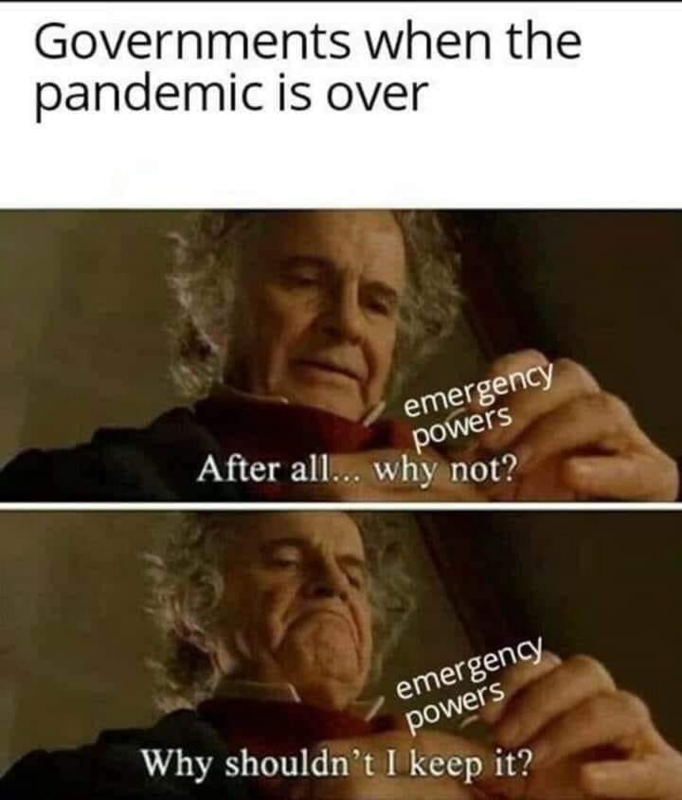
“Power corrupts and absolute power …” is something governments are not eager to give up, post-pandemic

Filed under: Australia, Britain, Europe, Government, Health — Tags: , , — Nicholas @ 03:00

Miguel Castaneda quotes Lord Acton’s famous aphorism (which I truncated in my headline) and warns of the consequences of giving governments too much power:

“Power corrupts and absolute power corrupts absolutely”. The words of Lord Acton, a fierce opponent of state power, are sadly no less relevant today than they were at his time of writing.

Over the past 20 months, the authoritarian approach of Western leaders has been justified by our representatives as a necessary response to a global emergency. Whether that’s true or not is up for discussion, however, one thing remains clear: such attitudes have handed governments a level of power that, left unchecked, severely curtails individual rights.

This path is not unique to the UK, nor is it unique to Europe. We’re seeing a near global normalisation of state overreach. Lockdowns in many liberal democracies have been brought in suddenly and without thorough scrutiny.

In this country, at no point were other methods to address the pandemic tested. They were barely even suggested. And with little counter from the mainstream media, the UK and others have normalised shutting down the country for the purpose of virus control.

It was only a few months ago that Australia locked over 5 million people after identifying a single case. A severe overreaction which likely contributed to the dramatic fall in Australian Prime Minister Scott Morrisson’s approval ratings of the handling of the pandemic, which fell from 85 per cent at the start of the pandemic to 47 per cent in the latest poll in August.

A commonly overlooked consequence of these authoritarian practices is the precedence it sets for how governments can and should act when faced with novel challenges. It has been predicted that future pandemics will become more frequent, and perhaps more deadly. Are we going to react again by shutting entire populations in their homes?

Looking to the continent, the ease at which governments are bringing in authoritarian measures should be an international scandal. Take Austria, where a national lockdown has just been extended until at least December 11th. Or Germany, which has announced today a de facto lockdown for the unvaccinated, and is debating bringing in a policy of mandatory vaccinations.

This extreme way of thinking is a new virus spreading across the Western world. Spain, France, Italy, Greece and Australia have all seen similar policies introduced.

December 1, 2021

Polling bias in a time of pandemic

Filed under: Britain, Government, Health, Media, Politics — Tags: , , , , — Nicholas @ 03:00

At The Daily Sceptic, Mike Hearn looks at the often incredible poll results turned up by YouGov that seem to indicate that well over half the population of Britain are budding medical fascists who want nothing more than a full-on pandemic tyranny from now to the end of time:

Recently YouGov announced that 64% of the British public would support mandatory booster vaccinations and another polling firm claimed that 45% would support indefinite home detention for the unvaccinated (i.e., forced vaccination of the entire population). The extreme nature of these claims immediately attracted attention, and not for the first time raised questions about how accurate polling on Covid mandates actually is. In this essay I’m going to explore some of the biases that can affect these types of poll, and in particular pro-social, mode and volunteering biases, which might be leading to inaccurately large pro-mandate responses.

There’s evidence that polling bias on COVID topics can be enormous. In January researchers in Kenya compared results from an opinion poll asking whether people wore masks to actual observations. They discovered that while 88% of people told the pollsters that they wore masks outside, in reality only 10% of people actually did. Suspicions about mandate polls and YouGov specifically are heightened by the fact that they very explicitly took a position on what people “should” be doing in 2020, using language like “Britons still won’t wear masks”, “this could prove a particular problem”, “we are far behind our neighbours” and most concerning of all – “our partnership with Imperial College”. Given widespread awareness of how easy it is to do so-called push polling, it’s especially damaging to public trust when a polling firm takes such strong positions on what the public should be thinking and especially in contradiction of evidence that mask mandates don’t work. Thus it makes sense to explore polling bias more deeply.

[…]

Given the frequency with which large institutions say things about COVID that just don’t add up, it’s not entirely surprising that people are suspicious of claims that most of their friends and neighbours are secretly nursing the desire to tear up the Nuremberg Code. But while we can debate whether the chat-oriented user interface is really ideal for presenting multi-path survey results, and it’s especially debatable whether YouGov should be running totally different kinds of polls under the same brand name, it’s probably not an attempt to manipulate people. Or if it is, it’s not a very competent one.

When I was much younger, I’d very occasionally get a call on our land line from a polling firm. I’d sometimes take part in the poll, although I don’t recall every seeing any of the polls I took part in being published later. After a few years, I stopped taking part and now I hang up as soon as it’s clear that the call is from a polling company. Apparently I’m far from alone in this learned aversion to dealing with polls:

Online panel polling solves the problem of low phone response rates but introduces a new problem: the sort of people who answer surveys aren’t normal. People who answer an endless stream of surveys for tiny pocket-money sized rewards are especially not normal, and thus aren’t representative of the general public. All online panel surveys face this problem and thus pollsters compete on how well they adjust the resulting answers to match what the “real” public would say. One reason elections and referendums are useful for polling agencies is they provide a form of ground truth against which their models can be calibrated. Those calibrations are then used to correct other types of survey response too.

A major source of problems is what’s known as “volunteering bias”, and the closely related “pro-social bias”. Not surprisingly, the sort of people who volunteer to answer polls are much more likely to say they volunteer for other things too than the average member of the general population. This effect is especially pronounced for anything that might be described as a “civic duty”. While these are classically considered positive traits, it’s easy to see how an unusually strong belief in civic duty and the value of community volunteering could lead to a strong dislike for people who do not volunteer to do their “civic duty”, e.g. by refusing to get vaccinated, disagreeing with community-oriented narratives, and so on.

In 2009 Abraham et al showed that Gallup poll questions about whether you volunteer in your local community had implausibly risen from 26% in 1977 to a whopping 46% in 1991. This rate varied drastically from the rates reported by the U.S. census agency: in 2002 the census reported that 28% of American adults volunteered.

November 27, 2021

King James I and his hatred of tobacco smoking — “so vile and stinking a custom”

Anton Howes recounts some stories he uncovered while researching English patent and monopoly policies during the Elizabethan and Stuart eras:

… some of the most interesting proclamations to catch my eye were about tobacco. Whereas tobacco was famously a New World crop, it is actually very easy to grow in England. Yet what the proclamations reveal is that the planting of tobacco in England and Wales was purposefully suppressed, and for some very interesting reasons.

James I was an anti-tobacco king. He even published his own tract on the subject, A Counterblaste to Tobacco, just a year after his succession to the English throne. Yet as a result of his hatred of “so vile and stinking a custom”, imports of tobacco were heavily taxed and became a major source of revenue. Somewhat ironically, the cash-strapped king became increasingly financially dependent on the weed he never smoked. The emergence of a domestic growth of tobacco was thus not only offensive to the king on the grounds that he thought it a horrid, stinking, and unhealthy habit — it was also a threat to his income.

What I was most surprised to see, however, was just how explicitly the king admitted this. It’s usual, when reading official proclamations, to have to read between the lines, or to have to track down the more private correspondence of his ministers. Very often James’s proclamations would have an official justification for the public good, while in the background you’ll find it originated in a proposal from an official about how much money it was likely to raise. There was money to be made in making things illegal and then collecting the fines.

Yet the 1619 proclamation against growing tobacco in England and Wales had both. The legendary Francis Bacon, by this stage Lord High Chancellor, privately noted that the policy might raise an additional £3,000 per year in customs revenue. And the proclamation itself noted that growing tobacco in England “does manifestly tend to the diminution of our customs”. Although the proclamation notes that the loss of customs revenue was not usually a grounds for banning things, as manufactures and necessary commodities were better made at home than abroad, “yet where it shall be taken from us, and no good but rather hurt thereby redound to our people, we have reason to preserve”. Fair enough.

And that’s not all. James in his proclamation expressed all sorts of other worries about domestic tobacco. Imported tobacco, he claimed, was at least only a vice restricted to the richer city sorts, where it was already an apparent source of unrest (presumably because people liked to smoke socially, gathering into what seemed like disorderly crowds). With tobacco being grown domestically, however, it was “begun to be taken in every mean village, even amongst the basest people” — an even greater apparent threat to social order. James certainly wasn’t wrong about this wider adoption. Just a few decades later, a Dutch visitor to England reported that even in relatively far-flung Cornwall “everyone, men and women, young and old, puffing tobacco, which is here so common that the young children get it in the morning instead of breakfast, and almost prefer it to bread.”

[…]

Indeed, policymakers thought that the domestic production of tobacco would actively harm one of their key economic projects: the development of the colonies of Virginia and the Somers Isles (today known as Bermuda). Although James I hoped that their growth of tobacco would be only a temporary economic stop-gap, “until our said colonies may grow to yield better and more solid commodities”, he believed that without tobacco the nascent colonial economies would never survive. Banning the domestic growth of tobacco thus became an essential part of official colonial policy — one that was continued by James’s successors, who did not always share his more general hatred of smoking. Although the other justifications for banning domestic tobacco would soon fall away, that of maintaining the colonies — backed by an increasingly wealthy colonial lobby — was the one that prevailed.

« Newer PostsOlder Posts »

Powered by WordPress