
- Choose a complex and chaotic system that is characterized by thousands or millions of variables changing simultaneously (e.g. climate, the US economy)
- Pick one single output variable to summarize the workings of that system (e.g. temperature, GDP)
- Blame (or credit) any changes to your selected output variable on one single pet variable (e.g. capitalism, a President from the other party)
- Pick a news outlet aligned with your political tribe and send them a press release
- Done! You are now a famous scientist. Congratulations.
Warren Meyer, “Modern Guide to Analyzing Complex Multivariate Systems”, Coyote Blog, 2018-06-25.
October 9, 2020
QotD: How to analyze complex multivariate systems for the popular press
Comments Off on QotD: How to analyze complex multivariate systems for the popular press
October 6, 2020
QotD: Herbert Hoover and the Belgian relief program
Just as Hoover is preparing to rest on his laurels, he receives a cry for help. Germany has occupied and blockaded Belgium. The blockade prevents this tiny, heavily urban country from importing food, and the Belgians are starving. Germany needs its own food for its own armies, and is refusing to help. The Belgians order a thousand tons of grain from Britain, but when their representative comes to pick it up, Britain refuses to let them transport it, nervous at sending food into enemy-occupied territory. During tense negotiations, someone suggests using neutral power America as a go-between. But America is 5,000 miles away and busy with its own problems. So the US Ambassador to Britain asks his new best friend Herbert Hoover if he has any ideas.
Hoover invites Emile Francqui, a Belgian mining engineer he knows, to Britain. Together, they plan a Committee For The Relief of Belgium, intended not just to help transport the thousand tons of grain at issue, but to develop a long-term solution to the impending Belgian famine. Nothing like this has ever been tried before. Belgium has seven million people and almost no food. No government is offering to help, and they don’t have enough money to feed seven million people even for one day, let alone indefinitely. Hoover springs into action …
… by crushing all competing attempts to provide food for Belgium. He attacks the Rockefeller Foundation, which is trying to help, with a blitz of press coverage accusing it of various forms of insensitivity and interference, until it finally backs off. Then he gets to work on the government:
The letter bore several Hoover watermarks, beginning with its heavy load of facts and figures organized in point form. It noted that myriad relief committees were springing up both inside and outside of Belgium, and urged consolidation. “It is impossible to handle the situation except with the strongest centralization and effective monopoly, and therefore the two organizations [Hoover outside Belgium and Francqui inside it] will refuse to recognize any element except themselves alone.” The letter also contained Hoover’s usual autocratic and slightly paranoid demands for “absolute command” of his part of the enterprise.
Control attained, Hoover springs into action actually feeding Belgium. He launches one of the largest public relations campaigns the world has ever seen, sending letters to newspapers around the world asking for donations. He “urged reporters to investigate the famine conditions in Belgium and play up the ‘detailed personal horror stuff’. He personally arranged for a motion picture crew to capture footage of food lines in Brussels, and he hired famous authors, including Thomas Hardy and George Bernard Shaw, to plead for public support of the rescue effort.” He constantly telegrams his exasperated wife and children, now safely back in Palo Alto, demanding they raise more and more money from the West Coast elite.
He browbeats shipping conglomerates until they agree to ship his food for free, then browbeats railroads until they agree to carry it. By telegraph and letter he coordinates banks, railroads, docks, ships, and relief workers on both sides of the Atlantic. But that’s just the prelude. His real problem is the governments. Britain doesn’t want food shipped to Belgium, because right now the starving Belgians are Germany’s problem, and they don’t want to solve an enemy’s problem for them. But Germany also doesn’t want food shipped to Belgium, because the Belgians are resisting the occupation, and they figure starvation will make them more compliant. Shuttling back and forth across the North Sea, Hoover tries to get them to switch theories: Germany needs to think starving Belgians are their problem which it would be helpful to solve, and Britain needs to think starvation would make Belgians more compliant with the German occupation. In the end, both countries allow the shipments.
He goes on a fact-finding mission to Belgium, and managed to somehow offend everyone in the country that he is, at that very moment, saving from mass starvation […] By 1915, Hoover is, indeed, feeding millions of Belgians, indefinitely, using only private funding. He is also almost broke. Millions of Brits and Americans have given him contributions, from tycoons donating fortunes to ordinary people donating their wages, but it’s not enough. His expenses pass $5 million a month, which would be about $100 million today; all these bills are starting to catch up to him. In an act of supreme sacrifice, Hoover pledges his entire personal fortune as collateral for the Committee’s loans, then takes out more money. The grain shipments continue to flow, but his credit is at its end.
He continues beating on the doors of every government official he can find – British, German, American – demanding help. They all say their budgets are already occupied with the war effort. He begs them, lectures them, tells them that millions of people are doing to die. He goes all the way to the top, finagling an opportunity to meet with British Prime Minister David Lloyd George. Lloyd George later calls Hoover’s presentation “the clearest he had [ever] heard on any subject”, but he can offer only moral support.
What finally works is going to Germany and meeting with their top military brass. The brass are unimpressed; they still think that Belgium starving is as likely to help them as hinder. But the contact spooks top British officials, who agree to meet with Hoover again. Hoover feeds them carefully crafted lies, saying that the German brass have told him that British aid to Belgium would be a disaster to the Central Powers and so they, the Germans, are going to fund everything Hoover wants and more. “Oh no they don’t!” say the British, who promise to give Hoover even more funding than his imaginary German partners. The Committee for the Relief Of Belgium is finally back in the black. And what a black it is:
The scope and powers of the Committee For Relief of Belgium were mindboggling. Its shipping fleet flew its own flag. Its members carried special documents that served as CRB passports. Hoover himself was granted a form of diplomatic immunity by all belligerents, with the British permitting him to cross the Channel at will and the Germans providing him a document saying “this man is not to be stopped anywhere under any circumstances”. Hoover had privileged access to generals, diplomats, and ministers. He enjoyed personal contacts with the heads of warring governments. He negotiated treaties with the belligerents, advised them on policy, and delivered private messages among them. Great Britain, France, and Belgium would soon be turning over to him $150 million a year, enough to run a small country, and taking nothing for it beyond his receipt. As one British official observed, Hoover was running “a piratical state organized for benevolence.”
Scott Alexander, “Book Review: Hoover”, Slate Star Codex, 2020-03-17.
Comments Off on QotD: Herbert Hoover and the Belgian relief program
July 30, 2020
“Muzzling” scientists only ever happens under Conservative governments…
… so even though the circumstances might look remarkably similar to the layman’s eyes, Justin Trudeau can’t possibly be accused of doing the same thing as that evil, anti-science Stephen Harper:
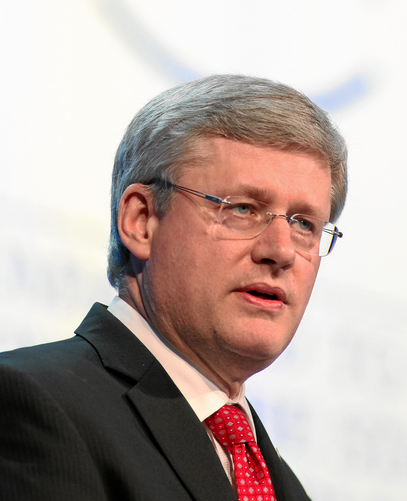
Prime Minister Stephen Harper speaking at the Annual Meeting 2012 of the World Economic Forum at the congress centre in Davos, Switzerland, January 26, 2012.
World Economic Forum photo via Wikimedia Commons.
In fact, Grant Robertson reports, the Trudeau regime effectively shuttered a small, cheap (less than $3 Million dollars ~ petty cash in Canada’s government) research and early warning team called the Global Public Health Intelligence Network (GPHIN) which
was among Canada’s contributions to the World Health Organization, and it operated as a kind of medical Amber Alert system. Its job was to gather intelligence and spot pandemics early, before they began, giving the government and other countries a head start to respond and – hopefully – prevent a catastrophe. And the results often spoke for themselves.
Unfortunately, by the time the COVID-19 pandemic was getting started, just when the GPHIN should have provided “early warning,” it had been told, by the Trudeau regime, to focus on domestic issues. But global pandemics don’t often start in Canada, do they? The GPHIN sifted through data from around the world, often from places like China, Iran and Russia which hide or manipulate medical information, conducting something akin to military reconnaissance so that Canadian (and global (WHO)) officials could “see” what might be headed our way.
Did Justin Trudeau give the order to “muzzle” the GPHIN scientists? No, of course not … no more than Stephen Harper gave the order to “muzzle” scientists in Environment Canada. The decision to “refocus” the GPHIN on useless, domestic busywork was likely made by an Assistant Deputy Minister who was acting on yet another demand from the Treasury Board Secretariat to justify every programme dollar … again.
You should be glad that the Treasury Board Secretariat casts a sceptical eye on every single government programme and is a constant thorn in the side of operational people (like I was when I was serving and like the GPHIN folks were, too). They, skilled, hard-working civil servants, are just trying to ensure that your tax dollars are not being wasted. They are good people doing good work. But sometimes the wheat gets tossed away with the chaff. That appears to have been the case with the GPHIN. In retrospect, it seems almost criminally stupid to have deprived Canada of a valuable medical reconnaissance agency just because there had not been an “attack” recently. But that appears to have been the bureaucratic justification ~ it’s like me saying that since my house hasn’t burned down recently we should disband the fire department.
Did Justin Trudeau muzzle scientists? No.
Did Justin Trudeau’s government disable a valuable (and cheap) “early warning” system just to make its own wild spending look a little less careless? Yes, that’s what the Globe and Mail‘s investigation says ~ and we have paid a horrendous price in lives for that decision.
This story, it seems to me, is very much like the “Harper muzzles scientists” stories from a few years ago … but minus the massive media attention. It appears very evident, from Mr Robertson’s investigations that bureaucrats, acting on their own, internal priorities, emasculated the GPHIN just when we needed it most. That, bureaucratic action, was I believe what was, mainly, behind the “Harper muzzles scientists” stories, too. But in the 2010s much of the mainstream media was in a sort of undeclared war against Stephen Harper and so the claims of climate activists became “news” and opinions were treated as facts.
Comments Off on “Muzzling” scientists only ever happens under Conservative governments…
May 17, 2020
China sees their public image damaged in the wake of the Wuhan Coronavirus
Arthur Chrenkoff on the ways other countries regard China after the epidemic spread beyond their borders and the Chinese Communist Party’s antics on the world stage:
Welcome to the political chaos theory – or, should we say, fact: a bat flapping its wings in China produces a hurricane… pretty much everywhere around the world. It seems likely that three decades’ worth of good PR painstakingly build up by the Chinese authorities after the downer of the Tiananmien Massacre have all been undone in a few short months of domestic and international missteps, from initially covering up the truth about COVID, through gifting or selling faulty personal safety and medical goods around the world, to now retaliating against countries like Australia which are asking some uncomfortable questions about the origins of the virus.
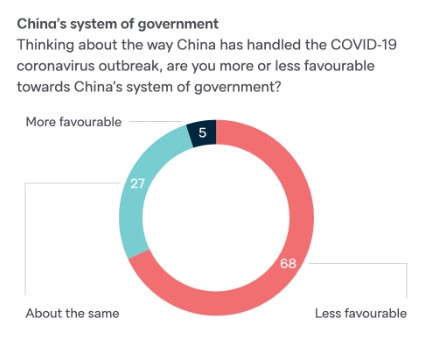
Earlier today, Australia’s Lowy Institute has released the results of its COVID poll on public attitudes about the Corona pandemic. Of particular interest, the perception of China’s rulers:
At the same time, 37 per cent of Australians think that China will emerge more powerful after the dust (or the viral load) settles, while 36 per cent believe in no change, and only 27 per cent think China will be weaker in the aftermath. By contrast, a majority of 53 per cent and a plurality of 48 per cent believe that the United States and Europe respectively will be less powerful in the post-pandemic future. Reading the two sets of figures together it seems that the prospect of China’s rebound to international power is viewed more with apprehension rather than enthusiasm.
As Lowy’s Natasha Kassam observed, the public trust in China has been already declining, falling dramatically from 52 to 32 per cent in just one year between 2018 and 2019. It will be interesting to see the figure for this year. It’s unlikely that the behaviour of the communist government so far in 2020 would have improved the perception.
Such findings mirror similar public opinion research elsewhere. Pew Research Center’s polling last month showed that the negative view of China in the United States has risen from 47 per cent in 2017 to 66 per cent this year. Seventy-one per cent have no confidence in China’s President for Life Xi and 61 per cent view China’s power and influence as a major threat.
Comments Off on China sees their public image damaged in the wake of the Wuhan Coronavirus
February 12, 2020
Guderian – Myth & Reality
Military History Visualized
Published 24 Apr 2018Heinz Guderian, the father of the German Panzerwaffe, is one of the best known German generals from the Second World War. He is also known for his opposition to the Battle of Kursk (Operation Zitadelle) and the early deployment of the Panzerkampfwagen V Panther, yet some historians noted recently that many of Heinz Guderian’s claims are not backed up by archives. Well, time to take a closer look.
»» SUPPORT MHV ««
» patreon – https://www.patreon.com/join/mhv
» paypal donation – https://www.paypal.com/cgi-bin/webscr…»» MERCHANDISE – SPOILS OF WAR ««
» shop – https://www.redbubble.com/people/mhvi…»» SOCIAL MEDIA ««
» twitter – https://twitter.com/MilHiVisualized
» twitch – https://www.twitch.tv/militaryhistory…
» minds.com – https://www.minds.com/militaryhistory…» SOURCES «
Pöhlmann, Markus: Der Panzer und die Mechanisierung des Krieges: Eine deutsche Geschichte 1890 bis 1945 (Zeitalter der Weltkriege)
Corum, James S.: The Roots of Blitzkrieg. Hans von Seeckt and German Military Reform
Macksey, Kenneth: “Generaloberst Heinz Guderian”; in: Ueberschär (Hrsg.) Gerd R.: Hitlers militärische Elite – 68 Lebensläufe (3. Auflage), S. 351-358
Guderian, Heinz: Panzer Leader (English Version of Erinnerungen eines Soldaten)
Guderian, Heinz: Erinnerungen eines Soldaten
Munzel, Oskar: Die deutschen gepanzerten Truppen bis 1945
Schacter, Daniel L.: The Seven Sins of Memory: How the Mind Forgets and Remembers
Citino, Robert M.: The German Way of War. From the Thirty Years’ War to the Third Reich
Citino, Robert M.: The Wehrmacht Retreats: Fighting a Lost War, 1943
» CREDITS & SPECIAL THX «
Song: Ethan Meixsell – “Demilitarized Zone”#ww2 #panzergeneral #Guderian

Comments Off on Guderian – Myth & Reality
January 1, 2020
Let there be LIGHT! – December 31st – TimeGhost of Christmas Day 8
TimeGhost History
Published 31 Dec 2019The electrical age was ushered in by Thomas Edison’s illumination of Menlo Park 140 years ago. For the first time, electrical lighting was demonstrated to a public audience.
Join us on Patreon: https://www.patreon.com/TimeGhostHistory
Hosted by: Indy Neidell
Written by: Tom Maeden and Spartacus Olsson
Directed by: Spartacus Olsson and Astrid Deinhard
Executive Producers: Bodo Rittenauer, Astrid Deinhard, Indy Neidell, Spartacus Olsson
Creative Producer: Joram Appel
Post-Production Director: Wieke Kapteijns
Research by: Tom Maeden
Edited by: Mikołaj Cackowski
Sound design: Marek KamińskiColorization by:
Dememorabilia – https://www.instagram.com/dememorabilia/Soundtracks from Epidemic Sound:
Howard Harper-Barnes – “A Sleigh Ride Into Town”
Traditional – “Carol of the Bells”A TimeGhost chronological documentary produced by OnLion Entertainment GmbH.
From the comments:
TimeGhost History
4 hours ago
On the eighth day of Christmas Thomas Alva Edison said: let there be light. Now, as we say say in the video, we know that Edison was not the only inventor of incandescent light, perhaps not even the inventor at all. But as with so many other things he brought the world, he was the first one to make it practicable, and perhaps more importantly; make it popular.It’s hard to fathom how monumental to humanity this day, 31st of December, 1879 is — the world literally changed forever with the flick of a switch. Our work behavior, or sleeping patterns, our leisure time, socializing, sex, media, industry, cooking, aesthetics … well more or less everything started to change on this day. In 2019 hardly anything we do is possible without it — especially not watching this video, which after all is brought to your eyes by one of many, many derivative innovations of the incandescent light bulb. In fact it’s 140 years later and we are still researching the depths of the change that incandescent light brought upon humanity.
Most of us take it for granted by now, artists celebrate it, entire industries depend on it, Luddites deplore it, environmental studies are showing that it might be harmful to other animals, neurologists are researching the effects of changed sleeping patterns on your brains, the production of energy we need to light our world has contributed to dramatic environmental changes on the entire planet, and the innovations coming from it just keep on pouring out of labs like Menlow Park every day. What do you think?
Happy New Year! May it be enlightening.

Comments Off on Let there be LIGHT! – December 31st – TimeGhost of Christmas Day 8
December 31, 2019
QotD: Canadian journalism
… a Canadian Journalist’s main job is to smooth over any rough spots and shush away worries as the Liberal government plunders the public purse to pay for technocratic solutions to problems we didn’t know we had while adopting a laissez-faire attitude to the problems we do have. If the Opposition has a point, it falls to a Canadian Journalist to correct the record and say that, well, actually, no they don’t.
Josh Lieblein, “Hack or Flack: Aaron Wherry Edition”, Raving Canuck, 2017-11-29.
Comments Off on QotD: Canadian journalism
December 7, 2019
Bryan Donkin, 19th century inventor, amateur public relations whiz and independent lobbyist
In the latest installment of Anton Howes’ Age of Invention newsletter, he recounts the story of Bryan Donkin and his efforts to save innovators from excessive government interference:
One of the major arguments of the book I’m writing is that inventors’ talent for public relations and lobbying was one of the main reasons that Britain — rather unexpectedly — was the place that experienced an unprecedented acceleration of innovation.
The greatest of these lobbyist-inventors has to be Bryan Donkin, a nineteenth-century mechanical engineer. As an inventor, Donkin improved threshing machines, dredging machinery, and a variety of other tools. He invented the steel pen, dabbled in chemistry, as well as phrenology, and was one of the key people responsible for mechanising the production of paper. He became best known for improving and commercialising tin cans for food. Mechanised paper-making and canned food, having both been invented in France, were perfected in Britain by Donkin. He was the archetypal tinkerer.
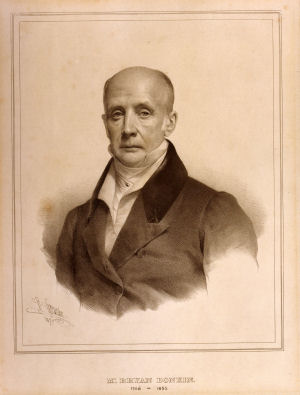
Bryan Donkin (1768-1855).
Photographer unknown via Wikimedia Commons.But it’s as a lobbyist that I think Donkin was truly exceptional. His experience has important lessons for all would-be supporters of invention today.
In April 1817, Donkin read in his newspaper that there had been a disaster in Norwich: the boiler aboard the steamboat Telegraph had exploded. Of the boat’s twenty-two passengers, eight had died immediately in the blast, and another six had eventually succumbed to their wounds. It was a shocking tragedy. And for Donkin, doubly so: in addition to the human death toll, the explosion threatened to kill off one of the era’s newest and most exciting inventions.
Although some of the first trials of steamboats had taken place in the 1780s, it wasn’t until the turn of the century that they began to be practical. By 1817, the first commercially successful steamboat service in Britain, Henry Bell’s Comet, had been chugging its way up the River Clyde between Glasgow and Greenock for only five years. And Londoners like Donkin had only just seen their first steamboat, Margery, when she puffed her way into the Thames in 1815 (the following year, after becoming the first steamboat to cross the Channel, she reinvented herself in Paris as Elise). Thus, by the time of Telegraph‘s explosion, the passenger steamboat had only just been born. There was a very real risk that it would be banned.
Fortunately, however, the steamboat had Donkin in its corner. His immediate reaction upon reading about the explosion was to gather some of his engineer friends — Timothy Bramah and John Collinge — and set off for Norwich to view the explosion site for themselves. As the first expert engineers on the scene, they then took control of the narrative about the explosion. Donkin and his friends went straight to Norwich’s MP to ask him to set up a parliamentary select committee to look into the disaster. And while they waited for the politicians to be assembled for the committee, they held a series of public meetings about the disaster at the Crown & Anchor Tavern — a favourite haunt of London’s engineers. There, they had a chance to rally the rest of the profession and get their story straight about what must have caused the explosion.
Comments Off on Bryan Donkin, 19th century inventor, amateur public relations whiz and independent lobbyist
October 5, 2019
Sultan Knish – Hillaryland must be the saddest place on earth
I think it would be safe to say that Daniel Greenfield does not anticipate Hillary Clinton making a move to enter the Democratic primaries for the 2020 election, based on this:
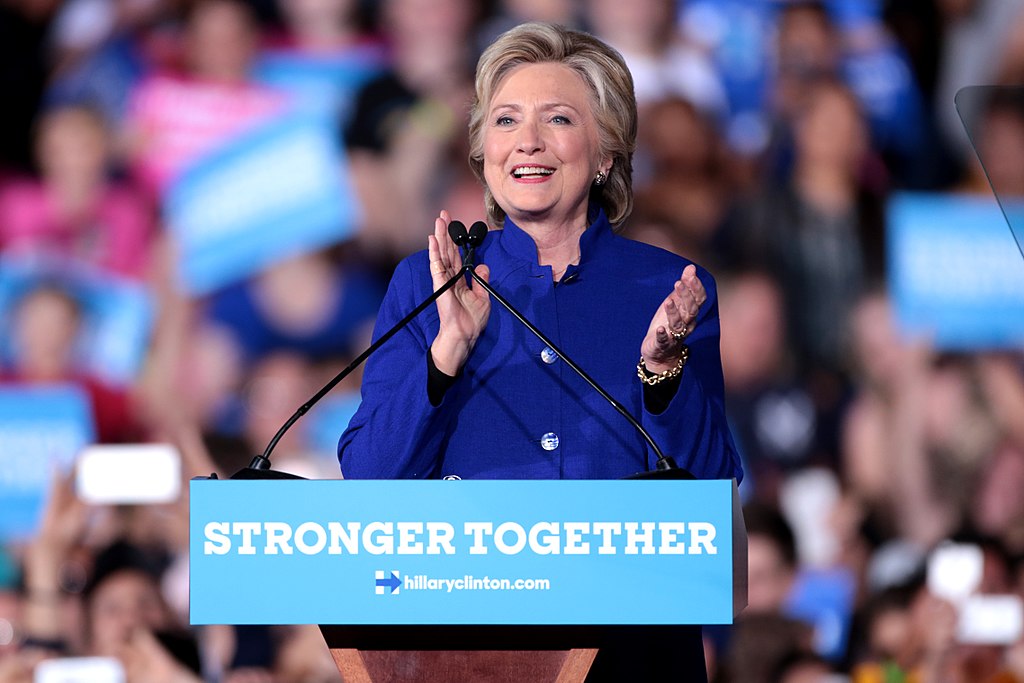
Former Secretary of State Hillary Clinton speaking with supporters at a campaign rally at the Intramural Fields at Arizona State University in Tempe, Arizona on 2 November 2016
Photo by Gage Skidmore via Wikimedia Commons.
They say that Disneyland is the happiest place on earth, but Hillaryland must be the saddest.
What is Hillaryland? It’s a social network “aiming to connect all the people who’ve worked for Hillary Rodham Clinton during her more than 40 years of public service.” It’s run by “volunteers” and offers a plain white $15 Hillaryland tote bag which it claims that it’s selling “at cost” and “not for profit”.
How the mighty have fallen.
Once upon a time, Hillary and her people gaslit the country on the big issues. Now they’ve gone from Benghazi to trying to convince a declining handful of suckers that $15 is the cost price for a tote bag.
Hillaryland is the sad successor to Clintonworld networks like the Clinton Foundation which connected world leaders, foreign criminals and a prospective president. The alumni network is now a joke. The Clintons will never hold public office again. Hillaryland isn’t an alumni network, it’s a political leper colony run by “volunteers” too dumb to realize that the S.S. Slick Willy will never rise again.
Hillaryland promotes such promising ventures as Nasty Women Serve which holds an annual Hillary Rodham Clinton Day of Service. The highest level of service in Hillaryland is hosting a “house party” on November 8, which is National Hillary Day, also known as the day of Hillary’s downfall and defeat. The party will have, “in the true spirit of HRC — some Chardonnay” and will go on “until the wine runs out”.
Only Nazi war criminals in Argentina have sadder and more pathetic reunions than Hillary minions.
Nazis and potheads have 4/20 to get high. Hillary fans have 11/8 to get drunk on white wine. And both of them even blame the Russians for the defeat of their miserably corrupt murderous regimes.
And where’s Madame Fuhrer?
Hillary stopped by the Venice Biennale, the umbrella organization that includes the Venice Film Festival, allegedly a favorite stalking ground of old Clinton pal, Harvey Weinstein, to attend the exhibit of “HILLARY: The Hillary Clinton Emails.”
For an hour, Hillary sat in a replica of the Oval Office pretending to read her own emails as part of an art project. To make her humiliation more complete, HILLARY was staged at the Despar Teatro Italia, a former theater turned into a supermarket. Confused shoppers watched a former American presidential contender pretending to be the President of the United States in an Italian supermarket.
There’s your chicken, your canned tomatoes and your pasta. Upstairs is a crazy lady who thinks she’s the President of the United States. Go easy on the chardonnay, you don’t want to end up like her.
Even Lady Macbeth went mad with more dignity than Hillary Clinton.
The Oval Office recreated in an Italian supermarket is only the second most famous piece of eponymous Hillary art. The National Museum of Women in the Arts also features a 6-foot-tall painting of a black fabric swatch named Hillary gifted to it by Heather and Tony Podesta. Heather and Tony have since split up. And Tony, a Hillarylander, got caught up in the Russia scandal and shut down his lobbying operation.
Sic transit gloria clintonmundi.
Comments Off on Sultan Knish – Hillaryland must be the saddest place on earth
September 20, 2019
Prime Minister Dressup and the make-up case
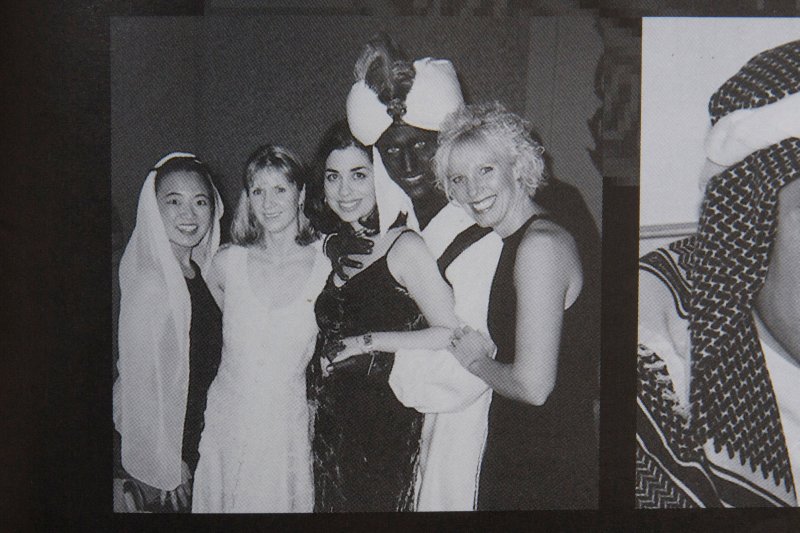
Prime Minister Justin Trudeau’s love of dramatic costume has been noted here before, but over the last couple of days it’s become evident that he’s also felt the attraction of stage make-up, even when most people would realize it’s no longer appropriate to wear blackface:
As Oscar Wilde almost said: “To be caught once wearing blackface may be regarded as a misfortune; to be caught doing so on three separate occasions in the run up to an election proves that there is a God, that he loathes liberal hypocrisy, and that he despises Justin Trudeau, especially.”
Here’s the first offending item:
Justin Trudeau with dark makeup on his face, neck and hands at a 2001 “Arabian Nights”-themed party at the West Point Grey Academy, the private school where he taught.
Photo from the West Point Grey Academy yearbook The View, via Time[…]
Will Justin Trudeau — President Bieber, as I prefer to call him — finally get his comeuppance as a result?
I doubt it. Alinsky’s Rules for Radicals tells us: “Make the enemy live up to its own book of rules.”
This is what we on the non-woke political side of the argument are doing right now. But it’s not going to make much difference, is it?
The other two “make up” incidents are covered in Time:
Speaking to reporters Wednesday night, following Time‘s publication of the photo, Trudeau apologized: “I shouldn’t have done that. I should have known better and I didn’t. I’m really sorry.” When asked if he thought the photograph was racist, he said, “Yes it was. I didn’t consider it racist at the time, but now we know better.”
Trudeau said he wore blackface “makeup” in high school to sing “Day-O,” a Jamaican folk song famously performed by African-American singer and civil rights activist Harry Belafonte. Time has confirmed that a photo shows Trudeau at a school talent show wearing blackface and an afro wig.
[…]
A third instance emerged Thursday — this one a grainy video showing Trudeau in blackface, raising his hands in the air. On Thursday, Astravas confirmed that the video showed Trudeau from the early 1990s. It comes despite Trudeau being asked at his press conference whether there were any other incidents he wanted to own up to.
#BREAKING: A video — obtained exclusively by Global News’ @MercedesGlobal — shows a third instance of Justin Trudeau in what appears to be racist makeup.#cdnpoli #elxn43 https://t.co/IEyeLFY0xc
— Global National (@GlobalNational) September 19, 2019
This is a critical moment for Trudeau, who began his re-election campaign on Sept. 11 under the cloud of a scandal over whether he pressured his then-attorney general to drop corruption charges against a large Canadian engineering firm [that’d be the SNC-Lavalin scandal, if you’re keeping track]. The Liberal Party leader has championed minority groups during his nearly four years as prime minister and made his embrace of Canada’s many cultures a major part of his leadership. At least seven of the 35 members of Trudeau’s cabinet are from ethnic minorities.
I doubt any of the remaining minority cabinet ministers will dare say much, as the Liberal Party has a long, long history of enforcing Omertà … or else. If they want to be back in cabinet on the lengthening odds that PM Dressup wins the October election, they’ll say little or nothing to the media.
The good news is that after careful consideration, the PM has found the guilty party … it’s the rest of Canada and its entrenched “systemic racism”:
At a press conference in Winnipeg, Justin Trudeau connects his black/brown face scandal to Canada’s issues with “systemic racism.” pic.twitter.com/sx9XNambyK
— Andy Ngo (@MrAndyNgo) September 19, 2019
Don’t you feel awful, fellow Canadians? That shame … that’s all yours, thanks to your shitty racist attitudes. Poor Justin is merely the victim.
Comments Off on Prime Minister Dressup and the make-up case
August 4, 2019
A sure-fire way to reduce monarchist sentiments – Royal celebrity slacktivism
Chris Selley offers some friendly advice to His Royal Highness the Duke of Sussex:
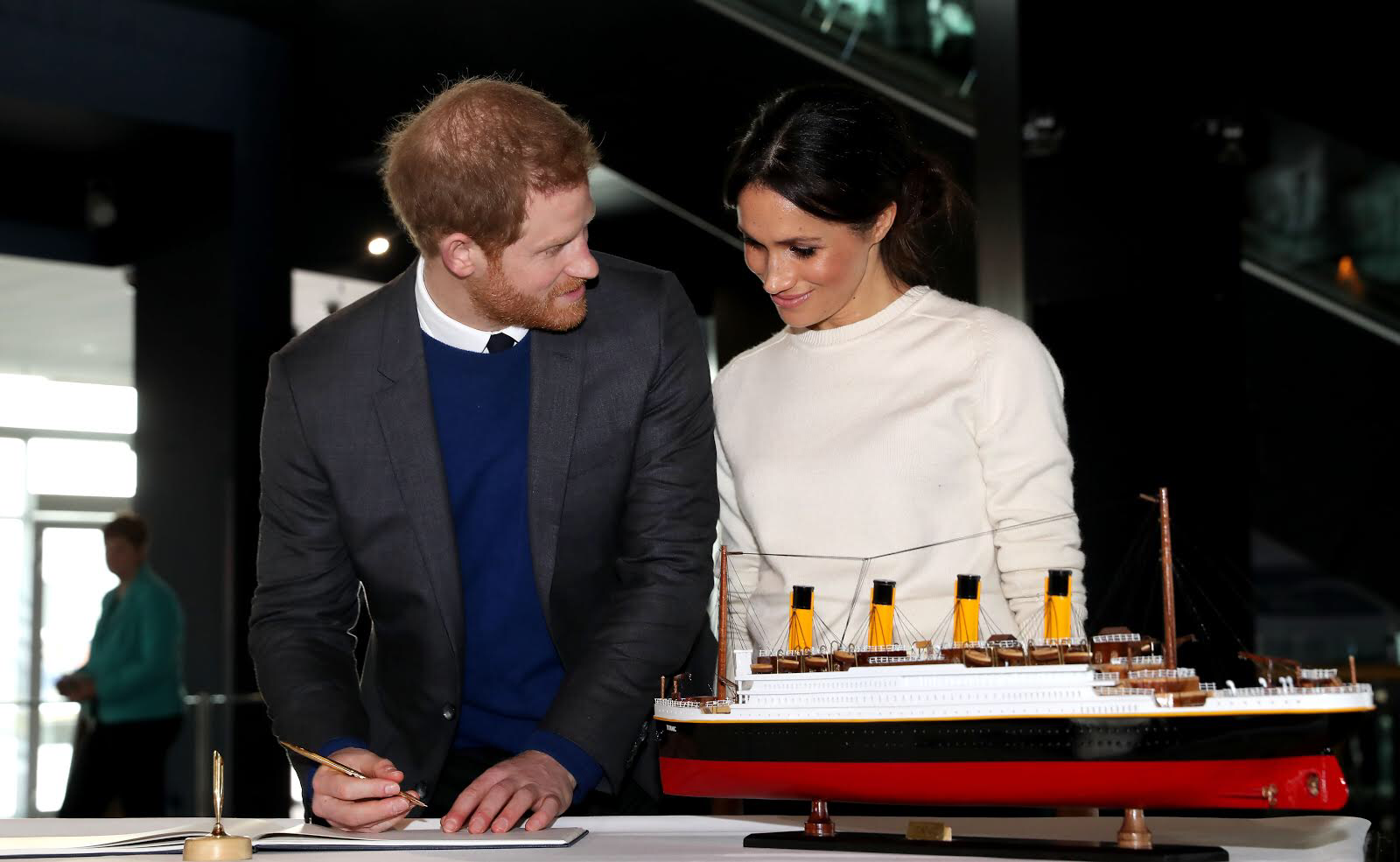
Prince Harry and Meghan Markle visit Titanic Belfast in March 2018.
Photo from the Northern Ireland Office via Wikimedia Commons.
Despite what some scandalized British headlines have suggested, Prince Harry, Duke of Sussex, has not claimed to be helping to save the world from climate change by only planning to get his 37-year-old wife pregnant one more time. “Two, maximum!” he tells primatologist Jane Goodall in an interview-cum-rambling discussion in the current edition of British Vogue, which was guest-edited by Meghan, Duchess of Sussex. It was in the context of some store-bought Harry musings about the perils facing planet Earth and its future inhabitants — “this place is borrowed,” etc. — but it was presented more as a half-joke than as an earnest plan to help out the biosphere.
Good thing, too, because not long after those headlines landed we learned Harry was off to Sicily for a massive Google-sponsored climate change celebrity gabfest. Needless to say, he didn’t row there. Italian media reported more than 100 private jets and several superyachts had delivered the actors, singers, supermodels and tech magnates. All reportedly had to sign non-disclosure agreements about what went on, which is a brilliant new innovation in climate-change slacktivism: “Our climate change discussions were not only important enough to justify heroic eruptions of carbon dioxide, but so important that we can’t tell you anything about them.”
Some think it’s petty to criticize climate activists for their own emissions. I was recently taken to task by myriad correspondents, many of whom were not Liberal partisans, for suggesting that a family long weekend surfing on Vancouver Island was a strange look for a prime minister trying to sell Canadians on a carbon tax with the very future of the planet, he argues, hanging in the balance. Honestly it baffles me. Is the idea that celebrity advocacy for decarbonized lifestyles will inspire so many other people to adopt them that we should forgive the celebrities’ own excesses? If people actually take their environmental cues from the likes of Leonardo DiCaprio, Harry Styles, Naomi Campbell and Orlando Bloom — all were reportedly in Sicily — then surely they would be far more inspired if the celebrities actually made half a personal effort.
But there will always be films, and they will always need actors, and there will always be pop music, and it will always need singers, and fame being what it is, a lot of the actors and singers will always end up being insufferable flakes. The monarchy Harry’s dad and brother are front of the line to lead isn’t nearly so immutable. No other Western royal family has managed to maintain such a conspicuously opulent lifestyle while maintaining head-of-state status and widespread affection not just on its home soil — where class remains a dominant social divider — but in many very different realms all over the world.
Whatever you think of the Royals, it’s quite an accomplishment. And a significant part of the recipe has been eschewing intellectualism and the unfortunate flights of fancy that can come with it. Prince Charles will be Britain’s (and Canada’s) first university-graduate monarch. In contrast, by some accounts, 10-year-old Elizabeth Windsor was home-schooled to the tune of just seven-and-a-half hours a week. As Ben Pimlott explains in his landmark biography of her, the goal was first and foremost to prevent her emerging as a “blue stocking” — i.e., as a female intellectual.
Comments Off on A sure-fire way to reduce monarchist sentiments – Royal celebrity slacktivism
August 3, 2019
We finally get an explanation for Justin Trudeau’s diplomatically catastrophic India tour
A few days ago, I noted on social media:
This is exactly the sort of suave, diplomatic polish that will smooth over all the damage in the Canada-India relationship. This is a quote from PM Trudeau’s right-hand man in John Ivison’s new book:
“We walked into a buzzsaw — (Narendra) Modi and his government were out to screw us and were throwing tacks under our tires to help Canadian conservatives, who did a good job of embarrassing us,”
http://thepostmillennial.com/out-to-screw-us-butts-blames-indian-pm-for-trudeaus-disastrous-trip/ #JustinTrudeau #India #fiasco #books #GeraldButts #NarendraModi #diplomacy
I figured this had to be some kind of new variant of the old “modifed limited hangout“, but it’s so potentially damaging to an already badly frayed relationship that there had to be more to it … possibly a lot more to it. No rational senior official would say something like that unless there was a much worse revelation that it was intended to camouflage. But whatever it was would have to be “recall the High Commissioner” bad to justify that kind of self-inflicted diplomatic wound.
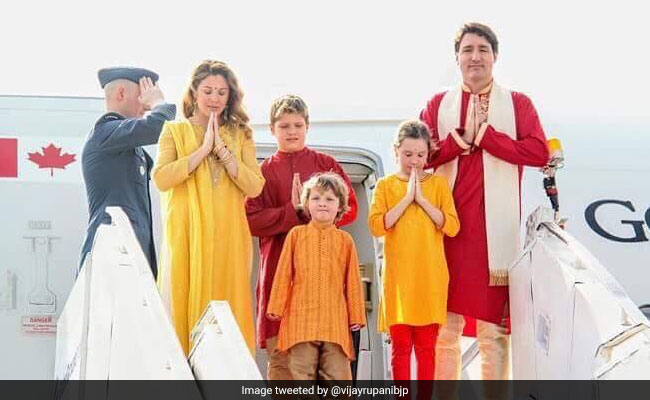
Justin Trudeau and family during India visit
Image via NDTV, originally tweeted by @vijayrupanibjp
Brian Lilley is similarly puzzled, but he has a simpler explanation: it’s that familiar combination of the Trudeau unwillingness to take responsibility, an over-developed blame-casting habit, and Trudeau’s own frequently demonstrated love of wearing costumes:
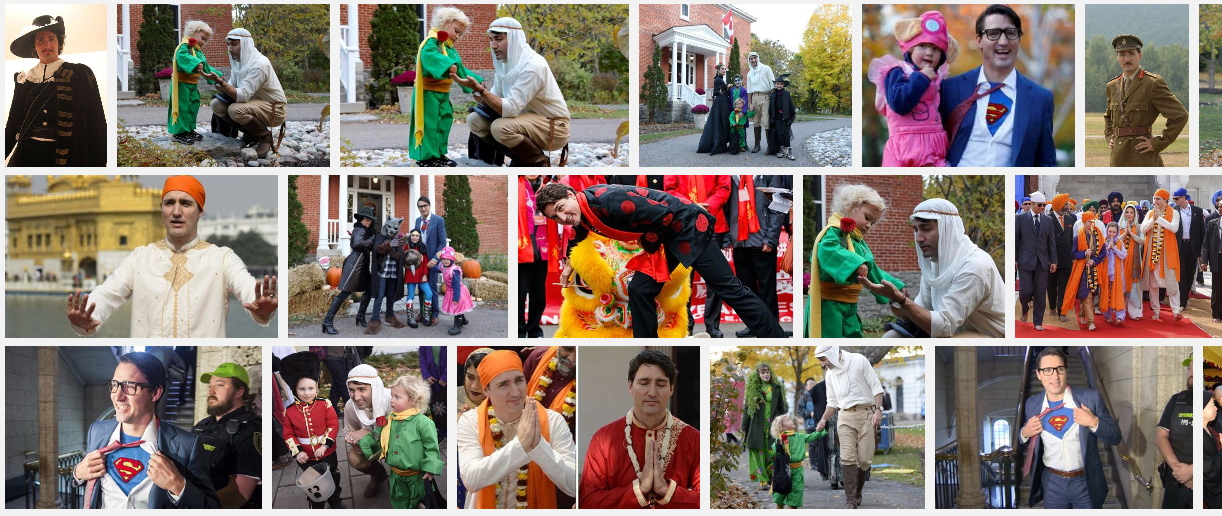
It’s one thing for Butts to think those things, another to voice them in a way that he knows will be made public. It’s also the most tone-deaf assessment of the trip I’ve seen since Sophie Trudeau went on TV and blamed the staff for those outfits.
I mean think about that trip, the two things that got Trudeau in trouble were the invite of the terrorist to dinner and the outrageous outfits. Both of those amount to self-inflicted wounds.
At least Butts admits the photos of Trudeau and his family were a problem.
“Nobody would remember any of that had it not been for the photographs. We should have known this better than anybody — in many ways we’d used this to get elected. The picture will overwhelm words. We did the count — we did forty-eight meetings and he was dressed in a suit for forty-five of them. But give people that picture and it’s the only one they’ll remember,” Butts told Ivison.
[…]
The simple fact of the matter is that the trip to India was a disaster, the kind Trudeau and his team weren’t used to dealing with. So now a year and half later they are still looking to lay the blame anywhere but where it belongs.
With themselves.
Comments Off on We finally get an explanation for Justin Trudeau’s diplomatically catastrophic India tour
July 30, 2019
Mark Steyn: Boris Johnson is “Bertie Wooster with Jeeves’ brain”
The new British PM is quite different from anyone else inhabiting Number 10 in my lifetime, certainly:
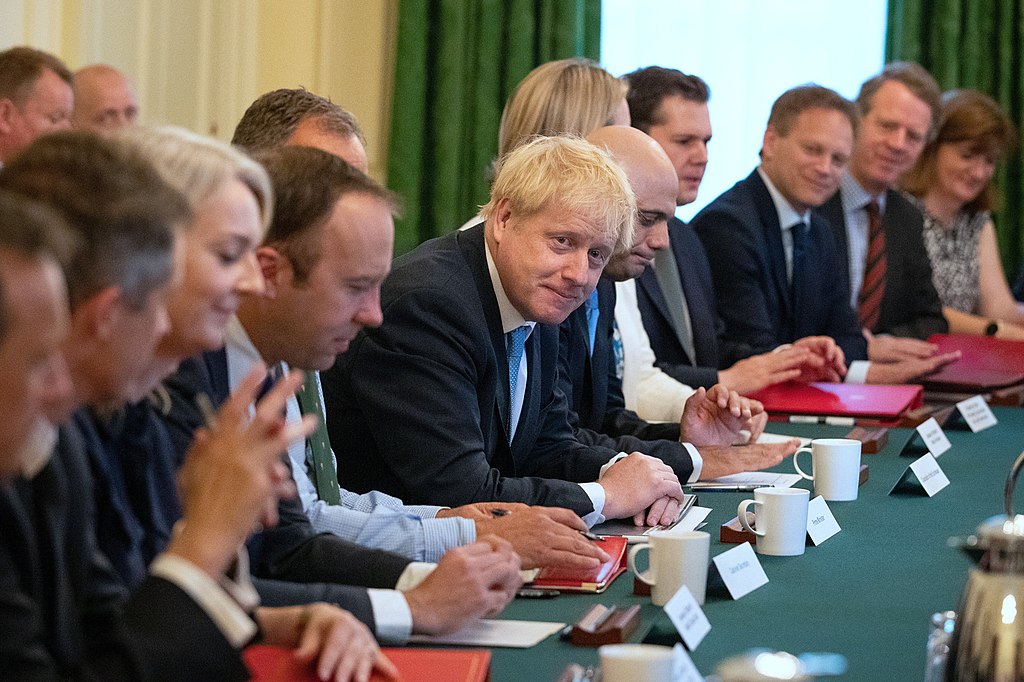
Prime Minister Boris Johnson at his first Cabinet meeting in Downing Street, 25 July 2019.
Official photograph via Wikimedia Commons.
… unlike most media or entertainment figures who progress into politics, Boris has not abandoned his old self — for the very good reason that it’s a hit persona: The great-grandchild of Jews, Muslims and a distant cousin of the Queen, he invented himself in his teens as what his Oxford chum (and another old editor of mine) Toby Young calls a Wodehousian buffer — one might say a Drones Club character, were it not for the fact that he is not, as it happens, terribly clubbable.
It was a canny choice of shtick: It duped the left and half of the right into dismissing him as a buffoon. And, even more cleverly, chuntering his way around the country as a toff with a massive thesaurus gave him, somewhat counter-intuitively, the common touch. The famous image of him stuck on the zipline in a beanie-like helmet waving plastic Union Jacks is so ingeniously endearing one assumes he paid them to stall the thing — because a failed photo-op is way less tedious than one that goes off like clockwork.
This is the genius of the act: He’s Bertie Wooster with Jeeves’ brain. Out on the street, he’s everybody’s friend; among his actual alleged friends, he’s utterly ruthless: Within twenty-four hours of entering 10 Downing Street, he’d pulled off the bloodiest cabinet reshuffle of “modern times”, as the papers say — although actually I can’t think of a bloodier one even from non-modern times. (Only four members of the May regime were retained: Michael Gove, Amber Rudd, Baroness Evans and Matt Hancock.)
Is he a nice person? Well, he’s left an awful lot of human wreckage in his wake. Some of the women he’s used and discarded seem to me, without naming names, to be sad and profoundly damaged from their brief intersection with his wandering zipper. His latest squeeze seems likely to be moving into Number Ten without benefit of clergy – a first for the Tories and a sign of how desperate they are after years of letting all the sober, serious, earnest types turn their party into a laughingstock.
What does he believe in? Other than himself, not terribly much. About a decade ago, I was in London for a couple of days and had lunch with him and Stuart Reid at a favorite Italian restaurant. Stuart was the deputy editor who did all the hard grind at the Speccie, while Boris was the great fizzing impresario fronting the operation — a business model he transferred successfully into his mayoral regime, and will no doubt be trying again in Downing Street. He was going on the BBC’s “Question Time” that night and was worried that he didn’t have anything sufficiently arresting to say, so asked if I had any tips. I gave him a few thoughts on the passing scene, and he considered them not in terms of his own public-policy positions (if any) but in terms of attitudinal cachet. Finally, I said, “Why don’t you really stir them up and put in a word for social conservatism?”
“You mean abortion and all that? Oh, God..,” he sighed, and ordered dessert.
If that seems to be (for self-interested reasons) his most firmly drawn red line, don’t nevertheless overstate his ideological flexibility. Like Boris, Theresa May schemed and maneuvered for decades to reach the top spot … and, by the time she pulled it off, she’d spent so much time and effort on the scheming and maneuvering that she had no idea of what to do once she got there. Boris is likewise invested in himself, but, having reached the finial of Disraeli’s greasy pole, he doesn’t intend to be just the latest seat-filler. Mrs May wanted to be prime minister; Johnson wants to be a great and consequential prime minister.
On another brief pop-in from the thirteenth century, David Warren also takes note of the new British PM:
It has come to my attention that Britain has a new prime minister, BoJo the Clown (known to his friends as “Alexander Boris de Pfeffel Johnson”). I gather Mrs Maybe, previously raised to that office under some gender equality programme I suspect, didn’t work out. Mr BoJo has already been criticized for having unkempt blond hair (and small eyes, I have noticed). Too, he was educated at Oxford University, which is still somewhat élite. He was able to use the word anaphora in a sentence (here), and shares with Churchill (and Trump) an ebullience, a buoyant exuberance, that his enemies invariably discount to their cost. He is a reminder that one man (and I have named three) can change the course of history, and the fate of nations.
Not necessarily for the better, of course.
Jacob Rees-Mogg, Member of Parliament for North East Somerset, is suddenly elevated from the backbenches to the front bench; from persistent articulate rearguard rebel, to House Leader in the Mother of Parliaments; and, Lord President of the Council.
Born to rule (the son of an editor of The Times), the now right honourable gentleman stands as a throwback to 1529, when the last indigenous Catholic was appointed to that office. (Though I am not entirely clear what were the Privy Council arrangements under Good Queen Mary, before the return to Erastian apostasy under Bad Queen Bess.)
Not merely a Conservative but a member of the party’s (“Faith, Flag, and Family”) Cornerstone Group, and a diligently practising Roman Catholic with forty children or so, Rees-Mogg has already made a mark in his new rôle, by imposing rules of civility upon the Tory caucus. He was able to do so while characteristically exhibiting them, in a talk that kept everyone in stitches.
Mr BoJo, too, was christened a Catholic, though it has not so far had much effect. He has rabbinical Jewish and infidel Turk antecedents, too, and learnt Anglican hymns at Eton. He is thus a kind of one-stop shop for nominal Abrahamic associations, but to the point, the Orangemen of Ulster are already calling him “England’s first Catholic prime minister” — and what’s good enough for Belfast is good enough for me.
Comments Off on Mark Steyn: Boris Johnson is “Bertie Wooster with Jeeves’ brain”
July 13, 2019
How to decode NFL training camp clichés
 Ted Glover posted this earlier in the week, but — it being the deadest of dead spots in the NFL year — I didn’t see it until just now. While this is oriented to the upcoming Minnesota Vikings training camp (now in Eagan instead of the decades-long tradition of Mankata, MN), it almost certainly applies to your favourite NFL team’s training camp too:
In just under three weeks, the Minnesota Vikings will begin their second training camp in Eagan, MN. Although where they conduct training camp is still new, what they do at training camp is no different than when they spent over 50 years in Mankato. They will practice, assemble the 53 best players possible, and
then compete to try and win the Super Bowl in Februarybreak our hearts in December or January.During training camp, though, we want to know how our beloved Purple and Gold are doing, and whether or not they’re improving. Along with the offensive, defensive, and special teams drills and practice updates, the Vikings players and coaches will tell you how things are coming along using tried and true clichés. Some clichés have very specific meanings, while others can mean a wide variety of things, or apply to many players.
Obviously, players can’t say what they REALLY mean, especially if someone’s performance is substandard, or their coach is an idiot. So these tried and true clichés help us get to the real meaning of what is being said.
[…]
I/He am/is in the best shape of my/his career: This is used by a player that is clearly on the downside of their career, and is in serious danger of getting cut. This is usually used by either the player or his agent, or maybe a close friend on the team, to help aging player find a different team once the Turk comes calling.
He added 15 pounds of muscle: This describes an aging free agent desperately trying to make the roster for one last ride. Normally used in conjunction with “he’s in the best shape of his career.”
Example: “Player X has added 15 pounds of muscle in the off season and is in the best shape of his career.”
Player X is really turning heads: This is used to describe a late round draft pick or undrafted player that virtually no one knew about three months ago. This player has made a minimum of three good plays in four days of practice, and the punditry is now doing feature stories on him. There is no guarantee of a roster spot, but he is now the clubhouse leader for Mr. Mankato. Anyone on Draft Twitter who even mentioned his name is now madly tweeting “LOOK AT MY BOIIIIIII I TOLD YOU SO!!”
Every team is 0-0/tied for first place: This is used by the players and staff of the Arizona Cardinals, Miami Dolphins, Detroit Lions, and Buffalo Bills to convince their fans that they can somehow sneak in to the playoffs as a wildcard with a 9-7 record. This will not happen, as these teams will be a combined 6- 14 in October. They are terrible.
He’s just a blue collar guy: This is used to describe the player that has little to no physical ability compared to other guys at his position, but outworks everyone. This player will generally be beloved, as he is the “scrappy underdog” story that captivates training camp. If he is a “player that’s turning heads” guy, he is on the fast track to the Hall of Fame after week one of camp. After this player has been on the team two years, every training camp hot take will begin with “this year finally being the year player X gets cut.” Player X will not get cut.
Who is this year’s Jim Kleinsasser? This is asked every year by Viking punditry to desperately find a guy to love as much as we loved Jim Kleinsasser, the ultimate blue collar player. This player does not exist, as there is only one People’s Champion.
Comments Off on How to decode NFL training camp clichés
April 20, 2019
The damage to (and the PR spin about) Notre-Dame de Paris
At Never Yet Melted, some quick analysis from Matthew Keogh (posted originally to Facebook) are quoted on the carefully curated public information made available about Notre-Dame de Paris, even while firefighters were still busy trying to contain the blaze:

Notre Dame Cathedral Fire, a few facts you should know courtesy of the mainstream media:
1. The exact cause of the blaze is still unknown.
2. The exact cause of the blaze is still unknown, but it has been ruled an accident (despite the fact that the exact cause of the blaze is still unknown).
3. The exact cause of the blaze is still unknown, but Islam is the real victim here.
4. The exact cause of the blaze is still unknown which means the damage has not been thoroughly assessed, but it’s not arson.
5. The exact cause of the blaze is still unknown which means the damage has not been thoroughly assessed, but Macron is setting up an international appeal for funding to rebuild despite not knowing how much is needed because the damage has not been thoroughly assessed.
This is the sort of information you get when journalists are in bed with the politicians.
Comments Off on The damage to (and the PR spin about) Notre-Dame de Paris


