Trinity College Dublin
Published 9 Aug 2012The Science of Discworld – with Terry Pratchett, Ian Stewart and Jack Cohen at SCIENCE GALLERY, Trinity College Dublin, Ireland in June 2012, as part of Dublin City of Science 2012

Trinity College Dublin
Published 9 Aug 2012The Science of Discworld – with Terry Pratchett, Ian Stewart and Jack Cohen at SCIENCE GALLERY, Trinity College Dublin, Ireland in June 2012, as part of Dublin City of Science 2012
World War Two
Published 8 Jun 2021All belligerents are working hard to develop a powerful nuclear super-weapon. The Americans wonder how far along the Germans are, and send in their spies.
(more…)
TimeGhost History
Published 10 Feb 2021Albert Einstein may be renowned for his work in the field of science, but this season he is fundraising for a new Jewish university. Charity isn’t the only activity on the cards in the United States this season however, much more tragic events are also afoot …
Join us on Patreon: https://www.patreon.com/TimeGhostHistory
Hosted by: Indy Neidell
Written by: Francis van Berkel
Director: Astrid Deinhard
Producers: Astrid Deinhard and Spartacus Olsson
Executive Producers: Astrid Deinhard, Indy Neidell, Spartacus Olsson, Bodo Rittenauer
Creative Producer: Maria Kyhle
Post-Production Director: Wieke Kapteijns
Research by: Francis van Berkel
Image Research by: Daniel Weiss
Edited by: Daniel Weiss
Sound design: Marek KamińskiColorizations:
– Daniel Weiss – https://www.facebook.com/TheYankeeCol…
– Dememorabilia – https://www.instagram.com/dememorabilia/
– Daniel HassSources:
Some images from the Library of CongressFrom the Noun Project:
– Death by Adrien Coquet
– Ukraine by Lluisa Iborra, ES
– Immigrants by Luis Prado
– sun by MRFA
– Wine by Made
– orange By lieuchien, SG
– Champagne By Pete BakerSoundtracks from Epidemic Sound and ODJB
– “One More for the Road” – Golden Age Radio
– “Dawn Of Civilization” – Jo Wandrini
– “London” – Howard Harper-Barnes
– “Ominous” – Philip Ayers
– “Prescient” – Howard Harper-Barnes
– “Not Safe Yet” – Gunnar Johnsen
– “Document This 1” – Peter Sandberg
– “Growing Doubt” – Wendel Scherer
– “Tiger Rag” – ODJB
– “It’s Not a Game” – Philip AyersArchive by Screenocean/Reuters https://www.screenocean.com.
A TimeGhost chronological documentary produced by OnLion Entertainment GmbH.
From the comments:
TimeGhost History
2 days ago
In the year that Buck’s Fizz is born, the USA promises to be a hotbed of funding for Albert Einstein. But for the nation’s black population, this season will brutally prove that the USA is still lightyears from any semblance of racial equality. Further highlighting this racial inwardness will be legislation to curb immigration. Clearly, America is still a long way from being the Land of the Free.Raunchy literature, Broadway and Buck’s Fizz will also make an appearance this season, tune in to find out how!

TimeGhost History
Published 11 Nov 2020It is a springtime of revolution throughout the world in 1919 and not just the political kind. Era-defining advances in science and technology and iconic cinematography are made this season.
Join us on Patreon: https://www.patreon.com/TimeGhostHistory
Hosted by: Indy Neidell
Written by: Indy Neidell and Francis van Berkel
Director: Astrid Deinhard
Producers: Astrid Deinhard and Spartacus Olsson
Executive Producers: Astrid Deinhard, Indy Neidell, Spartacus Olsson, Bodo Rittenauer
Creative Producer: Maria Kyhle
Post-Production Director: Wieke Kapteijns
Research by: Indy Neidell and Francis van Berkel
Edited by: Michał Zbojna
Sound design: Marek KamińskiColorizations:
Klimbim
Mikołaj Uchman
Wayne Degan
metacolor.orgSources:
Library of Congress
Bundesarchiv
Icons from The Noun Project:
– retro computer By Tinashe Mugayi, MY
– audio sound recorder By Vectors Point, PK
– Radio by Bill Denk
– Old TV By Pascal Heß, DE
– Radio Tower by Iris SunSoundtracks from Epidemic Sound:
– “British Royalty” – Trailer Worx
– “Flight Path” – Cobby Costa
– “Deflection” – Reynard Seidel
– “Flight Path” – Cobby Costa
– “A Single Grain Of Rice” – Yi Nantiro
– “Trapped in a Maze” – Philip Ayers
– “Symphony of the Cold-Blooded” – Christian Andersen
– “Rainy Landscapes” – Farrell Wooten
– “Ancient Saga” – Max AnsonArchive by Screenocean/Reuters https://www.screenocean.com.
A TimeGhost chronological documentary produced by OnLion Entertainment GmbH.
From the comments:
TimeGhost History
1 day ago
J’accuse is one of the many iconic films we’ll explore in this series. The interwar period is when European cinema really starts to hit its stride again after some serious setbacks during the Great War. In those years, American cinema rocketed to the mainstream both at home and abroad, with revolutionary filmmaking techniques being developed that we still see today such as close-ups, huge cast lists, and realistic set design.The post-Great War is set to be a great era in the history of cinema and not just because of the films themselves, J’accuse and other films are important as historical movers in their own right! They shape public perceptions, influence political change, and inspire whole social movements, so make sure you stay tuned to find out.
And in the meantime, are there any iconic interwar films you think deserve to be in this series?
BBC Earth Lab
Published 10 Jan 2013James May answers the question as to whether or not invisibility is possible. James draws upon quite a few interesting theories during this discussion.
Outtakes from this video: https://www.youtube.com/watch?v=6Fy1Xkx5VFc
James May’s Q&A:
With his own unique spin, James May asks and answers the oddball questions that we’ve all wondered about from ‘What exactly is one second?’ to ‘Is invisibility possible?’
BBC Earth Lab
Published 5 Aug 2013Getting to space in a rocket is expensive! One of the most popular alternative ideas is the space elevator, but is it really possible?
Here at BBC Earth Lab we answer all your curious questions about science in the world around you. If there’s a question you have that we haven’t yet answered or an experiment you’d like us to try let us know in the comments on any of our videos and it could be answered by one of our Earth Lab experts.
Overly Sarcastic Productions
Published 23 Sep 2015Blue hits us with some physics! Hold onto your butts. That butt is made of star stuff, ya know. It’s very special. Be proud of that butt. It was forged in the heart of a supernova.
Anyway, yeah, physics.
Guest starring yours truly! Watch out for my extremely subtle and unobtrusive cameos.
The ninja thing is a reference to earlier videos. I think he shows up in the College video and the one about The Borgias.
What is happening to our country, and our universities? It sometimes seems that everything is coming apart. To understand why, I have found it helpful to think about an idea from cosmology called “the fine-tuned universe.” There are around 20 fundamental constants in physics — things like the speed of light, Newton’s gravitational constant, and the charge of an electron. In the weird world of cosmology, these are constants throughout our universe, but it is thought that some of them could be set to different values in other universes. As physicists have begun to understand our universe, they have noticed that many of these physical constants seem to be set just right to allow matter to condense and life to get started.
For a few of these constants, if they were just one or two percent higher or lower, matter would have never condensed after the big bang. There would have been no stars, no planets, no life. As Stephen Hawking put it, “the remarkable fact is that the values of these numbers seem to have been very finely adjusted to make possible the development of life.”
Some have suggested that this fine-tuning might be evidence for the existence of God. This would be a deist conception of God, of the sort that Thomas Jefferson, James Madison, and most of the Founding Fathers believed in: a God who set up the universe like a giant clock, with exactly the right springs and gears, and then set it in motion.
Jonathan Haidt, “The Age of Outrage: What the current political climate is doing to our country and our universities”, City Journal, 2017-12-17.
Colby Cosh on the latest refugee to flee from Canada:
On Dec. 10, the World Magnetic Model used to calibrate compasses was officially updated. The “model” can be thought of as a map that you would use, given your location on or near the Earth’s surface, to find out how many degrees your magnetic compass is off from true geographic north (or south). This ordinarily happens every five years, but the wizards in charge of the system decided to update a year early because the north magnetic pole is moving particularly fast right now.
Positions of North Magnetic Pole of the Earth. Poles shown are dip poles, defined as positions where the direction of the magnetic field is vertical. Red circles mark magnetic north pole positions as determined by direct observation, blue circles mark positions modelled using the GUFM model (1590–1890) and the IGRF-12 model (1900–2020) in 1 year increments. For the years 1890–1900, a smooth interpolation between the two models was performed. The modelled locations after 2015 are projections.
Map by Cavit via Wikimedia Commons.As most Canadians will have heard, magnetic north is, at the moment, fleeing Canadian territory and heading toward Russia. The rate of change is still very high by historic standards, first established in the early 19th century, but it has slowed just a little. In the year 1900 the pole was firmly in the Canadian Arctic, off Somerset Island. It wandered north, broke out of our high Arctic archipelago in about 2000, and has been streaking Siberia-ward across the open sea at more than 50 km a year since. The time component in the new WMM forecasts a slight slowing over the next five-year period, to about 40 km/yr.
This, like everything else involving Earth’s magnetic field, is a bit of a guess. The WMM has to be updated often because it does incorporate guesswork about the magnitude and direction of changes in the short-term future. The model will be most accurate now, and increasingly less so over the five-year term as the magnetic poles do their little dance — independently, by the way; the magnetic poles are not exactly opposite the Earth from one another, and the “south” one is scooting along much more slowly than the “north.” (Also, the magnetic north pole, the one to which the “north” needle of your compass is attracted, is actually a “south” pole to physicists.)
The truth is that the naive inquirer should not research Earth’s magnetism in the expectation that it is as well understood by scientists as, say, oceanic tides. (You can probably detect that I am talking about myself here.) The question “Why is the magnetic pole leaving Canada?” does not really admit of a solid answer. Maybe it’s the investment climate?
Probably most everybody is dimly aware that the magnetic poles flip outright from time to time — every half-million years on average. But the assumptions embedded in your handheld compass run much deeper than that. The Earth itself is only a big dipole magnet generally, rather than locally, and there is no guarantee of only one “north magnetic pole” as the field is measured near the surface. Competing “north poles” can form. (Which would, at least, let Russia and Canada each have their own …)
BBC Earth Lab
Published 24 Jan 2013Why can we see through glass, but not other solid objects? James May explains.
Subscribe to Earth Lab for more fascinating science videos – http://bit.ly/SubscribeToEarthLab
All the best Earth Lab videos http://bit.ly/EarthLabOriginals
Best of BBC Earth videos http://bit.ly/TheBestOfBBCEarthVideosHere at BBC Earth Lab we answer all your curious questions about science in the world around you. If there’s a question you have that we haven’t yet answered or an experiment you’d like us to try let us know in the comments on any of our videos and it could be answered by one of our Earth Lab experts.
Extra Credits
Published 7 Nov 2019Start your Warframe journey now and prepare to face your personal nemesis, the Kuva Lich — an enemy that only grows stronger with every defeat. Take down this deadly foe, then get ready to take flight in Empyrean! Coming soon! http://bit.ly/EHWarframe
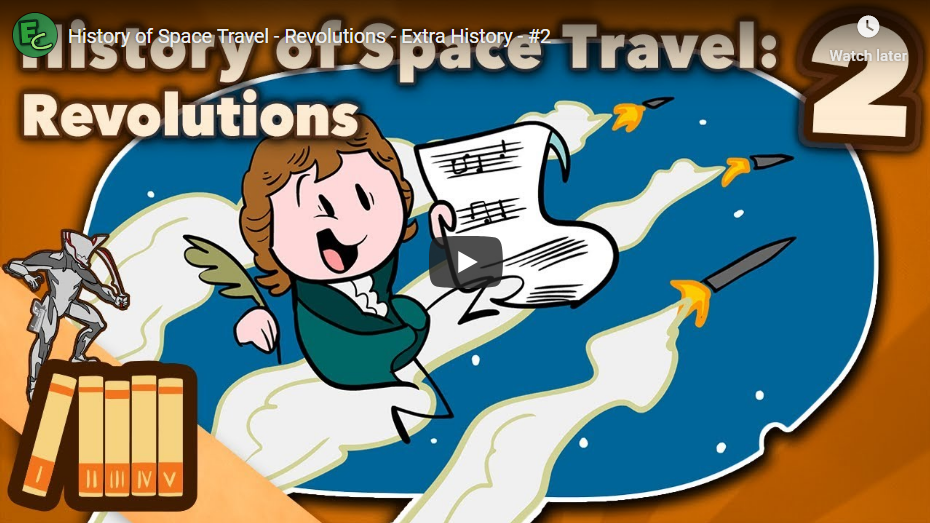
As the Renaissance breathes new life into Europe, Copernicus develops mathematical proofs for the sun resting in the center of the universe. And from his works, a new world is born. The scientific world gets faster and faster. Revolutions of all kinds begin to set off chains of events that reshape human history. And as science improves, so do the tools of war. Both will be necessary to propel humanity to the stars. Join us on this race through the scientific works between the Renaissance and the Industrial Revolution.
Copernicus’ publishing really came down to the wire! Legend has it that he was given the final printed pages on his death bed. When they presented him with the book, he awoke from a coma, saw his life’s work and finally passed away in peace. Or so the story goes.
Forgotten Weapons
Published on 10 Jan 2019http://www.patreon.com/ForgottenWeapons
Cool Forgotten Weapons merch! http://shop.bbtv.com/collections/forg…
How Does it Work: Blowback Action
The simplest for of firearms action is blowback, also called simple blowback. It is basically just an application of Newton’s 3rd Law; that for every action there is an equal and opposite reaction. As the bullet moves forward down the barrel, the slide or bolt of the gun moves backwards. The two move with the same energy, meaning that the light and very fast bullet is balanced out by the heavy and slow bolt or slide.
Contact:
Forgotten Weapons
PO Box 87647
Tucson, AZ 85754
exurb1a
Published on 21 Jan 2019Correction: I pulled a stupid. The fine structure constant is usually given as 1/137 at low energies, not 137.
From the comments:
Skadfled
57 minutes ago8:41 it says: “Full disclosure: The “physics is deeply logical” idea is just a pet theory I’ve shoehorned in here alongside clever people’s theories to make it look legitimate. But isn’t there something charming about the idea that the universe is purely geometrical down there at the very bottom? I think so. Then again, plenty of things are charming and still useless. Otters for example (*picture of otter*) Excuse me. Let’s continue.
minutephysics
Published on Oct 14, 2012Check out the Massey Lectures with Neil Turok: http://www.cbc.ca/radio/ideas/the-201…
Perimeter Institute for Theoretical Physics: http://pitp.caMinute Physics provides an energetic and entertaining view of old and new problems in physics — all in a minute!
Music by Nathaniel Schroeder: http://www.soundcloud.com/drschroeder
Thanks to Nima Doroud and Bruno LeFloch for contributions and to Perimeter Institute for support.
http://www.perimeterinstitute.caProduced in association with the 2012 Massey Lecture Series http://dft.ba/-massey Created by Henry Reich
H/T to Aeon:
The physics revolution that started with the flicker of a lightbulb
The discovery of quantum mechanics at the start of the 20th century shook the very foundations of physics, forcing scientists and philosophers to reexamine everything from particles upward. But as this short animation from MinutePhysics explains, the quantum revolution was jumpstarted by a rather unremarkable question. As the German government asked the theoretical physicist Max Planck: how can lightbulbs be made more efficient? To help solve the problem, Planck tried to account for the changing colour of light based on temperature, which he eventually realised couldn’t be explained by classical Newtonian physics. Working backwards from his data in ‘an act of despair’, Planck found that light wasn’t emitted continuously, but rather in discrete packets that he referred to as ‘quanta’. And the rest is the illusory arrow of time that we call history.
Extra Credits
Published on 21 Oct 2018Credit to Alisa Bishop for her art on this series: http://www.alisabishop.com/
What does the quantum revolution mean today? We talk about quantum computing application possibilities in machine learning, cybersecurity, environmental science, and more.
A tremendous thank-you to Alexander Tamas, the “mystery patron” who made this series possible. We finally found room in our busy production schedule to create and air this series alongside our regularly scheduled, patron-approved Extra History videos. A huge thank you to the multiple guest artists we got to work with, to Matt Krol for his skillful wrangling of the production schedule and keeping everyone happy, and to our Patreon supporters for your patience and support.
Support us on Patreon! http://bit.ly/EHPatreon



Powered by WordPress