
People without meaningful work and copious free time don’t write symphonies or create great works of art. They don’t live a life of the mind. They drink too much, or get in fights, or watch a lot of internet porn, or commit crimes. They don’t contribute to the economy or culture, as a rule. They just…exist. And it goes on like that, sometimes for generations.
Labor is the fate of all humankind. Always has been. We work to live. Work gives shape and meaning to our lives. It’s not just the income we derive from it; it’s the knowledge that we are able to function as adults in the wider world, and provide for ourselves and our families. It’s feeling the satisfaction of having contributed something to the maintenance of civilization, even if it means we haul trash away or keep the grass mowed. It’s all honorable work, necessary work, and not something to be ashamed of.
It’s not an outrage, it’s just the way things are. To try and embitter people about that, to make them feel that the natural order of things is unfair, is just to do an enormous amount of harm to the very people you’re claiming to want to help.
Monty, “We’re now living in a post-labor Utopia. Have you heard about this?”, Ace of Spades HQ, 2014-02-06
September 16, 2014
QotD: The real value of work
July 11, 2014
July 3, 2014
Jeremy Bentham’s “secret” writings
In the Guardian, Faramerz Dabhoiwala reviews a recent “discovery” that Jeremy Bentham, far from being an innocent about sexual matters (as portrayed by his disciple John Stuart Mill among others), had thought deeply on the topic and had written much. After his death, these writings were ignored for fear that they would discredit his wider body of work.
Bodily passion was not just a part of Bentham’s life: it was fundamental to his thought. After all, the maximisation of pleasure was the central aim of utilitarian ethics. In place of the traditional Christian stress on bodily restraint and discipline, Bentham sought, like many other 18th-century philosophers, to promote the benefits of economic consumption, the enjoyment of worldly appetites and the liberty of natural passions. This modern, enlightened view of the purpose of life spawned a revolution in sexual attitudes, and no European scholar of the time pursued its implications as thoroughly as Bentham. To think about sex, he noted in 1785, was to consider “the greatest, and perhaps the only real pleasures of mankind”: it must therefore be “the subject of greatest interest to mortal men”. Throughout his adult life, from the 1770s to the 1820s, he returned again and again to the topic. Over many hundreds of pages of private notes and treatises, he tried to strip away all the irrational and religious prohibitions that surrounded sexual activity.
Of all enjoyments, Bentham reasoned, sex was the most universal, the most easily accessible, the most intense, and the most copious — nothing was more conducive to happiness. An “all-comprehensive liberty for all modes of sexual gratification” would therefore be a huge, permanent benefit to humankind: if consenting adults were freed to do whatever they liked with their own bodies, “what calculation shall compute the aggregate mass of pleasure that may be brought into existence?”
The main impetus for Bentham’s obsession with sexual freedom was his society’s harsh persecution of homosexual men. Since about 1700, the increasing permissiveness towards what was seen as “natural” sex had led to a sharpened abhorrence across the western world of supposedly “unnatural” acts. Throughout Bentham’s lifetime, homosexuals were regularly executed in England, or had their lives ruined by the pillory, exile or public disgrace. He was appalled at this horrible prejudice. Sodomy, he argued, was not just harmless but evidently pleasurable to its participants. The mere fact that the custom was abhorrent to the majority of the community no more justified the persecution of sodomites than it did the killing of Jews, heretics, smokers, or people who ate oysters — “to destroy a man there should certainly be some better reason than mere dislike to his Taste, let that dislike be ever so strong”.
Though ultimately he never published his detailed arguments for sexual liberty for fear of the odium they would bring on his general philosophy, Bentham felt compelled to think them through in detail, to write about them repeatedly and to discuss them with his acquaintances. In one surviving letter to a friend, he joked that his rereading of the Bible had finally revealed that the sin for which God had punished the inhabitants of Sodom and Gomorrah was not in fact buggery, but the taking of snuff. He and his secretary had consequently taken a solemn oath to hide their snuff-pouches and nevermore to indulge “that anti-Christian and really unnatural practice” in front of one another. Meanwhile, they were now both happily free to enjoy “the liberty of taking in the churchyard or in the market place, or in any more or less public or retired spot with Man, Woman or Beast, the amusement till now supposed to be so unrighteous, but now discovered to be a matter of indifference”. Among those with whom Bentham discussed his arguments for sexual toleration were such influential thinkers and activists as William Godwin, Francis Place and James Mill (John Stuart Mill’s father). Bentham’s ultimate hope, “for the sake of the interests of humanity”, was that his private elaboration and advocacy of these views might contribute to their eventual free discussion and general acceptance. “At any rate,” he once explained, even if his writings could not be published in his own lifetime, “when I am dead mankind will be the better for it”.
June 26, 2014
The second volume of Patterson’s biography of Robert Heinlein
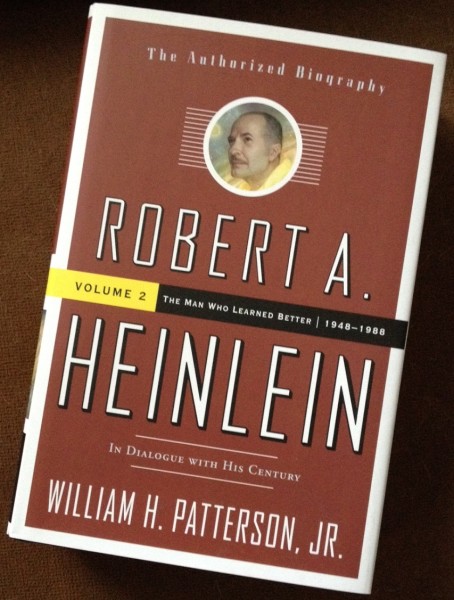 In the Washington Post, Michael Dirda reviews the second (and final) volume of William Patterson’s Robert A. Heinlein: In Dialogue With His Century.
Robert Anson Heinlein (1907-1988) possessed an astonishing gift for fast-paced narrative, an exceptionally engaging voice and a willingness to boldly go where no writer had gone before. In “— All You Zombies—” a transgendered time traveler impregnates his younger self and thus becomes his own father and mother. The protagonist of Tunnel in the Sky is black, and the action contains hints of interracial sex, not the usual thing in a 1955 young adult book. While Starship Troopers (1959) championed the military virtues of service and sacrifice, Stranger in a Strange Land (1961) became a bible for the flower generation, blurring sex and religion and launching the vogue word “grok.”
Heinlein’s finest work in the short story was produced in the late 1930s and early ’40s, mainly for the legendary editor of Astounding, John W. Campbell. But by 1948, when this volume opens, “The Roads Must Roll,” “By His Bootstraps, “Gulf” and “Requiem” are behind him. The onetime pulp writer has broken into the Saturday Evening Post and Boy’s Life, married his third (and last) wife, Virginia, and settled in Colorado Springs, where he designs and builds a state-of-the-art automated house. Apart from his occasional involvement with Hollywood, as in scripting Destination Moon, he will devote the rest of his career mainly to novels.
[…]
Like his fascinating but long-winded first volume, the second half of Patterson’s biography is difficult to judge fairly. Packed with facts both trivial and significant, relying heavily on the possibly skewed memories of the author’s widow, and utterly reverent throughout, volume two emphasizes Heinlein the husband, traveler, independent businessman and political activist. Above all, the book celebrates the intense civilization of two that Heinlein and his wife created. There is almost nothing in the way of literary comment or criticism.
Though Heinlein can do no wrong in his biographer’s eyes, if you use yours to look in Patterson’s voluminous endnotes, you will occasionally find confirmation that the writer could be casually cruel as well as admirably generous, at once true to his beliefs and unpleasantly narrow-minded and inflexible about them. Today we would call Heinlein’s convictions libertarian, his personal philosophy grounded in absolute freedom, individual responsibility and an almost religiously inflected patriotism. Heinlein could thus be a confirmed nudist and member of several Sunshine Clubs as well as a grass-roots Barry Goldwater Republican.
For the record, I loved this volume even more than I loved the first one. But Dirda’s comments are fair: Patterson worked hard to present Heinlein in as positive a light as possible, so it’s not unreasonable to suspect that the great man’s character quirks could make him difficult and awkward to deal with at times (to be kind). In the last post, I talked about the adolescent Heinlein as being “probably a pretty toxic individual” and that aspect of his character can still be discerned in the recounting of his later years.
June 15, 2014
Falsifiability as a way to test your beliefs
Wendy McElroy asks whether you really want to be correct:
“Some circumstantial evidence is very strong, as when you find a trout in the milk.” – Henry David Thoreau
Evidence that something is wrong with a theory is rarely as obvious as a trout in the milk. This is particularly true when a belief is deeply-held or invested with emotion.
One of the most powerful intellectual tools to test your own beliefs is a modified form of “falsification” (or refutation), a concept popularized by the philosopher Karl Popper. He argued that the process of trying to prove a scientific hypothesis through amassing evidence in support was the reverse of what should occur. A scientist should attempt to disprove his hypothesis by finding contradictory evidence.
His reason was simple but compelling. Popper agreed with Albert Einstein who once stated, “No amount of experimentation can ever prove me right; a single experiment can prove me wrong.” Popper used the now-classic example of the general statement, “all swans are white.” No matter how many white swans are counted, the statement cannot be proven. But one black swan disproves it.
Falsification was not intended to assess general beliefs or ideologies but the process can be loosely bent to that purpose. In fact, Popper himself used falsifiability in rejecting Marxism and Freudianism. Adapting falsifiability to become a general intellectual tool means that a person should reverse the normal process of trying incessantly to prove his beliefs are correct by amassing confirming evidence. Instead, he should pause every once in a while and ask, “What, in principle, would disprove my belief in X or Y?” For many people, this process offers an entirely fresh perspective on their own ideas.
[…]
Falsification has limitations and it is generally unpopular with contemporary philosophers who point to such flaws as the theory itself being unfalsifiable. Moreover, not all beliefs need to be based on evidence. Many personal beliefs are just that – personal; many religious beliefs fall into this category. But if you want to argue that a position is objectively true, then falsifiability is a quick and effective technique by which to test your beliefs, to get insight into how firmly you hold them … and why.
May 15, 2014
The “typical American voter [is] a moderate national socialist who strongly supports state intervention in many areas”
Kevin Williamson responds to Michael Lind’s recent hit piece on Bryan Caplan:
Mr. Lind’s piece contains no analysis. Like a great deal of what currently passes for commentary, it is mostly a half-organized swarm of insults out of which emerges the occasional tendentious misstatement of Professor Caplan’s views and those of the libertarian thinkers with whom he is sometimes associated. Mr. Lind begins by bemoaning our alleged national descent into plutocracy and writes: “Some on the libertarian right have responded to this research by welcoming our new plutocratic overlords. Among these is Bryan Caplan.” Professor Caplan, author of The Myth of the Rational Voter, is a trenchant critic of electoral decision-making. Voters, he argues, suffer from specific, predictable biases — anti-market bias, anti-foreign bias, make-work bias, and pessimistic bias — that causes them to hold, and act on, untrue beliefs about the way the world works. Being an economist, Professor Caplan focuses on what voters believe about economics vs. what professional economists believe. He characterizes the typical American voter as a moderate national socialist who strongly supports state intervention in many areas, and remarks, “Given public opinion, the policies of First World democracies are surprisingly libertarian.”
There is a great deal of agreement among the poor, the middle class, and the rich on most political issues, but the rich are significantly more libertarian than are the poor. As Professor Caplan notes, the wealthy and the poor both support raising the minimum wage, but the poor much more strongly so. You might think that that is a question of narrow self-interest, but self-interest, counterintuitively, has little effect on public opinion. And the rich are more libertarian than the poor not only on economic issues but also on social issues. The poor are “much more anti-gay,” Professor Caplan writes. “They’re much less opposed to restricting free speech to fight terrorism.” On the relatively few issues on which there is strong disagreement between the poor and the rich, the preferences of the rich have tended to prevail, and that pleases Professor Caplan, because that means that more libertarian policies are put into place than public opinion would suggest. “To avoid misinterpretation,” he writes, “this does not mean that American democracy has a strong tendency to supply the policies that most materially benefit the rich. It doesn’t.” But there is no avoiding misinterpretation when the opposite side is committed to misinterpreting you. Professor Caplan celebrates the advance of gay rights, pushback against the surveillance state, and, regrettably (especially for the author of Selfish Reasons to Have More Kids), abortion rights, among other items on the progressive social agenda. Mr. Lind sees only a champion of plutocracy — because that is all he is inclined to see.
Mr. Lind, who shares with fellow former conservative David Brock the convert’s zeal, is something of a fanatic on the subject of libertarianism, and the bulk of his piece is dedicated to abominating every libertarian thinker he’s ever heard of, making the case that the abominable Professor Caplan should fit right in. He starts with the predictable home-run swing (“you might be tempted to dismiss Bryan Caplan as just another Koch-funded libertarian hack …” and follows up with “Koch-subsidized intelligentsia of the libertarian right,” “almost all of them are paid, directly or indirectly, by a handful of angry, arrogant rich guys,” “third-rate minds like Peter Thiel”), goes right into the shallow insults (“that near-oxymoron, libertarian thought”), and then proceeds to the greatest hits: “Ludwig von Mises praised Mussolini,” “Friedrich von Hayek” [NB: The Hayek family ceased being the “von Hayek” family in 1919, when Hayek was twelve, and he did not use the honorific himself, but that “von” sounds kind of Nazi-ish, so, there you have it] admired the military dictator Augusto Pinochet,” and closes out with moral preening: “Our squalid age of plutocratic democracy has found a thinker worthy of it.”
January 22, 2014
QotD: The necessities of life
George said:
“You know we are on a wrong track altogether. We must not think of the things we could do with, but only of the things that we can’t do without.”
George comes out really quite sensible at times. You’d be surprised. I call that downright wisdom, not merely as regards the present case, but with reference to our trip up the river of life, generally. How many people, on that voyage, load up the boat till it is ever in danger of swamping with a store of foolish things which they think essential to the pleasure and comfort of the trip, but which are really only useless lumber.
How they pile the poor little craft mast-high with fine clothes and big houses; with useless servants, and a host of swell friends that do not care twopence for them, and that they do not care three ha’pence for; with expensive entertainments that nobody enjoys, with formalities and fashions, with pretence and ostentation, and with — oh, heaviest, maddest lumber of all! — the dread of what will my neighbour think, with luxuries that only cloy, with pleasures that bore, with empty show that, like the criminal’s iron crown of yore, makes to bleed and swoon the aching head that wears it!
It is lumber, man — all lumber! Throw it overboard. It makes the boat so heavy to pull, you nearly faint at the oars. It makes it so cumbersome and dangerous to manage, you never know a moment’s freedom from anxiety and care, never gain a moment’s rest for dreamy laziness — no time to watch the windy shadows skimming lightly o’er the shallows, or the glittering sunbeams flitting in and out among the ripples, or the great trees by the margin looking down at their own image, or the woods all green and golden, or the lilies white and yellow, or the sombre-waving rushes, or the sedges, or the orchis, or the blue forget-me-nots.
Throw the lumber over, man! Let your boat of life be light, packed with only what you need — a homely home and simple pleasures, one or two friends, worth the name, someone to love and someone to love you, a cat, a dog, and a pipe or two, enough to eat and enough to wear, and a little more than enough to drink; for thirst is a dangerous thing.
You will find the boat easier to pull then, and it will not be so liable to upset, and it will not matter so much if it does upset; good, plain merchandise will stand water. You will have time to think as well as to work. Time to drink in life’s sunshine — time to listen to the Æolian music that the wind of God draws from the human heart-strings around us — time to —
I beg your pardon, really. I quite forgot.
Jerome K. Jerome, Three Men in a Boat (to say nothing of the dog), 1889.
October 6, 2013
QotD: The corrupting influence of the political system
The underlying problem is that people do not yet widely understand that the higher the political office, the more likely it is that the electoral contest is between two sociopathic con men.
Indeed, the US Presidential election is a sort of quadrennial Olympics for con men. The odds of of a randomly selected untrained amateur winning the Olympic 500m race are poor when hundreds or thousands of professionals train for years for the event. The probability of a decent human being winning the White House when competing against hordes of amoral grifters whose skills are honed to a razor’s edge by years of competition are even lower.
Worse, people do not understand that even if a decent human being by some astounding accident wins high political office, they are almost inevitably both thwarted and corrupted. The system is built to derail reform, not to enable it, and it holds temptations that few normal people can resist. One is faced with (to name but a few things) the powerful financial interests of the Military-Industrial Complex, blackmail by the intelligence community, lobbyists more numerous than locusts, fellow politicians who do not want their sustenance to end, a press almost as interested in preserving the status quo as the pigs at the trough, Sir Humphrey Appleby‘s spiritual kin, constant luxuries from banquets to private jets to soften one’s moral resistance, and an endless series of instances where one might bend the rules just this once, for the common good.
Perry Metzger, “On Politics”, Samizdata, 2013-08-19
August 4, 2013
The Day The Universe Changed – “The Way We Are”
Episode 1 of James Burke’s ground-breaking series “The Day The Universe Changed” which explores the evolution of Western Scientific thought starting from the fall of Rome.
June 14, 2013
“The only truly new political idea in the last couple thousand years is this libertarian idea”
In National Review Online, Jonah Goldberg responds to a recent Salon hit piece on libertarianism:
In a much-discussed essay for Salon, Michael Lind asks: “If libertarians are correct in claiming that they understand how best to organize a modern society, how is it that not a single country in the world in the early twenty-first century is organized along libertarian lines?”
Such is the philosophical poverty of liberalism today that this stands as a profound question.
[. . .]
That phrase, “the wave of the future,” became famous thanks to a 1940 essay by Anne Morrow Lindbergh. She argued that the time of liberal democratic capitalism was drawing to a close and the smart money was on statism of one flavor or another — fascism, Communism, socialism, etc. What was lost on her, and millions of others, was that this wasn’t progress toward the new, but regression to the past. These “waves of the future” were simply gussied-up tribalisms, anachronisms made gaudy with the trappings of modernity, like a gibbon in a spacesuit.
The only truly new political idea in the last couple thousand years is this libertarian idea, broadly understood. The revolution wrought by John Locke, Edmund Burke, Adam Smith, and the Founding Fathers is the only real revolution going. And it’s still unfolding.
Indeed, what’s remarkable about all of the states Lind identifies as proof that libertarianism doesn’t work is that they are in fact proof that it does. What made the American experiment new were its libertarian innovations, broadly speaking. Moreover, those innovations made us prosper. Even Sweden — the liberal Best in Show — owes its successes to its libertarian concessions.
I’m actually not a full-blown libertarian myself, but it’s an ideal I’d like America to move closer to, not further away from as we’ve been doing of late — bizarrely in the name of “progress,” of all things.
April 14, 2013
Competition and co-operation in a free market
Sheldon Richman suggests that some people’s objections to free trade and free markets isn’t so much ethical as aesthetic:
Market advocates tend to respect the intellect of their fellow human beings. You can tell by their reliance on philosophical, moral, economic, and historical arguments when trying to persuade others. But what if most people’s aversion to the market isn’t founded in philosophy, morality, economics, or history? What if their objection is aesthetic?
More and more I’ve come to think this is the case, and I believe I witnessed an example recently at a lecture I gave at St. Lawrence University. During the Q&A a woman asked, in all sincerity, why society couldn’t do without money, since so many bad things are associated with it. She also suggested that cooperation is better than market competition. I replied that since money facilitates exchange and exchange is cooperation, it follows that money facilitates cooperation — a lovely thing, indeed. Government, I added, corrupts money.
I also said that competition is what happens when we are free to decide with whom we will cooperate. I don’t know if my response prompted her to rethink her objections to the market, but I am confident her objection was aesthetic. For her, money and competition are ugly. Perhaps I didn’t respond on an aesthetic level; it’s something I have to work on. But I tried, and so must we all when we encounter these sorts of objections.
Like that nice woman, many decent people dislike markets because they find them unattractive. And they associate markets with other things they find unattractive besides money and competition: (rugged, atomistic) individualism, selfishness, and profit. F.A. Hayek noticed this, writing in “Individualism: True and False”, “the belief that individualism approves and encourages human selfishness is one of the main reasons why so many people dislike it.” If that’s the case, philosophical, moral, economic, and historical arguments may fall on deaf ears. The objections must be met on an aesthetic level.
November 6, 2012
Adam Smith’s “invisible hand”
From LearnLiberty.org
Why are some countries wealthy while other nations are poor? Prof. James Otteson, using the ideas of Adam Smith, explains how the division of labor is a necessary and crucial element of wealthy nations. Additionally, Otteson explains Smith’s idea of the invisible hand, which explains how human beings acting to satisfy their own self interest often unintentionally benefit others.
August 12, 2012
Wendy McElroy on the Myth of the Greater Good
Have you been punked by your philosophy professor?
In entry-level philosophy class, a professor will often present a scenario that seems to challenge the students’ perspective on morality.
The argument runs something as follows: “The entire nation of France will drop dead tomorrow unless you kill your neighbor who has only one day to live. What do you do?”
Or “You could eliminate cancer by pressing a button that also kills one healthy person. Do you do so?”
The purpose is to create a moral dilemma. The questions pit your moral rejection of murder against your moral guilt for not acting to save millions of lives.
In reality, the questions are a sham that cannot be honestly answered. They postulate a parallel world in which the rules of reality, like cause and effect, have been dramatically changed so that pushing a button cures cancer. The postulated world seems to operate more on magic than reality.
Because my moral code is based on the reality of the existing world, I don’t know what I would do if those rules no longer operated. I presume my morality would be different, so my actions would be as well.
As absurd as they are, these are considered to be the “tough” moral questions. In grappling with them, some students come to believe that being true to morality requires the violation of morality in a profound manner; after all, there is no greater violation than the deliberate murder of another human being.
But how can the life of one outweigh those of millions in your hands? At this point, morality becomes a numbers game, a matter of cost-benefit analysis, rather than of principle. This is not an expansion of morality, as the professor claims, but the manufacture of a conflict that destroys morality. In its place is left a moral gray zone, a vacuum into which utilitarianism rushes.
June 11, 2012
An epitaph for the original Arts and Crafts movement
Colby Cosh has an interesting slant on William Morris and the original Arts and Crafts movement (for the record, I’m quite a fan of a lot of A&C artifacts, if not quite so much of their philosophy):
In the 19th century, William Morris preached a social revolution in which exploitative “useless toil” would be replaced by “useful work”. He dreamt of a world that would reject shoddy mass-produced goods in favour of objects made with care and craftsmanship. Any business that sells “artisanal” goods, whether the goods be curtains or crumpets, is essentially quoting Morris and referring to his promise.
That promise, of course, failed spectacularly. It did not even survive Morris’s own time. His “libertarian socialism” of crafted objects and honest work found itself drowned out at every turn by leftist alternatives which, more sensibly, accepted the power and inevitability of mass production. 20th-century Marxism wasn’t opposed to factories; it worshipped them, fetishized them. The fatal problem with Morris’s appeal is that he was just plain wrong about mass-produced objects necessarily being unlovely junk. We have been to Ikea; we know better.
Morris felt very strongly about this, and from his own historical standpoint, he was certainly on to something. It’s impossible for us to imagine what kind of things factories suppurated into the marketplace before things like statistical control charts were invented, or before items like micrometers were themselves mass-produced to a consistent high standard. Morris lived in a world where individual masons and cabinetmakers and weavers really were losing their livelihoods to a tide of undifferentiated, undistinguished banality; his feelings of alarm now seem fussy when we read him, but that is because only the better-made Victorian objects have physically survived destruction or disposal and reached our time.
Soon enough, however, the art of industrial design would come to the rescue. If Morris could have lived long enough to see the Studebaker Commander or the IBM Selectric II or, yes, the furshlugginer iPhone, he would have packed in the Arts and Crafts talk and gone straight to work designing pickle-jar labels. (Morris was not too consistent when it came to the ultimate logical consequences of a world made by hand, anyway. The influential Kelmscott Press he founded in 1891 favoured early printing techniques and letterforms, but it was, at any rate, a press; unlike his spiritual ancestor William Blake, he didn’t set out to mimic the appearance of illuminated manuscripts by the actual method implied in the etymology of the term “manuscript”.)
While I picked this section of the article to quote, you really should read the whole thing. It’s some of the most thought-provoking writing I’ve seen in months.
March 25, 2012
Bryan Caplan: John Stuart Mill was over-rated
Mill isn’t one of my favourite philosophers: I read On Liberty as a teenager, but most of it didn’t stick with me (probably more a reflection of my age than the work itself, I agree). Bryan Caplan makes a case for him being far more famous than he deserves:
One especially cringeworthy example: In the span of two pages in On Liberty, Mill names one “ultimate” principle and one “absolute” principle. His Ultimate Principle:
It is proper to state that I forego any advantage which could be derived to my argument from the idea of abstract right, as a thing independent of utility. I regard utility as the ultimate appeal on all ethical questions…
His Absolute Principle:
The object of this Essay is to assert one very simple principle, as entitled to govern absolutely the dealings of society with the individual in the way of compulsion and control, whether the means used be physical force in the form of legal penalties, or the moral coercion of public opinion.
You might think that Mill would argue that his Ultimate Principle implies his Absolute Principle — or at least that that the two principles never conflict. That would be silly and dogmatic, but consistent.
[. . .]
Unfortunately for Mill, neither his Ultimate nor Absolute Principles leaves any role for mere “capability.” You could say, “If free and equal discussion will improve a person, you should respect his liberty.” When words work, there’s no reason to resort to beatings. But after free and equal discussion fails to open the eyes of a person capable of free and equal discussion, why not try coercion? No matter what a person’s “capabilities,” Mill’s Ultimate Principle commands coercion and his Absolute Principle forbids it.


