Quotulatiousness

February 12, 2010

Careful wording of poll questions significantly influences responses

Filed under: Media, Military, Politics, USA — Tags: , , , , — Nicholas @ 09:09

I know, “duh!”

But most people don’t know how much the choice of questions does influence the outcome of polling. This is a perfect example:

As the Obama administration proposes repealing the policy known as “Don’t Ask, Don’t Tell,” a new New York Times/CBS News poll finds that a majority of the public support allowing openly gay men and women to serve in the military.

There’s less support, however, for allowing homosexuals to serve openly.

Confused?

The results highlight the importance of wording on the issue. In a test, half of the poll’s respondents were asked their opinion on permitting “gay men and lesbians” to serve, and the other half were asked about permitting “homosexuals” to serve.

The wording of the question proved to make a difference. Seven in 10 respondents said they favor allowing “gay men and lesbians” to serve in the military, including nearly 6 in 10 who said they should be allowed to serve openly. But support was somewhat lower among those who were asked about allowing “homosexuals” to serve, with 59 percent in favor, including 44 percent who support allowing them to serve openly.

This is a very simple example. It can get a lot more sneaky:

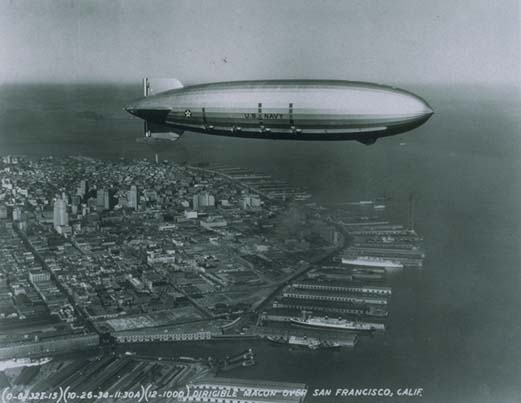
Crash site of the USS Macon declared a National Historic Site

Filed under: History, Military, USA — Tags: , , — Nicholas @ 08:53

Like most people, I assumed that the crashes of various post-WW1 dirigibles had already ruined the future of lighter-than-air flight well before the Hindenburg caught fire. I had forgotten about the US Navy’s fleet, including the Akron, Shenandoah, and the Macon:

The US government has added the crash site of the most powerful flying aircraft carrier ever built to the National Register of Historic Places, 75 years after the event.

The airship USS Macon — comparable in size to the even more famous and equally doomed liner Titanic — suffered storm damage and crashed into the ocean off Point Sur, south of San Francisco, exactly 75 years ago yesterday. The huge dirigible’s remains and those of her embarked biplane fighters now lie 1500 feet below the waves in the Monterey Bay National Marine Sanctuary. However, all but two of the 83 men aboard survived the crash and were rescued by responding waterborne ships.

“The USS Macon and its associated Sparrowhawk biplanes are not only historically significant to our nation’s history, but have unique ties to our local communities, where public museums highlight the airship’s history,” said Paul Michel, Monterey Bay National Marine Sanctuary superintendent. “The National Register listing highlights the importance of protecting the wreck site and its artifacts for further understanding our past.”

February 11, 2010

Britain to try new method of trimming defence budget: locking the generals out

Filed under: Britain, Bureaucracy, Military — Tags: , , , — Nicholas @ 08:40

It’s an unusual way of “[fixing] the counter-productive incentives within the system”:

Lord Drayson, the British arms industry’s man inside the Ministry of Defence, has moved to lock the heads of the armed services out of the room in which the Forces’ future is to be settled. This is being billed as an attempt to prevent interservice bickering, but it will leave the rapacious UK arms business facing almost no uniformed opposition in its bid to pocket more government cash.

The Financial Times, having seen a copy of a speech to be delivered by Drayson, reports that a new MoD committee set up to “review direction and affordability” will not include the heads of the army, navy and air force “because we need to fix the counter-productive incentives within the system”, according to Drayson.

“We need to make sure that the decisions made about capability are rigorously examined… from the perspective of Defence overall and not a single viewpoint within Defence,” the noble lord is expected to add.

A skeptic might assume that there’s no good reason for this, but there is a plausible explanation:

The RAF, left to itself, would squander fortunes on buying more Eurofighters and then turning them into a deep-strike force capable of penetrating strong enemy air defences — a thing that it is vanishingly unlikely the UK will need to do. The Army is currently planning to spend no less than £14bn recreating its heavy tank force, despite the fact that it is 20 years since that force went to war — and the general who commanded it then has since said that in fact the last real tank battles ever seen took place 20 years before that.

The Navy is also wasting money foolishly at the moment, not on aircraft carriers as everyone thinks — those are a good idea and a joint-service one to boot, and cheap in this context at £4-5bn — but on billion-pound unarmed missile destroyers.

February 8, 2010

Further skepticism warranted

Filed under: China, India, Military — Tags: , , — Nicholas @ 09:28

If, as I believe, China’s official economic statistics are not to be depended upon, even more skepticism is required whenever the topic of military spending is discussed:

In Asia, China is increasing its lead in defense spending. China does not release accurate data on defense spending (a common trait in all communist nations), but admits that its defense spending has doubled in the last decade. Current Chinese defense spending is believed to be $90 billion a year. That’s nearly ten times the $9.2 billion Taiwan spends. China spends twice what Japan does, and more than three times South Koreas’ $24 billion. Tiny Singapore spends nearly $6 billion a year, and has one of the most effective, man-for-man, forces in the region. India, which is increasingly becoming a military rival of China, spends about $30 billion a year. Australia spends about $24 billion a year. All the other nations in the region spend relatively small amounts, barely enough to keep threadbare forces fed and minimally equipped. China’s only allies in the region; North Korea and Pakistan, together spend less than $5 billion a year on defense.

China increased its defense spending 14.9 percent last year. That’s down from the 17.9 percent jump in 2008. China claims that its defense spending is only 1.4 percent of GDP (compared to 4 percent for the U.S. and 1-2 percent for most other Western nations.) But China keeps a lot of defense spending off the official defense budget, and actual spending is closer to three percent of GDP. Currently, the U.S. has a GDP of $13.8 trillion, Japan $4.4 trillion and China, $3.5 trillion.

February 5, 2010

China ramps up submarine activity

Filed under: China, Japan, Military — Tags: , , , — Nicholas @ 12:39

Strategy Page reports on increased activity around China’s maritime periphery:

Recently, the Taiwanese Navy detected an unidentified submarine outside one of its major naval bases. Ships and helicopters pursued the contact, but the suspected submarine left the area. A Chinese boat was suspected, mainly because for the last decade, Chinese subs have increasingly been showing up close to Japan and South Korea as well.

[. . .]

Chinese Song class diesel electric and Han class nuclear powered boats have been detected and tracked with increasing frequency over the last few years. In that time, one of each of these was spotted stalking the American carrier USS George Washington, as it headed to South Korea for a visit.

China is rapidly acquiring advanced submarine building capabilities, and providing money (for fuel and spare parts) to send its subs to sea more often. Moreover, new classes of boats are constantly appearing. The new Type 39A, or Yuan class, looks just like the Russian Kilo class. In the late 1990s, the Chinese began ordering Russian Kilo class subs, then one of the latest diesel-electric design available. Russia was selling new Kilos for about $200 million each, which is about half the price other Western nations sell similar boats for. The Kilos weigh 2,300 tons (surface displacement), have six torpedo tubes and a crew of 57. They are quiet, and can travel about 700 kilometers under water at a quiet speed of about five kilometers an hour. Kilos carry 18 torpedoes or SS-N-27 anti-ship missiles (with a range of 300 kilometers and launched underwater from the torpedo tubes.) The combination of quietness and cruise missiles makes Kilo very dangerous to American carriers. North Korea and Iran have also bought Kilos.

February 1, 2010

Good news, computer gamers!

Filed under: Gaming, Military, Science — Tags: , — Nicholas @ 09:16

Despite all the “video games turn our children into mindless killers!” tabloid headline nonsense, a recent study says that video games make you smarter and faster:

The U.S. military has long suspected that troops who have long experience with video console and computer games have made Americans better soldiers, at least when it comes to operating high-tech military equipment. But now a study (by the Office of Naval Research) has found that such experience also enables troops to solve problems faster, and act more quickly with those solutions. In technical terms, the computer game experience increases perceptual and cognitive ability 10-20 percent, over those with no computer game experience. The navy was interested in this because most sailors have technical jobs, and many of them involve operating electronic equipment. Officers and chiefs (NCOs) have noted that, over the years, the new recruits appear to be more skilled when they first show up. It didn’t have anything to do with new training methods, so many supervisors suspected video games. That proved to be the case, but the increased problem solving ability and responsiveness was a generally unrecognized bonus.

The army noted the same thing, especially under combat conditions. For example, because so many troops had years of experience with video games, they took to CROWS (the remotely controlled machine-gun turret on many vehicles) quickly, and very effectively. The guys operating these systems grew up playing video games. They developed skills in operating systems (video games) very similar to the CROWS controls. This was important, because viewing the world around the vehicle via a vidcam is not as enlightening (although a lot safer) than having your head and chest exposed to the elements, and any firepower the enemy sends your way. But experienced video gamers are skilled at whipping that screen view around, and picking up any signs of danger. The army now has a CROWS trainer built into its America’s Army online game. Many NCOs believe that all that multitasking kids do with their computers (and other electronic gadgets) have made the combat troops more effective.

I also suspect they’ll find similar positive effects among older computer users . . . that those who do some gaming (other than the Minesweeper/Solitaire/Freecell kind of games) probably have better overall mental awareness than those who do not.

January 22, 2010

On the fight card today, RAF versus RN

Filed under: Britain, Military, Politics — Tags: , , , — Nicholas @ 08:54

No matter what the outcome of the next British general election, the military situation is going to be near the top of the agenda for the incoming government. Britain’s army is stretched very thin with overseas obligations, while the RN and the RAF are at daggers drawn over the future of British carrier aircraft. The RAF would love to sink the navy’s carrier plans, as it would free up huge amounts of budget room for them to buy new toys for themselves (if there are no carriers, there’s no need to buy carrier aircraft, which are much more expensive than similar non-maritime planes). If the RAF succeeds, the army would prefer more money for troops on the ground, helicopters, and unmanned drones. The Economist provides a state-of-play summary:

Even in a great seafaring nation, the remorseless logic of austerity forces admirals to plead for their budgets. It has long been clear that fixing the fiscal crisis would mean taking money from the already cash-strapped Ministry of Defence. Where to make the cuts is something military chiefs have started to argue about in public.

On January 19th Sir Mark Stanhope, Britain’s top admiral, defended long-standing plans to build two expensive new aircraft carriers. The country is bogged down now in an Afghan ground war, he said, but future conflicts may require projecting power by sea. Britain has flirted with phasing out its carriers before, only for the Falklands war to prove their indispensability.

The day before, Sir Mark’s opposite number in the army, Sir David Richards, said that Britain’s agonies in Afghanistan showed the need for more helicopters and unmanned drones, and for better-equipped troops. An “impressive” amount of this gear could be bought if money were redirected from expensive equipment intended for big state-on-state wars; the risk of such conflicts was small enough to be dealt with through NATO (ie, America). Though Sir Richard did not say carriers should be cut (he offered to get rid of some army tanks), they are an obvious target.

It has been an aspect of all British governments since 1945 to take on additional responsibilities while constantly looking for economies in the military budget. Neither the Conservative opposition nor the current Labour government wants to take the political heat for increased military spending (that’s not even in consideration: the debate is over how deep the cuts must be). During a recession, it’s understandable that the politicians would take this kind of stance, but this is true regardless of the state of the economy.

January 21, 2010

Naval forces, estimated

Filed under: China, Military — Tags: — Nicholas @ 08:44

Strategy Page summarizes the recent accidental release of US intelligence estimates about the People’s Liberation Army Navy (PLAN):

The strength of the Chinese fleet was listed as;

Submarines- 62 (53 diesel Attack Submarines, six nuclear Attack Submarines, three nuclear Ballistic Missile Submarines). The U.S. has 72 submarines, all nuclear (53 attack and 18 ballistic missile.)

Destroyers-26. The U.S. has 52.

Frigates-48. The U.S. has 32, including two of the new LCS vessels.

Amphibious Ships 58. The U.S. has 30, all much larger and equipped with flight decks and helicopters, plus landing craft.

Coastal Patrol (Missile)- at least 80. The U.S. had a few of these, but got rid of them. China uses these for coastal patrol and defense, a concept they inherited from the Russians.

In addition, the U.S. has eleven aircraft carriers (ten of them nuclear powered) and 22 cruisers.

Most of the Chinese ships are older (in design, if not in the age of the vessels) than their American counterparts. China is building new classes of ships, with more modern equipment and weapons.

January 14, 2010

If the navies can’t do the job, the mercenaries will

Filed under: Africa, Middle East, Military — Tags: , — Nicholas @ 07:40

Looking at the pirate problem in the Gulf of Aden, where more than a thousand ships pass every month, the attackers are getting bolder — and more successful. Once upon a time, the Royal Navy would have been the primary shield for civilian vessels, but the RN has been reduced to little more than a coastal defence force (with more cuts coming). The US Navy can’t spare enough ships, the Indian Navy is concentrated closer to home, and the Chinese fleet doesn’t (yet) range so far overseas, so alternate arrangements are being made:

Most merchant ships are wary of pirate operations, and put on extra lookouts, and often transit the 1,500 kilometer long Gulf of Aden at high speed (even though this costs them thousands of dollars in additional fuel). The pirates seek the slower moving, apparently unwary, ships, and go after them before they can speed up enough to get away. For the pirates, business is booming, and ransoms are going up. Pirates are now demanding $3 million or more per ship, and are liable to get it for the much larger tankers and bulk carriers they are now seizing.

The larger, and more valuable, ships find that the additional security services (which include armed security guards on the ship while moving through the straights) worth the expense. Each month, 30-40 ships pay for this service, with the British security firm handling marketing and scheduling, and splitting the $55,000 (or more) fee with the Yemeni Navy. It’s unclear if the Yemeni government was aware of this arrangement, as such freelancing by government agencies in Yemen, is not unknown. Four of the ships being escorted were attacked anyway, but the attackers were driven off. Many more attacks were avoided because of the presence of the Yemeni patrol boat.

January 13, 2010

Haiti death toll could be in the tens of thousands

Filed under: Americas — Tags: , , , — Nicholas @ 15:22

The scale of the disaster engulfing Haiti is hard to comprehend. When the reports started to come in yesterday afternoon, it sounded bad (a hospital was said to have collapsed in the quake), but more recent reports show the situation is unimaginably worse:

Haiti’s prime minister on Wednesday warned the death toll may top 100,000 in a calamitous earthquake which left streets strewn with corpses and thousands missing in a scene of utter carnage.

Hospitals collapsed, destroyed schools were full of dead and the cries of trapped victims escaped from crushed buildings in the centre of the capital Port-au-Prince, which an AFP correspondent said was “mostly destroyed.”

Prime Minister Jean-Max Bellerive told CNN the final death toll from the 7.0 quake could be “well over 100,000,” as an international aid effort geared up in a race against time to pull survivors from the ruins.

Twitter and Facebook posts are encouraging people to donate to the Haiti relief efforts, but there’s some confusion as US residents can donate money by sending a text message to a certain address, but this method does not work for Canadians. Canadians can donate by visiting the Canadian Red Cross website (www.redcross.ca), by phone 800-418-1111, or in person (cash or cheque only) at any Red Cross office.

Update: CBC News reports that the Salvation Army can accept donations for disaster relief in Haiti by text message:

Canadians looking to donate money to earthquake disaster relief in Haiti through text messages can do so via the Salvation Army.

Cellphone users can send donations of $5 by texting the word “Haiti” to 45678 through a system set up by the Mobile Giving Foundation, a group that enables charities to collect money by text messages.

The Salvation Army is a member of the group, as are several other charities including the Children’s Wish Foundation and Princess Margaret Hospital.

According to the Canadian Wireless Telecommunications Association, the cellphone industry’s trade group, 100 per cent of all donations that go through Mobile Giving are forwarded to their respective charities.

Update, the second: The US Navy is reported to be assembling ships to send to the scene:

It looks like the Navy is developing a massive Sea Base operation centered around the USS Carl Vinson (CVN 70), the USS Bataan (LHD 5), USS Fort McHenry (LSD 43), and the USS Carter Hall (LSD 50) with cruisers and frigates in support (note helicopter capable vessels). Also as should be expected, significant Coast Guard and assets from other services are being mobilized as well, so far I think I have seen 4 different cutters mentioned.

The USS Carl Vinson (CVN 70) in particular will be what I am watching. With significant fresh water production capacity, that may turn into one of the most important early assets needed. It cannot be overstated the strategic and tactical significance of a large deck aircraft carrier arriving quickly to this situation. Consider for a moment what it means to look out into the sea following this disaster and seeing the distinct and globally recognized silhouette of a Nimitz class aircraft carrier. That really is by definition strategic communication of hope that the US is there to help. We should never take that symbolism for granted should we wish to remain a global power, as that soft power influence factors strategically well beyond the capacity for critics who desire to create hard power tactical alternatives.

January 8, 2010

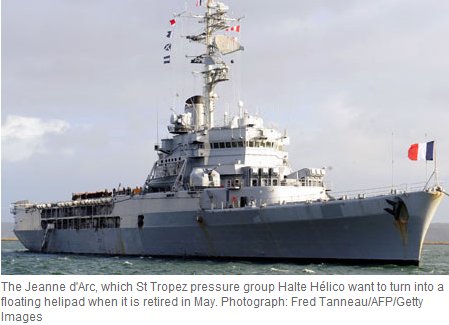
Second career for Jeanne d’Arc?

Filed under: Europe, France, Military — Tags: , — Nicholas @ 12:06

Due for retirement from the French fleet later this year, the helicopter carrier Jeanne d’Arc may have a civilian career ahead of her:

For the past 50 years, the venerable Jeanne d’Arc has had a career worthy of her name. She has toured the world, sailed to the rescue of populations in need and become a symbol of French military might.

But, if a bellicose group of activists get their way, the distinguished helicopter carrier could face a very different future when it is retired in May. Driven to distraction by private helicopters whirring above their homes, St Tropez residents are pushing for the icon of seafaring glory to become a landing strip for the international jet set.

The pressure group Halte Hélico sees the ageing 180m-long hulk of the carrier as a potential solution to the problems they have been fighting for years. Jean-Claude Molho, its president, said: “We thought it could be a good solution as there are already many landing strips for helicopters and we could also transform it into a hotel and restaurant to combine tourism with the practical issues.”

December 15, 2009

RAF and Royal Navy facing further cuts

Filed under: Britain, Bureaucracy, Military — Tags: , , , , — Nicholas @ 07:40

With the costs of maintaining British troops in Afghanistan still rising, the government is expected to announce further cuts to the Royal Air Force and Royal Navy today:

Some RAF bases face closure to pay for extra equipment for British forces in Afghanistan, a defence minister indicated this morning.

Quentin Davies said that it would be a “very good thing” to get by with fewer RAF bases if that was possible and that the Ministry of Defence wanted to spend its money with “maximum effect”.

[. . .]

Some Tornado and Harrier aircraft and small navy surface vessels are likely to face cuts. A number of RAF bases will be closed — including reportedly RAF Kinloss in Moray — and part of the sovereign base areas in Cyprus will be sold.

The two large aircraft carriers are expected to survive this particular cut, although it wouldn’t be surprising to see further delay introduced into their construction . . . even though stretching out delivery dates is an expensive way to increase short-term savings:

The announcement follows the publication of a report from the National Audit Office saying the gap between the cost of planned weapons projects and what the MoD can actually afford could be as much as £36bn.

The gap would have been larger had the ministry not delayed a number of projects, such as the construction of two large aircraft carriers, the Queen Elizabeth and the Prince of Wales, the NAO reports.

However, the decision to delay the carrier project to save £450m over the next four years will increase costs by £1.12bn over later years — a net increase of £674m, the NAO says.

The MoD has also decided to reduce an order of Lynx Wildcats from 80 to 62 helicopters, saving £194m but reducing planned flying hours by a third. The report says that last year the price for the 15 biggest military schemes rose by £1.2bn, £733m of which was the result of delays designed to save money in the short term.

Update: Believe it or not, there’s actually some sense to the government’s announced changes:

The headlining move comes with the announcement, widely anticipated, that the British fleet of US-made Chinook heavy-lift helicopters is to increase from 48 to 70 aircraft, with initial deliveries of ten new choppers arriving by 2013. The Chinook is the only helicopter in widespread Western service with enough spare lift to operate with any freedom in Afghanistan’s heat and high altitudes, and the new copters will be extremely welcome among British forces there.

It is also expected that another Boeing C-17 heavy transport plane will be ordered to join the existing UK fleet of 5, which are regarded as crucial to sustaining the “air bridge” logistic link between Blighty and its troops in Afghanistan.

These short-term improvements will be paid for not by any budget increase, but by reducing the active forces of Tornado bombers and Harrier close-support jets, and early retirement for much of the existing fleet of antique Nimrod MR2 maritime patrol aircraft. These moves will allow closure or mothballing of some of the RAF’s 45+ UK stations, with associated further job losses and savings.

They’ve also announced the retirement of the Sea King helicopter from active service, with the existing inventory of Merlin HC3 moving from the RAF to RN service (including whatever refitting will be necessary to “maricise” them for full-time service with the fleet).

Overall, the changes make a good deal of sense . . . what a surprise.

November 24, 2009

RN ship stood by, failing to do anything

Filed under: Africa, Britain, Bureaucracy, Military — Tags: , , , , — Nicholas @ 01:11

Max Hastings contrasts the Royal Navy of Churchill’s day with the modern one:

On February 16, 1940, the destroyer Cossack, acting on Churchill’s personal orders, steamed headlong into neutral Norwegian territorial waters in defiance of international law, boarded the German freighter Altmark and freed 299 captive British merchant seamen.

Legend held that the first the prisoners knew of their deliverance was a shout down a hatchway from a sailor on deck: ‘The Navy’s here!’ The episode passed into folklore, exemplifying the Royal Navy’s centuries-old tradition of triumphant boldness.

On October 28, 2009, the armed Royal Fleet Auxiliary tanker Wave Knight met Somali pirates transferring the British couple Paul and Rachel Chandler from their yacht Lynn Rival to a hijacked Singaporean container vessel.

When warning shots from Wave Knight failed to deter the pirates, its 100-strong crew stood by and did . . . absolutely nothing.

We know of this sorry incident only because a British sailor leaked the truth. The Ministry of Defence’s original statement declared, evasively and deceitfully, that Wave Knight had encountered the yacht unmanned. Nothing was said about the British ship witnessing the hostages’ removal.

I guess it’s a sign of progress that the Somali pirates were content with just capturing two civilians and didn’t also take the Wave Knight and her crew as well. That might count as a win — no formal inquiry, so the lawyers won’t be sent in to bayonet the survivors.

Today, instead, lawyers reign supreme, not least in the Ministry of Defence and even on Afghan and Iraqi battlefields. No warship’s captain feels able to take action that might breach the rights of others, even when those others are murderous Somalis.

The Royal Navy’s officers in the Indian Ocean know that every shot they fire is liable to be the subject of a later inquiry, possible litigation, even a criminal trial.

Then there is the galling question of human rights. You can almost hear the MoD’s solicitors putting forward the following argument: you have to be careful because any captured pirates might claim political asylum in the UK and that it would be a breach of their rights to send them back to the anarchy in Somalia.

Alternatively, suppose a pirate swims ashore from a craft sunk by the Navy, and uses some saved-up hijack plunder to fly to Europe. He finds a smart human rights lawyer and pleads that he was an innocent fisherman pulling in his nets when British cannon fire killed half his family.

The European Court in Strasbourg might award him almost as much booty as he would gain from ransoming a family of European yachtsmen.

It’s so bad that it may be a serious breach of human rights to refer to the pirates as pirates . . .

November 17, 2009

India to purchase “spare” British carrier?

Filed under: Britain, India, Military — Tags: , , — Nicholas @ 18:23

Ah, it must be a nightmare to be in the Royal Navy’s forward planning department these days. First, they gave up half the fleet now in exchange for guarantees that they’d get two new aircraft carriers in the near future. Then it became known that the government was considering equipping only one of the new ships as an aircraft carrier and converting the second to a helicopter carrier. Now, India’s growing navy appears to have a strong interest in taking one of those under-construction vessels off the Royal Navy’s hands. You can almost hear the gleeful cackling from the Brown government’s financial whizzes:

Yet another scheme by the MoD for cutting costs on the Royal Navy’s new aircraft carriers has surfaced in the media, with claims now being aired that one of the two ships might be sold to India.

The Guardian reports that India “has recently lodged a firm expression of interest to buy one of the two state-of-the-art 65,000 tonne carriers” and that an unnamed “defence source” has told the paper’s Tim Webb that “selling a carrier is one very serious option”.

As Webb is the Graun’s industrial editor, and glovepuppeting of biz correspondents by big companies is the most common way for such stories to appear, we can probably take it that the tale emanates from someone in the industrial consortium building the ships, led by BAE Systems. This is the more so as the article repeatedly states that contract penalties would make it impossibly expensive for the government to cancel one or both of the ships, which is probably the main message that Webb’s industry informant was trying to push.

F-35B to be too hot to handle?

Filed under: Military, Technology, USA — Tags: , , , , — Nicholas @ 16:59

Well, handling isn’t really the issue . . . it’s landing where there’s some strong concern for US Navy carrier captains:

It’s now official. The new generation of high-tech hovering aircraft — namely the famous V-22 “Osprey” tiltrotor and the upcoming F-35B supersonic stealth jump-jet — have an unforeseen flaw. Their exhaust downwash is so hot as to melt the flight decks of US warships, leading Pentagon boffins to look into refrigerated landing pads.

[. . .]

The jarheads* will want to operate their new machines from their existing helicopter-carrier amphibious assault vessels, which can’t practically be torn apart and refitted with massively reinforced upper decks as this would be likely to make them capsize. Similarly it would be extremely difficult to refrigerate the whole deck from beneath.

Hence the Marines would like someone to invent “a system that can be installed on top of the existing decks”, capable of resisting the hot breath of the F-35B and less than one inch thick. It should also, of course, be tough enough not to suffer any damage from the aircraft landing on it. This miracle fridge-sheet assembly should be covered with “thermally stable non-skid” finish — this latter perhaps incorporating “amorphous metal coatings”.

« Newer PostsOlder Posts »

Powered by WordPress