Quotulatiousness

November 27, 2019

John Browning vs Hiram Maxim: Patent Fight!

Forgotten Weapons
Published on 25 Sep 2019

http://www.patreon.com/ForgottenWeapons

Cool Forgotten Weapons merch! http://shop.bbtv.com/collections/forg…

When John Browning designed his Model 1895 machine gun with its rotary-lever gas operation system, Hiram Maxim filed suit claiming patent infringement. Maxim had filed quite broad patents covering gas pistons operation, but specifically in a linear format. Browning and Colt (who had the license to manufacture the Model 1895 machine gun) countered that the swinging lever was a different system, and thus not covered by Maxim’s patents. More to the point, they claimed that the gun would work without using a gas piston at all – and built this experimental model using a gas trap or muzzle cap system instead to prove the point.

Ultimately, the genesis of the fight was moot (the Maxim did not run well in 6mm Lee Navy, and would not have won a US Navy contract regardless of the Colt/Browning gun), and the court ultimately decided in favor of Colt and Browning. But this gun remains from the incident…

Contact:
Forgotten Weapons
6281 N. Oracle #36270
Tucson, AZ 85704

November 22, 2019

Battle of Savo Island 1942: America’s Worst Naval Defeat

Filed under: Australia, History, Japan, Military, Pacific, USA, WW2 — Tags: , , — Nicholas @ 02:00

Montemayor
Published 26 Aug 2017

(Animated Map) – WARNING: lower the volume if you are using headphones. sorry for the audio.

I do not own the rights to the songs or images. This video is purely for educational purposes.

No copyright intended, all image rights go to:

-Wikipedia Commons
https://commons.wikimedia.org/wiki/Ba…

-Naval History Heritage and Command
https://www.history.navy.mil/

-Portrait of Richmond K. Turner
https://www.ibiblio.org/hyperwar/Onli…

USS Jarvis
http://www.navsource.org/

Images contained on this site that are donated from private sources are © copyrighted by the respective owner. Images credited to the National Archives (NA, NARA); Naval History & Heritage Command (NHHC), formerly Naval Historical Center (NHC); and U.S. Navy (USN) are believed to be in the public domain. Some images credited to the United States Naval Institute (USNI) are from © copyrighted collections, the rest are believed to be in the public domain.

All songs by Ross Budgen https://www.youtube.com/channel/UCQKG…
-“Welcome to Chaos”
-“House Lannister Theme” – Game of Thrones Season 4 (Original composition)
-“Run”
-“Parallel”

Sources-

Hammel, E. (2017, March 6). “First Battle of Savo Island: The U.S. Navy’s Worst Defeat”. Retrieved August 25, 2017, from http://warfarehistorynetwork.com/dail…

Hornfischer, J. D. (2011). Neptunes Inferno: the U.S. Navy at Guadalcanal. New York: Bantam Books.

Newcomb, R. F., & Newcomb, R. F. (2002). The Battle of Savo Island. New York: H. Holt.

Stille, M. (2013). The Naval Battles for Guadalcanal 1942 (Vol. 225). Oxford, UK: Osprey Publishing.

Toll, I. W. (2016). The Conquering Tide: war in the Pacific Islands, 1942-1944. New York: W.W. Norton & Company.

USMC Casualty list taken from:
https://www.ibiblio.org/hyperwar/USMC…

November 20, 2019

The Sinking of the Royal Oak

Filed under: Britain, Germany, History, Military, WW2 — Tags: , , , — Nicholas @ 06:00

Eoin MacFreeman
Published 19 Sep 2014

STV and History channel documentary to coincide with the 70th anniversary of the sinking of HMS Royal Oak at Scapa Flow in Scotland. With harrowing eye witness accounts from survivors. Narrated by oor Alex Norton. We will remember them.

On 14 October 1939, Royal Oak was anchored at Scapa Flow in the Orkney Islands, Scotland, when she was torpedoed by the German submarine U-47. Of Royal Oak‘s complement of 1,234 men and boys, 833 were killed that night or died later of their wounds. The loss of the old ship – the first of the five Royal Navy battleships and battlecruisers sunk in the Second World War – did little to affect the numerical superiority enjoyed by the British navy and its allies, but the sinking had considerable effect on wartime morale. The raid made an immediate celebrity and war hero out of the U-boat commander, Günther Prien, who became the first German submarine officer to be awarded the Knight’s Cross of the Iron Cross. Before the sinking of Royal Oak, the Royal Navy had considered the naval base at Scapa Flow impregnable to submarine attack, and U-47‘s raid demonstrated that the German navy was capable of bringing the war to British home waters. The shock resulted in rapid changes to dockland security and the construction of the Churchill Barriers around Scapa Flow.

November 18, 2019

The Opium War – Lost in Compensation l HISTORY OF CHINA

Filed under: Britain, China, Economics, History, Military — Tags: , , , , — Nicholas @ 06:00

IT’S HISTORY
Published 22 Aug 2015

The Opium War started as a dispute over trading rights between China and Great Britain. Regular trade between Europe and the Chinese had been ongoing for centuries. But China’s trading restrictions frustrated the British who were eager to supply the Chinese people with the increasingly popular narcotic opium. Circumventing the government’s attempts to ban opium trade by smuggling and bribery, China declared the death sentence on Opium smuggling and refused to compensate British tradesmen for any losses. Furiously, the Brits sent out a fleet to demand compensation and end the Cohong trading monopoly. Fierce battles and attacks on the Chinese coast were followed. Find out all about the First Opium War from Indy in our new episode of Battlefields!

» SOURCES
Videos: British Pathé (https://www.youtube.com/user/britishp…)
Pictures: mainly Picture Alliance
Content:
Lovell, Julia: The Opium War: Drugs, Dreams and the Making of China
Wei, Yuan: Chinese Account of the Opium War
McPherson, Duncan: The First Opium War – The Chinese Expedition 1840-1842
Merwin, Samuel: Drugging a Nation – The Story of China and the Opium Curse
Bernard, William Dallas; Hall, Sir William Hutcheon: Narrative of the Voyages and Services of the Nemesis, from 1840 to 1843.
Isabel Hilton (The Guardian): “The Opium War by Julia Lovell – review”
Perdue, Peter C. (MIT): The First Opium War http://ocw.mit.edu/ans7870/21f/21f.02…

» ABOUT US
IT’S HISTORY is a ride through history – Join us discovering the world’s most important eras in IN TIME, BIOGRAPHIES of the GREATEST MINDS and the most important INVENTIONS.

» HOW CAN I SUPPORT YOUR CHANNEL?
You can support us by sharing our videos with your friends and spreading the word about our work.

» CAN I EMBED YOUR VIDEOS ON MY WEBSITE?
Of course, you can embed our videos on your website. We are happy if you show our channel to your friends, fellow students, classmates, professors, teachers or neighbors. Or just share our videos on Facebook, Twitter, Reddit etc. Subscribe to our channel and like our videos with a thumbs up.

» CAN I SHOW YOUR VIDEOS IN CLASS?
Of course! Tell your teachers or professors about our channel and our videos. We’re happy if we can contribute with our videos.

» CREDITS
Presented by: Guy Kiddey
Script by: Dan Hungerford
Directed by: Daniel Czepelczauer
Director of Photography: Markus Kretzschmar
Music: Markus Kretzschmar
Sound Design: Bojan Novic
Editing: Markus Kretzschmar

A Mediakraft Networks original channel
Based on a concept by Florian Wittig and Daniel Czepelczauer
Executive Producers: Astrid Deinhard-Olsson, Spartacus Olsson
Head of Production: Michael Wendt
Producer: Daniel Czepelczauer
Social Media Manager: Laura Pagan and Florian Wittig

Contains material licensed from British Pathé
All rights reserved – © Mediakraft Networks GmbH, 2015

November 17, 2019

Britain shows Japan how to Attack Pearl Harbor – WW2 – 064 – November 16, 1940

Filed under: Britain, Europe, Greece, History, Italy, Japan, Military, Russia, WW2 — Tags: , , , , — Nicholas @ 04:00

World War Two
Published 16 Nov 2019

Japan has two wins this week, and one might turn out to be very consequential for the rest of the war. In the meantime, the British RAF fights the Luftwaffe and Italy struggles in their offensive against Greece.

Join us on Patreon: https://www.patreon.com/TimeGhostHistory
Or join The TimeGhost Army directly at: https://timeghost.tv

Follow WW2 day by day on Instagram @World_war_two_realtime https://www.instagram.com/world_war_t…
Join our Discord Server: https://discord.gg/D6D2aYN.
Between 2 Wars: https://www.youtube.com/playlist?list…
Source list: http://bit.ly/WW2sources

Written and Hosted by: Indy Neidell
Produced and Directed by: Spartacus Olsson and Astrid Deinhard
Executive Producers: Bodo Rittenauer, Astrid Deinhard, Indy Neidell, Spartacus Olsson
Creative Producer: Joram Appel
Post-Production Director: Wieke Kapteijns
Research by: Indy Neidell
Edited by: Iryna Dulka
Map animations: Eastory

Colorisations by: Julius Jääskeläinen, https://www.facebook.com/JJcolorization/

Eastory’s channel: https://www.youtube.com/channel/UCEly…
Archive by Screenocean/Reuters https://www.screenocean.com.

Sources:
– Narodowe Archiwum Cyfrowe
– IWM: CM 164, C 1244
– Destroyed house icon by Gan Khoon Lay, people icon by Gregor Cresnar from the Noun Project

A TimeGhost chronological documentary produced by OnLion Entertainment GmbH.

From the comments:

World War Two
2 days ago
Do you want more World War Two in realtime? We have a great Instagram page, where we make a daily post about what happened in the war on that day. This might be something completely different from what’s covered in these videos, or might add some more details. You can follow it by searching @world_war_two_realtime or by clicking here: https://www.instagram.com/world_war_two_realtime/. See you there!
Cheers, Joram

The three cycles of a naval ship’s career

Filed under: Britain, Military — Tags: , — Nicholas @ 03:00

Last month, there was some concern over the state of the Royal Navy’s current fleet, based on things the Secretary of State for Defence had said to the Commons Defence Select Committee:

While discussing the size of the navy, and the minister made a valid point that it is hard to go to the Treasury and argue for more new warships when the RN is unable to make full use of the vessels already in service. “If I had more of our current fleet working, then I would have much more freedom to deploy to meet some of our ambitions and tasks. I’ve made it very clear to the First Sea Lord one of my priorities is to get what we’ve got working” he said.

Unfortunately the Minister then rather confused the issue by stating that the RN has “only” 57 of its 76 surface ships available. This statement is technically true but it needs a great deal of context. It is only possible to reach the 76 figure by counting absolutely everything in commission that floats including the MCMVs, OPVs, Royal Fleet Auxiliary vessels, the hydrographic ships and the two small boats of the Gibraltar Squadron. 16 small unarmed P2000 patrol/training boats and inshore survey boat HMS Magpie are also included in this total. These vessels all have important roles to play but major surface combat vessels number just 23, even if both aircraft carriers and both LPDs are counted. Of that 23, about 10 are active at the time of writing. (HMS Queen Elizabeth (not yet fully operational) Albion, Defender, Dragon, Montrose, Kent, Argyll, Sutherland, Northumberland and Westminster)

In fact, 57 vessels “available” from a fleet of 76 would be very impressive. Any navy that has 75% of its ships ready for operations would be doing exceptionally well. But it rather depends on your definition of “available” as ships are in constant cycle at differing levels of readiness. A more normal approximate ‘rule of thirds’ would apply for most serious navies; a third on operations, a third preparing for operations, in transit, training or maintenance and a third at very low readiness in deep refit. This cycle is simply unavoidable, warships are highly complex pieces of engineering that are exposed to the harsh marine environment and must be maintained.

What Ben Wallace was really talking about is improving the readiness of the frigates and destroyers. As we have reported before, delays to the frigate LIFEX refits are contributing to lower than usual numbers of ships available. Currently, more than half of the frigate fleet are all either awaiting refit or undergoing refit at Devonport.

A view of Royal Navy ships at Devonport, 19th October 2019. (Top) HMS Monmouth out of routine and awaiting refit. (Middle) The depressing sight of the decommissioned nuclear submarine “flotilla” awaiting disposal, comprising more boats than are currently active. In the basin are (top) HMS Richmond, first of the frigates to receive new engines and (bottom) HMS St. Albans. HMS Portland, Somerset and Iron Duke are inside the covered refit complex to the right. (Left) alongside at No.1 Wharf is HMS Lancaster.
Photo by Andy Amor, originally posted at Save The Royal Navy, 2019-10-25.

November 16, 2019

Report on the collision that sank HNoMS Helge Ingstad last year

Filed under: Europe, Military — Tags: , , , — Nicholas @ 03:00

The Norwegian frigate HNoMS Helge Ingstad was eventually declared a total loss due to the damage from the collision and the resulting water damage as the ship sank near the Sture Terminal in November 2018. The first part of the report on the accident has been released:

HNoMS Helge Ingstad, a Fridtjof Nansen-class frigate commissioned in 2009.
Photo detail via Wikimedia Commons.

The frigate HNoMS Helge Ingstad and the tanker Sola TS collided in the Hjeltefjord in the early hours of 8 November 2018. The frigate had 137 persons on board with a mix of conscripts and permanent crew. A total of seven watchstanding personnel were present on the bridge, including two trainees. The tanker Sola TS was operated by the Greek shipping company Tsakos Columbia Shipmanagement (TCM) S.A. There was a total of 24 persons on board. The bridge was manned by four persons, including the pilot.

HNoMS Helge Ingstad sailed south at a speed of approximately 17–18 knots with the automatic identification system (AIS) in passive mode, i.e. no transmission of AIS-signal. The frigate’s bridge team had notified Fedje Vessel Traffic Service (VTS) of entering the area and followed the reported voyage. Sola TS had been loaded with crude oil at the Sture Terminal, and notified Fedje VTS of departure from the terminal. Sola TS exhibited navigation lights. In addition some of the deck lights were turned on to light up the deck for the crew who were securing equipment etc. for the passage.

In advance of the collision, Fedje VTS had not followed the frigate’s passage south through the Hjeltefjord. The crew and pilot on Sola TS had observed HNoMS Helge Ingstad and tried to warn of the danger and prevent a collision. The crew on HNoMS Helge Ingstad did not realise that they were on collision course until it was too late.

At 04:01:15, HNoMS Helge Ingstad collided with the tanker Sola TS. The first point of impact was Sola TS‘ starboard anchor and the area just in front of HNoMS Helge Ingstad‘s starboard torpedo magazine.

HNoMS Helge Ingstad suffered extensive damage along the starboard side. Seven crew members sustained minor physical injuries. Sola TS received minor damages and none of the crew were injured. Marine gas oil leaked out into the Hjeltefjord. The Institute of Marine Research has ascertained the effect of the oil spill had little impact on the marine environment.

HNoMS Helge Ingstad after grounding, 13 November 2018. Due to the steep nature of the seabed at the shoreline, the frigate slid down until it was almost totally underwater after initial grounding.
Photo via The Drive.

There is an embedded video with the report that neatly summarizes the series of events leading up to the collision.

November 12, 2019

Speculations on South Korean or Japanese F-35 deployment

Filed under: Asia, Japan — Tags: , , , — Nicholas @ 03:00

Last week, Strategy Page considered the options available for both South Korea and Japan to convert some of their F-35 orders to F-35B variants which would allow operations from small helicopter carriers in service or in plan for both navies:

The Republic of Korea Navy amphibious landing ship ROKS Dokdo (LPH 6111) and the aircraft carrier USS George Washington (CVN 73) transit the Sea of Japan (July 27, 2010).
U.S. Navy photo by Mass Communication Specialist 3rd Class Charles Oki via Wikimedia Commons.

In October South Korea announced it was buying 20 more F-35 stealth fighters. There are already 40 on order and South Korea will have received 13 by the end of 2019. Those 60 F-35s will cost $9.7 billion and a decision still has to be made as to whether any of the second 20 will be the VTOL (Vertical Take-Off and Landing) F-35B version. The first 40 will all be the basic F-35A which just operates from land-based airfields. But South Korea has ships that F-35Bs could operate from.

By 2018 South Korea had two 14,500 ton Dokdo class large amphibious ships. These South Korea LPHs (Landing Platform Helicopter) are similar in appearance and operation to the larger American amphibious ships. The LPH flight deck can handle helicopters, as well as vertical takeoff jets like the F-35B. The Koreans deny that the ship will be used with these jets, but the capability is there. The LPH normally carries 720 combat troops and their heavy equipment. Dokdos also carry fifteen aircraft; two V-22 vertical takeoff transports and 13 helicopters. Marado, the second Dokdo, has a redesigned flight deck that can handle two V-22s at once instead of just one. In addition to a more powerful 3-D surveillance radar for tracking aircraft, Marado has to Phalanx anti-missile system.

JS Izumo DDH-183

South Korea is also planning to build one or more 30,000 ton ships that look like the Japanese DDH (destroyer helicopter carrier) and could handle a dozen F-35Bs. Neighboring Japan has already ordered some F-35Bs so that it can experiment with some of these aircraft aboard the existing Japanese DDHs. Since 2017 Japan has had two 27,000 ton “destroyers” (DDH type ships) that look exactly like an aircraft carrier. These Izumo class ships can carry up to 28 helicopters or up to ten vertical takeoff aircraft. The carriers are armed only with two 20mm Phalanx anti-missile cannon and launchers with sixteen ESSM missiles for anti-missile defense. The DDH have powerful engines capable of destroyer-like speeds of over fifty-four kilometers an hour. Izumo has considerable cargo capacity, which is intended for moving disaster relief supplies quickly to where they are needed. Apparently, some of these cargo spaces can be converted to carry additional weapons and equipment needed to support F-35B fighter-bombers. Izumo could carry and operate at least ten F-35Bs once modifications are made to the flight deck to deal with the extremely high temperatures the F-35B generates when taking off or landing vertically (like a helicopter). When the first DDH entered service in 2015 Japan made no mention of buying F-35Bs or modifying the LPH flight decks to handle the very high temperatures. The Izumos already have an elevator (to the hanger deck under the flight deck) powerful enough to carry an F-35B fighter.

Another factor that makes operating F-35Bs from an LPH or DDH possible is the availability of smart bombs and small air-to-ground guided missiles for warplanes. A LPH or DDH was not designed to haul a lot of munitions for aircraft but, the amount of smart bombs and missiles needed to make five or ten F-35Bs effective would not be large. These ships already carry a lot of fuel for helicopters and have space for maintenance gear to support many helicopters. South Korean and Japanese naval planners noted this when they suggested using LPHs and DDHs as platforms for F-35Bs.

November 11, 2019

In memoriam

Filed under: Britain, History, Military, WW1, WW2 — Tags: , , — Nicholas @ 03:00

A simple recognition of some of our family members who served in the First and Second World Wars:

The Great War

  • A Poppy is to RememberPrivate William Penman, Scots Guards, died 16 May, 1915 at Le Touret, age 25
    (Elizabeth’s great uncle)
  • Private Archibald Turner Mulholland, Argyll & Sutherland Highlanders, mortally wounded 25 September, 1915 at Loos, age 27
    (Elizabeth’s great uncle)
  • Private David Buller, Highland Light Infantry, died 21 October, 1915 at Loos, age 35
    (Elizabeth’s great grandfather)
  • Private Harold Edgar Brand, East Yorkshire Regiment. died 4 June, 1917 at Tournai.
    (My first cousin, three times removed)
  • Private Walter Porteous, Durham Light Infantry, died 4 October, 1917 at Passchendaele, age 18
    (my great uncle)
  • Corporal John Mulholland, Argyll & Sutherland Highlanders, wounded 2 September, 1914 (shortly before the First Battle of the Aisne), wounded again 29 June, 1918, lived through the war.
    (Elizabeth’s great uncle)

The Second World War

  • Flying Officer Richard Porteous, RAF, survived the defeat in Malaya and lived through the war
    (my great uncle)
  • Able Seaman John Penman, RN, served in the Defensively Equipped Merchant fleet on the Murmansk Run (and other convoy routes), lived through the war
    (Elizabeth’s father)
  • Private Archie Black (commissioned after the war and retired as a Major), Gordon Highlanders, captured at Singapore (aged 15) and survived a Japanese POW camp
    (Elizabeth’s uncle)
  • Elizabeth Buller, “Lumberjill” in the Women’s Land Army in Scotland through the war.
    (Elizabeth’s mother)
  • Trooper Leslie Taplan Russon, 3rd Royal Tank Regiment, died at Tobruk, 19 December, 1942 (aged 23).
    Leslie was my father’s first cousin, once removed (and therefore my first cousin, twice removed).

For the curious, the Commonwealth War Graves Commission the Royal British Legion, and the Library and Archives Canada WW1 and WW2 records site provide search engines you can use to look up your family name. The RBL’s Every One Remembered site shows you everyone who died in the Great War in British or Empire service (Canadians, Australians, New Zealanders, South Africans and other Imperial countries). The CWGC site also includes those who died in the Second World War.

In Flanders fields the poppies blow
Between the crosses row on row,
That mark our place; and in the sky
The larks, still bravely singing, fly
Scarce heard amid the guns below.

We are the Dead. Short days ago
We lived, felt dawn, saw sunset glow,
Loved and were loved, and now we lie
In Flanders fields.

Take up our quarrel with the foe:
To you from failing hands we throw
The torch; be yours to hold it high.
If ye break faith with us who die
We shall not sleep, though poppies grow
In Flanders fields.

Lieutenant Colonel John McCrae, MD Canadian Army Medical Corps (1872-1918)

October 31, 2019

“Big Lizzie” (HMS Queen Elizabeth) to sail into disputed waters in 2021

Filed under: Britain, China, Military — Tags: , , , , — Nicholas @ 05:00

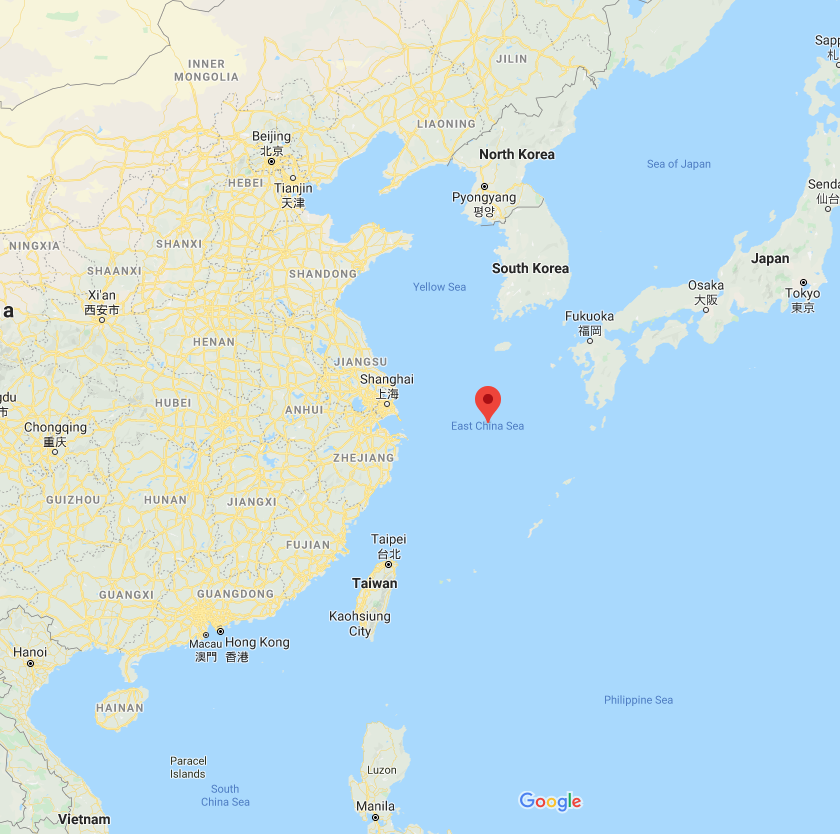
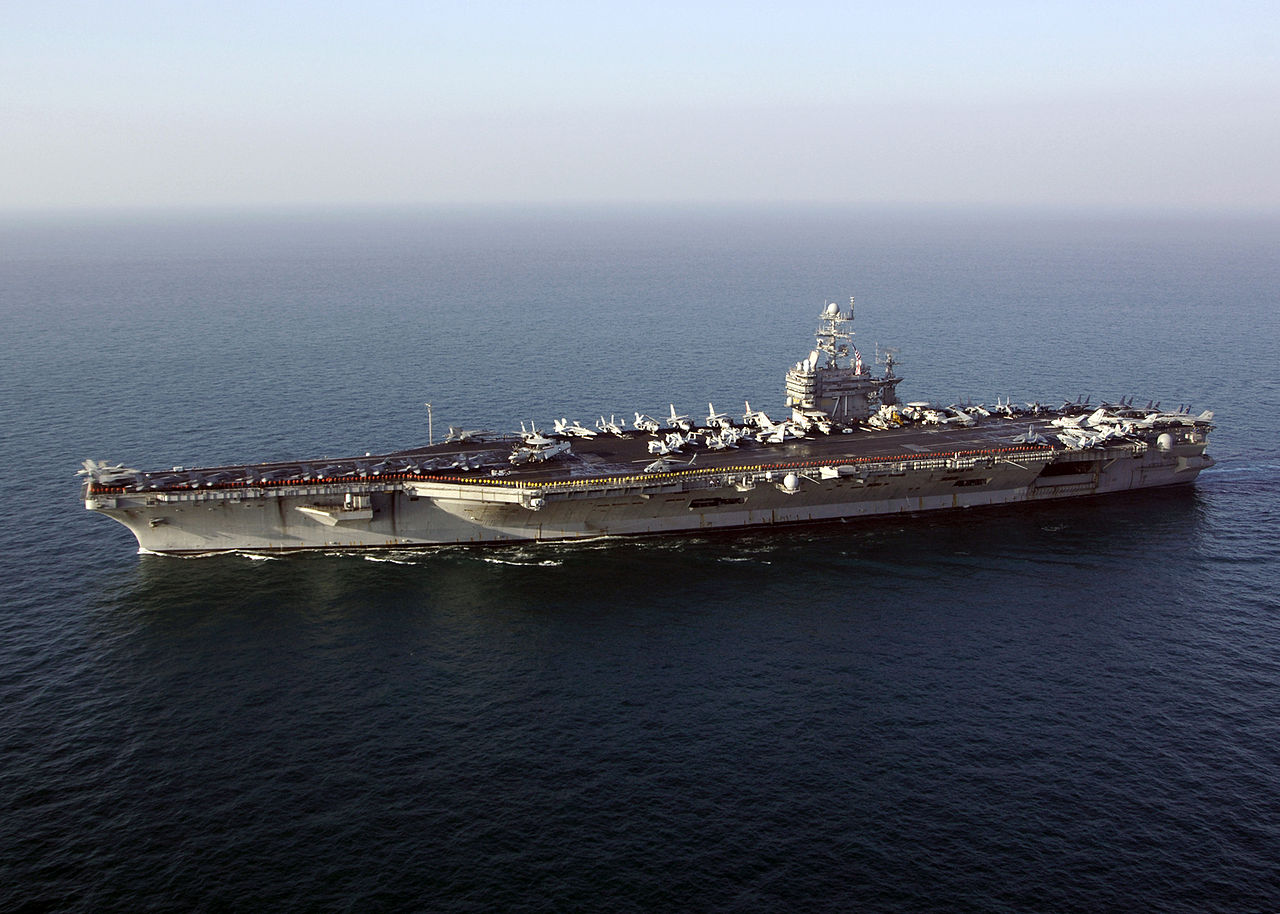
UK Defence Journal reported a few days back that the Royal Navy’s new aircraft carrier will take on her first active deployment in 2021, including a possible Freedom of Navigation exercise (FONOPS) in the South China Sea:

Aerial view of HMS Queen Elizabeth with Type 23 frigates HMS Iron Duke (centre) and HMS Sutherland (right) in June 2017 off the coast of Scotland.

Photo by MOD via Wikimedia Commons.

Commodore Michael Utley, Commander United Kingdom Carrier Strike Group, is reported by Save The Royal Navy here as saying that HMS Queen Elizabeth will be escorted by two Type 45 destroyers, two Type 23 frigates, a nuclear submarine, a Tide-class tanker and RFA Fort Victoria.

The ship will also carry 24 F-35B jets, including US Marine Corps aircraft, in addition to a number of helicopters.

Prior to the deployment, it is understood that the Queen Elizabeth carrier strike group will go through a work-up trial off the west Hebrides range sometime in early 2021.

When asked about whether or not the UK has enough escorts to do this without impacting other commitment, Defence Secretary Ben Wallace said:

    The size and the scale of the escort depends on the deployments and the task that the carrier is involved in. If it is a NATO tasking in the north Atlantic, for example, you would expect an international contribution to those types of taskings, in the same way as we sometimes escort the French carrier or American carriers to make up that.

    It is definitely our intention, though, that the carrier strike group will be able to be a wholly UK sovereign deployable group. Now, it is probably not necessary to do that every single time we do it, depending on the tasking, but we want to do that and test doing it. Once we have done that, depending on the deployment, of course, we will cut our cloth as required.

Gareth Corfield expands on this in The Register:

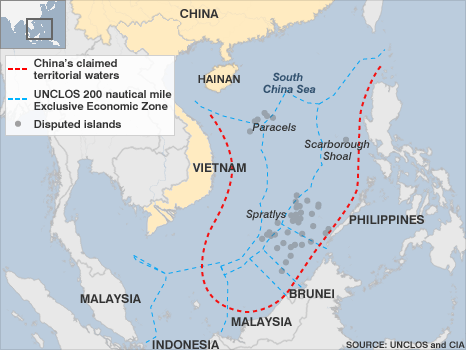
Although the initial plan was for Britain’s biggest ever warship to sail through the South China Sea, which China claims as its own territory in defiance of international laws and norms, and despite claims from at least six other countries including Vietnam and the Philippines, this detail was noticeably absent from the UKDJ report.

Over 200 islands, also subject to disputes between China, Taiwan, Vietnam, Malaysia, and the Philippines, also lie in the area, which stretches across 3.5 million square kilometres and is visited by one-third of the world’s shipping traffic.

A US presence on the South China Sea deployment will be a useful political tool for the administration as a show of strength to China as well as asserting the right to freedom of navigation in the sea. In addition, it reinforces the idea that the UK supports US foreign policy – Queen Elizabeth is effectively replacing a US carrier on her Far Eastern tour as part of the superpower’s standing naval presence.

Of the jets aboard QE, around half will be supplied by the US Marine Corps, as has been reported for years.

The Dutch Navy will definitely join the deployment, most likely with a De Zeven Provinciën-class frigate – replacing one of the British Type 23 frigates in the mooted carrier battle group. Similarly, UKDJ reckons that an American destroyer will join the 2021 deployment (named Carrier Strike Group 21), freeing up a British Type 45 destroyer.

Royal Navy aircraft carrier HMS Queen Elizabeth (R08) underway in the Atlantic on 17 October 2019, participating in exercise “WESTLANT 19”. The first operational deployment for HMS Queen Elizabeth with No. 617 Squadron and a squadron of USMC Lockheed Martin F-35B Lightnings is planned for 2021.
Photo by Mass Communication Specialist 3rd Class Nathan T. Beard, US Navy, via Wikimedia Commons

October 28, 2019

The Surrender of the Imperial German High Seas Fleet

Filed under: Britain, Germany, History, Military, WW1 — Tags: , , , — Nicholas @ 06:00

Historigraph
Published 26 Oct 2019

Buy Historigraph Posters here! https://teespring.com/en-GB/surrender…
Support the channel on Patreon: https://www.patreon.com/historigraph

#SurrenderOfTheHighSeasFleet #OperationZZ #Historigraph

►Twitter: https://twitter.com/historigraph
►Instagram: https://www.instagram.com/historigraph
►Patreon: https://www.patreon.com/historigraph
►Discord: https://discord.gg/vAFTK2D

Music:

Crypto, Incompetech https://incompetech.com

Rynos Theme, Incompetech https://incompetech.com

Britain’s Naval March, “Hearts of Oak”

Kaiserlicher MarinemarschGruß an Kiel

October 25, 2019

The World Takes Advantage of American Isolationism | BETWEEN TWO WARS | 1933 part 3 of 3

Filed under: History, Japan, Military, Pacific, USA — Tags: , , , , , , — Nicholas @ 04:00

TimeGhost History
Published 24 Oct 2019

America is very unprepared for rising tensions in the Pacific and in Europe. US President Franklin Roosevelt tries his best to re-arm the American Army and Navy, but the isolationist opposition is a fierce obstacle.

Join us on Patreon: https://www.patreon.com/TimeGhostHistory

Subscribe to our World War Two series: https://www.youtube.com/c/worldwartwo…

Hosted by: Indy Neidell
Written by: Joram Appel
Directed by: Spartacus Olsson and Astrid Deinhard
Executive Producers: Bodo Rittenauer, Astrid Deinhard, Indy Neidell, Spartacus Olsson
Creative Producer: Joram Appel
Post-Production Director: Wieke Kapteijns
Research by: Rune Vaever Hartvig, Sietse Kenter and Joram Appel
Edited by: Daniel Weiss
Sound design: Marek Kaminski

Picture colorizations by: Norman Stewart, Julius Jääskeläinen, Daniel Weiss and Joram Appel

A TimeGhost chronological documentary produced by OnLion Entertainment GmbH.

From the comments:

TimeGhost History
1 day ago (edited)
This episode is very much about the global ramifications of the US’s foreign policy. American inaction and isolationism left room for other nations to develop imperialist ambitions. There are of course a lot of other factors that influenced the rise of expansionist and militarist governments in Europe and East-Asia, many of which are explained in our other Between Two Wars episodes. In no way does this video have any connection to current-day events or our opinion on them. This is what happened, our future episodes will be about what followed. We’re historians and that’s all we want to do here.
Cheers,
Joram

October 18, 2019

7 Brutal Days for the Kriegsmarine – Battle for Norway

Filed under: Britain, Germany, History, Military, WW2 — Tags: , , , — Nicholas @ 02:00

iChaseGaming
Published on 9 Sep 2019

The first few days of Operation Weserübung, the invasion of Norway, cost the Kriegsmarine‘s surface fleet dearly. While the invasion and occupation was successful the German Navy would be hampered for the remainder of the war.

♥ Connect with me ♥
Discord: https://discord.gg/ichasegaming
Twitch: http://www.twitch.tv/ichasegaming
Twitter: https://twitter.com/iChaseGaming

♦ Become my Patron at https://www.patreon.com/iChaseGaming

To contact me via e-mail send it to chasegamingtv@gmail.com

October 12, 2019

“Midway” – The Battle of Midway – Sabaton History 036 [Official]

Filed under: History, Japan, Media, Military, USA, WW2 — Tags: , , , , — Nicholas @ 05:00

Sabaton History
Published 11 Oct 2019

The Battle of Midway in June 1942 was one of the decisive battles on the Pacific front during World War Two. The Sabaton song “Midway” is about that battle and the men who sailed, flew, fought and died there.

Support Sabaton History on Patreon: https://www.patreon.com/sabatonhistory

Listen to Coat of Arms (where “Midway” is featured):
CD: http://bit.ly/CoatOfArmsStore
Spotify: http://bit.ly/CoatOfArmsSpotify
Apple Music: http://bit.ly/CoatOfArmsAppleMusic
iTunes: http://bit.ly/CoatOfArmsiTunes
Amazon: http://bit.ly/CoatOfArmsAmzn
Google Play: http://bit.ly/CoatOfArmsGooglePlay

Watch the Official Lyric Video of Midway here: https://www.youtube.com/watch?v=0WAfB…

Listen to Sabaton on Spotify: http://smarturl.it/SabatonSpotify
Official Sabaton Merchandise Shop: http://bit.ly/SabatonOfficialShop

Hosted by: Indy Neidell
Written by: Markus Linke and Indy Neidell
Directed by: Astrid Deinhard and Wieke Kapteijns
Produced by: Pär Sundström, Astrid Deinhard and Spartacus Olsson
Creative Producer: Joram Appel
Executive Producers: Pär Sundström, Joakim Broden, Tomas Sunmo, Indy Neidell, Astrid Deinhard, and Spartacus Olsson
Maps by: Eastory
Edited by: Iryna Dulka
Sound Editing by: Marek Kaminski

Eastory YouTube Channel: https://www.youtube.com/channel/UCEly…
Archive by: Reuters/Screenocean https://www.screenocean.com
Music by Sabaton.

Sources:
National Security Agency
Letter icon by Mochammad Kafi from the Noun Project
Ship icon by Edward Boatman from the Noun Project

An OnLion Entertainment GmbH and Raging Beaver Publishing AB co-Production.

© Raging Beaver Publishing AB, 2019 – all rights reserved.

September 28, 2019

The Freikorps Fights On – Estonia and Latvia War For Independence I THE GREAT WAR 1919

Filed under: Britain, Germany, History, Military, Russia, WW1 — Tags: , , , , , — Nicholas @ 06:00

The Great War
Published 27 Sep 2019

Support 16 Days in Berlin: https://realtimehistory.net/indiegogo

After the Battle of Cesis it seemed the situation in Latvia and Estonia was about to quieten down. But the German soldiers in the region and the ongoing conflict with Bolshevik Russia meant the 2nd half of 1919 saw even more fighting in the Baltics.

» SUPPORT THE CHANNEL
Patreon: https://www.patreon.com/thegreatwar
Merchandise: https://shop.spreadshirt.de/thegreatwar/

»CREDITS
Presented by: Jesse Alexander
Written by: Jesse Alexander
Director: Toni Steller & Florian Wittig
Director of Photography: Toni Steller
Sound: Toni Steller
Editing: Toni Steller
Mixing, Mastering & Sound Design: http://above-zero.com
Maps: Daniel Kogosov (https://www.patreon.com/Zalezsky)
Research by: Jesse Alexander
Fact checking: Florian Wittig

Channel Design: Alexander Clark
Original Logo: David van Stephold

A Mediakraft Networks Original Channel

Contains licensed material by getty images
All rights reserved – Real Time History GmbH 2019

« Newer PostsOlder Posts »

Powered by WordPress