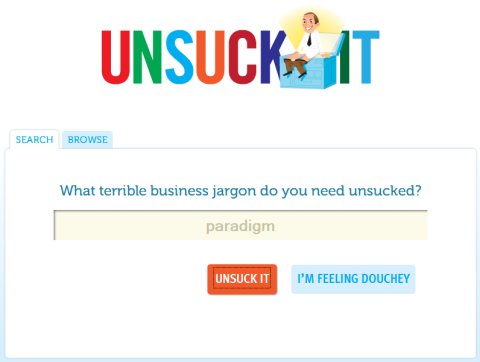
I’ve been known to print off Business Bingo cards for the inevitable business meeting jargon-fest, so I wholly support the notion behind Unsuck-it:
H/T to Xeni Jardin for the link.

I’ve been known to print off Business Bingo cards for the inevitable business meeting jargon-fest, so I wholly support the notion behind Unsuck-it:
H/T to Xeni Jardin for the link.
If you’re not a bit of a word geek, you can safely skip this post. “Johnson” looks at the role of the copy editor:
Having recently had my forthcoming book copy-edited, I jumped right on the link (at Andrew Sullivan) to read Lori Fradkin’s “What It’s Really Like To Be A Copy Editor”. I’d struggled for hours with my manuscript, wondering what to stet and what not to stet, marvelling both at my copy editor’s care and at the confusion she introduced in places. So I was eager to see what Ms Fradkin had to say about the other side of this relationship.
But the experience isn’t quite what he hopes: Ms Fradkin is inclined to a “because the dictionary says so” approach that “Johnson” finds overly restrictive.
This is not to say “everything is right” and to get back into the tired prescriptivist-descriptivist debate. A debate about hyphens or compounds should have something useful to say about language itself. For example, The Economist hyphenates compounds when they are used as modifiers: interest-rate hikes, balance-of-payments crises, and so forth. These aren’t hyphenated when used as nouns. (“Interest rates must go up.”) I like this hyphenation. It helps prevent so-called garden-path misanalysis, by letting the reader know that even though he’s seeing two nouns in a row, they should be understood as a compound modifier, and another noun is coming up. In other words, if someone asked me why I hyphenate “interest-rate hikes”, this is what I’d tell them, and not “Because the style book says so.” The latter answer is worse than wrong; it’s not interesting.
In some cases I might disagree with our style book. I obey it nonetheless, because rulings, even when arbitrary, keep a style consistent, so readers aren’t finding “Web sites” here and “websites” there in the same article. Readers expect and enjoy uniformity as a mark of quality.
Jesse Walker looks at efforts to take the notion of “capitalism” and wrap it up in the more user-friendly term “free enterprise”:
[T]here’s an effort afoot to rebrand “capitalism” as “free enterprise.” On the face of it, I like the idea. Capital is going to be a central part of any modern economic system, whether or not there’s a lot of government intervention. By contrast, the phrase “free enterprise” implies economic liberty.
Unfortunately, MSNBC identifies the chief force behind the idea as the U.S. Chamber of Commerce, a group whose commitment to economic liberty is so strong that it came out for TARP, the Detroit bailout, and the 2009 stimulus. If the Chamber were more honest about its outlook, it would reject “free enterprise” for a more frank label, like “corporate welfare.” But I suspect that wouldn’t be good branding.
In the same way we had to give up the historical meaning of the word “liberal” to folks who used it to imply almost the opposite, we should probably abandon the word “capitalism”. For a start, the word was popularized by that great pamphlet writer Karl Marx, and it has a pejorative connotation to most people who hear it used. “Capitalists” are folks in top hats who ride in chauffeured limousines and have no sympathy or respect for “the working man”. Try subbing in “Plutocracy” or “Rich F*cking Bastards” and you’ll get close to the popular image of the current term.
In any argument where you try using terms that have been appropriated by your opponents, you’re already ceding the high ground. “Capitalism” is a word that comes pre-loaded with all the negativity your opponents delight in — don’t play their game by their rules!
Michael Pinkus collects a few choice things which can only be said on a wine tour, or in a wine column:
Top Ten Things That Sound Dirty In Winespeak, But Aren’t
Courtesy of fellow wine writer Dean Tudor (www.deantudor.com):
1. “Spit or swallow?”
2. “Stick your nose all the way in”
3. “She’s needs to open up a bit”
4. “I’ve had a ’69 with my sister”
5. “My God! Check out the legs on that Blue Nun!”
6. “I keep Sherry on the rack in my cellar”
7. “I find the Italians flacid and the French hard”
8. “There are too many whites in this room”
9. “You have to pull it out slowly, otherwise it’ll shoot all over the place!”
10. “Wow that really swelled up, can you stick it back in?”Here are two more, just to make it an even dozen:
11. “Me and the guys did a 10 year old Tawny, it was sweet”
12. “I’m sorry Madame but your Pouilly-Fuisse is awfully dry”
SherryGrammarian would like to extend a welcome to all the soon-to-be-arriving Winter Olympics visitors and offers some explanations about the variant of English spoken in (parts of) Canada:
Like the country itself, Canadian English suffers from a bit of an identity crisis: Do we speak the tongue of our British heritage? Or do we employ the vernacular of our closest geographical and cultural neighbour, the United States?
And in quintessentially Canadian fashion, we’ve come up with an offend-no-one resolution: a little deference, a little defiance. Canadian English is the bastard child of a queen and a cowboy.
We honour the monarchy by minding our p’s and q’s, and in using u’s in words like “labour” and “flavour.” In Canada, you enter the “centre” and catch a feature at the “theatre.”
The last letter of the alphabet retains its British pronunciation yet appears American in words like “organize” and “realize” — but we draw the line at calling the bearded Texas rock band “ZedZed Top,” and for that we will not apologize.
[. . .]
And (Americans, take note), “rout” is what my hockey team does to your hockey team. “Route” — pronounced root — is the path to the nearest donut shop.
David Harsanyi falls into the trap cunningly laid for him by the devious wordmongers at Merriam-Webster:
Like other books Americans have a duty to own — the Bible or “Atlas Shrugged,” for instance — the dictionary does not require an absurd marketing ploy to sell itself.
Yet, every year a barrage of cockamamie “word lists” are unveiled by publishers seeking to bring attention to the evolving English language.
In the end, these lists establish two facts: 1) We are unable to invent any new words of value. 2) If you put a list together, a columnist will probably write about it.
One needn’t be William Safire, though, to be unsettled that the word “philanderer” is a major mystery to so many people. According to a new list by Merriam-Webster, “philanderer” (a national pastime, meaning to be sexually unfaithful to one’s wife) was one of the most searched words of the past year because of the crush of politicians and celebrities busy hiking the Appalachian trial.
The word receiving the highest intensity of searches over the shortest period of time was “admonish” (to express warning or disapproval). It was triggered by a crude outburst of a South Carolina congressman and the subsequent moralistic “admonishment” of him by Congress.
It’s not the lists themselves that bother me . . . it’s the blatantly contrived nature of the words appearing in most of the lists. “Unfriend”? Bleargh.
There is, admittedly, one trend that could prove to be a bright spot. The newly minted “teabagger” gives us hope that crude sexual terms will now regularly be applied to politics, where they can do the most good.
Perhaps “felching” will come to describe how the media gathers material for their coverage of the White House. Oh, wait . . .



Powered by WordPress