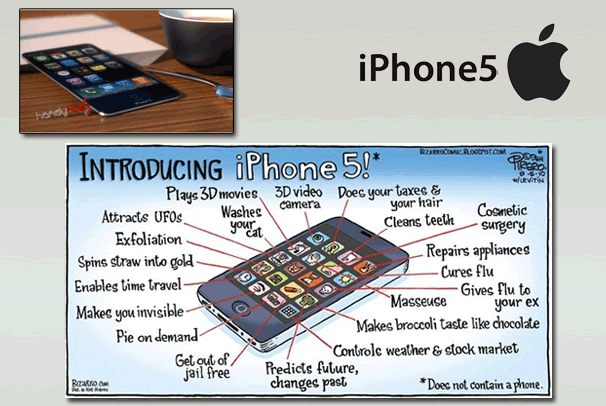
Image from PC World article which is a bit more serious than the graphic might indicate.

Image from PC World article which is a bit more serious than the graphic might indicate.
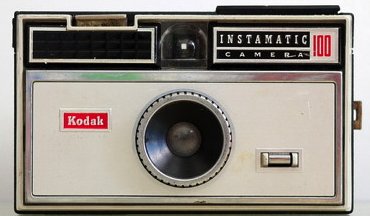
Tell me that this simple idea has never occurred to anyone at Kodak:
If the company that calls itself Kodak today had a brain, it would copy the “Instamatic 100” from Kodak’s greatest hits, drop a first rate lens in it, add some great chips, a view screen as big as the back of the camera, and rebrand it as the “Kodak Digimatic 100.” Instant win.
They’ll never be cool enough to do it. Somewhere in the 1990s, Kodak lost the ability to design and innovate. Once the king of the camera world, Kodak’s now just the place where bad designs and worse marketing go to die. Today, Kodak needs a brain the same way Scarecrow needed one in the first reel of “Wizard of Oz.” Like Scarecrow, there’s a long brick road awinding into the land of its dreams.
It wasn’t always that way. There was a time when it seemed that everyone in America owned an Instamatic. It was a camera that, in its simplicity, elegance and rock-bottom cost, was an icon of its age
Of course, doing it now would be far too late: this was a winning strategy for 2001, not 2011. If they do it now, it’ll flop because they’ve squandered all the immense goodwill that used to be associated with the company name. It was the “everyman” camera and film: professionals had their specialized cameras and even more specialized film, but everyone else just bought Kodak. Kodak was “good enough”, dependable, predictable.
It takes immense lack of talent to fumble that much potential so thoroughly and so consistently. Almost a genius level of anti-talent at the corporate level.
H/T to Jeff Scarbrough for the link.
This was written by Jon, my former virtual landlord, in an email to me earlier today. I’ve asked his permission to post it on the blog.
Did you see this Wall Street Journal post?
When Apple introduced the iPad last year, it added a new buzzword to technology marketing. The device, it declared, was not just “revolutionary,” a tech-hype cliché, but “magical.” Skeptics rolled their eyes, and one Apple fan even started an online petition against such superstitious language.
But the company stuck with the term. When Steve Jobs appeared on stage last week to unveil the iPad 2, which hit stores Friday, he said, “People laughed at us for using the word ‘magical,’ but, you know what, it’s turned out to be magical.”
I’m not sure what she’s on about when get gets to magic and dissing “makers” and hackers for their disdain of such. More on that later.
Sadly, I think love for the iPad is explained in much simpler terms: it is a shiny object, and people like shiny objects.
The thing is well proportioned (I’ve not looked at the specs, but I suspect that golden ratio proportions are present in its design), it has a polished surface, the display is bright and vivid — and people simply dig that sort of thing. I admit that I find the things attractive, but not attractive enough to overcome what are, for me, wallet-crushing limitations:
Another thing that keeps me from buying one of these is that I can see that they are not going to age well. A portable device is going to get beat up, and the iPad will lose much of its Jobs-gizz-polished luster as the screen gets greasy and smudged, the case gets dinged and pitted, and then, finally — horror of horrors — the screen gets a deep corner-to-corner gouge after you read about the next generation device, drop the thing face down in shock, accidentally kick it into the next stall, and the hobo there picks it up and does who knows what with it before passing it back to you under the cubicle wall. Something as precious as the iPad just will not weather that sort of abuse. And even if it did, would you really want it back after that?
Postrel dibbles:
Even the “maker ethic” of do-it-yourself hobbyists depends on having the right ingredients and tools, from computers, lasers and video cameras to plywood, snaps and glue. Extraordinarily rare even among the most accomplished seamstresses, chefs and carpenters are those who spin their own fibers, thresh their own wheat or trim their own lumber — all once common skills. Rarer still is the Linux hacker who makes his own chips. Who among us can reproduce from scratch every component of a pencil or a pencil skirt? We don’t notice their magic — or the wonder of electricity or eyeglasses, anesthesia or aspirin — only because we’re used to them.
I’m not sure what to make of that. It sounds like she’s saying that hackers should revere the iPad simply because they could not make one themselves from scratch. By that logic, I should revere a shipping pallet because I could not make one from scratch — and I’m thinking beyond my lack of woodworking skills here. To Postrel, the shipping pallet should be seen as magic because I did not plant the acorn that grew into the oak that I cut down with the axe that I forged myself from ore that . . . oh, screw it, you know where I’m going with this and have better things to do with your time than to follow me there).
Postrel is missing the fact that clever people have commoditized magic: they’ve found methods to manufacture tedious or complicated things in ways that make them commonplace and disposable. It’s true that your average hacker could not build an iPad from scratch, starting from raw silicon and copper and gold and dead plankton transmogrified into petrochemicals. I mean, really, who has the time to farm plankton, wait for them to die, settle to the bottom of the ocean, be covered by sediment, be compressed through the build-up of rock strata over geological epochs — sorry, I’m doing it again. While your average hacker is not going to build an iPad from raw materials, your average hacker could probably build a world-changing application for a popular platform if that platform were open.
The article throws out the old groan about any sufficiently advanced technology being indistinguishable from magic. To those who don’t think too much about how that technology works, it certainly must seem like magic. What’s truly magical, though, is when such magic is commoditized and becomes commonplace. It goes from being a flashy-bangy trick to something that’s actually useful. Sadly, Apple is not building magic — they are building a captive audience.
Damnit. I’ve been letting this stew for a couple of days, and I can see that it’s just going to boil down to some lame bromide about how free markets and free access to products that one actually owns after paying for them are what is truly magical, but I’m just not going to go there. So I’m going to consider this done and send it off.
. . . let’s look ahead to what’s on the menu for this year: four adaptations of comic books. One prequel to an adaptation of a comic book. One sequel to a sequel to a movie based on a toy. One sequel to a sequel to a sequel to a movie based on an amusement-park ride. One prequel to a remake. Two sequels to cartoons. One sequel to a comedy. An adaptation of a children’s book. An adaptation of a Saturday-morning cartoon. One sequel with a 4 in the title. Two sequels with a 5 in the title. One sequel that, if it were inclined to use numbers, would have to have a 7 1/2 in the title.1
And no Inception. Now, to be fair, in modern Hollywood, it usually takes two years, not one, for an idea to make its way through the alimentary canal of the system and onto multiplex screens, so we should really be looking at summer 2012 to see the fruit of Nolan’s success. So here’s what’s on tap two summers from now: an adaptation of a comic book. A reboot of an adaptation of a comic book. A sequel to a sequel to an adaptation of a comic book. A sequel to a reboot of an adaptation of a TV show. A sequel to a sequel to a reboot of an adaptation of a comic book. A sequel to a cartoon. A sequel to a sequel to a cartoon. A sequel to a sequel to a sequel to a cartoon. A sequel to a sequel to a sequel to a sequel to a movie based on a young-adult novel.2 And soon after: Stretch Armstrong. You remember Stretch Armstrong, right? That rubberized doll you could stretch and then stretch again, at least until the sludge inside the doll would dry up and he would become Osteoporosis Armstrong? A toy that offered less narrative interest than bingo?
[. . .]
1. Captain America, Cowboys & Aliens, Green Lantern, and Thor; X-Men: First Class; Transformers 3; Pirates of the Caribbean: On Stranger Tides; Rise of the Apes; Cars 2 and Kung Fu Panda 2; The Hangover Part II; Winnie the Pooh; The Smurfs in 3D; Spy Kids 4; Fast Five and Final Destination 5; Harry Potter and the Deathly Hallows Part 2.
2. The Avengers; Spider-Man (3D); Men in Black 3 (3D); Star Trek untitled; Batman 3; Monsters, Inc. 2; Madagascar 3; Ice Age: Continental Drift in 3D; The Twilight Saga: Breaking Dawn, Part 2.
Mark Harris, “The Day the Movies Died”, GQ, 2011-02
Many people have bought and used the Workmate collapsible workbench . . . 30 million or so. The inventor, Ron Hickman, Ron Hickman, died recently:
Hickman, who lived in Jersey, was 78. His design for the wood-and-steel foldable workbench and vice was rejected by several tool companies that believed the bench wouldn’t sell.
Tool company Stanley told him the device would sell in the dozens rather than hundreds, while other companies told him the design would not sell at the necessary price. It has since sold about 30 million units around the world, and 60,000 were sold in the UK last year alone.
Hickman sold the benches himself when he couldn’t find a backer through trade shows direct to professional builders. Black & Decker saw the light in 1973 and began producing them. By 1981 it had sold 10 million benches.
He came up with the design when he accidentally sawed through an expensive chair while making a wardrobe. He had been using the chair as a workbench.
His designing skill wasn’t limited to tools: he also is credited with the design of the Lotus Elan.
The hardest economic question is, What comes next? What, in other words, are the new sources of economic value? How can businesses grow and our standard of living rise?
Sometimes the answer is simply more of the same. Growth comes from rolling out existing goods and services to new markets, until there’s a chicken in every pot and a car in every garage. This kind of progress may be hard to achieve, but you at least start with a clear notion of what it would look like.
That’s why catch-up economies like China today or South Korea in the past can grow so fast. Their businesses don’t have to figure out what to make or sell. They know what’s possible by looking abroad, and have a reasonable idea of what consumers, local or international, want to buy. Refrigerators and air conditioning are popular; so are shampoo and disposable diapers.
At the economic frontier, the hardest question gets much harder. You no longer have a clear vision of the future. You know neither what’s possible nor what people want. You can only guess. Starbucks or FedEx may sound obvious in retrospect, but they were once crazy ideas.
Virginia Postrel, “Would Bogie Wear Gore-Tex?: The next big thing often consists of lots of little things”, Wall Street Journal, 2011-02-12
I thought this was a joke . . . but those are some pretty impressive results shown in the video.
H/T to BoingBoing for the link.
Joule Unlimited claims to have developed a new single-cell plant which can produce diesel fuel from sunlight and carbon dioxide:
Henry Ford, the father of the modern assembly line, predicted a future where fuel would be mass-produced from natural materials like fruit, weeds, or even sawdust — renewable alternatives to finite fossil fuels. Still, one energy technology being developed by Joule Unlimited, a company in Cambridge, Mass., might have surprised even him: a plant that sweats diesel.
Plants use the sun to convert carbon dioxide into energy, but Joule has designed tiny, gene-altered organisms (essentially single-celled plants) that use the photosynthetic process to create liquid fuel. Stored in brackish water enclosed in glass panels, they grow for a few days before a genetic switch is flipped, diverting their energy toward fuel production. The diesel, which they pump out continuously, is circulated away to a separator, where it’s extracted and sent to a storage tank. After several weeks, the plants are flushed away and the process starts over again. These microscopic organisms can be genetically engineered to secrete diesel or other chemicals the company plans on commercializing; president and CEO Bill Sims calls the technology an “above-ground oil well.”
A case where super-sizing is a good thing:
The product was inspired by a marine who, while serving in Somalia in 1993, thought it an obvious thing to have large size wipes. But there was no such product on the market. So the ex-marine took the idea to a friend who ran a gym, who then developed the product and found someone to manufacture it. All that took fifteen years, from the time the sweaty marine in Somalia got the idea.
Klenz Showers is a towel sized (2×4 feet/61x122cm) baby wipe. It was designed so that the package containing it fit into the pockets of field uniforms. The Klenz Showers wipe was large enough to clean yourself up, and feel refreshed. There was no scent, but there was aloe, so that the wipe helped heal the usual scrapes troops accumulated out in the bush. To keep the Klenz Showers light, you have to add four ounces (120ml) of water before using.
In the last two years, the Klenz Showers have become a major boost to morale, and cleanliness, for troops in Afghanistan, where many of them are out in the hills for weeks at a time. After ammo, water, batteries and food, the troops want their Klenz Showers packets.
Once you get past the initial “Dude, it’s a baby wipe” reaction, this is actually a really good idea.
Lewis Page discovers that the latest minisub for the US Navy’s SEAL teams is actually made in Britain:
A groundbreaking new miniature submarine in use by the US Navy’s secretive, elite frogman-commando special operations force was actually designed and built in old Blighty, the Reg can reveal.
We reported first on the S301 mini-sub two weeks ago, noting from federal documents that the famous US Navy SEALs had leased a demonstration model for “doctrinal, operational, and organizational purposes”. This was followed up last week by the Honolulu Advertiser, which had spoken to Submergence Group, the American firm listed by the US government as provider of the S301.
It emerged that the S301 — now in trials with the SEALs in Hawaii — had cost just $10m to develop, which contrasted especially well with the $885m+ spent on the ill-fated Advanced SEAL Delivery System (ASDS).
The ASDS, from US defence behemoth Northrop Grumman, had been intended to supersede the SEALs’ current Mark 8 Mod 1 minisubs, which are carried in a “Dry Deck Shelter” (DDS) airlock docking bay fitted to a full-sized US Navy nuclear submarine — either a normal attack boat or an Ohio-class dedicated Stingray-style special-ops mothership. The Ohios, nuclear missile subs retired from their old job under arms-reduction treaties, have space aboard for a large force of SEALs and pack a powerful armament of conventional-warhead cruise missiles for precision shore bombardment.
Benj Edwards looks at the long list of consumer electronic devices with design problems (most of which could have been avoided):
You saved and you saved until you could finally buy that shiny new $1000 gadget that promised you everything under the stars. When it came time to plug it in, you found your joy being subsumed by abject horror. Your stomach plunged deep into your gut and you (yes, mortal non-designer you) recognized a fundamental flaw in your flashy gizmo so obvious that it made you want to pick up the device and smash it over the designer’s head.
Even the best designers make mistakes . . . but this article isn’t about them. We’re about to, ahem, celebrate the worst consumer electronics designers through the lens of their faulty creations. Since I’m far from an all-knowing technology god, I’ve limited our survey to fifteen design problems that have not only bugged me through the years, but that are widespread enough to have bugged many of you too. These problems aren’t limited to current technology, but they all fall into the nebulous realm known as “consumer electronics.” You know: TVs, telephones, VCRs, DVD players, MP3 players, and more.
A freezer-sized box to provide power to 100 homes, running on renewable fuel? Sounds good, doesn’t it? If it turns out to be economical, practical, and efficient, it could be great:
A mini power station containing fuel cells that can run on anything from natural gas to the more renewable stuff, Bloom’s device has received the level of hype in Silicon Valley normally reserved for a new product from Apple.
For the past week, newspapers and websites have been filled with rumours about Bloom boxes, as the devices have been nicknamed, invented by former Nasa scientist KR Sridhar.
Fuel cells, which convert hydrogen and oxygen into electricity by an electrochemical process, are a promising source of energy while emitting less CO² and other pollutants, as well as being much more efficient, than burning. But most modern designs use expensive materials, such as platinum, or corrosive chemicals that shorten their lifespan.
At the heart of Sridhar’s device is a thin fuel cell made from a plentiful resource, sand. The size of a floppy disk, it is painted with proprietary inks that allow the fuels to react with oxygen from the air, a chemical process that produces electricity.
Bloom Energy claims that the boxes provide electricity at about half the cost of current conventional sources. Current customers include heavy hitters like Google, FedEx, WalMart, and Coca-Cola.
Of course, the company hasn’t been providing a lot of detailed technical information, so it’s not clear if this is one of the breakthroughs in electrical generation that will change everything, or if it’s another interesting blip that will quickly disappear.
Richard Miller, an innovation platform leader at the UK’s Technology Strategy Board, said Bloom Energy had yet to provide data to allow a fully informed decision on the value of its technology.
Update, 25 February: Alexis Madrigal says it’s too expensive for the current market conditions:
The analyst firm Lux Research posted a note to its blog today noting that Bloom had confirmed their 100-kilowatt boxes are priced between $700,000 and $800,000 without subsidies of any kind.
In fact, a long-term R&D collaboration between the Department of Energy and multiple solid-oxide fuel-cell manufacturers, the Solid State Energy Conversion Alliance, estimates that fuel cells will need to cost $700 per kilowatt of peak capacity to compete unsubsidized with the grid. Bloom’s product costs 10 times that.
“The cost is about an order of magnitude higher than it needs to be, to be truly competitive,” said Michael Tucker, a fuel cell scientist at Lawrence Berkeley National Laboratory.
When you do the math, the Bloom box’s electricity costs substantially more per kilowatt hour than the grid.
“Without incentives, we calculate electricity would cost $0.13/kWh to $0.14/kWh, with about $0.09/kWh from system cost and about $0.05/kWh coming from fuel cost,” Lux wrote. “Note that this is high compared to average retail U.S. electricity costs of roughly $0.11/kWh.”
An order of magnitude more than conventional power? Yep, that qualifies as “spendy”.



Powered by WordPress