
The stigmatization of science is also jeopardizing the progress of science itself. Today anyone who wants to do research on human beings, even an interview on political opinions or a questionnaire about irregular verbs, must prove to a committee that he or she is not Josef Mengele. Though research subjects obviously must be protected from exploitation and harm, the institutional-review bureaucracy has swollen far beyond this mission. Its critics have pointed out that it has become a menace to free speech, a weapon that fanatics can use to shut up people whose opinions they don’t like, and a red-tape dispenser that bogs down research while failing to protect, and sometimes harming, patients and research subjects. Jonathan Moss, a medical researcher who had developed a new class of drugs and was drafted into chairing the research-review board at the University of Chicago, said in a convocation address, “I ask you to consider three medical miracles we take for granted: X-rays, cardiac catheterization, and general anesthesia. I contend all three would be stillborn if we tried to deliver them in 2005.” The same observation has been made about insulin, burn treatments, and other lifesavers.
The hobbling of research is not just a symptom of bureaucratic mission creep. It is actually rationalized by many bioethicists. These theoreticians think up reasons that informed and consenting adults should be forbidden to take part in treatments that help them and others while harming no one. They use nebulous rubrics like “dignity,” “sacredness,” and “social justice.” They try to sow panic about advances in biomedical research with far-fetched analogies to nuclear weapons and Nazi atrocities, science-fiction dystopias like Brave New World and Gattaca, and freak-show scenarios like armies of cloned Hitlers, people selling their eyeballs on eBay, and warehouses of zombies to supply people with spare organs. The University of Oxford philosopher Julian Savulescu has exposed the low standards of reasoning behind these arguments and has pointed out why “bioethical” obstructionism can be unethical: “To delay by 1 year the development of a treatment that cures a lethal disease that kills 100,000 people per year is to be responsible for the deaths of those 100,000 people, even if you never see them.”
Steven Pinker, “The Intellectual War on Science”, Chronicle of Higher Education, 2018-02-13.
April 29, 2020
QotD: “Ethical” ways to prevent scientific progress
April 8, 2020
If the Wuhan Coronavirus panic feels oddly familiar … there’s a good reason for it
Warren Meyer explains why his skepticism about the dangers of the Wuhan Coronavirus epidemic kicked in quickly because it followed a very familiar pattern:
I have been skeptical about extreme global warming and climate change forecasts, but those were informed by my knowledge of physics and dynamic systems (e.g. feedback mechanics). I have been immensely skeptical of Elon Musk, but again that skepticism has been informed by domain knowledge (e.g. engineering in the case of the hyperloop and business strategy in the case of SolarCity and Tesla). But I have no domain knowledge that is at all relevant to disease transfer and pathology. So why was I immediately skeptical when, for example, the governor of Texas was told by “experts” that a million persons would die in Texas if a lock-down order was not issued?
I think the reason for my skepticism was pattern recognition — I saw a lot of elements in COVID-19 modelling and responses that appeared really similar to what I thought were the most questionable aspects of climate science. For example:
- We seem to have a sorting process of “experts” that selects for only the most extreme. We start any such question, such as forecasting disease death rates or global temperature increases, with a wide range of opinion among people with domain knowledge. When presented with a range of possible outcomes, the media’s incentives generally push it to present the most extreme. So if five folks say 100,000 might die and one person says a million, the media will feature the latter person as their “expert” and tell the public “up to a million expected to die.” After this new “expert” is repetitively featured in the media, that person becomes the go-to expert for politicians, as politicians want to be seen by the public to be using “experts” the public recognizes as “experts.”
- Computer models are converted from tools to project out the implications of a certain set of starting hypotheses and assumptions into “facts” in and of themselves. They are treated as having a reality, and a certainty, that actually exceeds that of their inputs (a scientific absurdity but a media reality I have observed so many times I gave it the name “data-washing”). Never are the key assumptions that drive the model’s behavior ever disclosed along with the model results. Rather than go on forever on this topic, I will refer you to my earlier article.
- Defenders of alarmist projections cloak themselves in a mantle of being pro-science. Their discussions of the topic tend to by science-y without being scientific. They tend to understand one aspect of the science — exponential growth in viruses or tipping points in systems dominated by positive feedback. But they don’t really understand it — for example, what is interesting about exponential growth is not the math of its growth, but what stops the growth from being infinite. Why doesn’t a bacteria culture grow to the mass of the Earth, or nuclear fission continue until all the fuel is used up? We are going to have a lot of problem with this after COVID-19. People will want to attribute the end of the exponential growth to lock-downs and distancing, but it’s hard to really make this analysis without understanding at what point — and there is a point — the virus’s growth would have turned down anyway.
- Alarmists who claim to be anti-science have a tendency to insist on “solutions” that have absolutely no basis in science, or even ones that science has proven to be utterly bankrupt. Ethanol and wind power likely do little to reduce CO2 emissions and may make them worse, yet we spend billions on them as taxpayers. And don’t get me started on plastic bag and straw bans. I am willing to cut COVID-19 responses a little more slack because we don’t have the time to do elaborate studies. But just don’t tell me lockdown orders are science — they are guesses as to the correct response. I live in Phoenix where it was sunny and 80F this weekend. We are on lockdown in our houses. I could argue that ordering everyone out into the natural disinfectant of heat and sunlight for 2 hours a day is as effective a response as forcing families into their houses (initial data, though it is sketchy, of limited transfer of the virus in summertime Australia is interesting — only a small portion of cases are from community transfer. By comparison less than a half percent of US cases from travel).
March 27, 2020
Sensible risk management is not compatible with the “precautionary principle”
David Zaruk wrote last week for Science 2.0 Europe:
Two decades of the precautionary principle as the key policy tool for managing uncertainties has neutered risk management capacities by offering, as the only approach, the systematic removal of any exposure to any hazard. As the risk-averse precautionary mindset cements itself, more and more of us have become passive docilians waiting to be nannied. We no longer trust and are no longer trusted with risk-benefit choices as we are channelled down over-engineered preventative paths. While it is important to reduce exposure to risks, our excessively-protective risk managers have, in their zeal, removed our capacity to manage risks ourselves. Precaution over information, safety over autonomy, dictation over accountability.
- Whatever happened to “Keep out of reach of children”? Now we cannot be trusted and all products must be child-safe.
- Whatever happened to “Handle with care”? Now safety by design has removed the need for individuals to exercise common sense or risk reduction measures.
- Whatever happened to trust? Now individuals are no longer left with the capacity to make their own decisions in managing personal risks.
“These are good things” precaution advocates would retort “since people often make mistakes and bad things can better be prevented!”. While continuous improvement of safety systems has its value, the bigger the fences, the less autonomously the individuals will react (creating a society of docile followers). The precautionary approach implies a lack of trust in individuals’ capacities to make their own (rational) choices. The over-engineered risk-management process would remove any situation where choices could be made. Fine for cases where there are no trade-offs, disruptions or loss of benefits (when the sheep have plenty of grass in their field), but in times of crisis (exposure to hazards), when precaution is your only tool, then sacrifice is the only solution.
[…]
When the public now sees everything of modern life (work, school, public events …) cancelled in a knee-jerk precautionary impulse, is it any wonder they are panicking? Enter the opportunist to sell you the silver solution or the naturopath detox remedy to put your mind at ease. Enter the quack to tell you to drink bleach. Enter the racist who will use the fear to mobilise outrage. Exit rationality and risk management.
With no bullets left in the risk-management gun, the only thing left to do is run … or as it is more commonly called: apply the precautionary principle. Precaution should only be applied after other risk management measures have failed but given how horribly inadequate our capacities to govern have become, it is the only strategy our regulators have come to know.
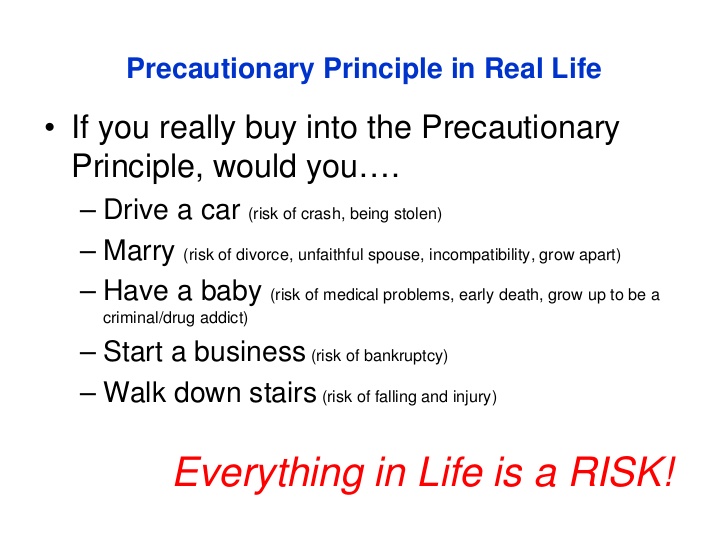
Slide from a presentation by Patti Gettinger, 2011-07-11.
Original slideshow at https://fr.slideshare.net/regsgridlock/the-precautionary-principle-8656034
H/T to Johnathan Pearce for the link.
March 18, 2020
What is really driving the Wuhan Coronavirus panic
… besides the wall-to-wall hysteria in the mainstream media, I mean. Severian discusses the insights of “perverted old cokehead” Sigmund Freud on anxiety and its effects, then segues to our current, shared, plight:
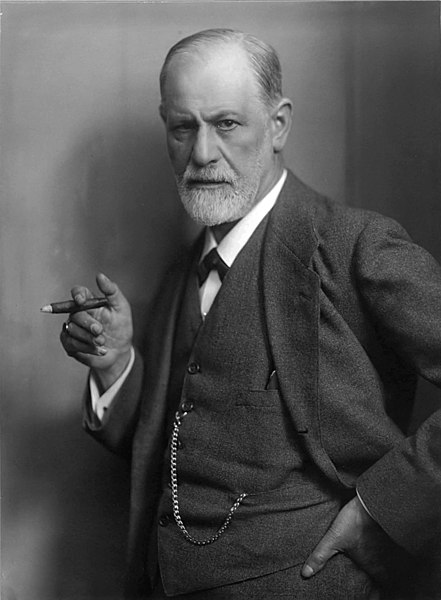
Photographic portrait of Sigmund Freud, signed by the sitter (“Prof. Sigmund Freud”) by Max Halberstadt (c. 1921)
Wikimedia Commons
Everyone who has thought about it for five minutes knows that something’s not right. […] As y’all have noted, actual hard information on the coronavirus is hard to come by. Is it fully air-transmissible? What are the infection rates? Hell, what are the death totals? And speaking of the death totals, even if you trust China’s figures (which no reasonable person can possibly do), they seem … low. Like, really low. I actually trust Italy’s government to deliver some vague approximation of the truth, and even there, where they’re in full-blown freakout mode, it seems to kill off old folks with compromised immune systems and lung problems at a fractionally higher rate than your garden-variety flu.
So, you know … it’s the flu. Not great by any means, and more infectious (possibly) than some other flus in our recent past, but for all that just the flu. The ongoing sky-is-falling global freakout has next to nothing to do with the actual bug. We live in a deeply anxious age, and that anxiety has to discharge somehow. It’s global hysteria — classic hysteria, Freudian hysteria, an excess of stress that must be discharged by “converting” it into behavior.
The people who are freaking out about it aren’t worried about dying from it. No, really, they’re not. Nor should they be — no reasonably healthy person under age 70 has any reason to be worried about that. Instead, what they’re worried about is powerlessness. We’ve all long suspected that we’re ruled by idiots and grifters. We’ve all long sensed that our “leaders” hold us in deep contempt. And we’ve long known that none of our problems are worth anything to the global pirate capitalist class. The only reason those bastards care if we all drop dead from the plague is that they can’t sell enough iCrap to each other to keep the company stock price up.
We know this. But we can’t say it, and we can’t act on it, because doing so goes against our self-image. Our media, our education system, our “culture” (such as it is) has spent the last half-century telling us what special and unique snowflakes we all are, even as it’s forcing us into ever-greater conformity. We’ve broken all the taboos, transgressed all the boundaries, liberated all the oppressed. If there ever were to be such a thing as “social justice,” then truly we’ve achieved it, here in this best of all possible worlds where you can lose your job for not addressing your co-worker as a wingless golden-skinned dragonkin and 6’2″ dudes with beards down to their collarbones can go wee-wee in the little girls’ room …
… and yet. And yet. And yet feminists (just to stick with a theme), despite running everything for the last 30 years, still can’t get that lousy 25 cent raise. Seven out of every five college girls are sexually assaulted the minute they step on campus, despite boys being as rare as sasquatches on most campuses (and despite the ever-growing clamor for free college for everyone). You’re free to — hell, you’re practically required to — make up your own pronouns, but you’re not allowed to ask just how a degree in “gender studies” could be worth even one dollar in student loan debt, let alone one hundred thousand dollars. We keep agitating for change, keep voting for it, keep tweeting about it … and nothing happens.
That profound sense of powerlessness is exactly, and I do mean exactly, what screwed up Anna O. She hated her father for not allowing her any personal agency. In her heart of hearts she wanted him dead. And yet she knew herself to be a loving daughter, so that overwhelming sense of relief — indeed, of joy — she felt when he kicked the bucket sent her around the bend.
March 3, 2020
The bottled water and toilet paper hoarders of 2020
Arthur Chrenkoff on one of the oddest features of the current infectious disease panic:

“sold out of bottled water?” by Klara Kim is licensed under CC BY-NC-SA 2.0


This is happening alright, and it’s not some isolated incidents; on my Facebook news feed, at least half a dozen posts from friends in Sydney and Brisbane display photos of Venezuela-style empty shelves at their local supermarkets. The fear is real, and so is the hoarding.
OK, I can understand face masks and hand sanitisers walking off the shelves, as these are the crucial tools in containing the spread of the pandemic. Most face masks – as with so many other products in our shops – are made in China and in the current crisis conditions any new and additional supplies won’t make it out of the country, so whatever is already here is it. And it isn’t, as masks have been the first item to disappear from retail outlets from your local pharmacy to a Bunnings store.
I can also understand the non-perishable food supplies. Even though Australia could be quite self-sufficient if need be (minus the out of season imported fruit and veg), possibly people are stocking up not so much in fear the food will run out but out of reluctance to go out in the public in a few weeks’ time should the situation really turn into a zombie apocalypse. In any case, there is nothing wrong with having a well stocked pantry.
Where I start to no longer understand the consumers is bottled water. We are fortunate to live in a developed country where one can safely drink from a tap. There won’t be shortages of drinkable water under any circumstances – except for a complete societal collapse – and coronavirus is not a water-borne pathogen like those causing cholera or typhoid. If you are still paranoid, you can boil your water before ingesting (just make sure you cool it down).
But it’s the toilet paper that really gets me. Trust me, if things go really belly up, toilet paper is the least of your worries. Humanity has survived for tens of millennia without sanitary tissues, and in their absence any paper or rag or even running water will substitute nicely. Food, water, medicines, electricity, to name just four, are much more crucial in a time of crisis or emergency. Again, it’s true that a lot of toilet paper is manufactured in China or generally overseas and so potentially susceptible to shortages if manufacturing and international transport are affected as they are already. But how much toilet paper does your household require to function? Are you expecting you might need the iron rations of your favourite rolls to last for at least a few months? And if you think that you might not be able to restock on toilet paper until later this year, then – let me repeat myself – don’t you think you will have much bigger problems with ensuring your continuing survival to worry about?
As Norman Lewis points out, the worst hysterics are among the “elites”, not us lumpenproles:
Last week, the world stock markets suffered their worst week since the financial crisis in 2008, with $6 trillion wiped from shares and, in some markets, a sell-off at a rate not seen since the Great Depression almost a century ago. Why? Because global investors are in a panic about the potential economic fallout from the coronavirus epidemic.
Many commentators are making the point that this is mad. Ross Clark argues convincingly in the Spectator that the “most dangerous thing about coronavirus is the hysteria”. Philip Aldrick, economics editor of The Times, agrees. He says it is the “panic we should fear more than the virus itself”.
Our appetite for doom and fear of the unknown are offered as explanations for this behaviour. Risk culture and a predisposition to overreacting to threats are also certainly components of what is happening. But there is another equally important element linked to these that is not being raised – that this madness is not being driven by the “low-information”, knuckle-dragging, gullible ignorant masses, but by the information-rich, university-educated and refined global business and government elites.
The contrast between the responses to coronavirus from the elites and ordinary people has been stark. Even as the level of panic in the mainstream reporting around coronavirus has risen, ordinary people have just gotten on with their lives. The supposedly well-informed elites, who often accuse the “dumb” masses of being vulnerable to hysteria and “fake news”, have themselves been prodded into panic. Meanwhile, where they are not in lockdowns, ordinary people are still going to work, commuting, going to bars … They’re simply getting on with their lives, while taking note of the potential risks.
The elites are in free-falling panic; like a herd of wildebeest, panicked by the sight of a predator and rushing blindly across crocodile-infested waters, they have sparked a potential global economic meltdown. Meanwhile, we see stoic common sense, simple but profound wisdom, on the part of the “great unwashed”.
January 22, 2020
Australian tourism, RIP
As we’ve all been inundated with the shocking images of almost the entire inhabited area of the Australian mainland burning, like this one, for example, claimed on social media to be a “satellite image”:
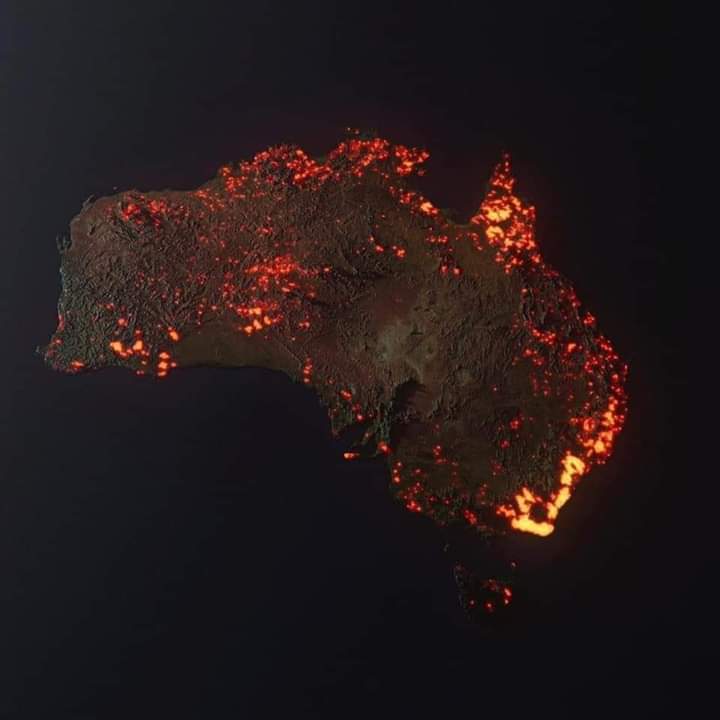
… it’s not surprising that anecdotal evidence of the decline in bookings from foreign tourists implies that there will be few visitors to the burned-out wasteland that used to be a thriving first-world nation. This, on top of the widely reported “death” of the Great Barrier Reef, means the few dozen dazed survivors will be reduced to cannibalism shortly. Or, as Arthur Chrenkoff suggests, we’ve been sold another bill of goods and things are not quite as desolate and post-apocalyptic as all that:
Just like many other people I know, I have been inundated by messages from family and friends overseas, inquiring about my safety, having been terrified by the media reports of what seemed like an environmental armageddon engulfing the entire country. I had to explain time after time that while the fires have been savage and extensive, they have largely burned through relatively sparsely populated areas (if it all, considering the vast extent of our national parks). No significant town has been threatened and destruction and loss of life, while tragic, have been pretty small in proportion to the area affected.
Yet, watching the hysterical and over-sensationalised coverage overseas has convinced many that the very existence of the nation is at stake. And the social media, if anything, has been even worse, with a number of completely misleading maps and photos exaggerating the extent of the affected areas by two-figure factors. As I pointed out, indeed the area the size of the state of Kentucky has been burned out, but unlike most other places on Earth, certainly in the developed world, Australia fits in nearly eighty Kentuckys, most of them pretty empty of human presence and activity.
Media sensationalises at the best of times in a never-ending quest for more eyeballs (“if it bleeds it leads”, or, in this case, “if it’s on fire, we’re on fire”) but the intersection of a large scale natural disaster with the “climate crisis” activism has generated a truly terrifying inferno of human passions where news becomes propaganda and the narrative trumps the objectivity. A significant proportion of the population — and the majority in the media — want to see the fires as Gaia’s wrath, with the disaster turning into green porn to terrify, titillate and agitate. Tourism has now become one of the casualties of this rhetorical excess, a collateral damage to the pursuit of a political agenda. This crisis is very much man-made and the economic pain unnecessarily inflicted on a whole industry because you wanted to make as terrible a point as possible will hang around your necks like a charred albatross, dear green activists on the streets and those masquerading as journalists.
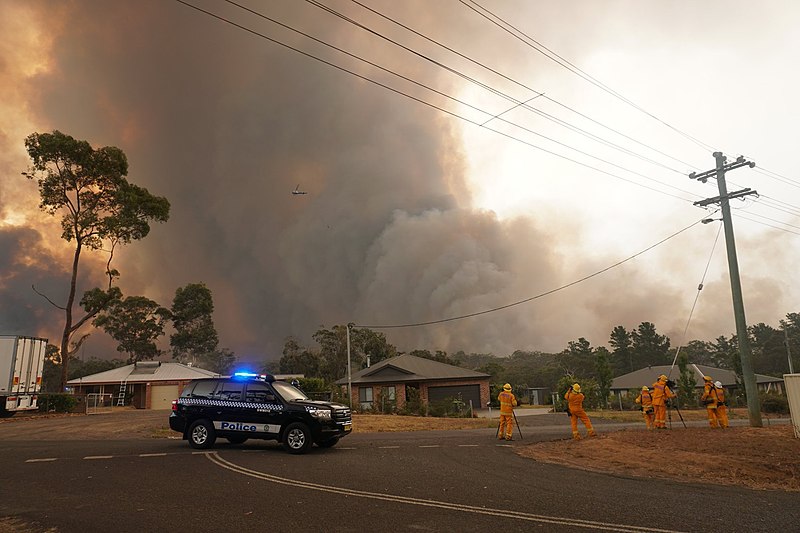
The Green Wattle Creek bushfire moves towards the Southern Highlands township of Yanderra as police evacuate residents from Yanderra Road, 21 December, 2019.
Photo by Helitak430 via Wikimedia Commons
September 27, 2019
QotD: Environmental cultists
Of course, back then it was global cooling that was going to kill us all, and do you see what I mean about True Believers? The very same people who were convinced that we were all gonna die in a new Ice Age in 1970 were certain we’d die of melted polar ice caps in 2006, just as they’re now positive we’re going to get killed by … whatever it is Thunberg is hectoring the UN about. Normal folks’ skulls would’ve exploded from cognitive dissonance, but the eco-freaks don’t suffer from cognitive dissonance. Because, for them, it never rises to the level of cognition in the first place. If “pulling a U-turn on your deepest convictions” is what it takes to stay in the group, well, start peeling rubber. The cult’s leadership will come up with a retcon in due time.
Two interesting effects flow from this. The first is the growing disconnect between the cult’s leadership and the True Believers. A cult with a big enough membership roster stops being a cult and becomes a movement. Movements beget organizations, which by universal law attract grifters, with predictable-as-sunrise consequences. E.g. Christianity. Back in the mid-first century, Christians were sure that Christ would return in their lifetimes — after all, He said so Himself. His comeback tour kept getting postponed, though, and these days you can be the leader of a major Christian denomination without ever bothering with that “Jesus” guy, much less any of the stuff He said.
This is why “global cooling” became “global warming,” which is now “global climate change.” We cognitively-normal folks assume that the eco-freaks keep changing the name to avoid cognitive dissonance. After all, the climate “changes” every day — we call it “weather,” but if you’re looking for evidence that your crackpot eco-doom theories are correct, well, just look at how much the temperature varies from noon to midnight!! But see above: Cognitive dissonance is actually a boon to the eco-freaks, because in cult psychology, disconfirmations prove that you were right all along. The eco-freaks would still trot goofy Greta Thunberg out there no matter what it’s called, and she, poor deluded little sod, would keep on doing her thing, because she’s in the cult. So: They, the eco-freaks, didn’t come up with “climate change;” the grifters in charge of Climate Shakedown Inc. did.
Severian, “What Happens if the UFO Actually Comes?”, Rotten Chestnuts, 2019-09-25.
September 6, 2019
“This is the worst [weather event] in history!”
At some point in the last decade or so, media organizations decided to make the weather report into an extension of the news, to (as I’m sure they’d have explained) provide a richer media experience for their audiences. This has degenerated into some pretty ridiculous weather-event related claims, as it seems every month for the last several years has been “the hottest evah!” if you got your news from the TV. Claiming something is the best/worst in history sounds very impressive, until you realize just how short a time we’re considering when we talk about the weather:
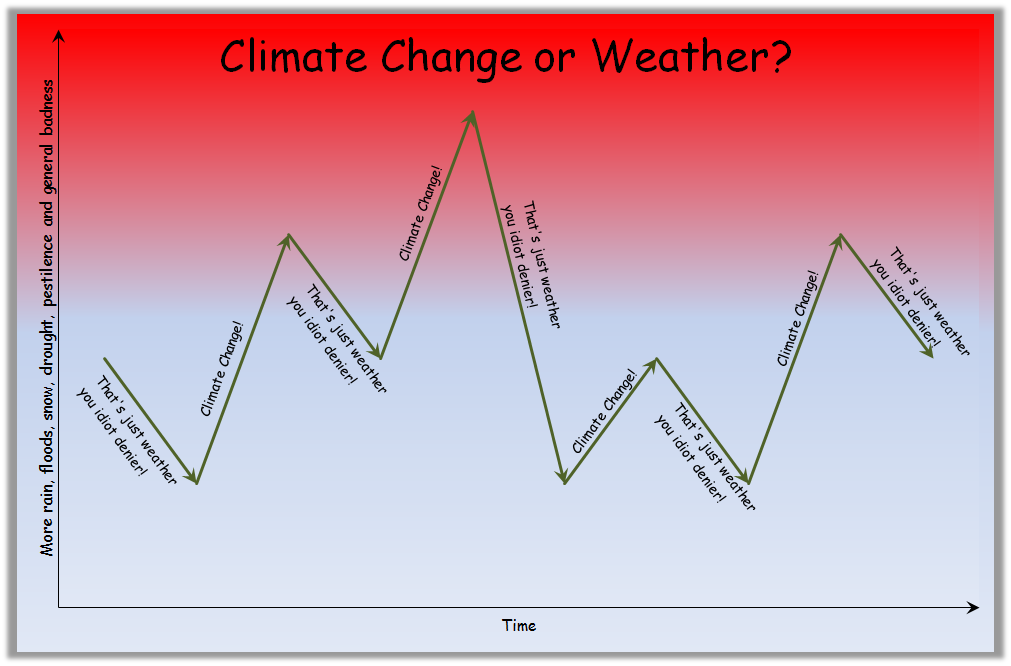
“This is the worst [weather event] in history!” You see it in all the headlines: “Hottest day in history!” “Worst hurricane in history!” “Coldest winter in history!” These headlines make me crazy and it’s not just because they’re being used to shill anthropogenic climate change fears nor is it because a lot of them are false. (For example, since 1924, there have been thirty-five Category Five hurricanes in our part of the Atlantic, most in September. Dorian was just the latest, not the most exceptional.)
No, what really irks me is that phrase “in history” or its companion phrase “ever” (“Worst heat wave ever!”) What the dopes in the media miss, or perhaps willfully ignore, is the fact that we have barely any weather history. Instead, we’ve only been measuring weather data since the second half of the 19th century. I learned this when I read Simon Winchester’s delightful Krakatoa: The Day the World Exploded: August 27, 1883. In it, he notes that the volcano’s explosion was the loudest sound ever recorded — and that it was recorded only because the Victorians had an obsession with record keeping.
Before the Victorians came along, there were always people who kept records, but once the Victorians came along it became a “thing.” For the first time in human history, people had (a) instruments that could measure things with a fair degree of accuracy and that were affordable, and (b) the literacy and leisure time to note and record these things.
Thus, in the late 19th century, owning a reliable thermometer, checking the weather daily, and taking the time to write it down was something entirely new. Before that, there were no reliable thermometers and only the richest could afford such unreliable tools as existed for measuring temperatures. The fact that people were no longer living at subsistence level and were literate enabled them to find the time and have the skills to record data.
That’s why we know how loud Krakatoa was: All over the world, as the sound waves reverberated around the earth, over and over, busy Victorians were looking at their reliable time-pieces (the first affordable, mass-produced watches were driven by railway needs and came onto the market in the late 19th century) and noting down the time at which they heard that strange loud noise.
All of which means that our reliable weather data isn’t about “history” or “ever,” but is, instead, about 150 years old, at most. Everything else is guess work, based upon random reminiscences and best guesses using things such as Arctic core samples or tree rings.
August 30, 2019
Communist Revolution in America? – The Red Scare 1919 I THE GREAT WAR 1919
The Great War
Published on 29 Aug 2019Get a free audiobook and 2 Audible Originals with a 30-day trial: http://audible.com/greatwar or text
greatwarto 500 500.The American intervention in the Russian Civil War, the economic hardships of workers and returning veterans and the strikes all over the US in 1919 created a hysteria that we know as Red Scare today. But how realistic was the idea of a Bolshevist revolution in America really?
» SUPPORT THE CHANNEL
Patreon: https://www.patreon.com/thegreatwar
Merchandise: https://shop.spreadshirt.de/thegreatwar/» SOURCES
US Congress. Senate. Bolshevik Propaganda: Hearings before a Subcommittee of the Committee on the Judiciary. 65th Cong., 3rd sess., February 11, 1919, to March 10, 1919
Brecher, Jeremy. Strike! Revised edition. South End Press, 1997.
Hanson, Ole. Americanism versus Bolshevism. New York and London: Doubleday, Page, & Co., 1920.
United States Department of Justice. Red Radicalism as Described by Its Own Leaders, Exhibits Collected by A. Mitchell Palmer, Including Various Communist Manifestos, Constitutions, Plans, and Purposes of the Proletariat Revolution, and Its Seditious Propaganda. Washington: Government Printing Office, 1920.
Cocks, Catherine, Peter C. Holloran, Alan Lessloff. The A to Z of the Progressive Era. Maryland: Scarecrow Press, Inc., 2009.
Dick, William M. Labor and Socialism in America. New York: Kennikat Press, 1972.
Gould, Lewis L. The Progressive Era. New York: Syracuse University Press, 1974.
Hagedorn, Ann. Hope and Fear in America: 1919. New York: Simon & Schuster, 2007.
Jaffe, Julian F. Crusade Against Radicalism: New York During the Red Scare, 1914-1924. New York: Kennikat Press, 1972.
Kornweibel, Jr., Theodore. “Seeing Red”: Federal Campaigns Against Black Militancy, 1919-1925. Indianapolis: Indiana Press University, 1998.
Hawley, Ellis W. The Great War and the Search for a Modern Order: A History of the American People and Their Institutions, 1917-1933. New York St Martin’s Press, 1979.
Murray, Robert K. Red Scare: A Study of National Hysteria, 1919-1920. New York: McGraw-Hill Book Company, 1964.
Powers, Richard Gid. Not Without Honor: The History of American Anticommunism. Yale University Press, 1998.»CREDITS
Presented by: Jesse Alexander
Written by: Jesse Alexander
Director: Toni Steller & Florian Wittig
Director of Photography: Toni Steller
Sound: Toni Steller
Editing: Toni Steller
Mixing, Mastering & Sound Design: http://above-zero.com
Motion Design: Christian Graef – GRAEFX
Maps: Daniel Kogosov (https://www.patreon.com/Zalezsky)
Research by: Jesse Alexander and Jonathan Dunning
Fact checking: Florian WittigChannel Design: Alexander Clark
Original Logo: David van StepholdA Mediakraft Networks Original Channel
Contains licensed material by getty images
All rights reserved – Real Time History GmbH 2019
August 3, 2019
QotD: The 1968 election and the schizoid break of the American media
Fortunately for the Democrats, what The Media wanted and what the Democratic Party wanted were in the same ballpark for most of the next three decades. But then Bill Clinton happened, as my students would write. He played The Media’s Messiah fantasies for all they were worth, such that every bobblehead in the country was still defending him as Liberalism’s avatar even as he was governing (in the few odd moments he bothered) as Newt Gingrich’s mini-me and acting like a frat boy on nickel beer night at the strip club.
You just don’t get over something like that.
Which brings us to the elections of 2000 and 2004. Boy do these look different in hindsight! […] I knew The Media was all-in on the Democrat, like they always are. But at the time, I thought that was a tactical decision. That is, I really believed that their attacks on W. were calculated political moves, designed to drag Gore and especially Kerry over the finish line. I thought that only the Mother Jones types were delusional, Iranian mullah-style fanatics.
Nope. The Media — ALL of them — really did see W. as the antichrist, the Twelfth Invisible Hitler (as the Z Man likes to put it) come to destroy the world. So when despite all their sacrifices to Moloch the Chimperor won, The Media went full retard. Like UFO cultists who keep the faith by telling themselves only their fervent prayers staved off the apocalypse, The Media convinced themselves that only more Social Justice would do …
Severian, “The Spirit of ’68”, Rotten Chestnuts, 2019-07-01.
July 27, 2019
The US Economy is About to Crash Hard | Between 2 Wars | 1929 Part 1 of 3
TimeGhost History
Published on 25 Jul 2019In 1929 it’s been nothing but growth for the US economy for years, at least if you judge by the New York Stock Exchange. But all that glitters is not gold, and when the gilding comes off this bubble it sinks like a lead ballon.
Join us on Patreon: https://www.patreon.com/TimeGhostHistory
Hosted by: Indy Neidell
Written by: Francis van Berkel
Produced and directed by: Spartacus Olsson and Astrid Deinhard
Executive Producers: Bodo Rittenauer, Astrid Deinhard, Indy Neidell, Spartacus Olsson
Creative Producer: Joram Appel
Post Production Director: Wieke Kapteijns
Edited by: Daniel Weiss
Sound Mix by: Iryna DulkaArchive by: Reuters/Screenocean http://www.screenocean.com
A TimeGhost chronological documentary produced by OnLion Entertainment GmbH
From the comments:
TimeGhost History
3 hours ago (edited)
Now… ladies and gents – this is not a video about 2019 and we are not making any political statements. We know that some of you love making parallels between the present day and historical events. Although we can learn from history, try to remember that the circumstances were very different. Others among you feel it appropriate to extend partisan conflicts backwards and make out our videos, or events in the videos as partisan statements or issues. First of all we simply don’t do that, we just relate the events and the circumstances as factually as possible with the best possible sources. Second of all it is pointless to look for the 2019 partisan left/right divide according to party lines in events that happened 90 years ago. There’s just no comparison as both reality, and political parties have gone through so much change that the members of the same party, from today and then would probably disagree so vehemently on so many points the they would not even understand each other. So please, try your best to not go off on partisan rants, as it distracts form the actual historical issues at hand
July 21, 2019
The humble egg – wonder food or deadly poison?
If you’ve paid any attention to popular reporting on nutrition studies over the years, you’ll have noticed how just about any advice on food has not only changed, but has often been completely the opposite of advice offered just a few years earlier. During my teenage years, the egg was pushed (thanks in part to the “Egg Marketing Board”, one of Canada’s supply management bureaucracies) as “the perfect food”. During the next decade, as newer nutrition studies were published, suddenly the wonderful, nutritious egg was now a huge risk to your cardiovascular health and even one egg per week might be enough to kill you. Rinse and repeat for so many other foods and you either stop eating altogether or, more sensibly, stop paying any attention at all to mainstream media interpretations of nutrition studies.

It’s been a tortuous path for the humble egg. For much of our history, it was a staple of the American breakfast — as in, bacon and eggs. Then, starting in the late 1970s and early 1980s, it began to be disparaged as a dangerous source of artery-clogging cholesterol, a probable culprit behind Americans’ exceptionally high rates of heart attack and stroke. Then, in the past few years, the chicken egg was redeemed and once again touted as an excellent source of protein, unique antioxidants like lutein and zeaxanthin, and many vitamins and minerals, including riboflavin and selenium, all in a fairly low-calorie package.
This March, a study published in JAMA put the egg back on the hot seat. It found that the amount of cholesterol in a bit less than two large eggs a day was associated with an increase in a person’s risk of cardiovascular disease and death by 17 percent and 18 percent, respectively. The risks grow with every additional half egg. It was a really large study, too — with nearly 30,000 participants — which suggests it should be fairly reliable.
So which is it? Is the egg good or bad? And, while we are on the subject, when so much of what we are told about diet, health, and weight loss is inconsistent and contradictory, can we believe any of it?
Quite frankly, probably not. Nutrition research tends to be unreliable because nearly all of it is based on observational studies, which are imprecise, have no controls, and don’t follow an experimental method. As nutrition-research critics Edward Archer and Carl Lavie have put it, “‘Nutrition’ is now a degenerating research paradigm in which scientifically illiterate methods, meaningless data, and consensus-driven censorship dominate the empirical landscape.”
Other nutrition research critics, such as John Ioannidis of Stanford University, have been similarly scathing in their commentary. They point out that observational nutrition studies are essentially just surveys: Researchers ask a group of study participants — a cohort — what they eat and how often, then they track the cohort over time to see what, if any, health conditions the study participants develop.
H/T to Marina Fontaine for the link.
May 27, 2019
QotD: The Green death cult
In keeping with all millenarian movements, the extinction-obsessed green cult reserves its priestly fury for ordinary people. Even when it is putting pressure on the government, it is really asking it to punish us. It wants tighter controls on car-driving, restrictions on flying, green taxes on meat. That these things would severely hit the pockets of ordinary people – but not the deep pockets of Emma Thompson and the double-barrelled eco-snobs who run Extinction Rebellion – is immaterial to the angry bourgeoisie. So convinced are they of their own goodness, and of our wickedness, that they think it is utterly acceptable for officialdom to make our lives harder in order to strongarm us into being more “green”. People complaining about Extinction Rebellion disrupting people’s lives in London over the past few days are missing the point – the entire point of the green movement is to disrupt ordinary people’s lives, and even to immiserate them. All in the jumped-up name of “saving the planet”.
And now the green cult has pushed Ms [Greta] Thunberg into the position of its global leader, its child-like saviour, the messiah of their miserabilist political creed. What they have done to Ms Thunberg is unforgivable. They have pumped her – and millions of other children – with the politics of fear. They have convinced the next generation that the planet is on the cusp of doom. They have injected dread into the youth. “I want you to panic”, said Ms Thunberg at Davos, and the billionaires and celebs and marauding NGOs that were in attendance all lapped it up. Because adult society loves nothing more than having its own fear and confusions obediently parroted back to it by teenagers. They celebrate Thunberg because she tells them how horrible they are: it is an entirely S&M relationship, speaking to the deep self-loathing of the 21st-century elites.
Brendan O’Neill, “The cult of Greta Thunberg: This young woman sounds increasingly like a millenarian weirdo”, Spiked, 2019-04-22.


