Quotulatiousness

May 18, 2021

In future, if you’re on TV, do not use your hands or fingers under any circumstances … OK?

Filed under: Media, Politics, USA — Tags: , , , , , — Nicholas @ 03:00

… as a Jeopardy contestant has recently discovered, there is no hand gesture that is free from the slightest hint of an emanation of a penumbra of white supremacy:

And then they came for the integers. The small social universe surrounding the syndicated game show Jeopardy has been boiling over for the past month because of a hand gesture made by a contestant, Kelly Donahue, at the outset of the April 27 episode. Donahue, returning to the show as a three-time winner, held up three fingers in a gesture of triumph and tapped his chest with them. He had done something similar on earlier episodes, flashing a “one” after his first win and a “two” after his second.

Needless to say, he had to be immediately chastised. A small number of conspiracy theorists felt his use of three fingers to represent three of something “resembled very closely a gesture that has been co-opted by white power groups, alt right groups and an anti-government group that calls itself the Three Percenters.”

That quote is taken from an indignant open letter signed by almost 600 members of a private Facebook group for former Jeopardy contestants, in which the signers demanded to know why Donahue’s heinous Nazi code, “whether intentional or not,” hadn’t been cut from the show before broadcast.

[…]

Smith’s column doesn’t actually get around to answering the question, although with a little legwork he was able to establish that the Facebook group had actually approached the Anti-Defamation League (ADL), the Jewish grandparent of all anti-hate monitoring groups, for advice. The ADL told the addled ex-contestants, “Uh, it looks to us like the guy’s just making a three,” which led some in the internet cocoon to conclude they were being “gaslit.” Smith also talked to members of the Facebook group who knew that their fellow contestants were talking twaddle and fomenting harassment of an innocent man, but who were afraid to contradict the leaders of a witch hunt, lest the purifying fire be kindled beneath their own tootsies.

Smith does identify a crucial point in what is otherwise a workaday tale of cancel culture run mad. Former Jeopardy contestants, every last three-o-phobic one of them, are people selected specifically for high intelligence and wide knowledge. This didn’t make the signers of the letter any less obtuse, or any more resistant to a complicated conspiracy theory. It was their knowledge of disaggregated facts that made them susceptible in the first place.

May 3, 2021

QotD: Marcus Aurelius and the “Mandate of Heaven”

A much more interesting scenario happens when seemingly legitimate, competent rulers find themselves at the helm during a major crisis. Marcus Aurelius has an overinflated rep among the laity, but he was decent at his job … until he wasn’t, thanks to things like the Antonine Plague. This, and a large barbarian invasion, brought all the Empire’s long-term structural problems into sharp focus. Yeah, Marcus is overrated, but it’s no knock on him that he didn’t fix these problems, or cure the plague; those were probably beyond the skill of even the most extraordinary man. His reaction, though, and the reaction of his subjects, is instructive.

Marcus faced no rebellion; no one sought to usurp him. For one thing, Marcus won his wars — no mean feat, considering the plague etc. But for another, it’s hard to blame Marcus for the plague, the weakness of the army staffing system, the structural weakness of the currency. And that’s where it gets interesting, because even though you can’t consciously blame Marcus for this, all those things create excessive anxiety among the people, and that anxiety has to go somewhere

… so they persecuted Christians.

“The extent to which Marcus Aurelius himself directed, encouraged, or was aware of these persecutions is unclear and much debated by historians,” Wiki informs us, but it doesn’t matter if he had a hand in them or not. The important thing is that the Christians were the perfect target for free-floating anxiety, since plagues etc. were supernatural events and the Christians were ostentatiously opposed to the official belief system. Perhaps Marcus didn’t lose the Mandate of Heaven; perhaps it was stripped from him. Burn the unbelievers, and maybe the world gets back into focus.

This is the pattern whenever the Powers That Be find themselves trying to ride out a massive, structural sea-change — one where it’s obvious to the stressed-out public that something HAS to change, but a mere change in leadership won’t cut it. You’ll have to trust me on this, I guess, unless you’re up on your Chinese history, but almost all their “rebellions” had this mystical character — widespread banditry was assumed, in itself, to be a sign that the Emperor had lost the Mandate of Heaven, and the bandit groups usually ended up looking like the White Lotus sect, who caused endless trouble for something like 300 years. And then there’s the Taiping Rebellion — led by Jesus Christ’s brother! — and by now I’m sure y’all take my point. You can’t really blame the Qing for everyone’s opium addiction, or getting stomped by the British, but you’ve got to blame someone – hence the mystical character of pretty much all Chinese rebellions, certainly including the Maoist.

Severian, “Witch Trial Syndrome”, Rotten Chestnuts, 2021-01-27.

September 29, 2020

Was it actually a “Plandemic”?

Filed under: Books, Britain, Government, Health — Tags: , , , , — Nicholas @ 03:00

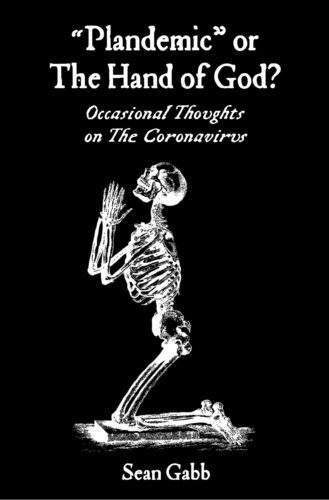
Sean Gabb recently published a collection of essays written during the lockdown for Wuhan Coronavirus. This excerpt is from the introduction to “Plandemic” or The Hand of God?:

My general argument is that the Coronavirus Panic should be divided under two headings. The first is the Virus itself as a medical fact and the immediate responses. The second is a set of changes already evident and sometimes advanced before the March of 2020, but that have now been greatly accelerated. Of these, the second is by far the more important. The first, even so, is of interest in its own right.

The Virus has not been all that we were told it would be. Last March, much of the world was ordered into indefinite lockdown on the grounds that we faced the greatest pandemic since the Spanish Flu of a century ago. For weeks in my own country, the BBC filled the television screens with statements by scared, sweating politicians, and lifted all restraint from its own hyperventilating staff. Now, as I write in the middle of September, we can be sure that it killed no more people than a seasonal influenza, and that most of its victims were very old or had been already weakened by some other condition. We can be sure it killed no more than seasonal influenza. Given the questionable definition of Coronavirus deaths, it may have killed many fewer.

I know that pandemic infections often come in several waves, and second waves can be more deadly than the first. But the second wave we are now said to be entering is evidenced by infections rather than deaths, and these infections are counted and published in ways more questionable than the counting and publishing of the earlier alleged deaths. I do not know what will have happened by Christmas. I suspect, however, that nothing much will have happened.

I have no fixed idea of what caused the panic. I am told that the Coronavirus was a bioweapon that escaped from a government laboratory. If it was, I can imagine that political leaders all across the world were taken aside by their own scientists, who were working on something similar, and told of the coming apocalypse. I lack the scientific understanding to judge the truth of this claim. But, if true, it would explain the panic. It would also justify the panic, so far as no one might have known for sure how infectious and how deadly this bioweapon was.

I am more inclined, though, to believe that the panic was a universal hysteria just waiting to be realised. The world at the beginning of this year was in a similar moral state to the world in 1914. There had been a generation of rising prosperity and of rising discontent. Some groups had benefitted out of proportion to their numbers and believed merit. If only relatively, others had fallen behind. Some believed the progress had not been fast enough, and that it could be hastened by various institutional changes, others that it was bad in its effects, and that it should be at least slowed. In 1914, all these discordant energies were channelled – both by deliberate policy and by popular enthusiasm – into a catastrophic war. This year, they found their outlet in the Coronavirus. Since I am making the same point, I might as well quote Marx:

    Hegel remarks somewhere that all great world-historic facts and personages appear, so to speak, twice. He forgot to add: the first time as tragedy, the second time as farce.

I will only add that, on the real stage of world affairs, farce is always preferable to tragedy. Facemasks are better than gasmasks. Better the statistical mirage of last spring than the genuine casualties of Verdun and the Somme.

September 20, 2020

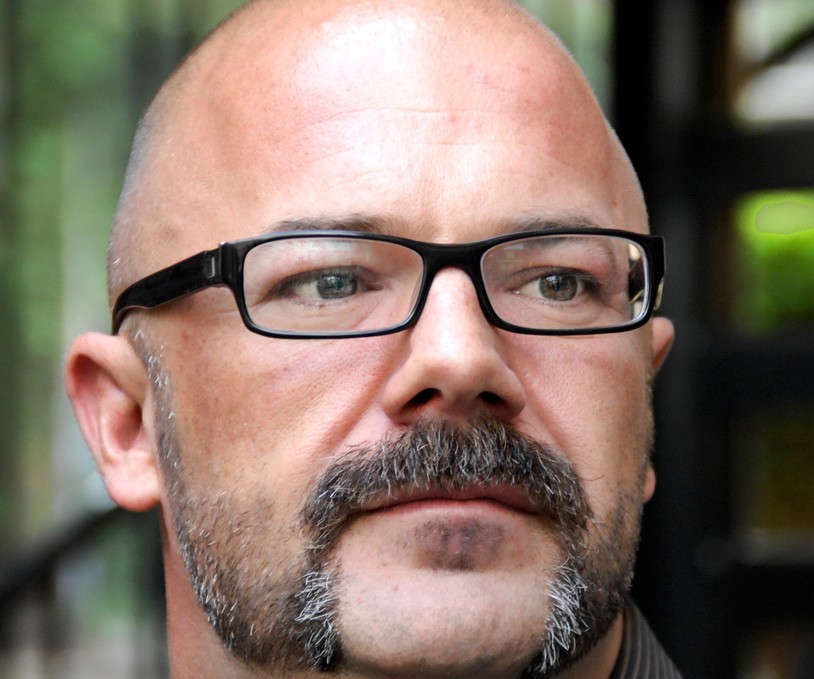
Andrew Sullivan on the politically deranging effects of social media addiction

Filed under: Media, Politics, Technology, USA — Tags: , , , , , — Nicholas @ 03:00

In his latest Weekly Dish installment, Andrew Sullivan decries the extreme polarization of the US electorate and points an accusing finger at social media for making things much worse:

An Electoral College victory for Trump, if he loses the popular vote again, would, in this new elite consensus, prove beyond doubt the centuries’ long grip of “white supremacy”. Some are already calling such a victory illegitimate, even though it would be completely constitutional, under the rules everyone has agreed to. The sickening street violence that the far left has downplayed, and permitted to run riot in major cities could be a mere taste of what is to come — along with ever-stronger white nationalist gangs instigating or responding in kind. (Trump’s toleration of this dangerous right-extremism in the past four years is as unforgivable as the left’s excuses for murderous violence.) But the upshot is the same: we will be lucky if the country doesn’t erupt in large-scale civil violence by the end of all this.

And the reason this dystopian scenario is so credible is not just the fault of these political actors. It’s ours too — thanks to the impact of social media. I think we’ve under-estimated just how deep the psychological damage has been in the Trump era — rewiring the minds of everyone, including your faithful correspondent, in ways that make democratic discourse harder and harder and harder to model. The new Netflix documentary, The Social Dilemma, is, for that reason, a true must-watch. It doesn’t say anything shockingly new, but it persuasively weaves together a whole bunch of points to reveal just how deeply and thoroughly fucked we are. Seriously, take a look.

The doc effectively shows how the information system necessary for democratic deliberation has, in effect, been jerry-rigged in the last decade to prevent any reasoning at all. It’s all about the feels, and the irrationality, and the moment, which is why Trump is so perfectly attuned to his time. And what’s smart about the documentary is that it shows no evil genius behind this unspooling, no sinister plot deliberately to destroy our system of government. One of the more basic motives in American life — making money — is all you now need, the documentary shows, to detonate American democracy at its foundation.

For Facebook and Google and Instagram and Twitter, the business goal quickly became maximizing and monetizing human attention via addictive dopamine hits. Attention, they meticulously found, is correlated with emotional intensity, outrage, shock and provocation. Give artificial intelligence this simple knowledge about what distracts and compels humans, let the algorithms do their work, and the profits snowball. The cumulative effect — and it’s always in the same incendiary direction — is mass detachment from reality, and immersion in tribal fever.

With each passing second online, news stories, graphic videos, incendiary quotes, and outrages demonstrate their stunning utility to advertisers as attention seizers, are endlessly tweaked and finessed by AI to be even more effective, and thereby prime our brains for more of the same. They literally restructure our minds. They pickle us in propaganda. They use sophisticated psychological models to trap, beguile, outrage, and prompt us to seek more of the same.

[…]

And online is increasingly where people live. My average screen time this past week was close to ten hours a day. Yes, a lot of that is work-related. But the idea that I have any real conscious life outside this virtual portal is delusional. And if you live in such a madhouse all the time, you will become mad. You don’t go down a rabbit-hole; your mind increasingly is the rabbit hole — rewired that way by algorithmic practice. And you cannot get out, unless you fight the algorithms to a draw, or manage to exert superhuman discipline and end social media use altogether.

But the thing about algorithms and artificial intelligence is that they don’t rest, they have no human flaws, they exploit every weakness we have, and have already taken over. This is not a future dystopia in which some kind of AI robot takes power and kills us all. It is a dystopia already here — burrowed into our minds, literally disabling the basic mental tools required for democracy to work at all.

If you watch video after video of excessive police force against suspects, for example, and your viewing habits are then reinforced by algorithms so you see no countervailing examples, your view about the prevalence of such excessive force will change, regardless of objective reality. A new study shows how this happens. Watching the videos, even more than reading text about them, raises the percentage of white liberals who believe the cops frequently or always use excessive force by around 20 percentage points. The actual data are irrelevant. The BLM movement this summer was less a racial reckoning, as we’re constantly lectured, than a moment of web-induced mass hysteria.

August 31, 2020

Michelle Remembers, the seminal Satanic Panic book

Filed under: Books, Cancon, History, Media, USA — Tags: , , , , , — Nicholas @ 03:00

Jen Gerson discusses the first modern Satanic Panic and the book about the “recovered” childhood memories of a British Columbia woman in the 1970s:

QAnon may sound like something that could only have birthed in the darker corners of the internet. But QAnon predates president Donald Trump and even the internet itself; It’s just the latest iteration of a moral panic that swept the highest levels of Western society only a generation ago. One of the most polarizing and divisive social movements in modern history; it destroyed families, turned communities against one another, and sent numerous innocent men and women to prison.

And it all started in Victoria, BC.

It was known as the Satanic Panic; a conspiracy theory that convinced millions of well meaning and rational people that a secret cabal of Satanists had infiltrated the highest echelons of society in order to sexually molest children. The Satanists were accused of sacrificing animals and using women as “breeders” to create an endless supply of dead babies for use in their gory, bloody-fuelled rituals and orgies.

It destroyed lives and ripped apart families. Reports of ritualistic child abuse were reported across the English speaking-world. Almost all of them were eventually found to have been partially, or wholly fabricated, but not before dozens of innocent people were falsely accused, and sentenced to years and even decades in prison.

Born of a genuine historical injustice — society’s neglect of childhood sexual abuse — this was a panic that saw some of the world’s smartest minds taken in by accusations, that, at their root, were as preposterous as any raised during medieval European witch hunts. It was legitimized by a professional class, captivated law enforcement and proved itself a lucrative grift for fraudsters and attention seekers. Worse, as the conspiracy grew under its own weight and influence, the hysteria inspired real and horrific crimes — usually by disturbed teenagers who claimed they were sacrificing humans to Satan.

This is a case study of how badly off the rails we can go when we allow our best intentions and passions to overwhelm us.

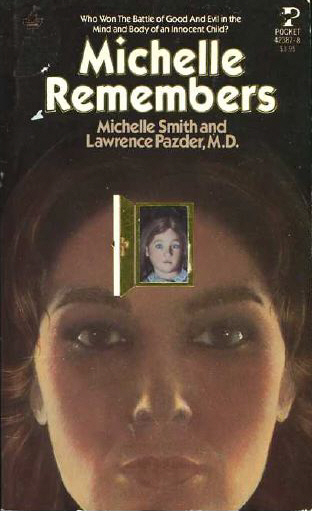
The story begins in 1980, with the publication of a book called Michelle Remembers. It detailed the fantastic claims of Michelle Proby, who recounted several months of gory and sadistic ritualistic abuse at the hands of a cabal of Satanists when she was a child in 1950s Victoria. The memories, she alleged, were repressed for decades, until she sought help from psychiatrist Lawrence Pazder. Under a state of hypnosis, Proby began to uncover a horrifying tale of murder, torture, abduction, and molestation. She claimed to have been taken from her willing family and groomed to take part in a ritual to call the devil — one in which she witnessed the murder of children, was forced to eat human remains, covered in dead baby parts, and locked in a cage with snakes.

An explosive bestseller. Michelle Remembers would become the folkloric template for countless other claims of Satanic Ritual Abuse ostensibly uncovered during therapy during the 80s and 90s.

July 14, 2020

QotD: The threat of galloping Karenism

Filed under: Government, Liberty, Quotations, USA — Tags: , , , — Nicholas @ 01:00

One of the least appealing aspects of the American character is the residual Puritanism that still compels a certain percentage of our countrymen, women and others, to nag, pester, and generally annoy the rest of us by trying to make us conform to their stick-up-the-Lieu vision of propriety. These people – these obnoxious Karens, for lack of a better FCC-compliant term – are delighted by the Chinese Bat Biter grippe and the opportunity it presents for them to try to impose their arbitrary will upon the rest of us. These mewling Mussolinis need to be slapped back, verbally if not physically, but as long as we are under this lockdown, they will not stop. They live for this, the chance to dictate to and control us, and the problem is some of them have positions of power.

This is yet another reason – as if the failure of the “We’re all gonna die!” model and the mass economic devastation the Twitter blue checks ignore were not reasons enough – that we need to be focusing on coming out of this Wuhan flu funk. If would be a pity if pangolin licking not only killed thousands of our most vulnerable citizens but also our will to resist petty tyrants who presume to scold us for such crimes as worshipping our God, seeing our families, and buying tomato seeds.

This is not to say that the Chinese coronavirus pandemic is fake or unserious, nor that we should ignore it and pretend that it’s just another flu. It is to say that there is more going on now than a respiratory ailment. There’s an economic ailment that most of us are painfully aware of, and there is a freedom ailment, where the Karens in everyday life and in the corridors or power are taking advantage of this crisis to let their fascist flag fly.

Kurt Schlichter, “The Rise of Karen-ism Means This Lockdown Nonsense Needs To End Soon”, Townhall.com, 2020-04-12.

July 5, 2020

With Christianity on its last legs, westerners seem to be looking for secular replacement beliefs

In Reason, John McWhorter discusses the pseudo-religious trappings of modern day Social Justice devotions:

Over the past several years, a social justice philosophy has arisen that is less a political program than a religion in all but name. Where Christianity calls for people to display their moral worth through faith in Jesus, modern Third-Wave Antiracism (henceforth TWA) calls for people to display their moral worth through opposition to racism. In the wake of the murder of George Floyd, this vision has increasingly been expressed through procedures, routines, and phraseology directly patterned on Abrahamic religion.

America certainly has work to do on race. For one, while racism does not explain why cops kill more black than white people — poverty makes all people more likely to be killed by the cops, hundreds of poor whites are killed annually, but more black people are poor — they harass and abuse black people more than white people, and the real-life impact of this is in its way just as pernicious as the disparity in killings would be. If the tension between black people and the cops were resolved, America’s race problem would quickly begin dissolving faster than it ever has. But making this happen will require work, as will ending the war on drugs, improving educational opportunities for all disadvantaged black children, and other efforts such as steering more black teenagers to vocational programs training them for solid careers without four years of college.

These are real things, upon which we must behold scenes like in Bethesda, where protesters kneeled on the pavement in droves, chanting allegiance with upraised hands to a series of anti-white privilege tenets incanted by what a naïve anthropologist would recognize as a flock’s pastor. On a similar occasion, white protesters bowed down in front of black people standing in attendance. In Cary, North Carolina, whites washed black protesters’ feet as a symbol of subservience and sympathy. Elsewhere, when a group of white activists painted whip scars upon themselves in sympathy with black America’s past, many black protesters found it a bit much.

Such rituals of subservience and self-mortification parallel devout Christianity in an especially graphic way, but other episodes tell the same story. Many conventional religious institutions are now rejecting actual Christianity where it conflicts with TWA teachings. At the Massachusetts Institute of Technology, a chaplain was forced to resign after writing a note exploring the contradiction between roasting the police as racist and the Christian call for love of all souls. Unitarianism has been all but taken over in many places by modern antiracist theology, forcing the resignation of various ministers and other figures.

The new faith also manifests itself in objections to what its adherents process as dissent. A friend wrote on Facebook that they agreed with Black Lives Matter, only to have another person — a white one, for the record — post this reply: “Wait a minute! You ‘agree’ with them? That implies you get to disagree with them! That’s like saying you ‘agree’ with the law of gravity! You as a white person don’t get to ‘agree’ OR ‘disagree’ when black people assert something! Saying you ‘agree’ with them is every bit as arrogant as disputing them! This isn’t an intellectual exercise! This is their lives on the line!”

This objection seems studiously hostile until we compare it to how a devout Christian might feel about someone opining that he “agrees” with Jesus’ teachings, as if the custom were to think one’s way through the liturgy in logical fashion and decide what parts of it makes sense, rather than to suspend logic and have faith.

The religious analogies pile higher by the week.

July 3, 2020

Back to the Future Middle Ages

At Spiked, Dominic Frisby takes us back to a time when today’s progressive temper tantrums would fit in perfectly with accepted behaviours of the age … the Middle Ages:

A social media heretic faces trial

How much of what went on in the Middle Ages and early-modern periods do we look back on with abhorrence and a certain amount of perplexity? Burning witches at the stake, lynch mobs, self-flagellation – what possessed people to do such things, we wonder.

But take a step back, look about and you see many of these practices are still flourishing today, though they go by different names.

Here are just some of them.

Let’s start with excommunication. Excommunication meant so much more than being banned from taking communion. It involved you being shunned, shamed, spiritually condemned, even banished. Only through some kind of heavy penance – often a very public, lengthy and humiliating contrition – could you and your reputation be redeemed.

Excommunication became a powerful political weapon. It was dished out to enemies of the faith to destroy their legitimacy. Often it was used as a punishment for sins as minor as uttering the wrong opinion.

What are No Platforming and cancel culture if not a modern form of excommunication? Qualified, competent professionals are hounded out of their jobs and publicly shamed just for uttering the wrong opinion, often simply for a misjudged choice of words. Even just the wrong pronouns.

As often as not, their employer wants a quiet life, so he bows to activist pressure and sacks the target of the witch hunt. Cancel culture is excommunication.

Today’s religions, however, are not the many sects of Christianity that once perforated Europe, but climate change, education, the NHS, gay rights, trans rights, the European Union and multiculturalism. Even coronavirus and the lockdown have become sacrosanct.

Intellectuals of the right and left, from Polly Toynbee to Nigel Lawson, have described the NHS as Britain’s religion. It has replaced the Virgin Mary as the divine matriarch. Why this worship? I suggest it goes back to the late 19th and early 20th centuries, when the state began to replace the church as the main provider of education, welfare and healthcare. After 1945, it was just a matter of time before the welfare state achieved altar status.

June 11, 2020

In 1929, the warning sign was getting stock tips from shoeshine boys and elevator operators

Filed under: Business, Economics, History — Tags: , , , , — Nicholas @ 05:00

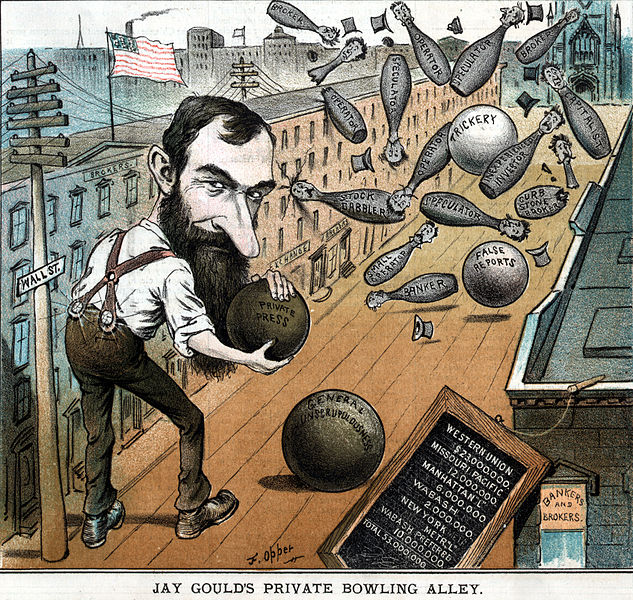
In 2020, as Jay Currie suggests, the warning sign might be robinhood.com:

“Jay Gould’s Private Bowling Alley.” Financier and stock speculator Jay Gould is depicted on Wall Street, using bowling balls titled “trickery,” “false reports,” “private press” and “general unscrupulousness” to knock down bowling pins labeled as “operator,” “broker,” “banker,” “inexperienced investor,” etc. A slate shows Gould’s controlling holdings in various corporations, including Western Union, Missouri Pacific Railroad, and the Wabash Railroad.
From the cover of Puck magazine Vol. XI, No 264 via Wikimedia Commons.

In the winter of 1928 Joe Kennedy, father of JFK and major stock market player, stopped to get his shoes shined. The shoeshine boy leaned in and said, “Buy Hindenburg”. Kennedy began unwinding his positions saying, “You know it’s time to sell when shoeshine boys give you stock tips. This bull market is over.”

I had a similar experience in late 1999 when a friend took out a mortgage on her condo to buy shares in the billion dollar online copy paper empire. She had a perfectly good job in retail garden supplies. Remembering Kennedy, I advised another friend that her Nortel was looking a bit overbought. As it happened she sold quite near the peak.

The 2020 equivalent of the shoeshine boy is the perfect storm is the free trading platform, robinhood.com. This is a nicely designed site where you can trade shares on your computer or phone. It has become very, very popular with younger, new investors. My late 1990’s day trading pals would have killed for this sort of interface and no brokers fees. It has spawned a whole host of reddit chats, twitter streams and countless YouTube videos on the excitement of swing trading. (One fun spot to watch Robinhood is the https://robintrack.net/leaderboard which shows which stocks the people on Robinhood are buying. It is a bit slow and buggy but a great front row seat.)

What is striking about the robinhood.com world is that it revolves around trading rather than any sort of “investing”. You hop into APPL in the morning, see if you can make a couple of bucks by noon and move onto the next thing. And Apple is a real, solvent, company.

Robinhood has been in the news recently because the herd has charged into the shares of a number of companies which are either in or near bankruptcy. Hertz Rent-a-Car dropped from $20 to $0.50 in three months as the market realized that with no travelers there would be no car rentals. Interestingly, we learn from robintrack.net that at $20 there were a little over 1000 users holding, as Hertz crashed the Robinhood users piled in, at $0.55 there were 44,000 and there are now 158,000. And many will have made money, lots of money, trading the gyrating price from $0.50 to back up to $5.00.

In the run up to the crash of October 1929, long after Joe Kennedy had pulled his money from the market, retail traders were coining it trading the “swings” on margin accounts. It didn’t matter what the company actually did, it was going up. The same “irrational exuberance” was a big feature in the dot com bubble.

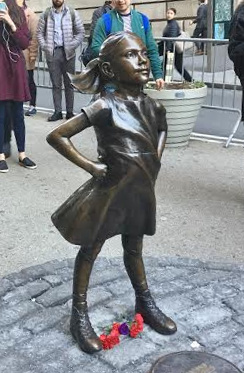
The “Fearless Girl” statue faces the Arturo Di Modica “Charging Bull” on Wall Street (Wikipedia)

The lessons of the 1929 crash and the 2000 dot com bust were simple – get out early and be in no hurry to get back in. Right now the dinosaurs like Buffet and Ichan are sitting on stacks of cash. Just like Joe Kennedy was when Wall Street swan dived in October 1929. They got that cash by selling their shares to shoeshine boys and the bright lights at Robinhood.

April 29, 2020

QotD: “Ethical” ways to prevent scientific progress

Filed under: Bureaucracy, Health, Politics, Quotations, Science — Tags: , , , — Nicholas @ 01:00

The stigmatization of science is also jeopardizing the progress of science itself. Today anyone who wants to do research on human beings, even an interview on political opinions or a questionnaire about irregular verbs, must prove to a committee that he or she is not Josef Mengele. Though research subjects obviously must be protected from exploitation and harm, the institutional-review bureaucracy has swollen far beyond this mission. Its critics have pointed out that it has become a menace to free speech, a weapon that fanatics can use to shut up people whose opinions they don’t like, and a red-tape dispenser that bogs down research while failing to protect, and sometimes harming, patients and research subjects. Jonathan Moss, a medical researcher who had developed a new class of drugs and was drafted into chairing the research-review board at the University of Chicago, said in a convocation address, “I ask you to consider three medical miracles we take for granted: X-rays, cardiac catheterization, and general anesthesia. I contend all three would be stillborn if we tried to deliver them in 2005.” The same observation has been made about insulin, burn treatments, and other lifesavers.

The hobbling of research is not just a symptom of bureaucratic mission creep. It is actually rationalized by many bioethicists. These theoreticians think up reasons that informed and consenting adults should be forbidden to take part in treatments that help them and others while harming no one. They use nebulous rubrics like “dignity,” “sacredness,” and “social justice.” They try to sow panic about advances in biomedical research with far-fetched analogies to nuclear weapons and Nazi atrocities, science-fiction dystopias like Brave New World and Gattaca, and freak-show scenarios like armies of cloned Hitlers, people selling their eyeballs on eBay, and warehouses of zombies to supply people with spare organs. The University of Oxford philosopher Julian Savulescu has exposed the low standards of reasoning behind these arguments and has pointed out why “bioethical” obstructionism can be unethical: “To delay by 1 year the development of a treatment that cures a lethal disease that kills 100,000 people per year is to be responsible for the deaths of those 100,000 people, even if you never see them.”

Steven Pinker, “The Intellectual War on Science”, Chronicle of Higher Education, 2018-02-13.

April 8, 2020

If the Wuhan Coronavirus panic feels oddly familiar … there’s a good reason for it

Warren Meyer explains why his skepticism about the dangers of the Wuhan Coronavirus epidemic kicked in quickly because it followed a very familiar pattern:

I have been skeptical about extreme global warming and climate change forecasts, but those were informed by my knowledge of physics and dynamic systems (e.g. feedback mechanics). I have been immensely skeptical of Elon Musk, but again that skepticism has been informed by domain knowledge (e.g. engineering in the case of the hyperloop and business strategy in the case of SolarCity and Tesla). But I have no domain knowledge that is at all relevant to disease transfer and pathology. So why was I immediately skeptical when, for example, the governor of Texas was told by “experts” that a million persons would die in Texas if a lock-down order was not issued?

I think the reason for my skepticism was pattern recognition — I saw a lot of elements in COVID-19 modelling and responses that appeared really similar to what I thought were the most questionable aspects of climate science. For example:

  • We seem to have a sorting process of “experts” that selects for only the most extreme. We start any such question, such as forecasting disease death rates or global temperature increases, with a wide range of opinion among people with domain knowledge. When presented with a range of possible outcomes, the media’s incentives generally push it to present the most extreme. So if five folks say 100,000 might die and one person says a million, the media will feature the latter person as their “expert” and tell the public “up to a million expected to die.” After this new “expert” is repetitively featured in the media, that person becomes the go-to expert for politicians, as politicians want to be seen by the public to be using “experts” the public recognizes as “experts.”
  • Computer models are converted from tools to project out the implications of a certain set of starting hypotheses and assumptions into “facts” in and of themselves. They are treated as having a reality, and a certainty, that actually exceeds that of their inputs (a scientific absurdity but a media reality I have observed so many times I gave it the name “data-washing”). Never are the key assumptions that drive the model’s behavior ever disclosed along with the model results. Rather than go on forever on this topic, I will refer you to my earlier article.
  • Defenders of alarmist projections cloak themselves in a mantle of being pro-science. Their discussions of the topic tend to by science-y without being scientific. They tend to understand one aspect of the science — exponential growth in viruses or tipping points in systems dominated by positive feedback. But they don’t really understand it — for example, what is interesting about exponential growth is not the math of its growth, but what stops the growth from being infinite. Why doesn’t a bacteria culture grow to the mass of the Earth, or nuclear fission continue until all the fuel is used up? We are going to have a lot of problem with this after COVID-19. People will want to attribute the end of the exponential growth to lock-downs and distancing, but it’s hard to really make this analysis without understanding at what point — and there is a point — the virus’s growth would have turned down anyway.
  • Alarmists who claim to be anti-science have a tendency to insist on “solutions” that have absolutely no basis in science, or even ones that science has proven to be utterly bankrupt. Ethanol and wind power likely do little to reduce CO2 emissions and may make them worse, yet we spend billions on them as taxpayers. And don’t get me started on plastic bag and straw bans. I am willing to cut COVID-19 responses a little more slack because we don’t have the time to do elaborate studies. But just don’t tell me lockdown orders are science — they are guesses as to the correct response. I live in Phoenix where it was sunny and 80F this weekend. We are on lockdown in our houses. I could argue that ordering everyone out into the natural disinfectant of heat and sunlight for 2 hours a day is as effective a response as forcing families into their houses (initial data, though it is sketchy, of limited transfer of the virus in summertime Australia is interesting — only a small portion of cases are from community transfer. By comparison less than a half percent of US cases from travel).

March 27, 2020

Sensible risk management is not compatible with the “precautionary principle”

Filed under: Government, Health — Tags: , , , , , — Nicholas @ 03:00

David Zaruk wrote last week for Science 2.0 Europe:

Two decades of the precautionary principle as the key policy tool for managing uncertainties has neutered risk management capacities by offering, as the only approach, the systematic removal of any exposure to any hazard. As the risk-averse precautionary mindset cements itself, more and more of us have become passive docilians waiting to be nannied. We no longer trust and are no longer trusted with risk-benefit choices as we are channelled down over-engineered preventative paths. While it is important to reduce exposure to risks, our excessively-protective risk managers have, in their zeal, removed our capacity to manage risks ourselves. Precaution over information, safety over autonomy, dictation over accountability.

  • Whatever happened to “Keep out of reach of children”? Now we cannot be trusted and all products must be child-safe.
  • Whatever happened to “Handle with care”? Now safety by design has removed the need for individuals to exercise common sense or risk reduction measures.
  • Whatever happened to trust? Now individuals are no longer left with the capacity to make their own decisions in managing personal risks.

These are good things” precaution advocates would retort “since people often make mistakes and bad things can better be prevented!”. While continuous improvement of safety systems has its value, the bigger the fences, the less autonomously the individuals will react (creating a society of docile followers). The precautionary approach implies a lack of trust in individuals’ capacities to make their own (rational) choices. The over-engineered risk-management process would remove any situation where choices could be made. Fine for cases where there are no trade-offs, disruptions or loss of benefits (when the sheep have plenty of grass in their field), but in times of crisis (exposure to hazards), when precaution is your only tool, then sacrifice is the only solution.

[…]

When the public now sees everything of modern life (work, school, public events …) cancelled in a knee-jerk precautionary impulse, is it any wonder they are panicking? Enter the opportunist to sell you the silver solution or the naturopath detox remedy to put your mind at ease. Enter the quack to tell you to drink bleach. Enter the racist who will use the fear to mobilise outrage. Exit rationality and risk management.

With no bullets left in the risk-management gun, the only thing left to do is run … or as it is more commonly called: apply the precautionary principle. Precaution should only be applied after other risk management measures have failed but given how horribly inadequate our capacities to govern have become, it is the only strategy our regulators have come to know.

Slide from a presentation by Patti Gettinger, 2011-07-11.
Original slideshow at https://fr.slideshare.net/regsgridlock/the-precautionary-principle-8656034

H/T to Johnathan Pearce for the link.

March 18, 2020

What is really driving the Wuhan Coronavirus panic

Filed under: China, Europe, Health, Media, Politics, USA — Tags: , , , , , — Nicholas @ 05:00

… besides the wall-to-wall hysteria in the mainstream media, I mean. Severian discusses the insights of “perverted old cokehead” Sigmund Freud on anxiety and its effects, then segues to our current, shared, plight:

Photographic portrait of Sigmund Freud, signed by the sitter (“Prof. Sigmund Freud”) by Max Halberstadt (c. 1921)
Wikimedia Commons

Everyone who has thought about it for five minutes knows that something’s not right. […] As y’all have noted, actual hard information on the coronavirus is hard to come by. Is it fully air-transmissible? What are the infection rates? Hell, what are the death totals? And speaking of the death totals, even if you trust China’s figures (which no reasonable person can possibly do), they seem … low. Like, really low. I actually trust Italy’s government to deliver some vague approximation of the truth, and even there, where they’re in full-blown freakout mode, it seems to kill off old folks with compromised immune systems and lung problems at a fractionally higher rate than your garden-variety flu.

So, you know … it’s the flu. Not great by any means, and more infectious (possibly) than some other flus in our recent past, but for all that just the flu. The ongoing sky-is-falling global freakout has next to nothing to do with the actual bug. We live in a deeply anxious age, and that anxiety has to discharge somehow. It’s global hysteria — classic hysteria, Freudian hysteria, an excess of stress that must be discharged by “converting” it into behavior.

The people who are freaking out about it aren’t worried about dying from it. No, really, they’re not. Nor should they be — no reasonably healthy person under age 70 has any reason to be worried about that. Instead, what they’re worried about is powerlessness. We’ve all long suspected that we’re ruled by idiots and grifters. We’ve all long sensed that our “leaders” hold us in deep contempt. And we’ve long known that none of our problems are worth anything to the global pirate capitalist class. The only reason those bastards care if we all drop dead from the plague is that they can’t sell enough iCrap to each other to keep the company stock price up.

We know this. But we can’t say it, and we can’t act on it, because doing so goes against our self-image. Our media, our education system, our “culture” (such as it is) has spent the last half-century telling us what special and unique snowflakes we all are, even as it’s forcing us into ever-greater conformity. We’ve broken all the taboos, transgressed all the boundaries, liberated all the oppressed. If there ever were to be such a thing as “social justice,” then truly we’ve achieved it, here in this best of all possible worlds where you can lose your job for not addressing your co-worker as a wingless golden-skinned dragonkin and 6’2″ dudes with beards down to their collarbones can go wee-wee in the little girls’ room …

… and yet. And yet. And yet feminists (just to stick with a theme), despite running everything for the last 30 years, still can’t get that lousy 25 cent raise. Seven out of every five college girls are sexually assaulted the minute they step on campus, despite boys being as rare as sasquatches on most campuses (and despite the ever-growing clamor for free college for everyone). You’re free to — hell, you’re practically required to — make up your own pronouns, but you’re not allowed to ask just how a degree in “gender studies” could be worth even one dollar in student loan debt, let alone one hundred thousand dollars. We keep agitating for change, keep voting for it, keep tweeting about it … and nothing happens.

That profound sense of powerlessness is exactly, and I do mean exactly, what screwed up Anna O. She hated her father for not allowing her any personal agency. In her heart of hearts she wanted him dead. And yet she knew herself to be a loving daughter, so that overwhelming sense of relief — indeed, of joy — she felt when he kicked the bucket sent her around the bend.

March 3, 2020

The bottled water and toilet paper hoarders of 2020

Filed under: Economics, Health, Media — Tags: , , — Nicholas @ 03:00

Arthur Chrenkoff on one of the oddest features of the current infectious disease panic:

“sold out of bottled water?” by Klara Kim is licensed under CC BY-NC-SA 2.0

This is happening alright, and it’s not some isolated incidents; on my Facebook news feed, at least half a dozen posts from friends in Sydney and Brisbane display photos of Venezuela-style empty shelves at their local supermarkets. The fear is real, and so is the hoarding.

OK, I can understand face masks and hand sanitisers walking off the shelves, as these are the crucial tools in containing the spread of the pandemic. Most face masks – as with so many other products in our shops – are made in China and in the current crisis conditions any new and additional supplies won’t make it out of the country, so whatever is already here is it. And it isn’t, as masks have been the first item to disappear from retail outlets from your local pharmacy to a Bunnings store.

I can also understand the non-perishable food supplies. Even though Australia could be quite self-sufficient if need be (minus the out of season imported fruit and veg), possibly people are stocking up not so much in fear the food will run out but out of reluctance to go out in the public in a few weeks’ time should the situation really turn into a zombie apocalypse. In any case, there is nothing wrong with having a well stocked pantry.

Where I start to no longer understand the consumers is bottled water. We are fortunate to live in a developed country where one can safely drink from a tap. There won’t be shortages of drinkable water under any circumstances – except for a complete societal collapse – and coronavirus is not a water-borne pathogen like those causing cholera or typhoid. If you are still paranoid, you can boil your water before ingesting (just make sure you cool it down).

But it’s the toilet paper that really gets me. Trust me, if things go really belly up, toilet paper is the least of your worries. Humanity has survived for tens of millennia without sanitary tissues, and in their absence any paper or rag or even running water will substitute nicely. Food, water, medicines, electricity, to name just four, are much more crucial in a time of crisis or emergency. Again, it’s true that a lot of toilet paper is manufactured in China or generally overseas and so potentially susceptible to shortages if manufacturing and international transport are affected as they are already. But how much toilet paper does your household require to function? Are you expecting you might need the iron rations of your favourite rolls to last for at least a few months? And if you think that you might not be able to restock on toilet paper until later this year, then – let me repeat myself – don’t you think you will have much bigger problems with ensuring your continuing survival to worry about?

As Norman Lewis points out, the worst hysterics are among the “elites”, not us lumpenproles:

Last week, the world stock markets suffered their worst week since the financial crisis in 2008, with $6 trillion wiped from shares and, in some markets, a sell-off at a rate not seen since the Great Depression almost a century ago. Why? Because global investors are in a panic about the potential economic fallout from the coronavirus epidemic.

Many commentators are making the point that this is mad. Ross Clark argues convincingly in the Spectator that the “most dangerous thing about coronavirus is the hysteria”. Philip Aldrick, economics editor of The Times, agrees. He says it is the “panic we should fear more than the virus itself”.

Our appetite for doom and fear of the unknown are offered as explanations for this behaviour. Risk culture and a predisposition to overreacting to threats are also certainly components of what is happening. But there is another equally important element linked to these that is not being raised – that this madness is not being driven by the “low-information”, knuckle-dragging, gullible ignorant masses, but by the information-rich, university-educated and refined global business and government elites.

The contrast between the responses to coronavirus from the elites and ordinary people has been stark. Even as the level of panic in the mainstream reporting around coronavirus has risen, ordinary people have just gotten on with their lives. The supposedly well-informed elites, who often accuse the “dumb” masses of being vulnerable to hysteria and “fake news”, have themselves been prodded into panic. Meanwhile, where they are not in lockdowns, ordinary people are still going to work, commuting, going to bars … They’re simply getting on with their lives, while taking note of the potential risks.

The elites are in free-falling panic; like a herd of wildebeest, panicked by the sight of a predator and rushing blindly across crocodile-infested waters, they have sparked a potential global economic meltdown. Meanwhile, we see stoic common sense, simple but profound wisdom, on the part of the “great unwashed”.

January 22, 2020

Australian tourism, RIP

Filed under: Australia, Environment, Media — Tags: , , , , , , — Nicholas @ 05:00

As we’ve all been inundated with the shocking images of almost the entire inhabited area of the Australian mainland burning, like this one, for example, claimed on social media to be a “satellite image”:

… it’s not surprising that anecdotal evidence of the decline in bookings from foreign tourists implies that there will be few visitors to the burned-out wasteland that used to be a thriving first-world nation. This, on top of the widely reported “death” of the Great Barrier Reef, means the few dozen dazed survivors will be reduced to cannibalism shortly. Or, as Arthur Chrenkoff suggests, we’ve been sold another bill of goods and things are not quite as desolate and post-apocalyptic as all that:

Just like many other people I know, I have been inundated by messages from family and friends overseas, inquiring about my safety, having been terrified by the media reports of what seemed like an environmental armageddon engulfing the entire country. I had to explain time after time that while the fires have been savage and extensive, they have largely burned through relatively sparsely populated areas (if it all, considering the vast extent of our national parks). No significant town has been threatened and destruction and loss of life, while tragic, have been pretty small in proportion to the area affected.

Yet, watching the hysterical and over-sensationalised coverage overseas has convinced many that the very existence of the nation is at stake. And the social media, if anything, has been even worse, with a number of completely misleading maps and photos exaggerating the extent of the affected areas by two-figure factors. As I pointed out, indeed the area the size of the state of Kentucky has been burned out, but unlike most other places on Earth, certainly in the developed world, Australia fits in nearly eighty Kentuckys, most of them pretty empty of human presence and activity.

Media sensationalises at the best of times in a never-ending quest for more eyeballs (“if it bleeds it leads”, or, in this case, “if it’s on fire, we’re on fire”) but the intersection of a large scale natural disaster with the “climate crisis” activism has generated a truly terrifying inferno of human passions where news becomes propaganda and the narrative trumps the objectivity. A significant proportion of the population — and the majority in the media — want to see the fires as Gaia’s wrath, with the disaster turning into green porn to terrify, titillate and agitate. Tourism has now become one of the casualties of this rhetorical excess, a collateral damage to the pursuit of a political agenda. This crisis is very much man-made and the economic pain unnecessarily inflicted on a whole industry because you wanted to make as terrible a point as possible will hang around your necks like a charred albatross, dear green activists on the streets and those masquerading as journalists.

The Green Wattle Creek bushfire moves towards the Southern Highlands township of Yanderra as police evacuate residents from Yanderra Road, 21 December, 2019.
Photo by Helitak430 via Wikimedia Commons

« Newer PostsOlder Posts »

Powered by WordPress