Forgotten Weapons
Published on 1 Jun 2014http://www.forgottenweapons.com
Theme music by Dylan Benson – http://dbproductioncompany.webs.com
The M6 Gun Motor Carriage was the first American tank destroyer of WWII – a 37mm antitank gun (basically identical to the M3 gun) mounted on the back of a Dodge 3/4 ton weapons carrier. A large armor shield protected the gun crew from small arms fire, but the vehicle was otherwise highly exposed. The truck was powered by a flathead 6-cylinder engine producing 99 horsepower, and had a top speed of 55 mph. The gun was effective and modern in the late 1930s when its design process began, but was underpowered and insufficient by the time the M6 first saw action in 1942/3 in Tunisia.
Not many complete M6 carriages remain in existence today, as they were replaced quickly after their poor showing in North Africa. Most had the guns removed and were converted back into utility trucks, while some were used by the Free French forces and some saw use in the Pacific theater (where the underpowered gun was less of a concern).
June 19, 2019
37mm Antitank Gun on a Dodge Weapons Carrier – M6
June 13, 2019
Shooting the MG-34 and MG-42
Forgotten Weapons
Published on 11 May 2014Cool Forgotten Weapons Merch! http://shop.bbtv.com/collections/forg…
Theme music by Dylan Benson – http://dbproductioncompany.webs.com
The MG-34 and MG-42 machine guns were the mainstay of German infantry (and vehicle) firepower during World War II, and it will take several videos to properly cover them. For now, we are shooting them both, and explaining how to load, unload, and operate them (including changing barrels on the MG42). Enjoy!
June 7, 2019
Bren Gun at the Range
Forgotten Weapons
Published on 23 Aug 2011We take a 1940 Bren gun to the range to demonstrate function, disassembly, and shooting from a variety of positions. For more information, check out http://www.ForgottenWeapons.com .
June 4, 2019
Original Vietnam-Era M60 at the Range
Forgotten Weapons
Published on 27 Apr 2019http://www.patreon.com/ForgottenWeapons
Cool Forgotten Weapons merch! http://shop.bbtv.com/collections/forg…
The M60 was the first modern American military machine gun, developed from the operating system of the German FG-42 and the feed system of the German MG-42 in the years after World War Two. It has a rather schizophrenic reputation, being loved by many who used it in Vietnam and hated by many who used it later in its service life. The design had some fundamental flaws, but did offer a far more mobile base of fire than the M1919A6 that it replaced. Today, I am going to do a bit of shooting with an original Vietnam pattens M60, which will act as a baseline for future videos covering the various improvements and modernizations of the platform.
Thanks to the Institute of Military Technology (https://www.instmiltech.com) for giving me the opportunity to bring this M60 on camera for you!
Contact:
Forgotten Weapons
PO Box 87647
Tucson, AZ 85754
June 1, 2019
Viper MkI: A Simplified Steampunk Sten
Forgotten Weapons
Published on 26 Apr 2019http://www.patreon.com/ForgottenWeapons
Cool Forgotten Weapons merch! http://shop.bbtv.com/collections/forg…
The Viper Mk I was an experimental submachine gun developed in the UK for use by military policemen in post-WW2 occupation West Germany. It was a simplified Sten gun (full-auto only, without the semiauto option normally included in the Sten trigger mechanism) put into a wooden housing. It was intended to be carried slung over one shouldered [and] fired under the arm with just one hand. To this end, it had neither sights nor trigger guard. The whole concept seems pretty questionable, and while multiple different Viper submachine guns were designed to fill this role, none were ever adopted.
Many thanks to the Royal Armouries for allowing me to film and disassemble this very rare weapon! The NFC collection there – perhaps the best military small arms collection in Western Europe – is available by appointment to researchers:
https://royalarmouries.org/research/n…
You can browse the various Armouries collections online here:
https://royalarmouries.org/collection/
Contact:
Forgotten Weapons
PO Box 87647
Tucson, AZ 85754
Experimental screen capture for social media thumbnailing purposes:
May 28, 2019
Rumours of a pending gun ban fuel panic buying at Canadian gun stores
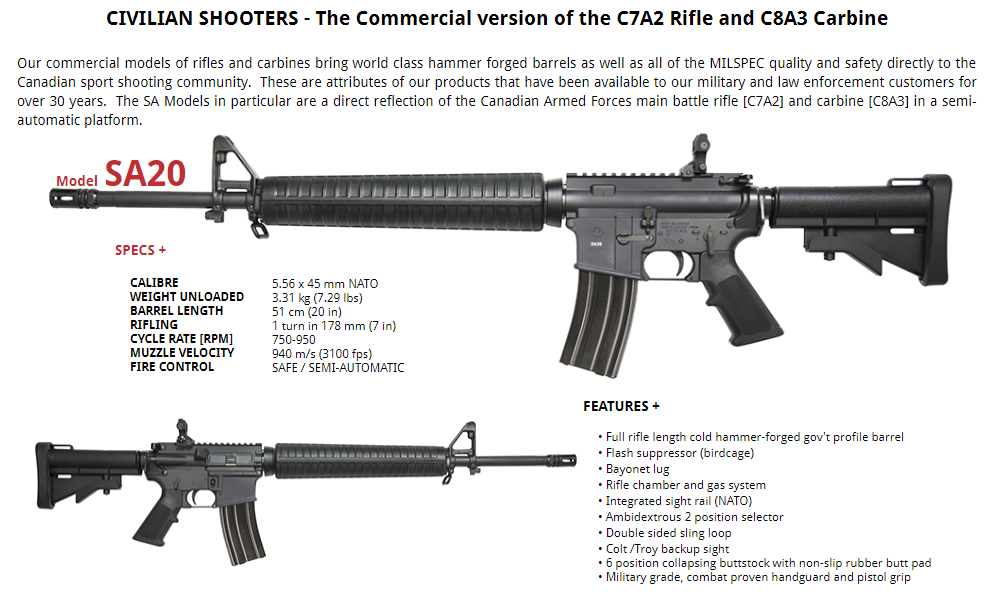
During the Obama years in the US, fears of new government restrictions on firearms helped create a booming market for firearms and the same thing is happening here in Canada as the Trudeau government is said to be contemplating some draconian revisions to existing gun laws, especially for handguns and AR-15 style semi-automatic weapons:

Colt Canada’s model SA20, a commercial version of the Canadian C7A2 rifle.
Image from the Colt Canada website.
Federally licensed sport shooters are snapping up $3,000 guns on concern Prime Minister Justin Trudeau will ban new sales to win votes in the October election.
The website of Firearms Outlet Canada showed all AR-15s “Out of Stock” today at 3 p.m. in Toronto. At Al Flaherty’s Outdoor Store, all but 2 of the 17 versions offered online were “Sold Out.” The website of Wolverine Supplies said most are “Out of Stock.”
The Ontario and Manitoba companies are among the biggest independent gun shops in Canada.
“We are completely sold out of AR-15s, AGAIN…except for what’s on consignment,” Select Shooting Supplies in Cambridge, Ontario, said today on Twitter.
[…]
All guns are banned already for everyone who doesn’t have a firearm licence authorized by the federal police.
Anyone who buys, sells, owns or travels with a firearm in Canada is severely restricted by law. They must pass courses, tests, background checks, reference checks and obtain spousal approval to get police permission for a licence. They must disclose breakups and job losses.
More Controls
People who own AR-15s and handguns endure even more controls.
They need special police permission to buy each gun or to take one to another province. They can go to prison for having a standard-capacity AR-15 ammunition magazine, for shooting anywhere besides one of the 1,400 government-approved target ranges, or for taking a detour on the way to the range.
As we all know, crime involving weapons — especially firearms — is widely reported in the media, and many Canadians seem to have the belief that the majority of these criminals are somehow going to be deterred from using firearms if we just pass one more law. Urban Canadians generally have little or no contact with legal gun owners, and tend to assume that gun crime is directly linked to legal guns (often through the totally nonsensical “gun show loophole” that doesn’t exist in Canada).
H/T to Blazing Cat Fur for the link.
May 22, 2019
Hotchkiss 1914: A French and American WWI Heavy MG
Forgotten Weapons
Published on 19 Apr 2019This Hotchkiss machine gun and its tripod are lot #2027 in the upcoming April 2019 Morphy auction:
https://www.forgottenweapons.com/hotc…
The gun that became the Hotchkiss 1914 and served as the bulwark of French and American forces in World War One was actually first designed and patented by an Austrian officer; Adolph von Odkolek. He took his idea to the Hotchkiss company in Paris hoping to arrange for them to produce it under license. The design was inspected by Laurence Benet (chief engineer at Hotchkiss) and Henri Mercie (Benet’s assistant), and they concluded that the gun was not suitable for production. However, the core concept in the patent – Odkolek’s gas piston system – was a worthy one and would allow production of machine guns to compete with Maxim and Colt without violating their existing patents. So Benet arranged to simply buy the patent outright for a flat fee, and then Hotchkiss set about redesigning the gun to be much better.
The result was the model 1897, an air-cooled, strip-fed heavy machine gun that was sold to many different nations. It was improved in 1900, and between the two models sales were made to Japan, Mexico, Chile, Brazil, China, Spain, Ethiopia, Finland, Greece, Guatemala, Luxembough, Norway, Sweden, Turkey, Portugal, and Venezuela in a variety of calibers. The French government also purchased some Hotchkiss guns, primarily for colonial use. For the bulk of the metropolitan army, France opted to design its own gun in the state arsenals (which was the Modele 1907 St Etienne gun; which is suspiciously like a Hotchkiss with the operating direction of the parts reversed to avoid patent infringement).
When World War One broke out, and the need for vast quantities of machine guns became apparent, the Hotchkiss was finally adopted on a large scale by France. The commercial 1900 pattern was revised slightly (a better barrel-locking system and replacement of the shoulder stock with a D-ring rear handle) and some 45,000 would be produced by 1918. The Hotchkiss would supplant the 1907 St Etienne over the course of the war, as it was a more reliable and less expensive design. It would go on to serve the French military through the end of World War Two, gaining a reputation as a gun of unparalleled simplicity and reliability.
http://www.patreon.com/ForgottenWeapons
Cool Forgotten Weapons merch! http://shop.bbtv.com/collections/forg…
Contact:
Forgotten Weapons
PO Box 87647
Tucson, AZ 85754
May 19, 2019
Samuel Pauly Invents the Cartridge in 1812
Forgotten Weapons
Published on 4 May 2019(Video reuploaded to removed an allegedly copyrighted still image)
This Pauly shotgun (lot #1346) sold at Morphy’s April 2019 auction for $5,535.
Samuel Johannes Pauli was born outside Bern, Switzerland in 1766, and became an engineer of wide interests. Among them were bridge design, passenger-carrying balloons (he would work seriously on a 15-20 passenger balloon service between London and Paris later in life), and firearms. Only a few years after Forsyth’s invention of fulminate priming, Pauly would become the first to use it in a fully self-contained cartridge. He patented this invention in Paris in 1812, having moved there in 1802 in pursuit of financing for his many grand projects (going then by the name Jean Samuel Pauly).
Pauly’s cartridge was a multi-part affair with a rimmed brass base containing a fulminate powder, connected to a paper or cardboard cartridge body which held a charge of regular gunpowder and the shot or ball to be fired. It was an expensive system, but contained all the necessary elements of a modern cartridge.
Pauly would move to England in 1814 (then taking the name Samuel John Pauly) in pursuit of aviation inventions, although he continued to tinker on his firearms design and filed two additional patent improvements. He died in London in 1821, and his name and work became rather obscure. His former apprentices would carry on his legacy in their own work – Nicolaus Dreyse would produce the needle fire system of Dreyse rifles used by the Prussian military, and Casimir Lefaucheux would create the pinfire system based on Pauly’s designs. Lefaucheux in fact became owner of the company in 1827, and with his son would provide the most direct link between Pauly’s design and the modern metallic cartridge.
http://www.patreon.com/ForgottenWeapons
Cool Forgotten Weapons merch! http://shop.bbtv.com/collections/forg…
Contact:
Forgotten Weapons
PO Box 87647
Tucson, AZ 85754
May 14, 2019
Hotchkiss Revolving Cannon from San Juan Hill
Forgotten Weapons
Published on 9 Apr 2019This Hotchkiss cannon and its accessories are lot #1116 in the upcoming April 2019 Morphy auction:
https://www.forgottenweapons.com/hotc…
Benjamin Hotchkiss was an American artillery designer who moved to Paris in 1867 in hopes of building a business for his improvements in artillery shells. He experienced the Franco-Prussian War in 1870, and understood the failure of the French Mitrailleuse multi-barrel volley guns. In his opinion, an effective rapid-fire weapon needed to fire explosive projectiles to have a real effect at extended range (unlike the Mitrailleuse which fired simple rifle bullets). So being the inventive sort, he went ahead and designed just such a gun. His revolving cannon was sized for 1-pound (450g) 37mm explosive shells (although he would also produce armor-piercing and canister ammunition). The gun looks like a Gatling gun at first glance, but its mechanical operation is quite different.
The Hotchkiss cannon would become quite popular, with major purchases by the French and American navies as well as many other nations. They would serve into World War One, including some use repurposed as antiaircraft weapons. This particular example was captured by American forces in Cuba during the Spanish-American War, most likely from San Juan Hill. It is a magnificent example of the type, and with a fantastic historical provenance to match.
http://www.patreon.com/ForgottenWeapons
Cool Forgotten Weapons merch! http://shop.bbtv.com/collections/forg…
Contact:
Forgotten Weapons
PO Box 87647
Tucson, AZ 85754
May 6, 2019
Arctic Warfare Magnum: Accuracy International L115A3
Forgotten Weapons
Published on 29 Mar 2019http://www.patreon.com/ForgottenWeapons
Cool Forgotten Weapons merch! http://shop.bbtv.com/collections/forg…
In 2007, the British Army placed an order for 582 AI Arctic Warfare Super Magnum rifles chambered for the .338 Lapua Magnum cartridge, formally adopting the model as the L115A3 sniper rifle. This followed special forces use of the .338 Accuracy International rifles in Afghanistan, where the A1 (fixed stock) and A2 (folding stock) models had both been given designations. With the adoption of the L115, the British retired all of their remaining L96A1 rifles, and moved to the .338 cartridge for all of their sniping equipment. At the same time, the SSIP (Sniper System Improvement Program) was improving and updating all the ancillary gear used with the guns – scopes, bipods, ballistic calculators and training programs, spotting scopes, and more. These remain the current British sniper weapon today, and they are quite formidable kit in properly trained hands.
Thanks to Steve Houghton for providing me access to this rifle! If you are interested in learning more, I highly recommend checking out Steve’s newly released book, “The British Sniper: A Century of Evolution”. It can be found at:
https://www.swiftandboldpublishing.co…
Contact:
Forgotten Weapons
PO Box 87647
Tucson, AZ 85754
Update: Apparently the video plays better if you actually remember to include the embed code before saving the post. Who knew?
May 3, 2019
The rarely used US Foreign Agent Registration Act (FARA)
Ron Paul wonders why Russian national Maria Butina got a harsher sentence under the Foreign Agent Registration Act than an actual foreign agent who was paid millions of dollars by the Iraqi regime under Saddam Hussein:
Russian gun rights activist and graduate exchange student Maria Butina was sentenced to 18 months in prison last week for “conspiracy to act as a foreign agent without registering.” Her “crime” was to work to make connections among American gun rights activists in hopes of building up her organization, the Right to Bear Arms, when she returned to Russia.
She was not employed by the Russian government nor was she a lobbyist on Putin’s behalf. In fact the Putin Administration is hostile to Russian gun rights groups. Nevertheless the US mainstream media and Trump’s Justice Department are treating her as public enemy number one in a case that will no doubt set the dangerous precedent of criminalizing person-to-person diplomacy in the United States.
The Foreign Agent Registration Act (FARA) was passed in 1938 under pressure from the FDR Administration partly to silence opposition to the US entry into World War II. While a handful of cases were prosecuted during the war, between 1966 and 2015 the Justice Department only brought seven FARA cases for prosecution.
Though very few cases have been brought on FARA violations, one of them was against Samir Vincent, who was paid millions of dollars by Saddam Hussein to lobby for sanctions relief without registering. He got off with a fine and “community service.”
Millions of dollars in unregistered payments from Saddam Hussein gets no jail time, while Butina gets 18 months in prison for privately promoting a cause most Americans support! How is this justice?
The US Justice Department is not even as tough on illegals who commit capital crimes in the US!
Unfortunately Maria Butina was in the wrong place at the wrong time. With the rise of the “Russiagate” hysteria, Butina’s case was seen as a useful tool by Democrats to push the idea that President Trump was put into office by the Russians. Plus, many of them are also hostile to our Second Amendment and to the National Rifle Association. So it was a perfect storm for Butina.
Musgrave 9mm: A Gun for the Black Market
Forgotten Weapons
Published on 27 Mar 2019http://www.patreon.com/ForgottenWeapons
Cool Forgotten Weapons merch! http://shop.bbtv.com/collections/forg…
In the brief couple of years between the election of a new black-majority government in South Africa in 1994 and the dissolution of the Musgrave company, it attempted to produce a new 9mm pistol to sell to the burgeoning market of black South African citizens buying handguns. Ownership of pistols by black citizens had been legal under apartheid, but was (not surprisingly) quite uncommon – this began to change in 1994. The most popular pistol at the time was the Norinco 213 Tokarev in 9x19mm, which was available in large numbers and at very low cost.
To compete against this, Musgrave designed a simple blowback, polymer framed pistol chambered for 9x19mm using Beretta 92 magazines (which Musgrave had a large supply of, being the licensed Beretta distributor in the country). The gun was extremely simple, held together with a handful of screws and using a single-action-only hammer-fired mechanism. It was a commercial flop, however — unable to match the quality and price combination of the Tokarev and only about 500 were made in 1995 and 1996.
Contact:
Forgotten Weapons
PO Box 87647
Tucson, AZ 85754
April 27, 2019
Israeli Light-Barrel FAL (from DS Arms)
Forgotten Weapons
Published on 23 Mar 2019http://www.patreon.com/ForgottenWeapons
Cool Forgotten Weapons merch! http://shop.bbtv.com/collections/forg…
Israel was one of the very First Nations to adopt the FN FAL rifle – after Canada but before many
actualother NATO nations. Israel made its first purchases of the rifles in 1955, and delayed them almost immediately in the 1956 Suez Crisis. The first rifles were wholly made by FN in Belgium, but over time IMI in Israel would produce almost all parts except receivers (they had a good working relationship with FN, which had licensed production of the Uzi submachine gun from IMI). These first rifles are good examples of many early FN design elements, which are not seen on later major NATO contracts, as the design details evolved over time. Israel would use the FAL through the Yom Kippur War in 1973 before transitioning to the 5.56mm Galil rifles.In addition to the light-barrel infantry rifle, Israel also adopted a heavy barreled version of the FAL as a light machine gun or automatic rifle. These were fitted with stout bipods, but used the same 20-round magazines as the standard rifles.
A very small number of Israel semiauto FAL rifles were imported in the late 1980s, and they are very scarce in the United States today – or they were, until DS Arms acquired a supply of Israeli light-barrel parts kits and began assembling them into complete rifles to sell. They are particularly nice builds as the DSA markings and serial number are on the inside of the magazine well, allowing the external surface to be engraved with a very nice recreation of the original Israeli receiver markings with their distinctive Hebrew text and IDF insignia.
Stay tuned for an upcoming 2-Gun Action Challenge Match on InRangeTV using this rifle!
Contact:
Forgotten Weapons
PO Box 87647
Tucson, AZ 85754
April 25, 2019
Muzzle Brakes – what are they for?
Lindybeige
Published on 15 Dec 2016Those things on the end of some gun barrels – what do they do?
Support me on Patreon: https://www.patreon.com/Lindybeige
A mystery that lasted for many years with me — what is the purpose of those strange things on the end of some, but far from all, gun barrels? It turns out that they are called muzzle brakes, and that I can ramble for rather a long time about them, if I let myself get sidelined enough.
Kit tanks by Airfix, Matchbox, Fujimi, and Esci.
Lindybeige: a channel of archaeology, ancient and medieval warfare, rants, swing dance, travelogues, evolution, and whatever else occurs to me to make.
▼ Follow me…
Twitter: https://twitter.com/Lindybeige I may have some drivel to contribute to the Twittersphere, plus you get notice of uploads.
website: http://www.LloydianAspects.co.uk
April 24, 2019
Vickers Heavy Machine Gun
Forgotten Weapons
Published on 14 Dec 2016http://www.patreon.com/ForgottenWeapons
Cool Forgotten Weapons Merch! http://shop.bbtv.com/collections/forg…
I may be a bit biased here, but I believe that the Vickers gun is one of the best all-around firearms ever made. It was designed during an era of experimentation and craftsmanship, with a quality and care that would make it today prohibitively expensive. It was exemplary in action, and served in every environment on earth through six decades and in the hands of 50 different nations. It was an infantry gun, an aircraft gun, an armored vehicle gun, and a shipboard gun.
Captain Graham Hutchison recorded this account of the Vickers in action during an attack on High Wood in August 1916 (exerpted from “The Grand old Lady of No Man’s Land by Dolf Goldsmith):
“For this attack, [ten] guns were grouped in the Savoy Trench, from which a magnificent view was obtained of the German line at a range of about 2000 yards. These guns were disposed for barrage. On August 23rd and the night of the 23rd/24th the whole Company was, in addition to the two Companies of Infantry lent for the purpose, employed in carrying water and ammunition to this point. Many factors in barrage work which are now common knowledge had not then been learned or considered. It is amusing today to note that in the orders for the 100th Machine Gun Company’s barrage of 10 guns, Captain Hutchison ordered that rapid fire should be maintained continuously for twelve hours, to cover the attack and consolidation. It is to the credit of the gunners and the Vickers gun itself that this was done! During the attack on the 24th, 250 rounds short of one million were fired by ten guns; at least four petrol tins of water besides all the water bottles of the Company and urine tins form the neighborhood were emptied into the guns for cooling purposes; and a continuous party was employed carrying ammunition. Private Robertshaw and Artificer H. Bartlett between them maintained a belt-filling machine in action without stopping for a single moment, for twelve hours. At the end of this time many of the NCOs and gunners were found asleep from exhaustion at their posts. A prize of five francs to the members of each gun team was offered and was secured by the gun team of Sgt. P. Dean, DCM, with a record of just over 120,000 rounds.”
The attack on the 24th of August was a brilliant success, the operation being difficult and all objectives being taken within a short time. Prisoner examined at Divisional and Corps Headquarters reported that the effect of the Machine Gun barrage was annihilating, and the counterattacks which had attempted to retake the ground lost were broken up whilst being concentrated east of the Flers Ridge and of High Wood.
In 1963 in Yorkshire, a class of British Army armorers put one Vickers gun through probably the most strenuous test ever given to an individual gun. The base had a stockpile of approximately 5 million rounds of Mk VII ammunition which was no longer approved for military use. They took a newly rebuilt Vickers gun, and proceeded to fire the entire stock of ammo through it over the course of seven days. They worked in pairs, switching off at 30 minute intervals, with a third man shoveling away spent brass. The gun was fired in 250-round solid bursts, and the worn out barrels were changed every hour and a half. At the end of the five million rounds, the gun was taken back into the shop for inspection. It was found to be within service spec in every dimension.
During its service life, the Vickers was made in .303 British, .30-06, 0.50 Vickers, .50 High Velocity, 7×57 Mauser, 7.65×53, 8mm Mauser, 8mm Lebel, 7.7 Japanese, 6.5×54 Dutch, 7.9x57R Dutch, 7.62 NATO, 7.62x54R, 8x52R Siamese, 11mm Vickers, and three different 40mm cartridges.
The Vickers was retired from British military service in 1968, having finally become obsolete. Its GPMG role was taken over by the FN MAG, and its long range indirect fire role performed by 3″ mortars. The Vickers was a weapon which required training and dedication to master, but rewarded its users with phenomenal endurance and a wide range of capabilities. Among all contenders, only the Browning machine gun can attempt to compare to the outstanding qualities of the Vickers, and even the Browning fails to match the elegance of the stalwart Brit.