Quotulatiousness

January 25, 2010

Top SF/Fantasy works

Filed under: Books, Media — Tags: , , , , , , — Nicholas @ 17:21

Tyler Cowen linked to Alex Carnevale’s top 100 SF&F works, which has some odd choices (Jack Vance and Ursula K. LeGuin appear to have been the compiler’s favourite authors). In the comments to Tyler’s post, an alternate (unannotated) list by David Pringle was recommended. Pringle’s list doesn’t include Fantasy books, so there’s less overlap between the two than you might expect.

No list of this kind is, or can be, truly authoritative, but there are some common items on each list I can’t criticize as being in the top of the field:

  • The Moon is a Harsh Mistress, Robert Heinlein. Carnevale has this at #2. Pringle doesn’t list it, but has several other (in my opinion, lesser) Heinlein works on his list. This is one of the best libertarian SF novels ever. Even if you’re not over-fond of his work, this short novel is well worth reading.
  • Frankenstein Mary Shelley. This book made #6 for Carnevale, but didn’t make Pringle’s list. I read this when I was 12, and it made quite an impression on me, although I have to admit I like it much more now than I did on first reading it.
  • Dune, Frank Herbert. Carnevale likes it much more than Pringle (#11 versus #48). I liked the original book, but lost interest sometime later in the series.
  • The Hobbit and The Lord of the Rings, J.R.R. Tolkien. Not the original fantasy work, but probably the most common source for inspiration (and verging-on-outright-plagiarism) for an entire sub-field of Fantasy.
  • Stranger in a Strange Land, Robert Heinlein. One of the most subversive books ever published, at least as far as the middle class of the 1960’s was concerned. On the surface, it’s the story of a Martian named Smith. It seems to be one of those books you either love or hate — not much middle ground here.
  • Alice in Wonderland, Lewis Carroll. Pair this with Carroll’s Through the Looking-Glass for the full effect. Another author whose work has been strip-mined for ideas by later writers.
  • 1984 by George Orwell. Pringle’s #1 pick and Carnevale’s #26. I’d certainly put it in my top ten.
  • Fahrenheit 451, Ray Bradbury. This book made both lists (#8 for Pringle,#27 for Carnevale), but I’m afraid I’ve never read it (I tried a couple of Bradbury books when I was in my early teens, but never warmed to him as an author).
  • The Man in the High Castle, Philip K. Dick. Another book that made both lists, but which I haven’t read, and for similar reasons. Early experiences with an author’s work can have long-lasting effects.
  • A Fire upon the Deep by Vernor Vinge. A book that appeals to both fans of the huge stage of deep space and aficionados of the early Internet.
  • Citizen of the Galaxy, Robert Heinlein. One of the very best “young adult” SF novels from before they called them that. Both a coming of age novel and a condemnation of slavery and hypocrisy. Powerful stuff for young minds.
  • Starship Troopers, Robert Heinlein. Another great polarizer: it’s either the best military SF novel ever written or the worst piece of hyper-Fascist propaganda ever written. It’s interesting that Heinlein wrote this book at about the same time as he was working on Stranger. Readers who only knew about the one work might have suffered severe mental whiplash to find he’d written the other one, too. Either way, pretend that the film never happened (aside from the names, it doesn’t have much to do with the novel).
  • The Hitchhiker’s Guide to the Galaxy, Douglas Adams. You want whimsical? HHG took whimsy to a whole different level. What Terry Pratchett did with Fantasy, Adams did with SF.
  • Animal Farm, George Orwell. A book that suffers from being pushed on high school students as mandatory reading. The revolution on the farm, and the aftermath.
  • The Baroque Cycle, Neal Stephenson. A huge four-volume work that repays the effort to work through. Some authors work best at a certain length (short story, novella, novel, etc.). Stephenson seems to work best at the library-shelf level.
  • Ringworld, Larry Niven. I wouldn’t call this a top-ten, but the series of books in this series certainly belong in the top 100.
  • A Canticle for Leibowitz, Walter M. Miller. Post-apocalyptic done well.
  • Snow Crash, Neal Stephenson. Certainly one of the most entertaining books I’ve ever read (it helped that I was working in the computer industry at the time). From Stephenson’s earlier less-than-library-shelf-length period.
  • The Day of the Triffids, John Wyndham. A book I had to read in middle school, yet one I still recall with great affection. Few books can survive being forced down kids’ throats. This one can.
  • Memory, Mirror Dance, and A Civil Campaign, Lois McMaster Bujold. I had trouble stopping at just three of Bujold’s “Vorkosigan” series, as they’re all highly entertaining and deeply engaging. Some call it space opera, but it’s far more involved and well-executed than that easy label would indicate. One of the very best SF authors ever. Her more recent work is predominantly Fantasy, and while they’re very good, I’m more interested in her SF writing.
  • The Atrocity Archive and The Jennifer Morgue, Charles Stross. Imagine if the British secret service had an even more eldritch secret service component. But run strictly according to civil service rules.
  • Pyramids, Men at Arms, Interesting Times, and The Wee Free Men, Terry Pratchett. Another author for whom it is difficult to select even a few examples (they’re all so good). His Discworld series started as a simple pastiche of typical swords-and-sorcery novels, but which quickly outgrew the confines of the first few books. The Wee Free Men is the first of a series of Young Adult novels for the Discworld (including A Hat Full of Sky, Wintersmith and the forthcoming I Shall Wear Midnight).
  • Old Man’s War, John Scalzi. Another military SF story, but so well thought-out and executed as to transcend the ordinary levels of the sub-genre. Follow-on works are equally good (The Ghost Brigades, The Last Colony, and Zoe’s Tale).
  • Island in the Sea of Time, S.M. Stirling. Another time-travel story, but avoiding the usual pitfalls of time travel story lines (the secret was to go back before written history…). This was the first book of a trilogy. Stirling is currently completing a related series of stories hinging on what happened to the world left behind in the original trilogy (starting with Dies the Fire).
  • The Probability Broach, L. Neil Smith. More interesting (and amusing) ideas per page than any other novel of its era. Another libertarian book, but don’t let the label scare you off: great reading.

What’s that? No Clarke? No Asimov? No Sturgeon? No Card? No Zelazny? No Brunner? Not in the top whatever-number-I-stopped-at. Each has strong fans, and some good work, but not top-rank in my view.

November 16, 2009

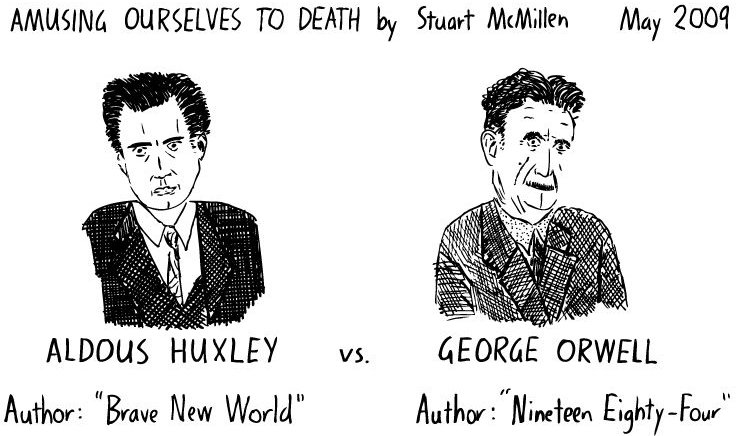
Orwell vs. Huxley

Filed under: Economics, Humour, Technology — Tags: , , — Nicholas @ 08:07

Victor sent me this link with the cryptic comment “Oh shit”:

Orwell_vs_Huxley

October 21, 2009

QotD: England of bye-gone days

Filed under: Britain, History, Quotations — Tags: , , , — Nicholas @ 00:11

[I]t is worth noting a minor English trait which is extremely well marked though not often commented on, and that is a love of flowers. This is one of the first things that one notices when one reaches England from abroad, especially if one is coming from southern Europe. Does it not contradict the English indifference to the arts? Not really, because it is found in people who have no aesthetic feelings whatever. What it does link up with, however, is another English characteristic which is so much a part of us that we barely notice it, and that is the addiction to hobbies and spare-time occupations, the privateness of English life. We are a nation of flower-lovers, but also a nation of stamp-collectors, pigeon-fanciers, amateur carpenters, coupon-snippers, darts-players, crossword-puzzle fans. All the culture that is most truly native centres round things which even when they are communal are not official — the pub, the football match, the back garden, the fireside and the ‘nice cup of tea’. The liberty of the individual is still believed in, almost as in the nineteenth century. But this has nothing to do with economic liberty, the right to exploit others for profit. It is the liberty to have a home of your own, to do what you like in your spare time, to choose your own amusements instead of having them chosen for you from above. The most hateful of all names in an English ear is Nosey Parker. It is obvious, of course, that even this purely private liberty is a lost cause. Like all other modern people, the English are in process of being numbered, labelled, conscripted, ‘co-ordinated’. But the pull of their impulses is in the other direction, and the kind of regimentation that can be imposed on them will be modified in consequence. No party rallies, no Youth Movements, no coloured shirts, no Jew-baiting or ‘spontaneous’ demonstrations. No Gestapo either, in all probability.

George Orwell, “England, Your England”, The Lion and the Unicorn: Socialism and the English Genius, 1941-02-19.

October 19, 2009

QotD: Freedom is slavery

Filed under: Politics, Quotations — Tags: , , — Nicholas @ 12:16

One of the most remarkable features of our age is the propensity toward changing the meaning of political terms. A semantic revolution converts the sense traditionally attached to words into its opposite. George Orwell has ingeniously described this tendency in his 1984. The second of the three slogans of Oceania’s party says, “Freedom Is Slavery.”In the opinion of the “progressive” intellectuals, Orwell’s dictum is the talk of a hysteric; nobody, they shout, has ever ventured to utter such a nonsensical proposition.

Unfortunately the facts belie their denial. There prevails in the writings of many contemporary authors the disposition to represent every extension of governmental power and every restriction of the individual’s discretion as a measure of liberation, as a step forward on the road to liberty. Carried to its ultimate logical conclusion, this mode of reasoning leads to the inference that socialism, the complete abolition of the individual’s faculty to plan his own life and conduct, brings perfect freedom. It was this reasoning that suggested to socialists and Communists the idea of arrogating to themselves the appellation liberal.

Ludwig von Mises, “Freedom Is Slavery”, Ludwig von Mises Institute, 1953-03-09

« Newer Posts

Powered by WordPress