Quotulatiousness

January 31, 2012

Germany issues “secret” document to Greek government on debt repayment

Filed under: Economics, Europe, Germany, Government, Greece, Politics — Tags: , — Nicholas @ 09:41

Mick Hume recounts the machinations within the European Union:

One outraged Greek government minister described it as ‘the product of a sick imagination’. Another called it ‘absolutely laughable’. The formal title of the document in question is ‘Assurance of Compliance in the Second GRC Programme’. It is neither a joke, nor a sick fantasy. It reads more like the draft of a death warrant for democracy, first in Greece and then elsewhere in Europe.

This supposedly secret document was issued by Angela Merkel’s German government to its partners in the Eurozone — and then carefully leaked, to ensure maximum impact. It sets out two extraordinary measures that the Germans want to impose to ensure that the Greek authorities comply with the swingeing budget cuts which they promised but have apparently failed to deliver to the markets’ satisfaction.

First, it says Greece must ‘legally commit itself to giving absolute priority to future debt service’. All state revenues must go first to paying debts and interest due, before a cent can be spent on public services. And the Greek government will not be allowed to threaten to default on its debts in future; if it cannot pay, it must accept that ‘further cuts’ will be ‘the only possible consequence’.

Second, the Germans want the Eurozone to oversee the ‘transfer of national budgetary sovereignty’ from Greece to ‘the European level’ under a ‘strict steering and control system’. The plan is for the Eurozone group to appoint a budget commissioner to oversee Greek finances, with the power ‘to veto decisions not in line with the budgetary targets’ set by European and international officials. If that was not humiliating enough, the Greeks would also have to look happy to bend the knee by ensuring that this new system of outside control ‘is fully enshrined in national law, preferably through constitutional amendment’.

To get the Greeks to agree to these unprecedented conditions, the German document also offers incentives — or as we used to call it, threats. If Athens does not accept the compliance measures, then ‘the Eurozone will not be able to approve guarantees for GRC II’. That is the second huge bailout of €130 billion which Greece desperately needs if it is not to go officially bust in weeks. The ‘Assurance of Compliance’ document is a ‘secret’ blackmail note.

Update: Ah, Monty captures the absurd state of the EU perfectly in a throw-away line in today’s Daily DOOM — “Like German porn, the politics of the Greek bailout just keep getting weirder and more complicated.”

January 30, 2012

Researching how to stop asteroids from “just dropping in”

Filed under: Europe, Science, Space, Technology — Tags: , , , — Nicholas @ 10:08

Brid-Aine Parnell in The Register on some of the technologies being explored to reduce or eliminate the chance of unpleasantly close encounters with celestial objects:

A new international consortium has been set up to figure out what Earthlings could do if an asteroid came hurtling towards the planet on a path of imminent destruction.

The project will look at three methods of averting disaster: the Hollywood-sanctioned solutions of sending up a crack team of deep drillers with a nuclear bomb to sort it out, or frantically hurling of all our nukes at it; dragging it to safety with a Star Trek-inspired tractor beam; or hitting it with something we have more control over, like a spaceship.

Sporting the cool moniker NEOShield, the project will explore the possibilities for kinetic impactors, gravity tractors and blast deflection as ways to save our planet from oblivion.

[. . .]

“In the light of results arising from our research into the feasibility of the various mitigation approaches and the mission design work, we aim to formulate for the first time a global response campaign roadmap that may be implemented when an actual significant impact threat arises,” NEOShield boldly stated.

January 26, 2012

Ireland’s septic protest

Filed under: Bureaucracy, Environment, Europe, Government — Tags: , , , , , — Nicholas @ 10:52

Elizabeth sent me a link to this Independent.ie article which allowed Lise Hand to dig deep into the Irish septic tank issue while managing not to get too potty-mouthed:

These doughty lads of the West weren’t messing about with a bit of chanting and poster-waving in the manner of an, ahem, bog-standard protest outside Leinster House. Not a bit of it, having driven since dawn in buses up from the corners of Galway, the attitude was, when we’re out, we’re out.

And so the Charge of the Septic Tank Brigade to the gates of Leinster was a colourful affair. They had brought a toilet with them and all, as a pertinent prop to illustrate their admanatine opposition to the introduction of a €50 septic-tank registration charge — a charge which affects rural Ireland, as it’s being imposed on almost half a million households who are not part of a public-sewage scheme.

What’s more, if any tanks fail an inspection, householders will be obliged to upgrade or replace them, which could cost thousands of euro.

And so, the several hundred men (and a few women) from the West were in fighting form on Kildare Street yesterday afternoon. And along with the toilet — which proved a handy seat for the protest’s organiser, Padraig ‘An Tailliura’ O’Conghaola from Rossaveal who was minding the megaphone and trying to keep a bit of order on proceedings.

There was an impressive array of giant paintings on black banners, tastefully depicting images such as sunsets and sailboats and a puzzled-looking lassie sitting on a toilet.

And there was quite a smorgasbord of slogans being waved about: from Winston Churchill’s observation, “We contend that for a nation to tax itself into prosperity is like a man standing in a bucket trying to lift himself up by the handle”; to more earthy exhortations, such as: “Septic Tank Charges are A Pain in the Hole”; and the bi-lingual “‘Cac’ Hogan RIP — Ireland’s Saddam Hussein”; to the pithy enjoinder, “Get A Grip — Stand Up to Europe”.

January 23, 2012

The EU culture war against Hungary

Filed under: Europe, Government, Media — Tags: , , , , , — Nicholas @ 10:07

Frank Furedi on the confused situation between the European Union bureaucracy and the government of Hungary:

Thirty or 40 years ago, the way that the EU and the IMF are behaving towards Hungary would have been described as a classic example of neo-colonial pressure. Unlike Greece, Hungary is not simply being lectured about the need to sort out its economy — it has also been subjected to a veritable culture war. As far as the EU and the Western media are concerned, the real crime of the Hungarian government is not so much its inept economic strategy as its promotion of cultural and political values that run counter to what is deemed correct in Brussels.

The Brussels bureaucracy has long regarded Hungary as a society in danger of being engulfed by white savages. In 2006, when people in Budapest rioted against their corrupt government, the EU and sections of the Western media described the demonstrators as right-wing mobs posing a threat to democratic values. At the time, Brussels weighed in to support its man in Budapest, Ferenc Gyurcsany, the Socialist prime minister. The fact that Gyurcsany had lied to cover up the scale of Hungary’s massive budget deficit, and that he had admitted his dishonesty to some of his close colleagues, did not stop his mates in the EU from singing his praises. Poul Nyrup Rasmussen, president of the Party of European Socialists, was quick to rush to Gyurcsany’s defence, claiming he was the ‘best man to make the reforms that Hungary needs’.

What the Western media overlooked was that the corrupt Gyurcsany government was complicit in creating the conditions for mass demoralisation and cynicism. It was this EU-backed regime that did much to unravel and damage public life in Hungary. Gyurcsany’s humiliating electoral defeat in 2010, and the triumph of Viktor Orban and his Fidesz party, meant that the EU’s placeman was replaced by an autocratic nationalist and populist prime minister.

[. . .]

But then, the EU itself has no inhibitions about imposing its values on to its target audiences. It, too, does not want its constitutional proposals held up to public scrutiny. Sometimes it rules by decree and refuses people’s requests to hold any referenda on EU-related matters, on the basis that the issues are far too complex for ordinary people to understand. Evidently, the EU commissioners have read their Voltaire. To recall — it was Voltaire who praised the Russian absolute monarch Catherine the Great’s invasion of Poland and celebrated her ability ‘to make fifty thousand men march into Poland to establish there toleration and liberty of conscience’. The EU does not have 50,000 men but it does have many other resources for executing its culture war. Voltaire was tragically mistaken in his belief that deploying coercion was a legitimate tool for forcing people to change their beliefs — but at least he actually believed in tolerance and freedom of conscience. In contrast, the EU technocracy has little time for genuine tolerance.

January 7, 2012

Conrad Black: Current events vindicate Margaret Thatcher

Filed under: Britain, Economics, Europe — Tags: , , , , , — Nicholas @ 11:25

The current situation in Europe proves that British prime minister Margaret Thatcher was right all along:

Though it is probably happening too late to be overly gratifying to her, events are piling on to vindicate Margaret Thatcher completely in her reservations about British integration in Europe. Her response to the proposal to reduce Britain to a local government in a federal Europe was, memorably: “No, no, no, and never.” And her reward for her refusal to get on board what was then the thundering bandwagon of Eurofederalism, was to be sent packing by her own ungrateful party, though she was the only British political leader who had won three consecutive, full-term election majorities since before the First Reform Act expanded the electorate in 1832.

She was immensely popular with millions of Britons as a patriotic and courageous leader who took Britain off financial life support, saved it from strangulation by over-mighty, almost anarchistic unions, built a prosperous, home-owning democracy, threw the Argentinians out of the little corner of the British Empire they had wrongfully seized (the Falkland Islands), and played a starring role in winning the Cold War.

[. . .]

And as she liberalized the economy; imposed a free, secret ballot for labour strikes; lowered all taxes; privatized industry, housing, airports, almost everything except the National Health Service and the BBC; jolting economic growth resulted. Unfortunately, its most conspicuous exemplars included many successful entrepreneurs and financier types who offended British sensibilities by their garish and spivvy ostentation. The basis of Margaret Thatcher’s support was the Daily Telegraph-reading, gin and tonic-drinking, cricket-loving middle class, the backbone of the nation. But her enemies identified her with an infelicitous combination of Colonel Blimp fuddy-duddies and sticky-fingered, vulgar parvenus.

She had a somewhat hectoring manner in debates, and was notoriously impatient with what she considered pusillanimity from senior colleagues, sometimes calling cabinet members “blanc-manges,” or “suet puddings,” or even “spineless, boneless, men” (not necessarily inaccurately). Naturally less known was her exquisite courtesy and unaffected and egalitarian kindness to subordinates and strangers. It annoyed feminists that she was such a traditionalist, and weak men that she was a strong woman. But she triumphed by perseverance and courage; to the end, though a stirring speaker, she was nervous before a speech. She was a strong woman, but not at all a mannish one.

December 15, 2011

Mick Hume: Dispelling Euro-myths

Filed under: Britain, Europe, France, Germany, Politics — Tags: , , , — Nicholas @ 08:49

In this post at Spiked, Mick Hume pours cold water on five Euro-myths:

Euro-myth No 1: ‘It was a triumph for Cameron — or Sarkozy’

Depending on who you listen to, either UK prime minister David Cameron bravely stood alone for Britain by rejecting a new EU treaty, or else he was beaten by the wily French president Nicolas Sarkozy who got what he wanted by the UK’s omission from the new deal around the Eurozone.

In fact, what the rupture showed was that both the six-footer Cameron and the diminutive Sarkozy are, to coin a phrase, pygmies in political terms. And so are German chancellor Angela Merkel and the rest of Europe’s political elite. Far from a triumph for anybody, it marked an embarrassing failure of basic diplomacy among substandard statesmen and women. There are always tensions and ructions at international summits. But in other times they would have been kept under control by careful diplomatic preparation and consultation beforehand – not left to break out in a schoolboy spat on the day, with Cameron and Sarkozy reportedly almost coming to blows. Even far more strident Eurosceptics such as Margaret Thatcher knew how to play the great power game without tripping over their own laces. Europe’s destiny is now in the hands of self-regarding pygmies who think more of their next headline than the shared future of the continent.

As for the notion that Cameron struck a noble blow for the British people and ‘our’ national sovereignty — come off it. Indeed, one of his main motives appears to have been to avoid giving the British people any kind of say on the matter, by dodging both the referendum that would be demanded if he accepted an amended EU treaty, and the general election that would follow if he went too far the other way and broke up his coalition with the EU-loving Liberal Democrats. The government would rather fall out with the French than risk the wrath of British voters.

December 14, 2011

Eurosceptics described as “bunch of insular snobs who seem to have a hard time restraining their inner fascist”

Filed under: Britain, Europe, Media, Politics — Tags: , , , , — Nicholas @ 09:06

Frank Furedi exposes the real reasons behind the chattering classes’ abuse of David Cameron:

It is one thing to accuse Cameron of committing a diplomatic faux pas or the Foreign Office of ineptitude. But the criticisms currently being made of Cameron verge on the hysterical. When I listen to the hyperbole about what will apparently be the consequences of his destructive behaviour, it almost sounds as if he has committed an act of political betrayal in order to appease a handful of incorrigible reactionary Eurosceptics.

Why this over-the-top reaction to what could turn out to be a relatively minor case of diplomatic miscommunication?

Outwardly, the anger of the cosmopolitan clerisy is directed at Cameron’s alleged appeasement of Tory Eurosceptics. The term Eurosceptic has a special meaning for the adherents to cosmopolitan policymaking. In their view, Euroscepticism is associated with values they abhor: upholding national sovereignty, Britishness and a traditional way of life. The moralistic devaluation of these values was vividly communicated by the New York Times columnist Roger Cohen, who this week characterised Tory Eurosceptics as the ‘pinstriped effluence of an ex-imperial nation’. He seeks to dehumanise these people by arguing that this ‘specimen’s ascendancy’ was reflected in Cameron’s behaviour during the treaty negotiations. Cohen’s moral devaluation of Eurosceptics, his dismissal of them from the ranks of humanity, is captured in his description of them as a ‘bunch of insular snobs who seem to have a hard time restraining their inner fascist’.

The intemperate language suggests that the venomous anger directed at Eurosceptics cannot simply be driven by the clerisy’s love affair with the European ideal. Rather, what is at issue here is the clerisy’s preference for the technocracy-dominated and cosmopolitan-influenced institutions of Brussels. From their standpoint, the main virtue of the EU is that its leaders and administrators speak the same language as the UK clerisy. They read from the same emotional and cultural script, which they believe to be superior to the script and values associated with national sovereignty. That is why it isn’t surprising that a BBC journalist can casually ask the Estonian prime minister to have a go at her own national leader. The UK-based communications clerisy has a greater affinity with the outlook of EU technocrats and political administrators than it does with the outlook of its own people.

December 12, 2011

“Cameron has made a crucial misjudgment, simply to appease the City and his own jingoistic right-wingers”

Filed under: Britain, Bureaucracy, Europe — Tags: , — Nicholas @ 09:12

Bruno Waterfield looks at the frenzied abuse being heaped on David Cameron’s head over the EU negotiations:

The breaking of the EU at an all-night summit last week, where British prime minister David Cameron vetoed changes to the EU Lisbon Treaty, is a healthy sign that politics can assert itself over the slavish routines of Euroland. Until this crack occurred, the EU had been using the full force of statecraft to deny new facts and to enshrine failed doctrines in a world where reality had changed.

Still, over the next few weeks, there will be a concerted establishment campaign to depoliticise the split in the EU and to paper over the cracks with the bureaucratic pieties and conceits at which the EU excels. Quick out of the gate on Sunday was Lord Paddy Ashdown, a serially unelected panjandrum and one-time UN viceroy of Bosnia, who accused Cameron of ‘acting as the leader of the Conservative Party, not the prime minister of Britain’.

[. . .]

The opprobrium heaped on Cameron’s head by Europe’s elites and their fellow travellers is because he is perceived as having allowed the politics of party to triumph over the bureaucratic routines of state. ‘As an act of crass stupidity, this has rarely been equalled’, opined Will Hutton in the Observer. ‘Cameron has made a crucial misjudgment, simply to appease the City and his own jingoistic right-wingers.’

The shrill attacks on Cameron’s failure to achieve the ‘national interest’ demonstrate the extent to which that priceless commodity is now defined by permanent Whitehall officials rather than by public politics or through a clash of parties competing to lead the British people. Similarly, the EU, particularly during this economic crisis, has shown itself to be a mechanism for evading or even overthrowing public politics; it is about drawing up policy away from the institutions of democratic accountability, in an arena that is ‘independent’ of the public.

December 7, 2011

Time to end the “forced march” to Fiskalunion?

Filed under: Europe, France, Germany, Government — Tags: , — Nicholas @ 09:40

Patrick Hayes outlines the way European national leaders and unelected EU officials are steadily blocking any democratic influence over the future of Europe:

Missing from this deal-making has been the European public, which has been held in complete disregard; whether such a ‘forced march’ is acceptable to the European populace is deemed utterly irrelevant, a triviality, in the face of impending doom. After all, as Merkel reminded us recently, ‘nobody should take for granted another 50 years of peace and prosperity in Europe’. The need for such fundamental changes to Europe’s government and economic system are deemed to be beyond debate.

Even when raising the importance of the national sovereignty of their countries, European leaders do so by pointing out too much economic and fiscal integration would get in the way of solving the short-term crisis. There is little discussion of sovereignty as a matter of principle, as the basis upon which voters can hold politicians and technocrats to account. Actually asking the people directly what they want, through national referenda on any new treaty, is regarded as an unnecessary distraction from the urgent task of saving the Euro, to be avoided at all costs.

[. . .]

Once again demonstrating who is actually wearing the trousers in the partnership between the two wealthiest Eurozone countries, Merkel largely got her way. Only last week, Sarkozy was calling for a return to greater democracy in the European Monetary Union: ‘The reform of Europe is not a march towards supra-nationality’, he said. However, Merkel also had to water down her desire to haul naughty countries before a supra-national authority such as the European Court of Justice or a ‘super commissioner’ in Brussels. Instead, sanctions for breaches of the new Eurozone rules would be enforced internally within countries, who would adopt new laws promising they will obey EU rules.

Despite this, as is evident by a leaked document being circulated by EU Council president Herman Van Rompuy and to be discussed by senior EU officials today, the full arsenal of punitive measures for rule-breaking Eurozone members remains on the table. Van Rompuy suggests that bailed-out countries could be temporarily deprived of political voting rights in EU councils; pension reforms, social security systems, labour-market policy and financial regulations could be ‘harmonised’ across EU countries; and there could be ‘more intrusive control of national budgetary policies by the EU’. Development aid for poorer EU countries could be cut, too.

[. . .]

Whatever gets decided at this week’s summit, and whether the fiscal rules are accepted by all 27 EU nations or just by the 17 Eurozone members, it’s clear that greater intrusion into member countries’ national sovereignty by EU officials is the way the wind is blowing. Should countries overspend and breach EU rules, they may no longer be allowed to decide how they set their taxes, how much they can borrow, even the make-up of their budgets. Such decisions, fundamental to a country’s sovereignty, get ripped from the hands of the people living in the countries and their elected representatives, with decisions instead being forcibly guided by European technocrats in Brussels.

Greek army reduces from 30 to 19 brigades

Filed under: Europe, Greece, Military — Tags: , , , , , — Nicholas @ 09:15

Strategy Page lists the initial impact on the Greek armed forces due to the financial squeeze:

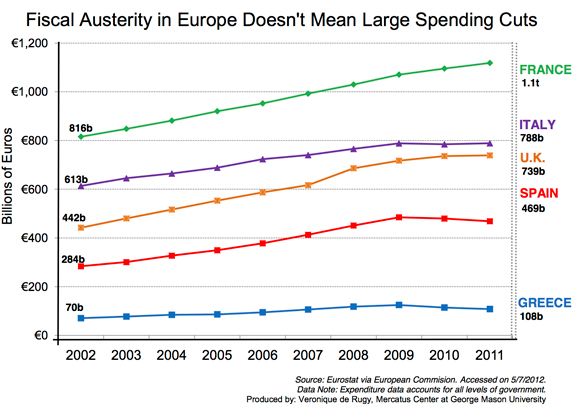
The current financial crisis in Greece has led to enormous cutbacks in government spending. The military has not been exempt. This year alone, the defense budget will be cut about a third. Over the next two years, the reduced budget will be cut another 15 percent. The army will lose 11 of its 30 brigades, but the air force has disbanded one of 16 squadrons, but kept the aircraft in service by moving them to surviving squadrons. The navy has retired some older patrol boats.

The army is apparently coping by disbanding many reserve units and retiring older tanks and equipment. There won’t be much new equipment purchased for the next few years, at least. Training will also be cut, because operating vehicles, aircraft and ships for these exercises is expensive. The reduction of training will decrease the combat capabilities of the troops. But the government does not want to dismiss lots of the 156.000 active duty troops. That will just increase the already high (approaching 20 percent) unemployment rate. It’s never a good idea to have a lot of professional soldiers among the unemployed.

December 1, 2011

Economists no longer bring out the “big guns”: now they reach for the “bazooka”

Filed under: Economics — Tags: , , — Nicholas @ 12:58

Terence Corcoran has lots of examples in his latest Financial Post column:

For months now Europe has been searching for the big bazooka of economic policy to get it out of its fiscal mess. Exactly when bazookas became a core principle of economic policy isn’t clear, but it is today everywhere in use. Google “euro and bazooka” and you’ll see what I mean.

In the high precincts of economic analysis, there is general agreement that Wednesday’s move by central banks, including the Bank of Canada, the Federal Reserve and the Bank of England, to make cheap dollar loans available to European banks, while a major bailout event, falls short of reaching the level of intervention required by the high priests of bazookanomics. “It’s not the bazooka the market was seeking,” said a Wall Street Journal report.

One of the early users of the word was Hank Paulson. As U.S. treasury secretary in 2008, he famously said, “If you have a bazooka in your pocket and people know it, you probably won’t have to use it.” At the time, his theory was that the U.S. government would not have to take over control of Fannie Mae and Freddie Mac because just having the power to take them over was good enough stop a bond market run on the two bankrupt mortgage backers at the heart of the U.S. housing crash.

November 29, 2011

European democracy is now “the preserve of right-wing populism”

Filed under: Europe, Government — Tags: , , , , — Nicholas @ 09:09

Frank Furedi on the urge to omit democracy from European government:

Over the past month, it has become clear that the European Union doesn’t simply suffer from a democratic deficit; rather, it has decided that in the current climate of crisis and uncertainty, the institutions of government must be insulated and protected from public pressure. In Brussels, and among an influential coterie of European opinion-makers, the idea that ordinary people have the capacity to self-govern is dismissed as at best a naive prejudice, and at worst a marker for right-wing populism.

As we shall see, this desire to renounce the politics of representation is by no means confined to EU technocrats. To no one’s surprise, many businesspeople and bankers also prefer the new unelected governments of Greece and Italy to regimes that are accountable to their electorates. And such elitist disdain for nations’ democratic representative institutions is also shared by sections of the left and the intelligentsia, too. So in his contribution on the crisis of democracy, Jürgen Habermas, the leading leftist German philosopher, writes off national electorates as ‘the preserve of right-wing populism’ and condemns them as ‘the caricature of national macrosubjects shutting themselves off from each other’.

Indeed, it isn’t the old-fashioned conservative detractors of the multitude who are at the forefront of the current cultural turn against democratic will-formation — no, it is liberal advocates of expert-driven technocratic rule who are now the most explicit denouncers of democracy. The current political attack on the principles of representative democracy is founded on three propositions. First it is claimed that the people cannot be trusted to support policies that are necessary for the preservation and improvement of society. Secondly, it is suggested that there is an important trade-off to be made between democracy and efficiency, and that in a time of crisis the latter must prevail over the former. And finally, anti-democratic ideologues believe that governments, especially democratic governments, have lost the capacity to deal with the key problems facing societies in today’s globalised world.

November 28, 2011

The real reason the German bond auction failed

Filed under: Economics, Europe, Germany, Italy — Tags: , , — Nicholas @ 08:58

Tyler Cowen explains:

If Germany and a few other, smaller AAA countries were to guarantee or monetize the debts of Italy, Spain, and possibly France and Belgium, never mind Greece and Portugal, Germany would not be AAA itself. The German median voter has very little interest in guaranteeing the above-mentioned debts. If German yields are flipping upwards, it is, in my view, because investors now see the whole euro deal as unraveling and don’t want to deal with the complexities and flak. A big chunk of the German auction didn’t sell at all. You don’t have to think that Germany is ripe to default to see that markets are warning Germany not to take on the whole burden.

The only remaining question, if Germany isn’t willing to take on the entire burden of European debt, is when will the whole edifice come crashing down and who’ll manage not to be crushed by falling debris.

November 24, 2011

Nigel Farage on “German-dominated Europe”

Filed under: Bureaucracy, Economics, Europe, Germany, Greece, Italy — Tags: , , — Nicholas @ 08:59

November 23, 2011

The political delusion: “We must re-establish the primacy of politics over the market”

Filed under: Economics, Europe, Germany — Tags: — Nicholas @ 10:06

That’s Angela Merkel, expressing the thought that many politicians have, but rarely speak out loud. There’s a lot of wishful thinking wrapped up in that statement:

“We must re-establish the primacy of politics over the market.” That sentence, spoken a little while ago by Germany’s Angela Merkel, sums up the startlingly unoriginal character of the approach adopted by most EU politicians as they seek to save the common currency from what even Paul Krugman seems to concede is its current trajectory towards immolation.

As every good European career politician (is there any other type?) knows, the euro project was never primarily about good economics, let alone a devious “neoliberal” conspiracy to let loose the dreaded market to wreck havoc upon unsuspecting Europeans. The euro was always essentially about the use of an economic tool to realize a political grand design: European unification. Major backers of the common currency back in the 1990s, such as Jacques Delors and Helmut Kohl, never hid the fact that this was their ultimate ambition. Nor did they trouble to hide their disdain of those who thought the whole enterprise would end in tears.

From the common currency project’s beginning, economic considerations were continually subordinated to the goal of using the euro to cement political bonds. That’s why most countries were allowed to enter the euro despite not having met some basic entry criteria. It also explains why no one really seemed to care too much when Greece admitted in 2004 that it had fudged, distorted, and lied its way into the euro club. Now, however, Europe is discovering what happens when political games diminish a currency’s ability to reflect economic facts on the ground.

H/T to “Monty” at Ace of Spades HQ, who commented:

This in a nutshell is everything that is wrong with the sovereign governments of both Europe and the United States (and China, and Russia, and…well, you get my point). The “market” is not a thing to be managed, or a process to be controlled. The market is just an aspect of the natural world, working on the creatures who move through it. Merkel’s comment reflects the combination of arrogance and ignorance that is at the root of so many of our economic problems.

« Newer PostsOlder Posts »

Powered by WordPress