Quotulatiousness

November 3, 2010

Maybe US politics have become “post-racial” after all

Filed under: Politics, USA — Tags: , , — Nicholas @ 12:19

One of the worries before the US midterm elections (aside from the Democrat fears of a Republican “tidal wave”) was that the number of female elected representatives would drop. That may have happened, but the unexpected result is an increase in the number of minority candidates elected:

The Republican wave produced groundbreaking results for minority candidates, from Latina and Indian-American governors to a pair of black congressmen from the Deep South.

In New Mexico, Susana Martinez was elected as the nation’s first female Hispanic governor. Nikki Haley, whose parents were born in India, will be the first woman governor in South Carolina, and Brian Sandoval became Nevada’s first Hispanic governor.

Insurance company owner Tim Scott will be the first black Republican congressman from South Carolina since Reconstruction, after easily winning in his conservative district. Scott, a 45-year-old state representative, earned a primary victory over the son of the one-time segregationist U.S. Sen. Strom Thurmond.

In Florida, veteran Allen West ousted a two-term Democrat to a House seat. He is the first black Republican elected to Congress from Florida since a former slave served two terms in the 1870s.

The last black Republican in Congress was J.C. Watts of Oklahoma. He left office in 2003. There were 42 black Democrats in Congress this term.

November 2, 2010

James Delingpole: “Thank God for the Tea Party!”

Filed under: Britain, Bureaucracy, Government, Liberty, USA — Tags: , , , — Nicholas @ 12:02

James Delingpole clearly wishes he could vote in today’s American elections:

Arriving back at Heathrow late on Sunday night I felt — as you do on returning to Britain these days — as if I were entering a failed state. It’s not just the Third World shabbiness which is so dispiriting. It’s the knowledge that from its surveillance cameras to its tax regime, from its (mostly) EU-inspired regulations to its whole attitude to the role of government, Britain is a country which has forgotten what it means to be free.

God how I wish I were American right now. In the US they may not have the Cairngorms, the River Wye, cream teas, University Challenge, Cotswold villages or decent curries. But they do still understand the principles of “don’t tread on me” and “live free or die.” Not all of them, obviously — otherwise a socialist like Barack Obama would never have got into power. But enough of them to understand that in the last 80 or more years — and not just in the US but throughout the Western world — government has forgotten its purpose. It has now grown so arrogant and swollen as to believe its job is to shape and improve and generally interfere with our lives. And it’s not. Government’s job is to act as our humble servant.

What’s terrifying is how few of us there are left anywhere in the supposedly free world who properly appreciate this. Sure, we may feel in our hearts that — as Dick Armey and Matt Kibbe put it in their Give Us Liberty: A Tea Party manifesto — “We just want to be free. Free to lead our lives as we please, so long as we do not infringe on the same freedom of others”. And we may even confide it to our friends after a few drinks. But look at Australia; look at Canada; look at New Zealand; look at anywhere in the EUSSR; look at America — at least until things begin to be improved by today’s glorious revolution. Wherever you go, even if it’s somewhere run by a notionally “conservative” administration, the malaise you will encounter is much the same: a system of governance predicated on the notion that the state’s function is not merely to uphold property rights, maintain equality before the law and defend borders, but perpetually to meddle with its citizens’ lives in order supposedly to make their existence more fair, more safe, more eco-friendly, more healthy. And always the result is the same: more taxation, more regulation, less freedom. Less “fairness” too, of course.

This is either App-alling or App-ealing, depending on your party affiliation

Filed under: Law, Politics, Technology, USA — Tags: , , , — Nicholas @ 09:30

There’s now an iPhone app for reporting suspicious election activity:

Just in time for Election Day, American Majority Action has created the nation’s first mobile application to help identify, report and track suspected incidents of voter fraud and intimidation. This free, cutting edge system will enable voters to take action to help defend their right to vote. Whether you’re a campaign junkie, or just want a better America, Voter Fraud will help you report violations at the election booth and serve to uphold the democratic process.

H/T to Ace of Spades HQ for the link.

November 1, 2010

QotD: The emergence of the Tea Party movement

There’s something else that’s been making me very happy lately, and frankly I don’t give a chipmunk’s cheeks who knows or what they may think about it. After years, decades, what even seems like centuries of unremittingly putrescent political news, we are suddenly all witnesses to the spectacular emergence of the so-called Tea Party movement.

The Tea Parties are just one of a number of historically pivotal developments (including the Internet, conservative talk radio, and perhaps even on-demand publishing) that became necessary to get over, under, around, and through the Great Wall of the Northeastern Liberal Establishment and its numberless, faceless hordes of duly appointed gatekeepers.

In that sense, the Tea Parties are exactly what the Berkeley Free Speech Movement and the New Left always aspired to be and never really were.

Just like each of those other developments, the Tea Parties are essentially a medium of communications. So far, they are leaderless and centerless (and at all costs, must remain that way). They have no founders, and no headquarters. They have no constitution, no by-laws, and no platform to argue over endlessly. More conventionally-minded politicrats might view all of these qualities as weaknesses, but they would be mistaken. As presently (un)constituted, Tea Parties can’t be taken over by high school student government types or mercenaries from the major political parties, who have nothing better to do with their lives.

I would point out, especially in the light of the recent Bob Barr embarrassment, that this arrangement is inexpressibly better suited to libertarians and to libertarianism than any formal, hierarchical structure copied from the other political parties (and I have been doing exactly that for almost thirty years) but that would be a digression.

L. Neil Smith, “My Tea Party”, Libertarian Enterprise, 2010-10-31

Gallup calls current polling data “unprecedented”

Filed under: Media, Politics, USA — Tags: , , — Nicholas @ 07:23

The US midterm elections are often taken as a poll on the performance of the President, so the Gallup organization is saying what many Republican and Tea Party speakers have been saying for weeks: Barack Obama is dragging down his party:

Gallup models the number of seats a party will control based on that party’s share of the national two-party vote for the House of Representatives, using historical voting data in midterm elections from 1946 to 2006. The model takes into account the majority party in Congress entering the elections.

Gallup’s historical model suggests that a party needs at least a two-point advantage in the national House vote to win a majority of the 435 seats. The Republicans’ current likely voter margin suggests that this scenario is highly probable, making the question of interest this election not whether the GOP will win the majority, but by how much. Taking Gallup’s final survey’s margin of error into account, the historical model predicts that the Republicans could gain anywhere from 60 seats on up, with gains well beyond that possible.

It should be noted, however, that this year’s 15-point gap in favor of the Republican candidates among likely voters is unprecedented in Gallup polling and could result in the largest Republican margin in House voting in several generations. This means that seat projections have moved into uncharted territory, in which past relationships between the national two-party vote and the number of seats won may not be maintained.

The other thing to keep in mind is that polling isn’t quite as definitive as pollsters would like you to believe: voters sometimes conceal their actual voting intentions. The most recent example of this was the Toronto municipal elections, where polls consistently had Rob Ford and George Smitherman in a statistical dead heat, but the actual result was a 12 point lead for Ford.

H/T to Ace for the link.

October 27, 2010

The new broom in Toronto

Filed under: Bureaucracy, Cancon, Politics — Tags: , , , — Nicholas @ 12:25

After a particularly hard-fought election campaign, Chris Selley looks at the opening moves Toronto mayor Rob Ford will be making:

It’s kind of funny to see people who’ve spent the past 10 months trashing Rob Ford now insist he needs to extend olive branches to the progressive community. If I were Rob Ford, and I had an olive branch, I might be tempted to extend it rather violently towards my harshest critics. (Then, in accordance with my new and improved image, I’d take two deep breaths and calm down.)

Clearly Mr. Ford is sticking with his gravy train priorities off the top: departmental efficiencies, contracting out services, cutting councillor budgets and staff. At a media scrum on Tuesday afternoon, his message hadn’t changed, that I could discern, from what it was during the campaign. Basically: Trust me. The money’s there to be saved, and it won’t hurt a bit.

Still, Mayor Ford will have a city to keep happy. And while they received very little notice during the campaign, his platform included several populist, pro-democratic and dirt-cheap measures I’d defy anyone to oppose and that could earn him some grudging praise from disaffected Pantaloons and Smithermanians.

The large turnout and the not-quite-majority of votes cast for Ford should at least quiet the claims that he “doesn’t have a mandate” for a little while. If he can actually deliver on some of his campaign promises to reduce spending and eliminate some of the least useful municipal programs/initiatives, he’ll be a vast improvement over the last mayor. Even if he doesn’t — he only has a single vote on council, so it’s not automatic that he’ll be able to implement his agenda — it should be an interesting term in office.

Kathy Shaidle shows why Rob Ford had “hidden” strength in the campaign that the media couldn’t account for:

What is Rob Ford most famous for?

No, not that he looks exactly like everybody’s drunk, abusive stepfather. No, not the “gravy train” line.

Rob Ford is “the guy who returns every call.”

That was always Ford’s claim to fame: that even if you didn’t [live] in his ward, he returned your call. If you were wrapped up in red tape and called Rob Ford, an hour or maybe a day later, the tape got snipped. The Wheeltrans showed up at your elderly mother’s door. That stupid problem you’d been screaming at bureaucrats about got taken care of.

Everyone in Toronto knows a Rob Ford story like that.

October 26, 2010

Did we just witness the start of “Tea Party Ontario”?

Filed under: Cancon, Politics — Tags: , , , , — Nicholas @ 07:53

Steve Paikin looks at the unexpected toppling of incumbent mayors across Ontario yesterday:

Did we just have our own “tea party” Ontario?

All over the province, incumbents were feeling the wrath of the electorate.

In the capital city, Rob Ford cruised to victory, besting George Smitherman by more than 90,000 votes. His margin of victory was bigger than David Miller’s when he “swept” into office with his broom seven years ago.

But it wasn’t only Toronto. Incumbent mayors lost in Hamilton, Ottawa, Burlington, Vaughan, London, Thunder Bay, and Sudbury.

In Mississauga, where Hazel McCallion is accustomed to winning with more than 90% of the vote, she only won re-election with 76%.

[. . .]

A few weeks ago, none of these results was seen as obvious.

[. . .]

The conventional wisdom in local politics is that name recognition counts for so much. The power of incumbency is fantastic.

Not last night. If anything, the opposite was true. If you were in, you had a target on you. And precious few escaped it, including many incumbent city councillors in Toronto.

A stunning night for upsets. A big night for turnout (more than 50% in Toronto…twice the normal turnout rate).

An Ontario Tea Party would be a good idea . . .

Toronto’s elite appalled: the barbarians have stormed City Hall

Filed under: Cancon, Politics — Tags: , , , , — Nicholas @ 07:24

I guess a lot of people were misleading the pollsters, as what looked like a dead heat only a few days before the election turned into a 12 point lead, just missing an actual majority for Rob Ford:

Right-wing juggernaut Rob Ford will take the top job in Canada’s most populous city, defeating former deputy premier George Smitherman in a bitter, 10-month race to become Toronto’s next mayor.

With 99 per cent of Toronto polls reporting Monday night, Ford took 47 per cent of the vote, compared to Smitherman’s 35 per cent and deputy mayor Joe Pantalone’s 12 per cent.

Smitherman was considered an early favourite to win, but couldn’t compete against Ford, a scrappy city councillor who tapped into a potent well of voter fury with his promises to cut taxes and kill big spending at city hall.

“This victory is a clear call from the taxpayers, enough is enough,” Ford told cheering supporters.

“The party with taxpayers’ money is over. We will respect the taxpayers again, and yes ladies and gentlemen we will stop the gravy train once and for all.”

The polarizing Toronto race was marred by ugly incidents, including homophobic ads targeting the openly gay Smitherman, and a newspaper article — later pulled from the Globe and Mail website — that took a shot at Ford’s weight.

His win is likely to send shockwaves all the way to Premier Dalton McGuinty’s office. Many experts have predicted that a Ford victory could herald a Conservative sweep in next fall’s Ontario election.

Ford is perhaps the least likely candidate to win in Toronto for decades, and is most certainly not the kind of mayor most progressives expected to see. He’s not particularly polished or smooth-talking or dignified, and has had a series of mis-steps that the media (and Toronto’s Liberal elite) expected to keep him from being more than a slight bump in the smooth road to Smitherman’s coronation. I expect this election result will be portrayed in the media, at least in the short term, as the suburbs “sticking it” to downtown (even though some polls showed Ford’s support to be nearly as strong in downtown wards as in the benighted suburbs).

Update: Chris Selley thinks that this is a wake-up call for politicians across the province:

One can only imagine the horror in certain quarters. Uncouth, uncultured, suburban, journalist-chasing, drunk driving, marijuana-possessing Air Canada Centre ejectee and lone wolf former city councillor Rob Ford is mayor-elect of Toronto — and not just by a little. Mayor David Miller congratulated him last night and so should everyone else. It sure won’t help not to.

Whatever happens over the next four years, this election sent a hugely important message to Canadian politicians: Ignore voter anger at your peril. If you think voters shouldn’t be angry, make your case early and sincerely. Don’t just blame a senior level of government for your problems.

October 25, 2010

Voting for the right candidates

Filed under: Cancon, Politics — Tags: , , — Nicholas @ 15:37

I just got back from exercising my right to vote for municipal representation. It was a case of trying to find candidates who didn’t copy one another’s homework (and campaign promises).

In municipal elections in Ontario, party affiliations aren’t shown on the ballot, but given the claims I saw in most of the pamphlets and local newspaper articles, almost all of our local candidates are fully paid-up members of the Green party. I don’t know why our school trustees need to be so concerned with things well outside the municipal level of responsibility, but I’d kinda prefer they concentrated on, y’know, the fricking schools in the region, rather than deforestation in the tropics, CO2 emissions, and banning plastic bags.

I ended up not using all my votes, as I couldn’t find candidates for some of the positions who didn’t seem to want to spend all their time stuffing envelopes for Greenpeace rather than running the town and regional governments.

Oh, and a protip for future candidates, especially if you’re late entering the race: not having a website means I can’t look up your positions on anything, and I’m not going to vote for you just on the basis of you having an interesting name.

October 18, 2010

Gaining votes by insulting the voters?

Filed under: Media, Politics, USA — Tags: , — Nicholas @ 13:53

President Barack Obama has an odd way of campaigning for his party:

President Barack Obama said Americans’ “fear and frustration” is to blame for an intense midterm election cycle that threatens to derail the Democratic agenda.

“Part of the reason that our politics seems so tough right now and facts and science and argument does not seem to be winning the day all the time is because we’re hardwired not to always think clearly when we’re scared,” Obama said Saturday evening in remarks at a small Democratic fundraiser Saturday evening. “And the country’s scared.”

Obama told the several dozen donors that he was offering them his “view from the Oval Office.” He faulted the economic downturn for Americans’ inability to “think clearly” and said the burden is on Democrats “to break through the fear and the frustration people are feeling.”

Blaming the voters for their economic worries isn’t quite the tone I’d expect him to set while trying to drum up support for his party’s candidates in the upcoming election. Perhaps Americans respond better to being insulted than Canadians would?

October 14, 2010

Little Bobby Tables must speak Swedish

Filed under: Europe, Humour, Politics, Technology — Tags: , , , — Nicholas @ 13:19

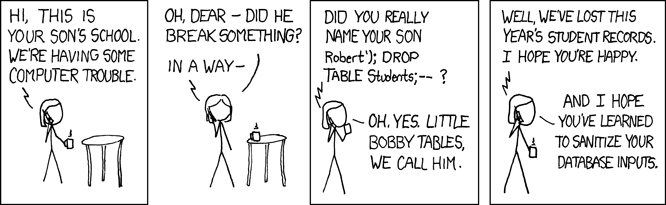
By way of Bruce Schneier an opportunity to show another xkcd comic:

Exploits of a Mom

So, what’s the Swedish tie-in?

As you may have heard, we’ve had a very close election here in Sweden. Today the Swedish Election Authority published the hand written votes. While scanning through them I happened to notice

R;13;Hallands län;80;Halmstad;01;Halmstads västra valkrets;0904;Söndrum 4;pwn DROP TABLE VALJ;1

The second to last field is the actual text on the ballot. Could it be that Little Bobby Tables is all grown up and has migrated to Sweden? Well, it’s probably just a joke but even so it brings questions since an SQL-injection on election data would be very serious.

October 12, 2010

Toronto’s election gets interesting

Filed under: Cancon, Politics — Tags: , , — Nicholas @ 10:05

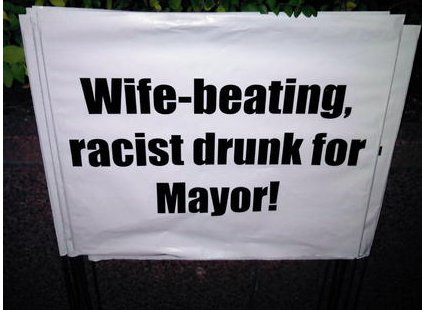
The race for the post of mayor of Toronto was supposed to be a dignified procession to the installation of George Smitherman, former provincial cabinet minister. The vote was expected to be a mere formality, as the assent of the right-thinking people in the downtown core was assured. Somehow, though, they forgot about having given the vote to the hillbillies and hockey hackers of the uncouth far-distant suburbs. Those unwashed hicks apparently supported some gaffe-prone character with lots of media-friendly damage already on tape and ready to roll.

Unbelievably, the release of the damaging material seemed not only not to cause a drop in support, it seemed to increase his support. At that point, the gloves came off (one assumes), as these signs were put up along University Avenue overnight:

Not my photo, they’d already been taken down before I got to that stretch of University this morning. Photo courtesy of 680 News.

September 30, 2010

QotD: Unintended consequences

Filed under: Economics, Media, Politics, Quotations — Tags: , , — Nicholas @ 13:42

Sometimes I think of the political blogosphere as a huge commons. An individual blogger can gain in readership or influence by attacking or ridiculing some enemy, but at the cost of making that enemy stronger in the world as a whole.

I also believe that every time the words “stimulus” or “fiscal policy” are blogged it helps the electoral prospects of the Republican Party, no matter what the content of the blog post.

Tyler Cowen, “Department of Unintended Consequences”, Marginal Revolution, 2010-09-28

September 23, 2010

Not that they’re getting too confident, or anything

Filed under: History, Humour, Politics, USA — Tags: — Nicholas @ 16:11

Tweet of the day, from Jim Geraghty:

August 5, 2010

US governments still finding this “free speech” thing annoying

If you support the notion of free speech, it is most important to support it during elections . . . but not everyone feels this way:

The Associated Press reports that California’s Fair Political Practices Commission (FPPC) is considering “how to regulate new forms of political activity such as appeals on a voter’s Facebook page or in a text message.

Not whether to regulate these new forms of political speech, but how.

The recommendations apparently include “requiring tweets and texts to link to a website that includes . . . full disclosures, although some people feel the disclosure should be in the text itself no matter how brief . . . .”

To paraphrase Chief Justice John Roberts, this is why we don’t leave our free speech rights in the hands of FPPC bureaucrats. To bureaucrats like those at the FPPC, the Federal Election Commission or their analogues, there seems to be no need to show any evidence that Twitter, Facebook or text messages actually pose any threat to the public. It is enough that they these new forms of low-cost media aren’t currently regulated, but could be. Their primary concern, apparently, is that the regulation of political speech be as comprehensive as possible.

Free speech can be a messy thing — but censorship is worse.

« Newer PostsOlder Posts »

Powered by WordPress