The Tory lead continues to hold fairly steady, in spite of the drumbeat of disapproval from the newspapers:
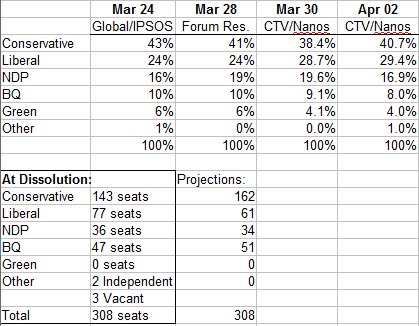

The Tory lead continues to hold fairly steady, in spite of the drumbeat of disapproval from the newspapers:
I think it’d be fair to say that Terence Corcoran is not a fan of Stephen Harper’s proposed “family tax plan”:
By calling this a “family tax cut,” and playing it as a matter of tax fairness, the Conservatives have managed to gloss over the shabby contradictions it introduces into Canadian tax policy. The Tory announcement said that the United States, France and other countries allow some form of income splitting. They do, but that’s not saying much about taxation or fairness.
France has a full-blown family tax regime, in which the incomes of both spouses are blended at a tax rate that is based on a formula that includes the number of children. But so what? France has one of the highest marginal tax rates in the world, and a notoriously dysfunctional tax burden that distorts behaviour and incentives. The U.S. income-splitting regime isn’t exactly revered for its soundness, in part because it clearly discriminates against single earners or anyone not part of a married couple. Nor are children a requirement to be part of the U.S. splitting regime.
[. . .]
The Harper family tax cut, based on the debatable tax policy ideal of taxing families instead of individuals, is a misguided income-splitting scheme that demonstrates once again that the Conservatives will never, ever get around to cutting personal income tax rates. The cost of the family tax cut will come at the expense of across-the-board income tax cuts for other Canadians. To pay for the family cut, other Canadians will have to continue to pay marginal tax rates that are too high.
The family tax cut, in some ways, is just another tax expenditure, a special tax treatment aimed at fulfilling some social-policy objective. The major beneficiaries are likely to be higher-income single-earner couples with children. Everybody else is out of luck.
To pull out the old saying, “that’s a feature, not a bug” to the Conservative party faithful.
The latest election poll is from Nanos, conducted for CTV and the Globe and Mail. The numbers show a smaller lead for Stephen Harper’s Conservatives, but it’s still ten percent over Michael Ignatieff and the Liberal party:
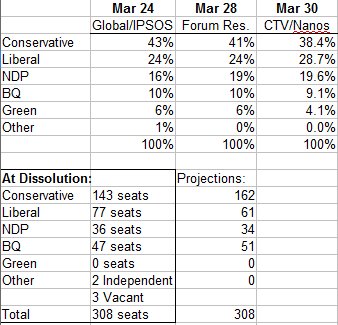
Nationally, the Conservatives are in front with 38.4 per cent. The Liberals are 10 points behind at 28.7 per cent, followed by the NDP at 19.6 per cent, the Bloc Quebecois at 9.1 per cent and the Greens at 4.1 per cent.
In comparison, a March 15 Nanos survey found the Tories at 38.6 per cent, the Liberals at 27.6 per cent, the NDP at 19.9 per cent, the Bloc at 10.1 per cent and the Greens at 3.8 per cent.
[. . .]
Pollster Nik Nanos said there’s reason for disappointment in the numbers for both the Conservatives and the Liberals.
For the Tories, it shows that so far Stephen Harper’s campaign for a majority mandate is not attracting enough support to actually win a majority of seats when Canadians vote again on May 2.
For the Liberals, Mr. Nanos noted that Michael Ignagtieff’s team might have expected its numbers to improve with the added attention that comes from a campaign, and the fact that they are now running TV ads in heavy rotation.
The Nanos numbers put the Conservatives back down in minority territory, unlike the two previous polls which indicated a majority government.
So far, the opposition hasn’t been able to make much headway against that strong Conservative lead:
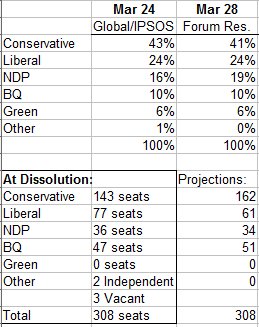
Here’s a summary from Kathryn Blaze Carlson:
The first poll since Saturday’s election call shows Tory support largely unchanged, bringing into question the opposition’s early emphasis on ethics.
Despite a weekend of being hammered for their alleged contempt of Parliament, the Conservatives boast the support of 41% of decided voters — 17 points ahead of the Liberals, who are at 24%. The NDP is at 19%, and the Bloc 10%.
The Forum Research poll also breaks it down by seat count, suggesting that if the election were held today, the Tories would surge from 143 seats to 162 seats, the Liberals would drop 17 seats to 61, the Bloc would rise from 44 to 51 and the NDP would be whittled from 36 seats to 34. The poll, conducted over the weekend via telephone with a random sample of 2,095 voters, is within the range of approximately plus or minus 10 seats for each party.
The seat projections reflect the regional strength of the BQ, who only run candidates in Quebec, and the natural disproportion of first-past-the-post voting.
Update: Publius points out the real root of Canada’s election issues:
Unfortunately neither you, nor any of the party leaders, have the temerity to admit what is actually wrong with Ottawa. Let me give you a hint. It’s not Stephen Harper’s pragmatism. It isn’t Lord Iggy’s incompetence. Not even Jack Layton’s spend till you’re broke ideology. The problem with Ottawa is Quebec. Gilles Duceppe and the Bloc Quebecois are merely the symptoms. Our national democracy is broken because part of the electorate refuses to participate.
In the 2006 and 2008 federal elections there were 308 seats up for grabs. That’s 75 in Quebec and 233 in the Rest of Canada (ROC). The 2006 election saw the Conservatives win 114 seats in ROC and 10 in Quebec. The Conservatives did better in the ROC in 2008 winning 133 seats and holding on to their seats in Quebec. If we were to remove Quebec’s 75 seats from Parliament a majority government could be formed with 117 seats. On that basis, including only their ROC seats, the Harper Tories would have won a strong minority government in 2006 and a clear majority in 2008. To say, as the opposition parties and the MSM have, that Harper has failed to seal the deal with Canadians is only partially correct.
For all his faults, chronicled in some detail on this blog over the years, Stephen Harper has in fact convinced a critical mass of the interested Canadian electorate of his fitness to lead us. Those who vote for the Bloc Quebecois have declared their disinterest in Canada as a working proposition.
The Bloc Quebecois are not political party in any meaningful sense but merely a pressure group that has won election to parliament. It is because of this we find ourselves in a series of weak hung parliaments. The BQ offers no vision for Canada, only its potential destruction. It’s bargaining position with the other parties in recent parliaments has been of routine blackmail. Vote what is in the best interests of Quebec, or else.
Because right now, we’ve got so-called Conservatives wearing Liberal clothing (and Liberals pawing through the NDP’s cast-off pile). There’s no major federal party in Canada that actually pursues fiscally responsible government policies, no matter how much they may talk about the virtues of smaller government.
Shortly after his government’s defeat, Prime Minister Stephen Harper attempted to deflect focus back to Tuesday’s budget. The economy, he said, is the number one priority of Canadians and the budget was the key to the country’s economic future. Then he said: “There was nothing in the budget that the opposition could not or should not have supported.” True enough — but what does that say to Canada’s conservatives? Based on the budget, they are now called on to support a Conservative party that has presided over an extravagant full-scale national revival of big government by fiscal expansion.
Only a few days ago, it seems, Canadian politics was abuzz with the possibility of a new ideological era that favoured smaller government and lower taxes, with less waste, more discipline and a determination to cut taxes. There were signs of revolt in British Columbia, a shake-up in Calgary and reform in Toronto, where Mayor Rob Ford captured a staggering 47% of the vote in a town where The Globe and Mail is considered a right-wing propaganda sheet. Ford Nation, they called it.
There is no Harper Nation. After five-plus years in office, the Harper Conservatives have singularly failed to change the Canadian ideological landscape. Instead, Canadian politics changed the Conservatives. In power, they transformed themselves into another basely partisan party that willingly and even eagerly pandered to whatever the political three-ring circus put on display. This week’s budget, in which $2-billion in loose cash was promptly distributed to a score of special interests and political agendas, left in place a $40-billion deficit for 2010 and solidified a $100-billion increase in the national debt over five years.
There’s no threat on the right to force the Conservatives to actually live up to their talk, so they’re free to drift as far into Liberal territory as they like — and they seem to like it a lot — because small-C conservative voters have nowhere else to go.
The poll numbers will change over the course of the election as muck is raked, accusations are hurled, and reputations are assailed (assuming that the Conservative government is defeated in Parliament later today). The last poll was conducted by IPSOS for Global News:
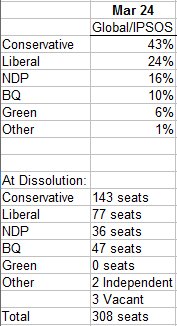
I’ll try to update this chart as the polls are published. I doubt that the 19% lead the Tories had yesterday will hold up for the first few days of the election campaign, but anything is possible.
Update: As expected, the government has fallen, so the election is on. Tasha Kheiriddin congratulates the media on their success:
And they’re off. In newsrooms across the country, journalists are tossing their Team 2012 shirts on the trash heap, while the Team 2011 folks are collecting their $5 bets. Sure, they could have cashed in on Tuesday, but it’s always prudent to wait for the chickens to actually hatch. Or, in this case, come home to roost. After stoking election fever for months, the media now get to feast on the fruits of their labors: bad plane food, no sleep, and crazy deadlines.
A round-up of what happens if the government falls includes this nugget of information for anyone who hoped the spending would at least slow down while the politicians are off on the campaign trail:
To fund the daily operations of government without a budget, the Governor-General will typically issue special warrants that allow government departments to take funds from the federal bank account (officially known as the Consolidated Revenue Fund) without having to get Parliament’s approval. The money must be “urgently required for the public good” according to the House of Commons Procedure and Practice manual, and the Treasury has to show that no existing funds have been set aside for the payments. The special warrants run from the date that parliament dissolves until 60 days after an election and the government has to give the next Parliament a list of everything they have spent within 15 days of the new government taking office. The money still needs to be retroactively approved by the new Parliament and included in their upcoming budget.
“Ultimately Parliament has to come back an approve the budget but there are these ways of getting interim finance when parliament has not passed a budget,” said Ned Franks, an expert in parliamentary procedure and professor emeritus at Queen’s University.
Thanks to some abuse of the system while Brian Mulroney was prime minister, the system was amended in 1998 to limit the use of special warrants to only those times when Parliament has dissolved.
Tasha Kheiriddin thinks this has been a deliberate trap laid by the Tories and that the opposition have tumbled right into it:
The Foyer of the House of Commons turned into a beehive on speed. Within the next hour came reports that the NDP and Liberals were moving staff into their war room. Mr. Layton, gaunt but with a glint of steel in his eyes, strode stiffly by the CBC booth, leaning on his cane, turned to a group of journalists and smiled: “Looks like an election”. Liberal leader Michael Ignatieff tweeted the first slogan of the coming campaign “An out-of-touch budget from an out-of control government.”
But Mr. Ignatieff is dead wrong — on both counts. This is very much an in-control government, which played its cards brilliantly in the face of not one, but two confidence motions this week. By falling on the budget instead of the contempt of Parliament motion, the Tories escape the stigma of being the only government to ever have been found in contempt by the House. This gives the Opposition less mud to throw their way, which is helpful in light of the brewing Carson scandal, and puts the focus back on the economy, the Tories’ campaign issue of choice.
It is also a very in-touch budget — in all the ways that benefit the Conservatives. The Tories have reached out and touched most of their key voter groups: homeowners, families, seniors, the military, and rural Canadians. They ignored less promising sectors of the electorates, including Quebec, though it is likely they are saving a Quebec HST announcement for the campaign. Had they included it in the budget itself, the Bloc would have been force to support it, which would have meant no election — yet another sign that the Tories were more interested in going to the polls than getting a deal.
Lots of pundits have (correctly) called the budget a “boutique”: small but attractive lures for many of the key constituencies, so that the Tories will have lots of opportunities on the campaign trail to characterize the Liberals as “taking away” promised benefits. It may never have been intended to be implemented: it works far too well as a campaign paper.
To the despair of small-c conservatives, the budget does not address the things that matter to that market. As Kelly McParland points out, it’s really a Liberal budget in a blue wrapper:
[The Toronto Star] is a big [Liberal party] supporter. It would like nothing more than to help orchestrate a return of Liberal hegemony to Ottawa. Yet it’s having trouble finding bad things to say about the budget over which the Liberal leader is determined to force an election.
Here are Wednesday’s headlines from The Star:
Page 1: “2011 Federal Budget Highlights: A Sprinkling of Cash for Almost Everyone”
Page 6: “Budget Promises $300 Tax Credit for Family Caregiver”
Page 8: “Tories Blueprint Looks a Shade of Liberal Red”
Page 9: “Low-income Elderly to Get Supplement Boost”
Page 9: “Tories Revive Retrofit Funding”
Page 9: “Job Creation Still Key Priority in Federal Budget”Yes, the Star managed to editorialize against the budget, arguing it “fails [the] nation’s needs,” but Finance Minister Jim Flaherty could happily stand at the Toronto GO station handing this newspaper to commuters and seeking their support.
With the opposition parties unified in their denunciations of the federal budget tabled today by Finance Minister Jim Flaherty, we’re now looking at the strong possibility of a May general election:
The minority Conservative government tabled a 2011 budget Tuesday that was quickly rejected by its political opponents for falling short in helping the middle class, setting the stage for an election campaign that could begin any day.
The leaders of the Liberals, Bloc Quebecois and NDP said they could not support the budget as presently written — even though Finance Minister Jim Flaherty tried to appease the left-wing party through a series of modest, symbolic initiatives.
“We’re forced to reject the budget and we are also forced to reject a government that shows so little respect for parliamentary democracy and our democratic institutions,” said Michael Ignatieff, the Liberal Leader.
Gilles Duceppe, Bloc Quebecois Leader, said his party “can’t support what has been offered here.”
And Jack Layton, head of the NDP and viewed as the person most likely to lend the government support, said the budget fell short of NDP expectations.
I have to admit that I’m surprised that the NDP and the Liberals appear to be ready to force an election at this moment: neither party has had much of a “bounce” in recent polls from government scandals (both real and imaginary). Perhaps they’ve got something held in reserve to release during the campaign that they think will cause voters to turn away from the Tories.
[poll id=”2″]
Scott Stinson thinks that Julian Fantino’s victory in yesterday’s Vaughan by-election is great for the Tories’ “tough on crime” rhetoric:
Here’s what Mr. Fantino, who won a byelection on Monday to end a 22-year Liberal hold on the riding of Vaughan, had to say five years ago in response to a weekend of gun violence in Toronto, where he was chief at the time.
“People don’t like me talking about stiffer sentences,” he told the Post. “But in actual fact, so many of the people we deal with have been given but a kiss by the system, and I would say that the majority of them are all career criminals.”
Chief Fantino’s solution? A 10-year mandatory minimum sentence for gun-related crimes. Why, it’s the kind of thing that must put a twinkle in Justice Minister Rob Nicholson’s eye.
[. . .]
And it’s the stuff for which Mr. Fantino has most recently been hotly criticized — allowing two-tiered policing at Caledonia, where native occupiers were allowed to break the law indiscriminately at a disputed housing development and his Ontario Provincial Police effectively abandoned the area rather than risk confrontation — that suggests he’s used to following orders.
The Ontario government didn’t want any trouble in Caledonia, and thanks to the see-no-evil strategy employed by its police force, it has so far avoided an Oka-type battle down in Haldimand County. That this tactic saw the OPP giving passes to the same criminals for whom Mr. Fantino would typically demand harsh punishment apparently did not trouble the force’s former commissioner. He seemed OK giving them “but a kiss by the system.” He was being a team player.
For someone carrying such a “tough on crime” reputation, he has an odd view of freedom of speech, freedom of assembly, and other trivial matters when they’re being exercised by the citizenry. Due process? Not something he appeared to care much about during his time at the OPP.
Update: Of course, no day is complete without someone trying to encourage the Liberals to bump off Michael Ignatieff:
Itching to see last night’s federal byelection result in Vaughan blown completely out of proportion? High-profile cop defeats Liberal nobody — when will Michael Ignatieff commit ritual seppuku next to the Centennial Flame? That sort of thing? The Globe and Mail’s John Ibbitson has the goods for you.
It’s probably safe to say that Christie Blatchford isn’t a fan of Julian Fantino, the Conservative candidate in the Vaughan by-election:
Now when Gary McHale, then of Richmond Hill, first poked his nose into the occupation that was going on in the town of Caledonia south of Hamilton, and began in late December, 2006, organizing rallies for those who objected to the way the Ontario government and the OPP were handling the occupation, Mr. Fantino had just taken over as the OPP boss.
He immediately demonized Mr. McHale, not a Caledonia resident, as “an outsider” with “an agenda.”
In a flood of internal e-mails to the officers who worked for him (these later were made public as a result of Mr. McHale’s various disclosure requests in court) and in his public statements, the then-commissioner went to remarkable lengths to characterize Mr. McHale and his supporters, to borrow from one of the e-mails Mr. Fantino sent, as “interlopers who put their own personal agendas” ahead of the purportedly grand peace efforts at the negotiating table.
It was an astonishing use of the resources of the state against a private citizen who had done nothing but exercise the very freedoms guaranteed by the Charter.
Of course, what made Fantino such a “great cop” is exactly why the Conservatives want him on their team:
But the point is, for a man hailed as the Conservatives’ hot new law-and-order fellow, there are some real questions about his credentials, at least as they showed themselves in Caledonia where the rule of law was shattered, and a rather terrifying indication of his willingness to turn the full beam of his attention and power upon individuals whose only sin is to disagree with him.
In this regard, I’m afraid, Mr. Fantino seems a sadly good fit for a party whose approach to law-and-order strikes me increasingly as cartoonish.
It must be pointed out, however, that the Liberals also tried to recruit Fantino to run for them. That reflects just as badly on Michael Ignatieff’s party as it does on Stephen Harper’s party.
If he is elected by the voters of Vaughan, he’s rumoured to be a shoo-in for a cabinet position. That says it all for the federal Conservatives.
A story in the Globe and Mail on how Elections BC rigged the rules after the fact to reject a petition:
Elections BC rejected a Fight HST recall application as too lengthy — but did so using rules that were drafted after it received the application.
The rejection has led recall organizers to suggest the province’s chief electoral officer deliberately thwarted their attempt to get approval to launch a petition to oust a Liberal MLA who supported the harmonized sales tax, and should step down.
While Elections BC has defended its new rules — which pushed the Fight HST application over a 200-word limit by counting the acronyms MLA and HST as eight words instead of two — recall organizers expressed concern that they were not included in the application form when they downloaded it from Elections BC’s website.
“It’s a total joke. This is the kind of thing they do in banana republics … when they don’t want to have elections or they don’t want people to win. And we’re doing it right here in Canada,” said Chris Delaney, an organizer of the Fight HST campaign.
H/T to Steve Muhlberger for the link.
Publius thinks that Julian Fantino does not deserve the easy ride he’s getting in his attempt to win the Vaughan by-election:
The image of the crime-fighting crusader contrasts sharply with the OPP’s inaction during the occupation of the Douglas Creek Estate. Fantino’s status as a star candidate for the Conservative Party belies opposition from genuine conservatives.
In his four years in power Stephen Harper has played bait and switch with the Canadian electorate. He has talked of conservative values, and fear mongered on the dangers of a Liberal-NDP coalition government, while running a government which is fiscally to the Left of those of Paul Martin and Jean Chretien. In Julian Fantino he has again offered Canadians a false bill of goods, a law and order candidate who, as OPP commissioner, failed to uphold basic law and order.
What has allowed the Prime Minister to get away, so far, with the candidacy of Julian Fantino is the near silence the MSM has offered on the Caledonia tragedy. With the honourable exception of Christie Blatchford, the media has largely ignored the near anarchy which persisted for years in a Canadian small town, all within driving distance of Toronto. Canadian television journalists should long ago have stopped, if only for a moment, chasing down crooked used car salesmen, and paid attention to what should have been the biggest news story of the last five years. Placing the violence of Caledonia in Canadian living rooms, might have ended the tragedy and pain much sooner.



Powered by WordPress